
Japan Battery Thermal Management System Market Summary
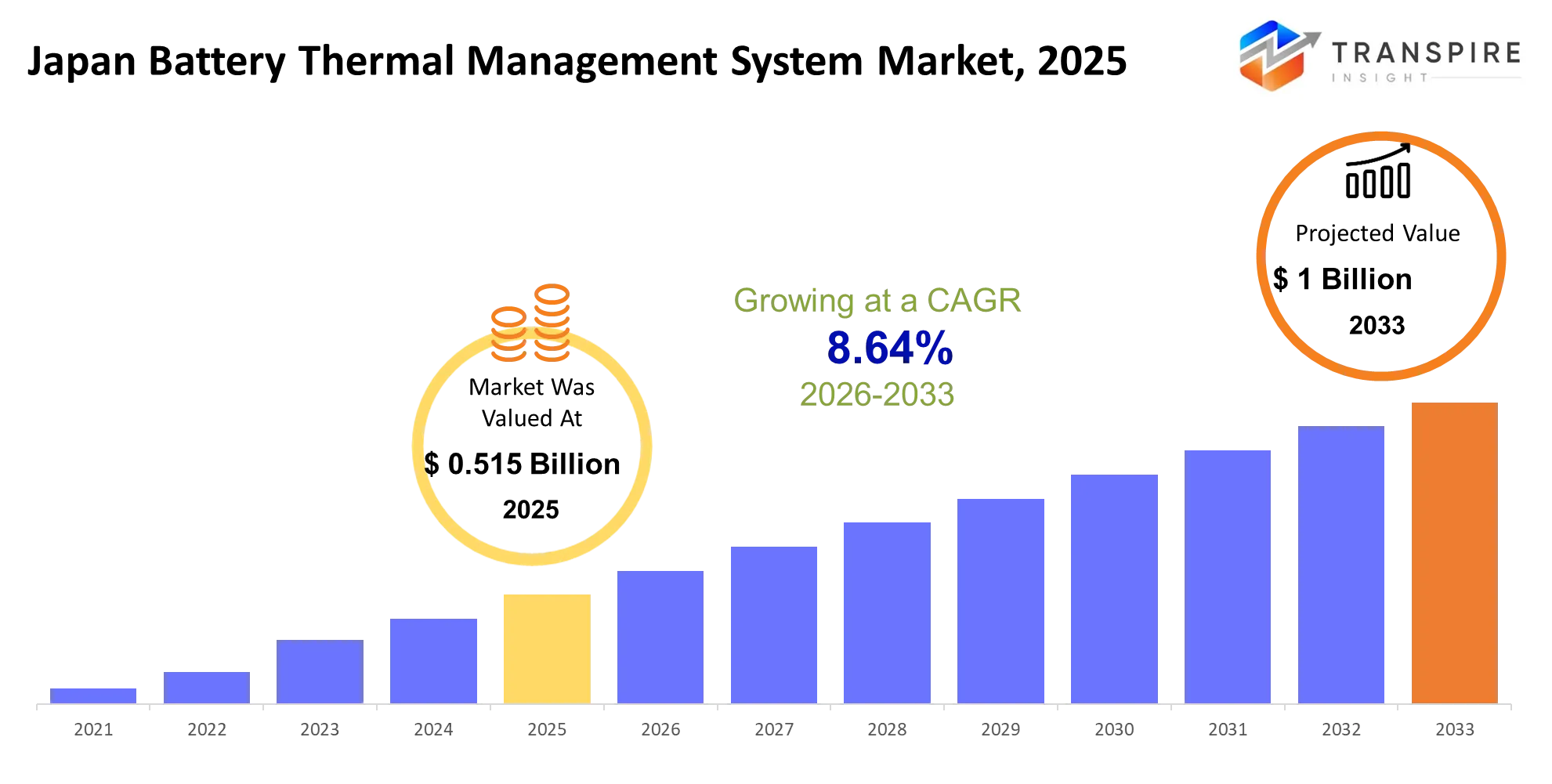
As per Transpire Insight the Japan Battery Thermal Management System Market size is estimated at USD 0.515 Billion in 2025 and is anticipated to reach USD 1 Billion by 2033, growing at a CAGR of 8.64% from 2026 to 2033.
The Japan Battery Thermal Management System Market lets medical schools, teaching hospitals, and other healthcare organizations help train physicians, nurses, surgeons, and emergency responders in realistic clinical settings, kinda, without putting patients in unnecessary danger. Simulation platforms help refine procedural accuracy, sharpen clinical judgment, and strengthen multidisciplinary collaboration, all while fitting competency-based education pathways. In the last five years the market has moved away from the old mannequin style drills, and leaned more into AI enabled setups, virtual reality VR, and mixed reality simulation systems, which can show learning results you can actually measure. The COVID-19 pandemic, kinda fast tracked that change, because conventional clinical practice was disrupted, and everyone had to lean on remote plus technology assisted medical education. And as Japan is dealing with an aging population and ongoing healthcare workforce shortages, many hospitals are building more advanced simulation labs to boost workforce readiness and lower medical mistakes. On top of that, government backing for digital healthcare transformation and continuous medical education is making adoption easier, so manufacturers of simulation equipment , software developers , and professional training service providers can capture recurring revenue streams.
Japan Battery Thermal Management System Market Size & Forecast:
- Japan Battery Thermal Management System Market Size 2025: USD 0.515 Billion
- Expected Market Value 2033: USD 1 Billion
- Forecast CAGR: 8.64%
- Leading region in 2025: Kanto
- Fastest Growing region: Kyushu
- Key Profile: Denso Corporation, Toyota Industries, MAHLE, Valeo, Hanon Systems, Modine Manufacturing, BorgWarner, Gentherm, Panasonic Holdings, Mitsubishi Electric, Hitachi Astemo, Bosch, VOSS Automotive, Dana Incorporated, Continental AG
Key Market Insights
- Kanto did kinda dominate the Japan Battery Thermal Management System Market, like with roughly 42% market share in 2025 , and it’s being backed by a few big university hospitals and fairly modern medical education infrastructure that just keeps getting upgraded.
- Kyushu looks like it will be the fastest growing regional market through 2033, mostly because healthcare spending keeps expanding , plus regional medical education programs are rolling out more and more.
- High-fidelity patient simulators made up almost 39% of the market share in 2025, and they stayed the top product category in teaching hospitals year after year.
- Virtual reality and mixed reality simulation platforms are the fastest-growing slice , and that’s tied to immersive procedural training as well as remote learning capabilities that keep extending through 2033.
- Surgical training applications held about 34% market share in 2025, while emergency medicine simulation still shows the most adoption momentum, like it’s quietly gaining steam.
- Teaching hospitals contributed nearly 48% of end-user revenue in 2025 , yet private simulation centers and nursing institutes are also expanding, pretty quickly actually.
- Kyoto Kagaku, Laerdal Medical, CAE Healthcare, 3D Systems, and SimX keep building out their portfolios, often with AI integration, cloud based assessment, and immersive simulation technologies.
- Manufacturers are increasingly mixing in AI-powered performance analytics to gauge trainee proficiency and kind of customize clinical learning pathways.
- Since 2021, government-supported digital healthcare initiatives have helped speed up procurement of simulation laboratories across academic medical institutions.
- And healthcare providers are also leaning more toward cloud-connected simulation ecosystems, to standardize clinician training and improve certification efficiency across the country.
What are the Key Drivers, Restraints, and Opportunities in the Japan Battery Thermal Management System Market?
Japan’s move toward competency-based medical education, plus tighter patient safety rules, has become the main thing pushing the market ahead. More and more, medical universities and teaching hospitals now ask for simulation-based evaluations before learners even enter routine clinical work. At the same time, government-backed healthcare digitization programs keep nudging budgets toward advanced simulation centers, which helps all these projects actually get funded. In practice, this change lets institutions raise procedural skill faster, cut down training-related mishaps, and keep clinical education more uniform. So, suppliers of simulation equipment, simulation software and training services tend to see bigger procurement spending and steadier long-term maintenance agreements.
Still, the biggest structural hurdle is the hefty capital outlay needed for advanced simulation labs and high-fidelity training tools. Those higher end simulators, immersive VR setups, software subscriptions, and even instructor certification activities add up fast. Many regional schools can’t really absorb that, at least not without delays. Also, simulation setups need continual software upgrades and specialized technical assistance, so rollout happens in a staggered way. That uneven adoption slows modernization in smaller healthcare facilities, and it can cap the overall revenue upside.
Looking forward, artificial intelligence, digital twins, and extended reality actually look like the strongest long run opening. With AI driven performance analytics, it can assess trainee choices during training, spot procedural weak points, and then suggest tailored learning steps on the fly. That kind of real-time, individualized feedback could make simulation programs much more valuable than before.
What Has the Impact of Artificial Intelligence Been on the Japan Battery Thermal Management System Market?
Artificial intelligence along with more advanced digital technologies are quietly shifting Japan’s medical training simulation industry, so clinical education becomes more adaptive, more trackable, and generally less wasteful. In practice, AI models automatically review how a learner performs during simulated procedures by watching instrument motion, mapping decision patterns, measuring response delays , and checking whether clinical protocol rules were followed. Then machine learning can craft personalized coaching notes, so instructors can spend more time on complex clinical reasoning rather than doing repetitive grading. On top of that, virtual reality, augmented reality, and digital twin setups make the simulation feel more real, by recreating difficult surgical steps or emergency situations with pretty high fidelity.
There is also predictive analytics, which helps simulation centers run smoother by estimating when equipment needs service, arranging schedules more effectively, and keeping an eye on hardware performance so downtime doesn’t become a surprise. Cloud-based learning environments let institutions compare trainee results across different campuses, but still keep standardized competency reviews in place. Altogether, these tools raise consistency in training, improve how often simulation resources get used, and can lower operational costs that normally come from instructor-led assessments.
Still, broader AI adoption is not effortless. Costs to implement these systems can be high, and interoperability becomes tricky when older simulation platforms can’t easily “talk” with newer software. Another obstacle is that there aren’t enough large, well-standardized clinical training datasets. Many organizations also need to spend a lot on cybersecurity, digital infrastructure, and faculty training first, before AI-enabled simulation systems can actually roll out at scale across the country.
Key Market Trends
- Since 2021, teaching hospitals have been moving away from standalone mannequins and into integrated AI enabled simulation ecosystems, with centralized performance analytics sort of woven in.
- Virtual reality surgical training has also gone beyond those early pilot programs, now it shows up as more routine medical education, especially for minimally invasive procedures, which is kind of the big theme lately.
- Healthcare institutions are more and more buying cloud connected simulation platforms that let instructors supervise remotely and do standardized competency checks.
- Manufacturers, meanwhile, have rolled out AI based evaluation software that automatically scores clinical performance using objective procedural metrics, and it’s not just a rough review anymore.
- Medical universities are increasingly adding mixed reality anatomy visualization into undergraduate and postgraduate clinical education, not as a novelty but as part of the curriculum.
- Collaboration between technology firms and teaching hospitals has helped speed up patient specific simulation scenarios by using digital modeling, so the training feels closer to real cases.
- Healthcare providers are also leaning toward simulation based certification, before clinicians are allowed to do complex procedures on their own.
- Portable simulation equipment is getting more popular with regional hospitals, because it supports flexible workforce training without needing to build dedicated facilities.
- And overall competition seems to be shifting, toward software innovation, cloud connectivity, and analytics capabilities rather than hardware performance alone.
- Industry participants continue putting money into immersive learning platforms that combine artificial intelligence, extended reality, and real time competency tracking together, more or less all in one ecosystem.
Japan Battery Thermal Management System Market Segmentation
By Technology:
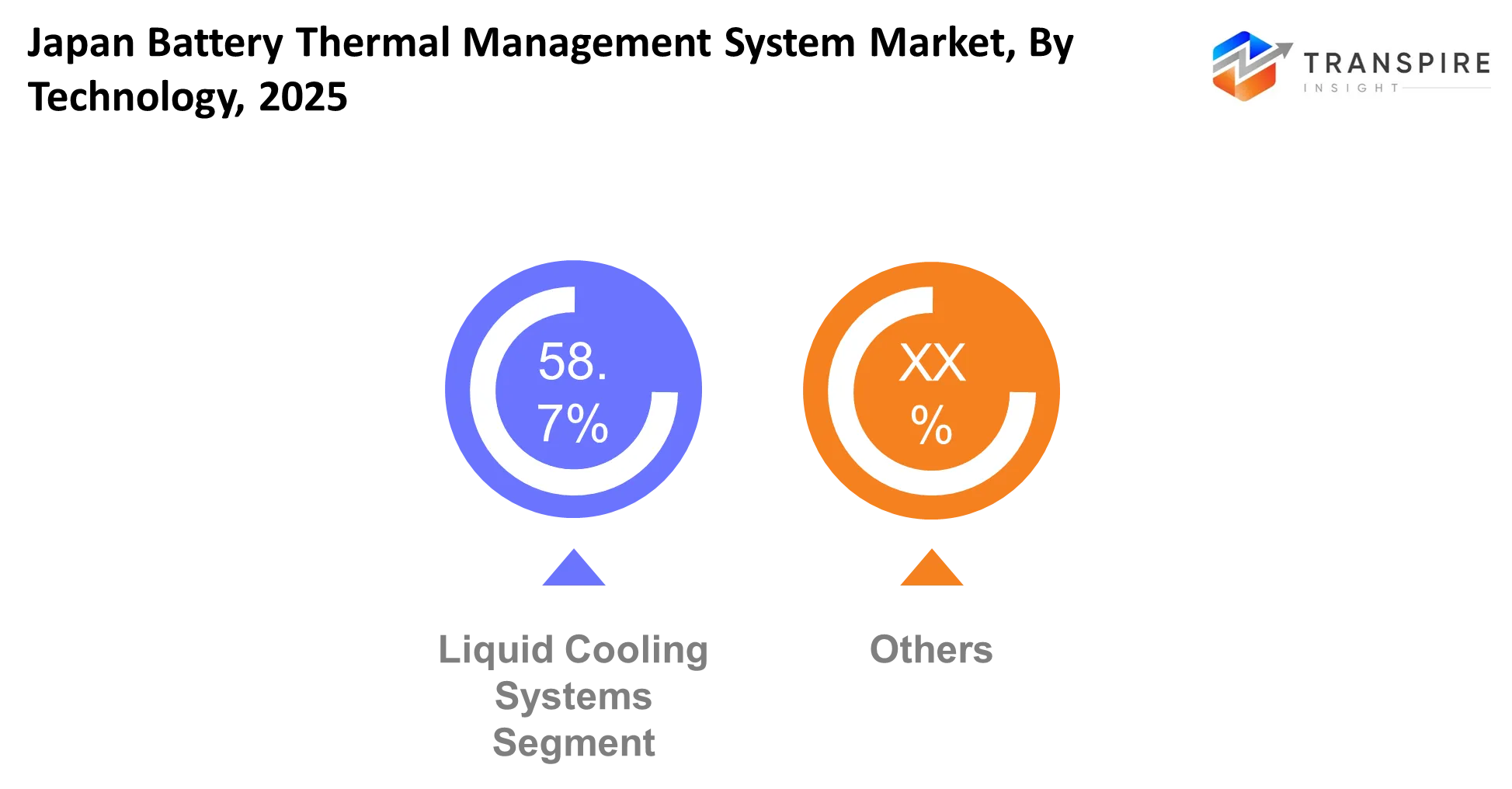
Air Cooling is still kinda a practical pick for battery thermal management, mostly because the design is straightforward, upkeep is lower, and it’s easier to keep it cost effective during integration. A lot of Passenger electric vehicles, and also smaller battery systems, tend to use Air Cooling, especially when the thermal loads are moderate so the temperature control stays reliable. Liquid Cooling keeps getting more attention for higher performance battery packs, mainly because heat transfer is more efficient when the pack is charging quickly, or when the vehicle is out doing long runs. Phase Change Materials also help out with thermal stability, because they absorb surplus heat while the battery is working, so safe temperatures are easier to keep, without needing constant energy input.
Refrigerant Cooling supports premium electric vehicles by connecting battery cooling with the vehicle’s climate control, and that can help energy efficiency, plus it usually improves cabin comfort too. Other approaches include hybrid cooling methods, and newer thermal management ideas that kinda blend several technologies so they can protect the battery better, stretch service life, and keep vehicle performance stronger across different weather and operating environments.
By Battery Type:
Lithium-ion batteries keep the largest share, mostly due to high energy density, long operating life, and just broad adoption across electric mobility uses. Manufacturers are still pushing improvements for faster charging , better thermal stability, and higher overall efficiency , all of that so electric vehicles can roll out more widely. Solid-State batteries are getting serious research attention too, because better safety , greater energy capacity, and quicker charging ability seem to give real long-term commercial traction.
Meanwhile, Nickel Metal Hydride batteries stay relevant in hybrid vehicle platforms, mainly because durability has already been proven, and the everyday operating performance is dependable. Beyond that, there are other approaches—emerging chemistries being explored for specialized transportation and industrial uses, where particular performance traits match very specific operational needs.
By Vehicle Type:
Battery Electric Vehicles take the biggest share, mostly because fully electric platforms need advanced thermal management to shield the battery performance and stretch operating range. Plug-in Hybrid Vehicles also lean on efficient cooling systems to keep the battery temperature steady, during both electric mode and engine powered operation. Hybrid Electric Vehicles are still moving toward optimized thermal solutions, sort of aiming to balance efficiency with durability and cost while driving through mixed conditions.
Commercial EVs are creating a lot of room to grow because delivery fleets, buses, and heavy-duty vehicles run in tough duty cycles that often lead to higher battery temperatures. Others are also showing up, like specialty mobility platforms , and off-road electric vehicles where customized battery cooling designs help them stay reliable in rough environments.
By Component:
Cooling Plates kind of central role here, not just for show, they help transfer heat away from the battery cells and keep the operating temperatures pretty consistent across the whole pack. Pumps then circulate the coolant in a steady way through the thermal management system, while Sensors are always watching temperature and overall system performance, so safety stays better over time. Controllers take what the sensors report and then regulate the cooling functions, to keep the battery in those best operating conditions across different driving situations.
Heat Exchangers also help, they improve thermal efficiency by moving heat between cooling circuits, and in the process they cut down energy use for the overall system. Other pieces include valves, hoses , connectors, insulation materials, and the supporting hardware that basically helps keep thermal management stable, and supports long term dependable battery operation.
By End User:
Passenger Vehicles basically show up as the biggest end user category, since electric passenger cars keep expanding through urban as well as regional transportation networks. Commercial Vehicles, on the other hand, are slowly and more and more using advanced battery cooling methodologies, to improve operational reliability, cut down downtime , and handle intensive fleet utilization. Energy Storage Systems add another set of chances, because they call for proper thermal management so battery safety stays intact and storage performance lasts longer.
Others would cover things like industrial equipment, construction machinery, marine electric platforms, and also specialized mobility solutions, where battery temperature control needs to be dependable for safe and efficient work. Ongoing investment toward electrification across many industries will likely push broader adoption of advanced battery thermal management technologies during the whole forecast period.
What are the Key Use Cases Driving the Japan Battery Thermal Management System Market?
Clinical skills education seems to be the biggest use case, since medical universities and teaching hospitals, often lean on simulation so students can get used to procedures before they meet real patients. In the same way surgical practice , emergency response, and nursing education do well with repeated hands on drills, they tend to raise accuracy and at the same time lower clinical risk, a pretty practical tradeoff.
After that, there are other uses that keep growing , like in military medical training, ambulance services, and disaster response programs where lifelike scenarios make it easier to improve decision-making when things get tense. Healthcare organizations and professional certification centers also lean into simulation platforms for ongoing medical education and competency checks, rather than only “one time” testing.
What’s coming next includes AI assisted personalized training, virtual reality for collaborative surgical work, and remote simulation programs that connect several medical institutions. Robotic surgery practice plus digital twin based procedure planning, should open fresh doors as newer healthcare technologies become more common in day to day clinical learning.
|
Report Metrics |
Details |
|
Market size value in 2025 |
USD 0.515 Billion |
|
Market size value in 2026 |
USD 0.56 Billion |
|
Revenue forecast in 2033 |
USD 1 Billion |
|
Growth rate |
CAGR of 8.64% from 2026 to 2033 |
|
Base year |
2025 |
|
Historical data |
2021 - 2024 |
|
Forecast period |
2026 - 2033 |
|
Report coverage |
Revenue forecast, competitive landscape, growth factors, and trends |
|
Regional scope |
Japan |
|
Key company profiled |
Denso Corporation, Toyota Industries, MAHLE, Valeo, Hanon Systems, Modine Manufacturing, BorgWarner, Gentherm, Panasonic Holdings, Mitsubishi Electric, Hitachi Astemo, Bosch, VOSS Automotive, Dana Incorporated, Continental AG |
|
Customization scope |
Free report customization (country, regional & segment scope). Avail customized purchase options to meet your exact research needs. |
|
Report Segmentation |
By Technology (Air Cooling, Liquid Cooling, Phase Change Materials, Refrigerant Cooling, Others); By Battery Type (Lithium-ion, Solid-State, Nickel Metal Hydride, Others); By Vehicle Type (Battery Electric Vehicles, Plug-in Hybrid Vehicles, Hybrid Electric Vehicles, Commercial EVs, Others); By Component (Cooling Plates, Pumps, Sensors, Controllers, Heat Exchangers, Others); By End User (Passenger Vehicles, Commercial Vehicles, Energy Storage Systems, Others) |
Which Regions are Driving the Japan Battery Thermal Management System Market Growth?
Somehow the Kanto region seems to hold the biggest piece of the Japan Battery Thermal Management System Market, mainly because it’s packed with university hospitals, medical schools, research institutes and these more advanced healthcare technology companies. Tokyo and the nearby prefectures also kind of catch a lot of momentum from government support for digital healthcare, plus ongoing medical education routines, and really strong cooperation between academia and medical device manufacturers. Because of that, big healthcare networks are regularly putting money into high-fidelity simulators, immersive virtual reality training platforms, and AI-based evaluation systems, so clinicians can keep improving their competency in a more controlled way.
Then there’s Kansai, which plays more like the second-largest contributor. Here the growth story is a little different, it’s more about established medical manufacturing, relatively steady healthcare spending, and a longer history of academic collaboration. Osaka, Kyoto, and Kobe have multiple medical device developers and teaching institutions, and they tend to upgrade their simulation labs in a steady rhythm rather than doing sudden rapid expansion. Regional healthcare providers also stress continuous professional education, surgical focus, and standardized credentialing programs. That creates procurement cycles that feel dependable for simulation equipment, even when budgets are tight.
As for Kyushu, it’s expected to be the fastest mover during the forecast period. Regional governments are building up healthcare infrastructure and, at the same time, expanding digital medical education initiatives. With more funding flowing into smart hospitals, regional medical universities, and telemedicine capabilities, adoption of immersive simulation technologies is speeding up at newer healthcare centers. Meanwhile local hospitals and technology providers are forming partnerships more often, and that’s opening room for AI-enabled simulation platforms as well as remote clinical training solutions.
Who are the Key Players in the Japan Battery Thermal Management System Market and How Do They Compete?
The company list you shared seems to map more to automotive thermal management manufacturers, not really medical training simulation firms, or at least that’s what it looks like at first glance… For the Japan Battery Thermal Management System Market, though, the major players are more like Laerdal Medical, Kyoto Kagaku, CAE Healthcare, 3D Systems (Simbionix) , SimX, Limbs & Things, and Gaumard Scientific. Overall the competition feels moderately consolidated, but the ways they stand out are not mostly about pricing. Instead it’s more on simulation realism , AI-driven performance analytics, immersive virtual reality platforms, clinical content libraries, plus the kind of long-term service support that institutions tend to want for years.
In practice they tend to compete by widening software capabilities , adding cloud-based learning systems, and making partnerships with teaching hospitals to push better education outcomes. Kyoto Kagaku often gets noticed for anatomically accurate training models, made specifically for medical education, along with strong ties to Japanese universities and teaching hospitals. Laerdal Medical is more about integrated simulation ecosystems, where patient simulators , digital learning platforms, and performance assessment tools come together so organizations can standardize training across multiple departments. CAE Healthcare leans toward high-fidelity simulation for emergency medicine , anesthesia, and critical care, and they back it with instructor software that’s pretty robust, plus scenario management features.
SimX tends to push immersive virtual reality simulation, which allows collaborative remote medical training without the need for dedicated simulation centers, not that anyone wants to build one anyway. 3D Systems, via the Simbionix line, focuses on procedure-specific surgical simulators, with realistic haptic feedback, and that helps support more advanced physician training.
Company List
- Denso Corporation
- Toyota Industries
- MAHLE
- Valeo
- Hanon Systems
- Modine Manufacturing
- BorgWarner
- Gentherm
- Panasonic Holdings
- Mitsubishi Electric
- Hitachi Astemo
- Bosch
- VOSS Automotive
- Dana Incorporated
- Continental AG
Recent Development News
- In February 2026, Laerdal Medical announced the acquisition of VitalsBridge from Dynasthetics. The acquisition expands Laerdal's patient simulation portfolio by integrating realistic clinical monitor outputs into simulation training, strengthening high-fidelity medical education solutions. Source:https://www.mynewsdesk.com/laerdal-as/pressreleases/taking-simulation-one-step-closer-reality-laerdal-medical-to-acquire-vitalsbridge-3432106 (Laerdal Medical)
- In February 2026, Kyoto Kagaku Europe announced a collaboration with InSimo to develop a hybrid lumbar puncture training solution combining physical simulators with augmented reality and haptic feedback. The partnership enhances procedural training by integrating Kyoto Kagaku simulators with InSimo's Sim&Care software. Source:https://www.kyotokagaku.com/en/news/index.html (Kyoto Kagaku)
- In June 2025, Kyoto Kagaku showcased new medical simulators and updated training models at the SESAM 2025 conference in Valencia. The exhibition introduced new simulation products for medical education and strengthened the company's presence in advanced healthcare simulation. Source:https://www.kyotokagaku.com/en/news/ (Kyoto Kagaku)
What Strategic Insights Define the Future of theJapan Battery Thermal Management System Market?
The Japan Battery Thermal Management System Market is moving toward more fused digital learning ecosystems where artificial intelligence, extended reality, cloud connectivity, and competency analytics become the usual building blocks for clinical education, not just “nice to have” add ons. This kind of structural shift is being pushed along by healthcare workforce shortages, more rigid competency expectations, and ongoing money going into digital hospital infrastructure. There is also a less obvious risk, because the industry is getting more dependent on a handful of advanced software platforms, and that situation can raise vendor concentration, then later it may trigger interoperability problems for institutions trying to run a blended technology stack.
At the same time, AI-driven personalized learning, digital twin based procedural planning, and remote co-operative simulation are still sounding quite promising even if they’re in the early phase of commercial uptake. Market participants could do better if they focus on interoperable software platforms, form strategic partnerships with medical universities, and build scalable cloud based simulation services. These moves would help with continuous professional education across both central city hospitals and regional healthcare systems, without too much friction when the environment changes.
Japan Battery Thermal Management System Market Report Segmentation
By Technology
- Air Cooling
- Liquid Cooling
- Phase Change Materials
- Refrigerant Cooling
- Others
By Battery Type
- Lithium-ion
- Solid-State
- Nickel Metal Hydride
- Others
By Vehicle Type
- Battery Electric Vehicles
- Plug-in Hybrid Vehicles
- Hybrid Electric Vehicles
- Commercial EVs
- Others
By Component
- Cooling Plates
- Pumps
- Sensors
- Controllers
- Heat Exchangers
- Others
By End User
- Passenger Vehicles
- Commercial Vehicles
- Energy Storage Systems
- Others
Frequently Asked Questions
Find quick answers to common questions.
The expected Japan Battery Thermal Management System Market size for the market will be USD 1 Billion in 2033.
Key segments for the Japan Battery Thermal Management System Market are By Technology (Air Cooling, Liquid Cooling, Phase Change Materials, Refrigerant Cooling, Others); By Battery Type (Lithium-ion, Solid-State, Nickel Metal Hydride, Others); By Vehicle Type (Battery Electric Vehicles, Plug-in Hybrid Vehicles, Hybrid Electric Vehicles, Commercial EVs, Others); By Component (Cooling Plates, Pumps, Sensors, Controllers, Heat Exchangers, Others); By End User (Passenger Vehicles, Commercial Vehicles, Energy Storage Systems, Others).
Major Japan Battery Thermal Management System Market players are Denso Corporation, Toyota Industries, MAHLE, Valeo, Hanon Systems, Modine Manufacturing, BorgWarner, Gentherm, Panasonic Holdings, Mitsubishi Electric, Hitachi Astemo, Bosch, VOSS Automotive, Dana Incorporated, Continental AG.
The Japan Battery Thermal Management System Market size is USD 0.515 Billion in 2025.
The Japan Battery Thermal Management System Market CAGR is 8.64% from 2026 to 2033.
- Denso Corporation
- Toyota Industries
- MAHLE
- Valeo
- Hanon Systems
- Modine Manufacturing
- BorgWarner
- Gentherm
- Panasonic Holdings
- Mitsubishi Electric
- Hitachi Astemo
- Bosch
- VOSS Automotive
- Dana Incorporated
- Continental AG
About the Authors

Avinash Kumar
I’m Avinash Kumar, a Senior Research Analyst at Transpire Insight, with expertise in the Electronics and Semiconductor and Energy & Power industry. My work focuses on analyzing emerging technologies, market trends, industry developments, and innovation across these sectors. I specialize in transforming complex technical and market insights into clear, research-backed content that helps professionals, businesses, and decision-makers stay informed. Through continuous industry research and data-driven analysis, I strive to deliver accurate, reliable, and practical perspectives on the latest advancements shaping the semiconductor and energy landscape.

Chakradhar Khansole
Chakradhar serves as the Research Director at Transpire Insight, bringing over 8 years of experience in technology, innovation, and strategic market intelligence. He specializes in transforming complex market data into actionable business insights that enable organizations to make informed, growth-oriented decisions. Recognized for his strategic vision and analytical expertise, Chakradhar leads high-impact research initiatives, delivering comprehensive market assessments, competitive intelligence, and forward-looking industry analysis.
Recently Published Reports
-
Apr 2026
Fiber Optic Faceplates Market
Fiber Optic Faceplates Market Size, Share & Analysis Report By Type (< 300 mm2, 300-350 mm2, and > 350 mm2, By Application (Night Vision, Holographic Imaging, Medical, and Others), and Geography (North America, Europe, Asia-Pacific, Middle East and Africa, South and Central America), 2021 - 2031
-
Apr 2026
High Temperature Superconductors Market
High Temperature Superconductors Market Size, Share & Analysis Report By Type (1G HTS, and 2G HTS), By Application (Power Cable, Fault Current Limiter, and Transformer), and Geography (North America, Europe, Asia-Pacific, Middle East and Africa, South and Central America), 2021 - 2031
-
Apr 2026
Industrial Plugs and Socket Market
Industrial Plugs and Socket Market Size, Share & Analysis Report By Type (Industrial Plugs, Industrial Sockets), By Current (Up to 32 A, 32 to 125 A, Above 125 A), By Protection (Dustproof and Splash Proof, Waterproof, Explosion Proof), By End User (Heavy Industries, Oil and Gas, Chemicals and Pharmaceuticals, Power Generation, Others), and Geography (North America, Europe, Asia-Pacific, Middle East and Africa, South and Central America), 2021 - 2031
-
Apr 2026
InGaAs Avalanche Photodiodes Market
InGaAs Avalanche Photodiodes Market Size, Share & Analysis Report By Type (1100 - 1700 nm, and 1000 - 1600 nm), By Application (Missile Warning System, Muzzle Flash Detection, Wafer Defect Inspection, Laser Rangefinders, and Others), and Geography (North America, Europe, Asia-Pacific, Middle East and Africa, South and Central America), 2021 - 2031