
Japan Automotive Over-The-Air (OTA) Updates Market Size & Forecast:
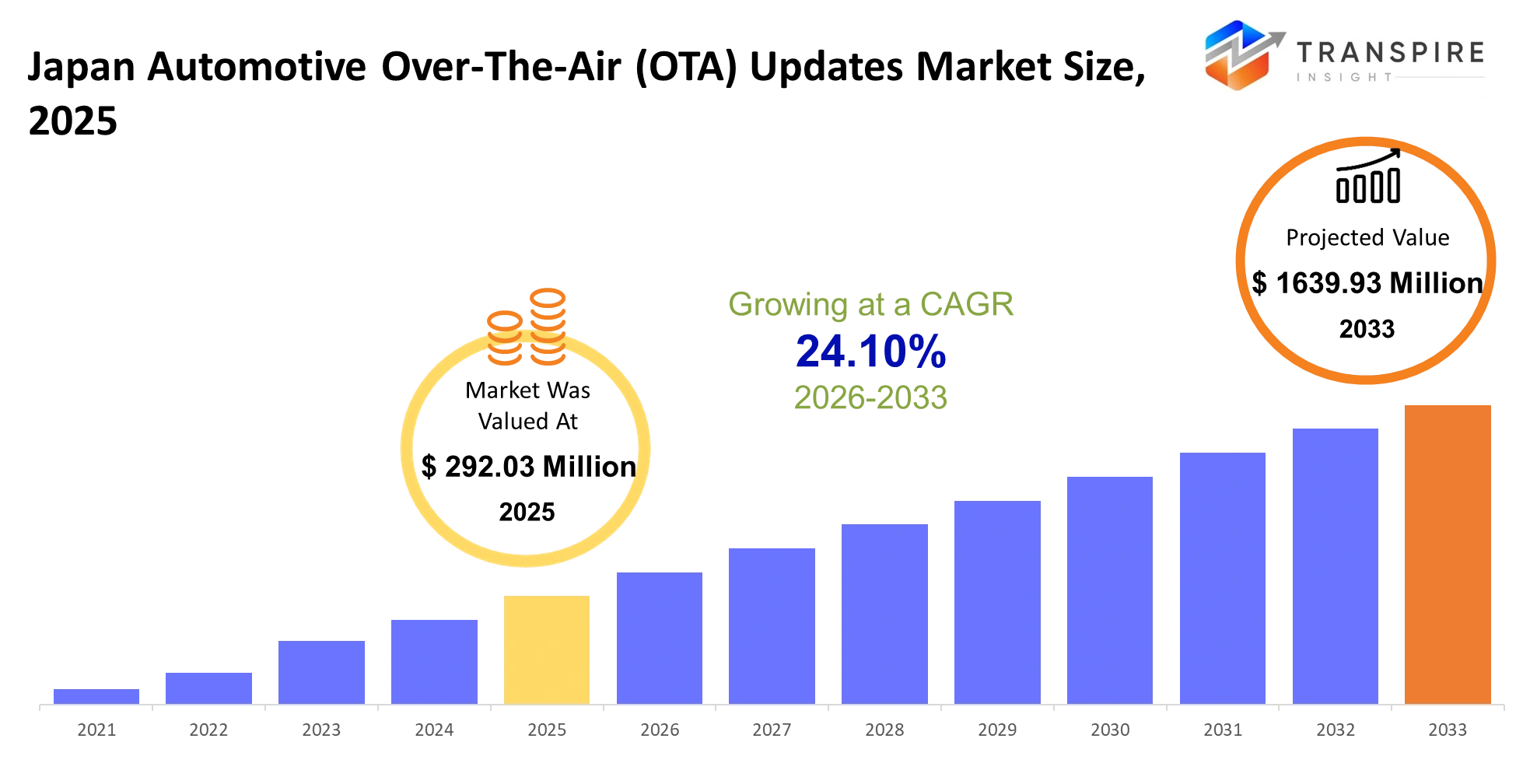
- Japan Automotive Over-The-Air (OTA) Updates Market Size 2025: USD 292.03 Million
- Japan Automotive Over-The-Air (OTA) Updates Market Size 2033: USD 1639.93 Million
- Japan Automotive Over-The-Air (OTA) Updates Market CAGR: 24.10%
- Japan Automotive Over-The-Air (OTA) Updates Market Segments: By Type (Software Updates, Firmware Updates, Security Updates, Others); By Application (Infotainment Systems, ADAS, Telematics, Powertrain, Navigation Systems, Others); By End-User (Automotive OEMs, Fleet Operators, Mobility Providers, Tech Companies, Others); By Deployment (Cloud, Embedded Systems, Hybrid, Others).
To learn more about this report,  Download Free Sample Report
Japan Automotive Over-The-Air (OTA) Updates Market Summary
The Japan Automotive Over-The-Air (OTA) Updates Market was valued at USD 292.03 Million in 2025. It is forecast to reach USD 1639.93 Million by 2033. That is a CAGR of 24.10% over the period.
Automakers in Japan use the automotive over-the-air (OTA) updates market to deliver software upgrades security patches and feature enhancements together with diagnostic improvements for their connected vehicles through remote updates that eliminate the need for customers to visit physical dealerships. The system provides a vital operational solution because it decreases expenses for recall services while it speeds up the process for implementing updates and it helps manufacturers maintain vehicle compliance throughout their entire operational period.
The market has evolved from offering basic infotainment software updates to providing complete control over all vehicle domains through advanced systems that manage battery power and ADAS calibration and powertrain performance. Japanese automakers accelerated this transition after global semiconductor shortages revealed the dangers involved with vehicle systems that depend entirely on their physical components because they needed to switch to software-defined vehicle platforms which enable changes after production.
Vehicle manufacturers need to create secure update systems because they must comply with new cybersecurity regulations together with new connected vehicle requirements. The system generates direct revenue through its subscription-based feature activation model which has established OTA capability as an essential element for developing next-generation vehicle systems.
Key Market Insights
- The Kanto region held the largest market share in 2025 with approximately 38% because it had both OEM headquarters and connected mobility research and development centers and advanced 5G network infrastructure.
- Chubu will experience its most rapid market expansion until 2030 because the region specializes in automotive manufacturing and develops software-defined vehicle platforms.
- Kansai is experiencing rising demand that exceeds 13% annual growth because smart mobility pilot projects and supplier digitalization initiatives are becoming more common.
- The Japan Automotive Over-The-Air (OTA) Updates Market in 2025 was dominated by software platforms which obtained more than 46% market share because original equipment manufacturers (OEMs) invested in centralized update orchestration systems.
- The market for OTA cybersecurity and authentication services achieved approximately 29% market share which made it the second largest segment of the market due to the impact of changing regulatory requirements.
- The fastest-expanding sector until 2032 consists of predictive diagnostics together with AI-powered update analytics which will grow at more than ten percent annual growth rates.
- Japanese consumers now expect complete digital vehicle experiences which led to infotainment and telematics updates capturing almost 41 percent of the market share in 2025.
- The Japanese market for Automotive Over-The-Air (OTA) Updates recorded its highest revenue in 2025 through passenger vehicle original equipment manufacturers who achieved 68 percent market share due to increased connected car usage.
- The end-user sector that experiences the most rapid growth consists of commercial fleet operators who use OTA solutions to achieve both maintenance downtime reduction and vehicle uptime enhancement.
- The main companies in the market include Toyota Motor Corporation together with Honda Motor Co. Ltd. and Denso Corporation and Bosch and Continental AG and NXP Semiconductors.
What are the Key Drivers, Restraints, and Opportunities in the Japan Automotive Over-The-Air (OTA) Updates Market?
The Japanese Automotive Over-The-Air (OTA) Updates Market experiences its strongest growth through the shift towards software-defined vehicles. The automotive industry developed secure remote update systems as a compliance requirement after UNECE WP.29 established cybersecurity and software update management regulations. Japanese OEMs responded by redesigning vehicle architectures around centralized computing platforms rather than fragmented electronic control units. The manufacturers gain new revenue streams from software upgrades and subscription features and they decrease expenses for dealership services. The development of connected vehicle programs now considers OTA functionality to be a standard investment requirement that exceeds its previous status as a premium feature.
The most significant structural barrier is Japan’s legacy vehicle platform ecosystem. The domestic automotive industry continues to use mixed-generation architectural systems which lack the capacity for complete remote software implementation. The process of retrofitting secure OTA capabilities necessitates expensive hardware modifications and cloud system connections and cybersecurity testing across all vehicle models. The automotive industry needs a long-term solution because its development cycles for new products usually take more than five years to complete. The result leads to delayed product launches which decrease revenue from software sales especially in the mid-range vehicle and commercial vehicle market.
The most obvious opportunity for future development exists through vehicle-to-everything connectivity integration which provides this potential. The combination of Japan's 5G corridor development and its smart mobility investments establishes perfect conditions for testing real-time OTA technology. The connected EV fleets which operate in urban logistics will receive automatic battery optimization updates which will boost their operational efficiency while enabling businesses to adopt their technology at scale.
What Has the Impact of Artificial Intelligence Been on the Japan Automotive Over-The-Air (OTA) Updates Market?
The combination of artificial intelligence with advanced digital technologies creates a new automotive OTA ecosystem in Japan which enables software deployment to function with greater independence and more accurate predictions and better operational effectiveness. Automakers now use AI-powered orchestration systems which automatically determine software deployment schedules based on actual vehicle usage and battery status and network conditions and cybersecurity vulnerabilities. The automated system establishes a link between failed update attempts and service disruptions which mainly affect connected electric vehicles and fleet-based mobility services.
Machine learning models enhance predictive maintenance operations through their advanced capabilities which strengthen predictive maintenance. The systems analyze sensor telemetry data together with onboard diagnostic information and driver behavior patterns to detect software defects before they cause vehicle performance problems. Japanese OEMs currently implement predictive analytics to enhance their battery management systems while conducting remote adjustments to their advanced driver assistance technologies.
The system implemented at connected fleet environments has resulted in increased vehicle uptime while decreasing unplanned dealership visits and cutting maintenance costs by 10 to 15 percent. AI-driven software validation processes speed up the compliance testing of cybersecurity and safety regulations because they shorten the testing period required before software deployment.
The present state of adoption faces a significant obstacle because integration processes prove to be exceedingly difficult. The complete Japanese domestic vehicle fleet uses outdated vehicle designs which require multiple separate systems for AI-based over-the-air updates instead of a single centralized computing system. The absence of historical software performance data restricts the accuracy of models which need to forecast update patterns for different vehicle systems across various real-world operational environments.
Key Market Trends
- Japanese car manufacturers stopped enhancing their infotainment systems for automotive use after 2022 to develop remote calibration capabilities for their advanced driver assistance systems and battery management systems and vehicle propulsion system control technologies.
- OEMs began to invest more in secure software update systems after they implemented UNECE WP.29 requirements which demanded higher cybersecurity certification standards starting in 2024.
- Toyota Motor Corporation and Honda Motor Co., Ltd. increased software engineering budgets by double digits between 2023 and 2025 to support software-defined vehicle strategies.
- The 2021 semiconductor shortage demonstrated that vehicle architectures required operational updates through methods which did not depend on multiple separate hardware components.
- The connected passenger vehicles which Japanese companies launched in 2025 will enable feature-on-demand activation for more than 40% of their new vehicles which will become available for purchase in Japan.
- Japanese regulators increasingly prefer continuous software compliance monitoring because they want to replace the existing periodic validation system that has controlled connected vehicle testing in Japan until now.
- The Cloud partnerships with Denso Corporation and Bosch experienced significant growth after 2023 because they wanted to develop better secure update orchestration capabilities.
- Fleet operators started to use maintenance optimization through OTA technology after pilot programs demonstrated that dealership service visits decreased by almost 15 percent between 2023 and 2025.
- The industry now prioritizes software development speed as the main competitive factor while hardware reliability testing remains less important.
Japan Automotive Over-The-Air (OTA) Updates Market Segmentation
By Type:
The Japan Automotive Over-The-Air (OTA) Updates Market displays upward movement throughout different update categories with software updates maintaining a significant share because connected vehicle platforms require constant updates for operational performance and new feature development. Automotive manufacturers continue to rely on remote software delivery to improve vehicle systems after purchase, helping reduce service center visits while keeping systems current. Vehicles today require more software updates because their advanced digital systems need optimization throughout their operational life.
Firmware updates remain crucial because vehicle control units require direct system improvements to achieve hardware compatibility and operational efficiency. Security updates have gained stronger attention as connected mobility systems face greater risks related to cyber threats and unauthorized access. Other update types include calibration improvements and system refinements that enhance vehicle functionality. The expansion of digital architecture across Japanese automotive production continues to support broader adoption of all update categories across the Japan Automotive Over-The-Air (OTA) Updates Market.
By Application:
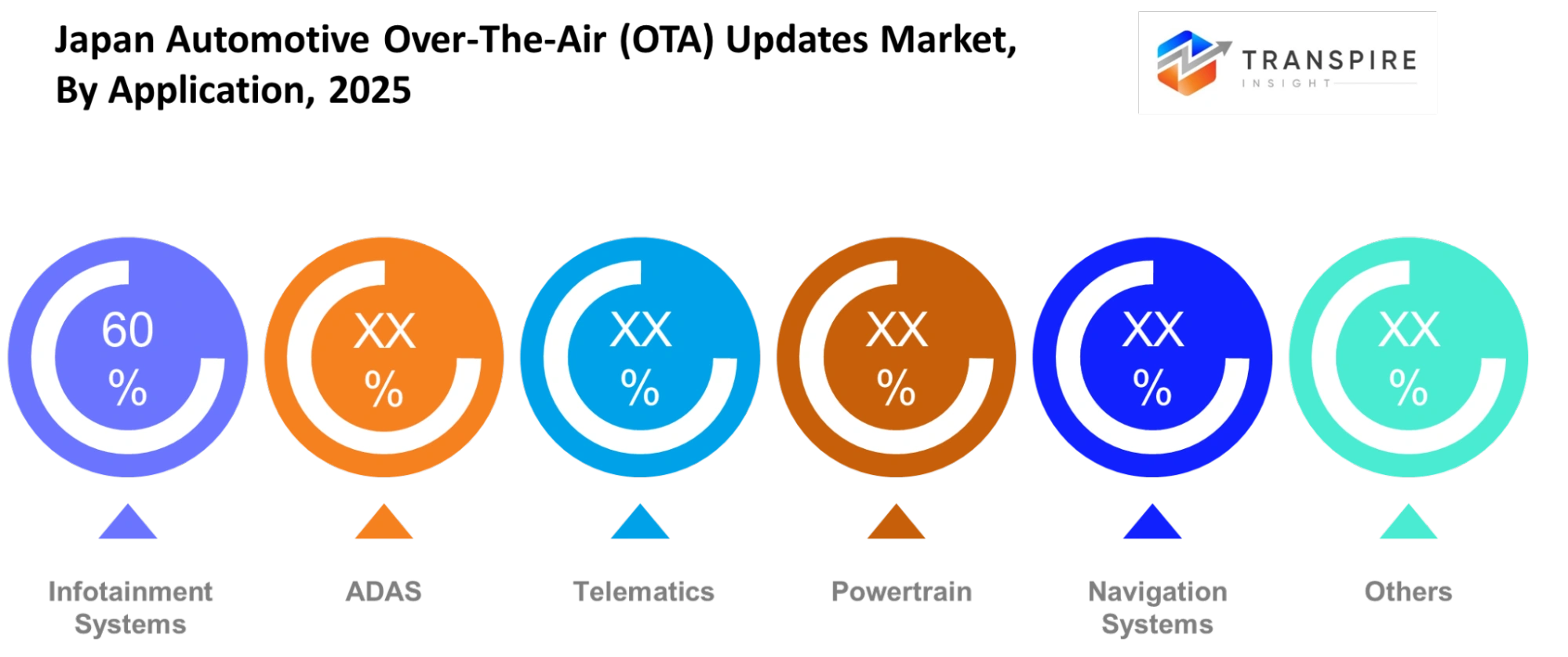
Car infotainment systems function as a primary market segment within the Japanese automotive over-the-air OTA update industry because drivers now demand digital experiences that operate without interruptions just like their mobile phones and other internet-enabled devices. Using OTA delivery systems people can improve their user interface design and application software and connectivity options and entertainment systems without needing to perform physical updates. The system provides customers with better satisfaction, while manufacturers gain the ability to enhance product value during the entire period of vehicle ownership.
Both advanced driver assistance systems ADAS and telematics systems and powertrain systems and navigation systems now use OTA remote updates to enhance their operational reliability and safety performance. The navigation system updates prove beneficial because modern mobility solutions depend on precise route information. Powertrain updates help optimize efficiency, while telematics updates strengthen connectivity services. The market for Japan Automotive Over-The-Air OTA updates now extends to every connected vehicle function through battery management systems and digital diagnostic tools which serve as additional applications.
To learn more about this report, Download Free Sample Report
By End-User:
The Japan Automotive Over-The-Air (OTA) Updates Market maintains automotive OEMs as its main end-user group because vehicle manufacturers develop direct software management capabilities which they include into their production strategies. Manufacturers use OTA systems to decrease recall costs while they work on developing better customer loyalty and effective post-sale product improvements. The system enables product maintenance to last for extended periods because it allows users to fix operational problems without needing physical access to the system.
Fleet operators and mobility providers are increasingly using OTA updates because operational continuity is essential for commercial vehicle performance. The system enhances fleet operations through remote system upgrades which decrease equipment downtime and limit the need for physical maintenance. Tech companies are becoming more involved by developing software platforms and providing cybersecurity solutions. The Japan Automotive Over-The-Air (OTA) Updates Market includes service integrators and connected infrastructure providers as additional end-users who work together to drive digital transformation across the market.
By Deployment:
The Japan Automotive Over-The-Air (OTA) Updates Market supports its cloud-based deployment system through its ability to manage software distribution across multiple vehicles from a single point which can grow to match demand. Automotive companies achieve faster product releases with improved system observation when they adopt cloud technologies. The system helps organizations plan their updates through analytical data which enables them to choose the most effective system improvements.
Direct vehicle operations require embedded systems because they enable control of sensitive components through direct onboard management. The systems deliver precise execution of essential updates which need to operate with exacting standards. Automotive companies increasingly adopt hybrid deployment systems because they combine the operational benefits of cloud technology with the dependable performance of embedded systems. The system enables efficient update distribution while it upholds all performance requirements which helps automotive companies in Japan execute their long-term operational plans for Over-The-Air (OTA) updates.
What are the Key Use Cases Driving the Japan Automotive Over-The-Air (OTA) Updates Market?
The primary reason that Japan uses OTA updates for its automotive industry arises from the need to conduct remote software maintenance operations on passenger vehicles which include their infotainment systems and their cybersecurity systems and their navigation platform systems. The application creates maximum demand because it enables automakers to reduce their need for dealership services while it decreases their costs for recall servicing and it allows them to keep their software systems up to date according to industry standards.
The system now supports two new applications, which include optimizing battery management for electric vehicles and using remote technology to calibrate advanced driver assistance systems. The premium EV manufacturers and commercial fleet operators assess these use cases because their business operations require them to keep equipment working and their vehicles running for as much time as possible.
New use cases will emerge from two developments, which include feature-on-demand activation technology and autonomous driving software development. Japanese OEMs are testing subscription-based capabilities such as temporary performance upgrades and advanced safety feature unlocks. The forecast period will show increased relevance for vehicle-to-infrastructure connected updates that support Japan's smart mobility corridor development, which will proceed as the country builds its urban intelligent transport systems.
|
Report Metrics |
Details |
|
Market size value in 2025 |
USD 292.03 Million |
|
Market size value in 2026 |
USD 361.82 Million |
|
Revenue forecast in 2033 |
USD 1639.93 Million |
|
Growth rate |
CAGR of 24.10% from 2026 to 2033 |
|
Base year |
2025 |
|
Historical data |
2021 - 2024 |
|
Forecast period |
2026 - 2033 |
|
Report coverage |
Revenue forecast, competitive landscape, growth factors, and trends |
|
Country scope |
Japan |
|
Key company profiled |
Bosch, Continental, Denso, Aptiv, Harman, Qualcomm, NVIDIA, Microsoft, Google, Amazon, Tesla, NXP, Renesas, Infineon, BlackBerry. |
|
Customization scope |
Free report customization (country, regional & segment scope). Avail customized purchase options to meet your exact research needs. |
|
Report Segmentation |
By Type (Software Updates, Firmware Updates, Security Updates, Others); By Application (Infotainment Systems, ADAS, Telematics, Powertrain, Navigation Systems, Others); By End-User (Automotive OEMs, Fleet Operators, Mobility Providers, Tech Companies, Others); By Deployment (Cloud, Embedded Systems, Hybrid, Others). |
Which Regions are Driving the Japan Automotive Over-The-Air (OTA) Updates Market Growth?
The Kanto region of Japan serves as the main market for automotive OTA updates because it contains the largest connected vehicle development ecosystem in the country. The major vehicle manufacturers and software development centers together with cloud service providers have established their main offices in Tokyo and Yokohama to support extensive secure update system deployment. The area functions as the most effective location for national transport authorities and automotive technology stakeholders to work together on validating cybersecurity and software compliance standards.
The established ecosystem provides automakers with essential technical capabilities and clear operational guidelines to implement OTA vehicle programs at a national level. The Chubu region contributes differently, relying less on digital infrastructure density and more on manufacturing consistency. The region maintains stable capital investments in advanced assembly facilities and long-term relations with suppliers because it hosts Japan's biggest automotive manufacturing centers. The Chubu region establishes its competitive advantage through its capability to embed OTA functional systems directly into vehicle production processes while the Kanto region depends on software-based innovation. The system provides dependable revenue generation because its adoption occurs during platform development instead of requiring additional work after production ends.
Since 2024, Kansai has become the fastest-growing regional market because of its increased smart mobility investments. The development of 5G-enabled transport corridors and connected infrastructure pilots through public-private partnerships has created effective testing environments which researchers use to test advanced software deployment methods. The regional authorities have increased their support for autonomous vehicle testing programs which they use to motivate car manufacturers to improve their remote software management systems. The growth of this sector creates new opportunities for investors and technology newcomers because they can establish initial partnerships as over-the-air deployment spreads to new regions outside existing automotive production centers until 2033.
Who are the Key Players in the Japan Automotive Over-The-Air (OTA) Updates Market and How Do They Compete?
The current competitive situation in Japan's automotive OTA updates market shows moderate consolidation because automotive technology companies and domestic OEM software divisions control most valuable market segments. Companies now compete based on their software integration capabilities and their ability to protect against cyber threats and their support for centralized vehicle computing systems. Established companies protect their market position by building their internal software development capabilities while cloud-based mobility technology companies compete through their ability to implement new solutions and use AI for update management. Companies now base their competition on platform intelligence and security validation and software management through all software phases instead of hardware compatibility.
Denso Corporation achieves market distinction through its complete operational system that links electronic control systems with OTA software systems to enable uninterrupted delivery across various domestic OEM platforms. Its partnerships with Japanese automakers give it a structural advantage in embedded software validation. Bosch competes through cybersecurity-certified OTA platforms and global deployment expertise which enables Japanese OEMs to satisfy emerging software regulations. The company continues to grow through software platform partnerships that concentrate on building centralized vehicle computing systems.
Toyota Motor Corporation establishes its enhanced market position through development of its proprietary software-based vehicle system which enables monetization of additional features. Honda Motor Co., Ltd. establishes its cloud-based OTA deployment through digital partnerships which enable faster update processes to implement new features. NXP Semiconductors establishes its market edge by integrating secure processing technology into vehicle systems which enables secure remote update solutions for upcoming security systems.
Company List
- Bosch
- Continental
- Denso
- Aptiv
- Harman
- Qualcomm
- NVIDIA
- Microsoft
- Amazon
- Tesla
- NXP
- Renesas
- Infineon
- BlackBerry
Recent Development News
In March 2026, Panasonic Automotive Systems entered a partnership with Toyota Motor Corporation to integrate its next-generation in-vehicle infotainment software with Toyota’s Arene software platform. The integration enables over-the-air (OTA) updates for multimedia and ADAS functions across Toyota’s software-defined vehicle lineup, strengthening Japan’s automotive OTA infrastructure and accelerating large-scale SDV deployment.
Source: https://news.panasonic.com/
In May 2025, Toyota Motor Corporation launched the sixth-generation RAV4 with its Arene software platform. As Toyota’s first production vehicle built around full OTA-capable software architecture, the launch marked a major commercialization step for Japan’s automotive OTA market by enabling continuous remote updates for safety systems, infotainment, and vehicle performance features.
Source: https://global.toyota/
What Strategic Insights Define the Future of the Japan Automotive Over-The-Air (OTA) Updates Market?
Japan's automotive market for over-the-air updates will develop until 2029 into a complete software-based mobility system that enables vehicles to receive digital upgrades throughout their operational life. The shift occurs because centralized vehicle computing systems need to meet stricter cybersecurity requirements while automakers use software features to develop ongoing revenue streams through service-based functions. The new business model will create competitive advantages that depend on organizations' software deployment capabilities and their systems' ability to work with different technologies.
The market faces a hidden danger because it depends on a few companies that control both cloud infrastructure and cybersecurity solutions. Japanese OEMs that rely heavily on specific software orchestration providers will face three major problems: they will experience pricing pressure, they will encounter operational bottlenecks, and their systems will lose architectural flexibility, which will limit their ability to create new products.
Edge-enabled OTA deployment creates an important new opportunity for autonomous logistics corridors in Kansai because the region currently invests heavily in connected infrastructure. The time has come for market participants to construct flexible OTA systems that use standardized integration methods. This design strategy will help companies achieve better system performance while reducing vendor dependency and enabling them to adapt to new laws and market demands that emerge during Japan's connected mobility market development.
Japan Automotive Over-The-Air (OTA) Updates Market Report Segmentation
By Type
- Software Updates
- Firmware Updates
- Security Updates
By Application
- Infotainment Systems
- ADAS
- Telematics
- Powertrain
- Navigation Systems
By End-User
- Automotive OEMs
- Fleet Operators
- Mobility Providers
- Tech Companies
By Deployment
- Cloud
- Embedded Systems
- Hybrid
Frequently Asked Questions
Find quick answers to common questions.
The Japan Automotive Over-The-Air (OTA) Updates Market size is USD 1639.93 Million in 2033.
Key segments for the Japan Automotive Over-The-Air (OTA) Updates Market are By Type (Software Updates, Firmware Updates, Security Updates, Others); By Application (Infotainment Systems, ADAS, Telematics, Powertrain, Navigation Systems, Others); By End-User (Automotive OEMs, Fleet Operators, Mobility Providers, Tech Companies, Others); By Deployment (Cloud, Embedded Systems, Hybrid, Others).
Major Japan Automotive Over-The-Air (OTA) Updates Market players are Bosch, Continental, Denso, Aptiv, Harman, Qualcomm, NVIDIA, Microsoft, Google, Amazon, Tesla, NXP, Renesas, Infineon, BlackBerry.
The Japan Automotive Over-The-Air (OTA) Updates Market size is USD 292.03 Million in 2025.
The Japan Automotive Over-The-Air (OTA) Updates Market CAGR is 24.10% from 2026 to 2033.
- Bosch
- Continental
- Denso
- Aptiv
- Harman
- Qualcomm
- NVIDIA
- Microsoft
- Amazon
- Tesla
- NXP
- Renesas
- Infineon
- BlackBerry
Recently Published Reports
-
Apr 2026
ATV & UTV Market
ATV & UTV Market Size, Share & Analysis Report By Type (ATV, and UTV), By Variants (Less Than 400 CC, 400 CC To 800 CC, and More Than 800 CC), and Geography (North America, Europe, Asia-Pacific, Middle East and Africa, South and Central America), 2021 - 2031
-
Apr 2026
Automotive Central Gateway Module Market
Automotive Central Gateway Module Market Size, Share & Analysis Report By Type (Ethernet Central Gateway Module, CAN Central Gateway Module, LIN Central Gateway Module, and FlexRay), By Application (Powertrain Control, Body Control, Infotainment System, Advanced Driver Assistance Systems (ADAS), and Others), By End User (Passenger Vehicles, and Commercial Vehicles), and Geography (North America, Europe, Asia-Pacific, Middle East and Africa, South and Central America), 2021 - 2031
-
Apr 2026
Automotive Engine Oil Filter Market
Automotive Engine Oil Filter Market Size, Share & Analysis Report By Filter Type (Fuel Filter, Engine Oil Filter, Hydraulic Oil Filter, and Others), By Filter Media (Cellulose, Synthetic, and Micro), By Sales Channel (OEMs, and Aftermarket), By Vehicle Type (Passenger Cars, Light Commercial Vehicles, Heavy Duty Trucks, Buses and Coaches, and Off-road Vehicles), and Geography (North America, Europe, Asia-Pacific, Middle East and Africa, South and Central America), 2021 - 2031
-
Apr 2026
Automotive Parts Aluminium Die Casting Market
Automotive Parts Aluminium Die Casting Market Size, Share & Analysis Report By Production Process (Pressure Die Casting, Vacuum Die Casting, Squeeze Die Casting, Gravity Die Casting), By Application (Body Parts, Engine Parts, Transmission Parts, Battery And Related Components, Other Application Types), and Geography (North America, Europe, Asia-Pacific, Middle East and Africa, South and Central America), 2021 - 2031
Our Clients