
Intelligent Lighting Controls Market Summary:
According to Transpire Insights, a detailed research report on the market reflects that the commercial buildings application segment dominates the Intelligent Lighting Controls Market, accounting for approximately 46-49% of the total market share. Signify N.V. leads the market with approximately USD 7.4 billion in annual revenue and an estimated 18-22% market share, making it the leading contributor to market development, continuous innovation, advanced intelligent lighting control technologies, expanding manufacturing and smart infrastructure capabilities, and overall industry growth dynamics.
Market Snapshot
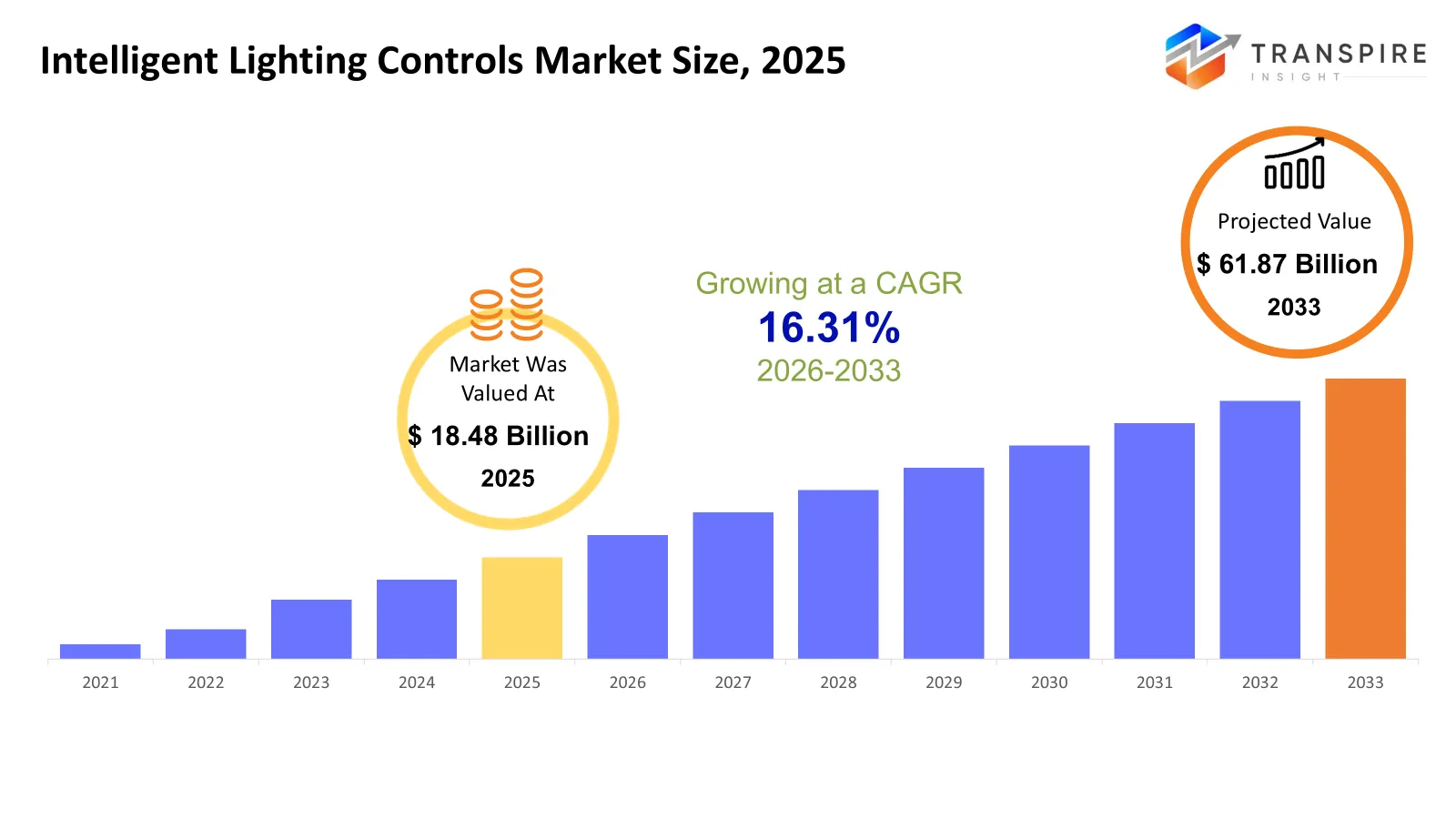
- Market Value (2025): USD 18.48 Billion.
- Expected Market Value (2026): USD 21.49 Billion.
- Estimated Market Value (2033): USD 61.87 Billion.
- Forecast CAGR (2026-2033): 16.31%.
- Leading Region in 2025: Asia Pacific
- Second-largest Region: Europe
- Fastest Growing Region: North America
Introduction
Advanced lighting management systems are employed in the Intelligent Lighting Controls Market, which consists of sensors, controllers, software, and communication networks, and automated technologies for the optimization of the amount of light illumination required based on occupancy, availability of daylight, scheduling, and user preference. These solutions are designed to optimize energy efficiencies, improve occupant comfort and simplify lighting operations in residential, commercial, industrial and public infrastructure spaces. Intelligent lighting controls are a key component of connected building ecosystems, supporting real-time monitoring, remote management, and automated decision-making to improve operational performance. The combined efforts of key components-LED drivers, sensors, dimmers and centralized control platforms-allow for reliable and adaptive lighting solutions. The increasing focus on smart buildings, sustainability efforts, digital transformation and connected infrastructure are driving the adoption of intelligent lighting control technologies across a variety of end-use sectors.
For instance:-
- North America: North America dominates the Intelligent Lighting Controls Market owing to smart building modernization, energy-efficiency regulations, utility rebate programs, commercial retrofits, and widespread adoption of connected lighting technologies.
- Asia-Pacific: The Asia-Pacific region is the fastest growing market, driven by rapid urbanization, smart city investments, expanding infrastructure projects, and government initiatives promoting energy-efficient intelligent lighting systems.
Key Market Highlights: -
- Asia Pacific is expected to grow at a rapid CAGR in the Intelligent Lighting Controls Market by holding around 25% of the share during the forecast period.
- Europe is anticipated to hold roughly 27% share of the Intelligent Lighting Controls Market over the predicted timeframe.
- North America is anticipated to hold nearly 38% share of the Intelligent Lighting Controls Market over the predicted timeframe.
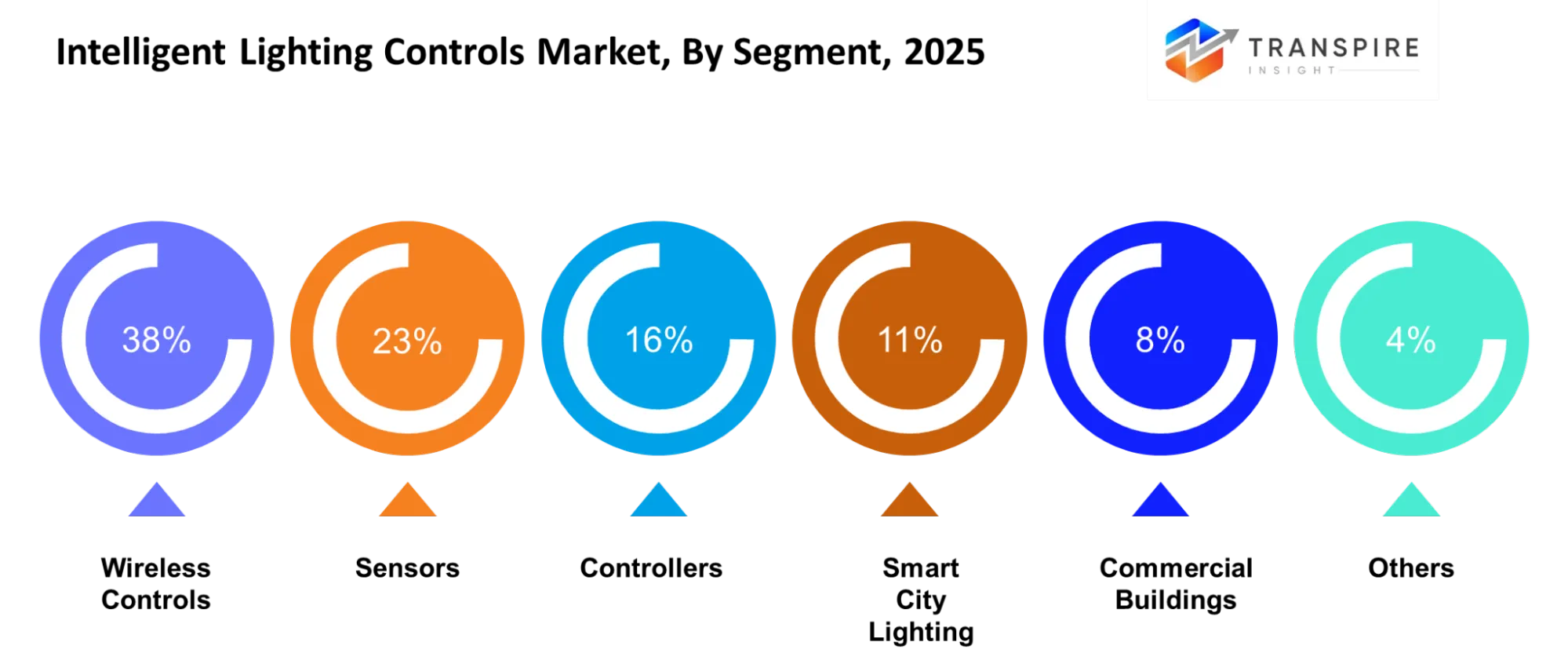
- By Product Type, the Sensors dominated the market and holds nearly 30.17% share in 2025 and is projected to grow at a substantial CAGR during the forecast period.
- By Communication Technology, the Wired segment dominated the market and holds close to 81% share in 2025 and is projected to grow at a substantial CAGR during the forecast period.
- By Application, the Commercial buildings dominated the market and holds about 35% share in 2025 and is projected to grow at a substantial CAGR during the forecast period.
- Government Initiatives: Government programs such as India’s UJALA and Street Lighting National Programme, the U.S. DOE Building Energy Codes, and Europe’s Green Deal and Energy Performance of Buildings Directive (EPBD) are promoting the adoption of intelligent lighting controls by promoting energy-efficient infrastructure, smart building modernization, and sustainable urban development.
How is Technology Driving Growth in the Intelligent Lighting Controls Market?
The Intelligent Lighting Controls Market is driven by the technological advancements with the integration of IoT, artificial intelligence (AI), edge computing, advanced sensors and wireless communication technologies. This innovation allows automated lighting control, real-time sensing, predictive maintenance and remote control in residential, commercial and industrial applications. Intelligent occupancy sensors and daylight harvesting technologies optimize energy consumption, while improving occupant comfort and operational efficiency. Wireless protocols also enable retrofit installations and enhance system scalability. The deployment of intelligent lighting controls is being accelerated by the increasing adoption of smart buildings, connected infrastructure and sustainable energy management solutions across markets.
Market Drivers
The intelligent lighting controls market is witnessing a high growth rate owing to increased investments in smart buildings, smart cities, and energy-efficient infrastructure in North America, Europe, and Asia-Pacific. North America has commercial building modernization, utility incentive programs, and advanced building energy regulations that support intelligent lighting adoption. Rapid urbanization, government-backed smart city initiatives and growing investments in connected infrastructure and IoT-enabled lighting systems are driving the Asia-Pacific. Strict energy-efficiency mandates, sustainability initiatives and green building programs continue to make Europe the leader in market growth. Growing demand for automated lighting, digital building management and carbon reduction initiatives further supports the expansion of the market and long-term investment opportunities.
For Instance: Europe: Europe is driving market growth through stringent energy-efficiency regulations, sustainability initiatives, smart building modernization, and increasing investments in connected lighting infrastructure in the commercial and public sectors.
Restrain
High installation and implementation costs are serving as a challenge to the growth of the Intelligent Lighting Controls Market. It discourages adoption among budget-conscious organizations and small enterprises. Interoperability issues between proprietary communication protocols and multi-vendor systems complicate integration and extend deployment time. In addition, cybersecurity concerns around connected lighting networks and IoT-enabled building infrastructure is a concern for end users, especially in commercial and critical facilities that require secure, reliable, and compliant automation systems.
Analysis of Prices and Consumer Behaviour
The wired lighting control systems segment holds the largest share of the intelligent lighting controls market (about 81% of the total market) due to their wide adoption in commercial buildings, industrial facilities, and institutional infrastructure that require highly reliable, secure, and scalable lighting networks. Advanced AI-enabled intelligent lighting control systems integrated with sensors, IoT connectivity, and cloud-based management platforms are expected to be 30-40% more expensive than traditional lighting control solutions due to their advanced automation capabilities, energy optimization features, cybersecurity integration, and long-term operational efficiency. Commercial buildings account for ~35% of total deployments, driven by increasing investments in smart buildings, energy-efficient retrofits and automated building management systems. Consumer purchasing behavior shows that approximately 55% of buyers focus on energy efficiency, system reliability, interoperability, and long-term operational savings. Approximately 33% of buyers prefer long-term procurement contracts, performance-based agreements, and integrated smart building solutions to minimize lifecycle costs and ensure reliable technology support across multiple facilities.
Top Companies in the Intelligent Lighting Controls Market
- Signify
- Legrand
- Schneider Electric
- Siemens
- ABB
- Acuity Brands
- Lutron Electronics
- Leviton
- Hubbell
- Eaton
- Honeywell
- Cree Lighting
- ams OSRAM
- Zumtobel Group
- Helvar
Intelligent Lighting Controls Market Segmentation
The Intelligent Lighting Controls Market share is divided into five categories: By Product Type, By Communication Technology, By Application, By End User, and By Installation Type.
The Sensors dominated the market, accounting for nearly 30.17% in 2025 and is expected to rise at a significant CAGR during the forecast period.
The Intelligent Lighting Controls Market is segmented by product type into sensors, dimmers, switches, controllers, gateways, smart relays, others. Among these, the Sensors dominated the market, accounting for nearly 30.17% in 2025 and expected to increase at a significant CAGR during the forecast period. Sensors are the dominant force in the intelligent lighting controls market due to their critical function in occupancy detection, daylight harvesting, energy optimization, automation, and overall smart building efficiency.
The Wired segment dominated the market, accounting for close to 81% in 2025, and is expected to rise at a significant CAGR during the forecast period
The Intelligent Lighting Controls Market is segmented by communication technology into wired, wireless, zigbee, bluetooth, wi-fi, dali, others. Among these, the wired segment dominated the market, accounting for close to 81% in 2025 and expected to increase at a significant CAGR during the forecast period. The wired systems segment dominates the Intelligent Lighting Controls Market due to the higher reliability, secure connectivity, stable performance, scalability and suitability for large commercial installations.
The Commercial buildings dominated the market, accounting for about 35% in 2025 and is expected to rise at a significant CAGR during the forecast period.
The Intelligent Lighting Controls Market is segmented by application into commercial buildings, residential buildings, industrial facilities, outdoor lighting, smart cities, healthcare, others. Among these, the Commercial buildings segment dominated the market, accounting for about 35% in 2025 and expected to increase at a significant CAGR during the forecast period. The Intelligent Lighting Controls Market is dominated by Commercial Buildings owing to the rising adoption of smart buildings, energy efficiency requirements, automated lighting management and sustainability initiatives.
Regional Segment Analysis of the Intelligent Lighting Controls Market
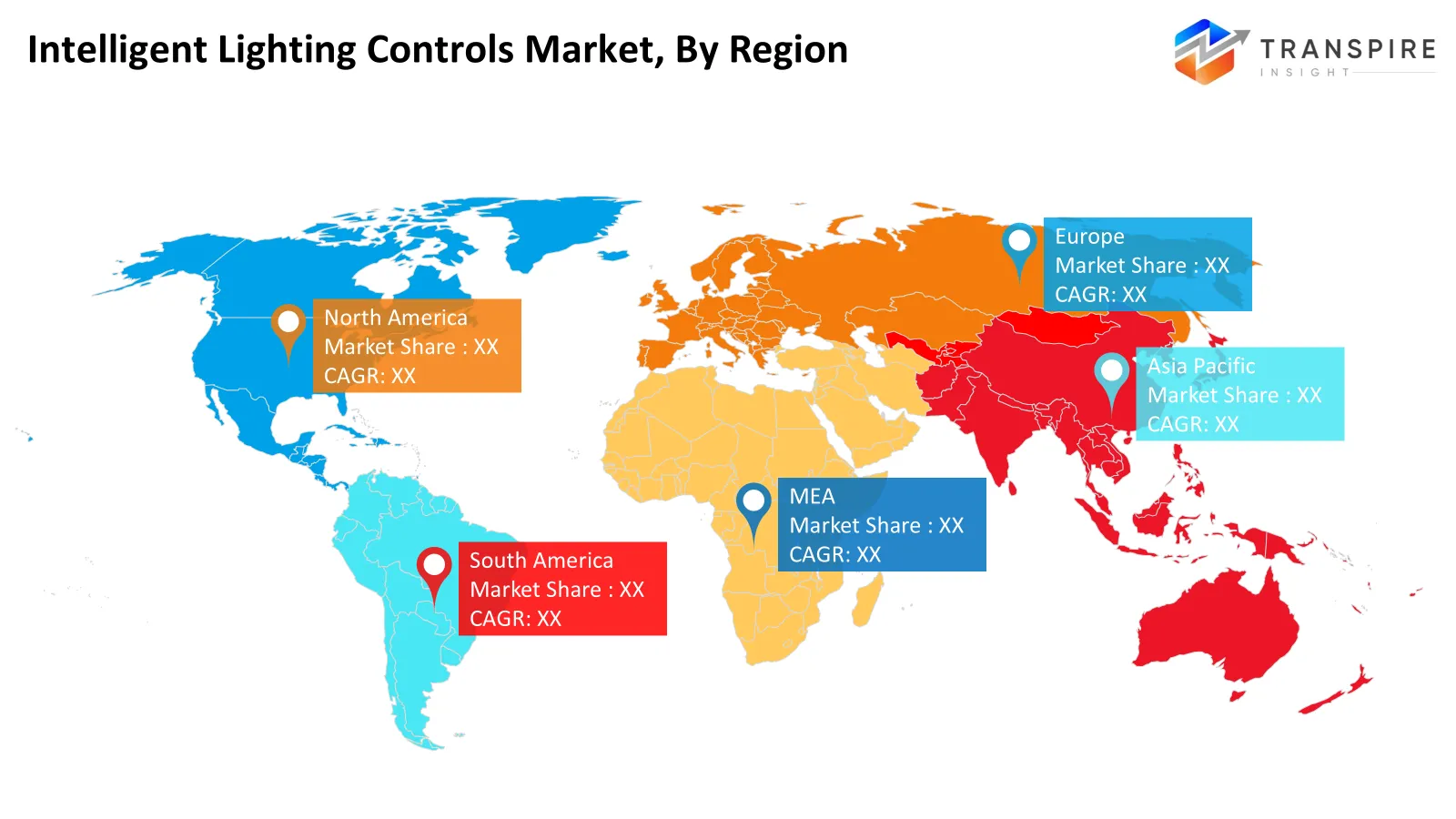
- Europe (Germany, France, U.K., Italy, Spain, Rest of Europe)
- North America (U.S., Canada, Mexico)
- Asia-Pacific (China, Japan, India, Rest of APAC)
- South America (Brazil and the Rest of South America)
- The Middle East and Africa (UAE, South Africa, Rest of MEA)
Asia Pacific is expected to grow at a rapid CAGR in the Intelligent Lighting Controls Market, holding around 25% of the share during the forecast period.
The Asia-Pacific region is anticipated to witness the fastest CAGR growth in the Intelligent Lighting Controls Market, holding approximately 25% of the market share over the forecast period. Accelerated urbanization, large-scale smart city developments, the expansion of commercial and industrial infrastructure, and the increased adoption of energy-efficient building technologies are spurring rapid growth in the region. Robust government initiatives for sustainable construction, increasing investments in IoT-enabled smart buildings, widespread deployment of LED lighting, and increasing demand for intelligent energy management systems further support the market expansion. Furthermore, the ongoing digitalization of China, India, Japan, and South East Asian economies is generating a high demand for advanced intelligent lighting control solutions, which is contributing toward the growth of the region’s market over the forecast years.
Europe is the fastest-growing region in the Intelligent Lighting Controls Market during the period, holding roughly 27% share.
Intelligent Lighting Controls Market is growing at the fastest pace in Europe. The region is expected to hold around 27% share of the market during the forecast period. Growth is fueled by stringent energy-efficiency regulations, aggressive carbon reduction targets, and investments in smart building modernization for commercial, industrial, and public infrastructure. Market growth is further augmented by government initiatives for sustainable construction, widespread adoption of IoT-enabled lighting systems and rising demand for connected building management solutions. Furthermore, the continuing expansion of smart city projects and the deployment of advanced automation technologies in Germany, the UK, France and the Netherlands are further supporting Europe’s dominant position in intelligent lighting controls.
North America is the fastest-growing region in the Intelligent Lighting Controls Market during the period, holding nearly 38% share.
North America is the largest region in the Intelligent Lighting Controls Market, accounting for nearly 38% of the market share during the forecast period. The region’s leadership is driven by widespread adoption of smart building technologies, advanced commercial infrastructure and strong investments in energy efficient lighting systems. Supportive government regulations, utility incentive programs and increasing demand for IoT enabled building automation further accelerate the market growth. Moreover, the presence of top technology providers, continuous innovation of connected lighting solutions, and large-scale modernization projects in commercial, industrial, and municipal markets strengthen North America’s leading position in the market.
Strategies for Market Growth in Non-Leading Regions:
The adoption in emerging economies would be hastened by the development of economical and scalable intelligent lighting control technologies for non-leading regions. Regional assembly and system integration, along with local production of sensors, controllers, LED drivers, wireless communication modules and lighting management software, can reduce import dependence and lower the overall deployment costs. Strategic partnership with lighting manufacturers, smart building solution providers, construction companies, utilities, and technology integrators will enhance penetration in regional markets. Technical expertise and workforce capabilities will be developed through training in IoT integration, lighting automation, system installation, cybersecurity and energy management. In addition, flexible finance models, public-private partnerships, long-term infrastructure contracts and energy performance contracts will improve affordability and encourage broader uptake. Interaction with government smart city programs, green building initiatives, energy efficiency agencies and digital distribution platforms will broaden accessibility, speed up intelligent lighting deployment and support sustainable long-term growth across developing markets.
Future Market Trends for the Intelligent Lighting Controls Market: -
- AI and Connected Lighting Artificial intelligence, edge computing and IoT-enabled intelligent lighting controls are improving predictive maintenance, real-time energy optimization, automated lighting management and overall smart building operational efficiency.
- Wireless Smart Infrastructure: The growing uptake of Bluetooth Mesh, Matter and cloud-based lighting platforms is making installations easier, providing for seamless connectivity and speeding up smart city and commercial infrastructure modernization.
- Human-Centric and Sustainable Lighting: Growing demand for human-centric lighting, integrated environmental sensors and energy-efficient building automation are propelling intelligent lighting controls that enhance occupant well-being, sustainability and regulatory compliance.
Recent Development
- AI and Adaptive Control (2026): The advent of AI-powered lighting solutions from intelligent lighting manufacturers has paved the way for automated lighting adjustments, occupancy optimization, predictive analytics, and enhanced energy management in smart buildings.
- Cybersecurity Improvements (2026): Top vendors launched lighting systems with embedded encryption technologies and edge-computing security features to protect connected smart building networks from cyber threats.
- Human-Centric Lighting Innovations (2026): Commercial lighting solutions with customizable color spectra and personalized illumination settings to improve occupant well-being, productivity, and workplace experience.
Market Segment
This study forecasts revenue at , regional and country levels from 2020 to 2033. Transpire Insights has segmented the Intelligent Lighting Controls Market based on the below-mentioned segments:
Intelligent Lighting Controls Market, By Product Type
- Sensors
- Dimmers
- Switches
- Controllers
- Gateways
- Smart Relays
- Others
Intelligent Lighting Controls Market, By Communication Technology
- Wired
- Wireless
- Zigbee
- Bluetooth
- Wi-Fi
- DALI
- Others
Intelligent Lighting Controls Market, By Application
- Commercial Buildings
- Residential Buildings
- Industrial Facilities
- Outdoor Lighting
- Smart Cities
- Healthcare
- Others
Intelligent Lighting Controls Market, By End User
- Residential
- Commercial
- Industrial
- Government
- Hospitality
- Others
Intelligent Lighting Controls Market, By Installation Type
- New Installation
- Retrofit
- Renovation
- Others
Intelligent Lighting Controls Market, By Regional Analysis
North America
- US
- Canada
- Mexico
Europe
- Germany
- UK
- France
- Italy
- Spain
- Russia
- Rest of Europe
Asia Pacific
- China
- Japan
- India
- South Korea
- Australia
- Rest of Asia Pacific
South America
- Brazil
- Argentina
- Rest of South America
Middle East & Africa
- UAE
- Saudi Arabia
- Qatar
- South Africa
- Rest of the Middle East & Africa
Frequently Asked Questions
Find quick answers to common questions.
Growing smart building adoption, IoT integration, energy-efficiency regulations, smart city investments, and increasing demand for automated lighting management drive market growth.
Sensors enable occupancy detection, daylight harvesting, automated lighting control, energy optimization, and improved operational efficiency, making them the leading product segment.
Commercial buildings require intelligent lighting for energy savings, smart building automation, sustainability compliance, occupant comfort, and efficient facility management operations.
North America leads through advanced smart infrastructure, widespread building automation, supportive energy regulations, utility incentives, and strong investments in connected lighting technologies.
AI enhances intelligent lighting through predictive maintenance, automated brightness adjustment, occupancy analytics, energy optimization, and seamless integration with smart building platforms.
- Signify
- Legrand
- Schneider Electric
- Siemens
- ABB
- Acuity Brands
- Lutron Electronics
- Leviton
- Hubbell
- Eaton
- Honeywell
- Cree Lighting
- ams OSRAM
- Zumtobel Group
- Helvar
About the Authors

Avinash Kumar
I’m Avinash Kumar, a Senior Research Analyst at Transpire Insight, with expertise in the Electronics and Semiconductor and Energy & Power industry. My work focuses on analyzing emerging technologies, market trends, industry developments, and innovation across these sectors. I specialize in transforming complex technical and market insights into clear, research-backed content that helps professionals, businesses, and decision-makers stay informed. Through continuous industry research and data-driven analysis, I strive to deliver accurate, reliable, and practical perspectives on the latest advancements shaping the semiconductor and energy landscape.

Chakradhar Khansole
Chakradhar serves as the Research Director at Transpire Insight, bringing over 8 years of experience in technology, innovation, and strategic market intelligence. He specializes in transforming complex market data into actionable business insights that enable organizations to make informed, growth-oriented decisions. Recognized for his strategic vision and analytical expertise, Chakradhar leads high-impact research initiatives, delivering comprehensive market assessments, competitive intelligence, and forward-looking industry analysis.
Recently Published Reports
-
Apr 2026
Fiber Optic Faceplates Market
Fiber Optic Faceplates Market Size, Share & Analysis Report By Type (< 300 mm2, 300-350 mm2, and > 350 mm2, By Application (Night Vision, Holographic Imaging, Medical, and Others), and Geography (North America, Europe, Asia-Pacific, Middle East and Africa, South and Central America), 2021 - 2031
-
Apr 2026
High Temperature Superconductors Market
High Temperature Superconductors Market Size, Share & Analysis Report By Type (1G HTS, and 2G HTS), By Application (Power Cable, Fault Current Limiter, and Transformer), and Geography (North America, Europe, Asia-Pacific, Middle East and Africa, South and Central America), 2021 - 2031
-
Apr 2026
Industrial Plugs and Socket Market
Industrial Plugs and Socket Market Size, Share & Analysis Report By Type (Industrial Plugs, Industrial Sockets), By Current (Up to 32 A, 32 to 125 A, Above 125 A), By Protection (Dustproof and Splash Proof, Waterproof, Explosion Proof), By End User (Heavy Industries, Oil and Gas, Chemicals and Pharmaceuticals, Power Generation, Others), and Geography (North America, Europe, Asia-Pacific, Middle East and Africa, South and Central America), 2021 - 2031
-
Apr 2026
InGaAs Avalanche Photodiodes Market
InGaAs Avalanche Photodiodes Market Size, Share & Analysis Report By Type (1100 - 1700 nm, and 1000 - 1600 nm), By Application (Missile Warning System, Muzzle Flash Detection, Wafer Defect Inspection, Laser Rangefinders, and Others), and Geography (North America, Europe, Asia-Pacific, Middle East and Africa, South and Central America), 2021 - 2031