

Asia Pacific Government & Public Sector Cybersecurity Market Size & Forecast:
- Asia Pacific Government & Public Sector Cybersecurity Market Size 2025: USD 11.46 Billion
- Asia Pacific Government & Public Sector Cybersecurity Market Size 2033: USD 25.42 Billion
- Asia Pacific Government & Public Sector Cybersecurity Market CAGR:10.47%
- Asia Pacific Government & Public Sector Cybersecurity Market Segments: By Security Type (Network Security, Endpoint Security, Cloud Security, Application Security, Identity Management, Data Security, Threat Intelligence, Others); By Deployment (Cloud, On-Premise, Hybrid, Government Cloud, Private Cloud, Multi-Cloud, Edge Security, Others); By Application (Critical Infrastructure Protection, Citizen Data Protection, Defense Security, Public Service Security, Election Security, Border Security, Smart City Security, Others); By End User (Central Government, State Government, Defense Agencies, Public Institutions, Law Enforcement, Municipal Authorities, Regulatory Bodies, Others).

Asia Pacific Government & Public Sector Cybersecurity Market Summary
The Asia Pacific Government & Public Sector Cybersecurity Market was valued at USD USD 11.46 Billion in 2025. It is forecast to reach USD 25.42 Billion by 2033. That is a CAGR of 10.47% over the period.
The Asia Pacific Government and Public Sector Cybersecurity Market is about keeping the digital infrastructure safe. This is the infrastructure that runs public services like taxation systems, citizen databases, defense networks, smart city platforms and utility control systems. The Asia Pacific Government and Public Sector Cybersecurity Market prevents problems caused by ransomware attacks, data breaches and state-sponsored cyber intrusions. These problems can stop governance operations. Expose sensitive national data.
Over the few years things have changed a lot. Now governments are moving towards cloud- infrastructure. This means they are replacing systems with new hybrid and multi-cloud environments. The Asia Pacific Government and Public Sector Cybersecurity Market is growing because of this change. It has made the attack surface bigger so governments need identity management and zero-trust architectures. There have been high-profile ransomware attacks on public institutions and geopolitical cyber conflicts. These attacks have shown that critical national systems are vulnerable. As a result governments are spending more on cybersecurity. They are moving from protecting themselves to continuously monitoring and using threat intelligence. This is driving the adoption of cybersecurity solutions across agencies.The growth of the Asia Pacific Government and Public Sector Cybersecurity Market shows that things are changing. Now cybersecurity is a part of governance frameworks. It is not an extra IT function. The Asia Pacific Government and Public Sector Cybersecurity Market is important for keeping services safe.
Key Market Insights
- The Asia Pacific Government & Public Sector Cybersecurity Market saw use of zero-trust architecture after 2023. This is because there were cyberattacks on identities.
- Many governments moved their systems to the cloud between 2022 and 2025. This move was 45% quicker than before. As a result they needed protection against threats.
- China and India led the way in 2025. They made up more than 50% of the market. This was due to their digital governance and smart city projects.
- Identity and access management became a growing area. Governments focused on keeping citizen authentication systems secure.
- Network security was still the area. Governments needed to protect defense, taxation and public administration platforms.
- Threat intelligence platforms became popular after 2024. This is because ransomware attacks on infrastructure increased a lot.
- Companies like Microsoft, Cisco, Palo Alto Networks and IBM improved their cybersecurity offerings for governments. They used AI to automate security.
- Governments in the region increased their cybersecurity budgets by over 30% after 2023. They moved from defending against attacks to monitoring systems proactively.
- Healthcare and finance applications in the sector became targets. This led to security deployments specific to these areas.
- The competitive strategy changed. Now it is about security ecosystems. These combine security endpoint protection and real-time analytics.
What are the Key Drivers, Restraints, and Opportunities in the Asia Pacific Government & Public Sector Cybersecurity Market?
Drivers
The main thing that is changing the Asia Pacific Government and Public Sector Cybersecurity Market is that public services are becoming digital fast and there are more state-sponsored and ransomware cyberattacks happening. Governments are moving things like taxation and healthcare records to the cloud and other kinds of infrastructure. This means there are ways for people to attack so agencies have to use special security systems and keep watching for threats all the time. Because of this the way governments buy cybersecurity is changing from upgrading every now and then to always paying for security, which means companies that sell security solutions can expect to make more money over time.
Restraints
One big problem is that old government computer systems are really complicated and hard to work with which makes it difficult to add cybersecurity measures. A lot of agencies are still using systems that cannot handle new security technologies, which makes it take longer and cost more to update everything. This slows down the process of making things more modern for smaller public institutions.
Opportunity
There is a chance for companies to do well in the area of sovereign cloud and localized cybersecurity ecosystems especially in Southeast Asia. Governments there are building data centers so they can control where their data is stored which means they need security platforms that are specific to their region and use artificial intelligence to analyze threats. Companies that work with governments to meet their security needs will be able to get long-term contracts and make money from them for a time. The Asia Pacific Government and Public Sector Cybersecurity Market is going to keep changing and cybersecurity is going to be a part of it.
What Has the Impact of Artificial Intelligence Been on the Asia Pacific Government & Public Sector Cybersecurity Market?
Artificial intelligence and digital technologies are changing the way public sector cybersecurity operations work in Asia Pacific. They are moving from monitoring to automated systems that can detect threats in real time. Now security operations centers use tools that are driven by intelligence to keep an eye on network traffic all the time. These tools automatically check alerts. Find anomalies in government cloud environments. This means they do not have to rely much on manual reviews of incidents and they can respond faster when there are big cyber incidents that affect citizen databases and public infrastructure systems.
People are using machine learning models more to predict threats. These models look at attack patterns to guess when someone might try to break in again and find weak points before they are attacked. Public agencies are also using analytics to make sure people are who they say they are and to stop unauthorized access to digital governance platforms. Because of this agencies that are up to date can respond to incidents 30 to 40 percent faster. They spend less money on security because they do not have to do as much by hand.
There is still a big problem. There is not good quality training data for cybersecurity that is specific to the region. This means the models are not as good at finding attack patterns that are used in that area. Many public institutions also have trouble getting intelligence tools to work with old IT systems. This slows down the process of putting these tools to use in all departments. Artificial intelligence and digital technologies are still very important for public sector cybersecurity operations in Asia Pacific.
Key Market Trends
- Zero-trust adoption really picked up after 2023. Governments stopped relying on perimeter-based defense. Started focusing on identity-centric security frameworks.
- Many government agencies moved their IT systems to the cloud between 2022 and 2025. This move increased their exposure to risks.
- There was a rise in ransomware attacks on public infrastructure after 2023. This forced agencies to focus on tools that can detect threats in time.
- As more government services went digital there was a need for authentication systems. This led to an expansion of identity and access management solutions.
- Companies like Microsoft, Cisco and Palo Alto Networks got cybersecurity contracts from governments. They provided security automation platforms driven by AI.
- After 2024 national data protection regulations became stricter. This led to a demand for sovereign cloud and localized security infrastructure.
- Security operations centers started using AI-based automation. This reduced the workload of responding to incidents on large government networks.
- Southeast Asia invested more in cybersecurity. This was due to the expansion of cities and digital governance initiatives.
- As government workers started working there was a significant increase in demand, for endpoint security.
- Government agencies shifted from reacting to cyber threats to predicting them. They used predictive threat intelligence frameworks to detect breaches.
Asia Pacific Government & Public Sector Cybersecurity Market Segmentation
By Security Type
We have kinds of security like Network Security, Endpoint Security, Cloud Security, Application Security, Identity Management, Data Security, Threat Intelligence and others that work together to protect our public sector digital systems. Network Security is very important for keeping our government communication systems and important data safe. Cloud Security and Identity Management are getting more popular because many citizen services are moving to platforms. Threat Intelligence solutions are being used more and more to find and stop cyberattacks on public databases and defense networks.
By Deployment
There are ways to set up our cybersecurity systems like Cloud, On-Premise, Hybrid, Government Cloud, Private Cloud, Multi-Cloud, Edge Security and others. Government Cloud is being used more because agencies want to store their data in a central place. Hybrid and Multi-Cloud models are popular because they give us flexibility and help us follow the rules. Edge Security is becoming more important as our cities get smarter. Our public systems get more spread out.
By Application
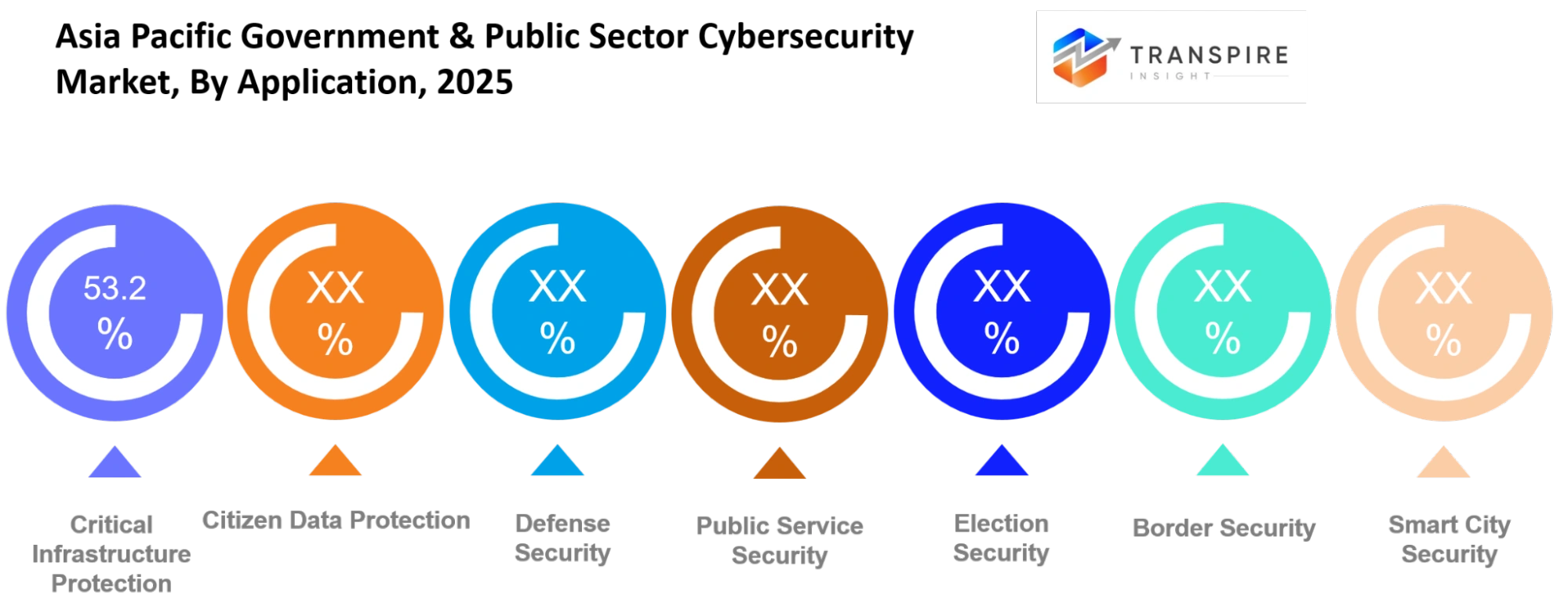
We need cybersecurity for things like Critical Infrastructure Protection, Citizen Data Protection, Defense Security, Public Service Security, Election Security, Border Security, Smart City Security and others to keep our government operations safe. Critical Infrastructure Protection is important because our energy, transport and communication systems are being threatened more and more. Smart City Security is growing because our cities are getting more digital. Election Security and Border Security are getting attention because of the risks and concerns about digital interference.
By End User
The people who buy cybersecurity systems are the Central Government, State Government, Defense Agencies, Public Institutions, Law Enforcement, Municipal Authorities, Regulatory Bodies and others. Central Government agencies are leading the way because they are doing digital transformation projects. Defense Agencies need systems to find and stop threats in real time. Municipal Authorities and Public Institutions are spending more on cybersecurity to keep their services and local networks safe, for citizens.
What are the Key Use Cases Driving the Asia Pacific Government & Public Sector Cybersecurity Market?
The protection of infrastructure is the main reason why governments in the Asia Pacific region are adopting cybersecurity measures. This is because things like energy grids, transportation systems and communication networks need to be watched all the time. If something goes wrong with these systems it can affect the country and put people in danger. There have been more cyber attacks on these systems so governments want to be able to find threats right away and respond automatically.This is especially important, for defense agencies.Government energy grids need to be protectedTransport systems need to be secureCommunication networks must be safe
Protecting citizen data and defense security is also becoming more important for public institutions and law enforcement. A lot of information is being stored online like identity systems, tax records and healthcare databases. This means there is a risk of data breaches so agencies need to have strong identity management and endpoint protection. Defense agencies also want to have the best threat intelligence to keep their communication networks secure.Some new areas where cybersecurity is being used are city security and election security. As cities become digital and voting systems are used online these areas are becoming more important. Municipal authorities are using surveillance and traffic systems, which need to be monitored for cyber threats all the time. Election systems are also using authentication and integrity verification tools to prevent digital interference and make sure the systems are reliable.
|
Report Metrics |
Details |
|
Market size value in 2025 |
USD 11.46 Billion |
|
Market size value in 2026 |
USD 12.66 Billion |
|
Revenue forecast in 2033 |
USD 25.42 Billion |
|
Growth rate |
CAGR of 10.47% from 2026 to 2033 |
|
Base year |
2025 |
|
Historical data |
2021 - 2024 |
|
Forecast period |
2026 - 2033 |
|
Report coverage |
Revenue forecast, competitive landscape, growth factors, and trends |
|
Regional scope |
Asia Pacific (India, China, Japan, Australia, South Korea, Rest of Asia Pacific) |
|
Key company profiled |
Palo Alto Networks, Fortinet, Cisco, CrowdStrike, Check Point, Microsoft, IBM, Trend Micro, Sophos, Broadcom, SentinelOne, Zscaler, FireEye, Splunk, Tenable. |
|
Customization scope |
Free report customization (country, regional & segment scope). Avail customized purchase options to meet your exact research needs. |
|
Report Segmentation |
By Security Type (Network Security, Endpoint Security, Cloud Security, Application Security, Identity Management, Data Security, Threat Intelligence, Others); By Deployment (Cloud, On-Premise, Hybrid, Government Cloud, Private Cloud, Multi-Cloud, Edge Security, Others); By Application (Critical Infrastructure Protection, Citizen Data Protection, Defense Security, Public Service Security, Election Security, Border Security, Smart City Security, Others); By End User (Central Government, State Government, Defense Agencies, Public Institutions, Law Enforcement, Municipal Authorities, Regulatory Bodies, Others). |
Which Regions are Driving the Asia Pacific Government & Public Sector Cybersecurity Market Growth?
North America leads the Asia Pacific Government & Public Sector Cybersecurity Market due to its advanced digital governance frameworks, strong cybersecurity mandates, and early adoption of zero-trust architecture across federal and defense systems. Extensive integration of cloud-based public services and well-funded national cybersecurity programs support continuous deployment of advanced security platforms. Mature vendor ecosystems and strict regulatory enforcement further strengthen demand for real-time threat intelligence and AI-driven defense systems across government networks.
Western Europe represents the second key region, supported by strong data privacy regulations and consistent investment in secure digital public services. Unlike North America, growth here is driven more by compliance-led modernization rather than aggressive technological expansion. Governments prioritize data protection laws and standardized cybersecurity frameworks across public institutions. Stable economic conditions and long-term digital governance strategies ensure steady adoption of identity management, cloud security, and endpoint protection solutions across central and regional agencies.
Southeast Asia is emerging as the fastest-growing region due to rapid digital transformation initiatives and increasing cyber threat exposure across developing economies. Recent investments in smart city infrastructure, digital identity programs, and national cloud platforms have significantly expanded the attack surface. Governments are strengthening cybersecurity policies to support cross-border data protection and infrastructure resilience. This momentum creates strong entry opportunities for cybersecurity vendors through 2026–2033, especially those offering scalable, cloud-native, and cost-efficient security solutions.
Who are the Key Players in the Asia Pacific Government & Public Sector Cybersecurity Market and How Do They Compete?
The Asia Pacific Government & Public Sector Cybersecurity Market shows a moderately consolidated competitive structure, where a few global technology providers hold significant contracts while regional specialists compete for localized government deployments. Competition is primarily driven by technology depth, especially in zero-trust architecture, AI-driven threat detection, and cloud security integration. Incumbents are actively defending share by expanding integrated security platforms, while new entrants are disrupting segments such as identity management and cloud-native security with flexible, cost-efficient solutions tailored for smaller government agencies.
Microsoft strengthens its position through tightly integrated cloud security solutions built into government cloud ecosystems, enabling seamless identity protection and compliance across public services. Its advantage comes from combining productivity platforms with native security tools, which reduces integration complexity for large-scale government deployments. Cisco focuses on network-centric cybersecurity, leveraging its dominance in government communication infrastructure to deliver secure connectivity and advanced threat detection capabilities across defense and public networks.
Palo Alto Networks builds its competitive edge through AI-driven security automation platforms that enable real-time threat prevention across hybrid environments. It expands through strategic partnerships with national cybersecurity agencies and cloud providers to enhance sovereign cloud security capabilities. Fortinet differentiates through high-performance, cost-efficient firewall and endpoint solutions, making it a preferred choice for large-scale government deployments requiring scalability and operational efficiency across distributed networks.
Company List
- Palo Alto Networks
- Microsoft
- IBM
- Trend Micro
- Sophos
- Broadcom
- SentinelOne
- Zscaler
- FireEye
- Splunk
- Tenable
Recent Development News
In June 2026, SoftBank announced a cybersecurity product launch in partnership with OpenAI to strengthen protection for critical digital infrastructure in Japan. The initiative focuses on AI-assisted security automation for government-linked systems and reflects rising demand for national-scale cyber defense platforms.
Source: https://www.reuters.com
In December 2025, Accenture announced the acquisition of CyberCX to expand its cybersecurity capabilities across Australia and New Zealand’s public sector. The deal strengthens its government-focused security services, including threat intelligence and cloud protection for regulated environments.
Source: https://www.reuters.com
In May 2025, ST Engineering expanded its cybersecurity operations by deploying AI-enabled command and control and critical infrastructure protection solutions for public sector clients in Asia Pacific. The move enhances national defense cybersecurity resilience and supports government digital transformation programs.
Source: https://en.wikipedia.org
What Strategic Insights Define the Future of the Asia Pacific Government & Public Sector Cybersecurity Market?
The Asia Pacific Government & Public Sector Cybersecurity Market is moving toward highly integrated, AI-driven, sovereign security architectures as governments prioritize digital independence and real-time threat response across critical infrastructure and citizen services. Expansion of cloud-first public platforms and national data localization policies will push demand for unified security stacks that combine identity, network, and endpoint protection under centralized control systems.
A key hidden risk is increasing vendor concentration within a small group of global cybersecurity providers, which may create dependency risks for government systems and reduce flexibility in procurement strategies. This concentration also raises systemic vulnerability if large-scale platform failures or breaches occur across shared infrastructure layers.
An emerging opportunity lies in sovereign cloud cybersecurity ecosystems tailored for mid-tier economies in Southeast Asia and South Asia, where rapid digital governance expansion is underway but security maturity remains uneven. Vendors that localize compliance-ready, scalable platforms aligned with national data laws will gain early advantage. Market participants should invest in modular, AI-enabled security platforms that integrate easily with government cloud infrastructure while maintaining adaptability across evolving regulatory frameworks.
Asia Pacific Government & Public Sector Cybersecurity Market Report Segmentation
By Security Type
- Network Security
- Endpoint Security
- Cloud Security
- Application Security
- Identity and Access Management
- Data Security
- Threat Intelligence
- Zero Trust Security
- Others
By Deployment Model
- Cloud-Based
- On-Premise
- Hybrid
- Government Cloud
- Private Cloud
- Multi-Cloud Security
- Edge Security
- Others
By Solution Type
- Security Information and Event Management (SIEM)
- Identity and Access Management (IAM)
- Endpoint Detection and Response (EDR)
- Firewall & Network Security
- Encryption Solutions
- Risk & Compliance Management
- Others
By Application
- Critical Infrastructure Protection
- Citizen Data Protection
- Defense & Intelligence Security
- Smart City Security
- Public Service Security
- Election Security
- Border Security
- Others
By End User
- Central Government
- State and Local Government
- Defense Agencies
- Law Enforcement Agencies
- Public Institutions
- Municipal Authorities
- Regulatory Bodies
Frequently Asked Questions
Find quick answers to common questions.
The expected Asia Pacific Government & Public Sector Cybersecurity Market size for the market will be USD 25.42 Billion in 2033.
Key segments for the Asia Pacific Government & Public Sector Cybersecurity Market are By Security Type (Network Security, Endpoint Security, Cloud Security, Application Security, Identity Management, Data Security, Threat Intelligence, Others); By Deployment (Cloud, On-Premise, Hybrid, Government Cloud, Private Cloud, Multi-Cloud, Edge Security, Others); By Application (Critical Infrastructure Protection, Citizen Data Protection, Defense Security, Public Service Security, Election Security, Border Security, Smart City Security, Others); By End User (Central Government, State Government, Defense Agencies, Public Institutions, Law Enforcement, Municipal Authorities, Regulatory Bodies, Others).
Major Asia Pacific Government & Public Sector Cybersecurity Market players are Palo Alto Networks, Fortinet, Cisco, CrowdStrike, Check Point, Microsoft, IBM, Trend Micro, Sophos, Broadcom, SentinelOne, Zscaler, FireEye, Splunk, Tenable.
The Asia Pacific Government & Public Sector Cybersecurity Market size is USD 11.46 Billion in 2025.
The Asia Pacific Government & Public Sector Cybersecurity Market CAGR is 10.47% from 2026 to 2033.
- Palo Alto Networks
- Fortinet
- Cisco
- CrowdStrike
- Check Point
- Microsoft
- IBM
- Trend Micro
- Sophos
- Broadcom
- SentinelOne
- Zscaler
- FireEye
- Splunk
- Tenable
About the Authors

Mayur Shinde
I am Mayur Shinde, a Senior Research Analyst at Transpire Insight, specializing in the Automotive & Transportation and Information & Communication Technology (ICT) Industry. My work focuses on analyzing emerging market trends, technological advancements, competitive landscapes, and industry developments to deliver accurate, data-driven insights. I am passionate about transforming complex market information into clear, actionable content that helps businesses, professionals, and decision-makers stay informed and make confident strategic decisions.

Chakradhar Khansole
Chakradhar serves as the Research Director at Transpire Insight, bringing over 8 years of experience in technology, innovation, and strategic market intelligence. He specializes in transforming complex market data into actionable business insights that enable organizations to make informed, growth-oriented decisions. Recognized for his strategic vision and analytical expertise, Chakradhar leads high-impact research initiatives, delivering comprehensive market assessments, competitive intelligence, and forward-looking industry analysis.
Recently Published Reports
-
Apr 2026
3D Optical Profiler Market
3D Optical Profiler Market Size, Share & Analysis Report By Type (Desktop 3D Optical Profiler, and Portable 3D Optical Profiler), By Technology (Confocal Technology, and White Light Interference), By End-Use Industry (Manufacturing, Research Institutions, Automotive, Aerospace and Defense, Medical Devices, and Other), and Geography (North America, Europe, Asia-Pacific, Middle East and Africa, South and Central America), 2021 - 2031
-
Apr 2026
Depth Sensor Market
Depth Sensor Market Size, Share & Analysis Report By Type (Infrared Depth Sensors, Time-of-Flight (ToF) Sensors, Stereo Vision Sensors, Structured Light Sensors, Ultrasonic Depth Sensors), By Application (Automotive, Robotics, Gaming, Consumer Electronics, Industrial Automation, Healthcare, Security & Surveillance, Others), By End Users (Automotive Manufacturers, Consumer Electronics Companies, Healthcare Providers, Industrial Companies, Security Agencies, Gaming Companies, Robotics Companies, Others), and Geography (North America, Europe, Asia-Pacific, Middle East and Africa, South and Central America), 2021 – 2031
-
Apr 2026
Digital Manufacturing Market
Digital Manufacturing Market Size, Share & Analysis Report By Component (Hardware, Software, and Services), By Technology (Robotics, 3D Printing, Internet of Things (IoT), and Others), By Application (Automotive and Transportation, Aerospace and Defense, Consumer Electronics, Industrial Machinery, and Others), By Process Type (Computer-Based Designing, Computer-Based Simulation, Computer 3D Visualization, Analytics, and Others), and Geography (North America, Europe, Asia-Pacific, Middle East and Africa, South and Central America), 2021 – 2031
-
Apr 2026
Digital Visa Services Market
Digital Visa Services Market Size, Share & Analysis Report By Type (Individual Travelers, Group Travelers), By Application (Tourism, Business Travel, Others), and Geography (North America, Europe, Asia-Pacific, Middle East and Africa, South and Central America), 2021 – 2031