
Hydraulische Stromversorgungseinheiten Market Summary:
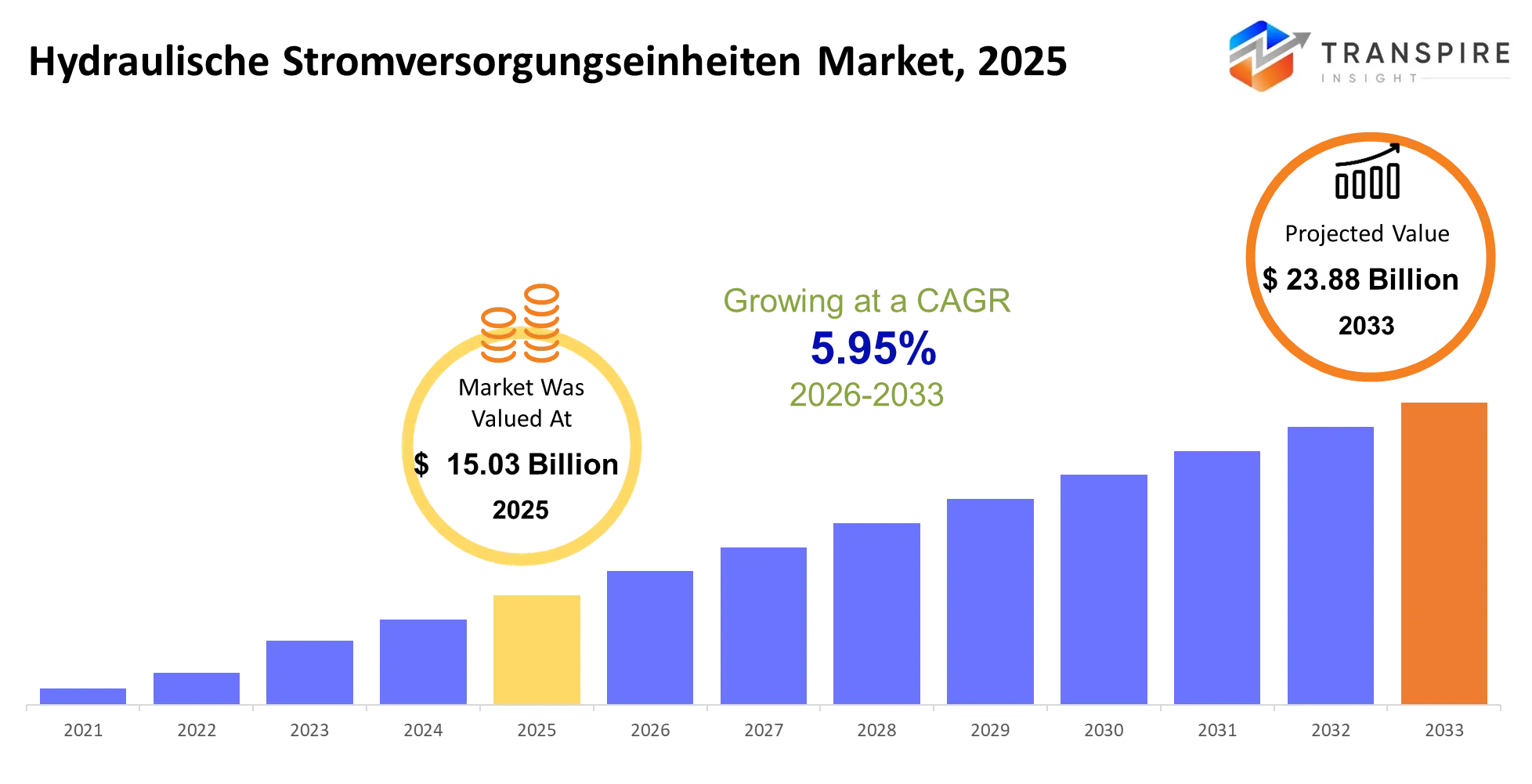
As per the Transpire Insight Analysis, The Hydraulische Stromversorgungseinheiten Market size is estimated at USD 15.03 billion in 2025 and is anticipated to reach USD 23.88 billion by 2033, growing at a CAGR of 5.95% from 2026 to 2033.
The worldwide Hydraulische Stromversorgungseinheiten market delivers small, complete hydromechanical energy systems that turn electrical or engine power into managed pressure and flow for cylinders, actuators, steering, lifting and auxiliary functions. In the last three to five years, the market for standalone pump-and-motor packs has progressively moved to electro-hydraulic devices with integrated sensors, electronic control units, variable-speed drives and vehicle-to-vehicle communications. A key structural trend in these markets is heading towards accelerated adoption of electrified and hybrid machinery, which requires hydromechanical energy packs to provide the correct output without putting additional load on the battery system. Zero-emission equipment plans and tougher machinery-efficiency regulations have helped accelerate this transition. Signs of this are seen in electric cranes, municipal and off-highway applications, where integrated motor-pump units minimise noise, space and power energy losses. Original Equipment Manufacturers' new electrified machines present opportunities to contribute to the re-architectures of complete hydro-mechanical energy systems rather than just replace traditional engines.
Hydraulische Stromversorgungseinheiten Market Size & Forecast:
- Market Size 2025: USD 15.03 Billion
- Expected Market Value (2033): USD 23.88 Billion
- Forecast CAGR (2026–2033): 5.95%
- Leading Region in 2025: Asia-Pacific
- Fastest Growing Region: North America
- Key Company Profiles: Bosch Rexroth, Parker Hannifin, Eaton, Danfoss, HYDAC, Kawasaki Heavy Industries, Bucher Hydraulics, HAWE Hydraulik, Linde Hydraulics, Sun Hydraulics, Yuken, Nachi-Fujikoshi, Atos, Moog, Hydac International.
Key Hydraulische Stromversorgungseinheiten Market Insights:
Hydraulic power units are being shifted from traditional power generation machines to software-controlled, energy-managed subsystems. The key to competitive advantage is no longer just pressure output, but also reduced lifecycle energy consumption, compact integration, and predictive service capability.
- The Asia-Pacific region accounts for 40.2%, and Bosch Rexroth's compact units are ideal for dense factory automation and quicker OEM integration, thereby supporting Industry 4.0.
- 25.0% is allocated to Europe, while HYDAC continues to provide efficient solutions for filtration and fluid management, as buyers look for systems that comply with regulations and have minimal leakage.
- North America accounts for 22.0% of the market; Parker brings together hydraulics, filtration, and digital control to help operators minimize downtime in mobile and material-handling fleets.
- The market in Latin America represents 7.0% of the total, and the modular diesel-hydraulic packs are still relevant, as mining and agricultural users prefer equipment that can be repaired in the field.
- In the Middle East and Africa, 5.8% of assets are in areas with more severe fluid-contamination challenges, which are met by Eaton's upgraded pressure-filtration solutions.
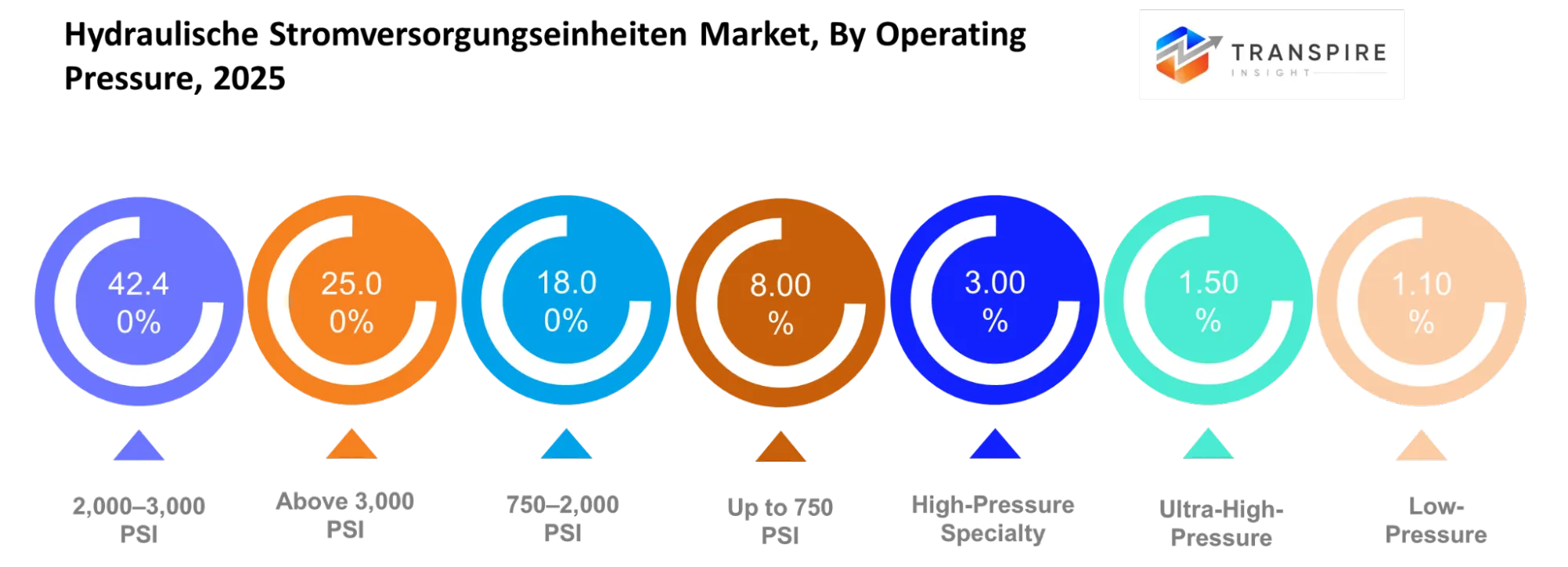
- The 42.4% lead in the 2,000–3,000 PSI range goes to Bosch Rexroth's Sytronix, which allows for variable-speed operation, pushing buyers in the direction of energy-by-demand.
- Above-3,000 PSI systems account for 25.0%-Kawasaki and Linde are focusing on severe-duty machinery where compact force density is more important than upfront cost.
- Bucher's small units fit quieter automated cells and mobile auxiliary functions; the 750–2,000 PSI segment accounts for 18.0%.
- 8.0% up-to-750 PSI systems, expanding battery-electric equipment, are driving low-noise, electronically controlled auxiliary hydraulics.
What are the Key Drivers, Restraints, and Opportunities in the Hydraulische Stromversorgungseinheiten Market?
Driver:
Manufacturing automation, infrastructure renewal, and mobile-equipment modernisation are increasing the need for compact systems that provide high force in limited space. The trigger is not merely higher equipment demand; it is the need to automate pressing, clamping, lifting, forming, and material movement without expanding plant footprints. The 2,000–3,000 PSI range, estimated at 42.4% of the market in the supplied data, benefits because it offers a practical balance of force, control, and component durability for industrial machinery and construction equipment. This raises revenue per installation as OEMs purchase integrated packages containing pumps, manifolds, controls, sensors, cooling, and commissioning support. Industrial automation is already the largest HPU application in the U.S., with a 56.3% revenue share.
Restraint:
Hydraulic power units remain difficult to standardise because pressure, duty cycle, temperature, footprint and control requirements vary by machine. Electrified architectures add battery, inverter, motor-control and software interfaces, increasing engineering and validation work. Bosch Rexroth notes that OEM software development, integration and maintenance become more demanding as electrified models multiply, illustrating the structural cost of customization.
Opportunity:
Connected electro-hydraulic units create a recurring aftermarket opportunity by shifting supplier relationships from one-time equipment sales to ongoing monitoring, maintenance, and performance support. Variable-speed electric drives reduce unnecessary power consumption, while onboard pressure, temperature, vibration, and fluid-condition sensors provide early warnings of pump, filter, or seal deterioration. Remote diagnostics and predictive analytics help factories, ports, mines, and fleet operators schedule maintenance before failures disrupt operations. Mobile applications, projected to grow at 6.2%, provide a particularly attractive route for rugged battery-electric and hybrid hydraulic power units used in construction, agriculture, lifting, and material-handling equipment.
What Has the Impact of Artificial Intelligence Been on the Hydraulische Stromversorgungseinheiten Market?
Artificial intelligence is switching the control of hydraulic power units from a reactive maintenance model to the condition-based model, according to the organisers of the event. Sensors are used to monitor pressure, temperature, vibration, oil level and flow characteristics, while machine-learning models are used to identify abnormal trends before equipment experiences downtime. In connected hydraulic power-unit monitoring, pressure and tank level deviations can be monitored over time to enable earlier maintenance.
Artificial intelligence can also be used to optimise pump speed and hydraulic output to match the actual load, reducing unnecessary energy consumption for equipment with varying duty cycles. For mobile equipment, AI-assisted control can coordinate between hydraulic functions, electric drives, battery status and conditions to produce a smoother work cycle and longer operation time. The broader AI, automation, electrification and hydraulics integration effort exemplified by HAWE's 2026 mobile-machinery program presents an integration issue, however. AI models require reliable sensor data, machine operating histories and control architectures, and older equipment may not have these data interfaces. Highly customised hydraulic systems require more tailored models and more costly retrofits.
In April 2026, HAWE Hydraulik announced its strategic partnership with Hydra-Power Systems Inc. to serve as its new authorised distributor across the Southeastern region of the United States.https://www.hawe.com/en-us/company/news/press/detail/hawe-hydraulik-usa-announcing-new-partnership-with-hydra-power-systems-inc/
Key Hydraulische Stromversorgungseinheiten Market Trends:
Hydraulic power units are moving from a "power pack" to a "power system" that is connected to specific applications to minimize heat, noise, and unnecessary downtime.
The greatest trend is the move to electric, modular and digitally monitored designs that maintain hydraulic force density whilst delivering lifecycle cost protection.
- Buyers of electric HPUs preferred these machines over gas-fired models because of reduced noise, local emissions and energy control.
- Constant speed is becoming a thing of the past, as variable speed drives are used to reduce throttling losses and heat caused by varying duty cycles.
- Modular manifolds, reservoirs, and pump packages reduced engineering cycles and offered flexibility in configuration for OEMs.
- As installation space requirements became challenging for mobile and robotic cells and retrofits, compact and micro HPUs grew in size. Compact and micro HPUs grew as installation space requirements became tight for mobile and robotic cells and retrofits.
- Smart sensors shifted maintenance from a calendar to a pressure, temperature, and fluid-condition basis.
- Mobile equipment adoption is picking up, with the estimate provided indicating a growth rate of 6.2% for portable, high-power-density equipment.
- Stronger seals, cooling, and safety architecture are commonly applied in high-pressure conditions, such as in mining, aerospace, and heavy construction.
- Biodegradable fluids and leak-proof designs became more important at marine, forestry, and environmentally sensitive sites with more demanding operating requirements.
- Digital controls and PLC connectivity made HPU selection more about system-level productivity than pump capacity.
- Investment in safer, cyber-aware control architectures is speeding up in Europe ahead of the Machinery Regulation's application date of 2027.
Hydraulische Stromversorgungseinheiten Market Segmentation
Operating Pressure:
2,000–3,000 PSI dominates at 42.40%, supported by lifting, clamping and mobile machinery requiring balanced force, efficiency and reliable control. Above 3,000 PSI holds 25.00% for demanding construction, mining and industrial cycles, while 750–2,000 PSI accounts for 18.00%. Up to 750 PSI represents 8.00%, serving lighter-duty equipment and controlled applications. High-Pressure Speciality contributes 3.00%, followed by Ultra-High-Pressure at 1.50%, Low-Pressure at 1.10%, and Others at 1.00%. These segments create specialised opportunities for precision, compact integration, extreme-duty performance, and application-specific hydraulic power solutions across diverse machinery environments and operating conditions while supporting varied equipment designs and pressure requirements ly.
Power Source:
Electric units are gaining strategic importance as manufacturers electrify mobile and industrial equipment, enabling variable-speed operation and reducing energy losses. Diesel and Gasoline remain relevant for heavy-duty machinery requiring long operating cycles and rapid refuelling. Hybrid and Battery-Electric systems are expanding as OEMs separate hydraulic peak-load requirements from primary propulsion. Hydraulic Drive supports specialised high-load applications, while Pneumatic-Assisted systems remain relevant where compressed-air infrastructure complements hydraulic actuation and improves operational flexibility across demanding equipment environments.
Application:
Industrial systems retain a strong installed base across manufacturing and material handling, while Mobile Applications are projected to grow at a 6.2% CAGR as construction, mining and agriculture adopt electro-hydraulic controls. Construction equipment requires compact units capable of repeated lifting cycles, whereas Mining emphasises durability and contamination resistance. Agriculture increasingly integrates electronic controls and variable-speed hydraulics. Marine and Oil & Gas favour ruggedised systems, while Aerospace prioritises compactness, precision, reliability and strict performance requirements.
Product Type:
Standard Packaged units support faster deployment where established specifications reduce engineering time, while Customised and Modular systems capture complex OEM requirements. Compact/Micro and Integrated units are gaining importance as machinery designs prioritise reduced footprint, shorter hydraulic lines and easier installation. Portable units support field operations and temporary equipment, while Skid-Mounted configurations remain suitable for industrial and remote installations. Future product development will increasingly emphasize modular architectures, sensor integration, simplified maintenance and flexible configurations across multiple equipment platforms.
End User:
Manufacturing, Construction, and Mining generate recurring demand because their equipment performs intensive lifting, pressing, drilling, and material-handling cycles. Agriculture is moving toward electronically controlled machinery that coordinates hydraulic functions with automated guidance and power management. Automotive applications increasingly require precise hydraulic actuation within production equipment, while Energy projects prioritize reliability and remote monitoring. Material Handling favours compact, responsive systems for automated equipment. Aerospace & Defense requires specialized power units where weight, reliability, precision, environmental resistance, and safety remain critical purchasing criteria.
What are the Key Use Cases Driving the Hydraulische Stromversorgungseinheiten Market?
The main use is for lift, clamp, steering, and handling, which fits the dominant pressure range of 2,000- 3,000 PSI. Integrated pumps, motors, reservoirs, and controls enable proven industrial duty cycles and easier maintenance.
A secondary use is mobile equipment, where construction, mining, agriculture, and municipal equipment combine hydraulics with electric or hybrid drive systems; compact electro-hydraulic modules match output to the workload, which cuts energy losses and makes batteries work better. Mobile applications will grow at a 6.2% CAGR.
The second driver is connected, decentralised hydraulics; mini power packs near the actuator shorten hydraulic lines, sensors enable condition monitoring, predictive maintenance, remote diagnostics, and Quiet operation of electric cranes and autonomous off-highway machines.
|
Report Metrics |
Details |
|
Market size value in 2025 |
USD 15.03 Billion |
|
Market size value in 2026 |
USD 15.93 Billion |
|
Revenue forecast in 2033 |
USD 23.88 Billion |
|
Growth rate |
CAGR of 5.95% from 2026 to 2033 |
|
Base year |
2025 |
|
Historical data |
2021 - 2024 |
|
Forecast period |
2026 - 2033 |
|
Report coverage |
Revenue forecast, competitive landscape, growth factors, and trends |
|
Regional scope |
United States; Canada; Mexico; United Kingdom; Germany; France; Italy; Spain; Denmark; Sweden; Norway; China; Japan; India; Australia; South Korea; Thailand; Brazil; Argentina; South Africa; Saudi Arabia; United Arab Emirates |
|
Key companies profiled |
Bosch Rexroth, Parker Hannifin, Eaton, Danfoss, HYDAC, Kawasaki Heavy Industries, Bucher Hydraulics, HAWE Hydraulik, Linde Hydraulics, Sun Hydraulics, Yuken, Nachi-Fujikoshi, Atos, Moog, Hydac International |
|
Customization scope |
Free report customisation (country, regional & segment scope). Available customised purchase options to meet your exact research needs. |
|
Report Segmentation |
Operating Pressure (Up to 750 PSI, 750–2,000 PSI, 2,000–3,000 PSI, Above 3,000 PSI, High-Pressure, Ultra-High-Pressure, Low-Pressure, Specialty); Power Source (Electric, Diesel, Gasoline, Hybrid, Battery-Electric, Hydraulic Drive, Pneumatic-Assisted, Others); Application (Industrial, Mobile, Construction, Mining, Agriculture, Marine, Oil & Gas, Aerospace); Product Type (Standard Packaged, Customized, Compact/Micro, Modular, Portable, Integrated, Skid-Mounted, Others); End User (Manufacturing, Construction, Mining, Agriculture, Automotive, Energy, Material Handling, Aerospace & Defense). |
Which Regions are Driving the Hydraulische Stromversorgungseinheiten Market Growth?
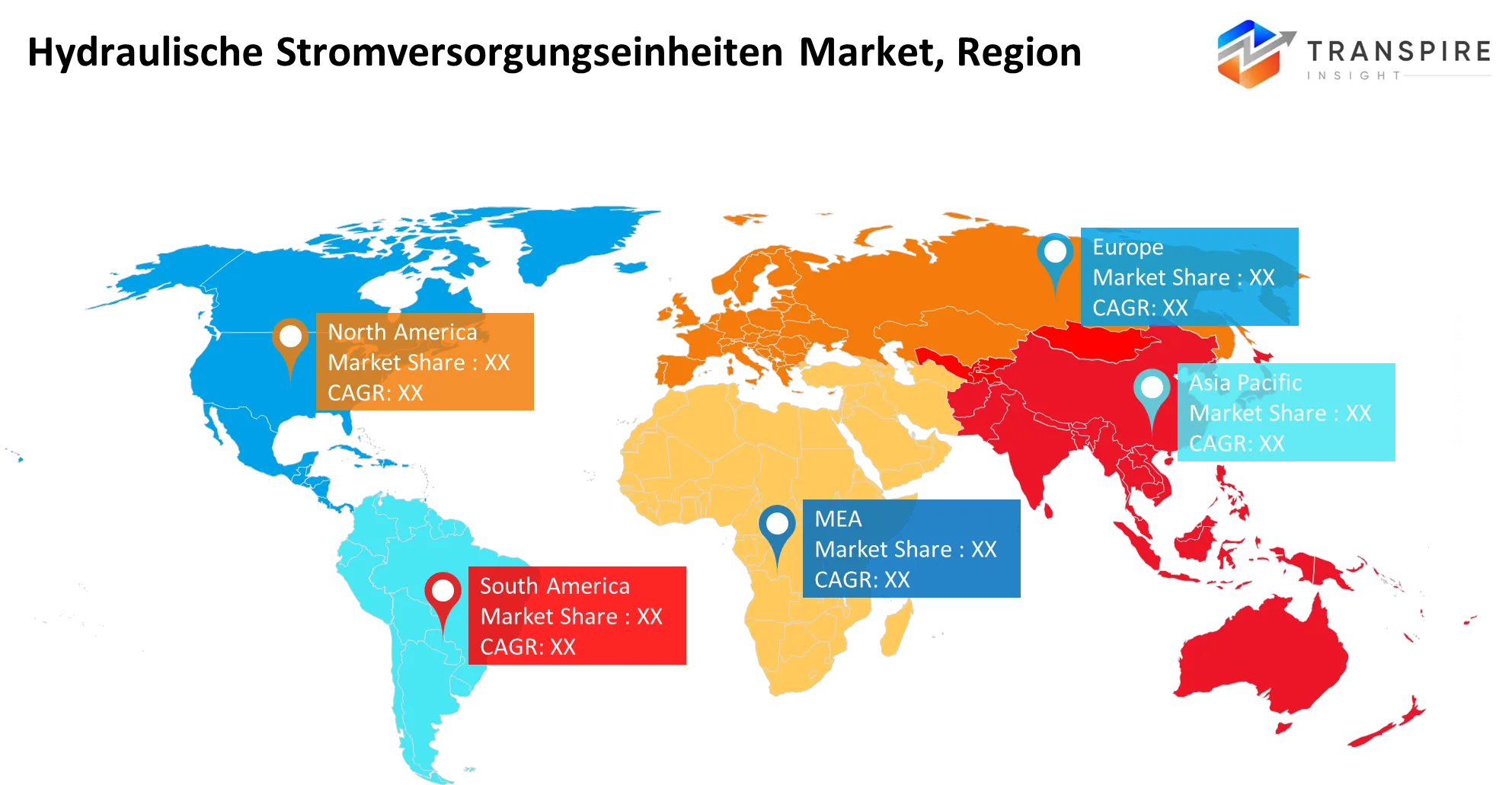
Asia-Pacific occupies a 40.2% share of the market for hydraulic power units and will be driven by the industrial growth in China, India, Japan, South Korea and Southeast Asia. Factors supporting Asia-Pacific's dominant position include the expansion of domestic production, output of machinery for construction, ports, and investments in factory automation. Clusters of regional OEMs have contributed to reducing the time-to-market for pumps, valves, motors and engineered power packs. Investments into urban infrastructure and rising machinery exports have generated consistent demand for both bespoke and pre-engineered unit configurations.
In February 2026, Kawasaki Heavy Industries announced that its Indian subsidiary WiproKPM had reached 200,000 cumulative shipments of hydraulic pumps and hydraulic motors to Indian domestic customers. The milestone strengthens India’s localised hydraulic manufacturing ecosystem and reflects the region’s expanding equipment supply base. Source: Kawasaki Heavy Industries.https://.kawasaki.com/en/corp/newsroom/news/detail/?f=20260210_8350
Europe has a 25.0% market share and does not fight for scale of production but for engineering intensity. Germany, Italy and the Nordic states have a resilient and well-entrenched industrial base of machine-builders, automation specialists and fluid-power partners. There is ongoing replacement demand related to automotive manufacturing, packaging machinery, marine equipment and high-end industrial retrofits. Strict energy, safety and environmental performance standards continue to feed demand for variable speed drives, filtration and leak prevention. The Machinery Regulation of the European Union coming into force in January 2027 will create opportunities for compliant digital control systems.
In January 2026, UK-based fluid power distributor Flowtech completed the acquisition of the Netherlands-based pneumatics and fluid power specialist Q Plus B.V. This strategic acquisition expanded Flowtech's European engineering capabilities and advanced its local specialized distribution infrastructure across the continent, directly addressing the growing demand for highly specialized technical support ahead of changing regional machinery requirements.https://www.investegate.co.uk/announcement/rns/flowtech-fluidpower--flo/completion-of-acquisition/9428776
North America accounts for 22.00% and is the fastest-growing region with a reported CAGR of 5.8% over the previous year due to reshoring, automated warehousing, infrastructure, and electrified off-highway equipment, amongst others. The investments from the last few years in material handling and high-value manufacturing increased the demand for dependable electro-hydraulic motion systems. The aftermarket mentality in the region creates over and over again, opportunities in remanufacturing, remote diagnostics and filtering upgrades. The proposed acquisition of Curtis Instruments by Parker shows how suppliers combine off hydraulic expertise with off electric and hybrid control systems.
In May 2026, Caterpillar introduced a new battery-electric power unit, integrating modular batteries, power electronics, and control technologies to support electrification across off-highway equipment applications. This modular approach facilitates deployment and expands zero-emission options in heavy-duty machinery.https://www.cat.com/en_US/news/engine-press-releases/first-showing-of-cat-battery-electric-power-unit-at-ifat-2026.html
Who are the Key Players in the Hydraulische Stromversorgungseinheiten Market, and how do they compete?
Industry competitors are characterised by engineering, application, and coverage. The competition is also based on matching hydraulics, electrification, and digital controls. Bosch Rexroth competes based on Sytronix variable-speed units expected to save as much as 80% of power in the right duty cycles.
Parker Hannifin combines integrated motion-and-control packages for industrial and mobile equipment. Eaton's stronghold is in heavy-duty hydraulics and filtration with aftermarket support for lifecycle value. Danfoss' mobile machinery focus is in eHydraulics, autonomy, software, and electrification; its 2025 acquisition of Hydro Holding expanded the fluid-conveyance side. HYDAC and HAWE Hydraulik supply engineered, compact, contamination-controlled solutions for specialised equipment. Bucher Hydraulics builds configurable, compact, and mobile offerings. Kawasaki Heavy Industries, Linde Hydraulics, Yuken, and Nachi-Fujikoshi focus on high-performance pumps/motors and severe-duty mobile machinery. Sun Hydraulics leverages the world's best cartridge-valve, manifold, and valve-block technology to enable a compact circuit. Atos and Moog are differentiated by electrohydraulic precision control for automation, test systems, and aerospace. The industry is growing more through local application engineering, regional distributor networks, and acquisitions strengthening electrification, controls, filtration, or aftermarket services.
Key Players are:
- Bosch Rexroth
- Parker Hannifin
- Eaton
- Danfoss
- HYDAC
- Kawasaki Heavy Industries
- Bucher Hydraulics
- HAWE Hydraulik
- Linde Hydraulics
- Sun Hydraulics
- Yuken
- Nachi-Fujikoshi
- Atos
- Moog
- Hydac International
Recent Development News
- In February 2026, HydraForce partnered with Elevāt to launch an integrated suite of intelligent hydraulic and electronic control solutions for OEMs. The collaboration combines hydraulic controls, sensors, ECUs, connectivity, and AI-enabled diagnostics, expanding the role of hydraulic power systems in connected construction, agriculture, forestry, and municipal equipment.https://www.hydraforce.com/resources/news/pr-elevat-partnership/
- In April 2026, Hydraulic Technologies Inc launched its new Synchronous Hydraulic Power Unit (SHPU Series). This newly designed product category delivers highly precise, synchronized hydraulic power supply across multiple independent lift points simultaneously to handle complex lifting and positioning projects across the infrastructure, manufacturing, and energy sectors.https://hydraulictechnologies.com/news-events/heavy-lift-solutions-announcement
- In September 2026, HAWE Hydraulik launched the INKA 3 compact hydraulic power unit for wind turbine yaw and rotor braking systems. The unit supports pressures up to 700 bar and incorporates optional sensors and IO-Link connectivity, strengthening compact, digitally monitored power-unit applications in wind-energy maintenance.https://www.hawe.com/company/news/press/
What Strategic Insights Define the Future of the Hydraulische Stromversorgungseinheiten Market?
The market is heading to intelligent electro-hydraulic systems that will deliver the right amount of flow and pressure at the right moment for each cycle. This shift will benefit suppliers who can provide proven, measurable energy savings, higher uptime, and integrated systems, rather than stand-alone pumps or reservoirs. A variable-speed solution like Bosch Rexroth's is commercially attractive because better-matched motor-pump output to cycle duty can produce dramatic energy reductions and lower noise levels. A hazard is that low-force and clean-environment applications could move to electric actuators if hydraulic providers do not reduce the complexity of maintenance, prevent leakage, and show the total-cost advantage. The opportunity lies in doing a direct retrofit to add sensors, variable-speed drives, and remote diagnostics to existing commercial and mobile assets, which can generate services-based income without replacing the entire asset. Next-generation strategies involve modular electric platforms, sensor-interface standards and OEM early-stage equipment collaboration. The focus should be on lifecycle service contracts priced against energy efficiency, uptime, filtration integrity, and predictive diagnostics.
Key Segmentations are:
Operating Pressure
- Up to 750 PSI
- 750–2,000 PSI
- 2,000–3,000 PSI
- Above 3,000 PSI
- High-Pressure
- Ultra-High-Pressure
- Low-Pressure
- Speciality
Power Source
- Electric
- Diesel
- Gasoline
- Hybrid
- Battery-Electric
- Hydraulic Drive
- Pneumatic-Assisted
- Others
Application
- Industrial
- Mobile
- Construction
- Mining
- Agriculture
- Marine
- Oil & Gas
- Aerospace
Product Type
- Standard Packaged
- Customised
- Compact/Micro
- Modular
- Portable
- Integrated
- Skid-Mounted
- Others
End User
- Manufacturing
- Construction
- Mining
- Agriculture
- Automotive
- Energy
- Material Handling
- Aerospace & Defense
By Regional Analysis
North America
- US
- Canada
- Mexico
Europe
- Germany
- UK
- France
- Italy
- Spain
- Russia
- Rest of Europe
Asia Pacific
- China
- Japan
- India
- South Korea
- Australia
- Rest of Asia Pacific
South America
- Brazil
- Argentina
- Rest of South America
Middle East & Africa
- UAE
- Saudi Arabia
- Qatar
- South Africa
- Rest of the Middle East & Africa
Frequently Asked Questions
Find quick answers to common questions.
The hydraulische Stromversorgungseinheiten market size was valued at USD 15.03 billion in 2025 and is poised to reach USD 23.88 billion by 2033, expanding at a 5.95% CAGR.
Key segments for the hydraulische Stromversorgungseinheiten market are Operating Pressure (Up to 750 PSI, 750–2,000 PSI, 2,000–3,000 PSI, Above 3,000 PSI, High-Pressure, Ultra-High-Pressure, Low-Pressure, Specialty); Power Source (Electric, Diesel, Gasoline, Hybrid, Battery-Electric, Hydraulic Drive, Pneumatic-Assisted, Others); Application (Industrial, Mobile, Construction, Mining, Agriculture, Marine, Oil & Gas, Aerospace); Product Type (Standard Packaged, Customized, Compact/Micro, Modular, Portable, Integrated, Skid-Mounted, Others); End User (Manufacturing, Construction, Mining, Agriculture, Automotive, Energy, Material Handling, Aerospace & Defense).
Growth is primarily driven by industrial automation, mobile-equipment electrification, demand for energy-efficient electro-hydraulic systems, connected condition monitoring, and expanding construction, mining, and manufacturing activity.
The hydraulische Stromversorgungseinheiten market is led by major manufacturers, including Bosch Rexroth, Parker Hannifin, Eaton, Danfoss, HYDAC, Kawasaki Heavy Industries, Bucher Hydraulics, HAWE Hydraulik, Linde Hydraulics, Sun Hydraulics, Yuken, Nachi-Fujikoshi, Atos, Moog, Hydac International.
Asia-Pacific holds a 40.20% share, supported by manufacturing expansion, construction-equipment production, factory automation, infrastructure investment, localised supply chains, and machinery exports.
Opportunities include intelligent condition-monitoring units, battery-electric mobile equipment, variable-speed hydraulic systems, modular power packs, and customized electro-hydraulic solutions.
- Bosch Rexroth
- Parker Hannifin
- Eaton
- Danfoss
- HYDAC
- Kawasaki Heavy Industries
- Bucher Hydraulics
- HAWE Hydraulik
- Linde Hydraulics
- Sun Hydraulics
- Yuken
- Nachi-Fujikoshi
- Atos
- Moog
- Hydac Internation
About the Authors

Avinash Kumar
I’m Avinash Kumar, a Senior Research Analyst at Transpire Insight, with expertise in the Electronics and Semiconductor and Energy & Power industry. My work focuses on analyzing emerging technologies, market trends, industry developments, and innovation across these sectors. I specialize in transforming complex technical and market insights into clear, research-backed content that helps professionals, businesses, and decision-makers stay informed. Through continuous industry research and data-driven analysis, I strive to deliver accurate, reliable, and practical perspectives on the latest advancements shaping the semiconductor and energy landscape.

Chakradhar Khansole
Chakradhar serves as the Research Director at Transpire Insight, bringing over 8 years of experience in technology, innovation, and strategic market intelligence. He specializes in transforming complex market data into actionable business insights that enable organizations to make informed, growth-oriented decisions. Recognized for his strategic vision and analytical expertise, Chakradhar leads high-impact research initiatives, delivering comprehensive market assessments, competitive intelligence, and forward-looking industry analysis.
Recently Published Reports
-
Apr 2026
Active Power Filter Market
Active Power Filter Market Size, Share & Analysis Report By Type (Shunt Active Power Filters, Series Active Power Filter, Hybrid Active Power Filter), By Application (Harmonics Mitigation, Reactive Power Compensation, Voltage Regulation, Power Factor Correction), By Phase (Single Phase, Three Phase), By End-User Industry (Manufacturing, Healthcare, Commercial, Automotive, Oil and Gas, Others), and Geography (North America, Europe, Asia-Pacific, Middle East and Africa, South and Central America), 2021 - 2031
-
Apr 2026
Electrical Transformer Market
Electrical Transformer Market Size, Share & Analysis Report By Core (Closed, Shell, and Berry), By Insulation (Gas, Oil, Solid, Air, and Other), By Phase (Single, and Three), By Rating (100 MVA to 500 MVA, 501 MVA to 800 MVA, and 801 MVA to 1200 MVA), and Geography (North America, Europe, Asia-Pacific, Middle East and Africa, South and Central America), 2021 – 2031
-
Apr 2026
Hydraulic Piston Pumps Market
Hydraulic Piston Pumps Market Size, Share & Analysis Report By Type (Axial Piston Pumps, Radial Piston Pumps), By Operating Pressure (Low Pressure, Medium Pressure, High Pressure), By Application (Construction, Mining, Agriculture, Automotive, Oil & Gas, Industrial Machinery, Others), By End-User (OEMs, Aftermarket), and Geography (North America, Europe, Asia-Pacific, Middle East and Africa, South and Central America), 2021 – 2031
-
Apr 2026
Laboratory Gas Generators Market
Laboratory Gas Generators Market Size, Share & Analysis Report By Product (Nitrogen Gas Generator, Hydrogen Gas Generator, Zero Air Gas Generator, Purge Gas Generator, TOC Gas Generators, Others), By Application (Gas Chromatography, Liquid Chromatography-mass Spectrometry (LC-MS), Gas Analyzers, Others), By End-user (Life Science, Chemical & Petrochemical, Food & Beverage, Others), and Geography (North America, Europe, Asia-Pacific, Middle East and Africa, South and Central America), 2021 – 2031