

Europe Server Operating System Market Size & Forecast:
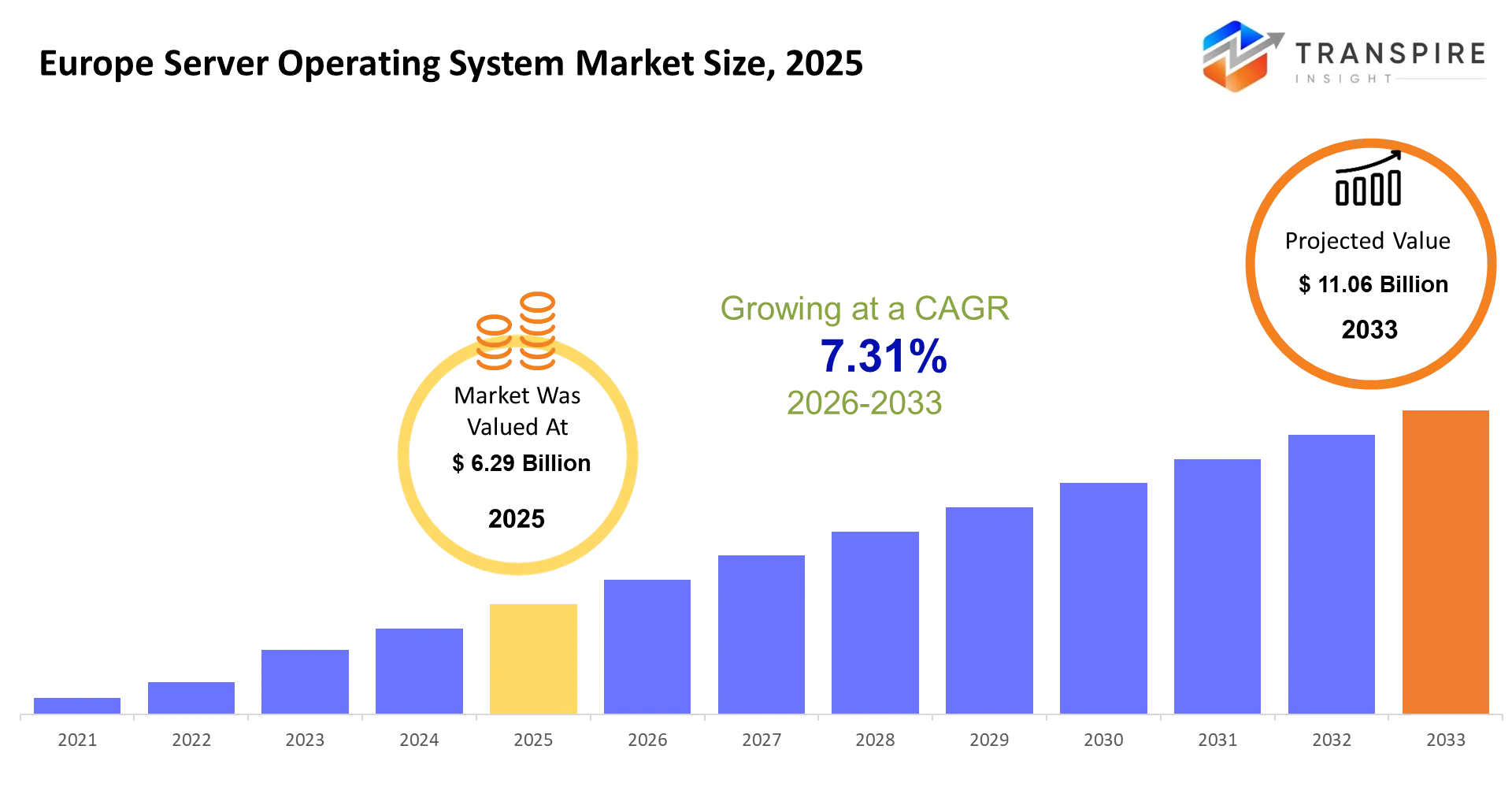
- Europe Server Operating System Market Size 2025: USD 6.29 Billion
- Europe Server Operating System Market Size 2033: USD 11.06 Billion
- Europe Server Operating System Market CAGR: 7.31%
- Europe Server Operating System Market Segments: By Type (Linux, Windows Server, Unix, Cloud OS, Hybrid OS, Others); By Application (Enterprise IT, Cloud Computing, Data Centers, Virtualization, Others); By End-User (Enterprises, SMEs, Government, IT Providers, Others); By Deployment (On-premise, Cloud, Hybrid, Edge, Others)
To learn more about this report,  Download Free Sample Report
Europe Server Operating System Market Summary
The Europe Server Operating System Market was valued at USD 6.29 Billion in 2025. It is forecast to reach USD 11.06 Billion by 2033. That is a CAGR of 7.31% over the period.
The Europe Server Operating System Market provides essential support to business operations and data center activities and public sector functions through its capacity to enable servers to handle workloads and execute applications and manage both cloud and on-premise systems. The European digital economy depends on this system because it provides essential support to services which handle financial transactions and operate cloud-based services and virtualization systems and industrial automation technologies.
The market underwent its fundamental transformation during the previous three to five years when organizations started adopting cloud-based container technologies instead of using traditional monolithic server systems. Enterprises started to adopt Linux systems which use Kubernetes for microservices operational needs to replace their outdated Unix and Windows-based systems. Organizations needed to update their systems because COVID-19 made remote work and cloud usage more important than before.
The European Union implemented data sovereignty regulations and GDPR regulations so organizations had to reevaluate their workload hosting practices which created this shift. The combination of regulatory requirements and hyperscaler expansion in Germany and France and the Nordics region led to an increase in hybrid cloud systems. Organizations now require server operating systems that provide them with flexible security options and ability to work with multiple systems which has resulted in ongoing spending from businesses and continuous system improvements for both public and private infrastructure systems.
Key Market Insights
- The Europe Server Operating System Market in 2025 shows Western Europe holding almost 48% market share because Germany France and the United Kingdom make significant investments in their cloud infrastructure.
- Through 2030 Northern Europe shows the highest growth rate because of its hyperscale data center development and renewable-powered digital infrastructure projects.
- The Europe Server Operating System Market shows Linux-based operating systems as its primary leader because they hold more than 55% market share through their widespread use in cloud-native and containerized applications.
- The Windows Server segment maintains its position as the second biggest segment because enterprises continue to depend on Microsoft ecosystems and need to connect their old applications.
- The cloud-based server operating system market shows the highest growth rate which will continue to increase between 2024 and 2030 because organizations adopt hybrid cloud systems.
- The enterprise IT applications area leads the market with approximately 40% segment share because regulated industries depend on secure internal infrastructure for their operations.
- As organizations embrace elastic infrastructure and distributed computing models cloud computing applications experience their most significant growth.
- The Europe Server Operating System Market shows enterprises as the main user group which drives more than 50% of market demand because they implement extensive digital transformation projects.
- SMEs represent the fastest-growing end-user category as subscription-based cloud OS models reduce upfront infrastructure costs and complexity.
- The competitive advantage of organizations now depends on three key factors, which include their ability to use container orchestration systems, their implementation of AI-driven workload optimization methods, and their development of operating system architectures that meet GDPR compliance requirements.
What are the Key Drivers, Restraints, and Opportunities in the Europe Server Operating System Market?
The Europe Server Operating System Market experiences primary market growth because enterprises and public institutions switch to cloud-native infrastructure. The transition accelerated after digital transformation programs which organizations implemented during and after 2020 because they faced limitations with their existing data center systems. Enterprises developed Linux-based environments which used hybrid operating systems to manage their containerized applications and Kubernetes systems and microservices-based operational structures. The shift enabled businesses to license their software products more flexibly while reducing their operational costs which resulted in higher rates of open-source server operating system adoption and increased income for enterprise support companies such as Red Hat and Canonical.
The banking and defense and healthcare sectors which operate under strict regulations face challenges because they must maintain their reliance on outdated systems. These environments maintain their dependence on Unix systems and long-standing Windows Server systems which they cannot replace in a short time frame because of certification needs and application dependencies and their conservative IT security protocols. The existing setup prevents organizations from modernizing their systems which results in reduced income from new system installations and higher costs for maintaining operational systems in different technological environments.
European Union member countries present a substantial chance to expand sovereign cloud services because the data localization regulations require them to establish local infrastructure systems. Germany and France are creating sovereign cloud systems which need their server operating system software to operate currently and establish security measures which meet local legal requirements.The existing patterns of demand create a need for Linux distributions that offer robust security and for hybrid operating system designs and for AI-powered management systems which are specifically designed to meet the needs of controlled digital environments.
What Has the Impact of Artificial Intelligence Been on the Europe Server Operating System Market?
European server operating system environments undergo transformation through artificial intelligence which implements automated solutions for infrastructure monitoring and workload orchestration and system health management. Data center operators increasingly use AI-powered controllers to automate CPU load distribution and container scheduling and to identify server problems before they lead to operational interruptions. The system decreases the need for human involvement in patch management processes while maintaining better system performance during busy periods across both cloud and hybrid environments.
The use of machine learning models extends to predictive maintenance because they analyze system logs and temperature signals and network latency patterns to predict upcoming hardware failures. The two hyperscale operators implemented predictive analytics into their server management systems and achieved uptime stability improvements that exceeded 15 to 25 percent reductions in unplanned downtime. AI-powered energy optimization tools enable environmentally friendly operations by adjusting compute power and decreasing idle resource usage which results in reduced data center electricity consumption.
AI adoption struggles to advance because companies must deal with complicated integration work between different types of systems. The absence of standardized telemetry data in legacy systems creates difficulties for model development because it impacts both model precision and model deployment across multiple locations. Organizations face challenges with automation because they need to connect their on-premise systems with cloud solutions in environments that use multiple types of servers.
Key Market Trends
- Linux usage in cloud-native deployments began to surpass Windows usage from 2020 onwards throughout Europe when businesses started to move their operations onto Kubernetes-based systems.
- European organizations reduced their reliance on Unix systems because maintenance expenses became more expensive, while the banking industry started to adopt Linux-based systems for high-availability operations during its modernization efforts from 2021 to 2025.
- European data centers shifted away from Microsoft Windows Server, which experienced a decrease in adoption for new deployments because cloud providers AWS and Azure, introduced Linux-first designs.
- After 2022, organizations began to adopt hybrid operating systems because they needed to protect their data under GDPR rules while they expanded their cloud computing capabilities which included connections between their private systems and public cloud services.
- Telecom companies installed lightweight server operating system versions to support 5G and Internet of Things applications, which led to a surge in edge computing installations between 2023 and 2025.
- European system vendors responded to GDPR and Digital Markets Act regulations by developing server operating system designs that followed secure-by-design principles and implementing more stringent procedures for software updates.
- Red Hat and Canonical expanded their support services, which enable businesses to trust open-source ecosystems instead of depending on proprietary server operating systems for their needs.
- European data center consolidation efforts gained momentum after 2021, which created a greater need for operating system optimization methods that support high-density environments and for techniques that use virtualization to handle workloads.
- Between 2022 and 2025, enterprises adopted containerization as they transitioned from using monolithic server operating system systems to implementing microservices-based frameworks.
Europe Server Operating System Market Segmentation
By Type:
Linux maintains its dominant position in the European Server Operating System Market because businesses use it extensively in both cloud-native environments and enterprise data centers. The installed base of Windows Server remains significant because it serves as a foundation for older enterprise systems, whereas Unix maintains its presence in critical banking and telecom operations. The Cloud OS and Hybrid OS categories experience growth because organizations need to move their workloads between different computing environments while using multiple distributed computing systems.
Linux growth occurs because its open-source nature enables users to operate without license fees while they build applications that work seamlessly with containerized systems. Windows Server maintains market demand because it provides complete connectivity with business software systems and Active Directory functions. Unix maintains its position in essential operational systems because of its specialized capabilities, which require substantial upkeep expenses. Cloud OS platforms become more popular because hyperscalers grow their infrastructure and Kubernetes architecture becomes more common.
Linux growth will continue in cloud and edge computing environments, but traditional Unix systems will experience a decline. Enterprises increase their adoption of Hybrid OS environments because they need to share workloads between their on-premise data centers and cloud services. Vendors who develop solutions for system interoperability and security enhancement and automation capabilities will achieve better market power during times of rising infrastructure complexity.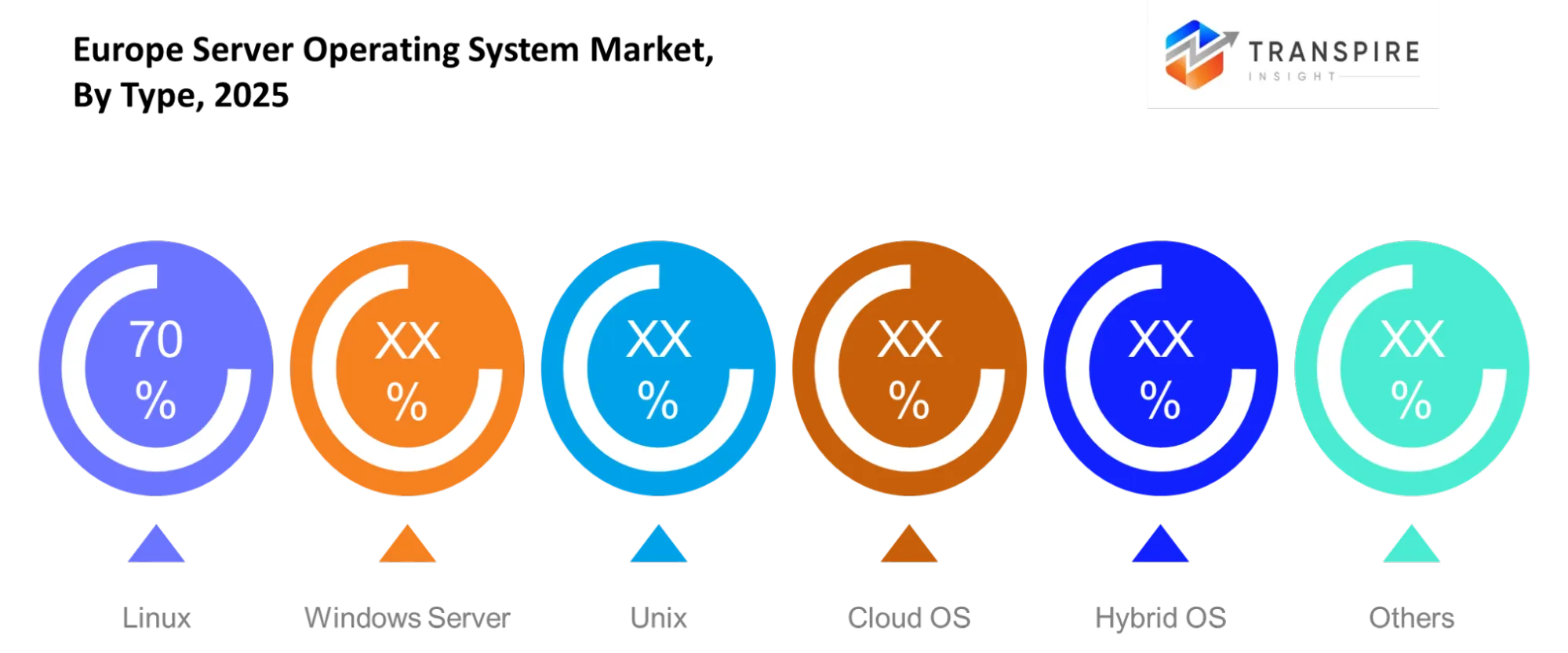
To learn more about this report, Download Free Sample Report
By Application:
Enterprise IT sustains its considerable share of the Europe Server Operating System Market because businesses depend on their internal systems to run essential applications. The Cloud Computing sector and Data Centers show rapid growth which results from customers shifting their workloads and hyperscale companies making investments. The virtualization technology enables better infrastructure operations while it also supports edge computing and dedicated industrial system requirements.
Organizations drive their cloud computing requirements because they need to scale operations and establish multiple deployment options. The Data Center industry experiences growth because customers demand more digital services and businesses require AI-related processing capacity. Virtualization technology enables organizations to achieve cost savings while they unify their hardware resources throughout their operations. The Enterprise IT sector maintains its essential role for businesses in regulated sectors that need to control their data on-site while following data sovereignty rules.
The future shows that both cloud services and data center operations will grow rapidly while businesses will increasingly adopt hybrid systems that connect existing IT infrastructure. Virtualization technology progresses to build systems that use containerization instead of traditional hypervisor frameworks. The development of AI IoT and edge computing technologies leads to a situation where workloads are distributed across different infrastructure components.
By End-User:
The Europe Server Operating System Market shows its largest enterprise market share because enterprises need extensive infrastructure to support their digital transformation projects. The cloud usage of SMEs has been increasing because cloud technology decreases the barriers which prevent them from entering the market. The need for secure infrastructure creates consistent demand from government agencies. IT providers assist in ecosystem growth by delivering managed services together with infrastructure outsourcing services.
The enterprise market needs organizations to handle their complex operational tasks while meeting their security requirements and running their worldwide business activities. The subscription-based OS models together with deployment process improvements have created new opportunities for SMEs to grow their businesses. Government spending is determined by three factors which include regulatory compliance needs and data localization requirements and cybersecurity needs. IT providers raise their market power by offering platform-as-a-service and infrastructure-as-a-service solutions.
The upcoming period will bring more SMEs to the market as cloud-native solutions simplify their business operations. Organizations continue to develop their hybrid infrastructure systems which enable them to manage their operational needs while growing their business. Government systems give priority to sovereign cloud solutions and secure operating system environments. IT providers boost their market position by implementing automated systems and orchestration technology together with managed security solutions.
By Deployment:
The European Server Operating System Market maintains strong support for on-premise deployment because both legacy systems and strict data control requirements continue to exist. Organizations pursue cloud deployment because it provides them with better operational efficiency and greater ability to grow their business operations. Enterprises adopt hybrid deployment solutions because they need to protect their systems while maintaining operational flexibility. Distributed computing requirements create the need for edge deployment which supports both Internet of Things devices and real-time processing systems.
Regulated industries continue to use on-premise systems because they need complete control over their infrastructure. Organizations select cloud deployment because it enables them to spend less money on initial expenses while they can establish systems at a faster pace. Hybrid models enable organizations to implement progressive migration methods while distributing their computing resources. Manufacturing, telecommunications, and autonomous systems require edge environments to support their applications which depend on low latency.
The future of cloud technology shows that it will maintain its current dominance while hybrid systems will experience growth in large business sectors. The use of on-premise systems will decrease over time yet they will continue to play an important role in industries that require strict compliance. AI-powered analytics and real-time decision systems drive the growth of edge deployment. When infrastructure systems become more divided vendors who create solutions for unified system management across different deployment methods will achieve better market results.
What are the Key Use Cases Driving the Europe Server Operating System Market?
The European server operating system market sees its main adoption drivers through enterprise cloud and hybrid infrastructure workloads which banking organizations and public administration bodies and telecommunications companies use for their extensive system deployments. The security needs of these environments which handle essential business functions and confidential information must be met through operating system platforms that maintain stability and security and meet compliance requirements. Companies require enterprise-grade Linux and Windows Server systems which enable them to use virtualization and cloud computing resources.
Industrial manufacturing and healthcare IT systems are now using edge computing and private cloud technology through their secondary adoption of these systems. Manufacturing companies use server operating systems to operate their predictive maintenance systems and digital twin technologies while healthcare organizations use them to manage their electronic health record systems and medical imaging technology. The two industries maintain steady operating system usage because they value system reliability and data protection more than they value fast system expansion.
AI model training infrastructure and sovereign edge data centers which governments and defense organizations use have started to create new operational requirements. The workloads demand server operating systems that require minimal resources and deliver optimized performance for GPU clusters and local processing tasks. The forecast period will see a growth in demand for modular operating systems which have enhanced security features and support AI applications and distributed computing systems.
|
Report Metrics |
Details |
|
Market size value in 2025 |
USD 6.29 Billion |
|
Market size value in 2026 |
USD 6.75 Billion |
|
Revenue forecast in 2033 |
USD 11.06 Billion |
|
Growth rate |
CAGR of 7.31% from 2026 to 2033 |
|
Base year |
2025 |
|
Historical data |
2021 - 2024 |
|
Forecast period |
2026 - 2033 |
|
Report coverage |
Revenue forecast, competitive landscape, growth factors, and trends |
|
Regional scope |
Europe (Germany, United Kingdom, France, Italy, Spain, Rest of Europe) |
|
Key company profiled |
Microsoft, Red Hat, Canonical, Oracle, IBM, SUSE, VMware, Amazon Web Services, Google Cloud, Hewlett Packard Enterprise, Dell, Cisco, Huawei, Alibaba Cloud, Tencent |
|
Customization scope |
Free report customization (country, regional & segment scope). Avail customized purchase options to meet your exact research needs. |
|
Report Segmentation |
By Type (Linux, Windows Server, Unix, Cloud OS, Hybrid OS, Others); By Application (Enterprise IT, Cloud Computing, Data Centers, Virtualization, Others); By End-User (Enterprises, SMEs, Government, IT Providers, Others); By Deployment (On-premise, Cloud, Hybrid, Edge, Others) |
Which Regions are Driving the Europe Server Operating System Market Growth?
The Europe server operating system market shows its major market strength from Western and Northern Europe because these regions possess extensive hyperscale cloud networks and established enterprise IT systems. The major data center hubs of Germany, the United Kingdom and France together with the Nordic countries create a foundation for enterprise Linux and Windows Server deployments. Organizations build their operating system environments to meet both GDPR requirements and sovereignty framework needs which create compliance and audit capabilities. The market maintains its long-term leadership position because of the regulatory environment which includes strong cloud provider presence and advanced digital infrastructure.
Central European countries like Austria and Switzerland together with Central European nations show stable economic growth because enterprises in these regions modernize their operations at a constant pace instead of adopting cloud technology all at once. The region develops through industrial and financial digitization instead of business growth patterns which dominate in the most developed area. Regional enterprises select hybrid cloud systems because they need dependable services and extended partnerships with their vendors and. The organization needs enterprise server operating systems which provide predictable demand through their stable performance record and their certification process and their ability to deliver support in local areas.
The European Union digital funding programs support both Eastern Europe's rapid cloud adoption and its aggressive data center expansion, making it the fastest growing region. The Baltic states and Poland and Romania are constructing new infrastructure to support both domestic and international workloads. Enterprises began to distribute their workloads from Western hubs after the digital sovereignty movement and geopolitical changes gained traction.This momentum creates a strong entry opportunity for OS vendors that can offer cost efficient, compliance ready, and cloud native server solutions tailored to emerging infrastructure ecosystems.
Who are the Key Players in the Europe Server Operating System Market and How Do They Compete?
The Europe server operating system market has reached a state of moderate consolidation, which enables a small number of existing companies to control most business operations while they compete through their cloud integration services and security certification process and their ability to meet sovereign compliance requirements. The market experiences disruption because cloud-native and container-first architectures emerge as the new standard, which eliminates the need for businesses to use traditional server operating systems. The current state of competition now rests on companies' abilities to build products that operate with hybrid cloud systems and their capacity to meet European Union data protection rules and their ability to deliver enterprise-level support functions.
Red Hat develops its enterprise Linux distribution through a subscription model that provides extensive support for hybrid cloud systems, while the company uses its certification system and Kubernetes-native tools to protect its business in regulated markets. Microsoft uses its Windows Server and Azure hybrid capabilities to compete with other companies, because its cloud on-ramps create operational dependencies for organizations that already use Microsoft products to transition into its ecosystem. SUSE establishes itself as a unique Linux enterprise solution through its dedication to European sovereignty and its ability to provide flexible Linux enterprise support for both regulated industries and government operations.
Canonical implements a cost-effective business model through Ubuntu Server, which gains market share through its partnerships with cloud providers and its rapid growth in developer and container-based environments. Oracle markets Oracle Linux to improve database performance and enterprise efficiency, which creates vendor dependency for Oracle customers who use Oracle applications and expands through bundled infrastructure and support services.
Company List
- Microsoft
- Red Hat
- Canonical
- Oracle
- IBM
- SUSE
- VMware
- Amazon Web Services
- Google Cloud
- Hewlett Packard Enterprise
- Dell
- Cisco
- Huawei
- Alibaba Cloud
- Tencent
Recent Development News
“In December 2025, SUSE entered a strategic partnership with evroc. The collaboration integrates SUSE Linux Enterprise Server and SUSE Linux Micro into evroc’s sovereign European cloud infrastructure, enabling fully EU-controlled deployment of operating systems for regulated workloads and strengthening demand for sovereignty-aligned server OS stacks.https://www.igorslab.de/en/suse-and-evroc-enter-into-strategic-partnership/ (Igor’sLAB)
In December 2025, SUSE and evroc announced a broader sovereign cloud stack initiative. The agreement included certification of SUSE Rancher Prime and deployment of SUSE Linux Enterprise across evroc’s platform, reinforcing integrated OS-to-Kubernetes environments designed for European regulatory compliance and accelerating adoption of Linux-based server OS in sovereign cloud architectures.https://aijourn.com/suse-and-evroc-announce-strategic-partnership-to-deliver-sovereign-european-cloud-solutions/ (The AI Journal)
What Strategic Insights Define the Future of the Europe Server Operating System Market?
The European server operating system market will transform from existing Linux distributions and on-premise systems to cloud-native security-hardened sovereignty-compliant OS solutions during the upcoming five to seven years because of two main factors D The first factor includes organizations which must meet data localization requirements while the second factor involves companies which need to implement hybrid and sovereign cloud solutions. The danger exists because open-source systems depend on a few main upstream maintainers and hyperscale cloud providers who create insecure situations even though these systems appear to have open access. The expansion of EU-backed digital infrastructure programs has created a new opportunity for companies to develop sovereign AI-ready edge operating systems which use energy-efficient ARM and RISC-V architecture. Market participants should proactively invest in compliance-by-design OS offerings and deepen partnerships with regional cloud providers to secure long-term positioning in regulated, sovereignty-sensitive workloads.
Europe Server Operating System Market Report Segmentation
By Type
- Linux
- Windows Server
- Unix
- Cloud OS
- Hybrid OS
- Others
By Application
- Enterprise IT
- Cloud Computing
- Data Centers
- Virtualization
- Others
By End-User
- Enterprises
- SMEs
- Government
- IT Providers
- Others
By Deployment
- On-premise
- Cloud
- Hybrid
- Edge
- Others
Frequently Asked Questions
Find quick answers to common questions.
The Europe Server Operating System Market size is USD 11.06 Billion in 2033.
Key Segments for the Europe Server Operating System Market are By Type (Linux, Windows Server, Unix, Cloud OS, Hybrid OS, Others); By Application (Enterprise IT, Cloud Computing, Data Centers, Virtualization, Others); By End-User (Enterprises, SMEs, Government, IT Providers, Others); By Deployment (On-premise, Cloud, Hybrid, Edge, Others).
Major Europe Server Operating System Market players are Microsoft, Red Hat, Canonical, Oracle, IBM, SUSE, VMware, Amazon Web Services, Google Cloud, Hewlett Packard Enterprise, Dell, Cisco, Huawei, Alibaba Cloud, Tencent.
The Current Europe Server Operating System Market size is USD 6.29 Billion in 2025.
The Europe Server Operating System Market CAGR is 7.31% from 2026 to 2033.
- Microsoft
- Red Hat
- Canonical
- Oracle
- IBM
- SUSE
- VMware
- Amazon Web Services
- Google Cloud
- Hewlett Packard Enterprise
- Dell
- Cisco
- Huawei
- Alibaba Cloud
- Tencent
Recently Published Reports
-
Apr 2026
3D Optical Profiler Market
3D Optical Profiler Market Size, Share & Analysis Report By Type (Desktop 3D Optical Profiler, and Portable 3D Optical Profiler), By Technology (Confocal Technology, and White Light Interference), By End-Use Industry (Manufacturing, Research Institutions, Automotive, Aerospace and Defense, Medical Devices, and Other), and Geography (North America, Europe, Asia-Pacific, Middle East and Africa, South and Central America), 2021 - 2031
-
Apr 2026
Depth Sensor Market
Depth Sensor Market Size, Share & Analysis Report By Type (Infrared Depth Sensors, Time-of-Flight (ToF) Sensors, Stereo Vision Sensors, Structured Light Sensors, Ultrasonic Depth Sensors), By Application (Automotive, Robotics, Gaming, Consumer Electronics, Industrial Automation, Healthcare, Security & Surveillance, Others), By End Users (Automotive Manufacturers, Consumer Electronics Companies, Healthcare Providers, Industrial Companies, Security Agencies, Gaming Companies, Robotics Companies, Others), and Geography (North America, Europe, Asia-Pacific, Middle East and Africa, South and Central America), 2021 – 2031
-
Apr 2026
Digital Manufacturing Market
Digital Manufacturing Market Size, Share & Analysis Report By Component (Hardware, Software, and Services), By Technology (Robotics, 3D Printing, Internet of Things (IoT), and Others), By Application (Automotive and Transportation, Aerospace and Defense, Consumer Electronics, Industrial Machinery, and Others), By Process Type (Computer-Based Designing, Computer-Based Simulation, Computer 3D Visualization, Analytics, and Others), and Geography (North America, Europe, Asia-Pacific, Middle East and Africa, South and Central America), 2021 – 2031
-
Apr 2026
Digital Visa Services Market
Digital Visa Services Market Size, Share & Analysis Report By Type (Individual Travelers, Group Travelers), By Application (Tourism, Business Travel, Others), and Geography (North America, Europe, Asia-Pacific, Middle East and Africa, South and Central America), 2021 – 2031