

Asia Pacific Solar Energy Systems Market Summary
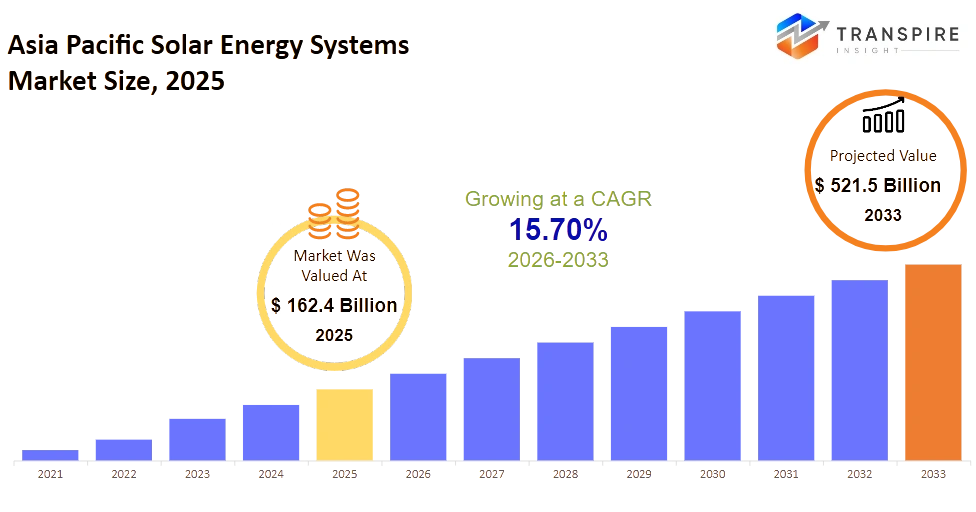
As per Transpire Insight Analysis the Asia Pacific Solar Energy Systems Market size is estimated at USD 162.4 Billion in 2025 and is anticipated to reach USD 521.5 Billion by 2033, growing at a CAGR of 15.70% from 2026 to 2033.
The Asia Pacific Solar Energy Systems Market kinda helps utilities, manufacturers, commercial facilities, and households make power closer to where it actually gets used, and so it reduces the dependence on imported fossil fuels, while also keeping long term energy costs steadier. Solar installations also end up nudging grid expansion in fast-growing urban and industrial pockets, where electricity demand keeps moving faster than normal generation capacity. Over the past five years, the market slowly shifted away from only standalone photovoltaic installs, into more blended systems that mix high-efficiency modules, battery storage, and digital energy management. That shift really gained momentum after global fuel price volatility, plus supply chain disruptions showed the financial downside of conventional power sources. Governments then responded by launching wider renewable procurement programs and local manufacturing incentives, pushing for quicker project development.And as system costs keep improving and financing is getting easier, businesses are treating solar projects like strategic infrastructure, strengthening their project pipelines, speeding up commercial adoption, and opening up longer lasting revenue opportunities across the whole regional value chain.
Asia Pacific Solar Energy Systems Market Size & Forecast:
- Asia Pacific Solar Energy Systems Market Size 2025: USD 162.4 Billion
- Expected Market Value 2033: USD 521.5 Billion
- Forecast CAGR: 15.70%
- Leading region in 2025: China
- Fastest Growing region: India
- Key Profile: LONGi Green Energy, Trina Solar, JinkoSolar, Canadian Solar, JA Solar, First Solar, Sungrow, Huawei Digital Power, SMA Solar Technology, GoodWe, Ginlong (Solis), Enphase Energy, Tigo Energy, Waaree Energies, Adani Solar
Key Market Insights
- China pretty much dominated the regional market in 2025 with roughly 58% market share, it was helped along by huge utility installations, domestic manufacturing and a steady push for more capacity expansion.
- India, on the other hand, is expected to move the quickest in the regional market across 2025–2033, mainly because of national solar missions, transmission upgrades , and more commercial project spending.
- Looking at products, photovoltaic PV systems led the whole segment space with around 82% market share in 2025 . This came as module prices kept sliding, which in turn boosted industry scale and the install numbers.
- Concentrated solar power (CSP) stayed in second place, with thermal storage investments giving support for industrial use and utility-scale electricity generation.
- Hybrid solar setups, the ones that combine solar with battery storage, are forecast to grow at the highest rate by 2033, basically because the demand for steady reliable renewable power 24/7 is starting to surface more.
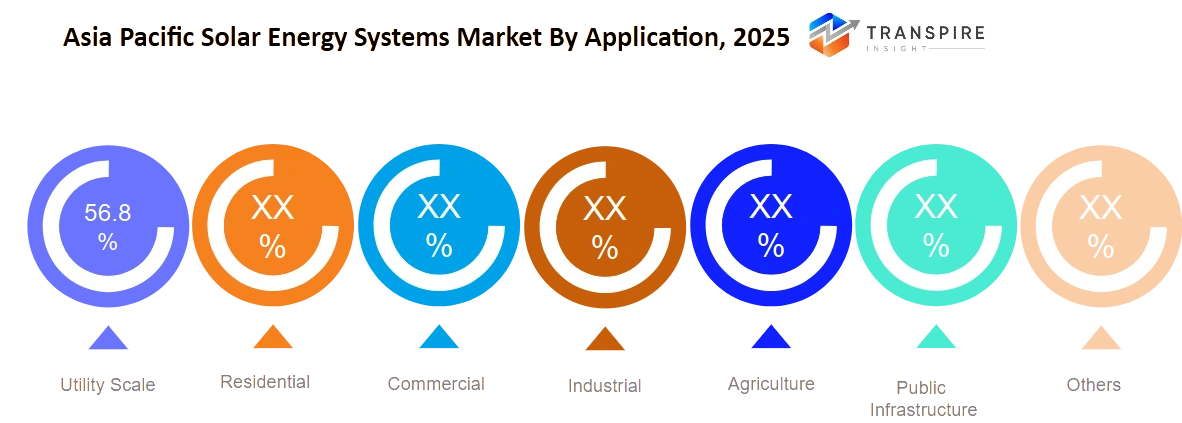
- On the generation side, utility-scale power generation held about 64% market share in 2025, since governments kept prioritizing big renewable procurement programs, plus projects tied into the transmission grid.
- For applications, commercial and industrial rooftop installations are the fastest-growing category, supported by lower operating costs and corporate decarbonization promises over the forecast window.
- In terms of end users , utility companies remained the top group with nearly 60% share in 2025, benefiting from long-term renewable procurement and ongoing grid infrastructure build-outs.
- Lastly, commercial and industrial enterprises are projected to become the fastest-growing end-user segment through 2033, because of energy cost optimization and long-run power purchase agreements, that kind of thing.
What are the Key Drivers, Restraints, and Opportunities in the Asia Pacific Solar Energy Systems Market?
The main force pushing market expansion feels like it comes from solar generation costs dropping fast, plus a set of renewable energy policies that actually help. Basically, competitive auctions with production-linked incentives, and also these net-zero commitments, kind of kicked off big procurement pushes across China, India, Australia, and parts of Southeast Asia. When module prices fall, project payback periods shrink, while in the same time higher electricity prices help boost investment returns. This whole chain reaction made utilities, manufacturers, and commercial operators more willing to sign off on bigger projects, so equipment sales go up, engineering contracts pick up, and long-term service revenue keeps growing across the regional solar value chain
Still, the biggest structural barrier seems to be transmission infrastructure, and also supply chain concentration. Grid expansion can take years—planning permitting, and capital allocation all in parallel, before the new renewable capacity can actually connect. If commissioning drags , then equipment utilization drops and revenue recognition gets postponed for developers and suppliers too. From what Transpire Insight saw in the regional procurement announcements and launch schedules, supply chain concentration stays the main execution risk. And the reliance on a limited number of manufacturing clusters means developers are more exposed to pricing swings, logistics disruptions, and late product deliveries
A big chance is in the way photovoltaic systems can work with battery energy storage and also AI enabled energy management platforms. Utilities are putting more money into dispatchable renewable capacity, which helps grid stability and smooth operations. India, Australia and Southeast Asia are in turn setting up pretty favorable conditions, via storage incentives , transmission upgrades, and more flexible electricity markets . Altogether these moves should boost commercial installations, unlock better priced energy services, and generate recurring software plus maintenance income, not just equipment sales.
What Has the Impact of Artificial Intelligence Been on the Asia Pacific Solar Energy Systems Market?
Artificial intelligence is now quietly transforming how solar energy gets rolled out across the Asia Pacific region, mainly by tuning plant operations, sharpening monitoring accuracy, and improving asset management in day to day practice. A lot of newer solar sites increasingly depend on AI enabled monitoring platforms that can automatically spot equipment anomalies, adjust inverter parameters, and even smooth out power output distribution across wide photovoltaic areas. At the same time, digital control systems help automate regulatory reporting, plus compliance documentation, so operators spend less time doing manual paperwork while trying to manage geographically dispersed locations.
On the analytics side, machine learning models chew through weather forecasts, historical generation curves, and electricity usage behaviors, and that feeds into better production forecasting, and better energy dispatch decisions too. Then predictive maintenance comes in with algorithms that flag early signals of possible inverter failures, module degradation, and transformer problems, before they start affecting electricity generation. The result is higher asset availability, better uptime, and lower maintenance costs which is honestly what most teams care about. In general, these tools support operators in increasing plant uptime, reducing inspection expenses, and lifting the overall energy yield from already operating installations.
Commercial facilities also use AI driven energy management software to refine battery charging schedules, which can reduce electricity procurement costs. Still, the big catch is that widespread deployment is often stuck because high integration costs keep piling up, plus the operational data isn’t as consistent from older assets, and there are basic connectivity issues in remote project areas. Those constraints then quietly reduce model reliability and can stretch the deployment timelines, especially for smaller developers who have tighter budgets and less digital infrastructure bandwidth.
Key Market Trends
- Since 2022, N-type photovoltaic modules have started taking a bigger slice of the market, i mean as manufacturers improved conversion efficiency and also managed to reduce long-term performance degradation, kind of steadily.
- Battery storage integration sort of sped up in a meaningful way across 2023–2026, so utilities could steady the renewable output a bit, and peak electricity availability would feel more dependable overall.
- China expanded its domestic manufacturing capability after 2021, which gave a lift to regional module supply, while also making exports more competitive for the principal producers.
- India ramped up local solar production through production-linked incentives, it helped reduce reliance on imports and backed a wider strategic industry expansion during the forecast period.
- Floating solar projects have increased across reservoirs and industrial water bodies, helping land utilization, and also opening up additional project opportunities after 2022.
- Digital twin platforms plus AI-enabled monitoring have become almost normal features in utility-scale deployments since 2023, which in turn improves operational efficiency, and supports predictive maintenance.
- Corporate power purchase agreements kinda took off after 2022, with manufacturers locking in long- term renewable electricity so they can smooth out operating costs. You know, that kind of setup.
- Companies like LONGi, JinkoSolar, Trina Solar, and JA Solar upped spending on higher efficiency technologies, and they also began stitching manufacturing more tightly, during those expansion phases that were happening recently, not too long ago.
- At the same time, several Southeast Asian countries strengthened their renewable procurement programs between 2023 and 2025, and that, in turn, helped cross-border investment plus wider regional project development kind of expand more than before.
Asia Pacific Solar Energy Systems Market Segmentation
By System Type:
Solar PV systems, really kept the largest share going, mostly because installation costs stayed lower , plus manufacturing capacity was pretty solid and there was broad policy support across big economies. In the meantime ongoing upgrades to module efficiency and production expenses that kept falling basically nudged more deployment, in residential setups, offices, and also utility-scale projects. Grid connected systems managed to take a noticeable chunk too, as governments pushed renewable electricity targets further and kept strengthening transmission infrastructure. Bigger utility installations then helped keep project pipelines steadier, which in turn makes long term investment easier across multiple countries
Hybrid solar systems are likely to show the quickest growth over the forecast period , mainly since battery storage becomes less pricey and energy reliability gains keep getting more attention. Floating solar setups will still pull in investment, due to limited land availability, and because reservoirs and industrial water bodies can be used more effectively. Off grid installations should keep a consistent pace in remote communities and isolated industrial sites, where standard electricity access is still restricted. Solar thermal systems, plus a few specialized technologies, will back certain industrial and commercial heating needs, with a more targeted expansion approach.
By Component:
Solar panels took the leading chunk because module technology moved a lttle too fast, and manufacturing scale drove down production costs, basically. The high-efficiency cell types increased electricity output, and it also made project economics more solid for developers as well as the folks using the system. Inverters came next in size, since almost every installation really needs dependable power conversion and grid synchronization, no fuss. Mounting systems plus monitoring services also kept showing steady adoption as project capacity kept getting larger, and yes.
Batteries, though will probably see the quickest growth, as energy storage turns into a must have piece of modern renewable builds. Battery prices easing, along with broader use of hybrid setups, should back stronger investment across commercial and utility use. Monitoring solutions will matter even more too, with digital performance tracking and predictive maintenance that helps raise day to day efficiency. Other supporting components should still ride along, since installation activity keeps expanding across different regional markets.
By Application:
Utility scale projects generated the top revenue because big renewable procurement programs pushed for more and more capacity build outs in most major economies. Competitive auctions , together with long term power purchase agreements, ended up making the investment climate feel pretty steady for developers and infrastructure investors . Industrial and commercial sites also kept expanding installations, partly to get better energy cost management, and partly to reinforce long term electricity resilience. Meanwhile public infrastructure projects helped spread renewable integration across transportation , healthcare and government facilities, bit by bit.
In the commercial segment, expansion should happen the quickest during the forecast period, since many businesses are hunting for reduced operating costs and better sustainability outcomes. Agricultural installations will keep climbing at a steady pace , driven by solar powered irrigation systems and also distributed electricity generation. Residential adoption should remain supported by rooftop installations and those favorable financing schemes showing up in several countries. Other specialized applications will add more chances, especially via localized renewable energy initiatives .
By End User:
Utilities stayed kind of the biggest end-user chunk because national renewable energy programs kept putting the focus on big electricity generation projects. Over longer procurement horizons, plus transmission networks that keep expanding, helped push investments into those large-scale installations. Also government organizations chipped in with public infrastructure work and clean energy procurement, initiative after initiative. Meanwhile industrial facilities boosted deployment, aiming for better operational efficiency and less exposure to electricity price swings.
Commercial enterprises are expected to grow the quickest, since renewable electricity is becoming a real, core piece of long-term business planning. Residential consumers will keep leaning into rooftop adoption, helped by financing support and equipment that is basically cheaper now. Industrial facilities will further put money toward integrated energy systems, especially with battery storage, for steadier day-to-day reliability. Other end users should open up extra chances through community energy setups and institutional projects.
By Installation Type:
Ground mounted installations were responsible for the biggest share, mostly because utility scale projects needed extensive land to run high capacity electricity generation. A lot of large renewable builds sort of “leaned” on this, since they get easier servicing , more design flexibility , and pretty strong economies of scale. Rooftop systems somehow ended up in the next slot , since adoption kept rising across residential, commercial and industrial buildings. Building owners kept putting money into distributed power generation, aiming for longer term energy cost stability and that kind of predictability.
Floating installations will, in the forecast period, show the quickest momentum because reservoir based developments can make use of unused water surfaces and also ease land constraints. Building integrated photovoltaic solutions are expected to be accepted bit by bit, especially with contemporary construction projects that merge electricity generation with architectural design. Rooftop systems should keep spreading through cities too, mainly where land is still scarce. Other installation approaches will still show up where specialized project needs exist, plus where location specific development strategies matter.
What are the Key Use Cases Driving the Asia Pacific Solar Energy Systems Market?
Utility-scale electricity generation is still the biggest thing, mainly because national utilities and independent power producers keep adding these large solar sites to hit their renewable targets and, honestly, to reinforce grid capacity more or less. Over time, long-term power purchase agreements and those competitive procurement programs help keep investment steady and sort of build dependable project pipelines.
On the other hand commercial buildings and industrial facilities are also rolling out on-site solar, partly for tighter energy cost control, and partly to limit how much they are exposed to those moving electricity prices. Agricultural operations are doing something similar too, using solar-powered irrigation and water pumping systems. This is being backed by rural electrification programs plus clean energy incentives, which makes adoption easier.
Then there are the more emerging angles like building-integrated photovoltaic systems and floating solar installations. New urban construction is starting to use energy-generating building materials, sort of quietly in the background. Meanwhile water authorities and industrial operators are looking at floating systems to use reservoir space in a more efficient way, and still deliver renewable electricity generation, without pushing land requirements upward so much.
|
Report Metrics |
Details |
|
Market size value in 2025 |
USD 162.4 Billion |
|
Market size value in 2026 |
USD 187.9 Billion |
|
Revenue forecast in 2033 |
USD 521.5 Billion |
|
Growth rate |
CAGR of 15.70% from 2026 to 2033 |
|
Base year |
2025 |
|
Historical data |
2021 - 2024 |
|
Forecast period |
2026 - 2033 |
|
Report coverage |
Revenue forecast, competitive landscape, growth factors, and trends |
|
Regional scope |
Asia Pacific (India, China, Japan, Australia, South Korea, Rest of Asia Pacific) |
|
Key company profiled |
LONGi Green Energy, Trina Solar, JinkoSolar, Canadian Solar, JA Solar, First Solar, Sungrow, Huawei Digital Power, SMA Solar Technology, GoodWe, Ginlong (Solis), Enphase Energy, Tigo Energy, Waaree Energies, Adani Solar . |
|
Customization scope |
Free report customization (country, regional & segment scope). Avail customized purchase options to meet your exact research needs. |
|
Report Segmentation |
By System Type (Solar PV Systems, Solar Thermal Systems, Hybrid Solar Systems, Off-Grid Solar Systems, Grid-Connected Systems, Floating Solar Systems, Others); By Component (Solar Panels, Inverters, Batteries, Mounting Systems, Monitoring Systems, Others); By Application (Residential, Commercial, Industrial, Utility Scale, Agriculture, Public Infrastructure, Others); By End User (Residential Consumers, Commercial Enterprises, Utilities, Government, Industrial Facilities, Others); By Installation Type (Ground Mounted, Rooftop, Floating, Building-Integrated PV, Others) |
Which Regions are Driving the Asia Pacific Solar Energy Systems Market Growth?
China accounted for approx. 58% of the regional revenue in 2025, so East Asia became the main regional market for solar energy systems. The thing is, strong renewable energy targets, big auction schemes, and the ongoing push for ultra-high-voltage transmission networks together set up pretty good conditions for fast project rollout. Also, the manufacturing ecosystem is pretty complete—modules, inverters, batteries, plus balance-of-system components—so domestic supply got stronger while exports kept moving across Asia Pacific. With more technology upgrades, a growing focus on energy storage integration, and steady policy backing, regional leadership should stay in place across the forecast timeline.
Japan, meanwhile, shows up as the second-largest regional market because investment choices tend to favor high-value, highly efficient installations rather than chasing sheer volumes of new capacity. Renewable energy rules are fairly stable, financing looks predictable and grid modernization programs continue on a consistent track, even with land constraints. Demand from commercial buildings, industrial sites, and public infrastructure keeps things balanced across several end-user groups. So overall, Japan is a dependable contributor to regional revenue, and it also helps keep adoption moving for advanced solar technologies.
India seems like the fastest-growing regional market now, because production-linked incentives, transmission expansion, and quicker renewable capacity targets have kind of strengthened project economics in recent years. On top of that there have been big investments in domestic manufacturing, and utility-scale infrastructure, which makes supply security better while also lowering dependence on imported equipment, a bit. Meanwhile the expansion of commercial installations, rural electrification programs, and battery storage deployment keeps opening up more investment chances across different sectors. All of these changes should set up pretty attractive conditions for project developers, technology providers, component manufacturers, and also for long-term infrastructure investors, especially through 2026–2033.
Who are the Key Players in the Asia Pacific Solar Energy Systems Market and How Do They Compete?
Competition in the Asia Pacific Solar Energy Systems Market is kind of moderately consolidated, not fully split, but still, global manufacturers and local, more regional developers keep going at each other using production scale, technology performance, manufacturing efficiency , and even more integrated energy solutions. Cost competitiveness still matters a lot, though module efficiency, battery integration, digital monitoring, plus supply reliability are starting to weigh in more on what buyers actually choose. The established players keep pushing production capacity up, while technology-led companies bring out higher-efficiency products, which then improves project economics and long- run performance.
LONGi Green Energy stands out because they keep investing in high-efficiency cell technology and they run very large scale manufacturing, so customers can get better electricity yield even when installation space is limited. JinkoSolar is more focused on advanced N-type module development and on global supply reach, and they try to stay competitive by leaning on dependable product performance and broad experience across utility, and commercial setups. Trina Solar mixes module manufacturing with smart energy and storage solutions, so the whole thing feels integrated, and deployment becomes simpler for developers and utilities, like less juggling.
JA Solar expands its market footprint via strategic partnerships with project developers and distributors, while also improving manufacturing efficiency to keep pricing competitive. Canadian Solar takes module production and also utility-scale project development, which basically gives them tighter control over project delivery and longer-term value creation. In the end, it’s this mix of manufacturing scale, technology upgrades, and integrated project capabilities that keeps shaping where companies sit competitively across the regional solar industry.
Company List
- LONGi Green Energy
- Trina Solar
- JinkoSolar
- Canadian Solar
- JA Solar
- First Solar
- Sungrow
- Huawei Digital Power
- SMA Solar Technology
- GoodWe
- Ginlong (Solis)
- Enphase Energy
- Tigo Energy
- Waaree Energies
- Adani Solar
Recent Development News
In April 2025, LONGi Green Energy achieved a 34.85% conversion efficiency for its crystalline silicon-perovskite tandem solar cell, certified by the U.S. National Renewable Energy Laboratory (NREL). The certification established a new world record and strengthened the commercial outlook for next-generation high-efficiency photovoltaic technology across Asia Pacific. Source https://www.longi.com/
In March 2026, JA Solar publicly introduced its DeepBlue 5.0 next-generation photovoltaic module platform during a global media event at its Yangzhou manufacturing facilities. The product launch highlighted manufacturing improvements and higher-value module performance, strengthening the company's competitive position in utility-scale, commercial, and residential solar deployments. Sourcehttps://kyodonewsprwire.jp/
What Strategic Insights Define the Future of the Asia Pacific Solar Energy Systems Market?
The Asia Pacific Solar Energy Systems Market will gradually move toward an integrated energy infrastructure model, where solar generation , battery storage, digital energy management, and flexible grid networks basically work as one connected system rather than stand alone assets. This structural shift is likely to be pushed by rising electricity demand, industrial electrification, and national energy security strategies that tend to favor homegrown renewable capacity.
There’s also a quieter risk that people don’t always notice, namely the concentration of key manufacturing and raw material processing, which may leave project economics more exposed to supply disruptions, trade restrictions, or even shifting industrial policies.
On the other side, an emerging opportunity is the growth of floating solar projects, and often these are paired with energy storage across Southeast Asia. In that region land availability is still constrained and many governments keep supporting renewable investment. Companies that diversify their supply chain arrangements, build tighter local partnerships, and start early on integrated storage plus intelligent energy management solutions should be in a stronger position to grab long term value while also dialing down execution risk and strengthening overall project resilience.
Asia Pacific Solar Energy Systems Market Report Segmentation
By System Type
- Solar PV Systems
- Solar Thermal Systems
- Hybrid Solar Systems
- Off-Grid Solar Systems
- Grid-Connected Systems
- Floating Solar Systems
By Component
- Solar Panels
- Inverters
- Batteries
- Mounting Systems
- Monitoring Systems
By Application
- Residential
- Commercial
- Industrial
- Utility Scale
- Agriculture
- Public Infrastructure
By End User
- Residential Consumers
- Commercial Enterprises
- Utilities
- Government
- Industrial Facilities
By Installation Type
- Ground Mounted
- Rooftop
- Floating
- Building-Integrated PV
Frequently Asked Questions
Find quick answers to common questions.
The expected Asia Pacific Solar Energy Systems Market size for the market will be USD 521.5 Billion in 2033.
Key segments for the Asia Pacific Solar Energy Systems Market are By System Type (Solar PV Systems, Solar Thermal Systems, Hybrid Solar Systems, Off-Grid Solar Systems, Grid-Connected Systems, Floating Solar Systems, Others); By Component (Solar Panels, Inverters, Batteries, Mounting Systems, Monitoring Systems, Others); By Application (Residential, Commercial, Industrial, Utility Scale, Agriculture, Public Infrastructure, Others); By End User (Residential Consumers, Commercial Enterprises, Utilities, Government, Industrial Facilities, Others); By Installation Type (Ground Mounted, Rooftop, Floating, Building-Integrated PV, Others) .
Major Asia Pacific Solar Energy Systems Market players are LONGi Green Energy, Trina Solar, JinkoSolar, Canadian Solar, JA Solar, First Solar, Sungrow, Huawei Digital Power, SMA Solar Technology, GoodWe, Ginlong (Solis), Enphase Energy, Tigo Energy, Waaree Energies, Adani Solar .
The Asia Pacific Solar Energy Systems Market size is USD 162.4 Billion in 2025.
The Asia Pacific Solar Energy Systems Market CAGR is 15.70% from 2026 to 2033.
- LONGi Green Energy
- Trina Solar
- JinkoSolar
- Canadian Solar
- JA Solar
- First Solar
- Sungrow
- Huawei Digital Power
- SMA Solar Technology
- GoodWe
- Ginlong (Solis)
- Enphase Energy
- Tigo Energy
- Waaree Energies
- Adani Solar
About the Authors

Avinash Kumar
I’m Avinash Kumar, a Senior Research Analyst at Transpire Insight, with expertise in the Electronics and Semiconductor and Energy & Power industry. My work focuses on analyzing emerging technologies, market trends, industry developments, and innovation across these sectors. I specialize in transforming complex technical and market insights into clear, research-backed content that helps professionals, businesses, and decision-makers stay informed. Through continuous industry research and data-driven analysis, I strive to deliver accurate, reliable, and practical perspectives on the latest advancements shaping the semiconductor and energy landscape.

Chakradhar Khansole
Chakradhar serves as the Research Director at Transpire Insight, bringing over 8 years of experience in technology, innovation, and strategic market intelligence. He specializes in transforming complex market data into actionable business insights that enable organizations to make informed, growth-oriented decisions. Recognized for his strategic vision and analytical expertise, Chakradhar leads high-impact research initiatives, delivering comprehensive market assessments, competitive intelligence, and forward-looking industry analysis.
Recently Published Reports
-
Apr 2026
Active Power Filter Market
Active Power Filter Market Size, Share & Analysis Report By Type (Shunt Active Power Filters, Series Active Power Filter, Hybrid Active Power Filter), By Application (Harmonics Mitigation, Reactive Power Compensation, Voltage Regulation, Power Factor Correction), By Phase (Single Phase, Three Phase), By End-User Industry (Manufacturing, Healthcare, Commercial, Automotive, Oil and Gas, Others), and Geography (North America, Europe, Asia-Pacific, Middle East and Africa, South and Central America), 2021 - 2031
-
Apr 2026
Electrical Transformer Market
Electrical Transformer Market Size, Share & Analysis Report By Core (Closed, Shell, and Berry), By Insulation (Gas, Oil, Solid, Air, and Other), By Phase (Single, and Three), By Rating (100 MVA to 500 MVA, 501 MVA to 800 MVA, and 801 MVA to 1200 MVA), and Geography (North America, Europe, Asia-Pacific, Middle East and Africa, South and Central America), 2021 – 2031
-
Apr 2026
Hydraulic Piston Pumps Market
Hydraulic Piston Pumps Market Size, Share & Analysis Report By Type (Axial Piston Pumps, Radial Piston Pumps), By Operating Pressure (Low Pressure, Medium Pressure, High Pressure), By Application (Construction, Mining, Agriculture, Automotive, Oil & Gas, Industrial Machinery, Others), By End-User (OEMs, Aftermarket), and Geography (North America, Europe, Asia-Pacific, Middle East and Africa, South and Central America), 2021 – 2031
-
Apr 2026
Laboratory Gas Generators Market
Laboratory Gas Generators Market Size, Share & Analysis Report By Product (Nitrogen Gas Generator, Hydrogen Gas Generator, Zero Air Gas Generator, Purge Gas Generator, TOC Gas Generators, Others), By Application (Gas Chromatography, Liquid Chromatography-mass Spectrometry (LC-MS), Gas Analyzers, Others), By End-user (Life Science, Chemical & Petrochemical, Food & Beverage, Others), and Geography (North America, Europe, Asia-Pacific, Middle East and Africa, South and Central America), 2021 – 2031