
High Speed Cameras Market Summary:
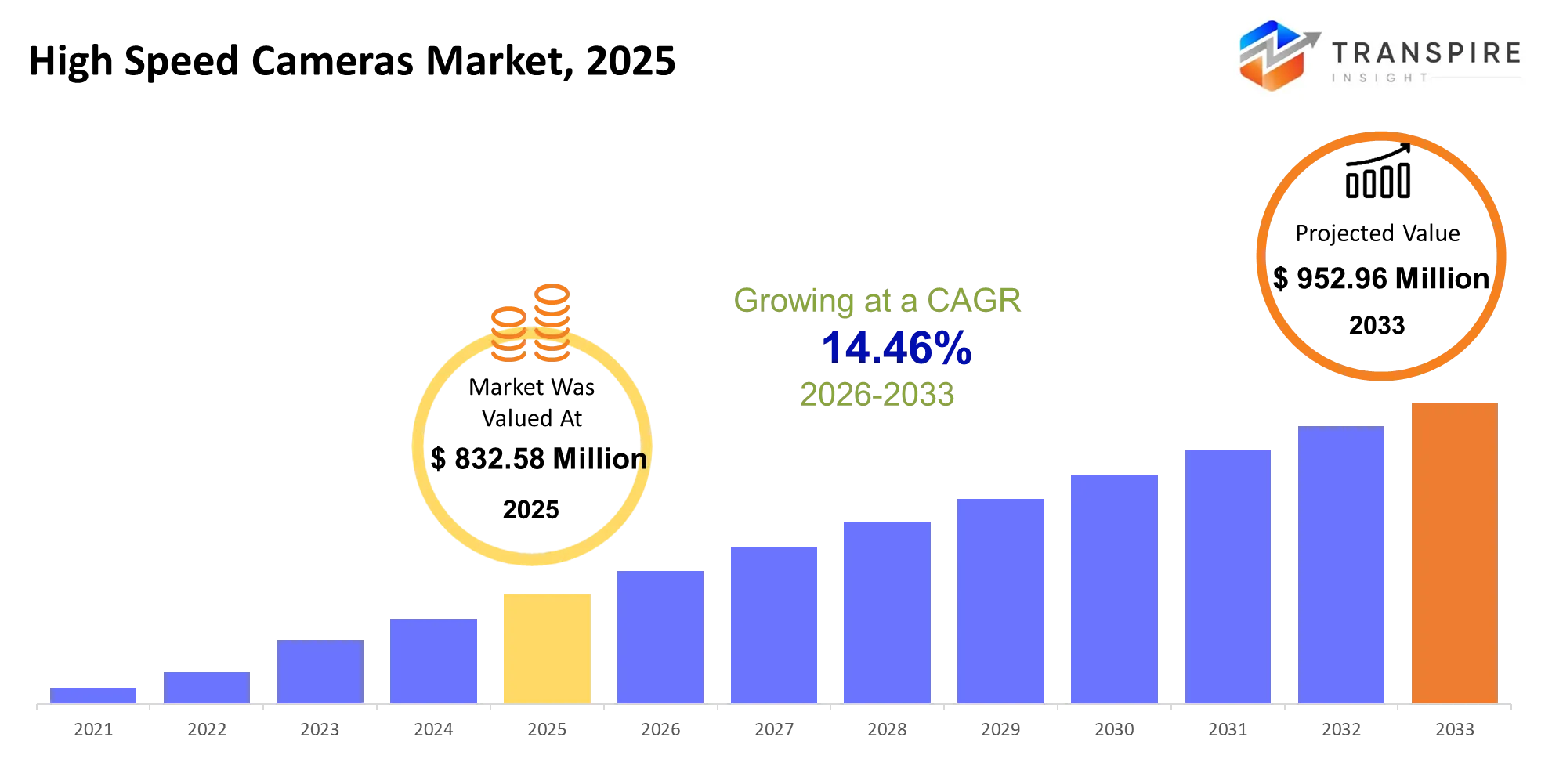
As per Transpire Insight, the High Speed Cameras Market size is estimated at USD 832.58 million in 2025 and is anticipated to reach USD 2,480.25 million by 2033, growing at a CAGR of 14.46% from 2026 to 2033.
The high-speed camera market supports applications when ordinary video cannot record motion clearly enough for engineering, research, safety testing, and motion analysis. High-speed cameras are needed in these situations. In practice, high-speed cameras record events such as vehicle impacts, material failure, combustion, fluid motion, sports movement and equipment vibration. High-speed cameras allow teams to study each frame in detail. Over the three to five years the high speed cameras market has shifted toward compact digital systems. These systems combine frame rates with better light sensitivity, greater resolution and easier data transfer. A key structural shift is the move from high-speed imaging to CMOS-based platforms. CMOS-based platforms feature sensor designs and software integration. A real-world trigger has been the need for detailed automotive crash and safety testing as vehicle designs become more complex. High-speed cameras are used in these tests. This is increasing adoption of speed cameras because engineers can obtain usable evidence, from short-duration events without relying only on post-test inspection.
High Speed Cameras Market Size & Forecast:
- Market Size 2025: USD 832.58 million
- Expected Market Value (2033): USD 2,480.25 million
- Forecast CAGR (2026–2033): 14.46%
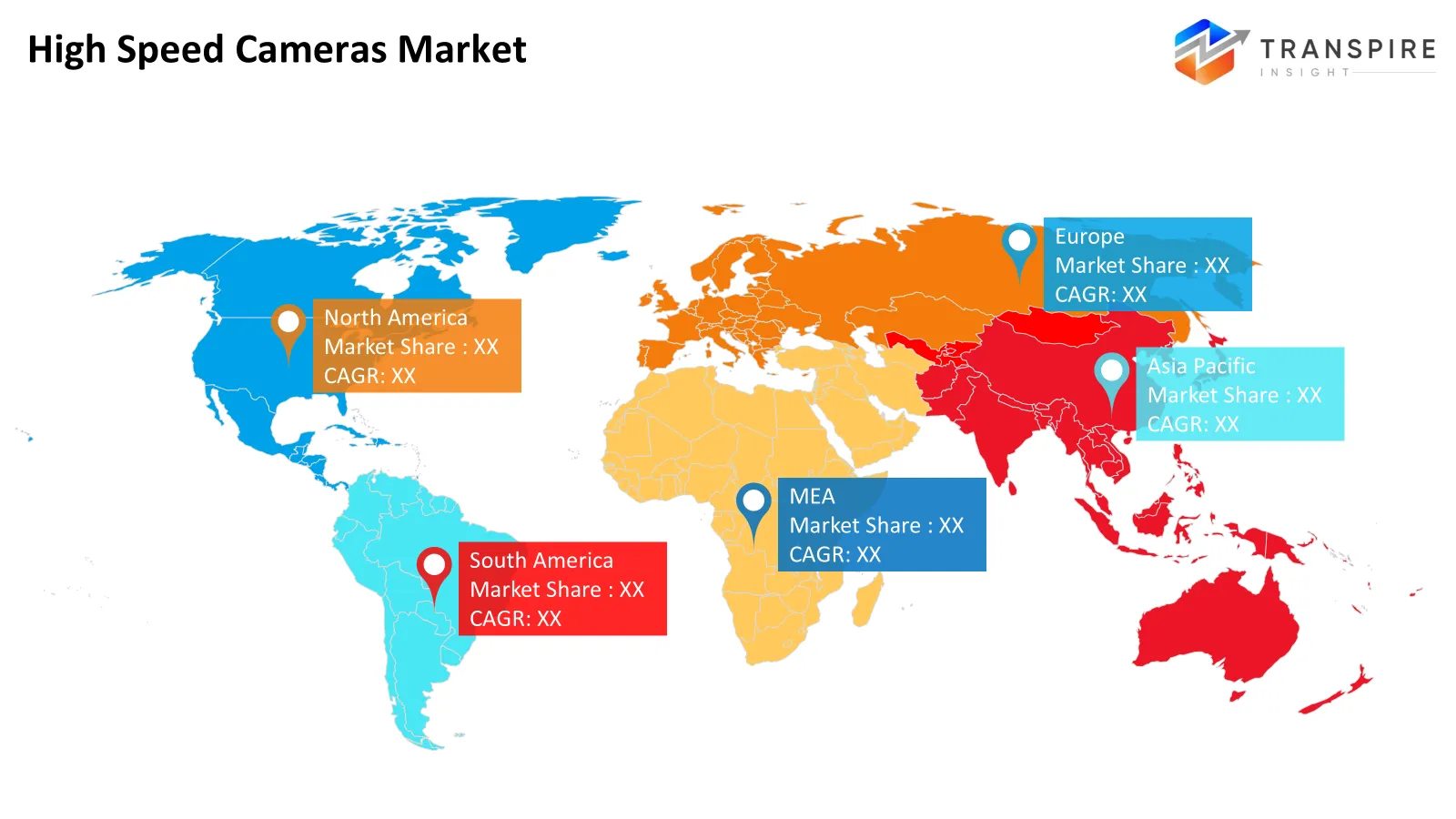
- Leading Region in 2025: North America
- Fastest Growing Region: Asia Pacific
- Key Company Profiles: Vision Research, Photron, nac Image Technology, Mikrotron, PCO, Optronis, AOS Technologies, Fastec Imaging, IDT, iX Cameras, Shimadzu, Olympus, Motion Capture Technologies, Phantom Cameras, Ximea
Key Market Insights:
market shifting towards Automotive and Transportation as the biggest application domain, whereas Scientific Research continues to grow as high-speed imaging is more closely integrated into digital measurement and analysis.
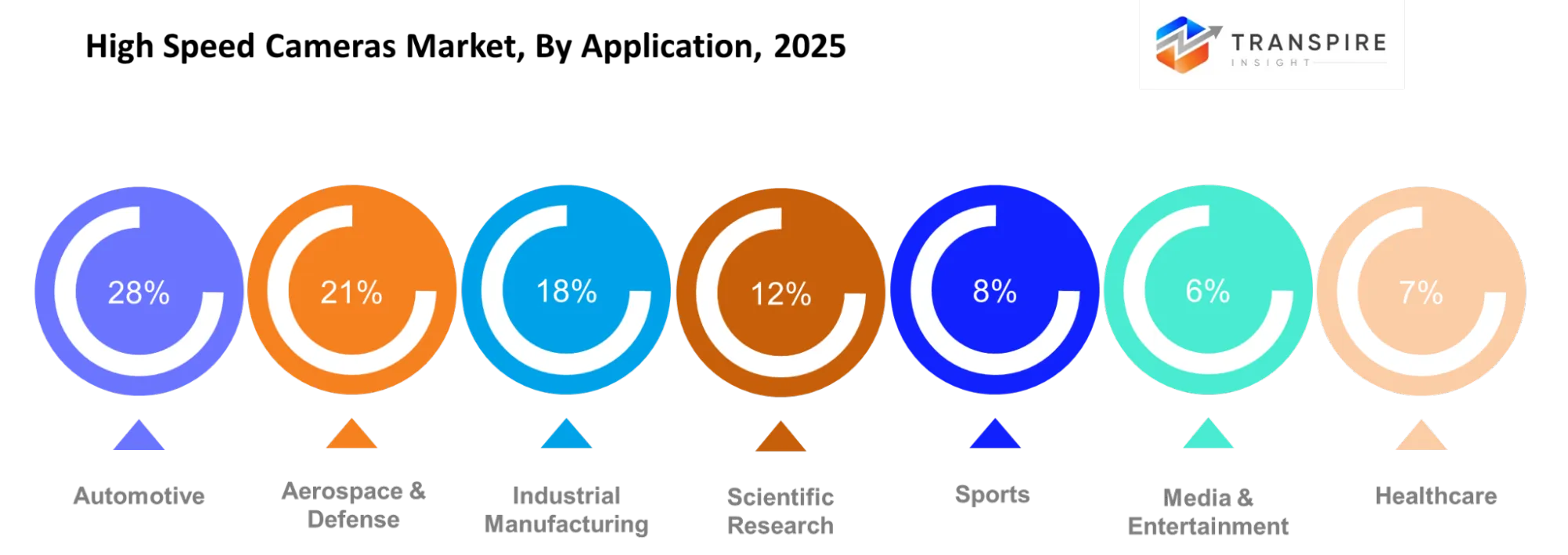
- Applications in Automotive and Transportation account for 27.50%, with crash testing and vehicle validation playing a critical role in driving camera demand.
- Scientific Research is the fastest-growing segment with 8.60% CAGR because of the increasing use of high-speed cameras in areas like PIV, combustion, materials testing, and lab tests.
- Vision Research is making progress in developing Phantom cameras with BSI sensors, indicating the trend towards sensitivity in small camera systems.
- Photron is innovating the FASTCAM series with BSI and correlated double sampling, indicating the trend towards low-noise and quantitative imaging.
- Together, Automotive, Aerospace & Defense, and Industrial Manufacturing comprise 66.50% of the application mix, driving demand for rugged and synchronized camera systems.
What are the Key Drivers, Restraints, and Opportunities in the High Speed Cameras Market?
Drivers:
The Market is driving Testing of automotive and transportation products is developing a good adoption base because crash testing, airbag deployment, component impact tests, and safety validations of vehicles necessitate capturing accurate images of events that happen within a fraction of a second. The underlying factor in this is the increasing complexity of vehicle designs and safety systems that have made it necessary for users to rely on visual evidence during development. Increased frame rate, increased sensitivity, and synchronization will help engineers capture more test data, hence motivating users to purchase cameras and use them repeatedly within laboratories.
Restraints:
High-speed camera systems are expensive because of the expensive technology that includes highly sensitive sensors, special lenses, big memory storage, fast interfaces, and other software that make the total cost of ownership high. The underlying structural reason for this is that besides the camera system, users might need trained operators, controlled lighting conditions, synchronization gear, and other technical supports.
Opportunities:
High-sensitivity compact cameras that include analytics and are easy to integrate into networks have the potential to increase adoption in non-specialist locations. For instance, new BSI cameras are offering high frame rates with a small size, which makes it possible to be used for applications like industrial inspection, microscopy, biomechanics, and field work. The camera manufacturers who complement their products with software and regional services will benefit more.
What is the Impact of artificial intelligence on the high-speed cameras market?
The use of Artificial Intelligence technology supports making high-speed imaging more efficient by enabling users to transition from mere recording to automatic analysis of results. In car tests, for example, the vision-based software powered by AI can detect objects, track motion, calculate displacement, and recognise abnormal events from large numbers of recorded images. AI technologies can be used in industrial inspections as well in the detection of changes in form, vibrations, cracks, particle movement, or responses of equipment to conditions without manual review of all sequences. Predictive ability may also be helpful to scientists in establishing correlations between visual measurements and operating conditions from repeating tests. High-speed camera manufacturers now regularly combine high-speed cameras with software packages, SDKs, and machine vision processing. The major disadvantage of the technology is that its efficiency depends on image quality, the training set, lighting, and correct integration of the system. Powerful cameras and computing hardware can also contribute to higher project costs, especially in those that require real-time processing.
Instance:
In August 2025, AIStorm and Tower Semiconductor launched Cheetah HS, a novel imaging chip that combines a neural network with high-speed imaging features, up to 260,000 frames per second. The innovation provides quicker and more efficient artificial intelligence analysis for use in various industries, including robotics and automotive testing.
https://towersemi.com/2025/08/12/08122025/
Key Market Trends:
The market is shifting from high-speed recorders to complete imaging systems which offer improved picture quality and analysis. Customers are beginning to look for cameras that can easily be integrated within their engineering, science, industrial, or automated inspection environments.
- Adoption of BSI sensors is increasing. Cameras are developing sensors that are designed to receive more light, resulting in clear images even under difficult conditions.
- Resolution is gaining importance. There is a growing demand for both high-resolution images and high frame rates, especially for deformation, impact and microscopic analysis.
- Integration with software is increasing. High-speed cameras are now often paired with various analysis platforms, SDKs, machine vision solutions and measurement programs.
- Camera synchronization is becoming a viable option. The testing teams are utilising synchronisation of multiple cameras in order to get views from several angles at once.
- Applications of scientific imaging are increasing. High-speed cameras find their application not only in fluid dynamics but also in combustion, material science, biomechanics, microscopy and other experiments.
High Speed Cameras Market Segmentation
By Technology:
CMOS is an important base technology for modern high-speed imaging, as it enables fast readout, digital processing and flexible camera design. Selected applications continue to benefit from CCD technology, and High-Speed CMOS is playing a growing role in challenging industrial and scientific measurements. Specialised imaging applications with different wavelength sensitivity are enabled by InGaAs technology, while Scientific CMOS enables research applications with high image quality and high-speed acquisition. Digital systems have continued to supersede film-based systems due to the ease of handling, storage, analysis, and data transfer of digital systems, whereas film-based cameras can still be used for speciality and legacy applications. The technology trend is thus heading towards smaller, more sensitive and more readily integrated digital imaging.
By Frame Rate:
Systems that have less than 1,000 FPS are used in applications that involve moderately fast motion requiring clearer analysis without demanding capture systems. Systems that have frame rates of 1,000 – 10,000 FPS are used in a wide variety of industries, automotive and research tests, while 10,000 – 100,000 FPS are appropriate for faster impacts, combustion, and materials studies. Systems that have frame rates ranging from 100,000 to 1 million FPS are used to capture highly transient events, while 1 – 10 million FPS and above 10 million FPS are specialised systems used in scientific physical research.
By Application:
Automotive & Transportation takes up the most significant market share at 27.50%, which is trailed by Aerospace & Defence and Industrial Manufacturing holding market shares of 21.00% and 18.00%, respectively. Next in line comes Scientific Research, which holds a 12.00% market share, while Sports, Media & Entertainment, Healthcare and Other Applications hold market shares of 8.00%, 6.00%, 4.00% and 3.50%, respectively. From the analysis above, it is evident that high-speed cameras are used both for business tests and scientific research.
By Resolution:
Below 1 MP cameras have their usefulness where very high speeds or smaller sizes are needed rather than the resolution of the picture. 1 – 2 MP cameras provide a compromise among all three factors thus making it applicable for wide engineering uses. Cameras of higher resolution such as 2 – 5 MP and 5 – 10 MP offer more precise analysis of the movements, while 10 – 20 MP and above 20 MP provide field of views or finer structures in their pictures. Ultra-High Resolution cameras are anticipated to attract interest where engineers need to combine both high resolution and fast event capture.
By End User:
Automotive Original Equipment Manufacturers are among the important customer base owing to the nature of vehicle design involving crash, parts and safety tests. High-speed cameras are used by Aerospace and Manufacturing Companies for validation purposes, whereas Universities and Research Laboratories make use of high-speed camera systems for experimentation and measurement purposes. There may be some government organisations that may require high-speed imaging for advanced testing purposes. High-speed imaging is used by Sports Organizations for broadcasting and analysing the performance of athletes. The future acceptance by end-users will rely upon integration and measurement capability.
By Sales Channel:
Direct sales are important for high-end systems as the end users may need technical guidance and customisation services. The distributors assist in selling to regional customers, while system integrators are needed where the cameras need to be used in a larger system of tests and machine vision systems. Online sales can help in purchasing small or standardised cameras, while OEM partnership is required where the high-speed imaging technology needs to be integrated into the testing machines.
What are the Key Use Cases Driving the high-speed cameras market?
The use case is automotive testing, which aligns with the predominant Automotive & Transportation. These high-speed cameras are used to image crash deformations, deployment of airbags, occupant dynamics, tyre dynamics, and failures. The applications continue to expand into aerospace & defence, the manufacturing industry and scientific research areas. In aerospace and defence industries, high-speed imaging is used for propulsion testing, impact testing and structure testing. In the manufacturing industry, high-speed imaging is used for machinery, form testing, combustion testing, fluid flow analysis and troubleshooting. Some emerging applications include machine vision processes for motion analysis, medical imaging, microscopy, and AI. In scientific research, labs would probably make use of high-speed cameras not only for capturing experiments but also analyzing the experiments quantitatively.
|
Report Metrics |
Details |
|
Market size value in 2025 |
USD 832.58 million |
|
Market size value in 2026 |
USD 952.96 million |
|
Revenue forecast in 2033 |
USD 952.96 million |
|
Growth rate |
CAGR of 14.46% from 2026 to 2033 |
|
Base year |
2025 |
|
Historical data |
2021 - 2024 |
|
Forecast period |
2026 - 2033 |
|
Report coverage |
Revenue forecast, competitive landscape, growth factors, and trends |
|
Regional scope |
United States; Canada; Mexico; United Kingdom; Germany; France; Italy; Spain; Denmark; Sweden; Norway; China; Japan; India; Australia; South Korea; Thailand; Brazil; Argentina; South Africa; Saudi Arabia; United Arab Emirates |
|
Key company profiled |
Vision Research, Photron, nac Image Technology, Mikrotron, PCO, Optronis, AOS Technologies, Fastec Imaging, IDT, iX Cameras, Shimadzu, Olympus, Motion Capture Technologies, Phantom Cameras, Ximea |
|
Customization scope |
Free report customization (country, regional & segment scope). Avail customized purchase options to meet your exact research needs. |
|
Report Segmentation |
Technology (CMOS, CCD, High-Speed CMOS, InGaAs, Scientific CMOS, Digital, Film-Based); Frame Rate (<1,000 FPS, 1,000–10,000 FPS, 10,000–100,000 FPS, 100,000–1 Million FPS, 1–10 Million FPS, >10 Million FPS, Ultra-High-Speed); Application (Automotive, Aerospace & Defense, Industrial Manufacturing, Sports, Research, Media & Entertainment, Healthcare, Scientific Research); Resolution (Below 1 MP, 1–2 MP, 2–5 MP, 5–10 MP, 10–20 MP, Above 20 MP, Ultra-High Resolution); End User (Automotive OEMs, Aerospace Companies, Universities, Research Laboratories, Industrial Manufacturers, Government Agencies, Sports Organizations); Sales Channel (Direct Sales, Distributors, System Integrators, Online Sales, OEM Partnerships, Specialty Dealers, Rental Services) |
Which Regions are Driving the High Speed Cameras Market Growth?
North America:
North America dominates as the leading regional market, accounting for a 38.40% share. This is due to the presence of well-established automotive testing, aerospace programs, research labs and specialist imaging providers in the region. In addition, the region has well-developed testing infrastructure and extensive adoption of high-quality engineering tools. This has led to continued deployment of high-speed cameras for product validation, defence, scientific experiments, and sports production.
In August 2026, Vision Research, an American manufacturer of high-speed imaging products, added the Phantom C540 and C980 to its line of standalone high-speed cameras from the Phantom C-Series. These devices have a 4 MP and 8 MP resolution, respectively, and can be used in scientific research, industrial testing, aerospace, automotive, and defence industries. It is one more example of investments in the high-speed imaging technology sector in North America. Phantom High Speed
https://www.phantomhighspeed.com/news/newsarticles/2026/july/phantom_cseries_expansion
Europe:
Europe holds a 29.00% market share. It maintains a strong market position owing to automotive manufacturing capacity, engineering capability, and research establishments in the region. As compared to North America, Europe has a very strong association with automotive engineering and industrial testing applications. Manufacturing hubs and research establishments ensure sustained demand for imaging technology in the region.
In July 2026, AOS Technologies, a Swiss company, announced that its M-VIT high-speed camera had been installed on board the International Space Station during the ESA-funded DropCoal experiment. The camera recorded droplet formation and collision under conditions of a microgravity environment. The development illustrates the involvement of high-speed camera technology from Europe in scientific researches.
Asia-Pacific:
Asia-Pacific accounts for 23.00% of the market share and is considered the fastest-growing regional segment with a CAGR of 9.80%. The growth of manufacturing, automotive, electronics, science & research and technology spending has increased the use of high-speed imaging technologies in various applications. Increasing capabilities in laboratories and industries have also created opportunities for camera providers.
In September 2026, Huachen Heyi Equipment Technology Co., Ltd. (HEVOX), a Chinese company, introduced the HC8CS-130 high-speed camera and made some design improvements to its range of scientific cameras. It was mentioned that the modified imaging equipment is supposed to be used in scientific research, industrial precision control, semiconductor production, and materials science.
Who are the Key Players in the high-speed cameras market, and how do they compete?
The market competition in high-speed cameras is defined by the performance of sensors, frame rate, resolution, light sensitivity, software integration, and applicability. Increasingly, manufacturers rely on their specialised camera platforms instead of only being distinguished by maximal frame rates. Photron, Vision Research, Excelitas/PCO, Shimadzu and Optronis provide several examples of competitive strategies in scientific, industrial and automotive fields. Photron applies an innovation strategy, featuring families of camera solutions for compact, megapixel, 4K, streaming and ultra-high speed applications. The company offers Orion S40, which integrates BSI and correlated double sampling technologies, and the NOVA range, which integrates high-speed imaging with higher-resolution solutions. Vision Research distinguishes itself from competitors with Phantom systems, focusing on high sensitivity, compactness, synchronisation, and very high frame rate cameras. The 2025 KT series of cameras from Vision Research integrates BSI sensors and aims at research, industrial tests, ballistics and biomedical fields. ametek.com
High Speed Cameras Market companies
- Vision Research
- Photron
- nac Image Technology
- Mikrotron
- PCO
- Optronis
- AOS Technologies
- Fastec Imaging
- IDT
- iX Cameras
- Shimadzu
- Olympus
- Motion Capture Technologies
- Phantom Cameras
- Ximea
Recent Development News
- In September 2026, Excelitas Technologies introduced the pco. Dimax CS8 high-speed camera. It has an 8-megapixel camera that can capture images at speeds exceeding 1,100 FPS at 4K resolution and also integrates with the FALCON high-speed video software. This indicates the shift towards having high-speed cameras with high resolution and ruggedness combined. https://www.excelitas.com/press-release/excelitas-launches-pcodimax-cs8-high-speed-camera-automotive-safety-testing-and
- In December 2025, Photron made a strategic move by acquiring AOS Technologies AG. This deal extended Photron's high-speed camera business to the automotive, aerospace, industrial, and defence industries. https://www.photron.co.jp/wp-content/uploads/2025/12/20251203_AOS_en.pdf
What Strategic Insights Define the Future of the High-Speed Cameras Market?
The future of the market is towards the development of cameras that combine high speed with good resolution, sensitivity, small size and software connectivity, which implies that competition in the market will become dependent on imaging processes rather than the individual parameter of frame rate. The potential problem with increased speed and resolution will be the necessity to store, transfer and analyse larger amounts of information, even with the improvement in the performance of cameras. The key opportunity will be related to the possibility of using AI-driven analysis in automotive validation, troubleshooting and measuring tasks in the industrial sector and in scientific research. The vendors can help the engineering teams make quick decisions based on video recording with the help of tools that allow detecting, tracking and measuring events. The best strategy for the business is the creation of camera and software solutions for certain applications, and provision of a modular interface that is compatible with the current test systems. The geographical growth should be application-driven, and North America is still the key region for the tests, while Asia Pacific has some potential because of expanding R&D and manufacturing operations in the region.
Key Segmentations are:
Technology
- CMOS
- CCD
- High-Speed CMOS
- InGaAs
- Scientific CMOS
- Digital
- Film-Based
Frame Rate
- <1,000 FPS
- 1,000–10,000 FPS
- 10,000–100,000 FPS
- 100,000–1 Million FPS
- 1–10 Million FPS
- 10 Million FPS
- Ultra-High-Speed
Application
- Automotive
- Aerospace & Defense
- Industrial Manufacturing
- Sports
- Research
- Media & Entertainment
- Healthcare
- Scientific Research
Resolution
- Below 1 MP
- 1–2 MP
- 2–5 MP
- 5–10 MP
- 10–20 MP
- Above 20 MP
- Ultra-High Resolution
End User
- Automotive OEMs
- Aerospace Companies
- Universities
- Research Laboratories
- Industrial Manufacturers
- Government Agencies
- Sports Organizations
Sales Channel
- Direct Sales
- Distributors
- System Integrators
- Online Sales
- OEM Partnerships
- Specialty Dealers
- Rental Services
By Regional Analysis
North America
- US
- Canada
- Mexico
Europe
- Germany
- UK
- France
- Italy
- Spain
- Russia
- Rest of Europe
Asia Pacific
- China
- Japan
- India
- South Korea
- Australia
- Rest of Asia Pacific
South America
- Brazil
- Argentina
- Rest of South America
Middle East & Africa
- UAE
- Saudi Arabia
- Qatar
- South Africa
- Rest of the Middle East & Africa
Frequently Asked Questions
Find quick answers to common questions.
The high-speed cameras market size was valued at USD 832.58 million in 2025 and is poised to reach USD 952.96 million by 2033, expanding at a 14.46% CAGR.
Key segments for the high-speed cameras market are Technology (CMOS, CCD, High-Speed CMOS, InGaAs, Scientific CMOS, Digital, Film-Based); Frame Rate (<1,000 FPS, 1,000–10,000 FPS, 10,000–100,000 FPS, 100,000–1 Million FPS, 1–10 Million FPS, >10 Million FPS, Ultra-High-Speed); Application (Automotive, Aerospace & Defense, Industrial Manufacturing, Sports, Research, Media & Entertainment, Healthcare, Scientific Research); Resolution (Below 1 MP, 1–2 MP, 2–5 MP, 5–10 MP, 10–20 MP, Above 20 MP, Ultra-High Resolution); End User (Automotive OEMs, Aerospace Companies, Universities, Research Laboratories, Industrial Manufacturers, Government Agencies, Sports Organizations); Sales Channel (Direct Sales, Distributors, System Integrators, Online Sales, OEM Partnerships, Specialty Dealers, Rental Services).
Growth is primarily driven by increasing demand for fast motion analysis, extensive use in automotive and aerospace testing, increasing industrial automation, new imaging technologies, and more applications in sports, medicine, and science.
The market is led by major manufacturers including Vision Research, Photron, nac Image Technology, Mikrotron, PCO, Optronis, AOS Technologies, Fastec Imaging, IDT, iX Cameras, Shimadzu, Olympus, Motion Capture Technologies, Phantom Cameras, Ximea.
The North American region accounts for 38.40% market share in terms of the high-speed camera industry on account of high demand coming from aerospace & defence, automotive testing, industrial manufacturing, and scientific applications. High investments in terms of technological advancement in imaging technology and the presence of manufacturers drive the regional market share.
Opportunities in the worldwide high-speed cameras market lie in the increasing need for sophisticated high-speed cameras in automotive tests, aerospace and defence applications, industrial automation, sports science, and scientific research. Another opportunity arises out of the increasing use of AI-driven imaging systems and real-time motion analysis.
- Vision Research
- Photron
- nac Image Technology
- Mikrotron
- PCO
- Optronis
- AOS Technologies
- Fastec Imaging
- IDT
- iX Cameras
- Shimadzu
- Olympus
- Motion Capture Technologies
- Phantom Cameras
- Ximea
About the Authors

Avinash Kumar
I’m Avinash Kumar, a Senior Research Analyst at Transpire Insight, with expertise in the Electronics and Semiconductor and Energy & Power industry. My work focuses on analyzing emerging technologies, market trends, industry developments, and innovation across these sectors. I specialize in transforming complex technical and market insights into clear, research-backed content that helps professionals, businesses, and decision-makers stay informed. Through continuous industry research and data-driven analysis, I strive to deliver accurate, reliable, and practical perspectives on the latest advancements shaping the semiconductor and energy landscape.

Chakradhar Khansole
Chakradhar serves as the Research Director at Transpire Insight, bringing over 8 years of experience in technology, innovation, and strategic market intelligence. He specializes in transforming complex market data into actionable business insights that enable organizations to make informed, growth-oriented decisions. Recognized for his strategic vision and analytical expertise, Chakradhar leads high-impact research initiatives, delivering comprehensive market assessments, competitive intelligence, and forward-looking industry analysis.
Recently Published Reports
-
Apr 2026
Fiber Optic Faceplates Market
Fiber Optic Faceplates Market Size, Share & Analysis Report By Type (< 300 mm2, 300-350 mm2, and > 350 mm2, By Application (Night Vision, Holographic Imaging, Medical, and Others), and Geography (North America, Europe, Asia-Pacific, Middle East and Africa, South and Central America), 2021 - 2031
-
Apr 2026
High Temperature Superconductors Market
High Temperature Superconductors Market Size, Share & Analysis Report By Type (1G HTS, and 2G HTS), By Application (Power Cable, Fault Current Limiter, and Transformer), and Geography (North America, Europe, Asia-Pacific, Middle East and Africa, South and Central America), 2021 - 2031
-
Apr 2026
Industrial Plugs and Socket Market
Industrial Plugs and Socket Market Size, Share & Analysis Report By Type (Industrial Plugs, Industrial Sockets), By Current (Up to 32 A, 32 to 125 A, Above 125 A), By Protection (Dustproof and Splash Proof, Waterproof, Explosion Proof), By End User (Heavy Industries, Oil and Gas, Chemicals and Pharmaceuticals, Power Generation, Others), and Geography (North America, Europe, Asia-Pacific, Middle East and Africa, South and Central America), 2021 - 2031
-
Apr 2026
InGaAs Avalanche Photodiodes Market
InGaAs Avalanche Photodiodes Market Size, Share & Analysis Report By Type (1100 - 1700 nm, and 1000 - 1600 nm), By Application (Missile Warning System, Muzzle Flash Detection, Wafer Defect Inspection, Laser Rangefinders, and Others), and Geography (North America, Europe, Asia-Pacific, Middle East and Africa, South and Central America), 2021 - 2031