
HCM For Deskless And Frontline Workers Market Summary:
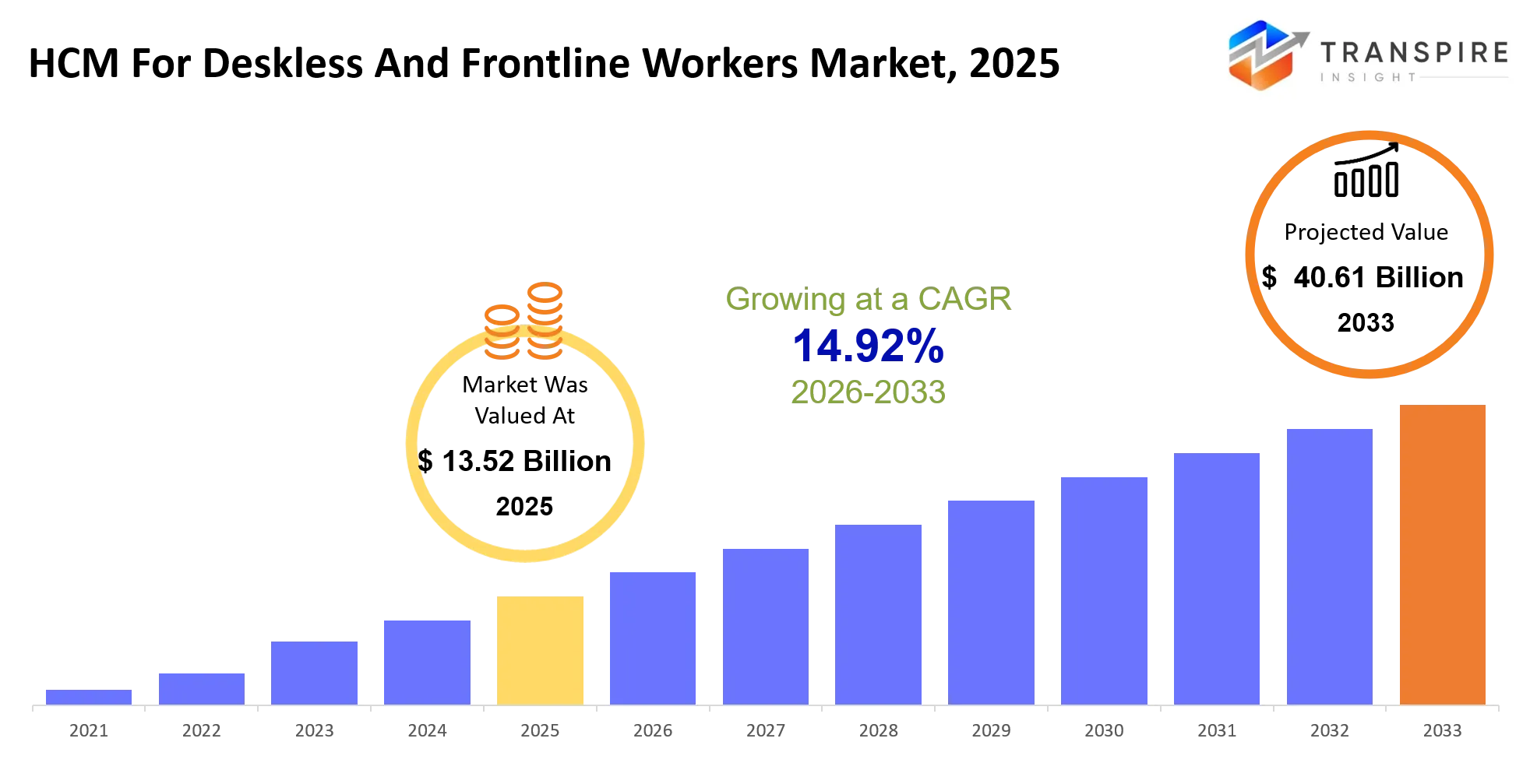
As per Transpire Insight Analysis, the HCM For Deskless and Frontline Workers Market size is estimated at USD 13.52 billion in 2025 and is anticipated to reach USD 40.61 billion by 2033, growing at a CAGR of 14.92% from 2026 to 2033.
The market for human capital management for deskless and frontline workers around the world is changing. Companies are searching for ways to handle employees who work outside regular office settings. These tools help companies manage staff schedules, attendance, pay, communication with workers and employee records using one digital system. In years the market has moved from simple HR record keeping to mobile-first platforms that support daily operations. The growth of cloud technology the availability of smartphones and flexible work setups have made this change happen faster. The pandemic showed how important it is to keep communication going and to keep the workforce operating in retail, health care, transport and manufacturing. Companies are more and more using HCM software to cut down on paperwork get a better view of their employees and handle teams that are spread out. This move toward connected workforces is opening up chances for technology companies that offer special tools, for frontline workers.
HCM For Deskless And Frontline Workers Market Size & Forecast:
- Market Size 2025: USD 13.52 Billion
- Expected Market Value (2033): USD 40.61 Billion
- Forecast CAGR (2026–2033): 14.92%
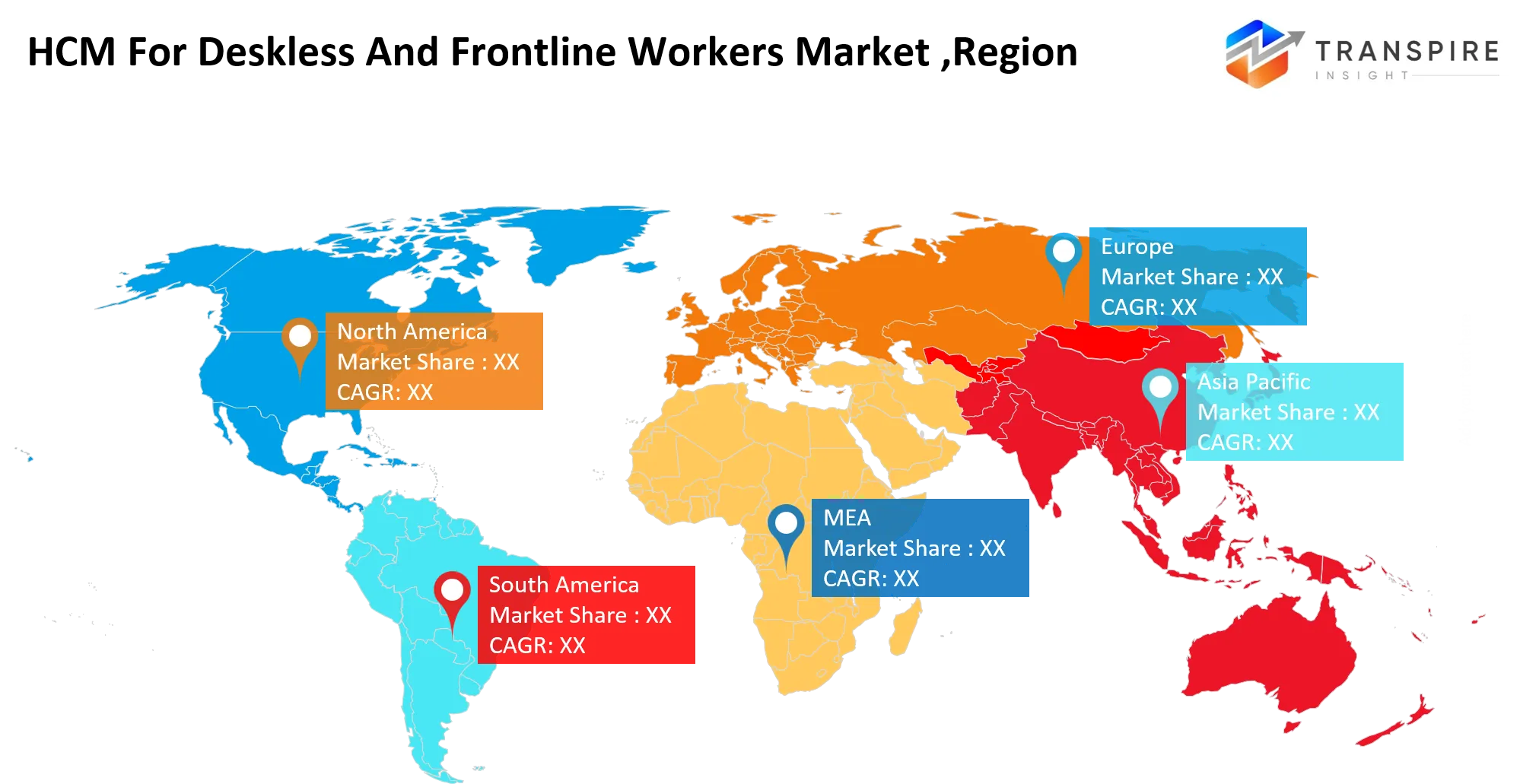
- Leading Region in 2025: North America
- Fastest Growing Region: Asia Pacific
- Key Company Profiles: Workday, UKG, SAP, Oracle, ADP, Dayforce, Legion Technologies, Quinyx, Beekeeper, Blink, Zebra Technologies, Microsoft, ServiceNow, Rippling, WorkJam
Key Market Insights:
The market is moving towards software-based workforce management, as organisations prefer centralised HR, employee scheduling, and digital workforce coordination.
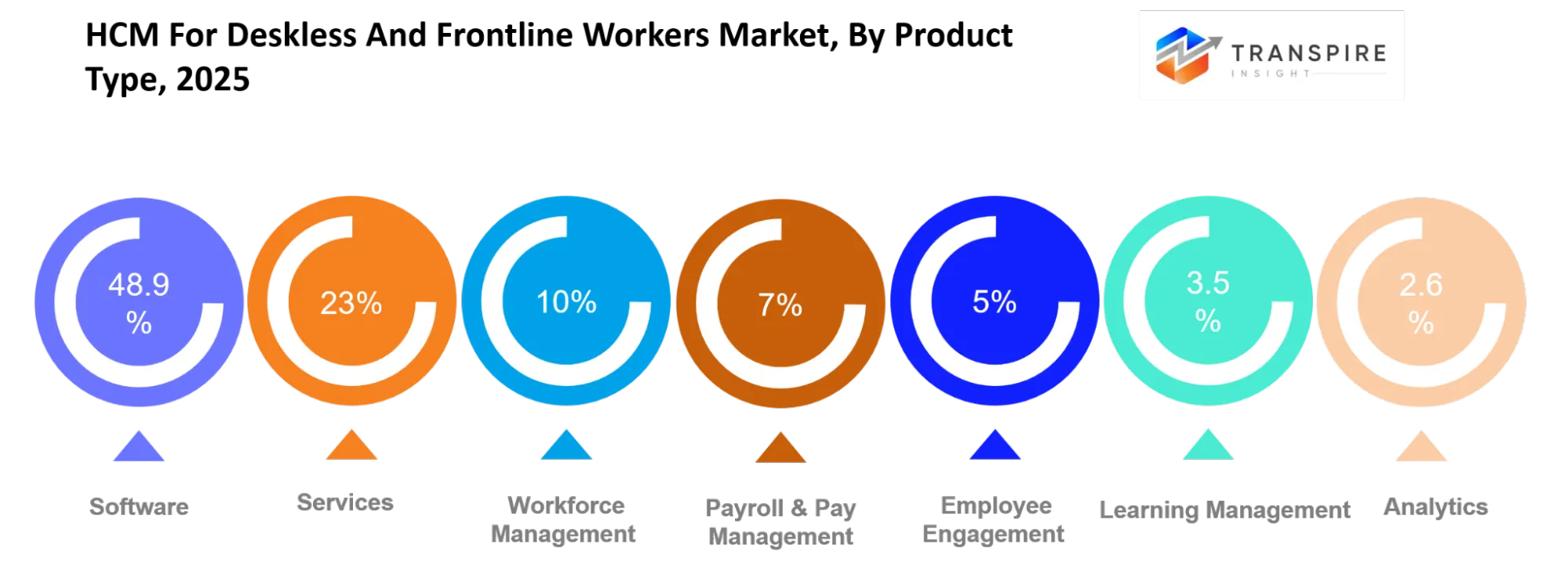
- Software occupied the major part of the offering segment, accounting for 65.72%, as there is an increase in the adoption of digital solutions for employee administration, scheduling, and workforce communication.
- Services will show the highest CAGR of 16.42%, driven by increasing demand for implementation services, system integration, and technical assistance.
- Workforce management occupied 7.0% of the market, due to increased offerings by UKG and Workday related to scheduling and workforce optimisation.
- Payroll and pay management accounted for 5.0% of the market, due to increased offerings by ADP related to automated payroll and employee payments.
- Employee engagement was 3.0% of the market, due to the increasing popularity of digital communication and employee self-service apps in front-line workplaces.
- Learning management accounted for 2.5% of the market, as HCM vendors are integrating learning and onboarding into their digital solutions to cater to distributed employees.
- Analytics accounted for 1.78% of the market, and companies are looking into predictive workforce insights to make better staffing decisions.
What are the Key Drivers, Restraints, and Opportunities in the HCM For Deskless And Frontline Workers Market?
Drivers
Increasing complexity in workforce management is one of the key factors that drives the market growth. Many retail chains, healthcare organisations, logistics firms, and manufacturing companies operate at various locations and shifts. Hence, there are problems with manual workforce management. The fast adoption of mobile applications and cloud HR solutions pushes businesses towards digitalisation of scheduling, attendance, payroll, and communication between employees.
Restraints
An expensive and complex implementation process remains a key challenge for market adoption, especially for small businesses. Integration of HCM software with existing systems such as payroll systems, ERP systems, and attendance systems requires significant IT capabilities. Moreover, frontline workers may not be technologically savvy or have access to devices.
Opportunities
There is development of AI-based workforce planning and payroll services, as well as predictive scheduling. Vendors can diversify their portfolios by offering inexpensive mobile-first solutions targeted at SMEs. Also, emerging markets in the Asia Pacific region offer potential growth as retailers, manufacturers, healthcare organisations, and logistics companies update their workforce management infrastructure.
|
Driver |
Relative Impact on Growth (%) |
Geographic Relevance |
Impact Timeline |
Demand Strength |
Growth Mechanism (5–10 words) |
Key Beneficiaries (5–10 words) |
Major Constraint (5–10 words) |
|
Increasing Adoption of Mobile-First Workforce Management Platforms |
25% |
North America, Europe, Asia-Pacific |
Short-term |
High |
Enables real-time scheduling, communication, and employee self-service |
HCM vendors, frontline employees, retail and logistics operators |
Limited device access and digital literacy among workers |
|
Rising Demand for Workforce Productivity and Employee Retention |
22% |
North America, Europe, Asia-Pacific |
Medium-term |
High |
Improves shift flexibility, engagement, and workforce retention |
Employers, HR technology providers, workforce management vendors |
High implementation costs and employee resistance |
|
Growing Need for Automated Payroll and Regulatory Compliance Management |
20% |
Europe, North America, Asia-Pacific |
Short-term |
High |
Automates wage calculations, attendance, and compliance reporting |
Payroll providers, HCM software vendors, multinational employers |
Changing labor regulations and regional compliance complexity |
|
Increasing Integration of Artificial Intelligence and Workforce Analytics |
18% |
North America, Asia-Pacific, Europe |
Medium-term |
High |
Optimizes staffing, predicts labor demand, and automates HR tasks |
AI technology vendors, HCM providers, large enterprises |
Data privacy concerns and legacy system integration |
|
Accelerating Cloud Adoption and Integrated HCM System Investments |
15% |
Asia-Pacific, North America, Europe |
Long-term |
High |
Connects workforce data across distributed business operations |
Cloud providers, HCM vendors, SMEs, multinational organizations |
Cybersecurity risks and migration expenses |
|
Total |
100% |
What Has the Impact of Artificial Intelligence Been on the HCM For Deskless And Frontline Workers Market?
AI will revolutionise the HCM market for deskless and frontline workers through predictive and responsive workforce management using automation. The predictive analysis in the AI-based scheduling tool considers employees' availability, historical staffing needs, business operations, and workload to recommend shifts that meet the organisation's needs. Through this, retailers, hospitals, warehouses, and hospitality firms will have enough employees on their rosters without incurring additional labour costs. Predictive analytics is yet another application of artificial intelligence in HCM. Predictive analytics will help organisations detect employee absenteeism, foresee staffing shortages, and workforce patterns that will result in staff turnover. AI chatbots and assistants will simplify HR processes by enabling employees to get details like payroll, vacation time, and attendance among others. There are challenges when implementing AI in HCM. These are low data quality, integration costs, and inaccurate predictions.
Instance
In November 2025, UKG introduced AI-based solutions like Rapid Hire and Dynamic Labour Management to automate front-end recruiting, forecast staffing needs, and manage staff effectively. It has helped companies save time on the recruitment process and improve their efficiency.
Key Market Trends
Market trends evolve from conventional HR administration to connected workforce management solutions that support employees during their working hours.
- Companies are gradually shifting from paper-based attendance sheets to software time-tracking tools that give more accurate data about the workforce.
- HCM mobile-first solutions have become quite common due to the need for frontline workers to have schedules, payslips, and other leave requests via smartphones.
- Workforce management and payroll functions are becoming closer, reducing repetitive work and ensuring payment accuracy.
- Scheduling using AI technology has started to be used as companies take advantage of historical workforce data and needs to create schedules.
- Employee communication is evolving to become a tool that provides managers with a way to instantly send announcements and policies regarding shifts to employees.
- Self-service capability of HCM solutions has become an essential feature, helping employees to keep track of their attendance and personal data independently of HR departments.
HCM For Deskless And Frontline Workers Market Segmentation
By Offering
The software segment has the largest market share of 65.72%, owing to increased demand for digital technology-based solutions for employee scheduling, attendance and workforce management. The service segment occupies a 15.0% share and is predicted to have the highest CAGR of 16.42% due to the increased need for implementation, customisation, and integration purposes. Workforce management comes with a 7.0% share, and payroll & payment management occupies 5.0%, which highlights the significance of workforce management in an organisation. Employee engagement holds 3.0% of the total share, and learning management 2.5%, whereas analytics accounts for only 1.78%. Increased demand for workforce platform integration will drive software adoption.
By Deployment
Cloud deployment is gaining more popularity because organizations are looking for something that will give them the capability to access their workforce information from any point. On-premise deployments have their place if an organization requires the use of infrastructure. Hybrid and private clouds provide even more options regarding flexibility, security, and control. In response, public clouds and SaaS, as well as hosted solutions, can enable an organization to grow and work in tandem with the system by dispersed employees.
By Enterprise Size
The large organizations are an interesting market due to their large number of employees working at the front line and varied administration requirements. There is a rising trend of adoption of cost-effective HCM software by the SMEs and smaller organizations for simplifying attendance, scheduling, and payroll management operations. The mid-sized firms want scalable software while the micro-businesses need cost-effective software.
by End-User Industry
HCM solutions are ideal for retail and e-commerce companies that manage their store employees and warehouse teams. In healthcare, staffing and attendance management are critical. For the hospitality and food service sectors, shift management solutions bring the required flexibility. In manufacturing and logistics companies, HCM solutions are used to manage employees in multiple facilities and distribution centres. Meanwhile, construction and BFSI companies also rely on digital solutions to manage their staff and stay compliant.
By Function
Scheduling and Time & Attendance are two important factors in managing the availability and hours of the workforce. Payroll makes sure that the right payments are made and communicated to the workers; Employee Communications enhances cooperation between managers and workers on the front line; Learning & Compliance aids in employee training and compliance at work; while Workforce Analytics helps organisations measure labour efficiency and usage.
By Worker Type
The retail sector gains from digital scheduling and attendance applications, while healthcare employees need to have reliable shift scheduling. The hospitality sector makes use of mobile solutions for managing work schedules that keep changing from time to time. The manufacturing and logistics sectors benefit from improved attendance tracking and workforce management. The field and service employees make use of mobile HCM applications.
What are the Key Use Cases Driving the HCM For Deskless And Frontline Workers Market?
The use case involves centralized workforce management through software applications, particularly for companies with employees working in different locations. These applications are utilized in retail businesses, hospitals, and logistics firms for managing shifts, attendance, payroll, and employee details. Other applications include mobile communication between managers and employees, onboarding of new hires through digital means, leave management, compliance monitoring, and workforce training. The managers are able to save time from doing repetitive tasks while accessing information about the workplace. The future applications include AI-based shift suggestion, absenteeism prediction, workforce planning automation, and support to employees through virtual HR applications. These applications are creating new possibilities for workforce management in industries with many employees without desks.
|
Report Metrics |
Details |
|
Market size value in 2025 |
USD 13.52 Billion |
|
Market size value in 2026 |
USD 15.34 Billion |
|
Revenue forecast in 2033 |
USD 40.61 Billion |
|
Growth rate |
CAGR of 14.92%from 2026 to 2033 |
|
Base year |
2025 |
|
Historical data |
2021 - 2024 |
|
Forecast period |
2026 - 2033 |
|
Report coverage |
Revenue forecast, competitive landscape, growth factors, and trends |
|
Regional scope |
United States; Canada; Mexico; United Kingdom; Germany; France; Italy; Spain; Denmark; Sweden; Norway; China; Japan; India; Australia; South Korea; Thailand; Brazil; Argentina; South Africa; Saudi Arabia; United Arab Emirates |
|
Key company profiled |
Workday, UKG, SAP, Oracle, ADP, Dayforce, Legion Technologies, Quinyx, Beekeeper, Blink, Zebra Technologies, Microsoft, ServiceNow, Rippling, WorkJam |
|
Customization scope |
Free report customization (country, regional & segment scope). Avail customized purchase options to meet your exact research needs. |
|
Report Segmentation |
Offering (Software, Services, Workforce Management, Payroll, Employee Engagement, Learning Management, Analytics); Deployment (Cloud-Based, On-Premises, Hybrid, Private Cloud, Public Cloud, SaaS, Hosted); Enterprise Size (Large Enterprises, SMEs, Small Businesses, Mid-Sized Enterprises, Micro Enterprises, Multinational Corporations, Government Organizations); End-User Industry (Retail & E-Commerce, Healthcare & Life Sciences, Hospitality & Foodservice, Manufacturing, Transportation & Logistics, Construction, BFSI); Function (Scheduling, Time & Attendance, Payroll, Employee Communications, Learning, Compliance, Workforce Analytics); Worker Type (Retail Workers, Healthcare Workers, Hospitality Workers, Manufacturing Workers, Logistics Workers, Field Workers, Service Workers) |
Which Regions are Driving the HCM For Deskless And Frontline Workers Market Growth?
North America
North America leads the market for deskless and frontline workers' HCM at 39.42% cloud-based share of total market value. This dominance is driven by the presence of leading HR tech vendors, advanced cloud technology, and extensive use of workforce automation systems in enterprises. Various retail, healthcare, hospitality, and logistics firms in the region are adopting integrated systems to manage employee administration and increase efficiency. High technology investment and workforce compliance needs drive the adoption of HCM in the region.
In September 2026, Catalyst Brands extended its collaboration with WorkJam to offer digital workforce management and employee engagement tools to nearly 70,000 retail workers in North America.
Europe
Europe holds a share of 27.0% of the total market. This market is led by the increasing adoption of digital HR systems among various well-established retail, manufacturing, healthcare, and hospitality companies. There is an increasing focus on employee data management, work hour compliance, and transparent workforce administration in Europe. The availability of technology-oriented companies and existing enterprise software infrastructure in Europe drives the adoption of integrated HCM solutions. Unlike North America, the demand in Europe is highly driven by employment laws and employee management in different countries.
In February 2026, Wolt partnered with Legion Technologies to optimise workforce scheduling, labour planning, time tracking, and communication for 20 countries.
Asia Pacific
Asia Pacific constitutes 23.0% of the share of the worldwide HCM for deskless and frontline workers market and is expected to witness the fastest growth rate at a 19.00% CAGR. Rapid growth in the retail, e-commerce, manufacturing, healthcare, and logistics industries is fueling the demand for improved coordination of the workforce in the region. Increasing use of smartphones and cloud technology, along with digital transformation efforts, is compelling companies to automate their manual HR processes through mobile-based systems.
In April 2026, Humanforce Connect, an employee scheduling and shift management platform offered by the Australian HCM company Humanforce, was introduced.
Who are the Key Players in the HCM For Deskless And Frontline Workers Market and how do they compete?
The competition in the market is driven by the rivalry between established enterprise software vendors and niche workforce management vendors. The major market participants include UKG, Workday, ADP, Oracle, SAP, Dayforce, Infor, Quinyx, Deputy, and Blue Yonder. They compete via innovations, integration of platforms, industry-specific functionalities, flexible pricing, and customer support. The competitiveness of the vendors also relies on their ability to integrate HR administration with scheduling, payroll, workforce analytics, and employee engagement. UKG specialises in integrated HR, payroll, and workforce management solutions, putting more effort into the development of AI-based frontline applications. Workday's competitive advantage is based on the connected HCM platform that combines workforce scheduling, time tracking, and labour optimisation solutions. ADP competes by means of payroll solutions and HR services. Oracle and SAP offer their solutions to enterprises requiring comprehensive workforce administration and integrated business systems.
HCM For Deskless And Frontline Workers Market companies
- Workday
- UKG
- SAP
- Oracle
- ADP
- Dayforce
- Legion Technologies
- Quinyx
- Beekeeper
- Blink
- Zebra Technologies
- Microsoft
- ServiceNow
- Rippling
- WorkJam
|
Company |
Est. Revenue Share Range |
Key Offerings |
Strategic Positioning |
Geographic Strength |
Technology Focus |
|
UKG |
8–12% (Estimated) |
UKG Pro WFM, UKG Ready, UKG Talk, UKG Rapid Hire |
Integrated frontline workforce leadership |
North America, Europe, Asia Pacific |
AI scheduling, workforce intelligence, mobile HR |
|
ADP |
7–11% (Estimated) |
ADP Workforce Manager, ADP Workforce Now, ADP Mobile, ADP Payroll |
Payroll-integrated workforce management |
North America, Europe, Asia Pacific |
AI forecasting, time tracking, payroll automation |
|
SAP |
5–8% (Estimated) |
SAP SuccessFactors, Time Tracking, Employee Central, SAP Fieldglass |
Enterprise HCM ecosystem integration |
Europe, North America, Asia Pacific |
AI assistants, cloud HCM, workforce analytics |
|
Oracle |
5–8% (Estimated) |
Oracle Cloud HCM, Workforce Scheduling, Time and Labor, Labor Optimization |
Enterprise cloud platform differentiation |
North America, Europe, Asia Pacific |
AI scheduling, predictive analytics, cloud automation |
|
Workday |
4–7% (Estimated) |
Workday HCM, Workday Scheduling, Time Tracking, Absence Management |
Unified employee-centric HCM platform |
North America, Europe, Asia Pacific |
Machine learning, AI scheduling, cloud analytics |
|
Dayforce |
3–6% (Estimated) |
Dayforce HCM, Workforce Management, Payroll, Dayforce Wallet |
Unified schedule-to-pay platform |
North America, Europe, Asia Pacific |
Agentic AI, real-time payroll, workforce optimization |
|
Zebra Technologies |
2–4% (Estimated) |
Reflexis Workforce Management, Task Management, Store Operations |
Retail-focused frontline optimization |
North America, Europe, Asia Pacific |
AI forecasting, task automation, operational analytics |
|
Legion Technologies |
1–3% (Estimated) |
Legion WFM, Labor Optimization, Employee Engagement, Scheduling |
AI-driven workforce specialization |
North America, Europe |
AI scheduling, demand forecasting, labor optimization |
|
Quinyx |
1–3% (Estimated) |
Quinyx WFM, Employee Scheduling, Time Tracking, Communication |
Flexible workforce management specialization |
Europe, North America |
AI forecasting, cloud scheduling, mobile workforce |
|
WorkJam |
1–2% (Estimated) |
WorkJam Platform, Task Management, Employee Communications, Learning |
Frontline digital workplace specialization |
North America, Europe |
Mobile workflows, workforce analytics, AI automation |
Recent Development News
In August 2026, UKG announced new developments with regard to its Workforce Operating Platform such as Bryte Voice, AI-enabled high-volume recruiting, and Agentic Pay. The move enhances the functionality of frontline employee self-service, recruiting, and payroll with the help of interconnected AI-enabled workforce operations.
In November 2025, Deputy announced a new platform powered by AI that will work on the AWS platform to improve the management of shift-based businesses. The move is indicative of the company's strategy of using artificial intelligence to manage workforces of frontline businesses.
What Strategic Insights Define the Future of the HCM For Deskless And Frontline Workers Market?
The future of the worldwide HCM for deskless and frontline workers market will come down to the ability of technology vendors to link employee management with live workforce activities. The business will opt to go for mobile-first solutions, payroll integration, predictive scheduling, and artificial intelligence-based employee services and not stand-alone HR solutions. Nonetheless, an underlying challenge will come in the form of increased complexity that comes about when integrating these HCM solutions with the existing enterprise ecosystem, especially in multi-location and regulated organisations. Data security and employee adoption will also determine the success of the solution. One major opportunity is the increasing demand for affordable workforce solutions driven by expansion in the retail, manufacturing, healthcare, and logistics sectors in the Asia Pacific region.
Offering
- Software
- Services
- Workforce Management
- Payroll
- Employee Engagement
- Learning Management
- Analytics
Deployment
- Cloud-Based
- On-Premises
- Hybrid
- Private Cloud
- Public Cloud
- SaaS
- Hosted
Enterprise Size
- Large Enterprises
- SMEs
- Small Businesses
- Mid-Sized Enterprises
- Micro Enterprises
- Multinational Corporations
- Government Organizations
End-User Industry
- Retail & E-Commerce
- Healthcare & Life Sciences
- Hospitality & Foodservice
- Manufacturing
- Transportation & Logistics
- Construction
- BFSI
Function
- Scheduling
- Time & Attendance
- Payroll
- Employee Communications
- Learning
- Compliance
- Workforce Analytics
Worker Type
- Retail Workers
- Healthcare Workers
- Hospitality Workers
- Manufacturing Workers
- Logistics Workers
- Field Workers
- Service Workers
Frequently Asked Questions
Find quick answers to common questions.
The HCM for deskless and frontline workers market size was valued at USD 13.52 billion in 2025 and is poised to reach USD 40.61 billion by 2033, expanding at a 14.92% CAGR.
Key segments for the HCM for deskless and frontline workers market are Offering (Software, Services, Workforce Management, Payroll, Employee Engagement, Learning Management, Analytics); Deployment (Cloud-Based, On-Premises, Hybrid, Private Cloud, Public Cloud, SaaS, Hosted); Enterprise Size (Large Enterprises, SMEs, Small Businesses, Mid-Sized Enterprises, Micro Enterprises, Multinational Corporations, Government Organizations); End-User Industry (Retail & E-Commerce, Healthcare & Life Sciences, Hospitality & Foodservice, Manufacturing, Transportation & Logistics, Construction, BFSI); Function (Scheduling, Time & Attendance, Payroll, Employee Communications, Learning, Compliance, Workforce Analytics); Worker Type (Retail Workers, Healthcare Workers, Hospitality Workers, Manufacturing Workers, Logistics Workers, Field Workers, Service Workers)
Growth is primarily driven by increasing digitalisation of workforce operations, rising adoption of cloud-based HCM solutions, growing demand for employee engagement and retention, increasing use of AI-powered workforce management, and the need for efficient scheduling, payroll automation, and real-time workforce monitoring.
The market is led by major manufacturers including Workday, UKG, SAP, Oracle, ADP, Dayforce, Legion Technologies, Quinyx, Beekeeper, Blink, Zebra Technologies, Microsoft, ServiceNow, Rippling, WorkJam
The North American region has a market share of 39.42% in the worldwide HCM for deskless and frontline employees market owing to the prevalence of cloud-based work management solutions, robust digital infrastructure, rise in the demand for employee engagement solutions, and the requirement for effective scheduling and payroll automation.
About the Authors

Mayur Shinde
I am Mayur Shinde, a Senior Research Analyst at Transpire Insight, specializing in the Automotive & Transportation and Information & Communication Technology (ICT) Industry. My work focuses on analyzing emerging market trends, technological advancements, competitive landscapes, and industry developments to deliver accurate, data-driven insights. I am passionate about transforming complex market information into clear, actionable content that helps businesses, professionals, and decision-makers stay informed and make confident strategic decisions.

Chakradhar Khansole
Chakradhar serves as the Research Director at Transpire Insight, bringing over 8 years of experience in technology, innovation, and strategic market intelligence. He specializes in transforming complex market data into actionable business insights that enable organizations to make informed, growth-oriented decisions. Recognized for his strategic vision and analytical expertise, Chakradhar leads high-impact research initiatives, delivering comprehensive market assessments, competitive intelligence, and forward-looking industry analysis.
Recently Published Reports
-
Apr 2026
3D Optical Profiler Market
3D Optical Profiler Market Size, Share & Analysis Report By Type (Desktop 3D Optical Profiler, and Portable 3D Optical Profiler), By Technology (Confocal Technology, and White Light Interference), By End-Use Industry (Manufacturing, Research Institutions, Automotive, Aerospace and Defense, Medical Devices, and Other), and Geography (North America, Europe, Asia-Pacific, Middle East and Africa, South and Central America), 2021 - 2031
-
Apr 2026
Depth Sensor Market
Depth Sensor Market Size, Share & Analysis Report By Type (Infrared Depth Sensors, Time-of-Flight (ToF) Sensors, Stereo Vision Sensors, Structured Light Sensors, Ultrasonic Depth Sensors), By Application (Automotive, Robotics, Gaming, Consumer Electronics, Industrial Automation, Healthcare, Security & Surveillance, Others), By End Users (Automotive Manufacturers, Consumer Electronics Companies, Healthcare Providers, Industrial Companies, Security Agencies, Gaming Companies, Robotics Companies, Others), and Geography (North America, Europe, Asia-Pacific, Middle East and Africa, South and Central America), 2021 – 2031
-
Apr 2026
Digital Manufacturing Market
Digital Manufacturing Market Size, Share & Analysis Report By Component (Hardware, Software, and Services), By Technology (Robotics, 3D Printing, Internet of Things (IoT), and Others), By Application (Automotive and Transportation, Aerospace and Defense, Consumer Electronics, Industrial Machinery, and Others), By Process Type (Computer-Based Designing, Computer-Based Simulation, Computer 3D Visualization, Analytics, and Others), and Geography (North America, Europe, Asia-Pacific, Middle East and Africa, South and Central America), 2021 – 2031
-
Apr 2026
Digital Visa Services Market
Digital Visa Services Market Size, Share & Analysis Report By Type (Individual Travelers, Group Travelers), By Application (Tourism, Business Travel, Others), and Geography (North America, Europe, Asia-Pacific, Middle East and Africa, South and Central America), 2021 – 2031