

Green Tea Market Summary:
According to Transpire Insights, a detailed research report on the market reflects that the household application segment dominates the Green Tea Market, accounting for approximately 54% of the total share worldwide. Ito En, Ltd. leads the market with a strong presence, making it a key contributor to market development, product innovation, advanced green tea production, expanding distribution capabilities, and overall market growth dynamics.
Market Snapshot
- Market Value (2025): USD 18.74 Billion.
- Expected Market Value (2026): USD 19.89 Billion.
- Estimated Market Value (2033): USD 29.66 Billion.
- Forecast CAGR (2026–2033): 5.87%.
- Leading Region in 2025: Asia Pacific
- Second-largest Region: North America
- Fastest Growing Region: Europe
Introduction
The green tea industry refers to the worldwide manufacture, treatment, distribution, delivery, and buying of green tea, which is produced from the leaves of the plant Camellia sinensis and has not undergone the withering and fermentation processes like black tea. The industry includes a variety of products, flavors, and applications in both the consumer and production sectors. Green tea is the drink obtained from leaves of the plant Camellia sinensis and is non-fermented. It has a high concentration of bioactive substances in its composition. Functional beverages are drinks that contain ingredients that are not traditional but which have certain health benefits associated with them. Green tea is known for a high amount of anti-oxidants, especially epigallocatechin gallate (EGCG) which helps reduce oxidation stress and maintain cell health. Green tea has several bioactive compounds such as caffeine and polyphenols that can help support metabolism and weight loss. Drinking green tea regularly is linked to a healthy heart as it helps reduce cholesterol and triglyceride levels. Its antimicrobial characteristics improve oral hygiene by reducing the amount of bacteria causing plaque. Due to its anti-oxidation and anti-inflammation history, green tea extracts are commonly added in beauty and skin care products. These advantages of green tea have boosted its popularity among customers in drinks, nutraceuticals, cosmetics, and wellness products.
For instance: The popularity of matcha, consumer trends toward functional health, and ready-to-drink (RTD) beverages have made the green tea market in North America one of the fastest-growing regional investment areas ly. Major companies like Fortune Business Insights and Persistence Market Research monitor strategic data, research insights, and market trajectories in great detail.

Market Highlights: -
- Asia Pacific is anticipated to hold around 36% share of the Green Tea Market over the predicted timeframe.
- North America is expected to grow at a rapid CAGR in the Green Tea Market by holding around 25% of the share during the forecast period.
- Europe is anticipated to hold roughly 18% share of the Green Tea Market over the predicted timeframe.
- By product type, the Green Tea Bags segment dominated the market and holds nearly 40% share in 2025 and is projected to grow at a substantial CAGR during the forecast period.
- By end user, the Households segment dominated the market and holds nearly 39% share in 2025 and is projected to grow at a substantial CAGR during the forecast period.
- By application the Dietary Supplements segment dominated the market and holds nearly 32% share in 2025 and is projected to grow at a substantial CAGR during the forecast period.
- Subsidies for producers: Programs initiated by the government, especially in countries producing vast amounts of tea like India, help small tea farmers by providing services through the Self-Help Groups and Farmer Producer Organizations that assist farmers create quality tea and improve productivity and add value. They contribute to the whole agricultural supply chain, leading to the development of the Green Tea Market.
How is Technology Driving Growth in the Green Tea Market?
Advancements in technology are making a huge impact on the worldwide market of green tea in different aspects which include cultivation, processing, manufacturing, packaging, and distribution. AI-based monitoring of crops, precision irrigation, and data-based farming are contributing positively to the improvement of the quality of tea leaves, forecasting of yields, as well as pest control, while blockchain technology helps to ensure traceability of tea from organic and also single-origin sources. Various innovative processing methods such as optimized processes of drying and flavor infusion, cold fill and aseptic technologies are helping to retain antioxidants in the final product, increase its shelf life and to ensure uniform flavor of tea. Packaging innovations such as biodegradable materials and airtight tea bags in pyramid shape are assisting to keep neither the product fresh or sustainable. Various tools of e-commerce and digital marketing are increasing the international reach of the market making it more visible and appealing for the young audience interested in premium green tea products.
|
Report Metrics |
Details |
|
Market size value in 2025 |
USD 18.74 Billion |
|
Market size value in 2026 |
USD 19.89 Billion |
|
Revenue forecast in 2033 |
USD 29.66 Billion |
|
Growth rate |
CAGR of 5.87% from 2026 to 2033 |
|
Base year |
2025 |
|
Historical data |
2021 - 2024 |
|
Forecast period |
2026 - 2033 |
|
Report coverage |
Revenue forecast, competitive landscape, growth factors, and trends |
|
Regional scope |
United States; Canada; Mexico; United Kingdom; Germany; France; Italy; Spain; Denmark; Sweden; Norway; China; Japan; India; Australia; South Korea; Thailand; Brazil; Argentina; South Africa; Saudi Arabia; United Arab Emirates |
|
Key company profiled |
Unilever, Tata Consumer Products, Ito En, Nestlé, The Coca-Cola Company, PepsiCo, Twinings, Dilmah, Bigelow Tea, Celestial Seasonings, Harney & Sons, Lipton, Numi Organic Tea, Teavana, Yogi Tea |
|
Customization scope |
Free report customization (country, regional & segment scope). Avail customized purchase options to meet your exact research needs. |
|
Report Segmentation |
By Product Type (Green Tea Bags, Loose Leaf Green Tea, Matcha, Instant Green Tea, Ready-to-Drink Green Tea, Organic Green Tea, Flavored Green Tea, Others); By Distribution Channel (Supermarkets & Hypermarkets, Convenience Stores, Online Retail, Specialty Stores, Tea Boutiques, Foodservice, Wholesale, Others); By Packaging (Tea Bags, Pouches, Cans, Bottles, Sachets, Bulk Packaging, Gift Packs, Others); By End User (Households, Cafés, Restaurants, Hotels, Offices, Wellness Centers, Food Manufacturers, Others); By Application (Beverages, Functional Foods, Dietary Supplements, Cosmetics, Pharmaceuticals, Nutraceuticals, Others) |
Market Drivers
The green tea industry around the world is experiencing rapid growth as individuals become increasingly interested in their health. The introduction of new drinks rich in catechins and antioxidants contributes to the industry advancement. The increased number of cases of specific diseases encourages consumers to buy functional drinks. The increasing shift from sweetened drinks to natural low-calorie and clean label options brings further growth to the industry. Additionally, the popularity of RTD green tea keeps increasing as an urban lifestyle calls for handy drinks. Also, due to social media and coffee culture, new trends such as matcha, organic green tea, and premium varieties become more and more popular among people. The international green tea industry has healthy prospects for growth due to the burgeoning realization among customers about the antioxidants it has, including EGCG, and its association with a healthy lifestyle. The increasing need for healthy low-calorie alternatives to sugary drinks will open up green tea consumption to even larger audiences. Innovation in product creation (RTD beverages, cold brews, flavored teas, premium matcha teas, and special blends) leads to large-scale consumer reach. Besides, growing use of green tea concoction in cosmetic and personal care industries opens new earning opportunities because of the rising demand for pure, plant-based and natural components for skin care.
For Instance: -
- The European green tea market, which is dominated by markets like Germany, the UK, and France, is driven by investments in premium loose-leaf or matcha categories, organic certifications, and functional wellness. Persistence Market Research, Data Bridge Market Research, and Vantage Market Research can be used to further assess detailed market forecasts.
- The worldwide market for green tea is huge in Russia, where black tea is the most popular kind. However, the urban green and functional tea markets are experiencing significant changes in import and investment.
Restrain
Some factors that the international green tea market must face are such as high production costs, competition from coffee and energy drinks, climate-related crop risks, and the high volatility of raw materials and prices. Other issues owing to high sensitivity and short life of products include logistical difficulties. Some factors affecting market growth include various issues including low consumer awareness in developing nations, concerns about pesticide residue and associated issues with packaging quality.
Analysis of Prices and Consumer Behaviour
The sector of the green tea market is mainly of tea bags which account for approximately 40-45% of the market share (a consequence of the rising needs for comfortable, easy and ready-to-make tea solutions). Prices of premium types of green tea are anticipated to be higher than those of conventional products because of the nature of production methods and other characteristics of premium types. As for the share of tea bags, it represents about 40.13% of the revenue of green tea in 2025. Sales are influenced by the mechanism of preparation and storage and therefore, easily accessible tea bags are being purchased. In addition, conventional green tea occupies about 74.43% of the market share as conventional products are available at reasonable prices. The consumers purchasing behavior relies on health benefits of the products, product quality, and antioxidant properties of the products. At the same time these days there is a growing tendency in the market towards preference to more premium types or organic or sustainably sourced products.
Who are the Key Players in the Green Tea Market and how do they compete?
The success of green tea companies in the market depends on their tough product quality policies, clever compositions, continuity in the sustainable sourcing of raw ingredients, and installation of countrywide distribution systems. This type of competition strategy makes it possible to use not only a pricing approach but also refers to selling high-quality tea of various grades, attracting organic clients, making use of various types of functional ingredients, developing sustainable packaging, and creating lasting consumer brand recognition.
The availability of green tea product lines of superior quality guarantees entrepreneurs are doing their best to advance their performance in the direction of premium green tea production and other unique blends. Being able to sell green tea of high quality in millions of outlets makes companies different. The leading companies (such as Tata Consumer Products, Ito En, Unilever, and Associated British Foods) enhance their business positions in the business environment due to their enhanced product offering, improved sourcing system, investment in green production, and establishment of a powerful distribution system.
Top Companies in the Green Tea Market
- Unilever
- Tata Consumer Products
- Ito En
- Nestlé
- The Coca-Cola Company
- PepsiCo
- Twinings
- Dilmah
- Bigelow Tea
- Celestial Seasonings
- Harney & Sons
- Lipton
- Numi Organic Tea
- Teavana
- Yogi Tea
Market Segmentation
The Green Tea Market share is divided into five categories: By product type, distribution channel, packaging, end user and application.
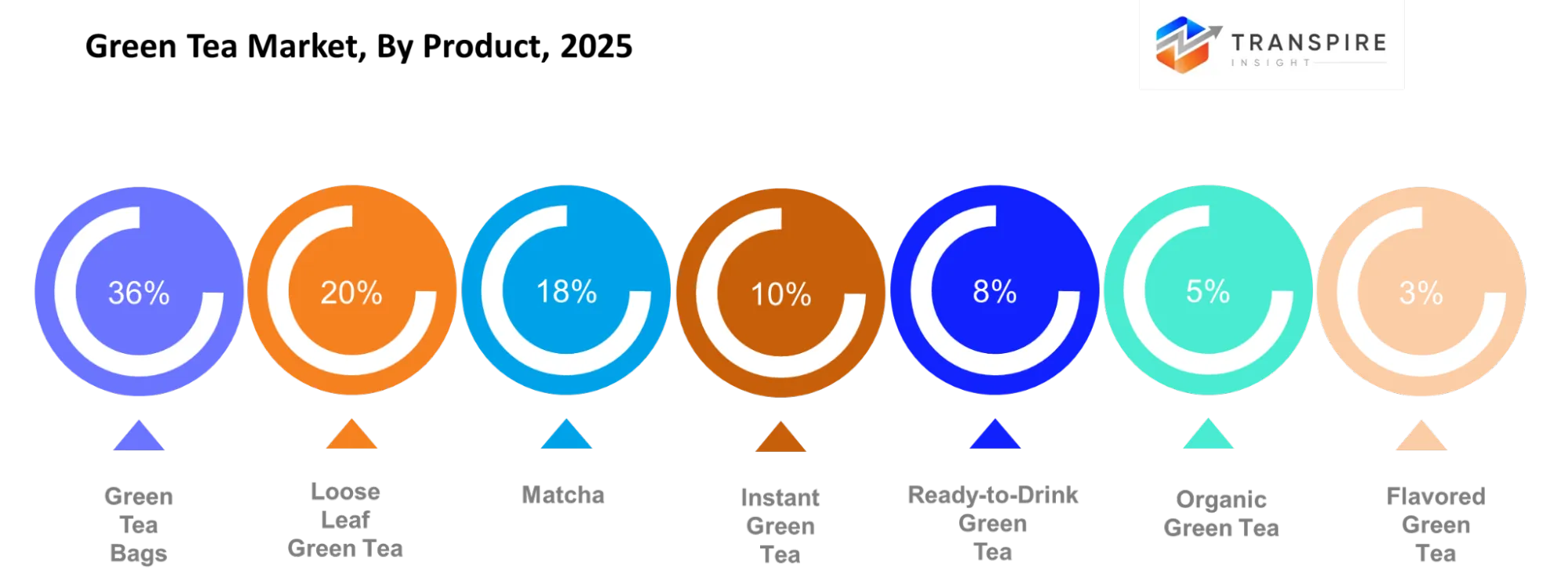
The Green Tea Bags dominated the market, accounting for nearly 40% in 2025 and is expected to rise at a significant CAGR during the forecast period.
The Green Tea Market is segmented by product type into Green Tea Bags, Loose Leaf Green Tea, Matcha, Instant Green Tea, Ready-to-Drink Green Tea, Organic Green Tea, Flavored Green Tea, Others. Among these, the Green Tea Bags segment dominated the market, accounting for nearly 40% in 2025 and expected to increase at a significant CAGR during the forecast period. As customer preference for practical, just-add-water tea items continues to increase, along with the recognition of the health benefits of green tea and its increased supply in the marketplace, green tea bags led the segment in 2025. The growth of certain products in this area will further benefit from the rising need for drinks that promote health and wellness, environmentally friendly packaging, and high-quality premium teas.
The Households dominated the market, accounting for nearly 39% in 2025, and is expected to rise at a significant CAGR during the forecast period.
The Green Tea Market is segmented by end user into Households, Cafés, Restaurants, Hotels, Offices, Wellness Centers, Food Manufacturers, Others. Among these, the Households segment dominated the market, accounting for nearly 39% in 2025 and expected to increase at a significant CAGR during the forecast period. In 2025, the household segment has emerged as the leading one in the market due to an increased interest in convenient, affordable, and health-promoting products by consumers. Growth in household consumption, rising knowledge concerning the advantages of products, and better availability of products in retail and e-commerce channels are expected to ensure high demand throughout the analyzed period.
The Dietary Supplements dominated the market, accounting for nearly 32% in 2025 and is expected to rise at a significant CAGR during the forecast period.
The Green Tea Market is segmented by application into Beverages, Functional Foods, Dietary Supplements, Cosmetics, Pharmaceuticals, Nutraceuticals, Others. Among these, the Dietary Supplements segment dominated the market, accounting for nearly 32% in 2025 and expected to increase at a significant CAGR during the forecast period. The dietary supplements sector dominated the market during the year of 2025, owing to rising health awareness, trends such as preventive healthcare, and increase in demand for nutritional products among consumers. The results of rising awareness regarding vitamins, minerals, and functional ingredients and greater availability of products via pharmacies, supermarkets, and e-commerce are expected to ensure positive growth of the market in the near future.
Regional Segment Analysis of the Green Tea Market:
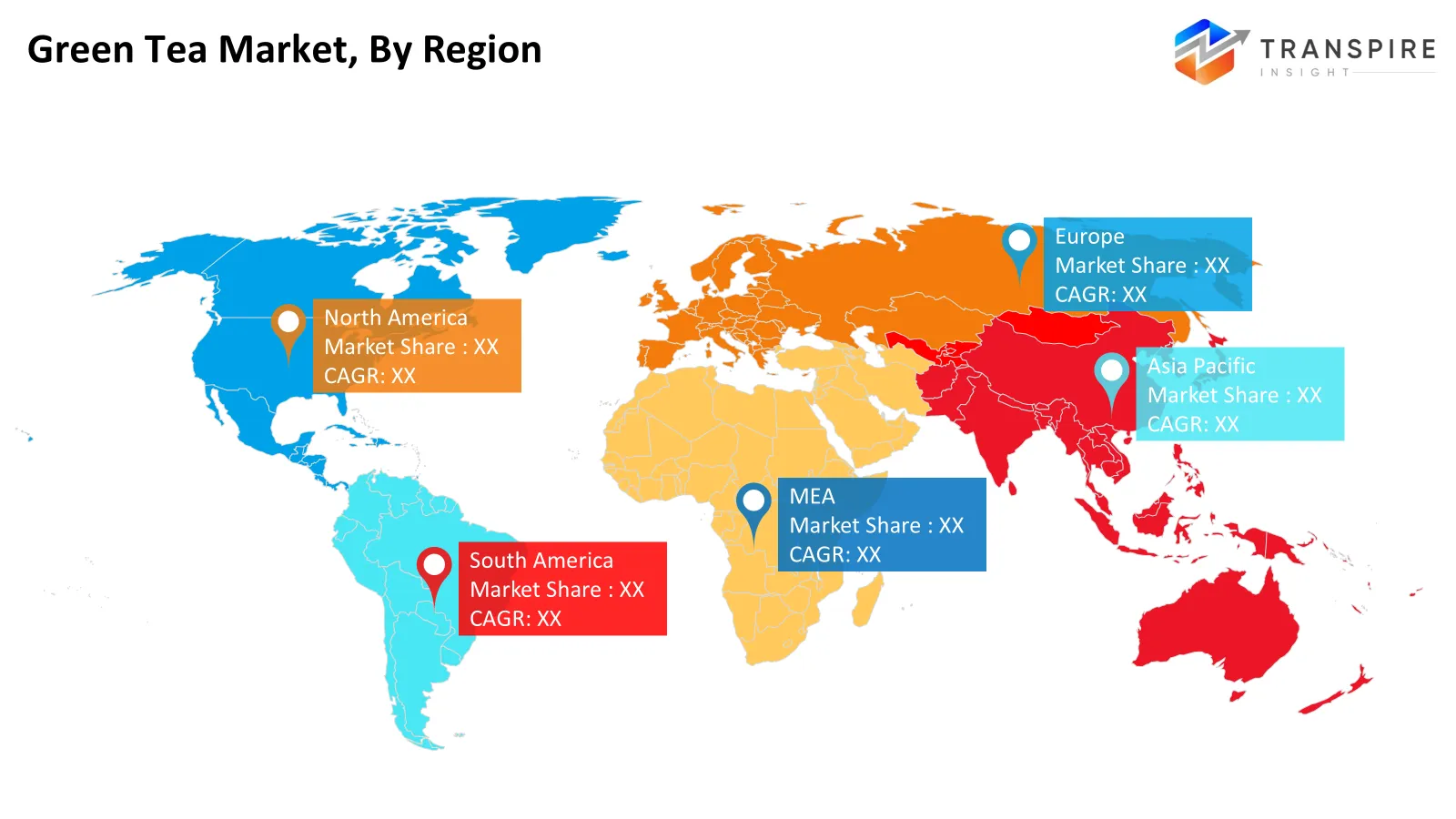
- North America (U.S., Canada, Mexico)
- Europe (Germany, France, U.K., Italy, Spain, Rest of Europe)
- Asia-Pacific (China, Japan, India, Rest of APAC)
- South America (Brazil and the Rest of South America)
- The Middle East and Africa (UAE, South Africa, Rest of MEA)
Asia Pacific is the fastest-growing region in the Green Tea Market during the period, holding around 36% share.
Asia Pacific is the fastest-growing region in the Green Tea Market during the forecast period, holding around 36% share during the forecast period. Asia Pacific is the most rapidly developing area in the worldwide market for green tea due to cultural acceptance, developed tea-drinking habits, and growing awareness of health benefits. The market is boosted by growing cities, increasing ways of making money, and the growing appetite for natural drinks, while e-commerce is helping to improve the accessibility of products.
North America is the fastest-growing region in the Green Tea Market during the period, holding around 25% share.
North America is expected to grow at a rapid CAGR in the Green Tea Market holding around 25% share during the forecast period. There is significant growth found in the green tea market in North America that can be attributed to increased awareness regarding health issues, demand for natural and functional beverages, and growing interest in wellness-oriented lifestyles. Moreover, the growth of the market in North America is further accelerated by large availability of products, innovation in premium green tea, and increasing accessibility through supermarkets, specialty stores, and online shopping platforms.
Europe is expected to grow at a rapid CAGR in theGreen Tea Market, holding roughly 18% of the share during the forecast period.
Europe is expected to grow at a rapid CAGR in the Green Tea Market holding roughly 18% share during the forecast period. The green tea market on a scale is likely to grow rapidly in Europe because of rising health awareness, higher demand for natural drinks, and more people embracing wellness-oriented life habits. Furthermore, the growth of the market in the region is supported by the rising number of top quality teas, new product formulas, sustainable packaging options, and wider distribution in retail and e-commerce channels.
Strategies for Market Growth in Non-Leading Regions:
Upgrading the growing areas of non-leading tea will entail sustainable green tea cultivation through cost-effective cultivation, processing and future production methods that will help local tea producers carry out tea farming and processing. By producing the green tea locally through establishing the production of green tea at the local level, imports will significantly reduce. Another aspect that must be taken into consideration is partnerships between tea business and local farmers, beverage companies, nutraceutical businesses, food-related corporations and dealers which will help producers to enter the market. To acquire new knowledge about green tea cultivation, processing, as well as about the quality control characteristics and product certification, there will be a need for conducting the seminars. In addition, the presence of various financing options, long-term contracts and manufacturing agreements will encourage consumers to buy the products.
Future Market Trends for the Green Tea Market: -
- Instances of Ready-to-Drink (RTD) Formats: The increasing popularity of ready-to-drink bottled and cold brew green tea beverages has risen to the point that it has become one of the fastest growing segments.
- Instances of Functional Infusions: Companies are infusing green tea with adaptogens, probiotics, minerals like zinc, and all kinds of superfoods like berries and turmeric for improving the immunization and digestive health.
- Instances of Premiumization and Single Origin: Consumers are becoming more conscious about organic certification and traceability and thus tend to buy loose leaves of origin and also matcha which is certain to be the best quality.
- Instances of Eco-Friendly Packaging: Sustainability trends impact the production processes leading to biodegradable tea bags and fewer plastics in packing.
- Instances of Cosmetic Crossovers: Green tea extracts are being utilized not only in drinks but also in the production of anti-aging and anti-inflammatory skin care products of clean label origin.
Recent Development
- In February 2026: TWG Tea established its presence in the Middle East with the opening of its first Flagship Salon and Boutique in Saudi Arabia. Located at Solitaire Mall in Riyadh; this new outlet is the fifth one in the region of GCC. The establishment of this outlet can be credited to the growing market for premium and specialty tea products, thus supporting the overall growth of Green Tea Market and contributing to luxury tea retailing premiumization and international market.
- In April 2026: The inaugural sparkling drink from the Pepsi Lipton Tea Partnership, Pure Leaf Mental Focus, was introduced in the U.S. market featuring naturally sourced caffeine from black tea along with L-theanine, a substance thought to ultimately enhance attentiveness and concentration levels. This introduction illustrates a rising need for easy-to-consume and wellness-based drinks including tea, thereby supporting the general trends of premiumization and innovations within the Green Tea Market.
- In April 2026: Dammann Frères officially opened a new manufacturing facility in Dreux, France. This facility covers an area of 26,500 square meters and enhances the efficiency of its blending, packaging, and distribution operations not only in France but also across Europe. The launch of this production facility will boost the company’s premium specialty tea segment. This move is in line with the current trends prevailing in the green tea industry.
Market Segment
This study forecasts revenue at , regional and country levels from 2020 to 2033. Transpire Insights has segmented the Green Tea Market based on the below-mentioned segments:
Green Tea Market, By Product Type
- Green Tea Bags
- Loose Leaf Green Tea
- Matcha
- Instant Green Tea
- Ready-to-Drink Green Tea
- Organic Green Tea
- Flavored Green Tea
- Others
Green Tea Market, By Distribution Channel
- Supermarkets & Hypermarkets
- Convenience Stores
- Online Retail
- Specialty Stores
- Tea Boutiques
- Foodservice
- Wholesale
- Others
Green Tea Market, By Packaging
- Tea Bags
- Pouches
- Cans
- Bottles
- Sachets
- Bulk Packaging
- Gift Packs
- Others
Green Tea Market, By End User
- Households
- Cafés
- Restaurants
- Hotels
- Offices
- Wellness Centers
- Food Manufacturers
- Others
Green Tea Market, By Application
- Beverages
- Functional Foods
- Dietary Supplements
- Cosmetics
- Pharmaceuticals
- Nutraceuticals
- Others
Green Tea Market, By Regional Analysis
North America
- US
- Canada
- Mexico
Europe
- Germany
- UK
- France
- Italy
- Spain
- Russia
- Rest of Europe
Asia Pacific
- China
- Japan
- India
- South Korea
- Australia
- Rest of Asia Pacific
South America
- Brazil
- Argentina
- Rest of South America
Middle East & Africa
- UAE
- Saudi Arabia
- Qatar
- South Africa
- Rest of the Middle East & Africa
Frequently Asked Questions
Find quick answers to common questions.
The market is projected to grow from USD 19.89 billion in 2026 to USD 29.66 billion by 2033, at 5.87% CAGR.
The Green Tea Bags segment dominates, accounting for nearly 40% share in 2025, driven by convenience, affordability, and accessibility.
Asia Pacific leads the market with approximately 36% share, supported by strong tea culture, health awareness, and rising consumption.
Health awareness, functional beverages, RTD innovation, premiumization, matcha popularity, organic products, and demand for natural alternatives drive market growth.
Key players include Unilever, Tata Consumer Products, Ito En, Nestlé, PepsiCo, Twinings, Dilmah, Lipton, Yogi Tea, and Bigelow Tea.
- Unilever
- Tata Consumer Products
- Ito En
- Nestlé
- The Coca-Cola Company
- PepsiCo
- Twinings
- Dilmah
- Bigelow Tea
- Celestial Seasonings
- Harney & Sons
- Lipton
- Numi Organic Tea
- Teavana
- Yogi Tea
About the Authors

Chetan Dhatrak
I’m Chetan Dhatrak, a Senior Research Analyst at Transpire Insight, specializing in the Consumer Goods, Foods and Beverages industry. I focus on analyzing market trends, consumer behavior, competitive landscapes, and industry developments to deliver accurate, data-driven insights. My research at Transpire Insight is built on credible sources and in-depth analysis, helping businesses and readers better understand market dynamics, emerging opportunities, and evolving consumer preferences. I’m committed to creating reliable, well-researched content that supports informed decision-making and reflects the latest developments in the consumer goods and food & beverage sectors.

Chakradhar Khansole
Chakradhar serves as the Research Director at Transpire Insight, bringing over 8 years of experience in technology, innovation, and strategic market intelligence. He specializes in transforming complex market data into actionable business insights that enable organizations to make informed, growth-oriented decisions. Recognized for his strategic vision and analytical expertise, Chakradhar leads high-impact research initiatives, delivering comprehensive market assessments, competitive intelligence, and forward-looking industry analysis.
Recently Published Reports
-
Apr 2026
Baby Infant Formula Market
Baby Infant Formula Market Size, Share & Analysis Report By ype (Infant Milk, Follow On Milk, Specialty Baby Milk, Growing-Up Milk), By Ingredient (Carbohydrate, Fat, Protein, Minerals, Vitamins, and Others), By Product Form (Powder, Liquid, and Ready-to-feed), By Distribution Channels (Supermarket/Hypermarket, Specialty Store, Pharmacies, Online Retail, and Others), and Geography (North America, Europe, Asia-Pacific, Middle East and Africa, South and Central America), 2021 - 2031
-
Apr 2026
Edible Insects for Animal Feed Market
Edible Insects for Animal Feed Market Size, Share & Analysis Report By Type (Insect Powder, Insect Meal, Insect Bar, Insect Paste, Insect Oil, and Others), By Insect Type (Beetles, Cricket, Caterpillar, Hymenoptera, Orthoptera, Tree Bugs, and Others), By Application (Livestock, Pet Food, and Aquaculture), By Livestock Type (Poultry, Swine, and Others), and Geography (North America, Europe, Asia-Pacific, Middle East and Africa, South and Central America), 2021 - 2031
-
Apr 2026
Food Industry Disinfection and Bacterial Control Market
Food Industry Disinfection and Bacterial Control Market Size, Share & Analysis Report By Type (Chemical Disinfectants, Physical Disinfectants, and Biocides and Antimicrobials), By Application (Food Processing Equipment Surface Disinfection, Food Preparation Areas Surface Disinfection, Storage Areas Surface Disinfection, Anti-microbial Coatings Food Preservation, and Preservative Solutions Food Preservation), By End User (Meat and Poultry Processing, Dairy Processing, Seafood Processing, Bakery and Confectionery, Restaurants and Commercial Kitchens, and Food Service Providers), By Sales Channel (Online, Offline), and Geography (North America, Europe, Asia-Pacific, Middle East and Africa, South and Central America), 2021 - 2031
-
May 2026
Freeze Dried Food Market
Freeze Dried Food Market Size, Share & Analysis Report By Product Type (Fruits, Vegetables, Freeze-Dried Dairy Products, Freeze-Dried Meat and Seafood, Freeze-Dried Pet Food, and Prepared Meal), By Nature (Organic, and Conventional), By Form (Powdered, Granules, and Diced), By End Use (Breakfast Cereals, Dairy Products, Bakery & Confectionery, Nutritional Bars & Supplements, Powdered Beverages, Snacks, and Retail (Household)), and Geography (North America, Europe, Asia-Pacific, Middle East and Africa, South and Central America), 2021 - 2031