

Global Web Development Outsourcing Services Market Size & Forecast:
- Global Web Development Outsourcing Services Market Size 2025: USD 1.62 Billion
- Global Web Development Outsourcing Services Market Size 2033: USD 2.62 Billion
- Global Web Development Outsourcing Services Market CAGR: 6.2%
- Global Web Development Outsourcing Services Market Segments: By Service Type (Frontend Development, Backend Development, Full-stack Development, CMS Development, E-commerce Development, Web Application Development, UI/UX Design, Others); By Deployment (Cloud-based Solutions, On-premise Solutions, Hybrid Solutions, SaaS Platforms, PaaS Platforms, API-based Solutions, Microservices Architecture, Others); By Enterprise Size (Large Enterprises, Medium Enterprises, Small Enterprises, Startups, Government Organizations, Educational Institutions, Non-profit Organizations, Others); By End User (IT & Telecom, BFSI, Healthcare, Retail & E-commerce, Manufacturing, Media & Entertainment, Government, Others); By Engagement Model (Dedicated Development Team, Fixed Price Projects, Time & Material Contracts, Staff Augmentation, Offshore Development, Nearshore Development, Hybrid Engagement, Others)

Global Web Development Outsourcing Services Market Summary
As per Transpire Insight Analysis, the Global Web Development Outsourcing Services Market size is estimated at USD 1.62 Billion in 2025 and is anticipated to reach USD 2.62 Billion by 2033, growing at a CAGR of 6.2% from 2026 to 2033. This digital engineering sector provides the external technical talent, specialized software engineering frameworks, and dedicated offshore development teams required to build, deploy, and maintain custom internet applications and enterprise digital portals. Over the past few years, an intense shortage of high-tier local programming talent alongside soaring corporate operational costs has forced enterprises away from maintaining oversized, in-house tech teams toward flexible vendor networks. This progression triggered a major structural shift as global firms transitioned to serverless microservices and distributed cloud architectures to bypass complex internal infrastructure buildouts. By utilizing external engineering squads to execute rapid software releases, businesses compress their time-to-market cycles and scale digital footprints efficiently without long-term local overhead.
Key Market Insights
The global web development outsourcing services landscape is transitioning from isolated, project-based engineering handovers toward continuous, cloud-native full-stack co-development partnerships. Driven by severe localized programming talent deficits and the imperative to deploy rapid digital touchpoints, enterprise brands are swapping traditional rigid pricing contracts for flexible, highly integrated offshore and nearshore agile teams.
- Locking down a dominant 36% market share, Full-stack Development leads the service type matrix, with global vendors like Cognizant expanding their engineering capacity to build interconnected frontend portals and complex server architectures simultaneously.
- Expanding at a market-leading standalone CAGR of 20.2%, AI-powered Web Development services dominate technology integration growth as enterprise IT leaders transition from traditional human-only coding sprints to automated, machine-learning-assisted code generation pipelines.
- Capturing a dominant 42% of total global revenue, North America functions as the largest regional market, backed by massive corporate digital modernization mandates and heavy software development demands from Fortune 500 corporations.
- Pacing regional market growth with an explosive standalone CAGR of 21.4%, Asia Pacific acts as the fastest-growing territory, fueled by a dense ecosystem of offshore engineering hubs across India and Southeast Asia executing large-scale digital transformations.
- Holding a stable 27% market slice, Europe drives strict system regulatory and data compliance, pushing web development outsourcing partners like Capgemini to embed comprehensive GDPR and localized data localization controls directly into remote software sprint frameworks.
- Securing 20% of total industry revenue, Frontend Development remains a vital pillar for user experience engineering, with digital brands accelerating their adoption of responsive React, Next.js, and Vue frameworks to optimize cross-platform consumer interfaces.
- Representing 16% of the service footprint, Backend Development faces heavy microservices modernization as engineering crews utilize specialized cloud-native API architectures to decouple legacy systems without creating operational downtime.
- Accounting for a targeted 11% slice of industry spending, E-commerce Development expands rapidly across the retail landscape, with companies like Infosys scaling modern, headless commerce architectures to maximize checkout conversion metrics globally.
- Holding a stable 8% market share, CMS Development drives automated corporate content deployment, pushing legacy enterprise networks to adopt decoupled, headless content management platforms that push localized assets instantly across global mobile and web storefronts.
- Securing a targeted 5% of total service demand, Web Application Development setups leverage advanced Progressive Web App (PWA) tools, with Accenture upgrading its core application development pipelines to deliver high-performance, offline-capable corporate software directly through web browsers.
What Are the Key Drivers, Restraints, and Opportunities in the Global Web Development Outsourcing Services Market?
Driver
The market expansion is heavily propelled by acute domestic programming talent deficits combined with intense corporate cost-optimization pressure to accelerate time-to-market metrics. Developing full-stack enterprise web portals internally places immense operational friction on corporate budgets due to high localized developer salaries and heavy onboarding overhead, pushing tech leaders toward external engineering networks. Global delivery partners mitigate these structural resource gaps by supplying highly qualified nearshore and offshore agile development squads that instantly integrate into existing enterprise workflows. This structural pivot in IT procurement directly increases software outsourcing contract values and platform subscription revenues as businesses aggressively scale cloud-based consumer applications while bypassing expensive domestic technical recruitment pipelines.
In April 2026, global technology consulting leader Infosys Limited officially demonstrated the financial impact of this macro talent reallocation, reporting full-year fiscal 2026 large deal wins reaching a massive total contract value of USD 14.9 Billion, representing a 28% expansion over the previous year. A major driver of this structural momentum was enterprise cost-optimization and legacy application migrations to modern microservices architectures. By deploying advanced AI foundation models to convert three million lines of legacy COBOL code for enterprise clients at a 60% lower cost and 60% quicker timeline than traditional methods, the performance underscores how major corporations are steadily expanding large-scale technology outsourcing contracts to drive engineering efficiency and platform modernization.
Restraint
Severe documentation fragmentation and complex architectural misalignments between external engineering providers and internal product managers act as a major structural barrier holding back rapid ecosystem scaling. When offshore development teams inherit poorly documented code bases, the resulting system compatibility bugs—such as unhandled API integration failures or broken offline data sync modules—demand continuous operational troubleshooting. This friction persists because legacy internal monolithic databases lack unified microservices connectivity, leading to frequent codebase communication lag times, delayed software deployment sprints, and bloated vendor remediation bills that depress initial outsourcing returns.
Opportunity
The most lucrative growth window lies in the deployment of AI-powered conversational code generation architectures and automated cloud-native DevOps pipelines optimized for continuous multi-tenant web application scaling. Fusing frontier LLM coding agents with distributed serverless computing frameworks allows remote engineering networks to instantly auto-generate cross-browser interface components and optimize backend database queries simultaneously. This technological shift unlocks highly profitable recurring managed services revenue across emerging enterprise sectors, where corporate clients willingly pay premium retainers for rapid, secure full-stack software upgrades that completely eliminate legacy server downtime.
What Has the Impact of Artificial Intelligence Been on the Global Web Development Outsourcing Services Market?
Artificial intelligence is completely reinventing the web development outsourcing services market, shifting standard engineering arrangements away from manual - time-intensive coding handoffs toward highly optimized, automated human-in-the-loop co-development cycles. Instead of requiring external front-end developers to meticulously write repetitive HTML or CSS components from scratch, engineering vendors deploy advanced multi-agent orchestration frameworks to translate abstract Figma wireframes directly into cloud-ready React code.
Inside high-velocity software delivery setups, built-in AI models drive operational improvements through predictive vulnerability tracking and automated test authoring. These algorithms continually evaluate real-time syntax generation, historical database queries, and system interface endpoints, predicting exactly where security vulnerabilities or severe application dependencies could break an active multi-tenant system. By anticipating these subtle software flaws, the system auto-generates custom unit tests and optimizes API routing tables, drastically compressing time-to-market metrics for enterprise clients.
However, a serious operational limitation persists around complex context-retention accuracy gaps and steep data governance alignment hurdles. Training agentic software layers on proprietary enterprise code bases requires extreme computational guardrails, creating intense integration friction when synchronizing remote AI models with older, heavily siloed legacy backend databases.
In June 2026, technology consulting pioneer Cognizant officially earned the prestigious PegaWorld 2026 Blueprint Pioneer Award, demonstrating its extensive mastery in utilizing enterprise agentic AI architectures across more than 30 complex digital transformations. This operational delivery model integrates advanced autonomous software development tools directly into unified enterprise architectures, enabling engineering crews to replace slow - manual legacy system modernizations with automated workflow comparison matrices. By utilizing these real-time agentic data loops to auto-map process steps and compress historical transformation timelines from months to days, the framework enables global clients to significantly maximize cross-platform development velocity while lowering total engineering overhead.
Key Market Trends
The global web development outsourcing services space is moving rapidly away from simple, transaction-bound body shopping and commodity labor toward value-driven, cloud-native co-development partnerships. Spurred by acute localized technical talent deficits and an enterprise push to deploy rapid customer-facing digital touchpoints, organizations are abandoning fragmented staff augmentation arrangements in favor of unified, outcome-based software delivery ecosystems.
- Corporate technology departments are shifting away from short-term developer staff augmentation to contract with dedicated, cross-functional agile squads that assume full end-to-end accountability for web platform product roadmaps.
- Software engineering networks are moving from legacy monolithic codebases to deploy cloud-native, serverless microservices architectures that allow discrete application components to be developed and updated independently by remote teams.
- Retail development teams are abandoning restrictive, all-in-one e-commerce platforms to adopt modular, headless commerce configurations that completely separate front-end consumer interfaces from back-end transactional engines.
- Enterprise architecture squads are transitioning from traditional manual web page layouts to implement automated, centralized design systems and component libraries to accelerate cross-platform software consistency.
- Procurement managers are stepping away from standard hourly time-and-materials billing models to demand outcome-based, milestone-linked service contracts that align vendor incentives directly with feature delivery speed.
- Digital product organizations are moving far past basic responsive web design to construct highly optimized Progressive Web Applications (PWAs) that deliver native app-like speeds and offline capabilities directly within mobile browsers.
- Security operations teams are abandoning late-stage, post-development vulnerability scans to embed automated security testing and threat modeling loops directly into continuous integration and continuous deployment (CI/CD) pipelines.
- Compliance officers are shifting from generic regional web audits to implement automated, real-time accessibility compliance monitoring modules to ensure digital portals adhere closely to strict global WCAG and ADA mandates.
- Front-end engineering cohorts are moving away from traditional static page serving to execute advanced edge-computing and server-side rendering (SSR) frameworks to minimize page-load latency across worldwide content delivery networks.
Global Web Development Outsourcing Services Market Segmentation
By Service Type
Full-stack Development commands the largest share of market capital, holding a dominant 36% of global revenue due to its end-to-end engineering capability, streamlined vendor management benefits, and extensive deployment across modern cloud architectures. Frontend Development follows at 20%, Backend Development holds 16%, E-commerce Development captures 11%, CMS Development accounts for 8%, while Web Application Development, UI/UX Design, and other custom services account for the remaining 9% of the total industry footprint. This division is shaped by the enterprise necessity for unified engineering logic that simultaneously addresses consumer-facing interfaces and server-side data frameworks. Full-stack Development maintains this peak position because mid-market enterprises and multinational brands seek to minimize communication silos and optimize engineering efficiency by utilizing single, multi-disciplinary vendor squads to deliver complete digital products. Moving forward, structural designs will pivot toward low-code hybrid architectures, forcing development partners to deploy advanced AI-assisted boilerplates that instantly auto-generate foundational stack configurations from simple natural language wireprints.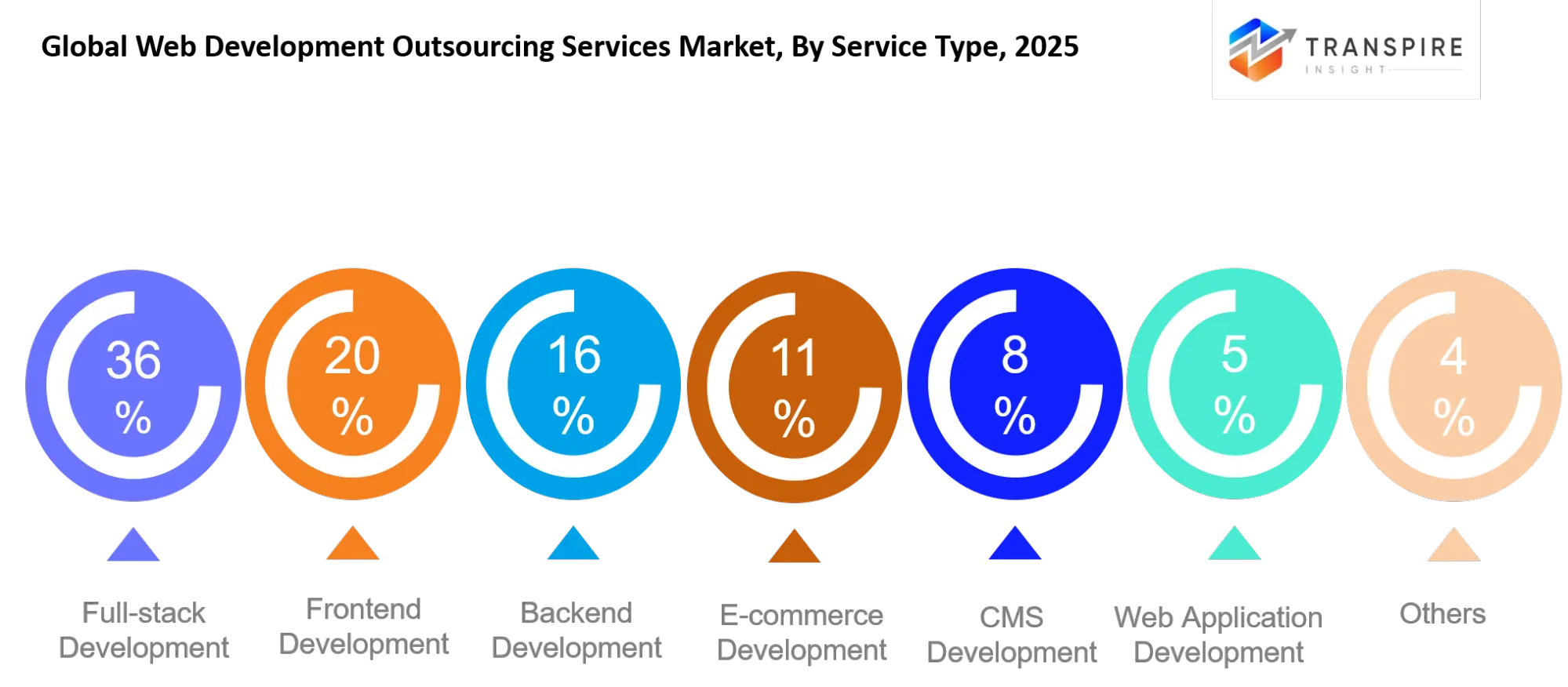
By Deployment
Cloud-based Solutions maintain a commanding grip on this segment, locking down a dominant portion of total industry revenue, while SaaS Platforms follow closely as the fastest-growing operational standard for modern enterprise architectures. Hybrid Solutions capture a stable secondary share, with PaaS Platforms, API-based Solutions, and Microservices Architecture expanding rapidly across complex, multi-tenant digital environments. The underlying growth logic relies on the corporate transition away from legacy, high-maintenance on-premise servers toward flexible, horizontally scalable cloud environments. Cloud-based Solutions lead the market position because global organizations require real-time application deployment, zero-downtime maintenance cycles, and instant global database replication across disparate regional nodes. Moving forward, deployment strategies will focus heavily on serverless edge computing, compelling outsourcing vendors to deliver ultra-low-latency distributed application control planes that calculate and push custom dynamic content to users within milliseconds of the initial web request.
By Enterprise Size
Large Enterprises command the largest share of market capital, holding a dominant position in global revenue due to the massive scale of international modernization budgets and multi-million-dollar legacy application overhauls. Startups follow as a highly volatile, rapidly accelerating secondary segment, while Medium and Small Enterprises present steady revenue baselines for localized development networks. This division persists because managing cross-border digital transformations and continuous software sprint pipelines requires deep engineering infrastructure and massive capital reserves. Large Enterprises maintain their peak position because multinational conglomerates must constantly re-architect complex internal workflows, integrate siloed databases, and secure multi-layered user authorization parameters across various global legal jurisdictions. Moving forward, the market will pivot sharply toward micro-outsourcing and fractional team models, enabling mid-market operators to easily deploy targeted software updates without funding long-term, large-scale enterprise retainers.
By End User
The IT & Telecom sector serves as the primary financial engine of the market, controlling massive external software engineering budgets as communications providers look to deploy high-performance user applications and multi-tenant self-service portals. Concurrently, BFSI, Healthcare, and Retail & E-commerce represent highly active, corporate buyers with strict system security parameters. The market dynamic here relies on the balance between optimizing customer digital acquisition pathways and ensuring ironclad data compliance. IT & Telecom leads because high-velocity communications networks require continuous frontend micro-features and automated billing API integrations to reduce consumer churn in intensely competitive consumer markets. Moving forward, market success will require a total pivot toward specialized domain-expert development squads, forcing engineering agencies to deliver pre-certified, industry-specific codebase frameworks that natively satisfy strict healthcare or financial transaction regulations right out of the box.
By Engagement Model
Dedicated Development Teams function as the undisputed anchor of this matrix, while Staff Augmentation stands out as the fastest-accelerating market driver, expanding at a high standalone CAGR as companies seek to plug immediate talent vacancies. Fixed Price Projects and Time & Material Contracts follow as critical operational standards for isolated, well-defined digital deliverables. This distribution pattern is driven by the macro shift away from transactional, hands-off software vendor arrangements toward highly embedded, long-term technical co-development alliances. Dedicated Development Teams lead the growth dynamic because complex modern web platforms require consistent product familiarity, continuous iteration cycles, and tight alignment with internal core architectural blueprints. Moving forward, model deployment will focus heavily on hybrid offshore-nearshore delivery grids, compelling software providers to orchestrate complex round-the-clock development pipelines that combine lower-cost offshore coding speed with highly synchronized nearshore product management oversight.
What Are the Key Use Cases Driving the Global Web Development Outsourcing Services Market?
Full-stack development engineering drives the bulk of this market because deploying interconnected frontend consumer interfaces and complex backend cloud server architectures concurrently requires unified, multi-disciplinary engineering logic. Enterprise technology groups configure these dedicated development teams following large-scale architectural modernization initiatives, allowing expanding corporate networks to safely transition legacy operations to modular frameworks without disrupting active production pipelines.
Outside core system re-architecting, cross-border banking squads leverage cloud-native managed services to implement hyper-secure B2B payment portals and digital onboarding pipelines. Because these complex systems require strict identity verification alongside airtight multi-tenant data isolation, financial institutions rely on specialized offshore engineering networks to build automated compliance modules that natively satisfy local financial regulations.
Lately, retail and global e-commerce groups are aggressively adopting headless commerce configurations and server-side rendering frameworks for customized digital storefront scaling. Corporate product teams deploy these modular, microservices-driven structures to decouple user-facing platforms from core transactional databases—enabling online retailers to dynamically optimize frontend speed and compress customer checkout latency to maximize conversion metrics worldwide.
|
Report Metrics |
Details |
|
Market size value in 2025 |
USD 1.62 Billion |
|
Market size value in 2026 |
USD 1.72 Billion |
|
Revenue forecast in 2033 |
USD 2.62 Billion |
|
Growth rate |
CAGR of 6.2% from 2026 to 2033 |
|
Base year |
2025 |
|
Historical data |
2021 - 2024 |
|
Forecast period |
2026 - 2033 |
|
Report coverage |
Revenue forecast, competitive landscape, growth factors, and trends |
|
Regional scope |
United States; Canada; Mexico; United Kingdom; Germany; France; Italy; Spain; Denmark; Sweden; Norway; China; Japan; India; Australia; South Korea; Thailand; Brazil; Argentina; South Africa; Saudi Arabia; United Arab Emirates |
|
Key company profiled |
Accenture, Cognizant, Tata Consultancy Services, Infosys, Capgemini, EPAM Systems, Globant, Wipro, HCLTech, Endava, Luxoft, ScienceSoft, Netguru, Ciklum, Tech Mahindra |
|
Customization scope |
Free report customization (country, regional & segment scope). Avail customized purchase options to meet your exact research needs. |
|
Report Segmentation |
By Service Type (Frontend Development, Backend Development, Full-stack Development, CMS Development, E-commerce Development, Web Application Development, UI/UX Design, Others); By Deployment (Cloud-based Solutions, On-premise Solutions, Hybrid Solutions, SaaS Platforms, PaaS Platforms, API-based Solutions, Microservices Architecture, Others); By Enterprise Size (Large Enterprises, Medium Enterprises, Small Enterprises, Startups, Government Organizations, Educational Institutions, Non-profit Organizations, Others); By End User (IT & Telecom, BFSI, Healthcare, Retail & E-commerce, Manufacturing, Media & Entertainment, Government, Others); By Engagement Model (Dedicated Development Team, Fixed Price Projects, Time & Material Contracts, Staff Augmentation, Offshore Development, Nearshore Development, Hybrid Engagement, Others) |
Which Regions are Driving the Global Web Development Outsourcing Services Market Growth?
North America maintains a commanding grip on the web development outsourcing services market, capturing a dominant 42% of all worldwide industry revenue. This geographic leadership is heavily driven by massive corporate digital modernization mandates combined with intense software engineering demands from Fortune 500 corporations seeking rapid digital transformations. The regional ecosystem is structurally supported by high concentrations of enterprise tech buyers who aggressively deploy serverless cloud infrastructures and decouple legacy application logic. Consequently, transitioning away from small, project-bound local development contracts toward long-term, distributed agile co-development frameworks has become the standard operational baseline for North American enterprises securing their digital infrastructure.
In June 2026, technology consulting pioneer Cognizant officially earned the prestigious PegaWorld 2026 Blueprint Pioneer Award, demonstrating its extensive mastery in utilizing enterprise agentic AI architectures across more than 30 complex digital transformations. This operational delivery model integrates advanced autonomous software development tools directly into unified enterprise architectures, enabling engineering crews to replace slow, manual legacy system modernizations with automated workflow comparison matrices. By utilizing these real-time agentic data loops to auto-map process steps and compress historical transformation timelines from months to days, the framework enables global clients to significantly maximize cross-platform development velocity while lowering total engineering overhead.
Europe serves as a highly stable, predictable secondary pillar for the global market, locking down an essential 27% share of total industry demand. While North American expansion is propelled by high-velocity enterprise software modernization and private tech spending, European web outsourcing adoption is shaped by rigid regional data compliance laws and severe local IT staffing gaps across traditional corporate hubs. This regional market stability is structurally insulated by long-term IT procurement models that prioritize absolute adherence to strict GDPR data sovereignty protocols and localized accessibility mandates. To minimize backend architectural vulnerabilities and navigate complex cross-border privacy regulations, continental engineering networks steadily invest in secure, dedicated nearshore delivery centers located across Eastern Europe.
In January 2024, global technology services leader Capgemini officially signed a multi-year strategic collaboration agreement with Amazon Web Services (AWS) engineered to optimize large language models via Amazon Bedrock to significantly reduce artificial intelligence production costs for global firms. This structural partnership focuses on launching specialized, industry-specific cloud tools and expanding Capgemini's network of AWS Centers of Excellence to train 30,000 employees in advanced engineering frameworks. By deploying these highly specialized technical squads to guide enterprise clients through complex legacy database conversions and code refactoring loops, the framework enables European organizations to execute secure, rapid software transformations at a lower total cost of ownership.
The Asia Pacific region has emerged as the fastest-growing territory globally, accelerating at a market-leading standalone CAGR of 21.4% while currently holding a 24% slice of global sales. This sudden structural shift is driven by massive government-led smart city infrastructure upgrades, rapid commercial e-commerce application expansions, and heavy investment in offshore software development centers. Historically, regional enterprises relied on maintaining oversized, high-cost internal tech support teams, but a rapid push toward smartphone-optimized mobile applications has forced the adoption of lean, agile external engineering networks. Looking ahead, future digital infrastructure development in this booming corridor relies heavily on deploying computerized microservices frameworks and deep API integration pipelines to securely anchor new financial and retail platforms.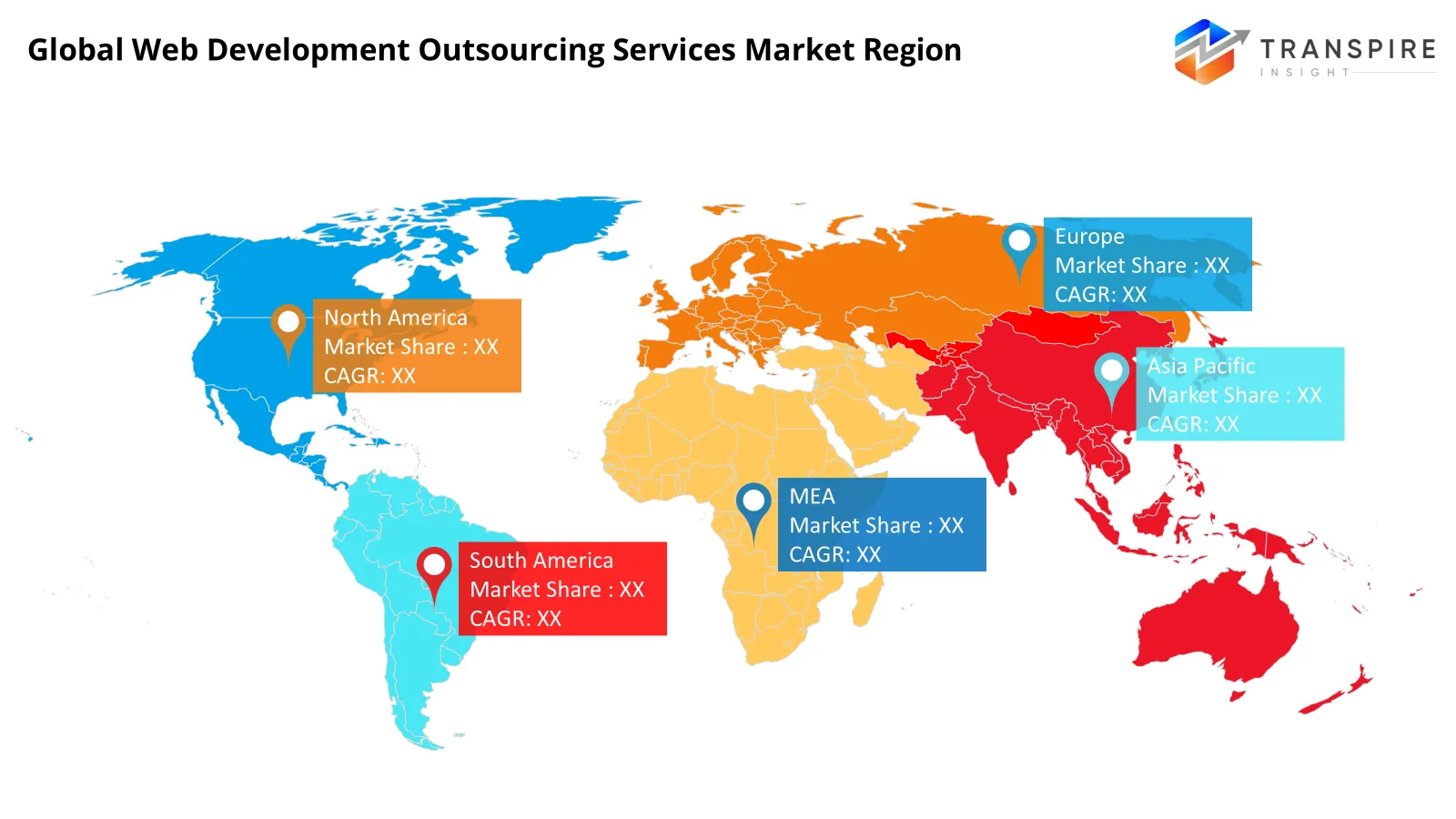
Who Are the Key Players in the Global Web Development Outsourcing Services Market and How Do They Compete?
The global web development outsourcing services space is an intense battleground contested by multi-billion-dollar technology consulting conglomerates - legacy offshore IT networks, and specialized digital platform engineering providers. With global organizations accelerating their transitions to modern serverless setups to capture shifting customer touchpoints, vendors compete on three operational fronts: engineering high-velocity full-stack frameworks, deploying autonomous agentic AI coding infrastructure, and providing certified multi-tenant data governance compliance architectures.
Accenture utilizes a massive scale-and-cost optimization strategy, positioning its extensive digital transformation business around hyper-automated legacy systems modernization and deep cloud infrastructure integrations. What makes them stand out is their proprietary AI-builder architecture and broad B2B ecosystem alliances, allowing them to systematically deploy automated code refactoring pipelines that completely eliminate technical debt across massive multi-brand corporate databases. The enterprise expands its global market footprint by deploying dedicated mid-market business structures like Accenture Edge to rapidly cross-sell automated software development services to expanding corporate sectors.
EPAM Systems runs a highly sophisticated technical innovation strategy focused squarely on complex cloud-native platforms, AI-native product engineering, and advanced customer experience transformations. The vendor differentiates its market presence by embedding its open-source GenAI enterprise orchestrator, DIAL, directly into remote co-development pipelines to enable distributed software engineers to generate clean, scalable code components. They expand their industrial footprint by value-engineering large-scale civil, retail, and life sciences digital ecosystems, embedding cross-functional agile development squads directly into client product management pipelines worldwide.
Company List
- Accenture
- Cognizant
- Tata Consultancy Services
- Infosys
- Capgemini
- EPAM Systems
- Globant
- Wipro
- HCLTech
- Endava
- Luxoft
- ScienceSoft
- Netguru
- Ciklum
- Tech Mahindra
Recent Development News
In May 2026, tech consulting multinational Wipro Limited wrapped up its acquisition of Mindsprint, the digital services business unit - agribusiness conglomerate Olam Group. This all-cash transaction absorbs over 3,200 specialized supply chain professionals and proprietary agricultural software IPs into Wipro's core engineering business, building immediate capacity to deploy automated, farm-to-fork web and logistics platforms for worldwide enterprise clients. [https://www.wipro.com/newsroom
In June 2026, professional services leader Accenture launched kind of a dedicated operating segment called Accenture Edge , to provide right sized software engineering and AI deployment pipelines , but specifically optimized for mid market firms bringing in between USD 300 Million and USD 3 Billion each year . The rollout, more or less, is meant as a commercial push that delivers standardized , ready to deploy digital core assets and cloud refactoring blueprints directly to mid tier enterprises. With this, they can dismantle legacy software code debt pretty quickly without taking on big scale enterprise overhead costs. [https://newsroom.accenture.com
What Strategic Insights Define the Future of the Global Web Development Outsourcing Services Market?
The web development outsourcing services market is heading toward full agentic and outcome-driven software co-delivery, where traditional hourly staff augmentation models dissolve into autonomous, multi-agent AI engineering networks managed by fractional product architects.
A significant hidden risk lies in "shadow code technical-debt accumulation." As remote vendors increasingly lean on generative AI tooling to hit hyper-aggressive feature sprint deadlines without rigorous structural documentation, clients inherit highly fragmented, non-standardized codebases that can trigger severe architectural failures or multi-tenant database synchronization crashes during system scaling.
Conversely - a major emerging opportunity is the development of localized, domain-specific regulatory compliance frameworks built straight into headless microservices architectures, enabling remote engineering teams to instantly guarantee airtight data localization and accessibility auditing for highly regulated enterprise clients.
Strategic recommendation - Technology leaders must transition away from legacy time-and-materials rate cards to implement milestone-based, outcome-linked service contracts backed by automated, real-time code quality gates to ensure architectural integrity while maximizing digital platform delivery velocity.
By Service Type
- Frontend Development
- Backend Development
- Full-stack Development
- CMS Development
- E-commerce Development
- Web Application Development
- UI/UX Design
- Others
By Deployment
- Cloud-based Solutions
- On-premise Solutions
- Hybrid Solutions
- SaaS Platforms
- PaaS Platforms
- API-based Solutions
- Microservices Architecture
- Others
By Enterprise Size
- Large Enterprises
- Medium Enterprises
- Small Enterprises
- Startups
- Government Organizations
- Educational Institutions
- Non-profit Organizations
- Others
By End User
- IT & Telecom
- BFSI
- Healthcare
- Retail & E-commerce
- Manufacturing
- Media & Entertainment
- Government
- Others
By Engagement Model
- Dedicated Development Team
- Fixed Price Projects
- Time & Material Contracts
- Staff Augmentation
- Offshore Development
- Nearshore Development
- Hybrid Engagement
- Others
Regional Outlook
North America
- United States
- Canada
- Mexico
Europe
- Germany
- United Kingdom
- France
- Spain
- Italy
- Rest of Europe
Asia Pacific
- Japan
- China
- Australia & New Zealand
- South Korea
- India
- Rest of Asia Pacific
South America
- Brazil
- Argentina
- Rest of South America
Middle East & Africa
- Saudi Arabia
- United Arab Emirates
- South Africa
- Rest of the Middle East & Africa
Frequently Asked Questions
Find quick answers to common questions.
The Global Web Development Outsourcing Services Market size was valued at USD 1.62 Billion in 2025 and is poised to reach USD 2.62 Billion by 2033, expanding at a 6.2% CAGR.
Key segments for the web development outsourcing services market are By Service Type (Frontend Development, Backend Development, Full-stack Development, CMS Development, E-commerce Development, Web Application Development, UI/UX Design, Others), By Deployment (Cloud-based Solutions, On-premise Solutions, Hybrid Solutions, SaaS Platforms, PaaS Platforms, API-based Solutions, Microservices Architecture, Others), By Enterprise Size (Large Enterprises, Medium Enterprises, Small Enterprises, Startups, Government Organizations, Educational Institutions, Non-profit Organizations, Others), By End User (IT & Telecom, BFSI, Healthcare, Retail & E-commerce, Manufacturing, Media & Entertainment, Government, Others), and By Engagement Model (Dedicated Development Team, Fixed Price Projects, Time & Material Contracts, Staff Augmentation, Offshore Development, Nearshore Development, Hybrid Engagement, Others).
Growth is primarily driven by acute domestic software engineering talent deficits, rising corporate overhead costs associated with local software teams, and intense pressure across consumer-facing industries to compress platform time-to-market metrics.
The global market is led by major manufacturers including Accenture, Cognizant, Tata Consultancy Services, Infosys, Capgemini, EPAM Systems, Globant, Wipro, HCLTech, Endava, Luxoft, ScienceSoft, Netguru, Ciklum, and Tech Mahindra.
North America holds a dominant 42% share of global revenue, heavily anchoring market dynamics due to widespread cloud-native legacy architecture overhauls and massive software application modernization spending across Fortune 500 corporations.
Highly lucrative commercial windows exist in deploying frontier AI-driven conversational code generation agents and automated cloud-native DevOps pipelines, alongside engineering specialized, pre-certified data localization and accessibility compliance modules for heavily regulated enterprise sectors.
- Accenture
- Cognizant
- Tata Consultancy Services
- Infosys
- Capgemini
- EPAM Systems
- Globant
- Wipro
- HCLTech
- Endava
- Luxoft
- ScienceSoft
- Netguru
- Ciklum
- Tech Mahindra
About the Authors

Mayur Shinde
I am Mayur Shinde, a Senior Research Analyst at Transpire Insight, specializing in the Automotive & Transportation and Information & Communication Technology (ICT) Industry. My work focuses on analyzing emerging market trends, technological advancements, competitive landscapes, and industry developments to deliver accurate, data-driven insights. I am passionate about transforming complex market information into clear, actionable content that helps businesses, professionals, and decision-makers stay informed and make confident strategic decisions.

Chakradhar Khansole
Chakradhar serves as the Research Director at Transpire Insight, bringing over 8 years of experience in technology, innovation, and strategic market intelligence. He specializes in transforming complex market data into actionable business insights that enable organizations to make informed, growth-oriented decisions. Recognized for his strategic vision and analytical expertise, Chakradhar leads high-impact research initiatives, delivering comprehensive market assessments, competitive intelligence, and forward-looking industry analysis.
Recently Published Reports
-
Apr 2026
3D Optical Profiler Market
3D Optical Profiler Market Size, Share & Analysis Report By Type (Desktop 3D Optical Profiler, and Portable 3D Optical Profiler), By Technology (Confocal Technology, and White Light Interference), By End-Use Industry (Manufacturing, Research Institutions, Automotive, Aerospace and Defense, Medical Devices, and Other), and Geography (North America, Europe, Asia-Pacific, Middle East and Africa, South and Central America), 2021 - 2031
-
Apr 2026
Depth Sensor Market
Depth Sensor Market Size, Share & Analysis Report By Type (Infrared Depth Sensors, Time-of-Flight (ToF) Sensors, Stereo Vision Sensors, Structured Light Sensors, Ultrasonic Depth Sensors), By Application (Automotive, Robotics, Gaming, Consumer Electronics, Industrial Automation, Healthcare, Security & Surveillance, Others), By End Users (Automotive Manufacturers, Consumer Electronics Companies, Healthcare Providers, Industrial Companies, Security Agencies, Gaming Companies, Robotics Companies, Others), and Geography (North America, Europe, Asia-Pacific, Middle East and Africa, South and Central America), 2021 – 2031
-
Apr 2026
Digital Manufacturing Market
Digital Manufacturing Market Size, Share & Analysis Report By Component (Hardware, Software, and Services), By Technology (Robotics, 3D Printing, Internet of Things (IoT), and Others), By Application (Automotive and Transportation, Aerospace and Defense, Consumer Electronics, Industrial Machinery, and Others), By Process Type (Computer-Based Designing, Computer-Based Simulation, Computer 3D Visualization, Analytics, and Others), and Geography (North America, Europe, Asia-Pacific, Middle East and Africa, South and Central America), 2021 – 2031
-
Apr 2026
Digital Visa Services Market
Digital Visa Services Market Size, Share & Analysis Report By Type (Individual Travelers, Group Travelers), By Application (Tourism, Business Travel, Others), and Geography (North America, Europe, Asia-Pacific, Middle East and Africa, South and Central America), 2021 – 2031