
Global Weather Data Service Market Size & Forecast:
- Global Weather Data Service Market Size 2025: USD 2.474 Billion
- Global Weather Data Service Market Size 2033: USD 4.436 Billion
- Global Weather Data Service Market CAGR: 7.57%
- Global Weather Data Service Market Segments: By Type (Forecasting Services, Climate Monitoring Services, Real-time Weather APIs, Satellite Weather Data Services, Marine Weather Services, Aviation Weather Services, Others); By Application (Agriculture, Aviation, Transportation & Logistics, Energy Management, Disaster Management, Others); By End-User (Government Agencies, Enterprises, Farmers, Airlines, Others); By Delivery Mode (Cloud APIs, Subscription-based Services, Mobile Platforms, IoT-integrated Services, Others).
Global Weather Data Service Market Summary:
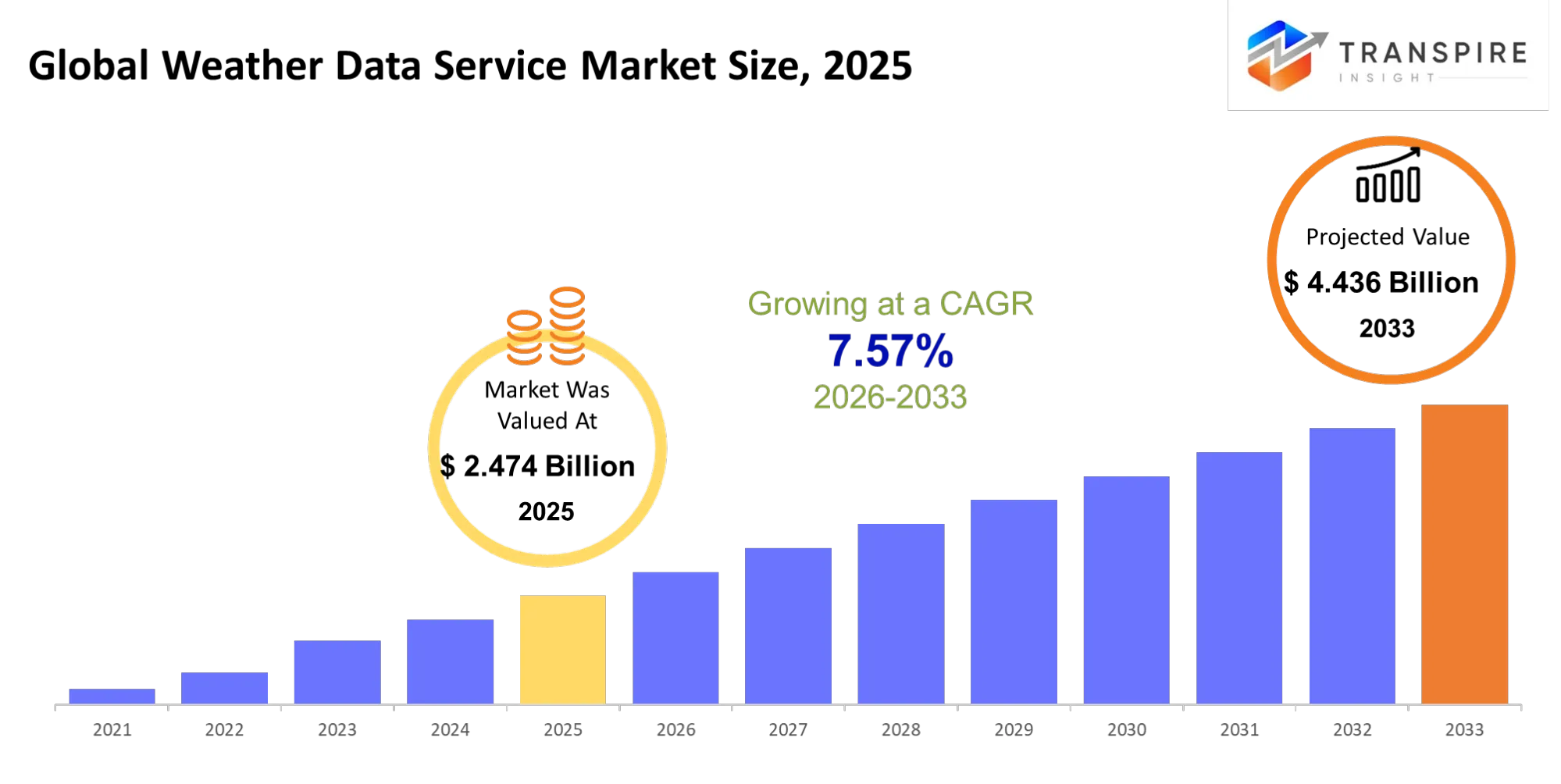
The Global Weather Data Service Marketsize is estimated at USD 2.474 Billion in 2025 and is anticipated to reach USD 4.436 Billion by 2033, growing at a CAGR of 7.57% from 2026 to 2033.
The market offers real-time weather intelligence, forecasting, climate analytics, and weather insights, which enable industries to make better decisions, minimize risks, and optimize their resources. In recent years, there has been a paradigm shift within the market, moving away from traditional forecasting mechanisms towards the use of AI-based prediction tools and hyperlocal weather sensing. One of the most important structural changes that have occurred is the adoption of Internet of Things, satellite technology, and machine learning to weather intelligence platforms. Climatic uncertainty, along with the increasing occurrence of extreme weather events, has been one of the driving forces behind the increased usage of weather analytics within organizations.
Global Weather Data Service Market Insights:
- Forecast data service accounts for almost 40% of the total market demand owing to the increasing use of predictive intelligence by organizations.
- The cloud delivery mode will contribute more than 60% to the total number of implementations due to the increasing demand for weather intelligence platforms based on APIs.
- The agriculture segment accounts for more than 20% contribution to the total utilization of weather data services.
- Applications of renewable energy sources are growing fast, as there are more investments being made in weather analytics due to increased utilization of solar and wind energy.
- Major companies in the sector have been incorporating AI and machine learning capabilities to enable better predictions with specific predictive models in the industries.
- Real-time weather API utilization is on the rise due to logistics, transportation, and supply chain businesses relying more on automation of decisions.
- Weather monitoring based on satellite utilization has become widespread thanks to technological advances that enable better data resolution.
- The market share in North America exceeds 35%, as a result of advanced digitalization, widespread use of analytics platforms, and enterprise adoption.
- There has been an increase in enterprises utilizing subscription services of weather intelligence software products.
What are the Key Drivers, Restraints, and Opportunities in the Global Weather Data Service Market?
Driver: The key factor behind the market growth for Weather Data Services is growing reliance on weather data to make decisions in various industries, such as agriculture, logistics, aviation, renewable energy, and insurance. Growing occurrences of extreme weather phenomena, climate change, and disruption in supply chains have spurred organizations to invest in weather forecast solutions. This is because companies are now trying to mitigate risks by predicting the impact of weather changes. The trend has positively affected the revenue of players who are providing services and subscriptions on weather platforms.
Restraint: One such constraint is the level of complexity and expensive nature of constructing the required infrastructure for weather prediction, which comprises satellite systems, sensors, radars, and computation capabilities. Some of the key difficulties faced by the industry include fragmented data sources, regional inconsistency in forecasting accuracy, and substantial funding demands. These constraints remain due to the need for continued infrastructure investment and availability of data sets.
Opportunity: One of the promising growth prospects is hyperlocal forecasts and climate intelligence technologies driven by artificial intelligence. The rise in spending on smart cities, solar plants, and agriculture requires specific forecasts based on location. Emerging markets in APAC and Latin America offer good possibilities for further development due to the growing deployment of digital technologies.
What Has the Impact of Artificial Intelligence Been on the Global Weather Data Service Market?
Influence of Artificial Intelligence on the Global Weather Data Service Market involves making weather forecasting highly accurate, fast, and providing for real-time decision-making among businesses that depend on the weather conditions. The AI tools analyze vast amounts of data acquired from satellites, radar systems, IoT devices, and climatic history databases to enable quicker and more accurate weather predictions than traditional models.
Automation and optimization have become the major benefits of using AI technologies in weather prediction. First, AI-based systems make processing large amounts of meteorological information faster and more effective by optimizing the weather forecasting process. Additionally, AI systems learn from mistakes made during previous weather forecasting operations and adjust future outputs accordingly.
Better predictive abilities have been realized via hyperlocal weather forecasting offered by advanced AI applications. Businesses get an opportunity to predict possible weather disruptions and plan their activities accordingly. Predictive technology is useful for businesses involved in logistics, agriculture, aviation, and renewable energy.
Another benefit realized by businesses is better operability through automated alerting and climate risk management analytics tools. In March 2026, several companies specializing in weather analysis launched new versions of their AI forecasting platforms. They improved weather prediction of storms and forecasted energy demand.
Global Weather Data Service Market Trends:
- Weather forecasting has moved away from regional forecasts towards hyperlocal forecast models that allow organizations to get more accurate local insight into future weather conditions.
- Over the last few years, organizations have started moving away from their infrastructure-heavy legacy systems towards cloud-based solutions for weather forecasting.
- Organizational approaches towards weather management have changed to be focused more on prediction and mitigation rather than simply managing weather events after they happen.
- With the advancement of AI and machine learning technologies, weather forecasting has transformed from static analysis into intelligent predictive systems.
- Usage of weather information has broadened its scope from being meteorologically oriented to include integration of APIs within logistics, agriculture, energy, and mobility systems.
- Traditional monitoring systems have been replaced with connected sensors and devices that collect weather data continuously.
- The trend of automating weather alerts is becoming more popular, especially for companies that value business resiliency during disruptions.
- Weather analytics has gained traction among renewable energy companies as a means to increase the accuracy of production forecasts and grid management processes.
- Climate risk analysis has become a trend in the weather industry, which means that weather information has been transformed from a forecasting tool to an enterprise application.
Global Weather Data Service Market Segmentation:
By Type
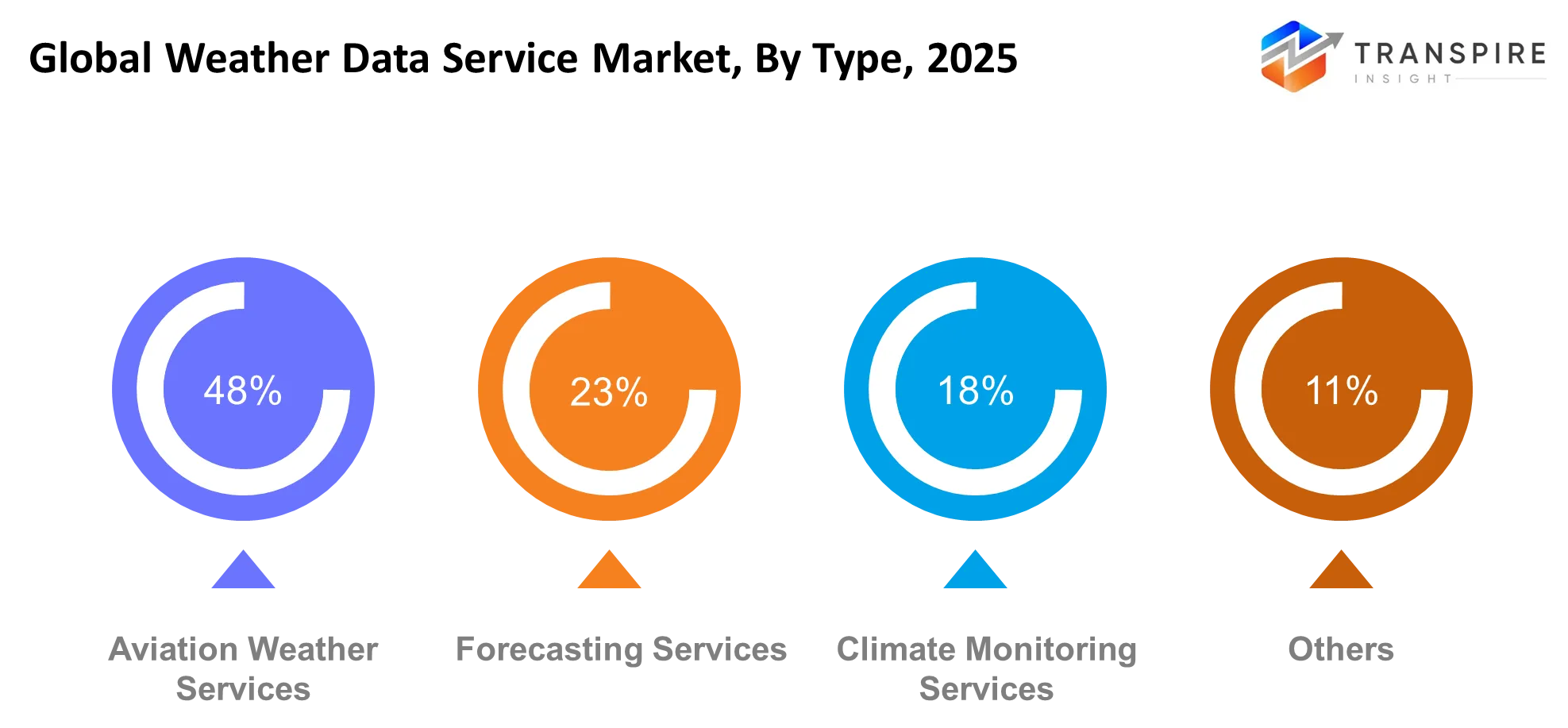
forecasting services have the greatest market presence since they are very important for making forecasts that reduce risks and increase planning capacity for companies. Development in this area is driven by improvements in models based on artificial intelligence technology and high-frequency data analysis, while development in the future will be associated with increasing the role of hyper-local forecasting solutions. Climate monitoring services grow because of increasing climate risk management needs and will become important in the sphere of sustainability and environmental monitoring. Weather APIs develop rapidly because of their integration into corporate platforms and their use in automated decisions. Satellite weather data services grow thanks to developments in remote sensing techniques, whereas marine and aviation weather services are essential because of regulations.
By Application
Agriculture is one of the key industries that embrace the technology owing to the impact of weather analysis on crop yields and efficient management of resources. The aviation and transport industry have begun incorporating weather intelligence in their practices to optimize routes and avoid interruptions. Energy management software usage is rising due to the need for weather prediction in renewable energy.
By End-User
The role of government departments as major users cannot be underestimated because of the forecast obligation and infrastructure development, but companies are moving more towards using subscription services for weather intelligence. Farmers are swiftly moving to precision agriculture systems, while airlines are still making significant investments in weather forecasting systems.
By Delivery Mode
The reason cloud-based APIs have become the way to go is that companies need scalable and easy-to-integrate solutions. Subscription-based offerings will keep growing because there will be a need for continuous analytics, while mobility services will improve access from the field. Services based on IoT integration will provide a great deal of value in the future.
What are the Key Use Cases Driving the Global Weather Data Service Market?
The main reason behind the demand for the Weather Data Services Market revolves around operational forecasting and risk management for industries such as agriculture, aviation, transport, and logistics where weather data can help optimize scheduling, mitigate disruptions caused by weather, enhance safety, and avoid business losses using intelligent decision making.
Some of the newer applications involve the use of weather data for energy management and logistics. Renewable energy providers are increasingly turning towards weather data services for forecasting solar and wind energy production. Logistics providers are leveraging weather insights for route optimization and better fleet management.
There are also many newer applications related to AI-based hyperlocal forecasting, smart city infrastructure, and IoT-based monitoring systems. Companies are now using automated systems for weather intelligence that offer real-time alerts and climate risk assessments along with intelligent operational response capabilities.
|
Report Metrics |
Details |
|
Market size value in 2025 |
USD 2.474 Billion |
|
Market size value in 2026 |
USD 2.661 Billion |
|
Revenue forecast in 2033 |
USD 4.436 Billion |
|
Growth rate |
CAGR of 7.57% from 2026 to 2033 |
|
Base year |
2025 |
|
Historical data |
2021 - 2024 |
|
Forecast period |
2026 - 2033 |
|
Report coverage |
Market size analysis, growth drivers, restraints, opportunities, competitive landscape, AI impact assessment, technology trends, regional outlook, segmentation analysis, and strategic developments. |
|
Regional scope |
North America, Europe, Asia Pacific, Latin America, Middle East & Africa. |
|
Key company profiled |
The Weather Company, AccuWeather, DTN, Tomorrow.io, Vaisala, Meteomatics, Weathernews Inc., StormGeo, OpenWeather, AerisWeather, Climacell, Skymet Weather, MeteoGroup, Earth Networks, NOAA. |
|
Customization scope |
Additional country-level analysis, company profiling, segment-specific insights, competitive benchmarking, and customized forecasting models available. |
|
Report Segmentation |
By Type (Forecasting Services, Climate Monitoring Services, Real-time Weather APIs, Satellite Weather Data Services, Marine Weather Services, Aviation Weather Services, Others); By Application (Agriculture, Aviation, Transportation & Logistics, Energy Management, Disaster Management, Others); By End-User (Government Agencies, Enterprises, Farmers, Airlines, Others); By Delivery Mode (Cloud APIs, Subscription-based Services, Mobile Platforms, IoT-integrated Services, Others) |
Which Regions are Driving the Global Weather Data Service Market Growth?
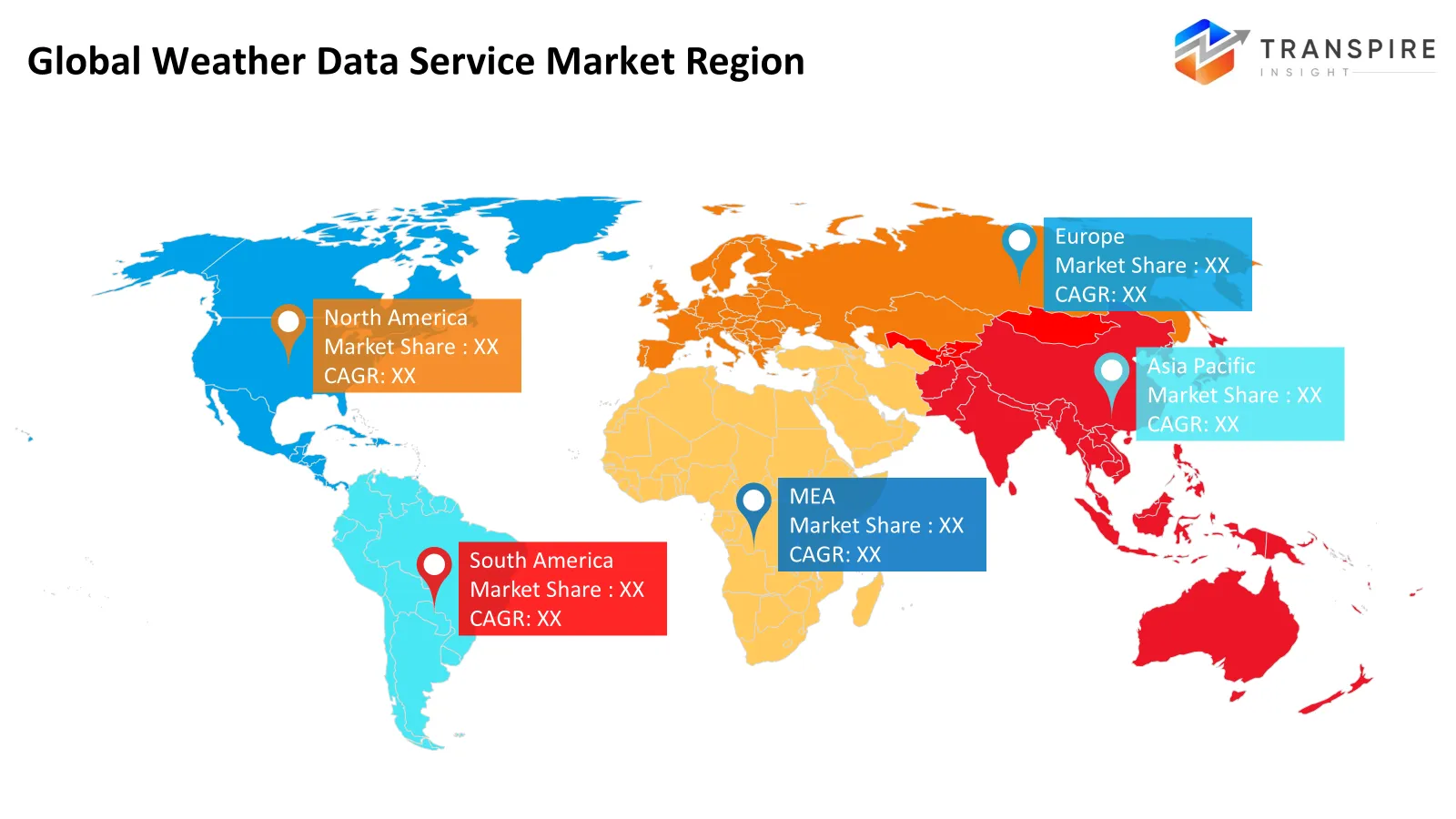
North America continues to dominate the Weather Data Services Market due to the well-developed infrastructure for monitoring the weather conditions, enterprise application of weather forecasting analytics, and the high degree of commercialization of weather intelligence solutions. In addition, the region boasts a large satellite network, cloud infrastructure, advanced institutions of meteorology, and robust investment in artificial intelligence-based forecasting solutions. In January 2026, growing investments in climate risk analysis and AI-based forecasting platforms enhanced the dominance of the region.
Europe forms the second-largest regional market, which is characterized by factors such as sustainability efforts, climate policies, and growth in renewable energy. Unlike North America, Europe's market has been influenced significantly by regulations and public-private collaborations in climate monitoring and adaptive measures. The adoption of renewable energy sources and weather monitoring across borders ensures sustained long-term adoption in different sectors. In March 2026, further investments in climate adaption programs and weather-related technologies contributed to regional market stability.
The Asia-Pacific region is becoming one of the fastest-growing markets due to growing digital infrastructure, climate vulnerability, and adoption of smart technology in developing nations. Some of the recent developments are increasing deployments of IoT-based monitoring solutions, smart agriculture solutions, and disaster management solutions which need real-time information about the weather.
Who are the Key Players in the Global Weather Data Service Market and how do they Compete?
The Competition in the Global Weather Data Service Market revolves around differentiation in terms of technology, level of prediction accuracy, ownership of data, and sector-specific service features instead of price wars. Businesses involved in the competition improve their performance by developing AI-based analytical capacities, increasing hyperlocal prediction accuracy, building APIs into enterprises’ operations, and enhancing satellite and sensor data networks. Subscription-based models and development of industry-specific services have become a prevalent trend.
The leading companies offering weather intelligence services such as weather analytics providers owned by IBM, platforms for forecast generation, satellite data providers, and API developers mainly engage in competition by employing innovative approaches. While some companies strive to use their predictive engine capacity and meteorological data sets for differentiating their products, others pay more attention to developing cloud-native solutions and thus accelerating the process of integration. Growth opportunities are mainly connected to collaboration with sectors like logistics, agriculture, renewable energy, and insurance.
Competitors are engaging in niche strategies by concentrating their efforts on specific applications like marine forecasting, aviation weather services, renewable energy solutions, or climate risk analysis. Businesses are increasingly relying on acquisitions, regional collaborations, API platforms, and building their capabilities in terms of satellite observation systems to build their positions in developing countries.
Global Weather Data Service Market Companies:
- The Weather Company
- AccuWeather
- DTN
- Tomorrow.io
- Vaisala
- Meteomatics
- Weathernews Inc.
- StormGeo
- OpenWeather
- AerisWeather
- Climacell
- Skymet Weather
- MeteoGroup
- Earth Networks
- NOAA
Recent Development News:
- In April 2026, SLR purchased the climate analytics platforms Planetrics and ClimSystems in order to enhance its climate modeling and digital weather intelligence. The purchase increased its climate risk analytics capability and enterprise-level forecasting capabilities.
- In February 2026, Tomorrow.io secured funding amounting to USD 175 million for the development of the AI-native DeepSky constellation of weather satellites. The funding improved weather forecasting through satellites and helped collect atmospheric data frequently.
What Strategic Insights Define the Future of the Global Weather Data Service Market?
The future of the Global Weather Data Service Market is moving beyond conventional weather forecasting models towards decision intelligence platforms where analytics around weather become directly integrated within systems. Going forward, growth in this market will be determined by the ability of service providers to use AI, IoT, satellite technology, and advanced analytics to generate high levels of local and industry-based insights.
The less obvious threat is the increasing reliance on accurate forecasts as companies automate their decisions through weather analytics. Even slight inaccuracies may translate into significant costs. However, an important upcoming opportunity is the use of climate intelligence services in areas such as renewable energy, smart cities, logistics, and infrastructure that continue to grow.
In terms of strategy, market players need to emphasize development of platforms with a particular industry focus over conventional weather forecast tools. Organizations that develop robust APIs, local forecasting abilities, and automation driven by AI in conjunction with expanded partnerships in weather-sensitive industries will benefit most.
Global Weather Data Service Market Segmentation:
By Type
- Forecasting Services
- Climate Monitoring Services
- Real-time Weather APIs
- Satellite Weather Data Services
- Marine Weather Services
- Aviation Weather Services
- Others
By Application
- Agriculture
- Aviation
- Transportation & Logistics
- Energy Management
- Disaster Management
- Others
By End-User
- Government Agencies
- Enterprises
- Farmers
- Airlines
- Others
By Delivery Mode
- Cloud APIs
- Subscription-based Services
- Mobile Platforms
- IoT-integrated Services
- Others
Regional Outlook
North America
- United States
- Canada
- Mexico
Europe
- Germany
- United Kingdom
- France
- Spain
- Italy
- Rest of Europe
Asia Pacific
- Japan
- China
- Australia & New Zealand
- South Korea
- India
- Rest of Asia Pacific
South America
- Brazil
- Argentina
- Rest of South America
Middle East & Africa
- Saudi Arabia
- United Arab Emirates
- South Africa
- Rest of the Middle East & Africa
Frequently Asked Questions
Find quick answers to common questions.
The Global Weather Data Service Market size was valued at USD 2.474 Billion in 2025 and is poised to reach USD 4.436 Billion by 2033, expanding at a 7.57% CAGR from 2026 to 2033.
Key segments for the Global Weather Data Service Market are By Type (Forecasting Services, Climate Monitoring Services, Real-time Weather APIs, Satellite Weather Data Services, Marine Weather Services, Aviation Weather Services, Others); By Application (Agriculture, Aviation, Transportation & Logistics, Energy Management, Disaster Management, Others); By End-User (Government Agencies, Enterprises, Farmers, Airlines, Others); By Delivery Mode (Cloud APIs, Subscription-based Services, Mobile Platforms, IoT-integrated Services, Others).
Growth is primarily driven by rising climate uncertainty, increasing adoption of AI-powered forecasting, growing demand for real-time weather intelligence, expanding renewable energy projects, and increased use of cloud-based APIs and IoT-enabled monitoring solutions.
The global market is led by major manufacturers including The Weather Company, AccuWeather, DTN, Tomorrow.io, Vaisala, Meteomatics, Weathernews Inc., StormGeo, OpenWeather, AerisWeather, Climacell, Skymet Weather, MeteoGroup, Earth Networks, NOAA.
Asia Pacific holds approximately 26% share of the Global Weather Data Service Market and significantly influences global market dynamics due to rapid digital transformation, increasing smart agriculture adoption, expanding renewable energy projects, and rising investments in climate monitoring infrastructure. The region’s strong growth is further supported by increasing IoT deployment, disaster management initiatives, and growing demand for real-time weather analytics across transportation, agriculture, and energy sectors.
Commercial opportunities include AI-powered forecasting, climate risk analytics, renewable energy forecasting, smart city weather monitoring, IoT-enabled weather solutions, and subscription-based weather API services.
- The Weather Company
- AccuWeather
- DTN
- Tomorrow.io
- Vaisala
- Meteomatics
- Weathernews Inc.
- StormGeo
- OpenWeather
- AerisWeather
- Climacell
- Skymet Weather
- MeteoGroup
- Earth Networks
- NOAA
About the Authors

Tejashri Dhatrak
I am Tejashri Dhatrak, a Senior Research Analyst at Transpire Insight, specializing in the Aerospace and Defence sector. My work focuses on analyzing industry trends, defence technologies, market developments, and emerging innovations that shape the global aerospace and security landscape. At Transpire Insight, I research complex topics, evaluate credible sources, and transform technical insights into accurate, well-structured, and easy-to-understand content for industry professionals and decision-makers. My goal is to provide reliable, research-backed information that helps readers stay informed about defence capabilities, aerospace advancements, strategic developments, and the evolving dynamics of the global defence ecosystem.

Chakradhar Khansole
Chakradhar serves as the Research Director at Transpire Insight, bringing over 8 years of experience in technology, innovation, and strategic market intelligence. He specializes in transforming complex market data into actionable business insights that enable organizations to make informed, growth-oriented decisions. Recognized for his strategic vision and analytical expertise, Chakradhar leads high-impact research initiatives, delivering comprehensive market assessments, competitive intelligence, and forward-looking industry analysis.
Recently Published Reports
-
Apr 2026
Aerospace Fluoropolymers Market
Aerospace Fluoropolymers Market Size, Share & Analysis Report By Type (PTFE, FEP, PFA, ETFE, and Others), By Application (Electrical Insulation, Seals & Gaskets, Coatings, and Others), By End User (Commercial Aviation, Military Aviation, General Aviation, and Others), and Geography (North America, Europe, Asia-Pacific, Middle East and Africa, South and Central America), 2021 - 2031
-
Apr 2026
Airborne SATCOM System Market
Airborne SATCOM System Market Size, Share & Analysis Report By Type (SATCOM Terminals, Transceivers, Airborne Radio, Modems and Routers, SATCOM Radomes, and Other), By Application (Government and Defense and Commercial), and Geography (North America, Europe, Asia-Pacific, Middle East and Africa, South and Central America), 2021 – 2031
-
Apr 2026
Ship Leasing Market
Ship Leasing Market Size, Share & Analysis Report By Vessel Type (Container Ships, Bulk Carriers, Tankers, and Specialized Vessels), By Lease Duration (Short-Term Lease (Less than 1 year), Medium-Term Lease (1-5 years), and Long-Term Lease (More than 5 years)), By Lease Type (Bareboat Charter, Time Charter, Financial Lease, and Others), By End-User Industry (Oil and Gas, Manufacturing and Industrial, Automotive, Agriculture and Food, Retail and Consumer Goods, and Others), and Geography (North America, Europe, Asia-Pacific, Middle East and Africa, South and Central America), 2021 – 2031
-
Apr 2026
Thread Rolling Dies Market
Thread Rolling Dies Market Size, Share & Analysis Report By Type (Flat Thread Rolling Dies, Circular (Cylindrical) Dies, Tangential Thread Rolling Dies, Planetary Thread Rolling Dies, and Other Types), By Material Type (High-Speed Steel (HSS), Carbide, Tool Steel, Alloy Steel, and Other Specialized Alloys), By Distribution Channel (Direct Sales, Distributors and Dealers, and Online Platforms), By Application (Automotive Industry, Aerospace and Defense, Construction and Infrastructure, Industrial Machinery, Electronics and Electrical Components, Medical Devices, and Fastener Production), and Geography (North America, Europe, Asia-Pacific, Middle East and Africa, South and Central America), 2021 – 2031
Our Clients





