

Global Voice and Language Intelligence Market Size & Forecast:
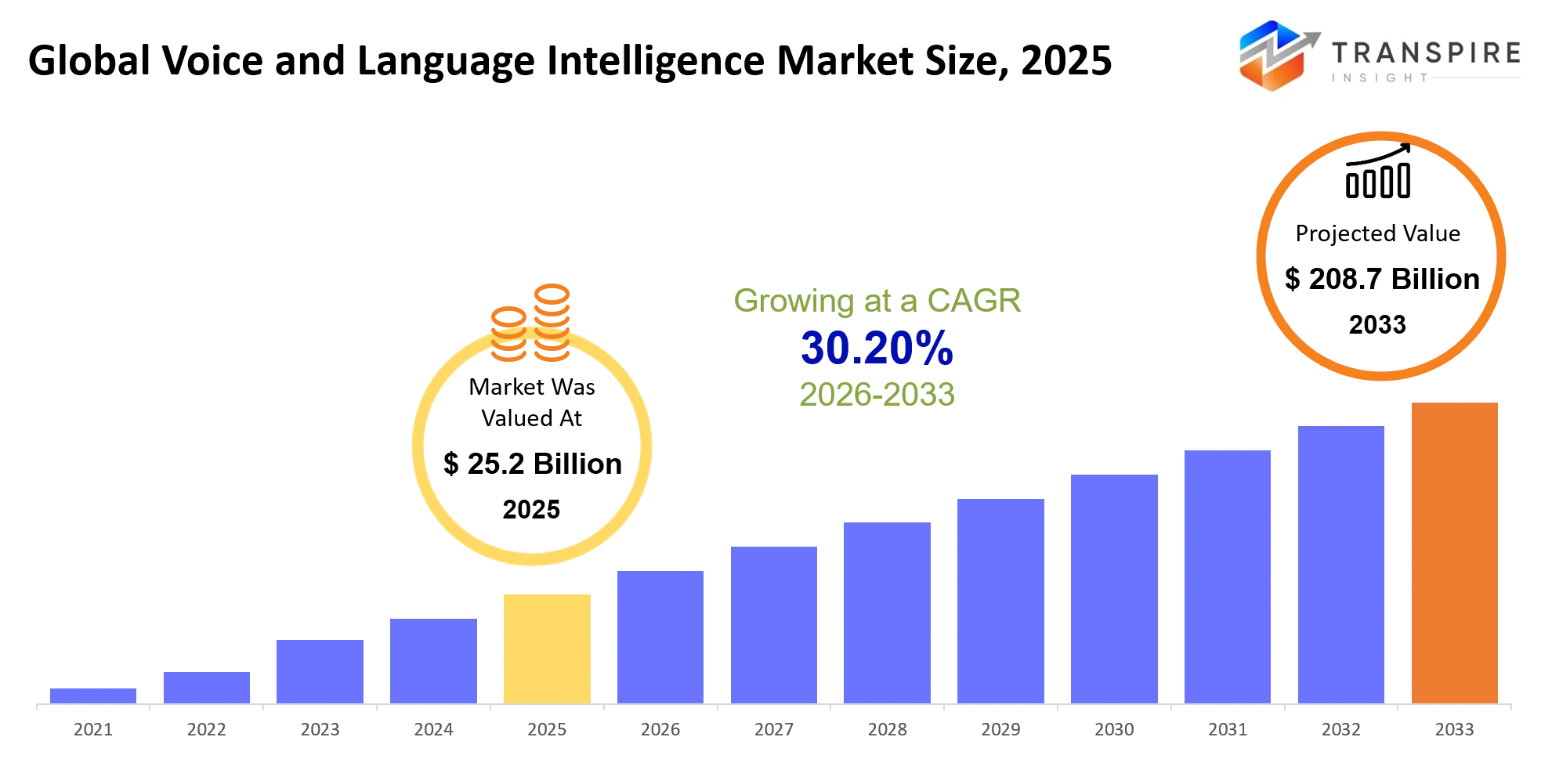
- Global Voice and Language Intelligence Market Size 2025: USD 25.2 Billion
- Global Voice and Language Intelligence Market Size 2033: USD 208.7 Billion
- Global Voice and Language Intelligence Market CAGR: 30.20%
- Global Voice and Language Intelligence Market Segments: By Component (Software, Services, Analytics, NLP Engines, Speech Recognition, Translation, Others); By Deployment (Cloud, On-Premise, Hybrid, Others); By Application (Customer Service, Healthcare, BFSI, Retail, Government, Others); By Technology (NLP, Speech Analytics, Conversational AI, Voice Biometrics, Others); By End User (Enterprise, SME, Public Sector, Others).
Global Voice and Language Intelligence Market Summary:
As per Transpire Insight Analysis, the Global Voice and Language Intelligence Market size is estimated at USD 25.2 Billion in 2025 and is anticipated to reach USD 208.7 Billion by 2033, growing at a CAGR of 30.20% from 2026 to 2033.
The ‘Global Voice and Language Intelligence Market’ has evolved from a phase of basic speech recognition and transcription to advanced intelligent platforms with the capability to process customer intents, sentiments, conversations and contextual flow across the customer journey and between employees/systems. The organisations are utilising the solutions for conversational AI, compliance enforcement, employee engagement and knowledge extraction out of unstructured voice and text inputs. Significant structural shifts in recent years, largely due to advancements in generative AI and LLMs, are transforming a category of primarily reactive, command-centric voice solutions to intelligent conversational AI. A critical Recent catalyst has been the accelerating deployment of conversational AI assistants and AI customer service automations throughout enterprise IT, which have created an insatiable appetite for real-time language intelligence. The growth is increasingly fueled by the demand for translating increasingly large volumes of conversational data into verifiable business value, real-time analytics, multilingual capabilities, and the ongoing drive for data-led insights to enhance decision making, improve CX, and optimise costs.
Key Global Voice and Language Intelligence Market Insights:
The market is moving from single-use speech processing solutions to enterprise workflows that integrate analytics, automation, and generative AI. Language understanding, predictive capabilities and autonomous decision-making are becoming commonplace across customer engagement, compliance and operational platforms as more technology providers start to integrate these features into their solutions.
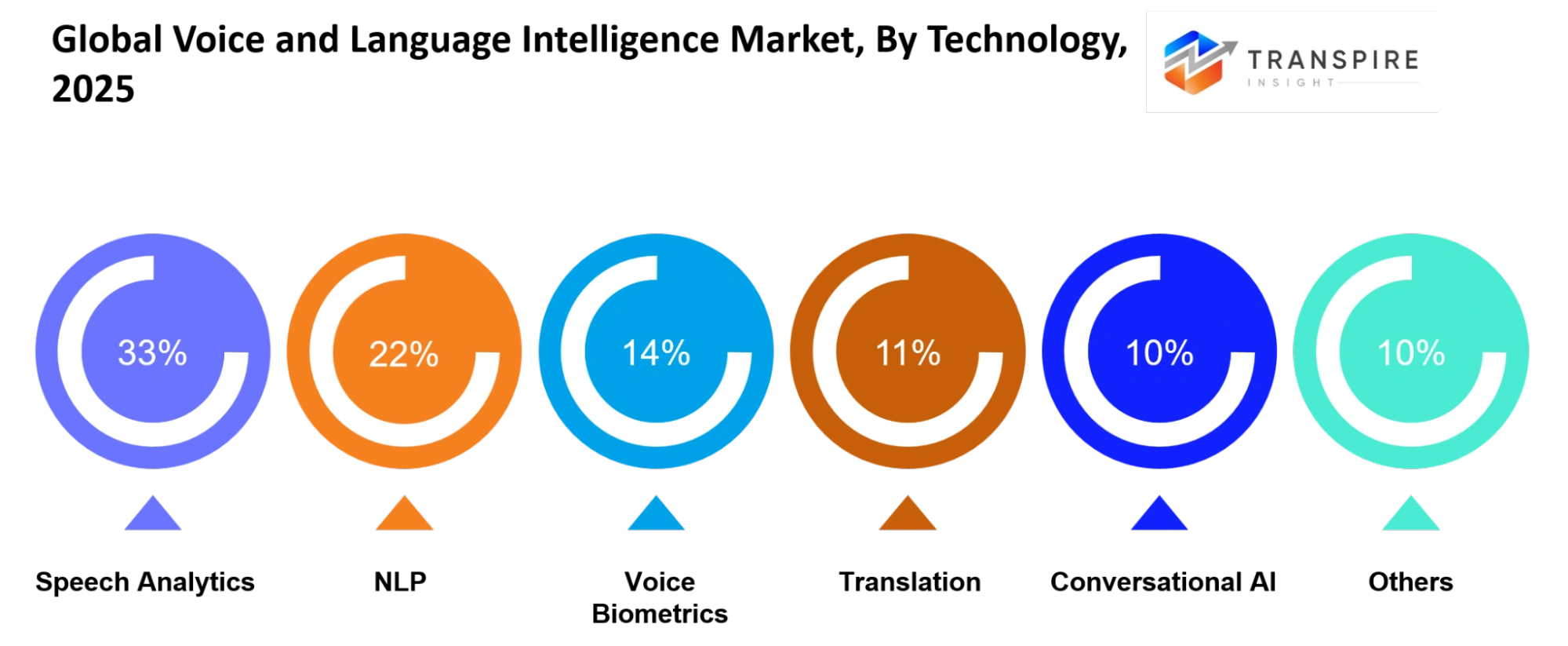
- Speech Analytics has 33% share, with NICE's Real-time Interaction Intelligence adding value as enterprises shift their focus to proactive Customer Experience Management.
- NLP represents 22% of the market, and Microsoft is rolling out contextual understanding and workflow automation powered by large language models.
- Voice Biometrics has a 14% share, as secure authentication solutions are growing in popularity due to the heightened need for preventing fraud.
- Translation solutions comprise 11%, while Google continues to build multilingual AI features for enabling global customer engagement and localisation strategies.
- Conversational AI captures 10% share and grows at 22.1% CAGR, with OpenAI driving adoption of AI agents and intelligent virtual assistants.
- North America dominates the market with 47% share, bolstered by the investments by Amazon and IBM in enterprise-grade conversational AI and cloud intelligence platforms.
- Customer Service continues to be the primary market, with Genesys and Five9 leading the AI-enhanced agent assist and automation in service orchestration.
- Enterprise end users have the biggest share, and Cisco, SAP and Oracle are integrating voice intelligence into wider digital transformation and business process ecosystems.
What are the Key Drivers, Restraints, and Opportunities in the Global Voice and Language Intelligence Market?
Driver:
The biggest growth engine is the adoption of conversational AI and real-time analytics across enterprises. Customers were enabled to analyse their conversations to uncover their intentions, predict churn, monitor compliance, and increase service quality. This intelligence translates into a direct impact on revenue via customer retention, conversion rates and cost savings. Banking, healthcare, telecommunications companies, insurance firms, and others are now leveraging voice intelligence to gain business insights from previously untapped voice customer engagement data, with a rise in thousands of daily analyses.
In June 2026, TELUS Digital announced a strategic partnership with ElevenLabs. This deployment scales enterprise customer care operations by making TELUS Digital a preferred implementation partner for the ElevenAgents voice AI platform.
Restraint:
Data Privacy and Compliance: The ability to ensure and prove data privacy while staying compliant is a hurdle. As language intelligence platforms may handle incredibly sensitive information, organisations do not tend to deploy these tools broadly. Moreover, policies related to storing customer data, consent mechanisms, and transferring data across borders add to the complexities. Multilingual, multicultural, multi-accent solutions also have complexities in model retraining to ensure efficacy, which further adds to costs.
Opportunity:
Significant potential awaits further development in the realm of multimodal intelligence platforms, a blend of voice, text, video and behaviour analysis that work together for smarter decision-making. Innovations such as those in generative AI, edge intelligence and specialised domain-specific language models are facilitating new, advanced business use cases. The health care industry is adopting AI for clinical documentation, for instance, with systems capable of automatically writing patient records from physician dialogues. Meanwhile, the growth of multilingual AI, used by diverse populations, will also benefit organisations from burgeoning Asian markets eager to access intelligence solutions with a tailored approach.
In January 2026, Insilico Medicine launched Science MMaI. This specialised multimodal generative AI system integrates domain-specific biological, chemical, and text datasets to accelerate automated analytical workflows and scientific documentation in highly specialised research environments.
What Has the Impact of Artificial Intelligence Been on the Global Voice and Language Intelligence Market?
AI fundamentally restructured the voice and language intelligence market, allowing for technologies to now focus beyond simply taking spoken words and transcribing them to actual intent understanding, prediction and actionable intelligence. Today, current AI systems process calls with contextual understanding in real-time; inferring customer intents, classifying emotions, creating conversational summaries and generating recommendations automatically. The capabilities from this are allowing the adoption and effectiveness of call summarisation, call centre analytics, compliance monitoring, quality management, and agent assistance for numerous industries, including customer services, financial, healthcare and enterprise applications.
With the integration of artificial intelligence, organisations have managed to enhance customer interactions, increase efficiency and lower operating costs through automation.
Companies utilising the tools to interpret the information collected are using intelligent systems that will automatically take spoken information and, not only transcribe it into words on a document, but also interpret its emotional tone. Forcing companies to adopt the technology that provides them with an enhanced quality of understanding, meaning an all-around more informed decision-making. In June 2026, NICE announced the commercial rollout of its next-generation native agentic AI architecture across its global customer experience platform. NICE Announces the Future of AI-Powered CX: Built-in agentic AI uses real-time CX data to automate decisions, understand customer sentiment, and streamline contact centre workflows.
Key Global Voice and Language Intelligence Market Trends:
Speech recognition applications are giving way to enterprise intelligence solutions that transform speech into strategic business insights. Contextual understanding, automation and multi-lingual functions are becoming more important than stand-alone transcription.
- Voice analytics platforms have shifted from analysing calls after the fact to intervening in the call and making decisions in real-time.
- From manual quality monitoring to automated coaching systems and conversation intelligence, contact centres are evolving.
- Large language models have replaced rule-based NLP methods to provide more contextual understanding.
- Multilingual intelligence platforms are becoming more popular among enterprises to back up global customer engagement strategies.
- Sentiment analysis has gone beyond measuring customer experience, moving into predictive risk and churn analysis.
- The scalability and regular model updates make cloud deployments the preferred alternative to on-premise deployments.
- Conversational data is being increasingly connected with CRM, ERP, and business intelligence for consolidated analytics.
- Voice biometrics is not only used for authentication but also for fraud detection and security monitoring.
- From one-off voice analytics initiatives to enterprise-wide conversational intelligence ecosystems that empower multiple business functions.
Global Voice and Language Intelligence Market Segmentation
By Component:
The largest category by market share 33% was speech analytics, which benefits from offering clear customer insights and facilitating compliance. NLP came in at 22% with a strong demand for linguistic comprehension and automated intelligence. 14% of the market was voice biometrics (driven by a growing demand for security features), with translation taking 11%. The smallest category is Conversational AI, 10%, but it is currently the fastest-growing sector and is predicted to continue growing 22.1% year over year due to a huge demand for AI agents and automation platforms.
By deployment:
Cloud is a favoured deployment for scaling, cost efficiencies in hardware and delivering perpetual innovation in our AI models. Hybrid has also risen in prominence, with many in the market focused on an equilibrium between adaptability and their need to maintain control over sensitive data. The future direction will be dominated by the continued deployment of cloud architectures with additional industry-specific variations in the years to come.
By Application:
A large segment across the globe is seeing widespread deployment of conversational analytics, agent-assisted capabilities and automated engagement tools are prevalent. Healthcare, BFSI, Retail and Government industries are increasing adoption for improved decision making, compliance and increased operational effectiveness. - New opportunities will be through AI industry specialised solutions that can drive business value.
By Technology:
Software remains leading with a substantial market size. Other solutions, such as services, analytics, NLP engines, Speech Recognition and Translations assist with implementation and customisations, and the advanced language processing solutions.
By End-User:
Enterprise uptake is large as a consequence of substantial AI expenditure, and with SMEs and Public Sector organisations, the use of both voice and language intelligence capabilities is starting to proliferate as a means of augmenting and enhancing their productivity, accessibility and service delivery.
What are the Key Use Cases Driving the Global Voice and Language Intelligence Market?
The top use case is still contact centre customer interaction analytics, where companies analyse voice interactions for better service, compliance, agent experience and retention in the banking, financial services and insurance (BFSI), telecom and retail industries. This use case makes up the bulk of deployments in this technology.
New opportunities have emerged in areas such as healthcare documentation, risk monitoring for financial institutions, employee productivity measurement and corporate knowledge management, as businesses use language intelligence to automate transcripts, summarise meetings and identify opportunities for the business.
Advanced usage examples are virtual assistants powered by AI, voice biometrics and voice for fraud, and creating legal documents, as well as in clinical support. Generative AI technologies for such areas as conversation search and auto content creation, human-machine partnerships and others.
|
Report Metrics |
Details |
|
Market size value in 2025 |
USD 25.2 Billion |
|
Market size value in 2026 |
USD 32.9 Billion |
|
Revenue forecast in 2033 |
USD 208.7 Billion |
|
Growth rate |
CAGR of 30.20% from 2026 to 2033 |
|
Base year |
2025 |
|
Historical data |
2021 - 2024 |
|
Forecast period |
2026 - 2033 |
|
Report coverage |
Revenue forecast, competitive landscape, growth factors, and trends |
|
Regional scope |
United States; Canada; Mexico; United Kingdom; Germany; France; Italy; Spain; Denmark; Sweden; Norway; China; Japan; India; Australia; South Korea; Thailand; Brazil; Argentina; South Africa; Saudi Arabia; United Arab Emirates |
|
Key company profiled |
Google, Microsoft, Amazon, IBM, NICE, Verint, Nuance, OpenAI, SoundHound, Speechmatics, Genesys, Five9, Cisco, SAP, Oracle. |
|
Customization scope |
Free report customisation (country, regional & segment scope). Avail customised purchase options to meet your exact research needs. |
|
Report Segmentation |
By Component (Software, Services, Analytics, NLP Engines, Speech Recognition, Translation, Others); By Deployment (Cloud, On-Premise, Hybrid, Others); By Application (Customer Service, Healthcare, BFSI, Retail, Government, Others); By Technology (NLP, Speech Analytics, Conversational AI, Voice Biometrics, Others); By End User (Enterprise, SME, Public Sector, Others). |
Which Regions are Driving the Global Voice and Language Intelligence Market Growth?
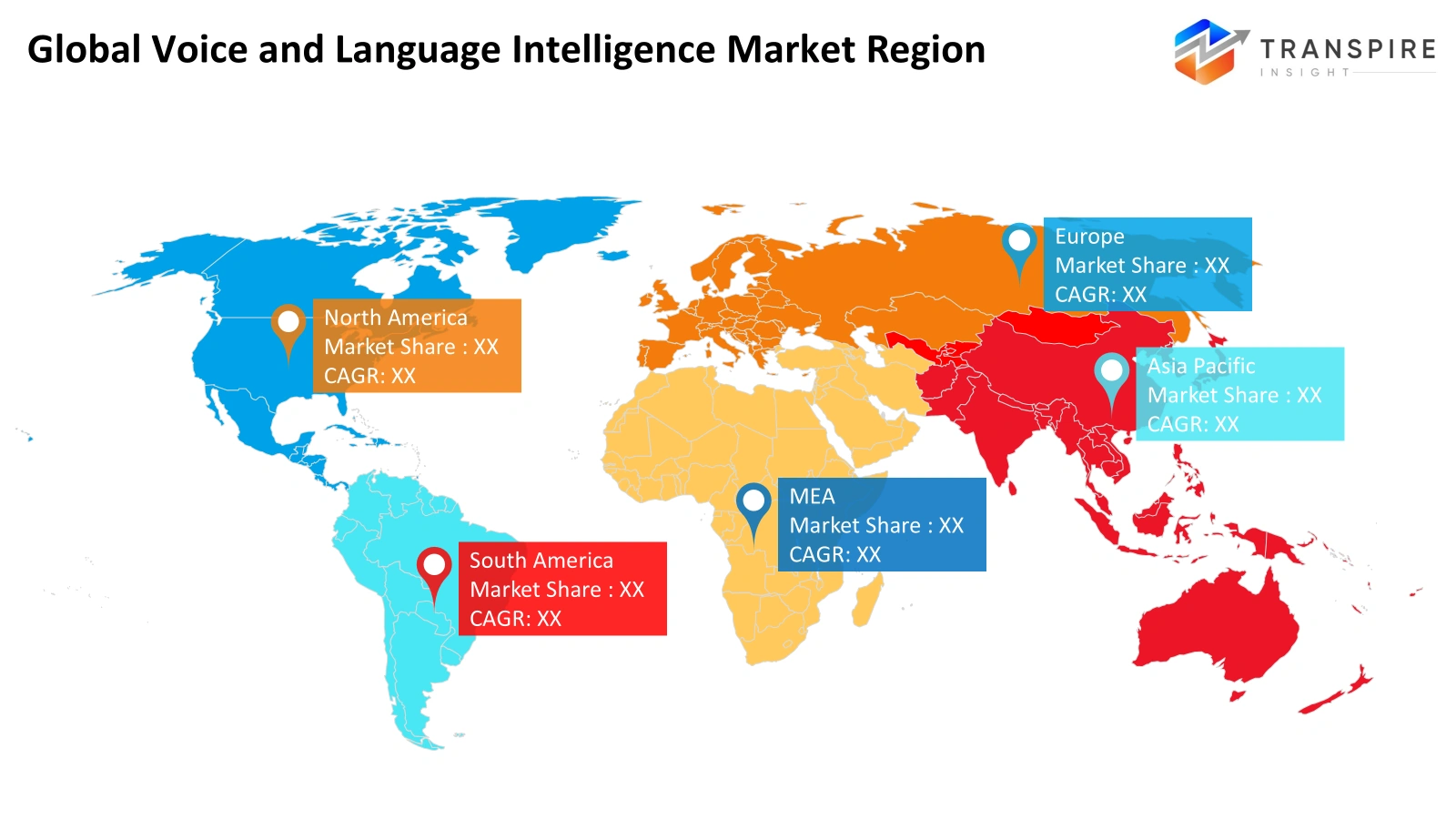
North America accounted for a commanding 47% of the global market share because it possesses one of the earliest AI mature ecosystems, major business technology and spending across large companies and cloud/software majors concentration. Early adoption and penetration with many industries, such as customer service, financial service and healthcare, to deploy virtual agents/chatbots in addition to advanced technology and cloud deployments, drives sustained rapid adoption. With increasing innovation of research into AI and automation, companies are positioned to lead. Europe represents 24% of the market and has robust growth powered by regulatory mandate, multi-national businesses and digital transformations. The market is more aligned with the North region by governance, data privacy, and operational transparency factors than economic stimulation or consumer demand factors. Many organisations implement this for the sake of compliance while increasing user engagement and customer data insights. Given the maturity of the industry and financial services sectors in this area, sustainable growth is predictable.
In June 2026, GreenDot and Osapiens formed a strategic partnership. This collaboration delivers an AI-powered Extended Producer Responsibility (EPR) compliance solution across Europe to help multi-national businesses handle complex operational regulatory mandates before the EU AI Act takes full effect.
The Asia Pacific is the fastest-growing regional market with a CAGR of 23.5%. Increased digitalisation, adoption of cloud technologies and the demand for regional languages in various services are all attributed to the rapid change of region in recent times. Various regional governments and authorities are also investing in regional AI and multilingual digital services infrastructure for the huge population base in these countries. Future potential lies in enhanced enterprise use cases of AI, smart governance, and regional language intelligence capability.
Who are the Key Players in the Global Voice and Language Intelligence Market and how do they Compete?
AI invention is taking place rapidly across several facets, including the integration of an AI ecosystem, focus on vertical applications, enterprise, scale, and more. We expect vendors to shed solitary speech functions and embrace integrated AI with an end-to-end conversational intelligence offering that includes analytics, process automation, generative AI, and full workflow integration to derive consistent and quantifiable business impact, safely and cost-effectively. Security, compliance, and multilingual capability are givens.
Google, Microsoft, Amazon, OpenAI, and IBM harness the power of sophisticated AI and cloud offerings to provide scalable and enterprise-level speech recognition, language understanding and automation. Microsoft continues to drive adoption with its integration in the productive ecosystem; Amazon highlights native cloud voice services and contact centre functions; OpenAI pushes the envelope on conversational AI and generative modelling; and IBM brings its governance-focused approach for the regulated sector. Specialised cloud providers (NICE, Verint, Nuance, Genesys, Five9, Cisco, SAP, Oracle, SoundHound and Speechmatics) differentiate with an industry focus, operational and productivity data for specialised workflows and solutions in the enterprise. NICE and Verint extend CX analytics and workforce automation features; Nuance has an established stronghold in healthcare documentation and workflow Automation; Genesys and Five9 further enhance cloud-based contact centre offerings, where Cisco builds in voice intelligence to enterprise communications and SoundHound and Speechmatics focus on multilingualism, specialised voice assistant technology, respectively.
Key Players are:
- Microsoft
- Amazon
- IBM
- NICE
- Verint
- Nuance
- OpenAI
- SoundHound
- Speechmatics
- Genesys
- Five9
- Cisco
- SAP
- Oracle.
Recent Development News
In January 2026, SoundHound AI, Inc. formed a strategic integration partnership with navigation giant TomTom. This deployment introduces SoundHound's advanced Amelia 7 agentic voice intelligence platform across international vehicle dashboards, enabling drivers to use conversational.
Source: https://finance.yahoo.com
In February 2026, ARTPARK @IISc, Digital Futures Lab, and legal firm Trilegal collectively launched the Voice Technologies Policy Report and Developers' Toolkit at the India AI Summit. Backed by the Digital India BHASHINI Division, this software framework establishes standardised data-governance models to accelerate the development of open-source.
Source: https://www.pib.gov.in
In February 2026, SoundHound AI launched its commercial "Sales Assist" agentic platform at Mobile World Congress (MWC). This software implementation uses a scalable multi-agent orchestration architecture to automate complex business workflows across retail, SMS, and telecommunications contact centres.
Source: https://finance.yahoo.com
What Strategic Insights Define the Future of the Global Voice and Language Intelligence Market?
Businesses are shifting to Autonomous conversational AI that understands and can forecast and act upon their interaction data in real-time. Increasingly, their competitive differentiator will be whether they are able to mash voice, text, behavioural and operational data together into coherent intelligence, versus the single-discipline speech analytic tool. A secret danger is whether organisations are capable of staying in trust, governance and compliance as the business increasingly depends upon generative AI systems, or whether the systems delay deployment of technologies through the regulatory ire. The key developing opportunity in this space is industry-specific AI models targeted at healthcare, financial services, government and legal services, where real contextual validity can translate into tangible value. Real success here will be found in multilingual intelligence, the responsible AI, and robust partner ecosystems that plug directly into workflows and scale their insights across organisations.
Key Segmentations are:
By Component
- Software
- Services
- Analytics
- NLP Engines
- Speech Recognition
- Translation
- Others
By Deployment
- Cloud
- On-Premise
- Hybrid
- Others
By Application
- Customer Service
- Healthcare
- BFSI
- Retail
- Government
- Others
By Technology
- NLP
- Speech Analytics
- Conversational AI
- Voice Biometrics
- Others
By End User
- Enterprise
- SME
- Public Sector
- Others
Regional Outlook
North America
- United States
- Canada
- Mexico
Europe
- Germany
- United Kingdom
- France
- Spain
- Italy
- Rest of Europe
Asia Pacific
- Japan
- China
- Australia & New Zealand
- South Korea
- India
- Rest of Asia Pacific
South America
- Brazil
- Argentina
- Rest of South America
Middle East & Africa
- Saudi Arabia
- United Arab Emirates
- South Africa
- Rest of the Middle East & Africa
Frequently Asked Questions
Find quick answers to common questions.
The global voice and language intelligence market size was valued at USD 25.2 Billion in 2025 and is poised to reach USD 208.7 Billion by 2033, expanding at a 30.20% CAGR.
Key segments for the global voice and language intelligence market are By Component (Software, Services, Analytics, NLP Engines, Speech Recognition, Translation, Others); By Deployment (Cloud, On-Premise, Hybrid, Others); By Application (Customer Service, Healthcare, BFSI, Retail, Government, Others); By Technology (NLP, Speech Analytics, Conversational AI, Voice Biometrics, Others); By End User (Enterprise, SME, Public Sector, Others).
Growth is primarily driven by enterprise adoption of generative AI, real-time speech analytics, conversational automation, multilingual communication needs, and demand for actionable insights from customer interactions.
The global voice and language intelligence market is led by major manufacturers, including Google, Microsoft, Amazon, IBM, NICE, Verint, Nuance, OpenAI, SoundHound, Speechmatics, Genesys, Five9, Cisco, SAP, and Oracle.
North America holds 47% of the market share, supported by strong AI investments, advanced cloud infrastructure, early technology adoption, and the presence of major industry innovators.
Key opportunities include multimodal AI platforms, industry-specific language models, healthcare documentation automation, multilingual intelligence solutions, and expanding enterprise AI adoption across the Asia Pacific.
- Microsoft
- Amazon
- IBM
- NICE
- Verint
- Nuance
- OpenAI
- SoundHound
- Speechmatics
- Genesys
- Five9
- Cisco
- SAP
- Oracle.
About the Authors

Mayur Shinde
I am Mayur Shinde, a Senior Research Analyst at Transpire Insight, specializing in the Automotive & Transportation and Information & Communication Technology (ICT) Industry. My work focuses on analyzing emerging market trends, technological advancements, competitive landscapes, and industry developments to deliver accurate, data-driven insights. I am passionate about transforming complex market information into clear, actionable content that helps businesses, professionals, and decision-makers stay informed and make confident strategic decisions.

Chakradhar Khansole
Chakradhar serves as the Research Director at Transpire Insight, bringing over 8 years of experience in technology, innovation, and strategic market intelligence. He specializes in transforming complex market data into actionable business insights that enable organizations to make informed, growth-oriented decisions. Recognized for his strategic vision and analytical expertise, Chakradhar leads high-impact research initiatives, delivering comprehensive market assessments, competitive intelligence, and forward-looking industry analysis.
Recently Published Reports
-
Apr 2026
3D Optical Profiler Market
3D Optical Profiler Market Size, Share & Analysis Report By Type (Desktop 3D Optical Profiler, and Portable 3D Optical Profiler), By Technology (Confocal Technology, and White Light Interference), By End-Use Industry (Manufacturing, Research Institutions, Automotive, Aerospace and Defense, Medical Devices, and Other), and Geography (North America, Europe, Asia-Pacific, Middle East and Africa, South and Central America), 2021 - 2031
-
Apr 2026
Depth Sensor Market
Depth Sensor Market Size, Share & Analysis Report By Type (Infrared Depth Sensors, Time-of-Flight (ToF) Sensors, Stereo Vision Sensors, Structured Light Sensors, Ultrasonic Depth Sensors), By Application (Automotive, Robotics, Gaming, Consumer Electronics, Industrial Automation, Healthcare, Security & Surveillance, Others), By End Users (Automotive Manufacturers, Consumer Electronics Companies, Healthcare Providers, Industrial Companies, Security Agencies, Gaming Companies, Robotics Companies, Others), and Geography (North America, Europe, Asia-Pacific, Middle East and Africa, South and Central America), 2021 – 2031
-
Apr 2026
Digital Manufacturing Market
Digital Manufacturing Market Size, Share & Analysis Report By Component (Hardware, Software, and Services), By Technology (Robotics, 3D Printing, Internet of Things (IoT), and Others), By Application (Automotive and Transportation, Aerospace and Defense, Consumer Electronics, Industrial Machinery, and Others), By Process Type (Computer-Based Designing, Computer-Based Simulation, Computer 3D Visualization, Analytics, and Others), and Geography (North America, Europe, Asia-Pacific, Middle East and Africa, South and Central America), 2021 – 2031
-
Apr 2026
Digital Visa Services Market
Digital Visa Services Market Size, Share & Analysis Report By Type (Individual Travelers, Group Travelers), By Application (Tourism, Business Travel, Others), and Geography (North America, Europe, Asia-Pacific, Middle East and Africa, South and Central America), 2021 – 2031