

Global Vacuum Pump Stations Market Summary
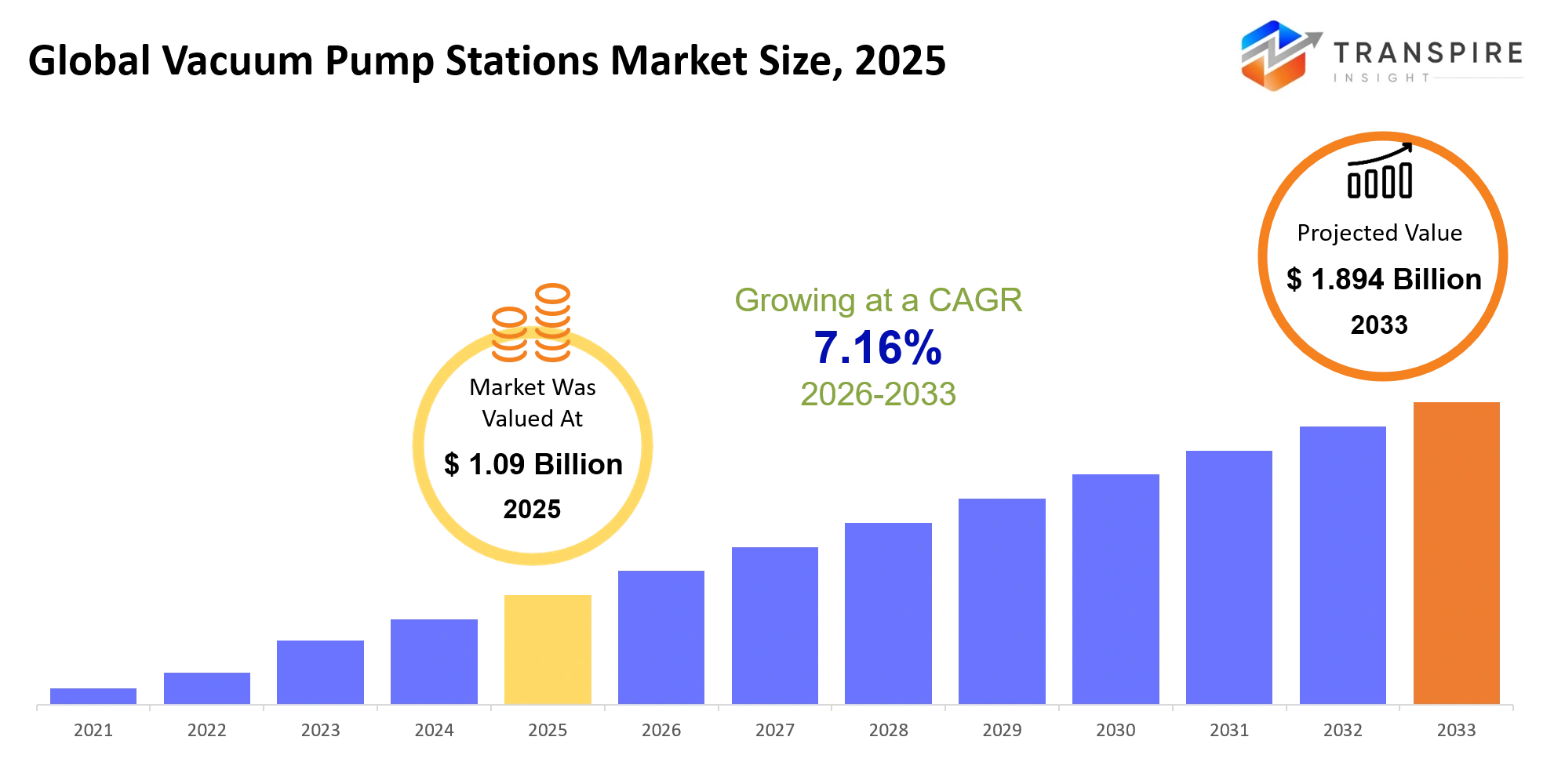
As per Transpire Insight Analysis, The Vacuum Pump Stations Market size is estimated at USD 1.09 Billion in 2025 and is anticipated to reach USD 1.894 Billion by 2033, growing at a CAGR of 7.16% from 2026 to 2033.
The vacuum pump stations market centers on engineered systems that maintain stable negative pressure environments for critical manufacturing tasks like drawing fluids, pulling semiconductor gas, and sealing medical packages. Over the last three to five years, industrial focus has shifted from high-maintenance oil-lubricated pumps toward dry - oil-free pump modules to completely prevent process stream cross-contamination. This structural shift is heavily accelerated by ultra-clean processing demands in high-tech cleanrooms and hygienic lines. Furthermore - the massive expansion of global microchip fabrication facilities serves as a real-world trigger, requiring deep vacuum setups to stabilize delicate wafer lithography. As automated factory networks expand, this strict reliance on contamination-free environments drives substantial tier-one industrial adoption, creating a solid base for future hardware upgrades.
Global Vacuum Pump Stations Market Size & Forecast
- Global Market Size 2025: USD 1.09 Billion
- Expected Market Value (2033): USD 1.894 Billion
- Forecast CAGR (2026–2033): 7.16%
- Leading Region in 2025: Asia Pacific
- Fastest Growing Region: North America
- Key Company Profiles: Atlas Copco, Busch Vacuum Solutions, Gardner Denver, Pfeiffer Vacuum, Edwards Vacuum, ULVAC, Becker Pumps, Elmo Rietschle, Leybold, Ingersoll Rand, KNF Neuberger, Tuthill Vacuum & Blower, Ebara Corporation, Agilent Technologies, Nash.
Key Global Vacuum Pump Stations Market Insights
The vacuum pump stations market - shifting from standalone negative pressure units toward highly integrated, dry-running ecosystems featuring smart automation and low-emission architectures. Continuous runtime tracking - advanced variable speed drives (VSD), and localized industrial compliance frameworks represent the core pillars driving sustainable product innovation across modern manufacturing lines.
- Dry Vacuum Pumps command a dominant 37% market share - with Atlas Copco and Edwards Vacuum engineering completely oil-free multi-stage systems to fulfill strict contamination-free semiconductor cleanroom configurations.
- Asia Pacific accounts for 40% of global demand - supported by Ebara Corporation and ULVAC expanding local sub-fab vacuum network deployments within regional microchip fabrication hubs.
- Europe captures 27% of industry revenue - as Pfeiffer Vacuum and Leybold integrate high-efficiency backing pumps to satisfy strict regional industrial eco-design and carbon emissions laws.
- North America represents 24% of volume - with Gardner Denver and Ingersoll Rand scaling heavy-duty industrial installations tailored for high-volume chemical and distribution networks.
- IoT-enabled Vacuum Stations stand out as the fastest-accelerating technology segment expanding at a 16.1% CAGR, propelled by Busch Vacuum Solutions rolling out intelligent cloud-linked monitoring setups to predict component wear in automated facilities.
- Liquid Ring Pumps capture 20% of the industry footprint, driven by Nash and Tuthill Vacuum & Blower enhancing extreme moisture tolerance structures for volatile waste water treatment plants.
- Rotary Vane Pumps hold a stable 16% market share, where Becker Pumps and Elmo Rietschle introduce specialized low-noise, compact internal configurations optimized for high-speed hospital medical vacuum systems.
- Screw Vacuum Pumps account for 10% of global value, as major developers deploy variable speed drive matrices to dynamically trim power draws under shifting manufacturing floor stress loads.
- Claw Vacuum Pumps lock down 7% of total revenue reinforced by brand-new dual-claw architectures that maintain deep ultimate pressure thresholds without introducing wear-prone internal friction points.
What Are the Key Drivers, Restraints, and Opportunities in the Global Vacuum Pump Stations Market?
Driver
Market growth is heavily propelled by a massive structural transition away from fragmented, point-of-use vacuum units toward highly integrated, centralized vacuum stations across modern processing plants. Operating multiple decentralized pumps under variable partial loads routinely causes substantial energy losses and elevated floor noise. This critical engineering friction triggered a widespread industrial shift toward multi-pump centralized setups featuring coordinated smart load balancing. Consequently, this architectural movement drives immense enterprise adoption because consolidating the negative pressure grid cuts system-wide power consumption, guarantees continuous operational redundancy, and lowers long-term maintenance overhead for automated manufacturing facilities.
In March 2026, global industrial vacuum pioneer Leybold expanded its intelligent facility-wide product capabilities by detailing its next-generation smart NOVADRY NDi System, an advanced centralized vacuum installation explicitly designed for high-throughput commercial packing floors. The structural framework demonstrates that moving away from legacy point-of-use equipment to a centralized, multi-pump configuration allows operations to dramatically lower factory heat generation and cut electrical loads. By proving that centralized configurations drop overall energy spending while ensuring seamless operational uptime during localized maintenance cycles, this real-world deployment highlights why global tier-one operators are heavily expanding capital hardware budgets to deploy high-efficiency centralized infrastructure. [https://www.leybold.com/en-in/products/vacuum-pumps/industrial-dry-vacuum-pumps/novadry-ndi-system]
Restraint
High initial engineering procurement costs paired with intensive mechanical alignment complexities act as a major structural barrier holding back mainstream adoption among mid-sized manufacturing plants. Transitioning from legacy point-of-use pumps to automated, facility-wide vacuum stations requires facilities to dedicate extensive capital to heavy-duty central piping networks, advanced multi-pump staging frames, and dynamic PLC control systems. This friction persists because custom vacuum engineering requires specialized thermodynamic calibration; incorrect layout geometry or poor valve seating causes immediate pressure drops, making installation highly resource-intensive.
Opportunity
The most lucrative growth window lies in the development of modular, multi-stage dry vacuum stations integrated with cloud-connected edge diagnostics and low-energy variable speed drives. Engineering fully oil-free compression chambers allows processing networks to maintain deep ultimate vacuums without exposing sensitive chemical lines or microchip cleanrooms to volatile operating fluid vapors. This technological pivot unlocks highly profitable contract opportunities—particularly across booming electronics hubs in the Asia Pacific region—by allowing vacuum system developers to help multinational semiconductor fabs hit extreme purity baselines cleanly.
What Has the Impact of Artificial Intelligence Been on the Global Vacuum Pump Stations Market?
Artificial intelligence is fundamentally reshaping the vacuum pump stations market, moving heavy-duty negative pressure grids away from rigid manual operations toward predictive, self-optimizing industrial networks. Instead of requiring plant technicians to manually check oil conditions or physically adjust pressure dials, next-generation manufacturing hubs deploy cloud-connected algorithmic workflows to evaluate operational baselines continuously.
Inside high-volume chemical, pharmaceutical, and microelectronics facilities, advanced AI architectures drive immense operational improvements through real-time load distribution and energy tracking. By integrating variable speed drive telemetry with edge-AI computing cells, automated multi-pump systems instantly predict sudden vacuum stress changes and balance active machinery workloads. This predictive mechanism ensures an absolute, zero-fluctuation pressure boundary in deep cleanrooms while identifying internal rotor degradation long before expensive component failures emerge.
However, a serious operational limitation persists around high multi-tier hardware integration costs and data standard compatibility gaps. Upgrading legacy, multi-brand factory floors to run cohesive AI algorithms requires expensive custom PLC modules and sensor retrofitting, creating a steep integration hurdle where mismatched machine data formats can cause analytical calibration drift over time. In July 2026, industrial equipment leader Atlas Copco expanded its digital factory capabilities by highlighting its advanced HEX@ intelligent vacuum controller architecture alongside its global GENIUS Instant Insights ecosystem. This specialized software framework utilizes deep learning algorithms to monitor critical vacuum parameters, optimize multi-pump energy allocation dynamically, and send real-time performance alerts directly to operations teams. By combining smart data loops with predictive wear monitoring, the platform allows modern sub-fabs and processing networks to significantly minimize unplanned downtime while maximizing baseline system efficiency.
Key Market Trends
The vacuum pump stations market is shifting away from isolated, mechanically regulated hardware toward unified, intelligent negative pressure networks. Driven by an aggressive structural expansion of sub-fab microchip cleanrooms and stringent global environmental zero-emission mandates, industrial infrastructure developers are rapidly replacing standard fluid-sealed assemblies with ultra-clean, data-optimized dry vacuum systems.
- System configurations are transitioning from isolated, point-of-use pump installations toward completely centralized facility networks to streamline energy use and optimize multi-pump load distributions.
- Lubrication methodologies are moving steadily past legacy oil-sealed or water-jacketed pumps to deploy high-performance dry compression chambers that eliminate oil backstreaming and downstream process contamination.
- Control architectures are leaving basic manual dials behind to adopt integrated cloud-linked edge systems featuring automated programmable logic controllers (PLCs) and real-time smart monitoring.
- Motor engineering is abandoning traditional fixed-speed operations to implement adaptive variable speed drives (VSD) that dynamically throttle machine RPM based on immediate line demand.
- Maintenance frameworks are evolving away from reactive breakdown responses to establish algorithmic predictive maintenance tracking that analyzes vibration and heat telemetry to flag internal rotor wear.
- Component materials are changing from basic cast iron components to use corrosion-resistant fluoropolymer coatings and specialized stainless steel grades suited for harsh chemical exhaust streams.
- Packaging line setups are shifting from rigid continuous evacuation cycles to utilize high-frequency start-and-stop vacuum configurations to limit unnecessary power consumption.
- Environmental monitoring is advancing from generic leak checks to incorporate inline optical gas-sensing diagnostics that identify invisible gas bypass or pressure drops immediately.
- System structures are moving away from customized, welded configurations toward highly flexible, skid-mounted modular frames that allow for rapid processing line expansions.
Global Vacuum Pump Stations Market Segmentation
By Pump Type
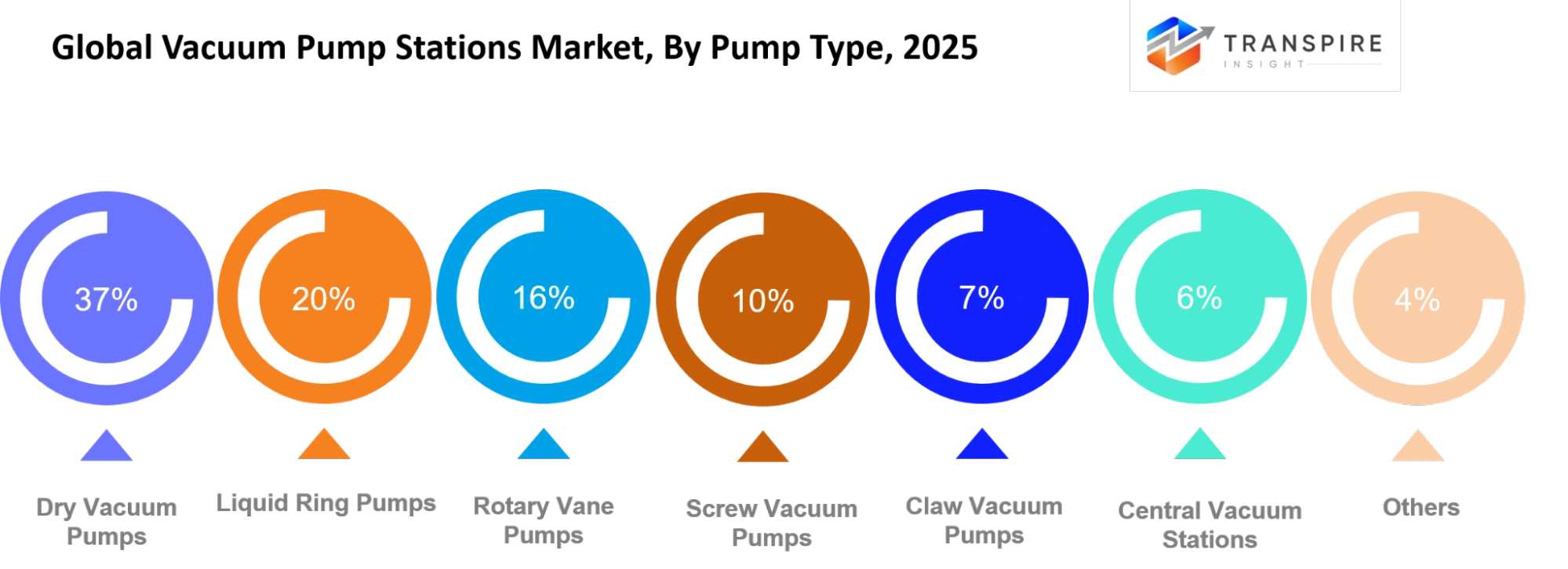
Dry Vacuum Pumps command the largest share of market capital, holding a dominant 37% of global revenue due to their unmatched operational reliability and massive adoption within contamination-free industrial environments. Liquid Ring Pumps follow at 20%, Rotary Vane Pumps hold 16%, Screw Vacuum Pumps capture 10%, while Claw Vacuum Pumps account for 7%. Central Vacuum Stations stand out as a highly efficient configuration trend holding 6%, while other specialized variants round out the remaining 4% of the industry footprint. This division is shaped by the strict operational balance between system cleanliness and heavy-duty fluid handling capability. Dry Vacuum Pumps maintain their peak position because manufacturing brands systematically solve process stream contamination liabilities—where oil or sealing fluids backstream into delicate manufacturing environments—by engineering completely oil-free multi-stage compression chambers. Moving forward, structural designs will pivot toward high-efficiency non-contact internal profiles, forcing hardware developers to roll out advanced dry systems that maximize internal volumetric throughput while keeping power draws and mechanical friction to an absolute minimum.
By Capacity
Industrial Capacity systems serve as the primary financial engine of the matrix, controlling a dominant majority of industry revenue due to their continuous heavy-duty processing capability and natural fit with large-scale chemical and manufacturing plants. High Capacity and Medium Capacity configurations follow as active secondary segments for localized factory grids, while Low Capacity, Custom Systems, Modular Systems, and High-vacuum Systems represent specialized engineered configurations tailored for distinct pressure thresholds. The underlying growth logic relies on scalable negative pressure generation and rapid evacuation velocity, where production lines demand stations that maintain stable vacuum boundaries under shifting gas stress loads. Industrial Capacity configurations maintain this peak market position because their robust multi-pump staging frames allow heavy processing plants to run complex chemical reactions or material handling cycles continuously without risking sudden pressure drops. Moving forward, industry success will require the widespread adoption of plug-and-play modular capacities, compelling system manufacturers to supply adaptable skid-mounted assemblies that allow factory managers to expand or contract their vacuum grid capacity effortlessly based on real-time production shifts.
By End User
The Semiconductor Industry functions as the undisputed anchor of this matrix, capturing a commanding portion of total industry revenue, while the Pharmaceutical Industry stands out as the fastest-accelerating operational standard for strict hygienic processing. The Chemical Industry alongside Food & Beverage hold a stable secondary share, primarily serving high-volume production lines, while Healthcare, Power Generation, and general Manufacturing form highly specialized technical niches. This distribution pattern is driven by the global corporate push for extreme product purity and the elimination of process cross-contamination, where stable vacuum environments secure the structural integrity of high-tech and sterile products. The Semiconductor Industry leads because global microchip fabrication facilities explicitly require continuous, deep negative pressure grids to stabilize delicate photolithography and chemical vapor deposition chambers. Moving forward, end-user strategies will focus heavily on zero-emission sub-fab architectures, pushing equipment providers to deliver unified vacuum station configurations that safely capture and exhaust hazardous process gases without environmental leakage.
By Application
Industrial Processing functions as the primary driver of this market, controlling a combined majority of total industry volume due to its relentless operational scale and widespread reliance on negative pressure for material handling and thermal separations. Packaging and Medical Vacuum Systems follow closely as critical pillars for product preservation and clinical safety, while Wastewater Treatment, Electronics Manufacturing, Chemical Processing, and Laboratory Applications represent highly specialized target operations. This division is shaped by the macro transition away from isolated, high-maintenance hardware setups toward integrated, automated facility networks where vacuum stability directly dictates manufacturing yield rates. Industrial Processing leads the market position because the vast expansion of automated factory networks has made continuous, facility-wide vacuum distribution vital to maintaining manufacturing throughput. Moving forward, application tech will focus heavily on closed-loop process integration, forcing system designers to deploy specialized vacuum layouts that sync directly with smart factory production schedules to optimize power usage based on line stress.
By Control System
IoT-enabled Vacuum Stations stand out as the fastest-accelerating technology segment expanding at an explosive 16.1% CAGR, while PLC-based Systems and SCADA-enabled Systems command the largest share of historical market capital due to their deeply established footprint in heavy industrial automation. Manual Control setups follow as a declining legacy segment, while AI-enabled Monitoring, Remote Monitoring, and Energy-efficient Systems represent high-growth digital touchpoints. This structural division persists because operating multi-pump assemblies under variable factory loads requires sophisticated digital staging and real-time operational tracking. IoT-enabled and smart monitoring platforms are rapidly capturing the market because their advanced digital frameworks allow operators to gather continuous component telemetry and balance motor workloads dynamically across the entire facility. Moving forward, the industry will pivot sharply toward self-contained autonomous optimization, enabling smart control systems to analyze internal thermal and vibration signatures to auto-schedule maintenance routines long before physical component failure occurs.
What Are the Global Key Use Cases Driving the Vacuum Pump Stations Market?
The dominant utilization of dry vacuum pumps is heavily driven by ultra-clean process isolation and contamination prevention to satisfy global semiconductor fabrication networks. High-volume microchip manufacturers integrate these oil-free systems directly into sub-fab grids to evacuate atmospheric gases during delicate wafer lithography and chemical vapor deposition loops - systematically eliminating microscopic particle defects and safeguarding high-tech manufacturing yields.
Beyond core cleanroom applications, expanding utilizations are highly visible across heavy-duty industrial processing and chemical separation sectors. Pharmaceutical and petrochemical corporations deploy high-capacity multi-pump stations to manage volatile solvent recovery and low-temperature vacuum distillation, securing volatile thermal transitions against degradation while providing reliable pressure stability across continuous high-volume production pipelines.
Emerging operational use cases focus on automated eco-efficiency mapping and predictive facility monitoring. Modern food packaging and wastewater management systems utilize smart, IoT-enabled vacuum installations to dynamically match motor staging with shifting operational stress loads, satisfying strict regional carbon mitigation quotas while delivering real-time internal wear diagnostics to prevent unplanned assembly downtime.
|
Report Metrics |
Details |
|
Market size value in 2025 |
USD 1.09 Billion |
|
Market size value in 2026 |
USD 1.167 Billion |
|
Revenue forecast in 2033 |
USD 1.894 Billion |
|
Growth rate |
CAGR of 7.16% from 2026 to 2033 |
|
Base year |
2025 |
|
Historical data |
2021 - 2024 |
|
Forecast period |
2026 - 2033 |
|
Report coverage |
Revenue forecast, competitive landscape, growth factors, and trends |
|
Regional scope |
United States; Canada; Mexico; Germany; United Kingdom; France; Italy; Spain; China; Japan; India; South Korea; Australia; Brazil; Argentina; South Africa; Saudi Arabia; United Arab Emirates |
|
Key company profiled |
Atlas Copco, Busch Vacuum Solutions, Gardner Denver, Pfeiffer Vacuum, Edwards Vacuum, ULVAC, Becker Pumps, Elmo Rietschle, Leybold, Ingersoll Rand, KNF Neuberger, Tuthill Vacuum & Blower, Ebara Corporation, Agilent Technologies, Nash. |
|
Customization scope |
Free report customization (country, regional & segment scope). Avail customized purchase options to meet your exact research needs. |
|
Report Segmentation |
By Pump Type (Liquid Ring Pumps, Rotary Vane Pumps, Dry Vacuum Pumps, Screw Vacuum Pumps, Claw Vacuum Pumps, Oil-sealed Pumps, Central Vacuum Stations, Others); By Capacity (Low Capacity, Medium Capacity, High Capacity, Industrial Capacity, Custom Systems, Modular Systems, High-vacuum Systems, Others); By End User (Chemical Industry, Food & Beverage, Pharmaceuticals, Healthcare, Power Generation, Semiconductor Industry, Manufacturing, Others); By Application (Industrial Processing, Medical Vacuum Systems, Packaging, Wastewater Treatment, Electronics Manufacturing, Chemical Processing, Laboratory Applications, Others); By Control System (Manual Control, PLC-based Systems, SCADA-enabled Systems, IoT-enabled Systems, AI-enabled Monitoring, Remote Monitoring, Energy-efficient Systems, Others). |
Which Regions are Driving the Global Vacuum Pump Stations Market Growth?
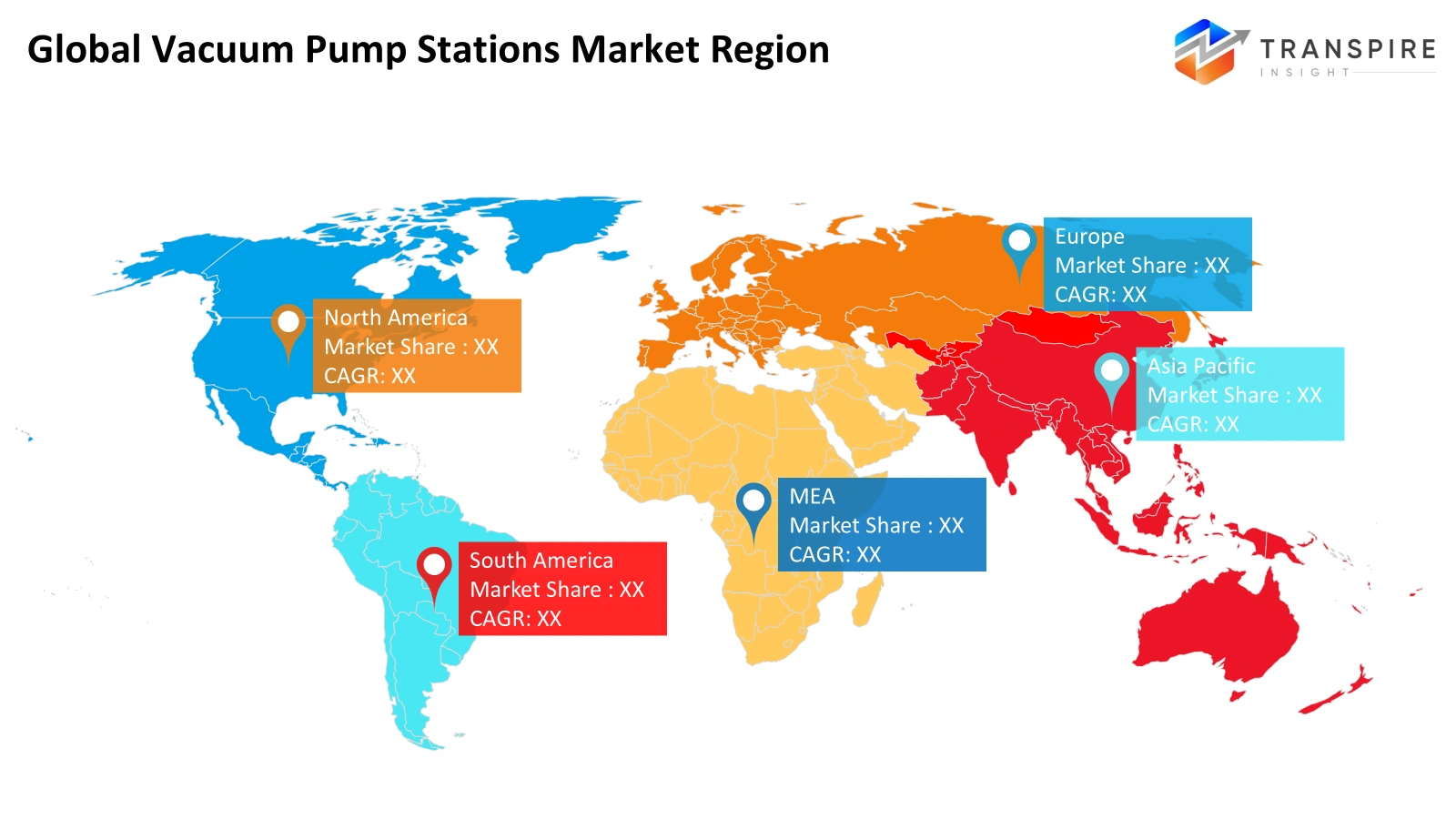
Asia Pacific maintains a commanding grip on the vacuum pump stations market, capturing a dominant 40% of all worldwide industry revenue. This geographic leadership is heavily driven by rapid heavy industrial production expansions combined with aggressive microchip fabrication capital investments across major regional technological zones. The regional ecosystem is structurally supported by a dense concentration of local original equipment manufacturers (OEMs) who install high-volume centralized systems to guarantee constant baseline processing operations. Consequently, transitioning away from high-maintenance localized pump configurations toward unified multi-pump setups has become the standard operational choice for regional facility developers seeking absolute infrastructure safety.
Europe serves as a highly stable, predictable secondary pillar for the global market, locking down an essential 27% share of total industry demand. While Asian expansion is propelled by massive microelectronics sub-fab scaling and rapid production volumes, European adoption is shaped by rigid regional eco-design rules and aggressive industrial carbon reduction mandates. This regional market stability is structurally insulated by long-term corporate sustainability transformations that prioritize absolute compliance with strict low-emission equipment standards. To minimize heavy utility power spending and navigate complex efficiency evaluations without structural errors, continental manufacturing networks steadily invest in advanced vacuum pump stations equipped with high-efficiency variable speed drives.
In July 2025, international vacuum systems innovator Busch Vacuum Solutions completely reshaped large-scale system performance parameters by introducing the air-cooled version of the COBRA NC 2500 C, celebrated as the world's largest dry, air-cooled vacuum pump. This mechanical product launch integrates a specialized self-sufficient closed-loop radiator cooling system that entirely cuts out the need for an external facility water supply. By eliminating dependence on municipal water grids while maintaining deep ultimate vacuum thresholds, this deployment provides massive operational flexibility and resource savings for large-scale carbon capture systems and centralized vacuum networks.
North America has emerged as the fastest-growing territory globally, accelerating at a market-leading standalone CAGR of 15.3% while currently holding a 24% slice of global sales. This sudden structural shift is driven by massive corporate supply chain localization policies, extensive chemical industry modernization campaigns, and heavy implementation of cloud-linked predictive factory maintenance grids. Historically, regional processing plants relied on traditional manual dials or isolated pneumatic hardware setups, but an aggressive transition toward fully automated digital factories has forced the widespread adoption of smart vacuum stations. Looking ahead, future digital infrastructure development in this booming corridor relies heavily on deploying edge-connected vacuum controllers featuring intelligent data tracking algorithms to dynamically optimize multi-pump pressure matrices.
In June 2026, international engineering powerhouse Atlas Copco officially took vacuum optimization to a higher benchmark by introducing its advanced GHS 402 - 902 VSD⁺ vacuum pump series integrated with its state-of-the-art HEX@ connectivity framework. This specialized second-generation configuration utilizes an intelligent IE5 motor layout to continuously govern internal vacuum pressure thresholds based on precise real-time flow demands. By deploying these smart data feedback loops alongside a vertically mounted, oil-cooled drivetrain, the machinery enables automated packaging and processing lines to drastically minimize power draws while reducing physical factory footprints to less than one square meter.
Who Are the Key Players in the Global Vacuum Pump Stations Market and How Do They Compete?
The global vacuum pump stations space functions as an intense industrial battleground between legacy multinational engineering conglomerates, specialized negative pressure developers - regional high-vacuum manufacturers. With high-volume industrial processing and sub-fab microchip cleanrooms prioritizing oil-free process streams, automated PLC compatibility, and multi-pump energy efficiency over standard isolated hardware, market participants compete on three primary fronts. These include engineering highly advanced, non-contact dry compression internal profiles, optimizing cloud-linked edge predictive monitoring architectures - scaling dedicated enterprise distribution agreements across high-growth electronic and chemical processing corridors.
Atlas Copco operates a highly sophisticated, innovation-driven product strategy, positioning its extensive vacuum portfolio around smart factory automation and superior thermal density optimization. The vendor differentiates its market presence by engineering specialized dry screw and oil-sealed matrices that integrate the state-of-the-art HEX@ connectivity framework to handle dynamic facility loads seamlessly. The corporation actively expands its global industrial footprint by leveraging existing high-tier semiconductor supplier contracts and executing regional proximity acquisitions to strengthen local service divisions.
Busch Vacuum Solutions runs a highly targeted, niche-focused infrastructure strategy aimed directly at large-scale packaging, chemical processing, and carbon capture grids requiring extreme environmental resilience. The manufacturer differentiates its market position by offering ultra-high-capacity modular assemblies - such as its flagship COBRA dry air-cooled pump lines, which completely eliminate external facility water dependencies. They expand their global operational footprint by acquiring specialized regional technical service providers and launching state-of-the-art sub-fab assembly hubs across key geographic markets.
Company List
- Atlas Copco
- Busch Vacuum Solutions
- Gardner Denver
- Pfeiffer Vacuum
- Edwards Vacuum
- ULVAC
- Becker Pumps
- Elmo Rietschle
- Leybold
- Ingersoll Rand
- KNF Neuberger
- Tuthill Vacuum & Blower
- Ebara Corporation
- Agilent Technologies
- Nash
Recent Development News
In February 2025, Busch Group USA completed the acquisition of Total Maintenance Solutions - LLC (TMS) -an established overpressure and vacuum specialist provider. This corporate integration leverages the shared expertise of both divisions within the high-volume food packaging and protein sectors to accelerate manufacturing innovation and enhance technical service deployment networks across North America.
Source: https://www.buschvacuum.com
In April 2026, international engineering powerhouse Atlas Copco officially launched its next-generation DHS 3000 VSD⁺ dry screw vacuum pump engineered for large-scale - high-flow industrial operations. This oil-free equipment launch combines a high-efficiency IE4 motor layout with integrated variable speed drive architecture to adjust operating speeds based on real-time plant load variables - completely eliminating process stream cross-contamination across heavy packaging and material handling pipelines.
Source: https://www.packagingnews.com.au
In August 2026, international vacuum technology designer Pfeiffer Vacuum+Fab Solutions officially introduced its advanced DuoVane C chemically resistant rotary vane vacuum pump series tailored for highly demanding and corrosive environments. This specialized product rollout features a robust, anti-corrosive layout optimized to handle aggressive chemical exhaust streams - significantly increasing component lifespan while maximizing operational safety bounds throughout global medical and laboratory processing applications.
Source: https://www.pfeiffervacuum.com/
What Strategic Insights Define the Future of the Global Vacuum Pump Stations Market?
The global vacuum pump stations market is heading toward the realization of fully autonomous, zero-emission negative pressure grids, where localized hardware units are treated as data-rich, interconnected plant sub-systems rather than basic standalone machinery.
A critical hidden risk lies in "variable-load integration imbalances." As automated production facilities rapidly combine diverse, multi-brand pump types onto a single smart control loop to minimize energy overhead, minor latency issues or mismatched sensor communication thresholds can trigger severe transient pressure drops, resulting in immediate cleanroom contamination and catastrophic batch structural scrap.
Conversely, a major emerging opportunity is the development of inline, multi-spectral exhaust diagnostics natively embedded into the station's core staging block, enabling high-volume chemical and electronics hubs to capture and analyze bypass gases in real time.
Strategic recommendation: Manufacturers must build highly adaptive, open-protocol PLC staging modules that execute millisecond-level workload distribution adjustments across heterogeneous pump setups, eliminating dynamic network pressure spikes without relying on dedicated, single-brand hardware configurations.
Key Segmentations are:
By Pump Type
- Liquid Ring Pumps
- Rotary Vane Pumps
- Dry Vacuum Pumps
- Screw Vacuum Pumps
- Claw Vacuum Pumps
- Oil-sealed Pumps
- Central Vacuum Stations
- Others
By Capacity
- Low Capacity
- Medium Capacity
- High Capacity
- Industrial Capacity
- Custom Systems
- Modular Systems
- High-vacuum Systems
- Others
By End User
- Chemical Industry
- Food & Beverage
- Pharmaceuticals
- Healthcare
- Power Generation
- Semiconductor Industry
- Manufacturing
- Others
By Application
- Industrial Processing
- Medical Vacuum Systems
- Packaging
- Wastewater Treatment
- Electronics Manufacturing
- Chemical Processing
- Laboratory Applications
- Others
By Control System
- Manual Control
- PLC-based Systems
- SCADA-enabled Systems
- IoT-enabled Systems
- AI-enabled Monitoring
- Remote Monitoring
- Energy-efficient Systems
- Others
Regional Outlook
North America
- United States
- Canada
- Mexico
Europe
- Germany
- United Kingdom
- France
- Spain
- Italy
- Rest of Europe
Asia Pacific
- Japan
- China
- Australia & New Zealand
- South Korea
- India
- Rest of Asia Pacific
South America
- Brazil
- Argentina
- Rest of South America
Middle East & Africa
- Saudi Arabia
- United Arab Emirates
- South Africa
- Rest of the Middle East & Africa
Frequently Asked Questions
Find quick answers to common questions.
The global vacuum pump stations market size was valued at USD 1.09 Billion in 2025 and is poised to reach USD 1.894 Billion by 2033, expanding at a 7.16% CAGR.
Key segments for the global vacuum pump stations market are By Pump Type (Liquid Ring Pumps, Rotary Vane Pumps, Dry Vacuum Pumps, Screw Vacuum Pumps, Claw Vacuum Pumps, Oil-sealed Pumps, Central Vacuum Stations, Others); By Capacity (Low Capacity, Medium Capacity, High Capacity, Industrial Capacity, Custom Systems, Modular Systems, High-vacuum Systems, Others); By End User (Chemical Industry, Food & Beverage, Pharmaceuticals, Healthcare, Power Generation, Semiconductor Industry, Manufacturing, Others); By Application (Industrial Processing, Medical Vacuum Systems, Packaging, Wastewater Treatment, Electronics Manufacturing, Chemical Processing, Laboratory Applications, Others); By Control System (Manual Control, PLC-based Systems, SCADA-enabled Systems, IoT-enabled Systems, AI-enabled Monitoring, Remote Monitoring, Energy-efficient Systems, Others).
Growth is primarily driven by a massive structural transition away from fragmented, point-of-use vacuum units toward highly integrated, centralized vacuum stations across modern processing plants. This consolidation cuts system-wide power consumption, guarantees continuous operational redundancy, drops factory heat footprints, and significantly lowers long-term maintenance overhead for automated manufacturing facilities.
The global market is led by major manufacturers including Atlas Copco, Busch Vacuum Solutions, Gardner Denver, Pfeiffer Vacuum, Edwards Vacuum, ULVAC, Becker Pumps, Elmo Rietschle, Leybold, Ingersoll Rand, KNF Neuberger, Tuthill Vacuum & Blower, Ebara Corporation, Agilent Technologies, and Nash.
Asia Pacific holds a dominant 40% share of the global market, heavily influencing dynamics through rapid heavy industrial production expansions and aggressive microchip fabrication capital investments across major regional technological zones. This dense concentration of local original equipment manufacturers (OEMs) utilizes high-volume centralized networks to secure baseline processing uptime and enforce contamination-free, oil-free sub-fab microchip cleanroom configurations.
Highly lucrative commercial opportunities exist in the development of modular, multi-stage dry vacuum stations integrated with cloud-connected edge diagnostics and low-energy variable speed drives. This technological shift enables vacuum system developers to supply adaptable, skid-mounted assemblies that allow multinational semiconductor fabs and processing hubs to maintain deep ultimate vacuums, meet extreme purity baselines, and hit strict regional carbon mitigation quotas cleanly.
- Atlas Copco
- Busch Vacuum Solutions
- Gardner Denver
- Pfeiffer Vacuum
- Edwards Vacuum
- ULVAC
- Becker Pumps
- Elmo Rietschle
- Leybold
- Ingersoll Rand
- KNF Neuberger
- Tuthill Vacuum & Blower
- Ebara Corporation
- Agilent Technologies
- Nash
About the Authors

Avinash Kumar
I’m Avinash Kumar, a Senior Research Analyst at Transpire Insight, with expertise in the Electronics and Semiconductor and Energy & Power industry. My work focuses on analyzing emerging technologies, market trends, industry developments, and innovation across these sectors. I specialize in transforming complex technical and market insights into clear, research-backed content that helps professionals, businesses, and decision-makers stay informed. Through continuous industry research and data-driven analysis, I strive to deliver accurate, reliable, and practical perspectives on the latest advancements shaping the semiconductor and energy landscape.

Chakradhar Khansole
Chakradhar serves as the Research Director at Transpire Insight, bringing over 8 years of experience in technology, innovation, and strategic market intelligence. He specializes in transforming complex market data into actionable business insights that enable organizations to make informed, growth-oriented decisions. Recognized for his strategic vision and analytical expertise, Chakradhar leads high-impact research initiatives, delivering comprehensive market assessments, competitive intelligence, and forward-looking industry analysis.
Recently Published Reports
-
Apr 2026
Active Power Filter Market
Active Power Filter Market Size, Share & Analysis Report By Type (Shunt Active Power Filters, Series Active Power Filter, Hybrid Active Power Filter), By Application (Harmonics Mitigation, Reactive Power Compensation, Voltage Regulation, Power Factor Correction), By Phase (Single Phase, Three Phase), By End-User Industry (Manufacturing, Healthcare, Commercial, Automotive, Oil and Gas, Others), and Geography (North America, Europe, Asia-Pacific, Middle East and Africa, South and Central America), 2021 - 2031
-
Apr 2026
Electrical Transformer Market
Electrical Transformer Market Size, Share & Analysis Report By Core (Closed, Shell, and Berry), By Insulation (Gas, Oil, Solid, Air, and Other), By Phase (Single, and Three), By Rating (100 MVA to 500 MVA, 501 MVA to 800 MVA, and 801 MVA to 1200 MVA), and Geography (North America, Europe, Asia-Pacific, Middle East and Africa, South and Central America), 2021 – 2031
-
Apr 2026
Hydraulic Piston Pumps Market
Hydraulic Piston Pumps Market Size, Share & Analysis Report By Type (Axial Piston Pumps, Radial Piston Pumps), By Operating Pressure (Low Pressure, Medium Pressure, High Pressure), By Application (Construction, Mining, Agriculture, Automotive, Oil & Gas, Industrial Machinery, Others), By End-User (OEMs, Aftermarket), and Geography (North America, Europe, Asia-Pacific, Middle East and Africa, South and Central America), 2021 – 2031
-
Apr 2026
Laboratory Gas Generators Market
Laboratory Gas Generators Market Size, Share & Analysis Report By Product (Nitrogen Gas Generator, Hydrogen Gas Generator, Zero Air Gas Generator, Purge Gas Generator, TOC Gas Generators, Others), By Application (Gas Chromatography, Liquid Chromatography-mass Spectrometry (LC-MS), Gas Analyzers, Others), By End-user (Life Science, Chemical & Petrochemical, Food & Beverage, Others), and Geography (North America, Europe, Asia-Pacific, Middle East and Africa, South and Central America), 2021 – 2031