

Global Structural Health Monitoring Market Size & Forecast:
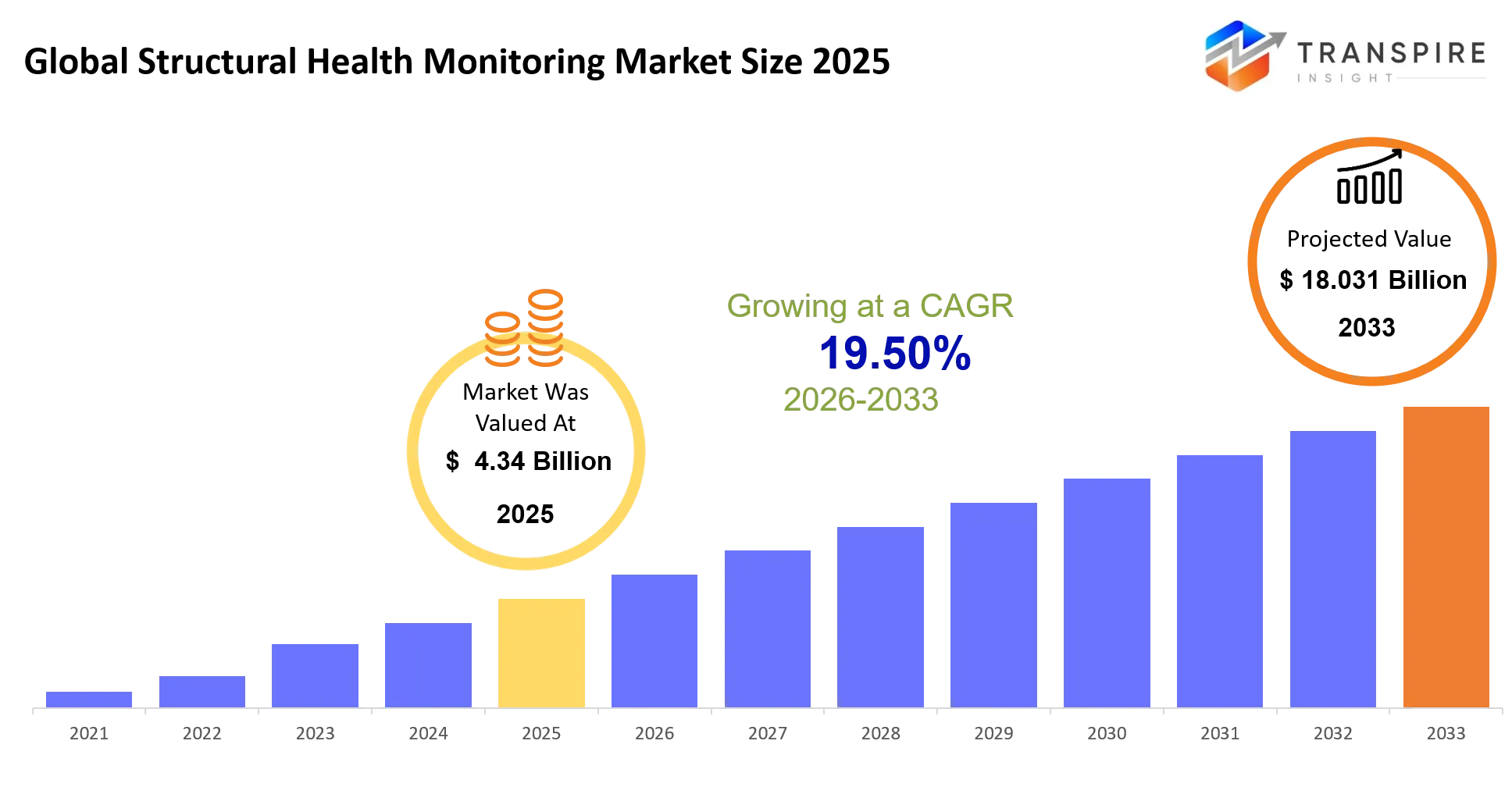
- Global Structural Health Monitoring Market Size 2025: USD 4.34 Billion
- Global Structural Health Monitoring Market Size 2033: USD 18.031 Billion
- Global Structural Health Monitoring Market CAGR: 19.50%
- Global Structural Health Monitoring Market Segments: By Type (Wireless Monitoring Systems, Wired Monitoring Systems, Sensor Networks, Vibration Monitoring Systems, Corrosion Monitoring Systems, Others); By Application (Bridges & Dams, Buildings, Energy Infrastructure, Aerospace Structures, Railways, Others); By End-User (Government Agencies, Construction Companies, Infrastructure Operators, Others); By Technology (IoT Monitoring, AI Analytics, Cloud Monitoring, Others)
Global Structural Health Monitoring Market Summary:
As per Transpire Insight Analysis, the Global Structural Health Monitoring Market size is estimated at USD 4.34 Billion in 2025 and is anticipated to reach USD 18.031 Billion by 2033, growing at a CAGR of 19.50% from 2026 to 2033.
The Global Structural Health Monitoring Market helps infrastructure owners understand how their bridges, dams, buildings, railways, and energy structures are performing and whether maintenance is required before failure occurs. SHM continuously monitors structural health, giving timely information about when to carry out repairs. The market has transformed significantly over the last 3–5 years into the domain of smart monitoring, where sensors are used to generate and analyse the structural data using cloud computing and diagnostics. Infrastructure ageing and the impacts of extreme events on critical assets are major market drivers across many countries. There is increasing emphasis on extending asset lifespan, reducing maintenance costs, and building reliable infrastructure using modern SHM.
Key Global Structural Health Monitoring Market Insights:
The structural health monitoring market is transitioning to a "data-centric infrastructure management ecosystem" in which asset intelligence plays a growing role in the investment and maintenance decision-making process. To gain a competitive edge, industry players are turning to developing advanced analytics, connected monitoring platforms and infrastructure resilience strategies for the long haul.
- Bridges & Dams represent 58% of the applications, motivating companies to create very focused solutions for monitoring large-scale civil infrastructure assets.
- Buildings (14%) represent an increasing trend towards continuous performance assessment in commercial and public buildings.
- Operational reliability and risk management are increasing with the expansion of monitoring capabilities in Energy Infrastructure, in which it has a 10% stake.
- 8% of the Aerospace Structures industry is spent on innovation in precision sensing technologies and high-accuracy structural diagnostics.
- Railways make up 5%, and real-time monitoring systems are being deployed to help ensure network safety and the longevity of assets.
- North America has a 37% share of the market, and digital infrastructure partnerships and advanced monitoring deployments are being expedited.
- Asia Pacific holds 33% of the market and is seeing investments in intelligent monitoring platforms to support large-scale infrastructure development.
- AI Analytics is growing at 15.1�GR, which will drive the vendors to incorporate predictive algorithms and automated anomaly detection features.
What are the Key Drivers, Restraints, and Opportunities in the Global Structural Health Monitoring Market?
Driver:
Demand for extending life and controlling lifecycle costs of vital infrastructure, mainly driven by ageing infrastructure and increasing costs, will drive the Global Structural Health Monitoring Market. Bridges, dams, transportation systems and industrial assets are demanding on-time structural condition assessment. Owners are installing such a system so that the structural damages can be identified at an early stage, and thus a major structural collapse can be avoided with the repair cost minimised and efficient resource allocation. In June 2026, Dewesoft completed a comprehensive upgrade across its entire smart hardware ecosystem by rolling out Dewesoft RT edge intelligence firmware. This product launch brings advanced embedded analytics, custom math function blocks, and local data storage capabilities directly onto wired monitoring nodes deployed on critical infrastructure.
Restraint:
Complexity in deploying monitoring technologies in legacy infrastructure environments a lot of assets were not initially designed with the ability to include digital monitoring capabilities. Technical and operational challenges exist in deploying such solutions because of the legacy structure. As the infrastructure portfolio comprises assets of diverse vintages, specifications, and data management regimes, integration costs escalate, and mass adoption decelerates.
Opportunity:
High potential is the intersection of monitoring technology and digital infrastructure investments. Advances in AI-powered analytics, cloud-based asset platforms, and smart city programs in markets like Asia-Pacific and emerging countries are creating opportunities for scalable deployment. High-value monitoring services and recurring data-driven revenue models should be a result of such advancement. With public and private investment in resilient infrastructure programs on the rise, this is a promising source of long-term monitoring engagements and higher-end asset intelligence capabilities. In June 2026, Skylark Drones signed a strategic partnership with e2E Rail to deploy AI-powered aerial asset intelligence and geospatial monitoring systems across national railway systems. This partnership combines advanced drone diagnostics, LiDAR mapping, and automated cloud data analytics to optimise high-value monitoring services.
What Has the Impact of Artificial Intelligence Been on the Global Structural Health Monitoring Market?
AI has transformed the market for structural health monitoring and provides enhanced value for infrastructure data collected by a system of sensors, monitoring equipment and interconnected systems. With the advent of AI algorithms, we are able to process complicated structural data quickly and automatically to pinpoint structural abnormalities, track performance shifts and quickly perform condition assessments. One of the most compelling applications for the integration of AI is its ability to provide optimal solutions to structural asset maintenance needs and to also increase predictions. AI-driven machine learning helps to optimise planning by enabling the high-risk asset prioritisation and helping owners avoid needless inspections and more efficiently predict structural wear patterns and potential structural failures. This approach can help reduce and or eliminate infrastructure downtime. AI can expedite decision-making processes, enhance infrastructure reliability, and enable more economical maintenance work. There is still a significant obstacle to infrastructure owner system integration because many have legacy infrastructure, which limits their ability to obtain all the data needed for AI models to produce effective, accurate outputs.
In March 2026, Curtin University's Centre for Infrastructural Monitoring and Protection (CIMP) secured competitive federal funding under the Australian Research Council (ARC) Discovery Project scheme to deploy an advanced AI-driven structural health monitoring framework.
Key Global Structural Health Monitoring Market Trends:
The structural health monitoring industry is changing from a measurement-focused industry to a strategic infrastructure intelligence ecosystem. Most organisations are no longer satisfied with just occasional inspections, as predictive insights, operational resilience and asset optimisation are gaining priority.
- The transition from maintenance to condition-based asset management relies on continuous monitoring technologies and is taking place among infrastructure owners.
- The industry is shifting from data collection to actionable intelligence: sophisticated analytics are turning data from sensors into actionable decisions.
- From pilot to operational, digital twin adoption has advanced to the point of being able to assess the performance of the infrastructure dynamically.
- Cloud-based monitoring systems are replacing standalone systems, fostering better collaboration between engineers, operators and decision makers.
- Lifecycle optimisation is growing in popularity among asset managers, indicating a greater emphasis on value creation over repair over the long haul.
- Climate resilience is increasingly a core component of monitoring investments as organisations look for more visibility of the impacts of environmental stress.
- Monitoring solutions are no longer just hardware-based, but increasingly integrated service-based ecosystems providing continuous monitoring performance information.
- Anomaly detection is becoming increasingly automated using AI, minimising the need for manual interpretation and quick responses.
Global Structural Health Monitoring Market Segmentation
By Type:
Wireless Monitoring Systems capture a substantial share in the market due to their scalability and lower installation cost, whereas Wired Monitoring Systems are still employed for mission-critical operations to facilitate data security. Sensor Networks, Vibration Monitoring Systems, Corrosion Monitoring Systems, etc., are upcoming trends that help asset owners achieve greater insights into operations. Future trends will be a greater demand for an integrated monitoring architecture that supports real-time decisions.
By Application:
Bridges & Dams hold the largest segment in the market share at 58% due to their high stake of protection required to secure public infrastructure. Buildings share is about 14%, Energy Infrastructure 10%, Aerospace Structures 8%, Railways 5%, and Others 5%. The growth in the segments is attributed to a rise in the adoption of predictive infrastructure management systems for improved performance, minimised life cycle costs, and optimised safety standards. The investment is further anticipated to shift toward proactive management and resilience-monitoring systems.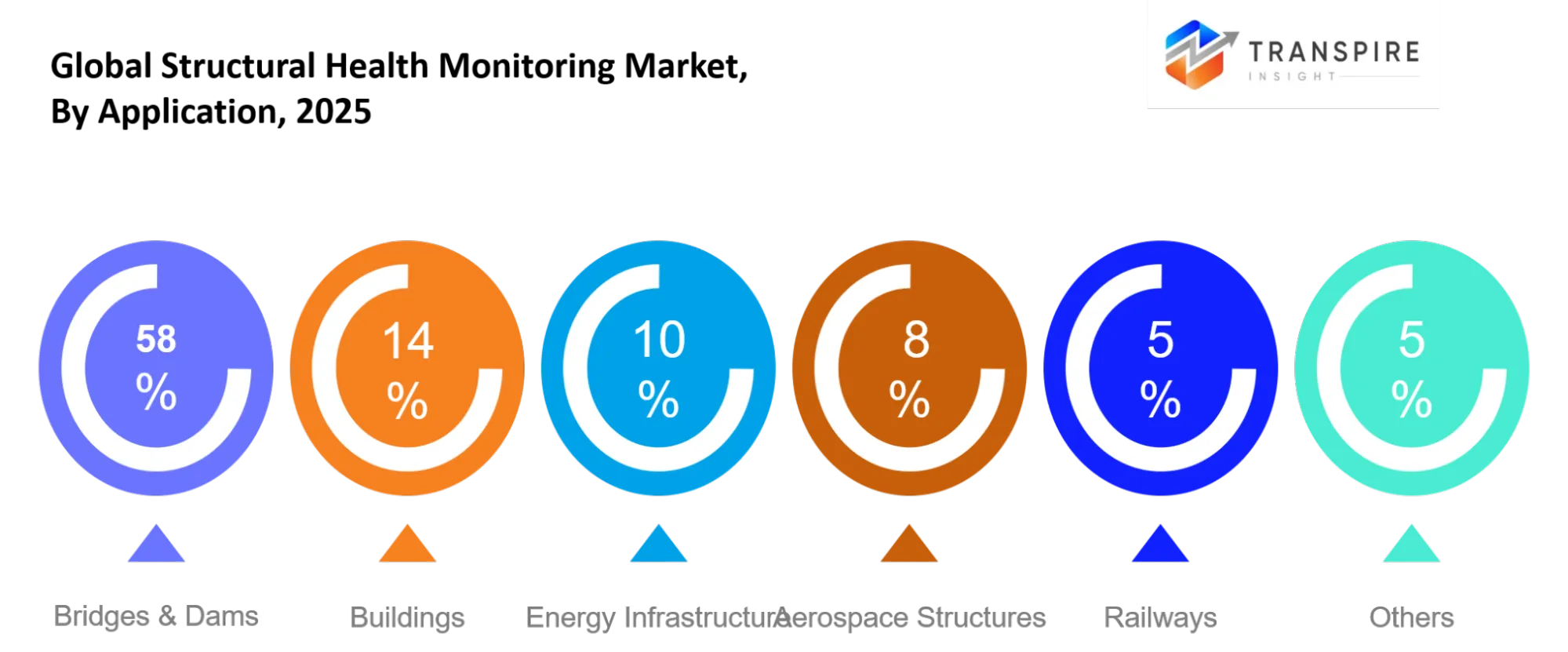
By End-User:
Government Agencies command the largest share of demand owing to widespread infrastructure holdings and regulatory obligations, and construction companies, infrastructure operators, and other users embrace monitoring solutions for operational efficiency and asset dependability.
By Technology:
IoT Monitoring technology is utilised across numerous digital deployments today, with AI Analytics being the fastest-growing sector, increasing at a rate of CAGR of 15.1% to predict the forthcoming migration towards predictive intelligence, autonomous diagnosis, and information-based infrastructure management.
What are the Key Use Cases Driving the Global Structural Health Monitoring Market?
The primary application is related to transportation infrastructure, where ongoing condition monitoring of bridges, tunnels and roadways results in preserved asset value, lower maintenance spend and predictive maintenance planning. This market remains by far the largest contributor to our market opportunity.
Proliferating applications- Growing use of monitoring solutions in energy, utilities and industrial plants to enhance operational dependability, control structural risks and improve the life of high-value assets operating in harsh environments.
Potential new use cases are associated with smart infrastructure initiatives and climate adaptation activities. Current adopters employ monitoring technologies for the assessment of environmental pressures, disaster resilience and long-term built-environment performance while facilitating forecast-driven asset management decisions.
|
Report Metrics |
Details |
|
Market size value in 2025 |
USD 4.34 Billion |
|
Market size value in 2026 |
USD 5.182 Billion |
|
Revenue forecast in 2033 |
USD 18.031 Billion |
|
Growth rate |
CAGR of 19.50% from 2026 to 2033 |
|
Base year |
2025 |
|
Historical data |
2021 - 2024 |
|
Forecast period |
2026 - 2033 |
|
Report coverage |
Revenue forecast, competitive landscape, growth factors, and trends |
|
Regional scope |
United States; Canada; Mexico; United Kingdom; Germany; France; Italy; Spain; Denmark; Sweden; Norway; China; Japan; India; Australia; South Korea; Thailand; Brazil; Argentina; South Africa; Saudi Arabia; United Arab Emirates |
|
Key company profiled |
Hottinger Brüel & Kjær, Campbell Scientific, Nova Metrix, Geokon, Digitexx, Sisgeo, Acellent Technologies, National Instruments, Kinemetrics, COWI, Advitam, Strainstall, SIXENSE, RST Instruments, Trimble. |
|
Customization scope |
Free report customisation (country, regional & segment scope). Avail customised purchase options to meet your exact research needs. |
|
Report Segmentation |
By Type (Wireless Monitoring Systems, Wired Monitoring Systems, Sensor Networks, Vibration Monitoring Systems, Corrosion Monitoring Systems, Others); By Application (Bridges & Dams, Buildings, Energy Infrastructure, Aerospace Structures, Railways, Others); By End-User (Government Agencies, Construction Companies, Infrastructure Operators, Others); By Technology (IoT Monitoring, AI Analytics, Cloud Monitoring, Others) |
Which Regions are Driving the Global Structural Health Monitoring Market Growth?
North America held a 37% market share of the Global Structural Health Monitoring Market because of significant demand for strengthening infrastructure and asset performance. Infrastructure-focused modernisation plans by government bodies, coupled with increased demand from long-span and value-rich infrastructure assets, drive demand for Structural Health monitoring solutions. A developed innovation ecosystem that fosters the combined effort of engineering intelligence, digital innovations and public spending also drives the market. In January 2026, Kistler Group launched a fully digital structural health monitoring architecture, enabling enhanced bridge safety and real-time data integration for highway departments.
The European market accounts for 22% of the total market and has a solid growth profile driven by prudent asset management. The trend of renewal seen in North America is largely compensated for in Europe with investment into lifetime extension and increased sustainability credentials. A well-regulated, predictable framework of long-term government investment in infrastructure allows for continuous deployment in rail lines, renewable energy facilities, tunnels, and cultural heritage sites.
The Asia-Pacific is the fastest-growing region in the market, with 33% and is expected to grow at a CAGR of 14.3%. The recent expansion is attributed to the fast rate of urbanisation, smart city trends, and mounting investment in the creation of megaprojects. Governments are implementing digital structure management for safer structures and smoother operations. Growing transportation facilities, industrial corridors, and next-generation city-building programs are a great prospect for new entrants, while the Rest of the World contributes 8%.
In May 2026, the International Association for Bridge and Structural Engineering (IABSE) partnered with Indian infrastructure authorities to host the International Conference on Structural Health Monitoring of Structures in Bengaluru, India.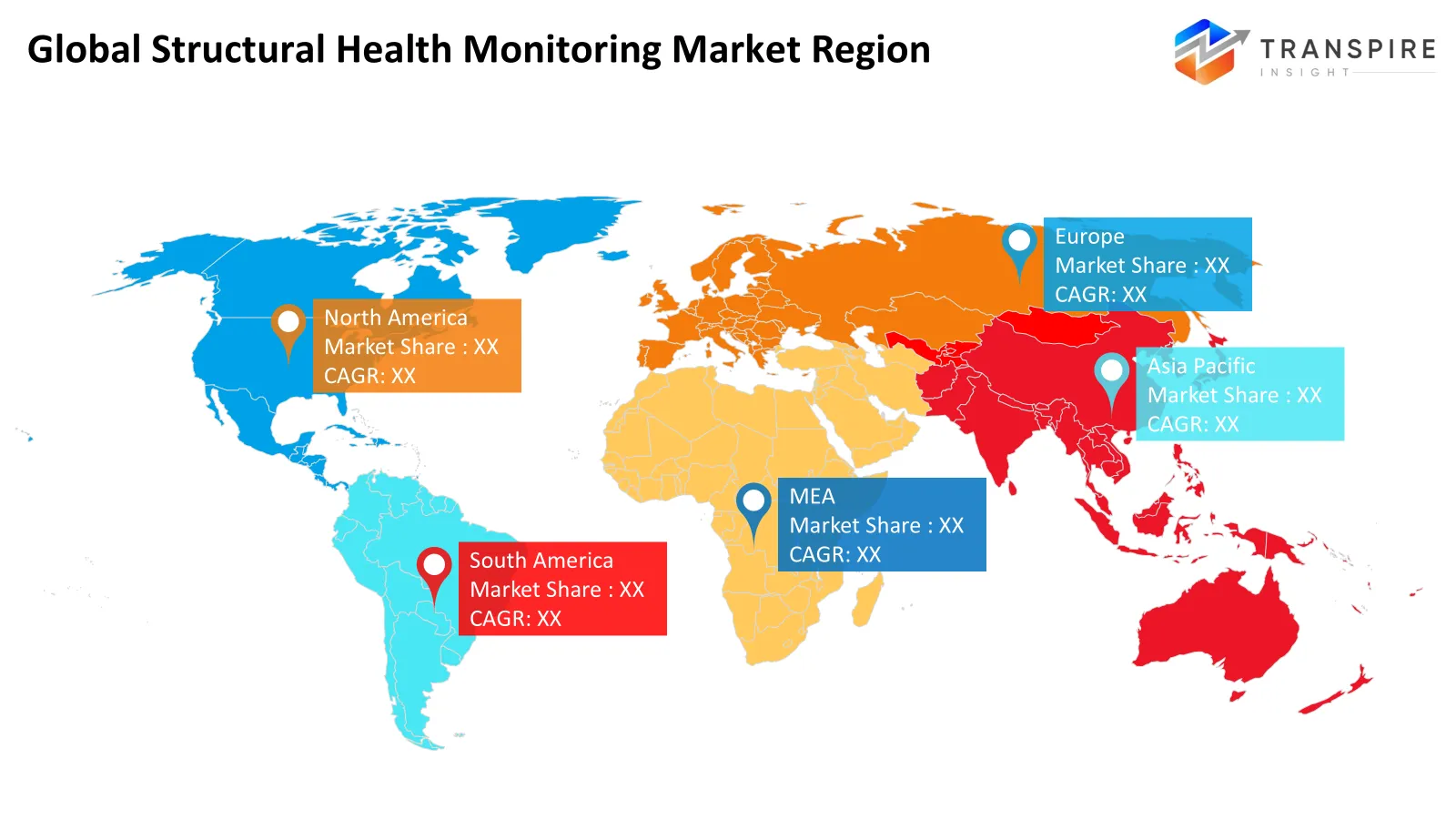
Who are the Key Players in the Global Structural Health Monitoring Market and how do they Compete?
Technology-led differentiation, enhanced analytics and lifecycle value propositions are driving competitive differentiation in the structural health monitoring (SHM) sector. Participants are increasingly competing on the development of holistic ecosystems encompassing sensors, software, interpretation and engineering support. Furthermore, infrastructure asset owners seeking predictive maintenance and risk-based decision-making are increasingly evaluating firms that differentiate on innovation, sector expertise, or geographic footprint.
Hottinger Brel & Kjr, National Instruments, and Trimble compete predominantly with innovation-based models incorporating sensor-based technology, data acquisition capabilities and digital technologies to provide precise measurement and scalable infrastructure monitoring. These players’ expansion plans centre on investments in smart city infrastructure and transportation systems. Campbell Scientific and Geokon build their market position with proven reliability in engineering instrumentation and bespoke infrastructure monitoring solutions across projects in energy. Sisgeo, RST Instruments, Nova Metrix, Digitexx and Strainstall focus on the niche with specialised solutions for the geotechnical sector and industrial applications. Acellent Technologies, Kinemetrics, SIXENSE, COWI, and Advitam have made differentiation through digital capabilities in asset analytics and consulting services across a range of sectors. They will seek to develop their service offerings in the smart city agenda.
Key Players are:
- Hottinger Brüel & Kjær
- Campbell Scientific
- Nova Metrix
- Geokon
- Digitexx
- Sisgeo
- Acellent Technologies
- National Instruments
- Kinemetrics
- COWI
- Advitam
- Strainstall
- SIXENSE
- RST Instruments
- Trimble
Recent Development News
- In February 2026, IDS GeoRadar (part of Hexagon) launched MyMO, a portable, non-contact structural health monitoring device. This product launch allows engineers to rapidly scan and prioritise infrastructure assets, scaling field inspections without needing fixed sensor networks. https://hexagon.com
- In June 2026, Estructura formed a strategic partnership with GeoSIG, becoming their Platinum Partner to deploy advanced Swiss sensing hardware across the Americas and the Caribbean. This partnership expands the availability of high-frequency structural behaviour testing for ageing civil, residential, and nuclear infrastructure.
https://www.coliseum-online.com
- In May 2026, Crystal Instruments launched the Ruby Wireless Vibration Sensor, an ultra-high accuracy data collection device boasting a 36-month battery life. This product launch provides infrastructure operators with a long-term, low-maintenance hardware solution to execute continuous, remote structural health monitoring across complex bridges and buildings.
What Strategic Insights Define the Future of the Global Structural Health Monitoring Market?
As the global SHM market matures, it will shift from passive asset monitoring to a realm of intelligent predictive infrastructure management. Future advancements will rely heavily on the integration of smart city digital twin platforms, IoT sensors, and cloud-based monitoring infrastructures, enabling infrastructure owners to preempt asset failure rather than respond to damage. There is an understated danger of fragmentation of SHM data among legacy platforms that inhibits real-world insights and limits technology ROI, with a tremendous growth opportunity focused on integrating these monitoring platforms within larger smart city and critical infrastructure modernisations to establish long-term recurring revenue streams. Businesses looking to develop a robust, differentiating SHM capability will need to focus on interoperable, intelligence-led SHM solutions that translate SHM data into measurable business value and will seek to engage with companies that serve as intelligent partners, not merely hardware suppliers.
Key Segmentations are:
By Type
- Wireless Monitoring Systems
- Wired Monitoring Systems
- Sensor Networks
- Vibration Monitoring Systems
- Corrosion Monitoring Systems
- Others
By Application
- Bridges & Dams
- Buildings
- Energy Infrastructure
- Aerospace Structures
- Railways
- Others
By End-User
- Government Agencies
- Construction Companies
- Infrastructure Operators
- Others
By Technology
- IoT Monitoring
- AI Analytics
- Cloud Monitoring
- Others
Regional Outlook
North America
- United States
- Canada
- Mexico
Europe
- Germany
- United Kingdom
- France
- Spain
- Italy
- Rest of Europe
Asia Pacific
- Japan
- China
- Australia & New Zealand
- South Korea
- India
- Rest of Asia Pacific
South America
- Brazil
- Argentina
- Rest of South America
Middle East & Africa
- Saudi Arabia
- United Arab Emirates
- South Africa
- Rest of the Middle East & Africa
Frequently Asked Questions
Find quick answers to common questions.
The Global Structural Health Monitoring Market size was valued at USD 4.34 Billion in 2025 and is poised to reach USD 18.031 Billion by 2033, expanding at a 19.50% CAGR.
Key Segments for the Global Structural Health Monitoring Market are By Type (Wireless Monitoring Systems, Wired Monitoring Systems, Sensor Networks, Vibration Monitoring Systems, Corrosion Monitoring Systems, Others); By Application (Bridges & Dams, Buildings, Energy Infrastructure, Aerospace Structures, Railways, Others); By End-User (Government Agencies, Construction Companies, Infrastructure Operators, Others); By Technology (IoT Monitoring, AI Analytics, Cloud Monitoring, Others).
Growth is primarily driven by rising investments in infrastructure lifespan extension, increasing adoption of predictive maintenance strategies, stricter safety regulations, and the need to reduce long-term asset management costs.
The Global Structural Health Monitoring Market is led by major manufacturers, including Hottinger Brüel & Kjær, Campbell Scientific, Nova Metrix, Geokon, Digitexx, Sisgeo, Acellent Technologies, National Instruments, Kinemetrics, COWI, Advitam, Strainstall, SIXENSE, RST Instruments, and Trimble.
North America, holding 37% of the global Market, influences industry dynamics through extensive infrastructure modernisation programs, advanced technology adoption, strong regulatory frameworks, and significant investments in critical asset monitoring.
Key opportunities include AI-powered analytics platforms, smart city infrastructure projects, cloud-based asset management solutions, digital twin integration, and long-term monitoring contracts across emerging infrastructure Markets.
- Hottinger Brüel & Kjær
- Campbell Scientific
- Nova Metrix
- Geokon
- Digitexx
- Sisgeo
- Acellent Technologies
- National Instruments
- Kinemetrics
- COWI
- Advitam
- Strainstall
- SIXENSE
- RST Instruments
- Trimble
About the Authors

Pankaj Ghogare Patil
I am Pankaj Ghogare Patil, a Senior Research Analyst at Transpire Insight, specializing in the Pharmaceutical, Chemicals & Materials, Healthcare IT, and Biotechnology industry. My expertise lies in conducting comprehensive market research, analyzing industry trends, evaluating competitive landscapes, and translating complex data into actionable insights. At Transpire Insight, I closely follow emerging technologies, regulatory developments, and market innovations to create accurate, well-researched, and informative content that helps businesses and professionals make informed decisions. I am committed to producing credible, evidence-based articles that reflect industry best practices while making technical topics accessible and valuable for a broad audience.

Chakradhar Khansole
Chakradhar serves as the Research Director at Transpire Insight, bringing over 8 years of experience in technology, innovation, and strategic market intelligence. He specializes in transforming complex market data into actionable business insights that enable organizations to make informed, growth-oriented decisions. Recognized for his strategic vision and analytical expertise, Chakradhar leads high-impact research initiatives, delivering comprehensive market assessments, competitive intelligence, and forward-looking industry analysis.
Recently Published Reports
-
Apr 2026
AI in Diabetic Retinopathy Market
AI in Diabetic Retinopathy Market Size, Share & Analysis Report By Type (Screening AI Systems, Diagnostic AI Systems, and Predictive AI Models), By Application Segment (Hospitals, Ophthalmology Clinics, Diagnostic Centers, and Research and Development), and Geography (North America, Europe, Asia-Pacific, Middle East and Africa, South and Central America), 2021 - 2031
-
Apr 2026
Psychometric Tests Market
Psychometric Tests Market Size, Share & Analysis Report By Type (Personality Tests, Ability/Aptitude Tests, Skill/Knowledge Tests, and Others), By Application (Talent Acquisition and Talent Management), and Geography (North America, Europe, Asia-Pacific, Middle East and Africa, South and Central America), 2021 – 2031
-
Apr 2026
Rare Biological Sample Collection Market
Rare Biological Sample Collection Market Size, Share & Analysis Report By Type (Isolation Kits & Reagent, Blood Collection Tubes, and Others), By Application (Oncology, Transcriptomics, Pharmacogenomics, and Others), and Geography (North America, Europe, Asia-Pacific, Middle East and Africa, South and Central America), 2021 – 2031
-
Jul 2026
Diabetic Retinopathy Market
Diabetic Retinopathy Market Size, Share & Analysis Report By Type (Proliferative Diabetic Retinopathy, and Diabetic Macular Edema (DME)), By Treatment Type (Anti VEGF Drug, Steroid Implants, Laser Surgeries, and Vitrectomy), and Geography (North America, Europe, Asia-Pacific, Middle East and Africa, South and Central America), 2021 – 2031
Our Clients







