

Global Servo Motors and Drives Market Size & Forecast:
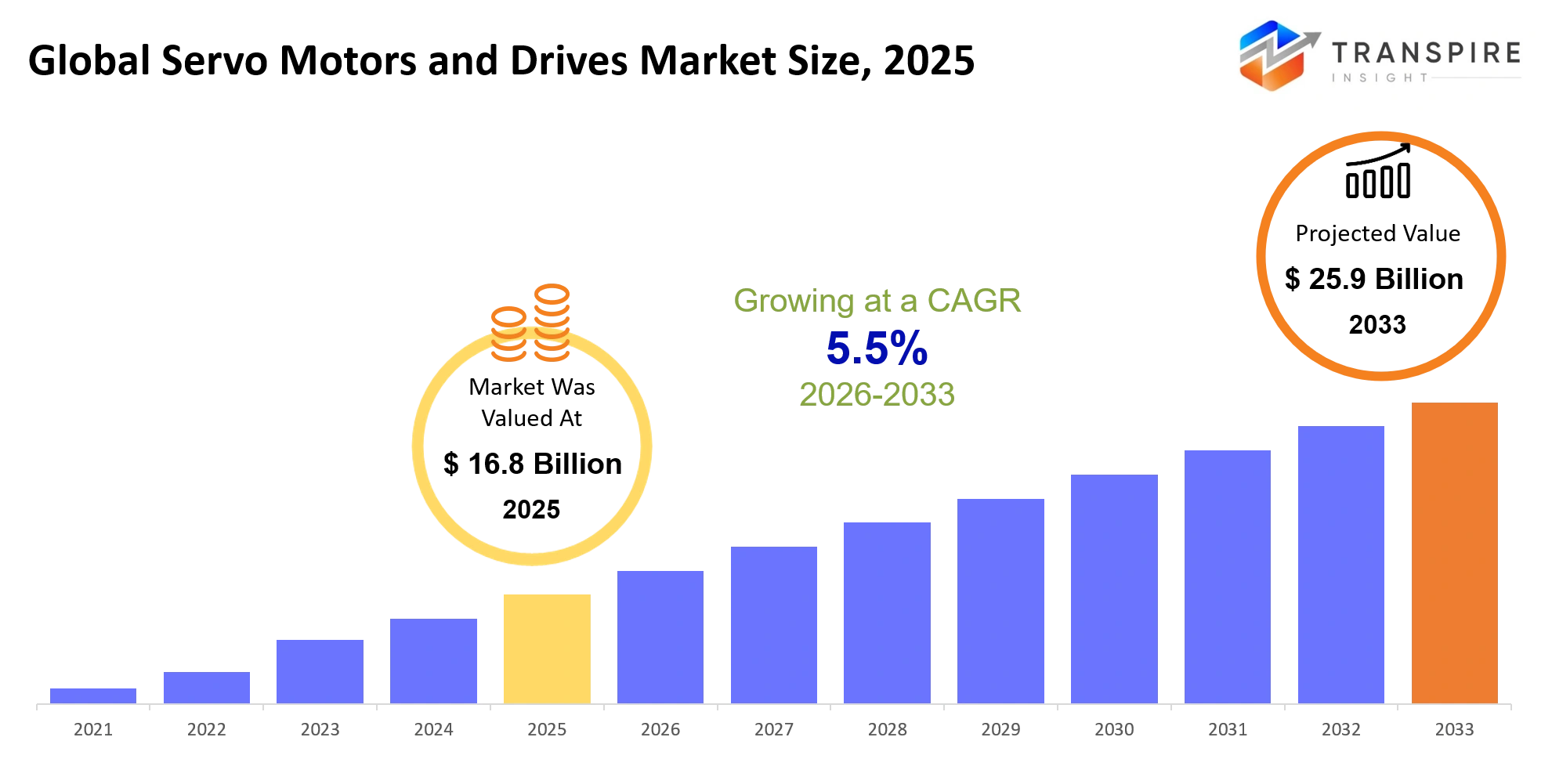
- Global Servo Motors and Drives Market Size 2025: USD 16.8 Billion
- Global Servo Motors and Drives Market Size 2033: USD 25.9 Billion
- Global Servo Motors and Drives Market CAGR: 5.5%
- Global Servo Motors and Drives Market Segments: By Product (Servo Motors, Servo Drives, Integrated Systems, AC Servo, DC Servo, Linear Servo, Rotary Servo, Others); By Voltage (Low, Medium, High, Others); By End User (Automotive, Semiconductor, Packaging, Electronics, Robotics, Others); By Application (Motion Control, CNC Machines, Material Handling, Others); By Communication (EtherCAT, PROFINET, Modbus, Others).
Global Servo Motors and Drives Market Summary:
As per Transpire Insight Analysis, the Global Servo Motors and Drives Market size is estimated at USD 16.8 Billion in 2025 and is anticipated to reach USD 25.9 Billion by 2033, growing at a CAGR of 5.5% from 2026 to 2033.
The global servo motors and drives market is really taking off as companies update their factories with the technology. Servo motors and drives are now a part of automated factories, giving us very precise movements, faster reactions and better energy use in many areas like car making, electronics, semiconductor manufacturing, packaging and industrial robotics. Many companies are investing in factories and digital manufacturing, which is making them want to switch from old motor systems to smarter servo motors and drives that help get more work done while saving money.
In recent years, people have started to want everything to work together, which is helped by the Industrial Internet of Things, Industry 4.0 and production systems that use artificial intelligence. The need for robots is going up, and companies are making more semiconductors and investing in factory automation, which is all helping the servo motors and drives market grow. As companies try to make their factories work better, reduce mistakes, and minimise downtime, they are using more advanced servo motors and drives, in both old and new industries. The servo motors and drives market is getting bigger because companies want to improve how they make things, and servo motors and drives are a part of that.
Key Market Insights:
The global servo motors and drives market is experiencing a rapid change in terms of automation, precision, and energy efficiency as companies seek to adopt efficient automation and production systems through servo motors and drives. Digitalisation of industry processes is motivating companies to adopt sophisticated servo motors and drives to maximise efficiency and accuracy in production systems.
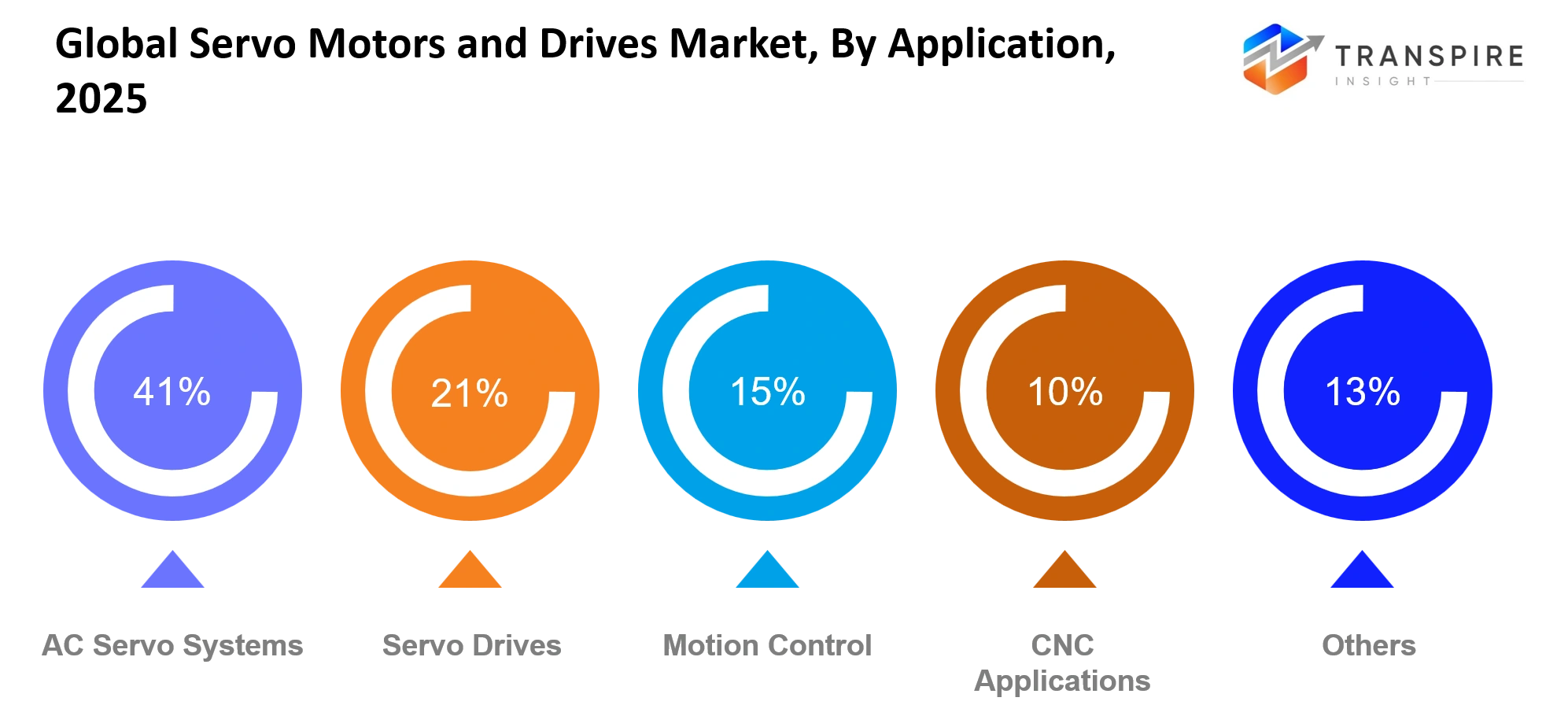
- AC Servo Systems have a 41% market share and lead the global market due to their high degree of precision, energy efficiency, and application in automatic manufacturing plants.
- robotics applications are anticipated to have the highest growth rate and have a compound annual growth rate of 14.6%, driven by increased investment in industrial robots in the automotive, electronics, and semiconductor industries.
- Servo Drives hold a 21% share of the market, driven by increased use of intelligent motor control technologies to improve production efficiency and lower energy consumption.
- Motion Control accounts for 15% of market revenue due to the increased demand for positioning and synchronisation of machines in high-speed production systems.
- CNC Machines have a 10% share of the market as companies upgrade machining machinery to improve accuracy, repeatability, and efficiency.
- Servo manufacturers have shifted their efforts toward designing compact, energy-saving, and efficient servo systems to conserve space and ensure high speed and torque control and reliability.
- The growing emphasis on smart factory, digital manufacturing, and industrial automation projects is leading to continuous demand for superior servo motors and drives in developed and developing countries.
What are the Key Drivers, Restraints, and Opportunities in the Global Servo Motors and Drives Market?
Drivers
The rise in the trend of automation and the move towards smart manufacturing are among the main reasons behind the growth of the global market for servo motors and drives. Increasing use of high-precision motion control devices among industries like automotive, electronics, semiconductor manufacturing, packaging industry, and food processing is driving the demand for these devices. Increasing automation and the use of Industry 4.0 technologies are increasing the demand for servo motors even further. Moreover, companies are shifting from old motor systems to efficient servo motors and drives in order to increase performance and save money on operating costs.
Restraints
The market, however, is facing certain challenges. First of all, the high initial cost of implementation is a major issue because servo motors and drives need to be integrated into the system along with the controller, which costs quite a lot of money, especially for small or medium-sized manufacturers. Moreover, system implementation needs special engineering work as well as employee training.
Opportunities
The market offers several lucrative opportunities as more and more investments are made globally towards the implementation of smart factories, digital manufacturing and artificial intelligence-based factory automation solutions. The increasing use of collaborative robotics, electric vehicles, semiconductor manufacturing plants and automated warehouses is expected to fuel demand for precise motion control solutions. Moreover, the development in the areas of predictive maintenance, connectivity through IIoT and machine monitoring through cloud computing would help the manufacturers enhance the reliability of their machines and minimise any unforeseen disruption in production activities.
What Has the Impact of Artificial Intelligence Been on the Global Servo Motors and Drives Market?
The development of artificial intelligence has greatly enhanced the performance of servo motors and drives since they are capable of analysing machines' operating conditions in order to ensure optimal operation in terms of speed, torque and positioning precision. The importance of this feature is increasing in the automotive, electronics, semiconductor manufacturing and robotics industry due to the fact that small mistakes during manufacturing may negatively affect the product quality and cost of production.
Moreover, artificial intelligence contributes to better maintenance through the prediction of equipment malfunctions. Thanks to data analysis of information that is collected through sensors of servo motors and drives, it is possible to predict when the equipment will fail. It helps to schedule maintenance in advance, which eliminates unplanned downtime, increases the lifespan of equipment and production efficiency. In addition, the manufacturer will be able to save money for maintenance and keep up production performance.
Artificial intelligence contributes to the process optimisation by changing machine parameters depending on production needs and, as a result, improving energy efficiency and resource utilisation. In addition, combining AI and IIoT platforms allows performing remote diagnostics and analysing the performance of several factories. In March 2025, at Hannover Messe 2025, Siemens made significant progress in AI within the industrial sector by incorporating AI in motion control and automation processes, which will support predictive maintenance, self-optimisation of machines, and real-time process optimisation. This is leading to an increased need for intelligent servo motors and drives in smart factories.
Key Market Trends
There is currently taking place a continuous evolution within the worldwide servo motors and drives industry as manufacturers concentrate on automation, precision and networking within the production process. As a result of the growing popularity of smart factories and digital manufacturing techniques, more and more producers opt for advanced servos that provide high efficiency and performance and decrease costs of operations.
- Increasingly, there appears a tendency of AI-based predictive maintenance that allows for the early detection of any faults and decreases production downtime.
- The usage of the IIoT technology is becoming much more common now and allows for the provision of real-time performance monitoring and diagnostics of servo motors and drives in manufacturing plants.
- Industrial robotics is being increasingly used in such industries as automotive, electronics and semiconductors and creates higher demand for high-speed and precision servo motion control systems.
- More compact and energy-efficient motors with high torque density and smaller power consumption and installation area are being offered by the manufacturers of servos.
- Smart factories and Industry 4.0 technologies encourage the use of networked servo drives to facilitate the automated manufacturing process.
- There is a continuous development of the motion control technology through improved software integration.
Global Servo Motors and Drives MarketSegmentation
By product
AC Servo Systems dominate the market with a 41% share, owing to better motion control accuracy, excellent energy efficiency, and reliable performance in automated manufacturing industries. These AC servo systems find application in the automotive manufacturing process, semiconductor manufacturing process, robotics, and packaging equipment. Servo Drives hold a 21% share in the market, owing to their rising demand for efficient motor control. Rising demand for integrated servo systems, linear servo systems, rotary servo systems, DC servo systems, and other specialised products is being witnessed across the globe.
By voltage
The low-voltage servo systems continue to command considerable shares in the market, due to their usage in the factory automation process, robotics, CNC machines, and electronic assembly equipment. Rising adoption of medium-voltage servo systems is being witnessed in the heavy industries owing to high power generation and performance. The high-voltage servo systems are increasingly becoming popular in large manufacturing industries owing to rigorous production processes, whereas other customised voltage configurations find application in specific industries.
By end users
The automotive industry continues to be among the largest consumers of servo motors and drives due to increasing adoption of robotic assembly lines and precision machining. The semiconductor and electronics industries are continuing to see growth in their application due to the increasing adoption of advanced servo technologies in fast-paced and highly precise manufacturing processes. Packaging industries are developing their intelligent motion control systems, while the robotics industry is expected to see the highest growth, powered by increased automation and adoption of collaborative robots.
By application
Motion Control constitutes about 15% of the total global market, owing to the importance of the technology in providing accurate positioning and synchronised movements of machines in the automated production process. Applications based on CNC machines constitute about 10%, backed by rising demand for precision machining in automotive, aerospace, and metalworking industries. Applications of material handling are also increasing along with the rising adoption of automated machinery in warehouses and logistics centres. Other industrial applications are also creating strong demand for the advanced servo technologies.
By Communication
Ether CAT has emerged as a suitable option for high-speed industrial automation due to low latency and better synchronization. PROFINET is gradually emerging as a suitable protocol for digitally networked manufacturing plants owing to its better integration with the industrial control system. Modbus is still in use due to its ease-of-use, reliability, and affordability, especially in conventional manufacturing units. Other industrial communication protocols are increasingly becoming part of the current servo systems for better connectivity and real-time data communication.
What are the Key Use Cases Driving the Global Servo Motors and Drives Market?
Global Servo motors and drives find their application primarily in industrial automation systems, in which precision motion control is necessary to preserve product quality and maintain an efficient production process. , are widely used in automotive production lines, CNC machines, semiconductor manufacturing, and packaging equipment. These devices' capability to provide accuracy of positioning, fast motion control, and high efficiency of operation makes them an advantageous solution for modern industrial automation.
Moreover, the usage of servos extends into robotics, electronic equipment manufacturing, material handling, and warehouse automation systems. Robots are equipped with advanced servo systems to provide assembly, welding, testing, pick-and-place, and other complicated operations with high accuracy. Applications of motion control continue to expand due to investment in automated manufacturing facilities that increase productivity of manufacturing processes and decrease the number of errors and power usage. Applications emerging in the industry provide new opportunities for market development, especially in such fields as collaborative robotics, electric vehicle manufacturing, smart factories, and logistics systems. In particular, robotics applications will demonstrate the highest growth rate due to investments in automation and intelligent manufacturing solutions enabled by artificial intelligence.
|
Report Metrics |
Details |
|
Market size value in 2025 |
USD 16.8 Billion |
|
Market size value in 2026 |
USD 17.7 Billion |
|
Revenue forecast in 2033 |
USD 25.9 Billion |
|
Growth rate |
CAGR of 5.5% from 2026 to 2033 |
|
Base year |
2025 |
|
Historical data |
2021 - 2024 |
|
Forecast period |
2026 - 2033 |
|
Report coverage |
Revenue forecast, competitive landscape, growth factors, and trends |
|
Regional scope |
United States; Canada; Mexico; United Kingdom; Germany; France; Italy; Spain; Denmark; Sweden; Norway; China; Japan; India; Australia; South Korea; Thailand; Brazil; Argentina; South Africa; Saudi Arabia; United Arab Emirates |
|
Key company profiled |
Yaskawa Electric, Siemens, Mitsubishi Electric, ABB, Schneider Electric, Rockwell Automation, Bosch Rexroth, Delta Electronics, Fanuc, Omron, Panasonic, Fuji Electric, Kollmorgen, Nidec, Beckhoff. |
|
Customization scope |
Free report customization (country, regional & segment scope). Avail customized purchase options to meet your exact research needs. |
|
Report Segmentation |
By Product (Servo Motors, Servo Drives, Integrated Systems, AC Servo, DC Servo, Linear Servo, Rotary Servo, Others); By Voltage (Low, Medium, High, Others); By End User (Automotive, Semiconductor, Packaging, Electronics, Robotics, Others); By Application (Motion Control, CNC Machines, Material Handling, Others); By Communication (EtherCAT, PROFINET, Modbus, Others). |
Which Regions are Driving the Global Servo Motors and Drives Market Growth?
North America
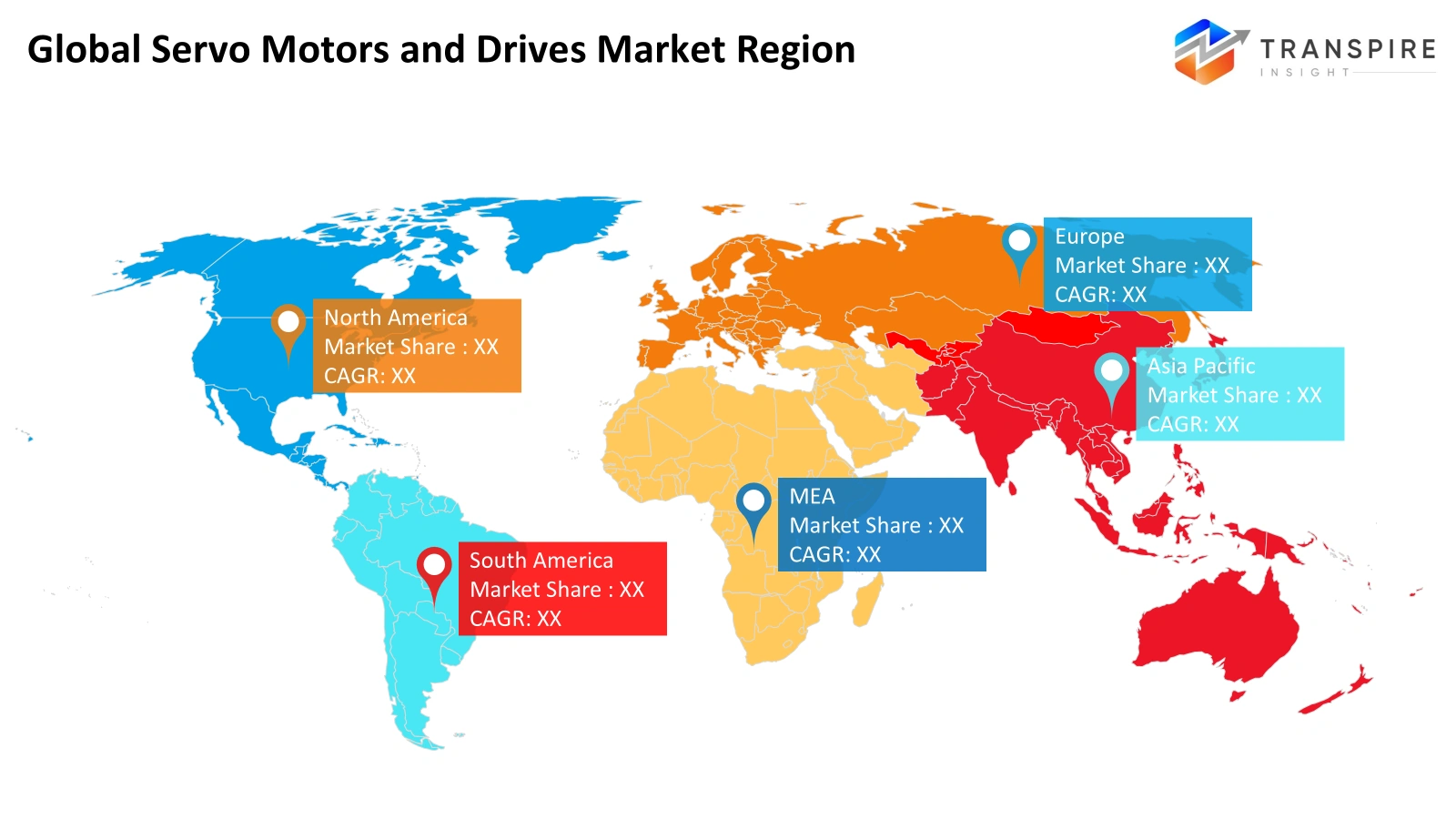
North America holds a 22% share in the global market of servo motors and drives and will register the highest growth at a CAGR of 15.1% during the forecast period. Growing investments in smart manufacturing, semiconductor manufacturing, warehouse automation, and industrial robotics will help drive the adoption of advanced servo solutions in the U.S. and Canada. Implementation of AI-based automation solutions, predictive maintenance, and connected manufacturing solutions will further increase the demand for intelligent motion control solutions. All these factors will help in making North America one of the fastest-growing regions in the coming years.In May 2025 , At Automate 2025 in Detroit, Siemens presented its latest servo-drive system and SIMATIC S7-1200 G2 motion control system, further reinforcing its motion control solutions in smart factories in North America and contributing to the increasing use of servo drives in manufacturing automation.
Europe
Europe contributes 26% share in the worldwide market and continues to be an important centre for precision engineering and industrial automation. The market in Europe receives advantages owing to an established presence of the manufacturing sector, especially in automobile manufacture, industrial machinery, packaging, and food processing industries. Manufacturers in the region are increasingly adopting energy-efficient motion control solutions to increase production efficiency while complying with stringent environmental and energy standards. Ongoing investments in the development of Industry 4.0 technology solutions, along with factory modernisation, will help in continuing the steady growth of the market in the region.In March 2025, Siemens introduced its new technologies in industrial AI, digital twins, and software-defined automation at Hannover Messe 2025 and developed its motion control ecosystem for intelligent manufacturing. These innovations optimise the performance of servo drives and motion systems that are widely employed in the automotive, machinery, and industrial automation industries across Europe.
Asia Pacific
Asia Pacific accounts for the highest market share for the global servo motors and drives market, which is 44%. The dominance of this region is backed up by factors like a well-established manufacturing industry, high industrial automation and manufacturing processes in automotive, electronics, and semiconductor industries. Some of the countries, like China, Japan, South Korea, and India, have continued making investments in the domain of smart manufacturing plants, robotics, and advanced manufacturing processes. This is increasing the requirement for efficient servo systems in the region. In April 2025,Mitsubishi Electric released its new-generation FR-D800 inverter series that enables increased efficiency and easy factory automation implementation. This drive technology facilitates high-performance motion control and is compatible with servo motor systems that are widely utilised in the Asia-Pacific region.
Who are the Key Players in the Global Servo Motors and Drives Marketand how do they Compete?
The competition in the international market of servo motors and drives is characterised by constant innovation, reliability, and the capacity to provide customers with comprehensive solutions of motion control across a range of industries. Leading manufacturers are trying to improve their market position by broadening their automation portfolio, adding features of AI and IIoT, as well as increasing energy efficiency. In addition, they invest in R&D to develop small and powerful servo systems that would meet the requirements of future smart manufacturing.
Mitsubishi Electric specialises in advanced technologies of motion control and factory automation. Its competitive advantage consists of the development of highly precise servo systems suitable for automotive, electronics, and semiconductor industries. The global expansion strategy of the company consists of constant product innovations, digital manufacturing solutions, and cooperation with industrial automation suppliers.
Yaskawa Electric Corporation competes in the market by providing high-speed servo motors and drive systems that suit robots and industrial automation. The company continues to strengthen its market position by developing automation-based products, expanding production capacity, and investing in smart factory technology. Siemens AG is focused on digitalisation through the integration of servo drives into industrial software and AI analytics.
Global Servo Motors and Drives Market companies
- Yaskawa Electric
- Siemen
- Mitsubishi Electric
- ABB
- Schneider Electric
- Rockwell Automation
- Bosch Rexroth
- Delta Electronics
- Fanuc
- Omron
- Panasonic
- Fuji Electric
- Kollmorgen
- Nidec
- Beckhoff
Recent Development News
In June 2025, the MELSERVO-JET series of servo drives was released by Mitsubishi Electric. The MELSERVO-JET series aims at providing an affordable automation solution that is easy to install and compact in design for industries. The launch will make precision motion control available to industries upgrading their automation with minimal investment.
Source: https://eu-assets.contentstack.com
In May 2025, the enhanced portfolio of motion controls from Siemens AG, comprising the SINAMICS S200 and S210 series of servo drives along with the new SIMATIC S7-1200 G2 controller, was unveiled at Automate 2025.
Source: https://www.automationmag.com
In April 2026, Yaskawa Electric Corporation introduced GA501, a small-sized AC drive with embedded Ethernet communication. This drive helps improve connectivity between servo drives and robots, enabling manufacturers to boost automation, machinery, and productivity levels in their factories.
Source: https://www.yaskawa-global.com
What Strategic Insights Define the Future of the Global Servo Motors and Drives Market?
There are numerous factors that indicate that the future of the global servo motors and drives market will be positive, as suppliers invest more into automation of production processes, implementation of smart factory concepts, development of robots and AI-based motion control systems. Firms that are concentrated on the design of energy-efficient products with intelligent diagnostic features and perfect integration with IIoT are anticipated to gain a competitive advantage, as customers are increasingly looking for connected automation solutions.
The one obstacle that should be addressed by suppliers is connected with the necessity to integrate advanced servo technology with old production infrastructure, as many firms still use outdated equipment in their facilities. Such integration difficulties should be overcome to achieve market penetration.
The one promising trend in terms of global servo motors and drives market development is associated with fast-growing markets of electric vehicle manufacturing, semiconductors production, warehouse automation and collaborative robotics. Suppliers are recommended to pay attention to innovations, the development of software features and regional partnerships.
Key Segmentations are:
By Product
- Servo Motors
- Servo Drives
- Integrated Systems
- AC Servo
- DC Servo
- Linear Servo
- Rotary Servo
By Voltage
- Low
- Medium
- High
By End User
- Automotive
- Semiconductor
- Packaging
- Electronics
- Robotics
By Application
- Motion Control
- CNC Machines
- Material Handling
By Communication
- EtherCAT
- PROFINET
- Modbus
Regional Outlook
North America
- United States
- Canada
- Mexico
Europe
- Germany
- United Kingdom
- France
- Spain
- Italy
- Rest of Europe
Asia Pacific
- Japan
- China
- Australia & New Zealand
- South Korea
- India
- Rest of Asia Pacific
South America
- Brazil
- Argentina
- Rest of South America
Middle East & Africa
- Saudi Arabia
- United Arab Emirates
- South Africa
- Rest of the Middle East & Africa
Frequently Asked Questions
Find quick answers to common questions.
The global servo motors and drives market size was valued at USD 16.8 Billion in 2025 and is poised to reach USD 25.9 Billion by 2033, expanding at a 5.5% CAGR.
Key segments for the global servo motors and drives market are By Product (Servo Motors, Servo Drives, Integrated Systems, AC Servo, DC Servo, Linear Servo, Rotary Servo, Others); By Voltage (Low, Medium, High, Others); By End User (Automotive, Semiconductor, Packaging, Electronics, Robotics, Others); By Application (Motion Control, CNC Machines, Material Handling, Others); By Communication (EtherCAT, PROFINET, Modbus, Others).
Growth is primarily driven by The growth in the market is mainly attributed to the fast adaptation of automation in industries, more use of robotics, increasing demand for precise motion control in manufacturing industries, increased production of electric vehicles, increased investments in smart factories, and the need for energy-efficient motors.
The global market is led by major manufacturers, including Yaskawa Electric, Siemens, Mitsubishi Electric, ABB, Schneider Electric, Rockwell Automation, Bosch Rexroth, Delta Electronics, Fanuc, Omron, Panasonic, Fuji Electric, Kollmorgen, Nidec, Beckhoff.
The Asia Pacific region is responsible for 44% of the total global market share in terms of servo motors and drives, thus emerging as the dominant market in the world. The dominance of this region is backed by factors including a high level of manufacturing activities, industrial automation, growth in the electronic and automotive industry, and investments in smart factories.
Commercial possibilities in the global market of servo motors and drives involve an increasing need for automation and intelligent factories, robotics adoption in manufacturing, investments in electric vehicles and batteries, increasing applications of servo motors in packaging and semiconductor sectors, and production facility modernisation via Industry 4.0 and energy-efficient motion control.
- Yaskawa Electric
- Siemen
- Mitsubishi Electric
- ABB
- Schneider Electric
- Rockwell Automation
- Bosch Rexroth
- Delta Electronics
- Fanuc
- Omron
- Panasonic
- Fuji Electric
- Kollmorgen
- Nidec
- Beckhoff
About the Authors

Avinash Kumar
I’m Avinash Kumar, a Senior Research Analyst at Transpire Insight, with expertise in the Electronics and Semiconductor and Energy & Power industry. My work focuses on analyzing emerging technologies, market trends, industry developments, and innovation across these sectors. I specialize in transforming complex technical and market insights into clear, research-backed content that helps professionals, businesses, and decision-makers stay informed. Through continuous industry research and data-driven analysis, I strive to deliver accurate, reliable, and practical perspectives on the latest advancements shaping the semiconductor and energy landscape.

Chakradhar Khansole
Chakradhar serves as the Research Director at Transpire Insight, bringing over 8 years of experience in technology, innovation, and strategic market intelligence. He specializes in transforming complex market data into actionable business insights that enable organizations to make informed, growth-oriented decisions. Recognized for his strategic vision and analytical expertise, Chakradhar leads high-impact research initiatives, delivering comprehensive market assessments, competitive intelligence, and forward-looking industry analysis.
Recently Published Reports
-
Apr 2026
Active Power Filter Market
Active Power Filter Market Size, Share & Analysis Report By Type (Shunt Active Power Filters, Series Active Power Filter, Hybrid Active Power Filter), By Application (Harmonics Mitigation, Reactive Power Compensation, Voltage Regulation, Power Factor Correction), By Phase (Single Phase, Three Phase), By End-User Industry (Manufacturing, Healthcare, Commercial, Automotive, Oil and Gas, Others), and Geography (North America, Europe, Asia-Pacific, Middle East and Africa, South and Central America), 2021 - 2031
-
Apr 2026
Electrical Transformer Market
Electrical Transformer Market Size, Share & Analysis Report By Core (Closed, Shell, and Berry), By Insulation (Gas, Oil, Solid, Air, and Other), By Phase (Single, and Three), By Rating (100 MVA to 500 MVA, 501 MVA to 800 MVA, and 801 MVA to 1200 MVA), and Geography (North America, Europe, Asia-Pacific, Middle East and Africa, South and Central America), 2021 – 2031
-
Apr 2026
Hydraulic Piston Pumps Market
Hydraulic Piston Pumps Market Size, Share & Analysis Report By Type (Axial Piston Pumps, Radial Piston Pumps), By Operating Pressure (Low Pressure, Medium Pressure, High Pressure), By Application (Construction, Mining, Agriculture, Automotive, Oil & Gas, Industrial Machinery, Others), By End-User (OEMs, Aftermarket), and Geography (North America, Europe, Asia-Pacific, Middle East and Africa, South and Central America), 2021 – 2031
-
Apr 2026
Laboratory Gas Generators Market
Laboratory Gas Generators Market Size, Share & Analysis Report By Product (Nitrogen Gas Generator, Hydrogen Gas Generator, Zero Air Gas Generator, Purge Gas Generator, TOC Gas Generators, Others), By Application (Gas Chromatography, Liquid Chromatography-mass Spectrometry (LC-MS), Gas Analyzers, Others), By End-user (Life Science, Chemical & Petrochemical, Food & Beverage, Others), and Geography (North America, Europe, Asia-Pacific, Middle East and Africa, South and Central America), 2021 – 2031