

Global Repairable Small Appliances Market Size & Forecast:
- Global Repairable Small Appliances Market Size 2025: USD 147.9 Billion
- Global Repairable Small Appliances Market Size 2033: USD 227.7 Billion
- Global Repairable Small Appliances Market CAGR: 5.54%
- Global Repairable Small Appliances Market Segments: By Product Type (Kitchen Appliances, Cleaning Appliances, Personal Care Appliances, Home Comfort Appliances, Smart Small Appliances, Garment Care Appliances, Portable Appliances, Others); By Repair Type (Mechanical Repair, Electrical Repair, Component Replacement, PCB Repair, Motor Repair, Refurbishment Services, Preventive Maintenance, Others); By Distribution Channel (Authorized Service Centers, Independent Repair Shops, Online Repair Platforms, Retail Stores, OEM Service Centers, Doorstep Repair Services, Third-party Service Providers, Others); By End User (Residential Consumers, Commercial Establishments, Hospitality Industry, Healthcare Facilities, Educational Institutions, Government Organizations, Industrial Users, Others); By Appliance Technology (Corded Appliances, Cordless Appliances, Smart Connected Appliances, Energy-efficient Appliances, IoT-enabled Appliances, AI-enabled Appliances, Conventional Appliances, Others).
Global Repairable Small Appliances Market Summary:
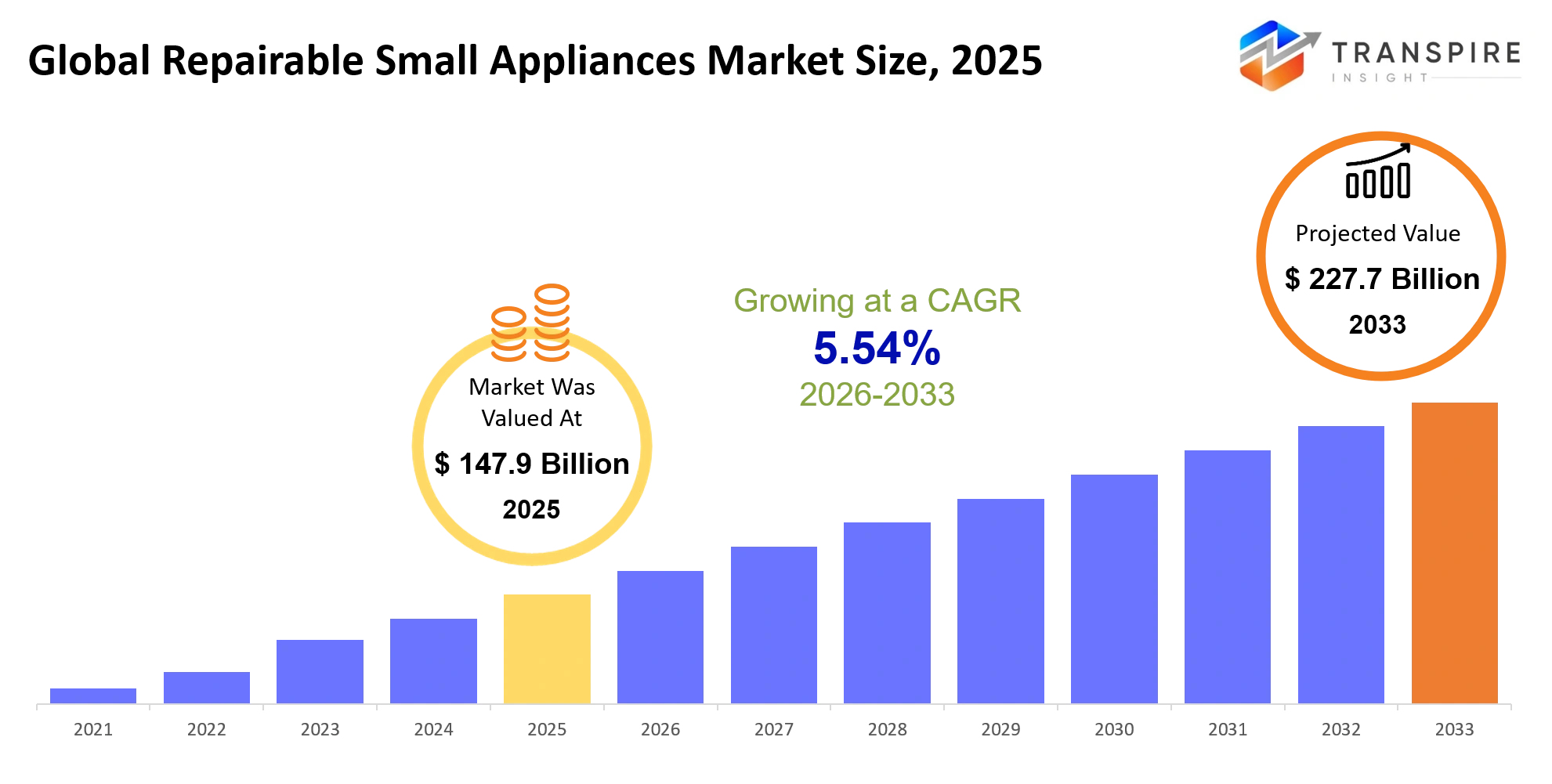
As per Transpire Insight Analysis, the Repairable Small Appliances Market size is estimated at USD 147.9 Billion in 2025 and is anticipated to reach USD 227.7 Billion by 2033, growing at a CAGR of 5.54% from 2026 to 2033.
Market demand for repairing, refurbishing, maintenance, and lifetime-extending services for home appliances, from mixers, vacuum cleaners, coffee makers, irons, hair dryers, and other small electronics, offers opportunities to help consumers reduce their replacement spend and prolong useful life. In the last five years, sustainability imperatives, concerns about e-waste, and a more cost-conscious consumer culture have moved appliance repair from an after-sales service back-office function to a business-model service offering. An important structural development, enabling appliance repair, has been product design for reparability and the right-to-repair movement, enabling service and spare parts availability. In an ageing base of appliances, the service market, with technicians, spare parts availability, refurbishment networks, and online service platforms, is growing rapidly.
Key Repairable Small Appliances Market Insights:
Moving from reactive repair services to lifecycle management with digital diagnostics, refurbishment ecosystems and product strategies geared toward sustainability. Consumers are demanding more repairability, affordability, and environmental protection rather than replacing products frequently, and manufacturers are enhancing their after-sales service.
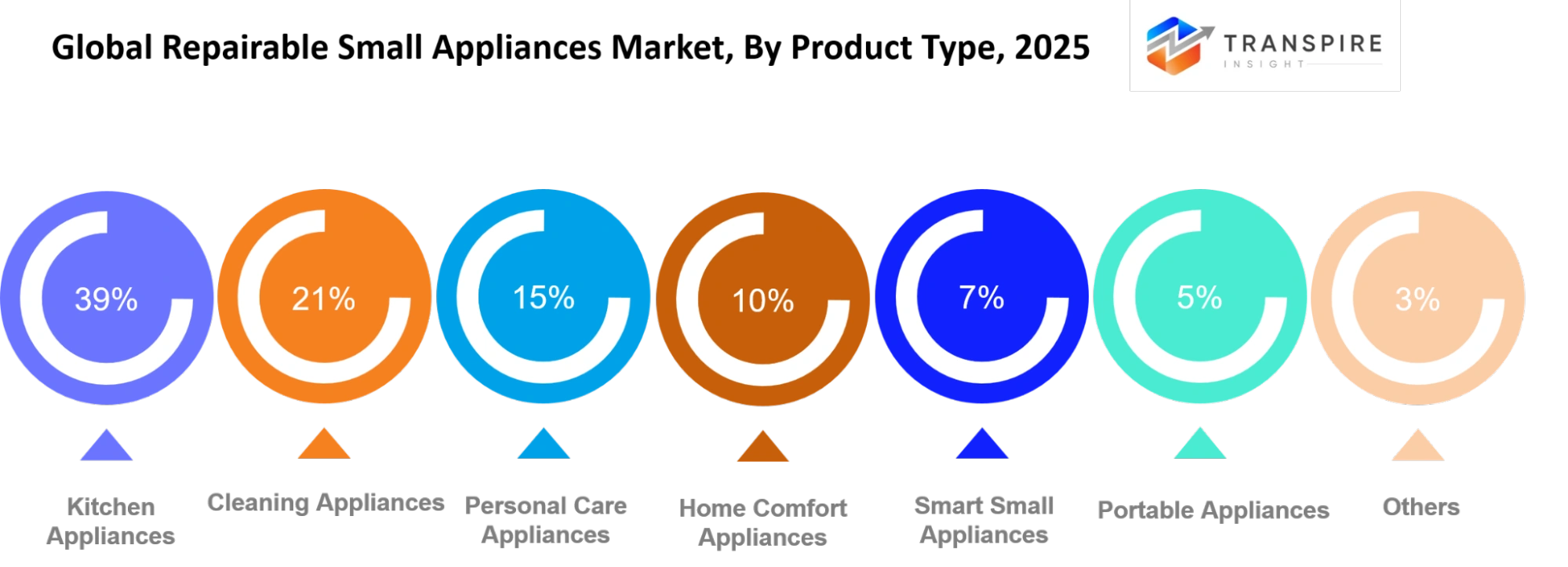
- Kitchen appliances capture 39% of the market as Whirlpool and Bosch invest in modular component designs that lead to greater repair success and product life.
- Cleaning appliances make up 21%, with Dyson and SharkNinja offering service-friendly motor technology and app-assisted servicing support.
- Personal Care Appliances make up 15%, with Philips and Panasonic making replaceable parts more accessible to maximise grooming device life cycles.
- 36% of demand is in Europe, where Electrolux and Bosch are building certified repair networks in line with circular economy rules.
- Smart Connected Appliances are growing at a 15.3% CAGR, featuring remote diagnostics and predictive servicing from Samsung Electronics and LG Electronics.
- Asia Pacific accounts for 28%, with Haier and Midea opening refurbishment centres across the region to meet the growing demand of middle-class consumers for appliances.
- Authorised service channels keep increasing, and this is thanks to Breville and De'Longhi investing in technician certification and a true spare-part environment.
- Portable Appliances have 5%, and Black+Decker and Tefal are improving battery replacement and repair, and lessening electronic waste.
What are the Key Drivers, Restraints, and Opportunities in the Global Repairable Small Appliances Market?
Driver:
Driven by growth in small appliance installed base and increasing consumer intent to prolong product life instead of buying new products; High cost of new appliances, stronger brand sustainability pledges and changing regulations on the right to repair have motivated manufacturers to provide greater availability of spare parts and facilitate ease of repairs, resulting in recurring revenue generation via repair, refurbished goods, extended warranty, replacement of parts, improving customer satisfaction and brand image, along with circular economy principles.
In June 2026, Parts Town acquired 86 Repairs to expand its foodservice technology capabilities. This acquisition strengthens their investment in helping operators reduce downtime, streamline repairs and maintenance, and keep commercial equipment running seamlessly.
Restraint:
Restricted access to original spare parts, proprietary product designs, and complex electronic assemblies continues to limit repairability across many small appliance categories. Many modern appliances incorporate sealed components and integrated circuit boards that require specialised diagnostic tools and skilled technicians. These design constraints increase repair costs, extend service turnaround times, and discourage independent repair providers, limiting broader adoption of repair services.
Opportunity:
IoT-connected smart appliances and the growing network of third-party repair shops provide long-term growth prospects for the repairable small appliances market. IoT-enabled remote diagnostics and artificial intelligence-aided fault detection are enhancing the productivity of repair technicians. Digital service platforms reduce overall service cost. Refurbishment and certified repair centre networks are expanding across emerging economies with rising appliance ownership.
Modular product designs from manufacturers can help build up recurring service revenue from repair, subscription, and maintenance services, and spare part replacement while supporting compliance with circular economy initiatives and evolving environmental regulations. In February 2026, Samsung launched the SmartThings Home Care platform for its Bespoke AI ACs. This proactive monitoring system alerts users to potential faults and streamlines service support, significantly reducing downtime and service costs.
What Has the Impact of Artificial Intelligence Been on the Global Repairable Small Appliances Market?
The integration of artificial intelligence into repair operations facilitates more efficient diagnostic processes and proactive maintenance scheduling. Through the analysis of performance data originating from connected appliances, algorithmic models identify operational anomalies before component failure. This transition toward predictive strategies serves to minimise unexpected downtime and associated repair expenditures. Technical productivity also experiences gains from automated troubleshooting systems and image recognition tools, which streamline the identification of faults and the delivery of repair protocols. In the realm of logistics, machine learning provides a framework for spare parts inventory management. Demand forecasting, derived from a combination of historical records and regional usage trends, allows for a more balanced stock level, reducing the incidence of shortages. Customer support functions are similarly affected by digital interfaces that handle service appointments and guide users through remote diagnostics. Despite these advancements, the transition remains hindered by substantial setup costs and the technical difficulty of retrofitting legacy equipment. A lack of high-quality data and the absence of necessary digital infrastructure within smaller repair firms often impede the realisation of these efficiency gains, despite the clear potential for improved long-term service quality.
In January 2026, Vertiv launched Vertiv™ Next Predict, an AI-powered managed service combining advanced machine learning to anticipate data centre infrastructure issues proactively, improving uptime and service reliability.
Key Global Repairable Small Appliances Market Trends:
The market is shifting away from the traditional repair service towards a digitally connected lifecycle management that's driven by predictive maintenance and sustainability to create long-term customer value. From a service perspective, there is a growing trend for industry to integrate, repair, refurbish, supply spare parts and perform smart diagnostics in a service ecosystem.
- Business models are bolstered by consumer preference for repairing high-quality equipment over replacing it, thereby increasing the circular economy.
- Online scheduling systems have changed the repair process from requests to real-time allocation of technicians.
- Manufacturers are growing certified repair networks to increase their brand loyalty and post-warranty earnings.
- Sealed product designs are being replaced by modular appliance engineering, making parts replacement and services easier.
- Smart connected devices allow for remote diagnosis, which minimises trips by the technician and increases the likelihood of repairs being completed on the first visit.
- As retailers launch certified resale and trade-in schemes, refurbished appliance schemes are gaining widespread traction.
- Predictive maintenance solutions are taking proactive steps from reactive breakdown repair to planned maintenance cycles.
- International laws and guidelines on e-waste are ongoing and continue to push investment in repair facilities, training technicians, and sustainable product lifecycle management.
Global Repairable Small Appliances Market Segmentation
By Product Type:
Kitchen appliances dominate the market with 39%, with daily usage products such as blenders, food processors, coffee makers, microwave ovens, mixers, etc driving repair and replacement parts. Cleaning appliances captured 21% of the market as increased ownership of vacuum cleaners and robotic cleaners drives routine servicing, and Portable appliances capture 15%, driven by personal care and grooming products in need of routine repairs. Home comfort appliances 10%, smart small appliances 7%, portable appliances 5%, and Others 3% are seeing an uptick in this space, driven by the demand for product longevity and avoiding new purchases.
By Repair Type:
Since motors, gears, switches, and moving parts inevitably wear and fail, Mechanical Repair is the largest service segment. Electrical Repair, Component Replacement, PCB Repair, Motor Repair, Refurbishment Services, and Preventive Maintenance are growing rapidly as modern appliances have more sophisticated electronics, which require expertise and factory-authorized parts for repairs.
By Distribution Channel:
Authorized Service Centres continue to dominate the market space with the provision of warranty repairs and OEM replacement parts. Independent Repair Shops, Online Repair platforms, Retail Shops, OEM Repair centres, Doorstep service centres, and third-party service Providers keep on increasing with more services such as speedy repair response, budget-friendly costs, digital services, etc.
By End User:
Residential Consumers account for the greatest demand due to high appliance ownership and regular maintenance requirements. Commercial establishments, hospitality, healthcare facilities, educational institutions, government organizations, industrial users, and others increasingly depend on preventive maintenance to minimize equipment downtime and operational costs.
By Appliance Technology:
Smart Connected Appliances represent the fastest-growing category with a 15.3% CAGR, supported by remote diagnostics and predictive maintenance capabilities. Corded, cordless, energy-efficient, IoT-enabled, AI-enabled, and conventional appliances continue shaping repair service requirements as product technologies become increasingly sophisticated.
What are the Key Use Cases Driving the Global Repairable Small Appliances Market?
The main driver is kitchen appliances, 39%, the usage within households demands continuous replacement, repair of the motor, electrical parts, preventive maintenance, and refurbishment to increase the lifetime and decrease the cost of ownership of an appliance.
Organised repair services are getting traction in the commercial kitchen, hotel, health care, education, retail, etc. To keep operational processes seamless, reduce equipment replacement cost, and ensure sustainability & maintenance standard compliance.
Emerging applications focus on smart connected appliances at a CAGR of 15.3%, with demand for remote diagnostics, Predictive Maintenance, AI based Troubleshooting & Online repair platforms to drive proactive services, accelerate issue diagnosis, enhance customer satisfaction, and optimise life-cycle management for households and commercial appliances.
|
Report Metrics |
Details |
|
Market size value in 2025 |
USD 147.9 Billion |
|
Market size value in 2026 |
USD 156.1 Billion |
|
Revenue forecast in 2033 |
USD 227.7 Billion |
|
Growth rate |
CAGR of 5.54% from 2026 to 2033 |
|
Base year |
2025 |
|
Historical data |
2021 - 2024 |
|
Forecast period |
2026 - 2033 |
|
Report coverage |
Revenue forecast, competitive landscape, growth factors, and trends |
|
Regional scope |
United States; Canada; Mexico; United Kingdom; Germany; France; Italy; Spain; Denmark; Sweden; Norway; China; Japan; India; Australia; South Korea; Thailand; Brazil; Argentina; South Africa; Saudi Arabia; United Arab Emirates |
|
Key company profiled |
Whirlpool, Philips, Panasonic, Samsung Electronics, LG Electronics, Bosch, Electrolux, Haier, Midea, SharkNinja, Breville, Dyson, De'Longhi, Black+Decker, Tefal. |
|
Customization scope |
Free report customization (country, regional & segment scope). Avail customized purchase options to meet your exact research needs. |
|
Report Segmentation |
By Product Type (Kitchen Appliances, Cleaning Appliances, Personal Care Appliances, Home Comfort Appliances, Smart Small Appliances, Garment Care Appliances, Portable Appliances, Others); By Repair Type (Mechanical Repair, Electrical Repair, Component Replacement, PCB Repair, Motor Repair, Refurbishment Services, Preventive Maintenance, Others); By Distribution Channel (Authorized Service Centers, Independent Repair Shops, Online Repair Platforms, Retail Stores, OEM Service Centers, Doorstep Repair Services, Third-party Service Providers, Others); By End User (Residential Consumers, Commercial Establishments, Hospitality Industry, Healthcare Facilities, Educational Institutions, Government Organizations, Industrial Users, Others); By Appliance Technology (Corded Appliances, Cordless Appliances, Smart Connected Appliances, Energy-efficient Appliances, IoT-enabled Appliances, AI-enabled Appliances, Conventional Appliances, Others). |
Which Regions are Driving the Global Repairable Small Appliances Market?
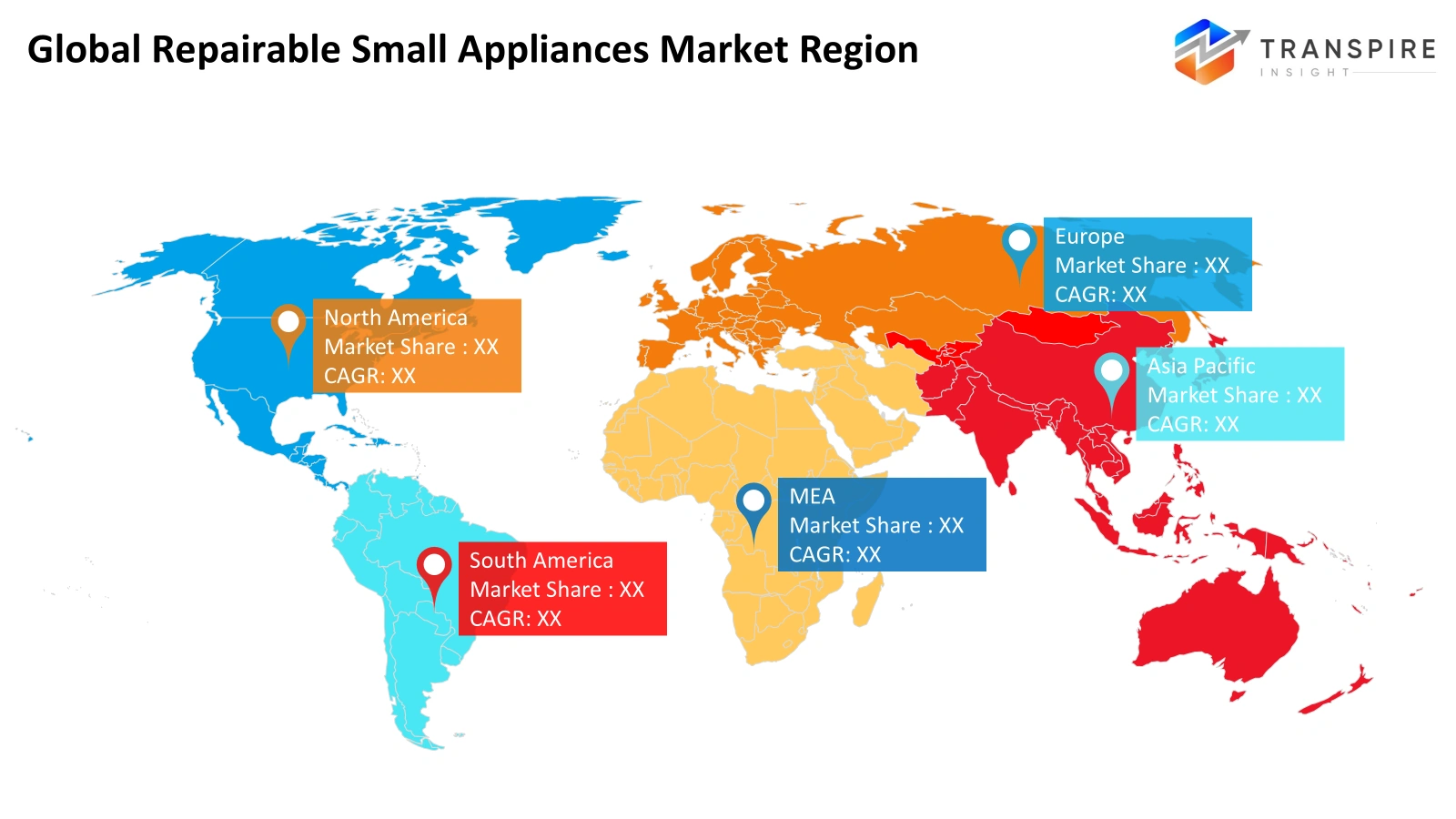
Europe leads the global market, with 36% of the total market, thanks to robust environmental controls, plenty of repair centres and the use of circular economy business models. At the household-appliance sector level, right-to-repair policies have spurred manufacturers to more readily make spares and products more serviceable. Consumers are very receptive to refurbishment and certified repair services, enabling a sustainable aftermarket business model. Europe continues to benefit from large networks of recyclers and technologists, as well as generous incentives for sustainability. In May 2026, the European Union and the Government of India launched a joint funding call of EUR 15.2 million for EV battery recycling technologies. This strengthens transnational technology partnerships and accelerates the development of scalable, circular recycling infrastructure.
North America accounts for a 25% share as it has high ownership of high-quality appliances, organised aftermarket services, and robust warranty repair systems. Unlike in Europe, market growth depends on more than regulatory measures, on manufacturer-backed services and digital repair platforms. As operational costs become important, commercial users are turning to preventive maintenance contracts. Meanwhile, Latin America accounts for 5%, while the Middle East & Africa account for 6%, as appliances are being purchased and independent repair systems are slowly growing. In April 2026, Electrolux Group and Midea Group formed a strategic partnership in North America to co-develop, manufacture, and optimise food preservation products and supply chains, accelerating profitable growth and innovative after-sales operations.
Asia Pacific accounts for 28% of the market and is the fastest-growing region at a 16.2% CAGR. Organised repair services are growing at a much quicker pace due to rapid urbanisation, a growing middle class, and demand for low-cost appliance repair services. The manufacturers are still investing in refurbishment facilities in the region, digital diagnostics,s and technician training programmes. Smart appliance usage, local production of spare parts, ts and growing e-commerce-oriented repair services will support future opportunities.
Who are the Key Players in the Global Repairable Small Appliances Market, and how do they compete?
Competition now focuses less on just product sales and more on post-purchase after-sales service, repairability, and ease of sourcing of spare parts and availability of digital service offerings, differentiating themselves with modular design, connected diagnostics, certified repair networks, and refurbishment to improve retention, as well as circularity efforts.
Whirlpool, Bosch, Electrolux, and Panasonic leverage robust engineering and certified repairs/authentic spare parts for quicker fixes and longer lifespans of appliances. Philips, Breville, De'Longhi, and Tefal compete with quality engineering and the expansion of service and spare parts support for their products, providing long-term customer satisfaction. Samsung Electronics, LG Electronics, Haier, and Midea rely on the use of AI for diagnostics, IoT integration, and remote/predictive service technology to hasten repairs. Dyson, SharkNinja and Black+Decker leverage innovative motor technology, modular product architecture and direct-to-consumer repairability alongside expansion of regional repair and digital services to cut costs and gain new, recurring revenues.
Key Players are:
- Whirlpool
- Philips
- Panasonic
- Samsung Electronics
- LG Electronics
- Bosch
- Electrolux
- Haier
- Midea
- SharkNinja
- Breville
- Dyson
- De'Longhi
- Black+Decker
- Tefal
Recent Development News
In May 2026, appliance tech network FixMyAppliance launched an advanced Self-Diagnostic and Preventative Maintenance Software Suite engineered explicitly for next-generation smart small home appliances. This product introduction utilizes IoT sensor layers embedded within heating elements, control panels, and small compressor lines to automatically track current anomalies.
Source: https://fixedappliance.in/news/N-2
In January 2026, the French Government finalized the allocation of its comprehensive €410 million "Repair Bonus" (Bonus Réparation) funding envelope running through 2026 under the AGEC Anti-Waste Law framework. This financial state injection directly drives consumer engagement within the repairable small appliances sector by providing direct subsidies ranging from €10 to €60 per product.
Source: https://www.service-public.gouv.fr
What Strategic Insights Define the Future of the Global Repairable Small Appliances Market?
The market will continue to shift towards a circular product life cycle where product repairability, refurbishment, preventative maintenance, and digitally-enabled service networks will become a major area of competition. Beyond sales of new products, manufacturers' revenue from aftermarket service offerings is predicted to grow, supported by increasingly stricter sustainability rules and tight consumer budgets in a challenging economy. Hidden under this surface is also the rise of AI-enabled electronics and other proprietary components in increasingly complex products, potentially elevating service prices and potentially inhibiting non-OEM participation even with supportive legislation. Yet simultaneously, modularity, predictive maintenance through remote diagnostics, and digitally-linked spare-parts catalogues will also create huge potential for better customer satisfaction. This includes the effective use of connected diagnostic data, standardised replaceable components, a certified ecosystem of third-party repair service providers, and a geographically organised refurbishment capacity for this market.
Key Segmentations are:
By Product Type
- Kitchen Appliances
- Cleaning Appliances
- Personal Care Appliances
- Home Comfort Appliances
- Smart Small Appliances
- Garment Care Appliances
- Portable Appliances
- Others
By Repair Type
- Mechanical Repair
- Electrical Repair
- Component Replacement
- PCB Repair
- Motor Repair
- Refurbishment Services
- Preventive Maintenance
- Others
By Distribution Channel
- Authorized Service Center
- Independent Repair Shops
- Online Repair Platforms
- Retail Stores
- OEM Service Centers
- Doorstep Repair Services
- Third-party Service Providers
- Others
By End User
- Residential Consumers
- Commercial Establishments
- Hospitality Industry
- Healthcare Facilities
- Educational Institutions
- Government Organizations
- Industrial Users
- Others
By Appliance Technology
- Corded Appliances
- Cordless Appliances
- Smart Connected Appliances
- Energy-efficient Appliances
- IoT-enabled Appliances
- AI-enabled Appliances
- Conventional Appliances
- Others
Regional Outlook
North America
- United States
- Canada
- Mexico
Europe
- Germany
- United Kingdom
- France
- Spain
- Italy
- Rest of Europe
Asia Pacific
- Japan
- China
- Australia & New Zealand
- South Korea
- India
- Rest of Asia Pacific
South America
- Brazil
- Argentina
- Rest of South America
Middle East & Africa
- Saudi Arabia
- United Arab Emirates
- South Africa
- Rest of the Middle East & Africa
Frequently Asked Questions
Find quick answers to common questions.
The global repairable small appliances market size was valued at USD 147.9 Billion in 2025 and is poised to reach USD 227.7 Billion by 2033, expanding at a 5.54% CAGR.
Key segments for the global repairable small appliances market are By Product Type (Kitchen Appliances, Cleaning Appliances, Personal Care Appliances, Home Comfort Appliances, Smart Small Appliances, Garment Care Appliances, Portable Appliances, Others); By Repair Type (Mechanical Repair, Electrical Repair, Component Replacement, PCB Repair, Motor Repair, Refurbishment Services, Preventive Maintenance, Others); By Distribution Channel (Authorized Service Centers, Independent Repair Shops, Online Repair Platforms, Retail Stores, OEM Service Centers, Doorstep Repair Services, Third-party Service Providers, Others); By End User (Residential Consumers, Commercial Establishments, Hospitality Industry, Healthcare Facilities, Educational Institutions, Government Organizations, Industrial Users, Others); By Appliance Technology (Corded Appliances, Cordless Appliances, Smart Connected Appliances, Energy-efficient Appliances, IoT-enabled Appliances, AI-enabled Appliances, Conventional Appliances, Others).
Growth is primarily driven by rising right-to-repair initiatives, an expanding installed base of appliances, increasing repair cost advantages over replacement, and growing demand for sustainable product lifecycle management.
The global repairable small appliances market is led by major manufacturers, including Whirlpool, Philips, Panasonic, Samsung Electronics, LG Electronics, Bosch, Electrolux, Haier, Midea, SharkNinja, Breville, Dyson, De'Longhi, Black+Decker, Tefal.
Europe holds 36% of the market, supported by strong circular-economy regulations, established repair infrastructure, high consumer awareness, and the widespread availability of certified repair services and spare parts.
Key opportunities include AI-powered diagnostics, modular appliance designs, digital repair platforms, refurbishment services, expanding certified repair networks, and growing demand across emerging Asia-Pacific markets.
- Whirlpool
- Philips
- Panasonic
- Samsung Electronics
- LG Electronics
- Bosch
- Electrolux
- Haier
- Midea
- SharkNinja
- Breville
- Dyson
- De'Longhi
- Black+Decker
- Tefal
About the Authors

Chetan Dhatrak
I’m Chetan Dhatrak, a Senior Research Analyst at Transpire Insight, specializing in the Consumer Goods, Foods and Beverages industry. I focus on analyzing market trends, consumer behavior, competitive landscapes, and industry developments to deliver accurate, data-driven insights. My research at Transpire Insight is built on credible sources and in-depth analysis, helping businesses and readers better understand market dynamics, emerging opportunities, and evolving consumer preferences. I’m committed to creating reliable, well-researched content that supports informed decision-making and reflects the latest developments in the consumer goods and food & beverage sectors.

Chakradhar Khansole
Chakradhar serves as the Research Director at Transpire Insight, bringing over 8 years of experience in technology, innovation, and strategic market intelligence. He specializes in transforming complex market data into actionable business insights that enable organizations to make informed, growth-oriented decisions. Recognized for his strategic vision and analytical expertise, Chakradhar leads high-impact research initiatives, delivering comprehensive market assessments, competitive intelligence, and forward-looking industry analysis.
Recently Published Reports
-
Apr 2026
Bottled Water Market
Bottled Water Market Size, Share & Analysis Report By Product Type (Still Bottled Water, Carbonated Bottled Water, Functional Bottled Water, and Others), By Packaging (PET, Cans, and Others), By Sales Channel (Supermarkets/Hypermarkets, Convenience Stores/Drug Stores, Grocery Stores/Club Stores, Foodservice, and Others) and Geography (North America, Europe, Asia-Pacific, Middle East and Africa, South and Central America), 2021 - 2032
-
Apr 2026
Color Cosmetic Packaging Market
Color Cosmetic Packaging Market Size, Share & Analysis Report By Application (Mascara Packaging, Liquid Packaging, and Liquid Face), By Type (Tubes & Bottles, Pens & Markers, Compacts & Containers, and Droppers & Pumps), and Geography (North America, Europe, Asia-Pacific, Middle East and Africa, South and Central America), 2021 - 2031
-
Apr 2026
External Microphone For Camera Market
External Microphone For Camera Market Size, Share & Analysis Report By Type (Shotgun Microphone, Lavalier Microphone, and Others), By Application (Digital Camera, Professional Video Camera, and Others), and Geography (North America, Europe, Asia-Pacific, Middle East and Africa, South and Central America), 2021 - 2031
-
Apr 2026
Foot Orthotic Insoles Market
Foot Orthotic Insoles Market Size, Share & Analysis Report By Type (Pre-fabricated, and Custom-made), By Material (Thermoplastic, Composite Carbon Fiber, and Others), By Distribution Channel (Drug Stores, Hospitals & Clinics, and Others), and Geography (North America, Europe, Asia-Pacific, Middle East and Africa, South and Central America), 2021 - 2031