
Global Process Instrumentation Market Summary:
As per Transpire Insight Analysis, the Global Process Instrumentation Market size is estimated at USD 19.48 billion in 2025 and is anticipated to reach USD 39.09 billion by 2033, growing at a CAGR of 9.1% from 2026 to 2033. The market is growing as a result of automation and process control within industries.
The Global Process Instrumentation Market is really important for industries because it helps them measure and control what they are making. This is used in a lot of places like oil and gas, chemicals and pharmaceuticals to make sure everything runs smoothly and safely.
Over the past five years, people have started using digital tools instead of old analogue systems because they are better. This is because of rules about safety and people investing in new technology for their plants. Also, more companies are using computers to monitor and fix problems before they happen. The Global Process Instrumentation Market is getting stronger because companies want to make things that spend less money and have better control over what they are doing. So companies around the world are putting more money into smart instruments that can help them do these things. The Global Process Instrumentation Market is used in industries like food and beverage and water treatment to improve how things are made.
Global Process Instrumentation Market Size & Forecast:
- Global Market Size 2025: USD 19.48 Billion
- Expected Market Value (2033): USD 39.09 Billion
- Forecast CAGR (2026–2033): 9.1%
- Leading Region in 2025: Asia Pacific
- Fastest Growing Region: North America
- Key Company Profiles: Emerson Electric, ABB, Siemens, Endress+Hauser, Yokogawa Electric, Honeywell, Schneider Electric, Rockwell Automation, VEGA Grieshaber, WIKA, Fuji Electric, Azbil Corporation, KROHNE, Badger Meter, AMETEK

Key Market Insights:
The Global Process Instrumentation Market has been experiencing consistent evolution as industrial organisations are replacing traditional process monitoring systems with advanced intelligent instrumentation systems.
- Pressure Instruments make up 35% of the market because of the wide range of their applications across oil and gas, chemical processing, and power generation industries.
- Flow Instruments make up 21% of the market as companies are now placing more importance on measuring liquids to conserve and improve their manufacturing processes.
- Temperature Instruments make up 15% of the market owing to increased needs for quality assurance in the pharmaceutical, food processing, and manufacturing industries.
- Level Instruments make up 10% of total demand as there has been increased spending on automated storage and process monitoring systems.
- Analytical Instruments make up 8% of the market because of the tightening of environmental policies and increased needs for continuous process monitoring.
- Control Valves make up 7% of the market as manufacturing organisations are now updating their industrial plants through automation and flow control technologies.
- AI-based Monitoring Systems have been seen as the fastest-growing technology category, registering an impressive CAGR of 16.7%.
What are the Key Drivers, Restraints, and Opportunities in the Global Process Instrumentation Market?
Drivers
The process instrumentation solutions market globally is witnessing an increase owing to the increasing trend in industries toward deploying efficient monitoring and control solutions to ensure efficiency, quality of products, and safety at workplaces. Process instrumentation solution market growth has been fueled by the trend of adopting smarter manufacturing practices along with Industry 4.0, as there is a need for intelligent solutions that can capture process data in real time. Increased investment in automation in various sectors, including oil & gas, chemical, pharmaceutical, food & beverage, and power generation, has also played a major role in driving the growth of the process instrumentation solution market.
Restraints
Despite rising demand for the solution, high installation and integration costs have hindered the growth of the market. Most of the industries have old equipment in their facility, which needs to undergo huge changes before they can adopt advanced digital instrumentation solutions.
Opportunities
The growing trend in this industry includes the swift development of Industrial IoT, Artificial Intelligence (AI), and process monitoring through the cloud. The industries have started investing in predictive maintenance and asset management from far distances to make their plants reliable and to cut down maintenance costs. There is also the growing trend of emerging industrial economies in APAC, the Middle East, and Latin America, making more chances for the company.
What Has the Impact of Artificial Intelligence Been on the Global Process Instrumentation Market?
Artificial intelligence has enabled the development of process instrumentation through improved data analysis, automated operations, and decision-making. With modern artificial intelligence-enabled process instrumentation, manufacturers constantly analyse data obtained through pressure, flow, temperature, and level sensors and detect performance anomalies before they become full-scale failures and result in maintenance needs. Artificial intelligence allows for automated optimisation of production operations based on current operating conditions and provides recommendations on improving the effectiveness of manufacturing while minimising energy usage and material losses.
Artificial intelligence-based monitoring tools provide the maintenance of stable product quality, increased process safety, and remote control of production processes in different sectors such as oil & gas, chemicals, pharmaceuticals, and power plants. Combining artificial intelligence and Industrial Internet of Things (IIoT) solutions improves process visualisation through centralised monitoring and performance analysis. Even with these benefits, the widespread use of AI in industries has been hindered by the high costs involved in implementation. Most manufacturing plants still rely on outdated control systems that need many improvements before they can utilise AI-powered instrumentation. Additionally, there have been concerns regarding the quality of data and cybersecurity as well as the availability of skilled personnel. In November 2025, Honeywell added AI-driven capabilities to its industrial automation solution that leverage real-time process data and predictive analytics for enhancing the performance of plants and improving the reliability of process instrumentation.
Key Market Trends:
The global process instrumentation industry is undergoing a change as the world favours process control technologies that leverage digital connectivity and data for improved performance and productivity. The emphasis in the market has moved away from simple measurement systems to intelligent instrumentation systems used for automation and predictive maintenance.
- Manufacturers are now shifting their focus to the replacement of traditional analogue instruments with digital instrumentation.
- Wireless process instrumentation is increasingly being adopted in the market to cut down on costs of installation and facilitate future expansion of plants.
- There is an increase in the integration of Industrial IoT platforms with instrumentation systems for continuous monitoring of assets in real-time.
- Increased use of artificial intelligence systems for monitoring to predict equipment failures and carry out predictive maintenance.
- Increased adoption of process monitoring using cloud computing to facilitate centralised monitoring of all manufacturing plants in multiple locations.
- Process industries are increasingly adopting cybersecure process instrumentation systems for secure management of operational data.
- The end users are implementing automation systems by integrating sensors, control valves, and process controllers.
Global Process Instrumentation MarketSegmentation
By Instrument Type
Pressure Instruments command the major market share in the process instrumentation market, accounting for 35% owing to the crucial importance of monitoring process stability in sectors like oil & gas, chemicals, and power. It's their capacity to measure pressure accurately in challenging operational environments that has been driving their wide adoption. Flow Instruments have a 21% market share, and Temperature Instruments take 15% due to the increasing concern over process efficiency and quality in the industries. Level Instruments and Analytical Instruments account for 10% and 8%, respectively, due to the growing need for environmental monitoring and quality control. Control Valves make up 7%, and 4% go to other types of instruments.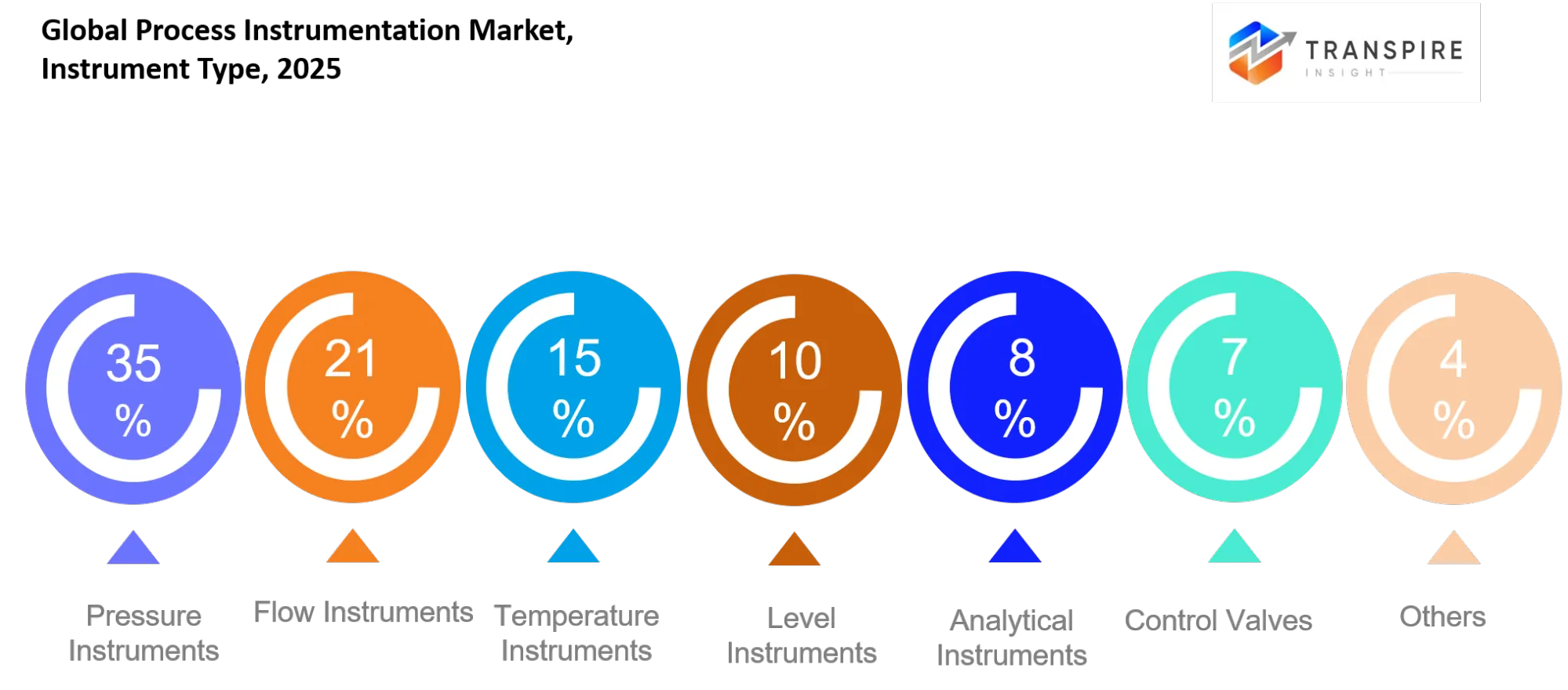
By Technology
Smart Instrumentation is ahead of technology adaptation because manufacturers prefer connected devices that can provide operational data instantly. Wireless and Digital Instrumentation technologies are also on the rise, providing better ease of installation and communication among industrial assets. IoT-enabled Instruments become more popular since businesses implement remote monitoring in their production plants. The most rapid growth among the technology segments belongs to AI-enabled Monitoring Systems, having a CAGR of 16.7% thanks to the increasing application of predictive maintenance, diagnostics, and process optimisation. Hybrid Instrumentation becomes more popular for the combination of reliability of classic solutions with new digital features and allows updating plants without full infrastructure change.
By End User
The oil & gas industry keeps its first place as an end-user market segment due to constant requirements in measurement, safety control, and process monitoring. Next comes the chemical manufacturing industry, in which proper instrumentation is necessary to ensure consistent production and compliance with regulations. The growth of demand is also observed in power generation, pharmaceutical, food & beverages, and water/wastewater treatment industries. Expansion of industries in developing countries promotes wider implementation of intelligent instrumentation solutions in various manufacturing sectors.
By Application
Process Monitoring continues to be the dominant application area because of increasing use of continuous data collection in production processes to ensure efficiency and product quality. Process Control and Safety Systems will continue to grow due to industries’ focus on reliability and safety. Predictive Maintenance and Asset Performance Management will see rapid growth thanks to integration of IIoT and AI that will allow detecting failures in advance and decrease maintenance costs. Plant Automation and Quality Assurance applications will gain importance because manufacturers pursue productivity, reduced risks, and better results.
By Deployment
Field-mounted Instruments will retain dominance due to their direct integration with industrial equipment and processes. Panel-mounted Instruments will continue to be widely deployed in control rooms, while Portable Instruments will be used for maintenance, inspections, and diagnostic purposes. DCSs, PLC-based Systems, and SCADA-integrated Systems will become increasingly popular as industries modernise plants and increase automation with these solutions. Cloud-connected Systems are expected to become the high-growth deployment option thanks to their ability to monitor processes remotely and analyse performance.
What are the Key Use Cases Driving the Global Process Instrumentation Market
Process pressure gauges are widely deployed in oil and gas, chemicals, and power generation industries for measuring important process parameters, ensuring safety, and increasing production efficiency. Their ability to measure accurately helps prevent machinery from breaking down and maintain product consistency.
The use of process instrumentation is increasing in pharmaceuticals, food and beverage, water and wastewater treatment, and pulp and paper industries through accurate measurement for compliance with regulations, quality assurance, and optimisation of resources. Some of the emerging applications of process instrumentation include process monitoring using artificial intelligence, predictive maintenance, remote asset management, and automation of the factory.
|
Report Metrics |
Details |
|
Market size value in 2025 |
USD 719.48 Billion |
|
Market size value in 2026 |
USD 21.25 Billion |
|
Revenue forecast in 2033 |
USD 39.09 Billion |
|
Growth rate |
CAGR of 9.1% from 2026 to 2033 |
|
Base year |
2025 |
|
Historical data |
2021 - 2024 |
|
Forecast period |
2026 - 2033 |
|
Report coverage |
Revenue forecast, competitive landscape, growth factors, and trends |
|
Regional scope |
United States; Canada; Mexico; United Kingdom; Germany; France; Italy; Spain; Denmark; Sweden; Norway; China; Japan; India; Australia; South Korea; Thailand; Brazil; Argentina; South Africa; Saudi Arabia; United Arab Emirates |
|
Key company profiled |
Emerson Electric, ABB, Siemens, Endress+Hauser, Yokogawa Electric, Honeywell, Schneider Electric, Rockwell Automation, VEGA Grieshaber, WIKA, Fuji Electric, Azbil Corporation, KROHNE, Badger Meter, AMETEK |
|
Customization scope |
Free report customisation (country, regional & segment scope). Avail customized purchase options to meet your exact research needs. |
|
Report Segmentation |
By Instrument Type (Pressure Instruments, Flow Instruments, Temperature Instruments, Level Instruments, Analytical Instruments, Control Valves, Process Controllers, Others); By Technology (Smart Instrumentation, Wireless Instrumentation, Digital Instrumentation, Analog Instrumentation, IoT-enabled Instruments, AI-enabled Monitoring Systems, Hybrid Instrumentation, Others); By End User (Oil & Gas, Chemicals, Power Generation, Food & Beverage, Pharmaceuticals, Water & Wastewater, Pulp & Paper, Others); By Application (Process Monitoring, Process Control, Safety Systems, Quality Assurance, Asset Performance Management, Predictive Maintenance, Plant Automation, Others); By Deployment (Field-mounted Instruments, Panel-mounted Instruments, Portable Instruments, Distributed Control Systems, PLC-based Systems, SCADA-integrated Systems, Cloud-connected Systems, Others) |
Which Regions are Driving the Global Process Instrumentation Market Growth?
North America
North America represents around 28% share of the global market and will continue to contribute in future as well, since the region has been one of the early adopters of process automation and digital process control technologies. It offers mature oil & gas, pharmaceutical, food processing, and chemical industries which are modernising their manufacturing units using intelligent process instrumentation systems. In the coming years, growth will be driven by Industrial IoT, cloud computing, and predictive maintenance systems with a projected CAGR of 15.8%.In February 2025,Emerson extended its Impact Partner Network to cover all of North America, offering on-site servicing of measurement instrumentation equipment to better serve process industry customers such as oil & gas, chemicals, power, and water treatment segments as well as improved lifecycle management of process instrumentation systems.
Europe
The European share in the global market is estimated at 24%, mainly because of strict regulations concerning industrial safety, requirements for energy saving, and adoption of Industry 4.0 technology. Companies in Germany, France, Italy, and the UK keep investing in process control systems in order to increase the quality of their products and comply with regulatory requirements. The region is characterised by well-developed industrial infrastructure and sustainable manufacturing practices being implemented there more often. Latin America and the Middle East & Africa markets are slowly growing owing to investments in industrial development, energy, and water infrastructure.
Asia Pacific
Asia Pacific is currently dominating the process instrumentation market with a market share of 37%, owing to the region's robust industrialisation, growing number of manufacturing activities, and constant investment in smart factories. China, India, Japan, and South Korea are among those countries that are driving the market demand with their huge automation projects in oil & gas, chemicals, electronics, and power generation sectors. There are government efforts in favour of modernising the industry and adopting digital manufacturing techniques, which are fostering the uptake of advanced process instrumentation technologies.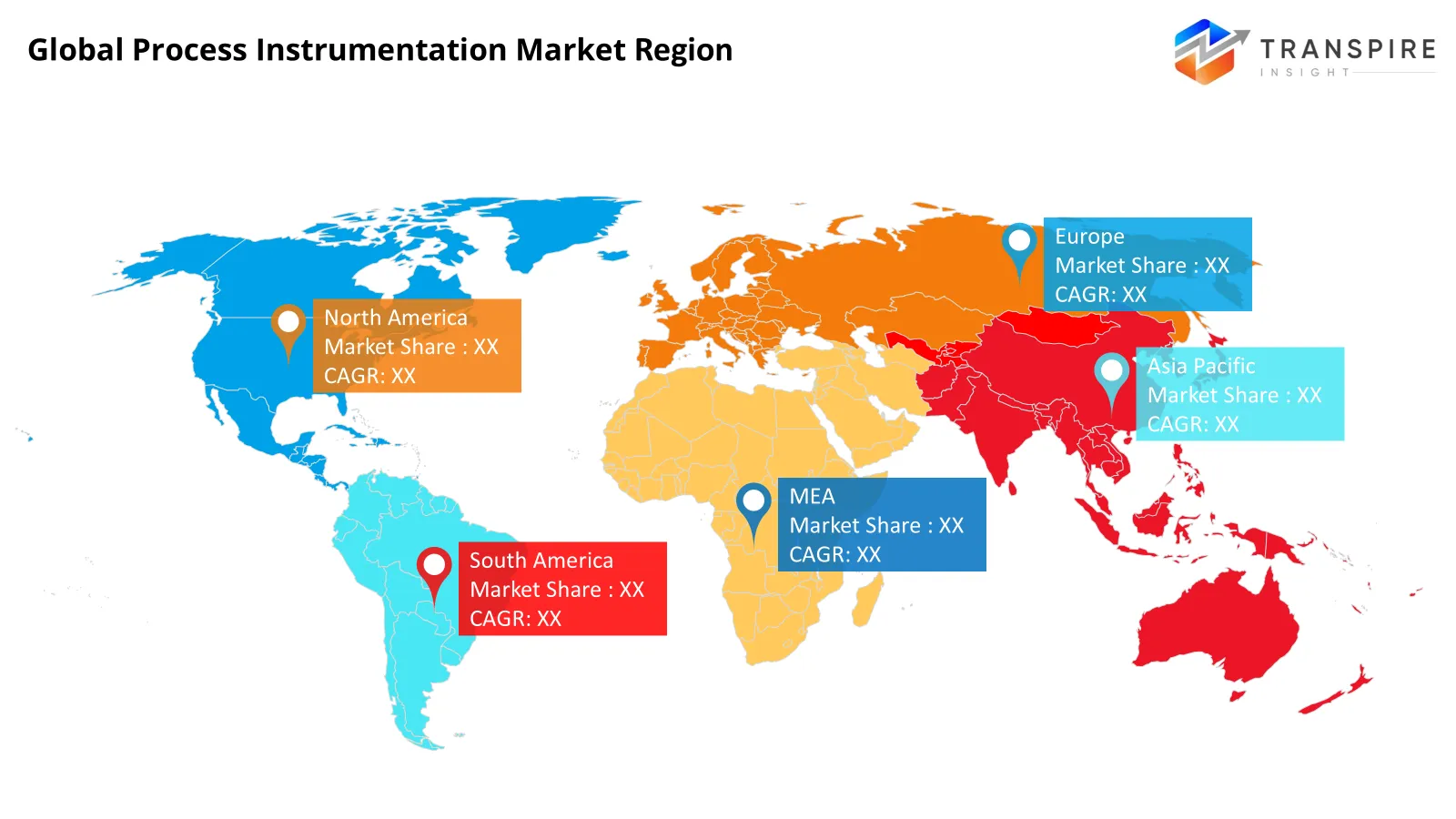
Who are the Key Players in the Global Process Instrumentation Marketand how do they Compete?
The Global Process Instrumentation Market is highly competitive, with established vendors focusing on innovation, digitalisation, and long-term services in order to enhance their presence in the market. The competition is based on the creation of intelligent instrumentation, development of portfolios for industrial automation and integration solutions for increasing plant efficiency, safety and reliability. Moreover, companies are investing in developing software platforms that would allow them to monitor, predict maintenance and remotely manage assets.
The main players of the industry are Emerson Electric Co., ABB Ltd., Siemens AG, Yokogawa Electric Corporation, and Honeywell International Inc. They compete by offering smart instruments for pressure, flow, temperature and analysis integrated into Industrial IoT, cloud and AI analytics. They use an extensive global distribution network and engineering capabilities to provide customised automation solutions for different process industries.
The other major players like Schneider Electric SE, Endress+Hauser Group, Rockwell Automation, Inc., Azbil Corporation and Fuji Electric Co., Ltd. are enhancing their presence in the market through strategic alliances, launching new products, regional manufacturing and improved digital services. They are developing industry-specific solutions, cybersecurity and lifecycle solutions to build stronger customer relations and competitive advantage in global industrial mar
Global Process Instrumentation Market companies
- Emerson Electric
- ABB
- Siemens
- Endress+Hauser
- Yokogawa Electric
- Honeywell
- Schneider Electric
- Rockwell Automation
- VEGA Grieshaber
- WIKA
- Fuji Electric
- Azbil Corporation
- KROHNE
- Badger Meter
- AMETEK
Recent Development News
In October 2025, Honeywell International Inc. introduced a new organisational structure by forming the Process Automation and Technology segment before the company's corporate restructuring. This reflects Honeywell's increased emphasis on industrial automation and digital process control technology and instrumentation.
https://investor.honeywell.com
In February 2026, Yokogawa Electric Corporation introduced the OpreX Pressure Transmitter EJX S series, which provides enhanced measurement accuracy, improved maintenance ability, and higher reliability for industrial process plants. The new product adds to the smart instrumentation range from Yokogawa.
In March 2026, ABB Ltd. made an investment of around US$75 million in increasing its production and research facilities in India. This would speed up innovations in automation and process instrumentation technologies.
What Strategic Insights Define the Future of the Global Process Instrumentation Market?
The Global Process Instrumentation Market would experience steady development owing to increasing investments made by companies into smart manufacturing, digital process control, and digital industrial infrastructure. Development of Industrial IoT, AI, and monitoring platforms based on cloud technologies would help manufacturers increase their efficiency, enhance the reliability of assets, and make quick data-driven decisions. One more challenge, which would not be visible from outside, is the need to use outdated industrial systems, which could complicate digital transformation because of the high cost of upgrades and their complexity. On the other hand, expansion of industrialisation in emerging markets would provide substantial opportunities for instrumentation providers who offer scalable and smart solutions. Companies that would pay attention to such factors as interoperability, cybersecurity, predictive maintenance, and innovations in industry-specific products would have an opportunity to gain competitive advantages.
By Instrument Type
- Pressure Instruments
- Flow Instruments
- Temperature Instruments
- Level Instruments
- Analytical Instruments
- Control Valves
- Process Controllers
By Technology
- Smart Instrumentation
- Wireless Instrumentation
- Digital Instrumentation
- Analog Instrumentation
- IoT-enabled Instruments
- AI-enabled Monitoring Systems
- Hybrid Instrumentation
By End Use
- Oil & Gas
- Chemicals
- Power Generation
- Food & BeverageP
- Harmaceuticals
- Water & Wastewater
- Pulp & Paper,
By Application
- Process Monitoring
- Process Control
- Safety Systems
- Quality Assurance
- Asset Performance Management
- Predictive Maintenance
- Plant Automation
By Deployment
- Field-mounted Instruments
- Panel-mounted Instruments
- Portable Instruments,
- Distributed Control Systems
- PLC-based Systems
- SCADA-integrated Systems
- Cloud-connected Systems
Regional Outlook
North America
- United States
- Canada
- Mexico
Europe
- Germany
- United Kingdom
- France
- Spain
- Italy
- Rest of Europe
Asia Pacific
- Japan
- China
- Australia & New Zealand
- South Korea
- India
- Rest of Asia Pacific
South America
- Brazil
- Argentina
- Rest of South America
Middle East & Africa
- Saudi Arabia
- United Arab Emirates
- South Africa
- Rest of the Middle East & Africa
Frequently Asked Questions
Find quick answers to common questions.
The Global Process Instrumentation Market size was valued at USD 19.48 Billion in 2025 and is poised to reach USD 39.09 Billion by 2033, expanding at a 9.1% CAGR.
Key segments for the Global Process Instrumentation Market are By Instrument Type (Pressure Instruments, Flow Instruments, Temperature Instruments, Level Instruments, Analytical Instruments, Control Valves, Process Controllers, Others); By Technology (Smart Instrumentation, Wireless Instrumentation, Digital Instrumentation, Analog Instrumentation, IoT-enabled Instruments, AI-enabled Monitoring Systems, Hybrid Instrumentation, Others); By End User (Oil & Gas, Chemicals, Power Generation, Food & Beverage, Pharmaceuticals, Water & Wastewater, Pulp & Paper, Others); By Application (Process Monitoring, Process Control, Safety Systems, Quality Assurance, Asset Performance Management, Predictive Maintenance, Plant Automation, Others); By Deployment (Field-mounted Instruments, Panel-mounted Instruments, Portable Instruments, Distributed Control Systems, PLC-based Systems, SCADA-integrated Systems, Cloud-connected Systems, Others).
Growth is primarily driven by growing automation in industries, an increase in the need for real-time process monitoring, stricter regulations for safety and more use of intelligent manufacturing systems.
The global market is led by major manufacturers including Emerson Electric, ABB, Siemens, Endress+Hauser, Yokogawa Electric, Honeywell, Schneider Electric, Rockwell Automation, VEGA Grieshaber, WIKA, Fuji Electric, Azbil Corporation, KROHNE, Badger Meter, AMETEK.
The Asia Pacific region represents a 37% share of the global market of process instrumentation due to its fast industrialisation, growing manufacturing operations, automation, and investments in sectors including oil & gas, chemical, power, and pharmaceuticals industries.
Business opportunities exist due to increasing demand for intelligent automation in industries, growth in digital monitoring systems, increased use of predictive maintenance techniques, and investment in the energy, water purification, and pharmaceutical sectors.
- Emerson Electric
- ABB
- Siemens
- Endress+Hauser
- Yokogawa Electric
- Honeywell
- Schneider Electric
- Rockwell Automation
- VEGA Grieshaber
- WIKA
- Fuji Electric
- Azbil Corporation
- KROHNE
- Badger Meter
- AMETEK
About the Authors

Kartik bhong
I am Kartik Bhong, a Senior Research Analyst at Transpire Insight, specializing in the Packaging, Manufacturing, and Construction industry. My work focuses on analyzing market trends, emerging technologies, industry regulations, and competitive landscapes to deliver accurate, data-driven insights. I am passionate about transforming complex industry information into clear, practical content that helps businesses, professionals, and decision-makers stay informed and make confident strategic decisions. Through continuous research and a strong commitment to accuracy, I strive to create reliable, well-researched content that reflects the latest developments across these dynamic industries and supports the vision of Transpire Insight in delivering valuable market intelligence.

Chakradhar Khansole
Chakradhar serves as the Research Director at Transpire Insight, bringing over 8 years of experience in technology, innovation, and strategic market intelligence. He specializes in transforming complex market data into actionable business insights that enable organizations to make informed, growth-oriented decisions. Recognized for his strategic vision and analytical expertise, Chakradhar leads high-impact research initiatives, delivering comprehensive market assessments, competitive intelligence, and forward-looking industry analysis.
Recently Published Reports
-
Apr 2026
Handling and Lifting Equipment Market
Handling and Lifting Equipment Market Size, Share & Analysis Report By Product (Cranes and Hoists, Forklifts, Conveyor Systems, Aerial Work Platforms, Others), By Application (E-Commerce, Automotive and Railway, Food and Beverages, Aviation, Others), and Geography (North America, Europe, Asia-Pacific, Middle East and Africa, South and Central America), 2021 - 2031
-
Nov 2026
HVAC Equipment Market
HVAC Equipment Market Size, Share & Analysis Report By Heating Equipment Type (Boilers and Furnaces, Heat Pumps, and Unitary Heaters), By Ventilation Equipment (Air Handling Units, Humidifiers and Dehumidifiers, Air Filters, and Fan Coiling Units), By Air Conditioning Equipment (Unitary Air Conditioners, Room Air Conditioners, Packaged Terminal Air Conditioners, and Chillers), By End User (Commercial, Residential, Industrial, and others), and Geography (North America, Europe, Asia-Pacific, Middle East and Africa, South and Central America), 2021 – 2031
-
Apr 2026
Refrigeration Valves Market
Refrigeration Valves Market Size, Share & Analysis Report By Type (Solenoid Valves, Expansion Valves, Check Valves, Service Valves, Others), By Application (Commercial Refrigeration, Industrial Refrigeration, Transport Refrigeration, Residential Refrigeration, Air Conditioning Systems), By End User (Food and Beverage Industry, Pharmaceutical Industry, HVAC Industry, Chemical Industry, Others), and Geography (North America, Europe, Asia-Pacific, Middle East and Africa, South and Central America), 2021 – 2031
-
Apr 2026
E-Commerce Packaging Materials Market
E-Commerce Packaging Materials Market By Material Type (Corrugated Boxes, Paper & Paperboard, Foam & Cushioning Materials, Plastic Packaging, Flexible Packaging, Protective Packaging, Others), By Product(Primary Packaging, Secondary Packaging, Tertiary Packaging), By Packaging Function (Protective Packaging, Branding & Presentation Packaging, Transit & Logistic Packaging, Sustainable Packaging, Tamper Evidence Packaging), By End-User (Retail & Consumer Goods, Electronic Appliances, Food & Beverages, Healthcare & Pharmaceutical, Fashion & Apparel, Home & Furnishing, Others); By Industry Analysis, Size, Share, Growth, Trends, and Forecasts 2021-2033