
Global Instrumentation Valves Fittings Market Size & Forecast:
- Global Instrumentation Valves Fittings Market Size 2025: USD 16.11 Billion
- Global Instrumentation Valves Fittings Market Size 2033: USD 21.89 Billion
- Global Instrumentation Valves Fittings Market CAGR: 3.91%
- Global Instrumentation Valves Fittings Market Segments: By Type (Ball Valves, Needle Valves, Check Valves, Compression Fittings, Tube Fittings, Manifold Valves, Others); By Application (Oil & Gas, Chemical Processing, Power Generation, Pharmaceuticals, Water Treatment, Others); By End-User (Industrial Plants, Energy Companies, Chemical Manufacturers, Others); By Material (Stainless Steel, Brass, Alloy Steel, Nickel-based Alloys, Others).

To learn more about this report,  Download Free Sample Report
Global Instrumentation Valves Fittings Market Summary:
The Global Instrumentation Valves Fittings Market size is estimated at USD 16.11 billion in 2025 and is anticipated to reach USD 21.89 billion by 2033, growing at a CAGR of 3.91% from 2026 to 2033.
Instrumentation valves and fittings serve as the “plumbing” for industrial systems, managing flow, pressure, and liquid and gas separation while preventing leaks and downtime in high-pressure, hazardous, and corrosive environments. Over the last 3-5 years, the sector has transitioned from mechanical parts to smart components, connected by the Internet of Things, that monitor in real-time wear, vibration, and seal integrity in real time. Predictive maintenance: operators are taking digital transformation to improve maintenance operations, moving from reactive to continuous monitoring. The real-world trigger: the development of pipelines for hydrogen transport, carbon capture, and renewables projects, fuelled by net-zero policies, will require corrosion and low-temperature-rated valves. The market is expanding as a result of stricter environmental legislation and the growing industrial projects driving infrastructure up to date. Leak-proof valves prevent accidents, mitigate unplanned shutdowns, and enhance operational performance, making precision components more cost-effective.
Key Global Instrumentation Valves Fittings Market Insights:
- Regional industrialisation and a transition to smarter, more reliable flow-control systems are driving market changes. The Asia Pacific region is synonymous with volume, with the Middle East region emerging as the fastest growth area, with project investment and modernisation picking up pace.
- The growing scale of manufacturing expansion is driving the demand towards high-volume instrumented installations, with the Asia Pacific accounting for 41%.
- North America has 25% of the market, exhibiting a well-established transition to replacement, automation and high-spec process control.
- Europe accounts for 24%, and upgrades are being engineered to meet compliance and energy efficiency standards.
- ROW also supplies 10%, while demand is growing due to the standardisation of instrumentation systems that are being installed in smaller industrial sites.
- The Middle East's growth is at 10.4% CAGR, reflecting a shift from simple procurement to larger project deployments.
- The leading companies are extending regional distribution and service networks with an increasing trend towards closer technical support and quicker delivery.
- Smart control features are being incorporated into the machines, as customers are demanding remote monitoring and increased uptime.
- Suppliers are increasingly targeting corrosion-resistant and high-purity solutions to meet more demanding operating and safety demands.
What are the Key Drivers, Restraints, and Opportunities in the Global Instrumentation Valves Fittings Market?
Driver: The use of smart instrumentation valves is increasing at a rapid pace as the Industrial Internet of Things (IIoT) is integrated. With increasingly stringent safety measures and targets for uptime, real-time diagnostics and predictive maintenance are demanding that plants make more valves sensor‑based. Benefits: vendors generate more revenue from smart products and services (analytics, firmware, connectivity), operators reduce unplanned downtime and extend asset life, thereby creating a recurring revenue stream for analytics and maintenance.
Instance:InJanuary 2026, Emerson was named “Industrial IoT Company of the Year” for its IoT‑enabled smart valves delivering real‑time diagnostics and predictive maintenance in chemical and energy plants.
Restraint: Variable raw material costs and a growing number of cheap, fake components limit the use of premiums. Why it continues: volatility in the global supply chain, due to raw material shortages, shipping bottlenecks, etc., makes it difficult for manufacturers to balance cost control and inventory buffer with the strict certifications needed for hazardous service. This structural tension increases lead times and squeezes margins, and consequently, procurement teams prefer to stick with their existing, more affordable parts over the more expensive smart parts when it comes to budget cycles.
Opportunity: AI-powered edge analytics and digital twins can help enable faster replacement of obsolete valves. Smart digital valves that simulate system activity, identify and alert on micro leaks, and suggest repairs in near real-time. Infrastructure expansion and retrofit programs in APAC industrial hubs (refining, petrochemicals, hydrogen projects), driven by the need for compliance with regulatory targets, can quickly scale smart valve deployments and software services.
Instance: In March 2026, Petronas showcased AI‑powered digital‑twin‑driven valve monitoring at Future Digital Twin & AI Asia 2026, targeting leak‑free, emission-optimised operations in APAC refineries and petrochemical hubs.
What Has the Impact of Artificial Intelligence Been on the Global Instrumentation Valves Fittings Market?
AI has made instrumentation valves and fittings from passive fluid regulators into smart, data-driven assets that connect with Industrial Internet of Things (IIoT) networks. Automated functions continuously adjust pressure, temperature and flow variables to maximise self‑sustaining automation, with reduced energy usage, human error and plant throughput. Predictive capabilities use machine-learning models to study data from sensors installed in valves and fittings, identifying early-stage issues such as micro-leaks, stem wear or increased friction before they lead to critical failures, which moves maintenance from a reactive to a proactive approach and prolongs asset life.
In terms of operational impact, AI improves the visibility of asset health, which helps to speed up the troubleshooting process and also simplifies the commissioning process with digital‑twin simulations representing real‑world scenarios, reducing configuration time and commissioning errors. However, one significant drawback is the high cost and complexity involved in retrofitting legacy control systems, pipes, and sensors, as well as integrating secure communication standards and modern data infrastructure, which will increase initial capital investment and slow time to value realisation, particularly in older or cost-sensitive industrial applications.
Instance: In February 2026, Honeywell rolled out an AI‑driven valve‑monitoring suite for existing oil and gas plants, using IoT sensors and predictive analytics to cut retrofit downtime and extend legacy valve life across brownfield sites.
Key Global Instrumentation Valves Fittings Market Trends:
The instrumentation valves and fittings market is shifting away from traditional hardware and towards smart and integrated flow-control solutions. The most significant difference is not only increased adoption numbers, but also the increasing importance of uptime, traceability and compatibility with automated plants for buyers.
- There is a gradual shift from basic operation to control-led performance in the manual components, which are being replaced by automated systems.
- Buyers are shifting from price to lifecycle value, and want products that minimise leaks and downtime as well as maintenance.
- Material selection is also becoming more application-specific, with the emphasis on corrosion resistance and compliance determining the purchase.
- Although stainless steel is still the main material, more expensive alloys are becoming more common in more stringent, corrosive environments.
- Industrial plants are upgrading existing lines, resulting in more requests for retrofit valves and fittings.
- The use of more precision products is adopted by chemical and energy users, due to higher process control and safety requirements.
- Nowadays, integrated valve-fittings assemblies are gaining popularity over fragmented sourcing of components.
- The design is being impacted by digital monitoring, with customers choosing products that can be monitored remotely and diagnosed.
Global Instrumentation Valves Fittings Market Segmentation
By Type:
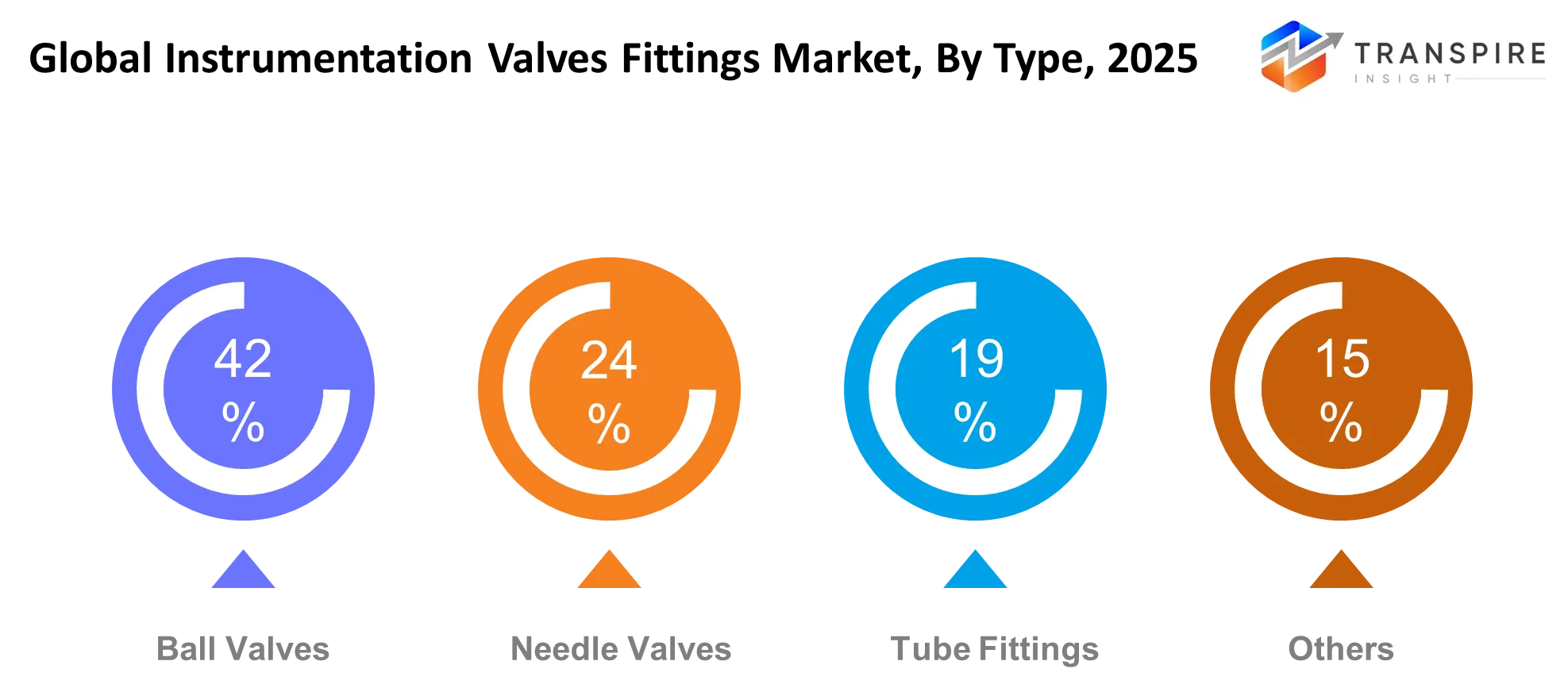
The instrumentation valves & fittings market is split into a few key families, with Ball Valves accounting for 42%, as well as being easy to actuate and compatible with a wide range of automation devices, and also reliable for shut-off and leak‑tight control in instrument lines, Needle Valves capturing 24% with their ability to meter accurately and control with complete shut-off, Tube Fittings 19% as the default for small bore connections and sampling, and check, compression, manifold and specialty valves making up 15%. Smart control valves have been added to the primary types for retrofitability and modularity, which are key features customers are looking for with growth at approximately 9.7% CAGR, thus increasing ASPs and aftermarket service demand. Implication for the future: 42% ball valve share will be sustained as smart features are added to ball, needle (24%), and tube fitting (19%) valve platforms, and the 15% of other valves will continue to play a significant role in safety and special applications.
To learn more about this report, Download Free Sample Report
By Application:
Application demand is divided into volume-intensive process industries (Oil & Gas, Chemical Processing) that drive the largest installed base, for scale and harsh service conditions, and precision, compliance-driven industries (Power Generation, Water Treatment) that ensure reliable, regulated applications, with smaller volumes but high validation and traceability requirements for materials. The one-of-a-kind growth logic is regulatory tightening, emissions control, and digital monitoring, which reduce replacement cycles and will be more favorable to instrumented products. The type distribution will remain consistent across applications (Ball Valves 42%, Needle Valves 24%, Tube Fittings 19%, Others 15%) while total spend and technical specs for smart control valves will grow at a ~9.7% CAGR.
By End-User:
Industrial Plants and Energy Companies can purchase a significant amount of valves and fittings, due to both bulk capex and maintenance programs; Chemical Manufacturers purchase a large amount of valves and fittings, with additional requirements for specialized valves for manifolds and metering; other end-Users (utilities, smaller processors) can purchase a large number of valves and fittings, primarily through retrofit and after-market programs. The particular logic of growth is the budgets for modernisation & energy transition, focused on automation, reliability, and minimised downtime. Future implication: Major end-user is the primary adopter of smart control valves (≈9.7% CAGR) and will retain the core type mix—Ball Valves 42%, Needle Valves 24%, Tube Fittings 19% and Others 15%.
By Material:
Material stainless steel leads as the default because it is a cost-effective option and it meets the demands in terms of corrosion resistance and cleanliness in the services; Brass and Alloy Steel are used for cost sensitive or higher strength services, respectively, while Nickel‑based and other exotic alloys are used in niche applications involving sour service or high temperatures or highly corrosive services; Polymers are used in limited applications in non-critical lines. The special growth logic is lifecycle cost and traceability: premium materials are accepted by buyers when they bring about the reduction of downtime, risk of inspection and validation. Implication for future: The superior 42% ball-valve group will remain the most dominant, while higher-grade alloys will expand in the needle (24%) and tube fitting (19%) markets and exotic materials will proliferate in the remaining 15% of specialty applications, as the sales of smart valves increase.
What are the Key Use Cases Driving the Global Instrumentation Valves Fittings Market?
The instrumentation valve & fitting for high-pressure hazardous fluids, back-leak protection and safe fluid transfer in critical upstream/petrochemical/downstream networks is the core use-case, which dominates the market for instrumentation valves and fittings.
In pharmaceuticals and chemical processing, corrosion‑resistant, hygienic valves and fittings enable exact dosing, containment of hazardous substances, and compliance with strict cleanliness and safety standards during drug and batch production.
Smart, leak‐tight valves and fittings enable real‐time monitoring, predictive maintenance and precise control in hydrogen, biogas, water treatment and digital twin‐driven plants, among a range of emerging use cases in industrial automation, power generation and renewable energy.
|
Report Metrics |
Details |
|
Market size value in 2025 |
USD 16.11 Billion |
|
Market size value in 2026 |
USD 16.74 Billion |
|
Revenue forecast in 2033 |
USD 21.89 Billion |
|
Growth rate |
CAGR of 3.91% from 2026 to 2033 |
|
Base year |
2025 |
|
Historical data |
2021 - 2024 |
|
Forecast period |
2026 - 2033 |
|
Report coverage |
Revenue forecast, competitive landscape, growth factors, and trends |
|
Regional scope |
United States; Canada; Mexico; United Kingdom; Germany; France; Italy; Spain; Denmark; Sweden; Norway; China; Japan; India; Australia; South Korea; Thailand; Brazil; Argentina; South Africa; Saudi Arabia; United Arab Emirates |
|
Key company profiled |
Swagelok, Parker Hannifin, Emerson Electric, IMI plc, Ham-Let Group, Hy-Lok, DK-Lok, Hoke, Fujikin, Bray International, Crane Co., KITZ Corporation, Valmet, SMC Corporation, Aalberts. |
|
Customization scope |
Free report customization (country, regional & segment scope). Avail customized purchase options to meet your exact research needs. |
|
Report Segmentation |
By Type (Ball Valves, Needle Valves, Check Valves, Compression Fittings, Tube Fittings, Manifold Valves, Others); By Application (Oil & Gas, Chemical Processing, Power Generation, Pharmaceuticals, Water Treatment, Others); By End-User (Industrial Plants, Energy Companies, Chemical Manufacturers, Others); By Material (Stainless Steel, Brass, Alloy Steel, Nickel-based Alloys, Others). |
Which Regions are Driving the Global Instrumentation Valves Fittings Market Growth?
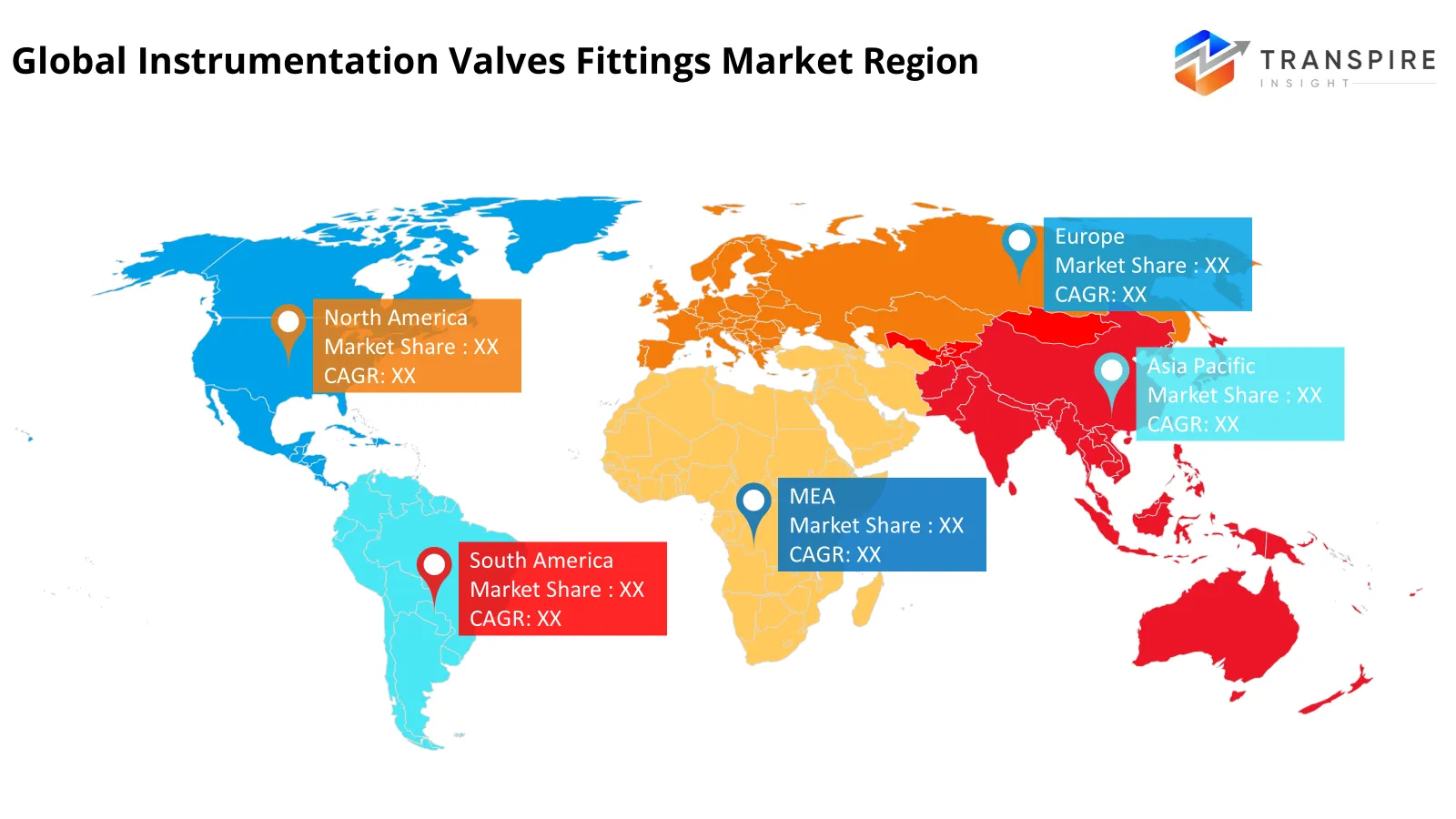
The oil & gas, chemical, and power generation are leading the instrumentation valves and fittings market, with North America capturing 25% of the market, followed by Europe, the Asia Pacific, and the LATAM region. Its success is due to a well-established automation platform, regulatory requirements for safety and environmental compliance, as well as high use of IIoT-enabled smart valves and digital-twin-based monitoring systems. The investment in shale‑gas growth, hydrogen‑ready projects and digital retrofits continues to drive a need for high-integrity, precision instrumentation valves and fittings. The region is structurally ahead of other markets, with 25% of the total share, thanks to the fact that these components are deeply embedded in the market's predictive‑maintenance and process‑safety programs. In April 2026, ExxonMobil launched an IIoT‑linked instrumentation‑valve upgrade across its U.S. Gulf‑Coast refineries, embedding predictive‑maintenance analytics to cut unplanned downtime and strengthen process‑safety compliance.
The second largest region is Europe (24%) with a medium pace of growth, while North America is experiencing fast growth. Europe's industrial sector is also technology-driven, but it has slower cycles of capital investment and is more conservative with retrofit spending, in particular with dated assets such as chemical and power facilities. A stable regulatory environment, robust process‑safety regulations, and decarbonization requirements in utilities and chemicals drive predictable demand, based on compliance. The 24% share underlines a more consistent and long-term modernisation journey than breakaway infrastructure peaks and tweaks and signals a more resilient, but less explosive, market in Europe. In April 2026, BASF rolled out a Europe‑wide instrumentation‑valve upgrade across its German chemical sites, aligning ageing assets with tightened PED and fugitive‑emission rules while maintaining measured retrofit spending.
The region of Asia Pacific is the highest growing region, accounting for 41% of the incremental market growth and also showing the highest CAGR, including the Middle East segment with 10.4% CAGR within the overall Asia Pacific growth. The recent change is the transition of legacy hardware imports to the regional construction of smart, hydrogen-ready, emission-compliant systems as a result of India, China and Southeast Asian national net-zero roadmaps, infrastructure push policy and localization target. The growth share indicates a significant opportunity to incorporate AI-enabled, IIoT-connected valves and fittings into new build plants, hydrogen transport corridors and digital turnaround initiatives. This growth contribution is making Asia Pacific the biggest market at the moment, whilst North America remains the largest market and Europe the stable aftermarket base. In April 2026, India’s first large‑scale hydrogen‑ready refinery in Jamnagar installed AI‑connected, IIoT‑enabled instrumentation valves and fittings across new hydrogen‑transport and emissions‑compliant systems, aligning with the region’s 10.4% CAGR‑linked green‑transition push.
To learn more about this report, Download Free Sample Report
Who are the Key Players in the Global Instrumentation Valves Fittings Market and how do they Compete?
The instrumentation valves and fittings market is competitively split between two types: broad‑portfolio industrial groups and specialist, high-integrity OEMs, with the depth of niche engineering, the breadth of product integration, and product innovation driven by digital twins. Three different approaches are represented by Swagelok, Parker Hannifin, and Emerson Electric. Investing in high-integrity, leak-tight instrumentation systems in critical fluid and gas lines is Swagelok's niche strategy and differentiates its tube fitting designs while expanding through engineering-service centres and long-term partnerships in pharma, energy, and high purity applications—standardised, modular, and “no compatible intermixing”. Parker Hannifin's strategy is to pursue integration, most of which involves combining valves and fittings into larger systems that control fluid and motion, differentiate through modular, Industry 4.0‑ready sub‑assemblies and digital‑ready spare parts ecosystems, and expand through global distribution and OEM-centric modular solutions. Emerson Electric distinguishes itself via long-term performance‑ and decarbonization‑based service contracts in oil & gas, chemicals, and life-sciences; predictive‑maintenance‑ready instrumentation; and smart valves and fittings embedded in Plantweb and AMS analytics platforms.
Key Players are:
- Swagelok
- Parker Hannifin
- Emerson Electric
- IMI plc
- Ham-Let Group
- Hy-Lok
- DK-Lok
- Hoke
- Fujikin
- Bray International
- Crane Co.
- KITZ Corporation
- Valmet
- SMC Corporation
- Aalberts
Recent Development News
In [February 2026], the Karnataka Valve Manufacturers Association hosted the Valvx 2026 summit. This event deepened the regional supply chain, promoted international standards testing and foreshadowed new regional and international collaborations between manufacturers to enhance component reliability.
Source:https://www.youtube.com/watch?v=xISSisZX82s
In [January 2026], SkyQuest Technology released a strategic forecast. The rise of corporate investments in digital twin technology and predictive maintenance is driving this market's growth, which is expected to reach USD 8.84 billion by 2033.
Source:https://www.skyquestt.com/report/instrumentation-valves-and-fittings-market
What Strategic Insights Define the Future of the Global Instrumentation Valves Fittings Market?
The instrumentation valves and fittings market is evolving towards an AI powered ecosystem of smart components as embedded performance and safety nodes within an industrial digital twin, and not as stand-alone hardware. One unintentionally overlooked risk, however, is “smart-valve complacency,” in which operators assume AI diagnostics is enough, but fail to invest in mechanical-integrity programs, thereby increasing the likelihood of a slow-moving corrosion or fatigue failure that may be missed by the algorithms. A new opportunity is the integration of instrumentation valves, combined with data analytics, cyber security and remote monitoring services in the context of retrofitting brownfield plants, particularly within the hydrogen, CCS and high hygiene pharmaceuticals clusters in Asia and the Middle East. OEMs should shift from a hardware-based approach to a “valve-as-a-service” approach, integrating the in‑built capabilities of IoT with predictive maintenance and performance analytics into long-term contracts. It allows for the generation of recurring revenue, further integration with customer control systems, and increased stickiness in safety-critical and data-rich process operations.
Key Segmentations are:
By Type
- Ball Valves
- Needle Valves
- Check Valves
- Compression Fittings
- Tube Fittings
- Manifold Valves
- Others
By Application
- Oil & Gas,
- Chemical Processing
- Power Generation
- Pharmaceuticals
- Water Treatment
- Others
By End-User
- Industrial Plants
- Energy Companies
- Chemical Manufacturers
- Others
By Material
- Stainless Steel
- Brass
- Alloy Steel
- Nickel-based Alloys
- Others
Regional Outlook
North America
- United States
- Canada
- Mexico
Europe
- Germany
- United Kingdom
- France
- Spain
- Italy
- Rest of Europe
Asia Pacific
- Japan
- China
- Australia & New Zealand
- South Korea
- India
- Rest of Asia Pacific
South America
- Brazil
- Argentina
- Rest of South America
Middle East & Africa
- Saudi Arabia
- United Arab Emirates
- South Africa
- Rest of the Middle East & Africa
Frequently Asked Questions
Find quick answers to common questions.
The approximate global instrumentation valves fittings market size will be USD 21.89 Billion in 2033.
Key segments for the global instrumentation valves fittings market are By Type (Ball Valves, Needle Valves, Check Valves, Compression Fittings, Tube Fittings, Manifold Valves, Others); By Application (Oil & Gas, Chemical Processing, Power Generation, Pharmaceuticals, Water Treatment, Others); By End-User (Industrial Plants, Energy Companies, Chemical Manufacturers, Others); By Material (Stainless Steel, Brass, Alloy Steel, Nickel-based Alloys, Others).
Major global instrumentation valves fittings market players are Swagelok, Parker Hannifin, Emerson Electric, IMI plc, Ham-Let Group, Hy-Lok, DK-Lok, Hoke, Fujikin, Bray International, Crane Co., KITZ Corporation, Valmet, SMC Corporation, Aalberts.
The global instrumentation valves fittings market size is USD 16.11 Billion in 2025.
The global instrumentation valves fittings market CAGR is 3.91% from 2026 to 2033.
- Swagelok
- Parker Hannifin
- Emerson Electric
- IMI plc
- Ham-Let Group
- Hy-Lok
- DK-Lok
- Hoke
- Fujikin
- Bray International
- Crane Co.
- KITZ Corporation
- Valmet
- SMC Corporation
- Aalberts
About the Authors

Kartik bhong
I am Kartik Bhong, a Senior Research Analyst at Transpire Insight, specializing in the Packaging, Manufacturing, and Construction industry. My work focuses on analyzing market trends, emerging technologies, industry regulations, and competitive landscapes to deliver accurate, data-driven insights. I am passionate about transforming complex industry information into clear, practical content that helps businesses, professionals, and decision-makers stay informed and make confident strategic decisions. Through continuous research and a strong commitment to accuracy, I strive to create reliable, well-researched content that reflects the latest developments across these dynamic industries and supports the vision of Transpire Insight in delivering valuable market intelligence.

Chakradhar Khansole
Chakradhar serves as the Research Director at Transpire Insight, bringing over 8 years of experience in technology, innovation, and strategic market intelligence. He specializes in transforming complex market data into actionable business insights that enable organizations to make informed, growth-oriented decisions. Recognized for his strategic vision and analytical expertise, Chakradhar leads high-impact research initiatives, delivering comprehensive market assessments, competitive intelligence, and forward-looking industry analysis.
Recently Published Reports
-
Apr 2026
Handling and Lifting Equipment Market
Handling and Lifting Equipment Market Size, Share & Analysis Report By Product (Cranes and Hoists, Forklifts, Conveyor Systems, Aerial Work Platforms, Others), By Application (E-Commerce, Automotive and Railway, Food and Beverages, Aviation, Others), and Geography (North America, Europe, Asia-Pacific, Middle East and Africa, South and Central America), 2021 - 2031
-
Nov 2026
HVAC Equipment Market
HVAC Equipment Market Size, Share & Analysis Report By Heating Equipment Type (Boilers and Furnaces, Heat Pumps, and Unitary Heaters), By Ventilation Equipment (Air Handling Units, Humidifiers and Dehumidifiers, Air Filters, and Fan Coiling Units), By Air Conditioning Equipment (Unitary Air Conditioners, Room Air Conditioners, Packaged Terminal Air Conditioners, and Chillers), By End User (Commercial, Residential, Industrial, and others), and Geography (North America, Europe, Asia-Pacific, Middle East and Africa, South and Central America), 2021 – 2031
-
Apr 2026
Refrigeration Valves Market
Refrigeration Valves Market Size, Share & Analysis Report By Type (Solenoid Valves, Expansion Valves, Check Valves, Service Valves, Others), By Application (Commercial Refrigeration, Industrial Refrigeration, Transport Refrigeration, Residential Refrigeration, Air Conditioning Systems), By End User (Food and Beverage Industry, Pharmaceutical Industry, HVAC Industry, Chemical Industry, Others), and Geography (North America, Europe, Asia-Pacific, Middle East and Africa, South and Central America), 2021 – 2031
-
Apr 2026
E-Commerce Packaging Materials Market
E-Commerce Packaging Materials Market By Material Type (Corrugated Boxes, Paper & Paperboard, Foam & Cushioning Materials, Plastic Packaging, Flexible Packaging, Protective Packaging, Others), By Product(Primary Packaging, Secondary Packaging, Tertiary Packaging), By Packaging Function (Protective Packaging, Branding & Presentation Packaging, Transit & Logistic Packaging, Sustainable Packaging, Tamper Evidence Packaging), By End-User (Retail & Consumer Goods, Electronic Appliances, Food & Beverages, Healthcare & Pharmaceutical, Fashion & Apparel, Home & Furnishing, Others); By Industry Analysis, Size, Share, Growth, Trends, and Forecasts 2021-2033