

Global Pre-Assembled Harness Modules Market Summary:
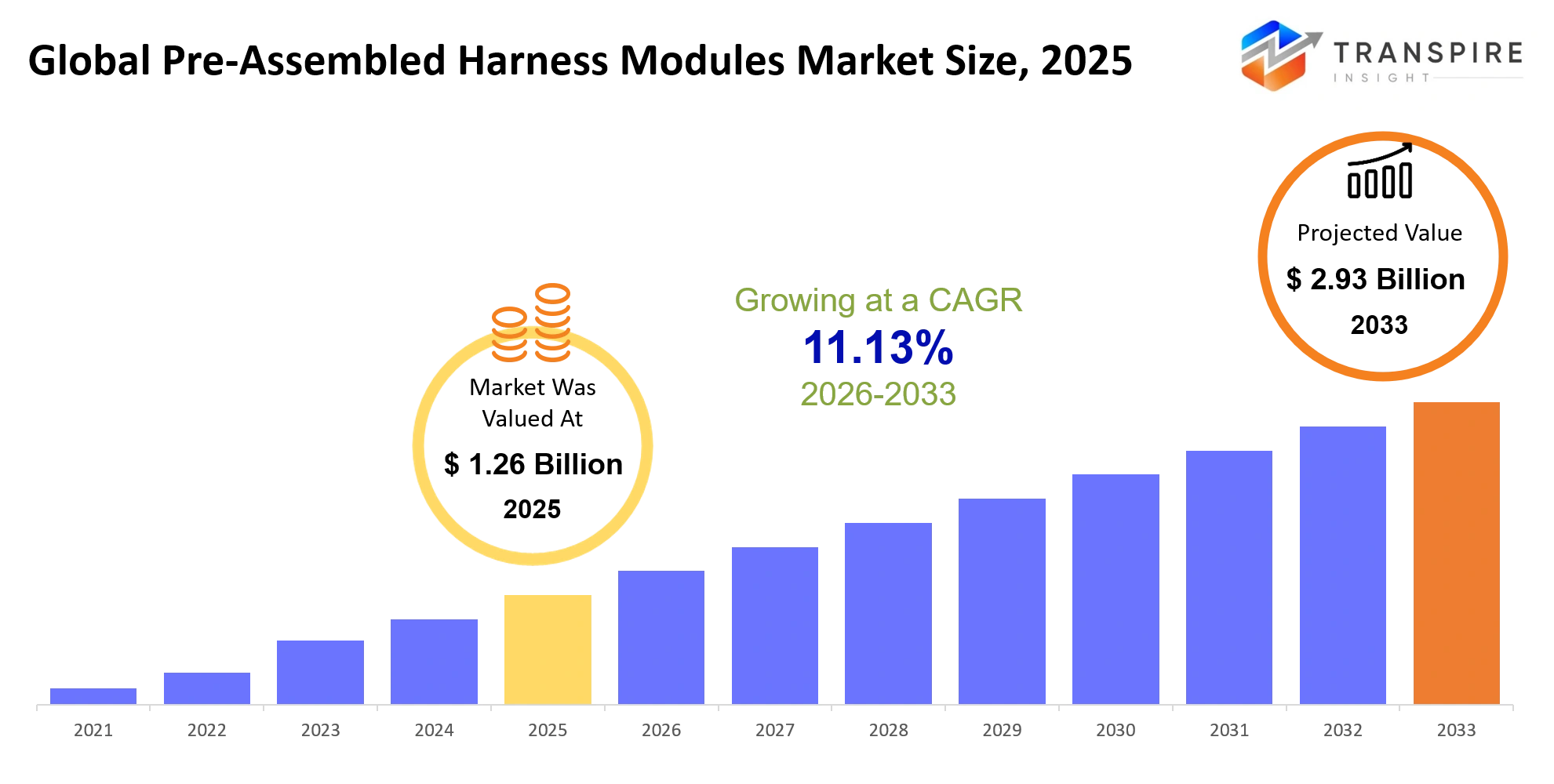
As per Transpire Insight Analysis, The Global Pre-Assembled Harness Modules Market size is estimated at USD 1.26 Billion in 2025 and is anticipated to reach USD 2.93 Billion by 2033, growing at a CAGR of 11.13% from 2026 to 2033, driven by the rapid adoption of EV and ADAS platforms, which is increasing wiring complexity and pushing OEMs toward pre-assembled harness modules for faster, more reliable vehicle assembly.
Preassembled modules bundle wiring, connectors, and submodules; manufacturers can install complete, ready-to-use wiring systems on their assembly lines instead of routing individual wires, thereby reducing assembly time and field failures. Market drivers over the past three to five years—specifically the integration of EV battery packs and ADAS electronics have driven module complexity upward, increasing quality standards and requiring new connector designs. A structural shift away from traditional copper-centric designs toward aluminium and hybrid harnesses is occurring to meet accepted lightweight standards for cars. Furthermore, a contextual driver for the adoption of preassembly was the significant increase in EV capital expenditure (capex) by Chinese and European OEMs, which led to volume orders for preassembled modules and high-voltage, high-precision harnesses. Market growth is driven by OEMs' pressure to reduce line takt times (the cause), resulting in the increased adoption of preprocessed modules and service fees (the effect). One key reason for this is that increased body modularisation will lead to the largest manufacturing centralisation and streamline harness connections through platform standardisation.
Global Pre-Assembled Harness Modules Market Size & Forecast:
- Global Market Size 2025: USD 1.26 Billion
- Expected Market Value Size (2033): USD 2.93 Billion
- Forecast CAGR (2026–2033): 11.13%
- Leading Region in 2025: Asia Pacific(38%)
- Fastest Growing Region: Europe (24% & CAGR 16.3%)
- Key Company Profiles: Aptiv, Yazaki Corporation, Sumitomo Electric Industries, Leoni AG, Lear Corporation, Furukawa Electric, Nexans, TE Connectivity, Amphenol Corporation, PKC Group, Motherson, Fujikura, LS Cable & System, Rosenberger, BizLink Holding.
Key Global Pre-Assembled Harness Modules Market Insights:
The market is shifting from labour-intensive wire routing to pre-tested platform-based modules to reduce assembly time and enhance quality control for EV and electronic vehicle designs. The competitive edge is increasingly in automation, in the lightness of the material, and in the high-voltage validation, and not only in the mere ability to wire.
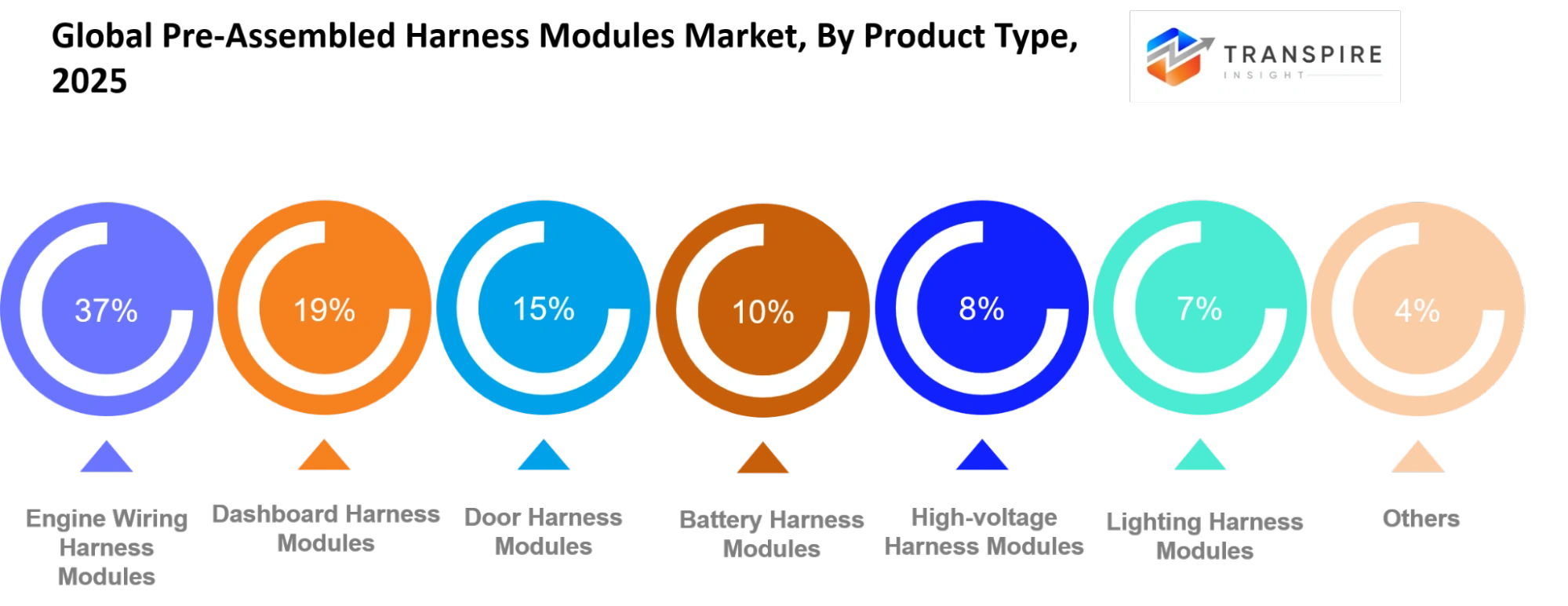
- Engine Wiring Harness Modules continue to drive 37% of the market, and suppliers are digitizing design rules to meet the challenges of new hybrid powertrains and platform changes.
- Progress is being made with cockpit integration with Dashboard Harness Modules at 19%, on track to advance.
- Rising comfort and safety electronics are driving companies to thinner, more flexible routing packages as Door Harness Modules with a 15% benefit.
- Firms adding pack-level safety testing and quicker assembly of EVs are seeing increased adoption of Battery Harness Modules at 10%.
- High-voltage Harness Modules, despite making up a small portion of 8%, are being aggressively engineered, as providers are fine-tuning insulation and connector durability for fast-charging platforms.
- Lighting Harness Modules have 7% and are moving toward an LED-based architecture, creating more compact and stable designs.
- Other modules at 4% are a proving ground for special builds and integration programmes with niche sensors.
- Asia Pacific accounts for 46%, and localised capacity is being built to cater to the dense OEM and battery ecosystems faster.
- Europe is making headway on technical specialism-focused high-voltage, lightweighting and regulatory compliance initiatives in 24%.
What are the Key Drivers, Restraints, and Opportunities in the Global Pre-Assembled Harness Modules Market?
Driver:
OEM platform modularization and EV electrification are generating revenue as manufacturers push the complexity to the first and second-tier suppliers; the proliferation of EV programs has led to a surge in new, multi-cycle purchases of HVB and high-voltage harness modules, increased harness content per vehicle as a result of platform sharing, and enabled demand for higher margins to be realized; also the capacity needs fueled Tier1 automation investment, faster Rolls Royce feeling and kit out of new methods to the market. In March 2026, TE Connectivity finalised the acquisition of the charging inlets business from Phoenix Contact E-Mobility. This strategic expansion enables TE to seamlessly integrate critical charging and high-voltage e-mobility technologies.
Restraint:
The market suffers from prolonged validation cycles considering vehicle safety and regulatory approvals – mostly a structural problem as harness failure directly impacts the vehicle's safety and exposure to warranty; therefore, the company remains time-to-market sensitive and kills supplier engineering capacity all the time, limiting the rapid scale-up. Material issues (copper/aluminium flakiness) and long lead times for more specific connectors also increase costs.
Opportunity:
Automation of inline functional testing, utilization of AI robotics for end-of-line inspection, laser welding of aluminium conductors, etc. Are indicative of manufacturing cost reductions. Investments in regional assembly plants in Eastern Europe and India from suppliers enhance proximity to OEM EV plants and increase responsiveness. Establishing working relationships with suppliers having test as a service, advanced validation, and manufacturing technologies will bring the product to market faster, to the right quality, and at a sustainable competitive advantage.
What Has the Impact of Artificial Intelligence Been on the Global Pre-Assembled Harness Modules Market?
AI is being explored in harness module production for assembly automation, in-line optical inspection and process optimisation, where machine vision models identify missed crimps and badly aligned terminals at line speed, cutting defect escape and rework. Machine-learning predictions of connector or wire joint blow-out based on production and field failure data reduce warranty costs and allow additional ducting or infrastructure to be provisioned, freeing engineering headspace. AI is also used to optimise nesting and cut list generation for harnesses to cut material scrap costs, critical handling/installer expenses, and increase gross margins. Digital simulation of numerous optimised harness versions in a virtual twin lowers design iterations and time-to-qualification. The size of investment needed for AI tools is large, and achieving the required accuracy can suffer from data integration issues for holistically analysing multiple and bulk import/export routings, and the lack of direct failure labelling within limited data sets; this performance problem hampers smaller volume suppliers that are unable to make the capital investment needed for success.
In January 2026, Overview.ai launched upgraded AI-powered computer vision platforms to enable manufacturers to train defect-identification models using as few as five images, reducing machine integration setup time and inspection costs to help lower the barrier to entry for smaller-scale suppliers.
https://www.overview.ai/blog/top-ai-vision-system-companies/
Key Global Pre-Assembled Harness Modules Market Trends:
Automation and materials innovation are shortening the time to qualification and cost, and suppliers are evolving from piece-part wiring to integrated, test-ready modules to address the complexity of EVs and ADAS. The industry is moving from labour-intensive assembly to regionally distributed, digitally verified production centres.
- Over time, the mix of battery and high-voltage harness content will rise as EV architectures move away from ICE, affecting the bill of materials.
- Vehicle weight reduction through copper to aluminium/hybrid conductors and new joining and testing techniques.
- During the past 3 years, the number of manual inspection steps decreased with increasing use of automated functional testing and machine vision.
- This has changed suppliers' assembly footprint, with regionalisation becoming key to shortening lead times and complying with local content regulations.
- As ADAS and infotainment become more complex, the number of connectors per vehicle grows, changing how the modules are designed.
- Tier‑1s progress to systems partners by offering services beyond harness validation and lifecycle support.
- Reducing the reuse of module interfaces over time through design standardisation on OEM platforms reduces per-unit engineering costs.
- As systems grew in voltage, so did certification and safety testing cycles, and investment was made in test labs and third-party validation.
Global Pre-Assembled Harness Modules Market Segmentation
By Product Type:
Engine Wiring Harness Modules are the largest segment, with a 37% share driven by their widespread usage across the powertrain assemblies. Dashboard Harness Modules constitute 19% of the overall market, followed by Door Harness Modules at 15% and Battery Harness Modules at 10%. High-voltage Harness Modules constitute an 8% share, witnessing the fastest growth rate at a CAGR of 17.4%, supported by the expansion of EVs and fast-charging infrastructure. Lighting Harness Modules account for 7%, while Others capture a 4% share for the specialised and legacy vehicle applications.
By Vehicle Type:
Passenger cars are still the main volume drivers. EVs and hybrid vehicles are the fastest-growing segment because of higher harness content and higher HV requirements, pressuring suppliers to acquire HV and battery expertise. Heavy Commercial and Off-highway vehicles require large, high-reliability modules, keeping demand steady for shielded and high-temperature harnesses.
By Material:
Copper Harnesses are still king, but Aluminium and Hybrid Harnesses are gaining ground for weight savings through new joining techniques and inspection procedures; Future needs for Shielded and Fibre Optic harnesses will coincide with the advent of ADAS systems and the required bandwidth for infotainment systems.
By End User:
Original Equipment Manufacturer (OEM) Buyers and Tier1 Suppliers constitute the main market segment, with EV Manufacturers accounting for the largest incremental spend once battery and HV harnesses become a scale commodity; Aftermarket and Industrial OEMs are more modest in high demand but with lower growth.
By Application:
Power Distribution and Battery Systems are the backbone of high-value module sales; ADAS and Infotainment are the most significant contributors to increased connector density and signal integrity requirements; and Body Electronics/Lighting is the synergetic platform for incremental feature content – these will push the average selling prices and engineering content per module.
What are the Key Use Cases Driving the Global Pre-Assembled Harness Modules Market?
Power distribution and battery integration for EVs support the market connected to the battery and high-voltage harness modules, and tested interconnects accelerate battery pack assembly time and increase safety across EV platforms.
Consolidation of instrumentation and infotainment is an activity that will be responsible for much of the breakup of the dashboard harness modules market in passenger and luxury cars. Integrated clusters and camera-to-ECU connections are going to need shielded, high-bandwidth wiring assemblies.
The new forms of harness-fibre optic and shielded modules for high-speed data and EMI/EMC in commercial and off-highway vehicles, ADAS sensor arrays, vehicle-to-everything (V2X) communications, and distributed sensors are providing opportunities on the supply side for testing and certification services.
|
Report Metrics |
Details |
|
Market size value in 2025 |
USD 1.26 Billion |
|
Market size value in 2026 |
USD 1.40 Billion |
|
Revenue forecast in 2033 |
USD 2.93 Billion |
|
Growth rate |
CAGR of 11.13% from 2026 to 2033 |
|
Base year |
2025 |
|
Historical data |
2021 - 2024 |
|
Forecast period |
2026 - 2033 |
|
Report coverage |
Revenue forecast, competitive landscape, growth factors, and trends |
|
Regional scope |
United States; Canada; Mexico; United Kingdom; Germany; France; Italy; Spain; Denmark; Sweden; Norway; China; Japan; India; Australia; South Korea; Thailand; Brazil; Argentina; South Africa; Saudi Arabia; United Arab Emirates |
|
Key company profiled |
Aptiv, Yazaki Corporation, Sumitomo Electric Industries, Leoni AG, Lear Corporation, Furukawa Electric, Nexans, TE Connectivity, Amphenol Corporation, PKC Group, Motherson, Fujikura, LS Cable & System, Rosenberger, BizLink Holding. |
|
Customization scope |
Free report customisation (country, regional & segment scope). Avail customised purchase options to meet your exact research needs. |
|
Report Segmentation |
By Product Type (Engine Wiring Harness Modules, Chassis Harness Modules, Dashboard Harness Modules, Door Harness Modules, Battery Harness Modules, Lighting Harness Modules, High-voltage Harness Modules, Others); By Vehicle Type (Passenger Cars, Light Commercial Vehicles, Heavy Commercial Vehicles, Electric Vehicles, Hybrid Vehicles, Off-highway Vehicles, Luxury Vehicles, Others); By Material (Copper Harnesses, Aluminum Harnesses, Shielded Harnesses, Fiber Optic Harnesses, High-temperature Harnesses, Lightweight Harnesses, Hybrid Harnesses, Others); By End User (Automotive OEMs, Tier-1 Suppliers, Commercial Vehicle Manufacturers, EV Manufacturers, Aftermarket Suppliers, Defense Vehicle Manufacturers, Industrial Equipment OEMs, Others); By Application (Power Distribution, Battery Systems, Infotainment Systems, ADAS, Body Electronics, Lighting Systems, Powertrain Systems, Others). |
Which Regions are Driving the Global Pre-Assembled Harness Modules Market Growth?
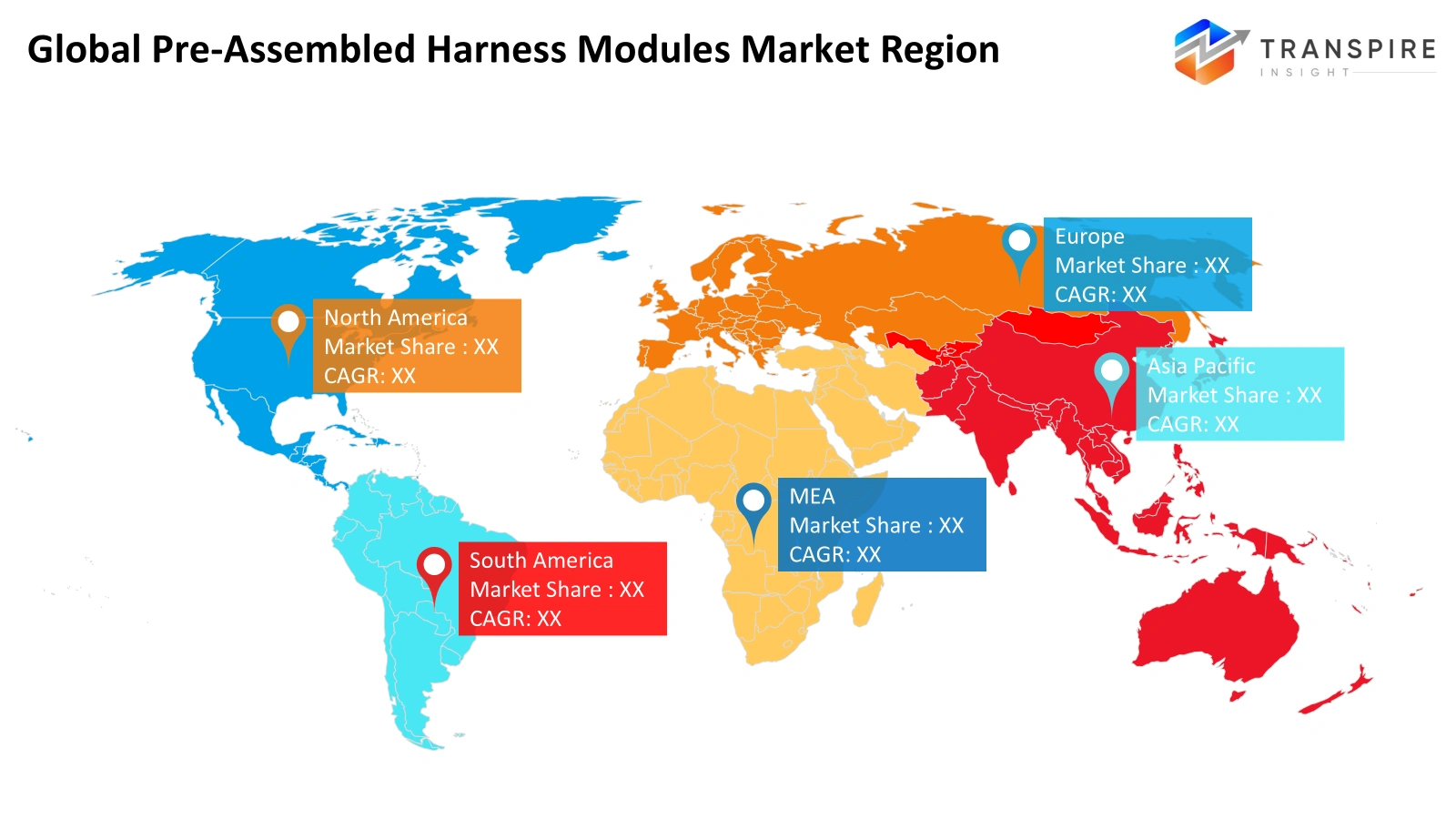
Asia Pacific dominates at 46% due to high vehicle production volumes, electric vehicle battery production, and a high density of OEMs and suppliers, which lead to shorter production lead times. Ecosystem strength is bolstered by government backing of electrification and manufacturing localisation. Electronics assembly infrastructure and connector sourcing in the region are fully developed. Such factors contribute to making the region central to volume adoption for modules. In July 2026, Energy In Motion signed a 500 MWh battery pack supply agreement with CATL, accelerating regional domestic electric truck deployment.
North America is 22% of it, and it is growing even more steadily than Asia Pacific, as in North America, the demand is driven by high-end vehicles, EV platform restyling, and safety/quality. The region is less volume-dense, but the continuing purchasing by large OEMs and Tier 1 suppliers supports the recurring volume business. Supply chains are also getting closer to the final assembly plants to mitigate tariff and logistics risks. This stable pastis keeps the region strategically important. In July 2026, Ford Motor Co. and General Motors signed supplier agreements with Micron Technology. This partnership ensures dedicated sources for advanced memory and storage technologies, supporting the production of next-generation vehicles and mitigating supply chain risks.
Europe is the fastest-growing region, with a 24% growth and a 16.3% CAGR, as automakers are quickening the pace on EV, hybrid, and lightweight wiring upgrades. Last year saw an added mandate on emissions compliance and high-voltage safety, requiring ever more sophisticated harness modules, which in turn open up opportunities to narrow-focus supplier specialisations specialising in high-spec assembly and validation. Ideal for premium EV clusters and internationalised manufacturing centres.
In May 2026, Stellantis and Leapmotor expanded their strategic partnership to commence full-scale European manufacturing and platform integration. This will accelerate local assembly and supply chain localisation, anchoring hi-spec NEV technology directly in European plants like Figueruelas, Spain.
Who are the Key Players in the global pre-assembled harness modules market, and how do they compete?
Competition is driven by platform engineering, scale manufacturing, and rapid adaptation to EV and ADAS content growth. Players compete not only on cost but on depth of testing, design integration, and regional supply consistency. Aptiv, Yazaki Corporation, Sumitomo Electric Industries, Leoni AG, Lear Corporation, and Furukawa Electric generally compete on innovation and system integration, differentiated by high-voltage know-how, modular system design, and OEM co-development. Nexans, TE Connectivity, Amphenol Corporation, PKC Group, Motherson, Fujikura, LS Cable & System, Rosenberger, or BizLink Holding may tend toward niche competency, connector expertise, or regional expansion to win individual vehicle programs. Cost leadership is most pronounced in high-volume passenger car programs, where suppliers utilise automation and regional plants to maximise profit margins. Innovation-led suppliers concentrate on the EV battery pack area, sought-after shielded data lines, and lightweight bundle materials to continuously increase content. Regional expanding strategies have been increasingly trademarked by firms adding capacity close to EV powertrain assembly plants and battery clusters to accelerate qualification and validate long-life programs.
Key Players are:
- Aptiv
- Yazaki Corporation
- Sumitomo Electric Industries
- Leoni AG
- Lear Corporation
- Furukawa Electric
- Nexans
- TE Connectivity
- Amphenol Corporation
- PKC Group
- Motherson
- Fujikura
- LS Cable & System
- Rosenberger
- BizLink Holding
Recent Development News
In March 2026, CSG N.V. signed a preliminary agreement through its subsidiary, CSG Polska, to acquire DOMAR MS, a prominent Polish manufacturer of specialised cable harnesses, electrical distribution boxes, and connector modules. This transaction expands CSG’s European industrial-technology footprint and deepens its production capacity for pre-assembled electrical subsystems deployed in high-stress defence and specialised industrial platforms.
Source: https://live.euronext.com
In June 2026, Leoni Wiring Systems officially broke ground on the construction of a new, advanced industrial unit in Bouskoura, Morocco. This expansion increases the group's manufacturing presence in the region to 12 facilities, directly scaling its capacity to produce modular power distribution boxes, low-voltage systems, and integrated cockpit/door cable harness modules for leading global automotive OEMs.
Source: https://www.leoni.com
What Strategic Insights Define the Future of the Global Pre-Assembled Harness Modules Market?
The industry will transition toward integrated HV wiring systems designed to support electrification (EVs), advanced driver assistance systems (ADAS), and connected vehicle architectures. Competitiveness will be predicated on lightweight materials, software-enabled verification and validation, and modular designs to reduce vehicle set-up/assembly and improve electrical performance. There are also underlying risks of over-dependency on limited sources of high-purity conductors, niche connectors, and other critical raw materials, which could drive supply issues and volatility in pricing. An emerging opportunity for industry will be the increase in modular EV platforms and regional manufacturing plants close to gigafactories and car plants. Automotive suppliers will need to focus on AI-enabled quality checks, digital engineering tools, automation, and on-shoring to reduce qualification cycles and improve manufacturing efficiencies, thereby driving increased profitability, faster launches, and enabling the industry to grow profitably in a fast-changing global electrification space.
Key Segmentations are:
By Product Type
- Engine Wiring Harness Modules
- Chassis Harness Modules
- Dashboard Harness Modules
- Door Harness Modules
- Battery Harness Modules
- Lighting Harness Modules
- High-Voltage Harness Modules
- Others
By Vehicle Type
- Passenger Cars
- Light Commercial Vehicles
- Heavy Commercial Vehicles
- Electric Vehicles
- Hybrid Vehicles
- Off-highway Vehicles
- Luxury Vehicles
- Others
By Material
- Copper Harnesses
- Aluminum Harnesses
- Shielded Harnesses
- Fiber Optic Harnesses
- High-temperature Harnesses
- Lightweight Harnesses
- Hybrid Harnesses
- Others
By End User
- Automotive OEMs
- Tier-1 Suppliers
- Commercial Vehicle Manufacturers
- EV Manufacturers
- Aftermarket Suppliers
- Defense Vehicle Manufacturers
- Industrial Equipment OEMs
- Others
By Application
- Power Distribution
- Battery Systems
- Infotainment Systems
- ADAS
- Body Electronics
- Lighting Systems
- Powertrain Systems
- Others
Regional Outlook
North America
- United States
- Canada
- Mexico
Europe
- Germany
- United Kingdom
- France
- Spain
- Italy
- Rest of Europe
Asia Pacific
- Japan
- China
- Australia & New Zealand
- South Korea
- India
- Rest of Asia Pacific
South America
- Brazil
- Argentina
- Rest of South America
Middle East & Africa
- Saudi Arabia
- United Arab Emirates
- South Africa
- Rest of the Middle East & Africa
Frequently Asked Questions
Find quick answers to common questions.
The global pre-assembled harness modules market size was valued at USD 1.26 Billion in 2025 and is poised to reach USD 2.93 Billion by 2033, expanding at a 11.13% CAGR.
Key segments for the global pre-assembled harness modules market are By Product Type (Engine Wiring Harness Modules, Chassis Harness Modules, Dashboard Harness Modules, Door Harness Modules, Battery Harness Modules, Lighting Harness Modules, High-voltage Harness Modules, Others); By Vehicle Type (Passenger Cars, Light Commercial Vehicles, Heavy Commercial Vehicles, Electric Vehicles, Hybrid Vehicles, Off-highway Vehicles, Luxury Vehicles, Others); By Material (Copper Harnesses, Aluminum Harnesses, Shielded Harnesses, Fiber Optic Harnesses, High-temperature Harnesses, Lightweight Harnesses, Hybrid Harnesses, Others); By End User (Automotive OEMs, Tier-1 Suppliers, Commercial Vehicle Manufacturers, EV Manufacturers, Aftermarket Suppliers, Defense Vehicle Manufacturers, Industrial Equipment OEMs, Others); By Application (Power Distribution, Battery Systems, Infotainment Systems, ADAS, Body Electronics, Lighting Systems, Powertrain Systems, Others).
Growth is primarily driven by EV and ADAS adoption, rising vehicle electronics complexity, modular vehicle platforms, lightweighting, and OEM demand for faster assembly and lower defect rates.
The global pre-assembled harness modules market is led by major manufacturers, including Aptiv, Yazaki Corporation, Sumitomo Electric Industries, Leoni AG, Lear Corporation, Furukawa Electric, Nexans, TE Connectivity, Amphenol Corporation, PKC Group, Motherson, Fujikura, LS Cable & System, Rosenberger, and BizLink Holding.
Asia Pacific holds 46% and influences global pre-assembled harness modules market dynamics through dense OEM production, strong EV battery manufacturing, localised supplier ecosystems, and faster line integration across high-volume vehicle programs.
Commercial opportunities include EV battery and high-voltage module supply, regionalised contract manufacturing near OEM hubs, automation-led testing and validation services, lightweight aluminum/hybrid harness programs, and premium ADAS/infotainment integration work.
- Aptiv
- Yazaki Corporation
- Sumitomo Electric Industries
- Leoni AG
- Lear Corporation
- Furukawa Electric
- Nexans
- TE Connectivity
- Amphenol Corporation
- PKC Group
- Motherson
- Fujikura
- LS Cable & System
- Rosenberger
- BizLink Holding
About the Authors

Mayur Shinde
I am Mayur Shinde, a Senior Research Analyst at Transpire Insight, specializing in the Automotive & Transportation and Information & Communication Technology (ICT) Industry. My work focuses on analyzing emerging market trends, technological advancements, competitive landscapes, and industry developments to deliver accurate, data-driven insights. I am passionate about transforming complex market information into clear, actionable content that helps businesses, professionals, and decision-makers stay informed and make confident strategic decisions.

Chakradhar Khansole
Chakradhar serves as the Research Director at Transpire Insight, bringing over 8 years of experience in technology, innovation, and strategic market intelligence. He specializes in transforming complex market data into actionable business insights that enable organizations to make informed, growth-oriented decisions. Recognized for his strategic vision and analytical expertise, Chakradhar leads high-impact research initiatives, delivering comprehensive market assessments, competitive intelligence, and forward-looking industry analysis.
Recently Published Reports
-
Apr 2026
ATV & UTV Market
ATV & UTV Market Size, Share & Analysis Report By Type (ATV, and UTV), By Variants (Less Than 400 CC, 400 CC To 800 CC, and More Than 800 CC), and Geography (North America, Europe, Asia-Pacific, Middle East and Africa, South and Central America), 2021 - 2031
-
Apr 2026
Automotive Central Gateway Module Market
Automotive Central Gateway Module Market Size, Share & Analysis Report By Type (Ethernet Central Gateway Module, CAN Central Gateway Module, LIN Central Gateway Module, and FlexRay), By Application (Powertrain Control, Body Control, Infotainment System, Advanced Driver Assistance Systems (ADAS), and Others), By End User (Passenger Vehicles, and Commercial Vehicles), and Geography (North America, Europe, Asia-Pacific, Middle East and Africa, South and Central America), 2021 - 2031
-
Apr 2026
Automotive Engine Oil Filter Market
Automotive Engine Oil Filter Market Size, Share & Analysis Report By Filter Type (Fuel Filter, Engine Oil Filter, Hydraulic Oil Filter, and Others), By Filter Media (Cellulose, Synthetic, and Micro), By Sales Channel (OEMs, and Aftermarket), By Vehicle Type (Passenger Cars, Light Commercial Vehicles, Heavy Duty Trucks, Buses and Coaches, and Off-road Vehicles), and Geography (North America, Europe, Asia-Pacific, Middle East and Africa, South and Central America), 2021 - 2031
-
Apr 2026
Automotive Parts Aluminium Die Casting Market
Automotive Parts Aluminium Die Casting Market Size, Share & Analysis Report By Production Process (Pressure Die Casting, Vacuum Die Casting, Squeeze Die Casting, Gravity Die Casting), By Application (Body Parts, Engine Parts, Transmission Parts, Battery And Related Components, Other Application Types), and Geography (North America, Europe, Asia-Pacific, Middle East and Africa, South and Central America), 2021 - 2031
Our Clients



