

Global Powder Metallurgy Market Size & Forecast:
- Global Powder Metallurgy Market Size 2025: USD 3.407 Billion
- Global Powder Metallurgy Market Size 2033: USD 10.561 Billion
- Global Powder Metallurgy Market CAGR: 15.2%
- Global Powder Metallurgy Market Segments: By Type (Ferrous Metal Powders, Non-ferrous Metal Powders, Titanium Powders, Nickel Powders, Stainless Steel Powders, Aluminum Powders, Others); By Application (Automotive Components, Aerospace Components, Industrial Machinery, Medical Implants, Electrical & Electronics, Others); By End-User (Automotive OEMs, Aerospace Manufacturers, Industrial Companies, Medical Device Companies, Others); By Process (Press & Sinter, Metal Injection Molding, Hot Isostatic Pressing, Additive Manufacturing, Others).

To learn more about this report,  Download Free Sample Report
Global Powder Metallurgy Market Summary:
The Global Powder Metallurgy Market size is estimated at USD 3.407 Billion in 2025 and is anticipated to reach USD 10.561 Billion by 2033, growing at a CAGR of 15.2% from 2026 to 2033. The market will continue to expand due to the rising utilization of powder metallurgy techniques among producers to manufacture lightweight and precise components with minimum wastage of materials and minimal energy consumption. During the past 3–5 years, the demand pattern has transformed from traditional automotive components to more demanding applications such as electric vehicle parts, aircraft components, and machinery. One key structural change has been the inclusion of additive manufacturing technologies and advanced metal powders, making it possible to achieve quick prototyping and customization. One key external trigger has been the ongoing rapid transformation in the automobile industry towards electric vehicles, thus making it necessary to manufacture lightweight and highly efficient transmission components.
Global Powder Metallurgy Market Insights:
- The automotive sector contributes around 65% to the overall demand in the market, with companies like GKN Powder Metallurgy focusing on producing EV components owing to automakers' inclination towards lightweight drive system cars.
- The consumption of iron-based powders exceeds 70% due to their relatively low cost and durability, and manufacturers are developing high-grade alloy mixtures that help create strong industrial components.
- Over 45% of manufacturers are utilizing additive manufacturing technologies alongside powder metallurgy techniques, wherein companies like Höganäs AB have come up with customized metal powders for 3D printing and prototyping purposes.
- The Asia-Pacific region constitutes around 48% of the global market revenue, driven by robust automotive and electronics manufacturing in countries including China and India.
- Some 35% of new industrial investments go into sustainable production technologies, which favor powder metallurgy in that it saves on machining losses and energy expenditure when compared to traditional casting.
- The aerospace industry is growing at an annual rate of more than 8%, with such firms as Sandvik AB developing titanium and nickel powder technology for making lighter aircraft parts.
- Close to 40% of consumers choose near-net-shape technologies to minimize the costs associated with post-process operations, thus driving innovations in precision sintering and compacting.
- More than 29% of plants are investing in digital control and AI-based monitoring to enhance density performance, avoid defects, and optimize the efficiency of powder use.
- Growing consumer demand for soft magnetic components is up more than 20% in automotive electrification and renewables; manufacturers respond by researching and improving magnetic powders for electric motors, sensors, and power electronics.
- Increased application in medicine and dentistry is gradually becoming apparent, with more patients using biocompatible metal powders for implants and other surgical applications.
What are the Key Drivers, Restraints, and Opportunities in the Global Powder Metallurgy Market?
Driver
The major force propelling the Global Powder Metallurgy Market is the fast-growing production of electric vehicles and lightweight equipment used in industry. For the production of such components, automotive manufacturers require small and strong products, which can only be made through powder metallurgy technology as traditional casting is not always capable of producing them economically. The main reason behind this has been tighter global emissions control standards and the move towards battery-based transport modes among automobile manufacturers. The advantages offered by powder metallurgy include minimal scrap production in the range of 95%, enhanced dimensional accuracy, lower manufacturing costs, and shorter manufacturing processes, leading to increased sales.
Restraint
Another major constraint involves the substantial cost involved in obtaining sophisticated processing equipment and tooling machines that would be needed. Small to medium sized firms generally find it difficult to invest in sophisticated compaction and sintering facilities and superior metallic powder technology. This remains a continuing problem since manufacturing in the powder metallurgy process demands technical know-how, an ideal environment for manufacturing, and consistent quality of raw materials. Moreover, variations in metal powder prices, especially nickel, titanium, and tungsten, present uncertainties that prevent wider use within budget-conscious industries.
Opportunity
An important opportunity for the future would be the combination of additive manufacturing with superior powdered metal products. Many sectors such as aerospace, medical implants, and defense have come to rely on custom metal components that have complicated geometries. Metal 3D printers in Germany, Japan, and United States are generating demand for high-quality powders and alloyed metals. This trend may present a way for the company to access premium margin products in a broader market than auto parts.Bottom of Form
What Has the Impact of Artificial Intelligence Been on the Global Powder Metallurgy Market?
The emergence of AI in the Global Powder Metallurgy Market has enabled greater efficiency, accuracy, and automation in such activities as powder mixing, compaction, sintering, and testing. AI-based technologies that monitor the processes of production help ensure consistent performance in such aspects as temperature control, particle size, and density analysis. In March 2025, GKN Powder Metallurgy took its steps toward implementing AI in the process of production analysis.
In addition, AI is enhancing predictive manufacturing through the use of machine learning techniques that enable prediction of equipment deterioration, sintering anomalies, and production constraints prior to failure. This will minimize downtime and increase efficiency in high volume manufacturing of automotive and aerospace parts. In September 2024, Sandvik AB launched state-of-the-art digital monitoring technologies in their metal powder manufacturing process, aimed at improving consistency of materials and optimizing additive manufacturing applications.
In terms of operations, AI-driven automation technologies have increased energy efficiency, minimized raw materials usage, and optimized quality assurance inspections using computer vision-based systems. As more manufacturers integrate Industry 4.0 approaches, the need for AI becomes inevitable if precision-based manufacturing is to be achieved at scale.
Global Powder Metallurgy Market Trends:
- For the past five years, there have been efforts among automotive makers to move from traditionally machined components to sintered lightweight components in order to increase efficiency and minimize energy usage.
- The increasing utilization of metal powders that are suited to use in additive manufacturing processes has made powder metallurgy shift from mass production processes to precision manufacturing techniques.
- Since 2021, the need for soft magnetic components has increased as high performance but low energy-loss magnetic components are required by the manufacturers of electric vehicle motors and renewable energy equipment.
- Factories are also switching from manual quality control methods to artificial intelligence-based methods.
- Aerospace industries are opting for titanium and nickel alloy powders in place of conventionally cast materials for manufacturing advanced lightweight products that are used in aircraft manufacturing.
- The focus on sustainability goals has forced companies to opt for near-net-shape manufacturing processes to cut down on waste, raw material consumption, and machining-related energy consumption.
- The suppliers of metal powders are upgrading their processes to create ultra-fine and highly purified metal powders as there is an increasing need for custom-made products within the medical implants industry.
- Supply chains have changed significantly due to the impact of the COVID-19 pandemic, and manufacturers have started focusing on local powder procurement and manufacturing processes.
- There has been extensive adoption of industrial automation, including the use of smart compacting systems and sintering furnaces to increase efficiency.
Global Powder Metallurgy Market Segmentation:
By Type
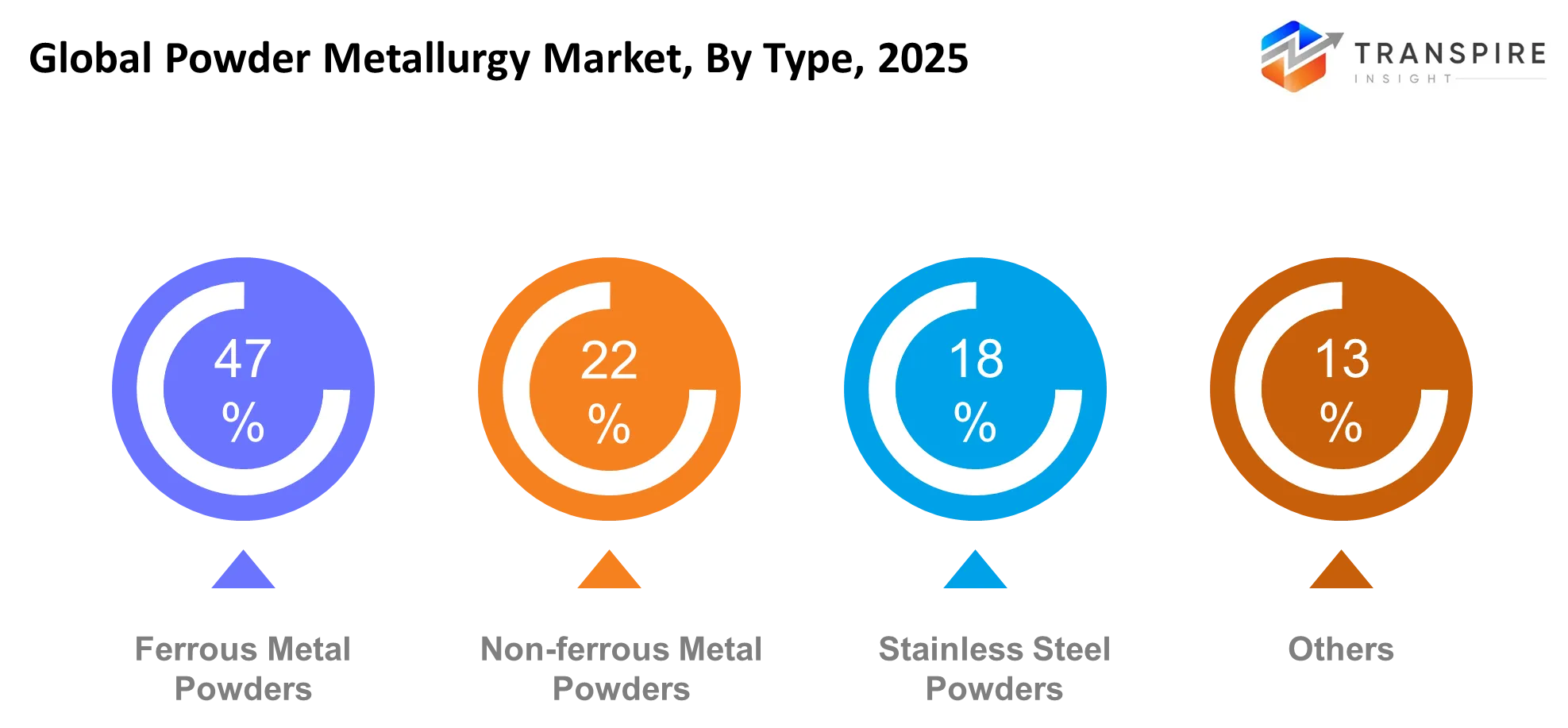
Metal powder continues to dominate the Global Powder Metallurgy Market based on its widespread application in the manufacture of automobile transmissions, gears, bearing, and machine parts. The growth of metal powder is driven mainly by cost-effectiveness, strength, and compatibility with mass production processes. With emphasis on affordability and light engineering materials, metal powder plays a significant role in mass manufacturing. In contrast, non-metal powders such as aluminum and copper alloy powders are growing steadily owing to their anti-corrosive qualities and conductive nature in the manufacture of electronic devices and aerospace products. Titanium and nickel powders are increasingly vital in high-performing industries that require heat resistance and biocompatibility. The long-term significance of titanium and nickel powders includes aerospace industry and defense technology, besides being used in custom medical implants. Stainless steel powder finds wide application in the manufacture of durable and chemically resistant industrial equipment.
To learn more about this report, Download Free Sample Report
By Application
The automotive components account for the biggest application category because of the ability of powder metallurgy to manufacture large quantities of highly complicated shapes and structures without wasting much raw material. The move to electric vehicles is increasing the demand for magnetic materials, lighter gears, and transmissions. Adoption of technology is growing within aerospace components as manufacturers look for more efficient materials that are lighter in weight. The industrial machinery application is gaining traction through the production of automated machinery, whereas medical implants represent a new, highly valuable category of application due to the growing demand for custom-designed parts made of metals.
By End-User
OEMs of automotive continue to lead as end users on account of persistent demands for light weight and efficient machinery. Aerospace OEMs are ramping up investment towards powders used in addtive manufacturing and turbine systems. Powder metallurgy is gaining traction in industrial sectors as a way to cut down on machining expenses and make production more scalable. The medical devices industry is rapidly moving towards customized implants and surgery tools using advanced powder techniques.
By Process
The dominant technology used in the process segment is press & sinter, owing to its ability to produce at lower costs due to mass production and ease of operation. Nonetheless, metal injection molding technologies are progressively becoming more prevalent as the best way to manufacture minute products with high precision. Hot isostatic pressing finds wide usage within aerospace and defense industries, as it helps achieve maximum density in parts that need to be structurally sound. Additive manufacturing seems to be the most revolutionary segment within the industry.
What are the Key Use Cases Driving the Global Powder Metallurgy Market?
The key application scenario for the Global Powder Metallurgy Market includes the fabrication of automotive parts, which include gears, bearings, transmission systems, and magnetic systems. An increasing number of Automotive Original Equipment Manufacturers are using powder metallurgy since it allows large-scale production while reducing waste and ensuring precision in dimension and weight, thus catering to their needs for producing cars that consume less fuel and electricity.
There are new application areas coming up for powder metallurgy including aviation industry, industrial equipment, and electronics. The aviation industry uses advanced titanium and nickel metals as powder form for light aircraft parts, whereas the industrial sector uses powder metallurgy for building robust machine parts and saving costs related to machining operations.
Examples of emerging applications are related to additive manufacturing and medicine. Orthopedic implants, dental products, and surgery tools are more and more frequently made from high-end metal powder due to its compatibility with the body and exact properties. On the other hand, the implementation of 3D printing has allowed for efficient prototyping and minimal waste industrial applications.
|
Report Metrics |
Details |
|
Market size value in 2025 |
USD 3.407 Billion |
|
Market size value in 2026 |
USD 3.922 Billion |
|
Revenue forecast in 2033 |
USD 10.561 Billion |
|
Growth rate |
CAGR of 15.2% from 2026 to 2033 |
|
Base year |
2025 |
|
Historical data |
2021 - 2024 |
|
Forecast period |
2026 - 2033 |
|
Report coverage |
Market trends, growth drivers, restraints, opportunities, AI impact, segmentation analysis, competitive landscape, regional analysis, and recent developments |
|
Regional scope |
North America, Europe, Asia-Pacific, Latin America, Middle East & Africa |
|
Key company profiled |
Hoganas AB, GKN Powder Metallurgy, Rio Tinto Metal Powders, Carpenter Technology, Sandvik, BASF, Miba AG, Sumitomo Electric, Hitachi Chemical, Plansee Group, ATI Metals, Praxair Surface Technologies, PMG Holding, Erasteel, Fine Sinter. |
|
Customization scope |
Customized regional analysis, competitive benchmarking, segment-specific insights, and company profiling available on request |
|
Report Segmentation |
By Type (Ferrous Metal Powders, Non-ferrous Metal Powders, Titanium Powders, Nickel Powders, Stainless Steel Powders, Aluminum Powders, Others); By Application (Automotive Components, Aerospace Components, Industrial Machinery, Medical Implants, Electrical & Electronics, Others); By End-User (Automotive OEMs, Aerospace Manufacturers, Industrial Companies, Medical Device Companies, Others); By Process (Press & Sinter, Metal Injection Molding, Hot Isostatic Pressing, Additive Manufacturing, Others). |
Which Regions are Driving the Global Powder Metallurgy Market Growth?
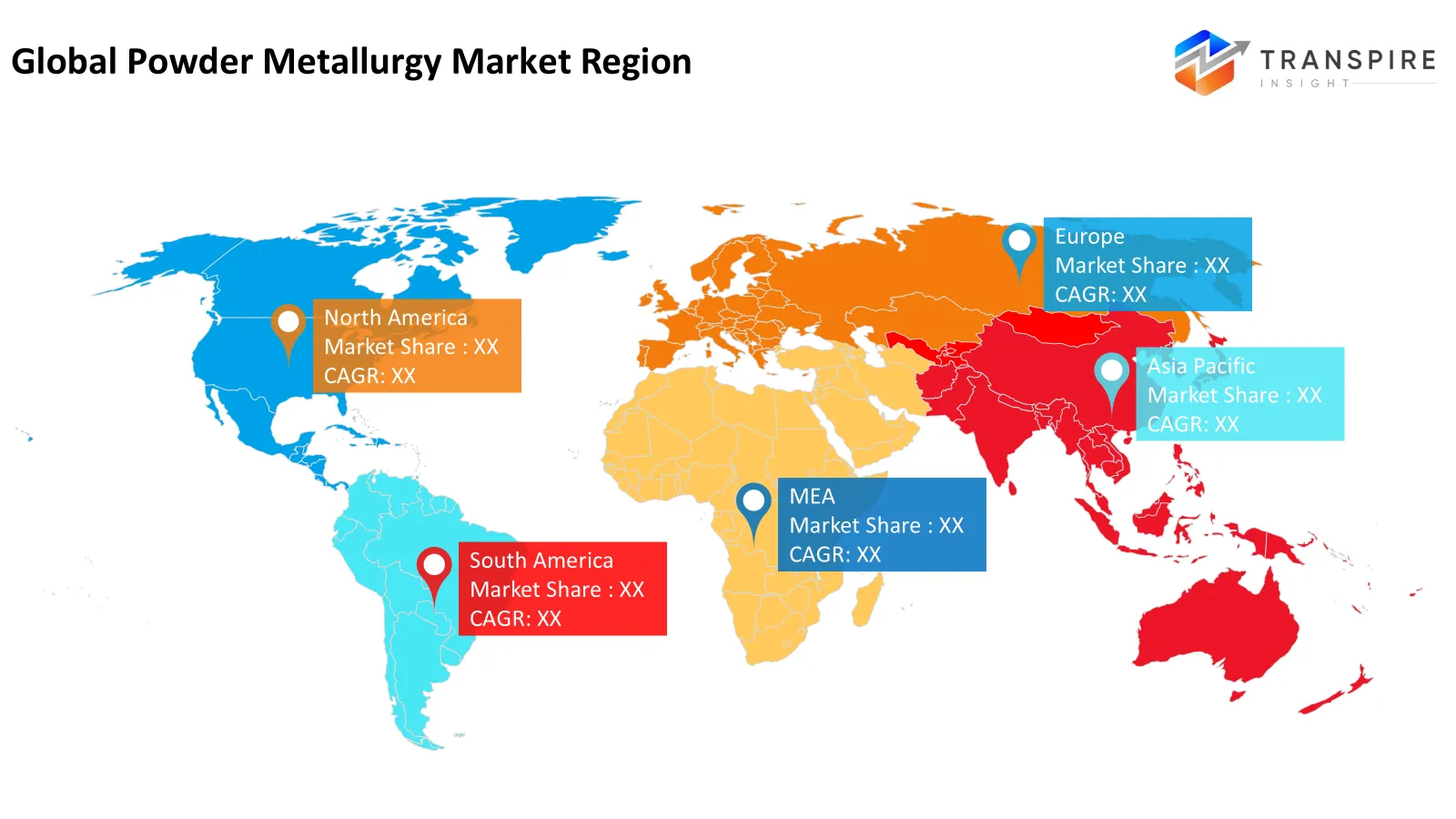
The Asia Pacific region leads the way in terms of market share in the Global Powder Metallurgy Market owing to the presence of a robust automotive manufacturing sector and increasing production of industrial machinery and electronic supplies. China, Japan, and India lead production owing to cost-effective manufacturing facilities and high demand for lightweight parts domestically. In March 2025, Hoganas AB enhanced production partnerships in the Asia region to increase their capacity to meet the rising demand for electric vehicles. Policy initiatives towards the manufacturing of EVs, automation of industries, and domestic manufacturing boost the dominance of Asia Pacific in both production and consumption.
Europe comes second in terms of the largest regional market due to its development of aerospace engineering, sustainable manufacturing policies, and the widespread use of precision manufacturing technologies. While comparing it with Asia-Pacific, it should be mentioned that Europe has smaller production volumes but prioritizes high-value-added products including aerospace parts, medical implants, and additive manufacturing material. In September 2024, Sandvik AB raised its investments into advanced metal powders used in industrial and aerospace applications in the European region. Stability in Europe is assured by environmentally conscious regulation, well-established research capacity, and long-standing cooperation within the industry.
North America is currently seen as the fastest-growing region because of rapid uptake of additive manufacturing, reshoring of industrial manufacturing chains, and defense-related investment. North America has recently demonstrated an increasing need for customized metal products in aerospace, healthcare, and high-performance industrial machinery. In January 2025, Carpenter Technology Corporation began expanding production capacities for specialty alloy powders needed to manufacture more aerospace and medical devices in the United States. Opportunities for further growth will be accelerated by smart manufacturing driven by artificial intelligence, advanced 3D printing, and the increase in defense production.
To learn more about this report, Download Free Sample Report
Who are the Key Players in the Global Powder Metallurgy Market and how do they Compete?
Competition in the Powder Metallurgy Industry is determined by technology specialization, material innovation, and partnership with automotive, aerospace, and industrial customers. Firms have started competing not just based on their manufacturing scale but also their advanced powder capabilities, precise engineering expertise, and ability to work with additive manufacturing techniques. The industry is moderately consolidated, with industry players competing on customized alloy formulation, AI-supported manufacturing platforms, and regional expansion to build strong industrial supply chains.
The competitive advantage of GKN Powder Metallurgy comes from its large-scale automotive production and efficient manufacturing of components. Its competition strategy includes creating light-weight parts for electric vehicles and efficient production platforms minimizing wastage and increasing efficiency. GKN's competitive advantage arises from vertical manufacturing and long-term partnership with automobile original equipment manufacturers globally. Höganäs AB competes on innovation-led metal powder creation for applications related to additive manufacturing and sustainable industrial manufacturing processes.
Sandvik AB has differentiated itself in its premium aerospace segment through innovation in producing high-grade titanium and nickel powders to meet highly engineered requirements. Their differentiating features include their research and development strengths and materials technologies for 3D printers. On the other hand, Carpenter Technology Corporation has adopted the specialization approach by developing specialty alloys for use in aerospace, defense, and medical industries. They have been growing through alloy development and localized production facilities within North America.
Global Powder Metallurgy Market Companies
- Hoganas AB
- GKN Powder Metallurgy
- Rio Tinto Metal Powders
- Carpenter Technology
- Sandvik
- BASF
- Miba AG
- Sumitomo Electric
- Hitachi Chemical
- Plansee Group
- ATI Metals
- Praxair Surface Technologies
- PMG Holding
- Erasteel
- Fine Sinter
Recent Development News:
- In February 2026, The Dauch Corporation finished their takeover of the Dowlais Group plc, along with their subsidiaries, GKN Automotive and GKN Powder Metallurgy. Through this takeover, Dauch Corporation improved their abilities to create electrified drivelines and produce powder metal parts, while growing their position in the global automotive supply chain. https://www.gknpm.com
- In May 2026, A contract was signed between Mkango Resources Ltd. and Heraeus Amloy Technologies GmbH where Mkango Resources acquired Heraeus Remloy for €8 million. This made it possible for the company to recycle rare earth magnets and produce powder alloy of neodymium-iron-boron. https://www.investegate.co.uk
- In June 2025, A contract was signed between Mkango Resources Ltd. and Heraeus Amloy Technologies GmbH where Mkango Resources acquired Heraeus Remloy for €8 million. This made it possible for the company to recycle rare earth magnets and produce powder alloy of neodymium-iron-boron. https://www.metalpowder.sandvik
What Strategic Insights Define the Future of the Global Powder Metallurgy Market?
The future of Global Powder Metallurgy Market is headed towards digital, waste-reducing, and performance-enhancing ecosystems enabled by developments in electric mobility, aerospace technologies, and additive manufacturing. Manufacturers combining superior powder technology with intelligent control of their operations using AI will have a competitive edge, considering the rising demand for custom, light, and precision engineered parts. A less obvious threat to manufacturers is the increasing reliance on strategic metals like nickel, titanium, and rare earth metals, which may prove a bottleneck due to their uncertain supply chains and volatile pricing.
An opportunity for growth lies in the fast-growing sector of metal additive manufacturing used in the production of medical implants, aircraft components, and defense equipment in countries like the United States and Germany, as more firms are making significant investments in automation of their processes. To take full advantage of the new trend, companies must invest in local powder production and sustainable recycling, as well as collaborations with makers of automobiles and aircraft.
Global Powder Metallurgy Market Segmentation
By Type
- Ferrous Metal Powders
- Non-ferrous Metal Powders
- Titanium Powders
- Nickel Powders
- Stainless Steel Powders
- Aluminum Powders
- Others
By Application
- Automotive Components
- Aerospace Components
- Industrial Machinery
- Medical Implants
- Electrical & Electronics
- Others
By End-User
- Automotive OEMs
- Aerospace Manufacturers
- Industrial Companies
- Medical Device Companies
- Others
By Process
- Press & Sinter
- Metal Injection Molding
- Hot Isostatic Pressing
- Additive Manufacturing
- Others
Regional Outlook
North America
- United States
- Canada
- Mexico
Europe
- Germany
- United Kingdom
- France
- Spain
- Italy
- Rest of Europe
Asia Pacific
- Japan
- China
- Australia & New Zealand
- South Korea
- India
- Rest of Asia Pacific
South America
- Brazil
- Argentina
- Rest of South America
Middle East & Africa
- Saudi Arabia
- United Arab Emirates
- South Africa
- Rest of the Middle East & Africa
Frequently Asked Questions
Find quick answers to common questions.
The global powder metallurgy market size was valued at USD 3.407 Billion in 2025 and is poised to reach USD 10.561 Billion by 2033, expanding at a 15.2% CAGR 2026-2033.
Key segments for the global powder metallurgy market are By Type (Ferrous Metal Powders, Non-ferrous Metal Powders, Titanium Powders, Nickel Powders, Stainless Steel Powders, Aluminum Powders, Others); By Application (Automotive Components, Aerospace Components, Industrial Machinery, Medical Implants, Electrical & Electronics, Others); By End-User (Automotive OEMs, Aerospace Manufacturers, Industrial Companies, Medical Device Companies, Others); By Process (Press & Sinter, Metal Injection Molding, Hot Isostatic Pressing, Additive Manufacturing, Others).
Growth is primarily driven by electric vehicle production, higher demand for lighter weight materials used in automobiles, and increased use of 3D printing technology. Powder metallurgy is being widely adopted due to its benefits such as lower material wastage, cost-effective processing, and accurate manufacturing of metal parts. Increased applications in aerospace, machine tools, and surgical implants are also boosting the growth of the industry, along with developments in artificial intelligence and sustainable manufacturing processes.
The global powder metallurgy market is led by major manufacturers including Hoganas AB, GKN Powder Metallurgy, Rio Tinto Metal Powders, Carpenter Technology, Sandvik, BASF, Miba AG, Sumitomo Electric, Hitachi Chemical, Plansee Group, ATI Metals, Praxair Surface Technologies, PMG Holding, Erasteel, Fine Sinter.
North America has about 22% of the total share of the worldwide powder metallurgy market and wields significant influence in setting benchmarks for innovative development and advanced manufacturing processes. Due to a predicted CAGR of 12.1%, this region is poised for rapid expansion owing to increasing adoption of additive manufacturing technology, aerospace parts fabrication, and the advent of electric vehicles. Being home to some of the world’s largest aerospace and defense manufacturers in the U.S., and also leading producers of medical devices in Canada, there is a robust demand for high-grade titanium, nickel, and specialty alloy powders. Additionally, North America is at the forefront of AI-based manufacturing systems, metal 3D printing applications, and product development through extensive R&D, thus driving efficiency and innovation.
Some of the key business opportunities in the powder metallurgy industry are the rapid growth of electric vehicle production, which involves the need for lightweight gears, magnets, and transmissions. The growing use of metal-based additive manufacturing and 3D printing technology is providing an additional source of income generation in terms of customized parts for the aerospace, defense, and medical industry sectors. The increased spending on AI-powered smart manufacturing solutions as well as automated sintering technology provides new business opportunities for efficient manufacturing systems. Apart from that, the rising demand for high-purity titanium and nickel powders in aerospace and healthcare applications, coupled with industrialization in emerging countries like India and China, can create a promising future ahead for powder metallurgy players.
- Hoganas AB
- GKN Powder Metallurgy
- Rio Tinto Metal Powders
- Carpenter Technology
- Sandvik
- BASF
- Miba AG
- Sumitomo Electric
- Hitachi Chemical
- Plansee Group
- ATI Metals
- Praxair Surface Technologies
- PMG Holding
- Erasteel
- Fine Sinter
About the Authors

Pankaj Ghogare Patil
I am Pankaj Ghogare Patil, a Senior Research Analyst at Transpire Insight, specializing in the Pharmaceutical, Chemicals & Materials, Healthcare IT, and Biotechnology industry. My expertise lies in conducting comprehensive market research, analyzing industry trends, evaluating competitive landscapes, and translating complex data into actionable insights. At Transpire Insight, I closely follow emerging technologies, regulatory developments, and market innovations to create accurate, well-researched, and informative content that helps businesses and professionals make informed decisions. I am committed to producing credible, evidence-based articles that reflect industry best practices while making technical topics accessible and valuable for a broad audience.

Chakradhar Khansole
Chakradhar serves as the Research Director at Transpire Insight, bringing over 8 years of experience in technology, innovation, and strategic market intelligence. He specializes in transforming complex market data into actionable business insights that enable organizations to make informed, growth-oriented decisions. Recognized for his strategic vision and analytical expertise, Chakradhar leads high-impact research initiatives, delivering comprehensive market assessments, competitive intelligence, and forward-looking industry analysis.
Recently Published Reports
-
May 2026
Healthcare Polymer Packaging Market
Healthcare Polymer Packaging Market Size, Share & Analysis Report By Packaging Type (Syringes, IV Bottles and Pouches, Clamshells, Blisters, Bottles & Jars, Containers, Tubes, IV Parental Packaging, Others), By Type (Regulated, Non-regulated), By Polymer Type (LDPE (Low-Density Polyethylene), HDPE (High-Density Polyethylene), Homo-polymer (Homo), Random Copolymer (Random), Block Copolymer (Block), PET, Polystyrene, Polyvinyl Chloride, Polyamide/EVOH, Others), and Geography (North America, Europe, Asia-Pacific, Middle East and Africa, South and Central America), 2021 - 2031
-
Apr 2026
Hydrophilic Tape (Waterstop) Market
Hydrophilic Tape (Waterstop) Market Size, Share & Analysis Report By Type (Bentonite-Based Hydrophilic Tape, Rubber-Based Hydrophilic Tape), By Application (Residential Buildings, Commercial Buildings, Infrastructure Projects), and Geography (North America, Europe, Asia-Pacific, Middle East and Africa, South and Central America), 2021 - 2031
-
Apr 2026
Metalens Market
Metalens Market Size, Share & Analysis Report By Type (Visible Light Metalens, and Infrared Metalens), By Application (Consumer Electronics, Automotive Electronics, Industrial, Medical, and Others), and Geography (North America, Europe, Asia-Pacific, Middle East and Africa, South and Central America), 2021 - 2031
-
Apr 2026
PBT Resin Market
PBT Resin Market Size, Share & Analysis Report By Type (Reinforced PBT Resin, Unreinforced PBT Resin), By Processing Method (Injection Molding, Extrusion, Blow Molding, Others), By End-User (Automotive, Electrical & Electronics, Consumer Appliances, Industrial Machinery, Medical Devices, Packaging, Others), and Geography (North America, Europe, Asia-Pacific, Middle East and Africa, South and Central America), 2021 - 2031