
Global Post-acute Care Market Size & Forecast:
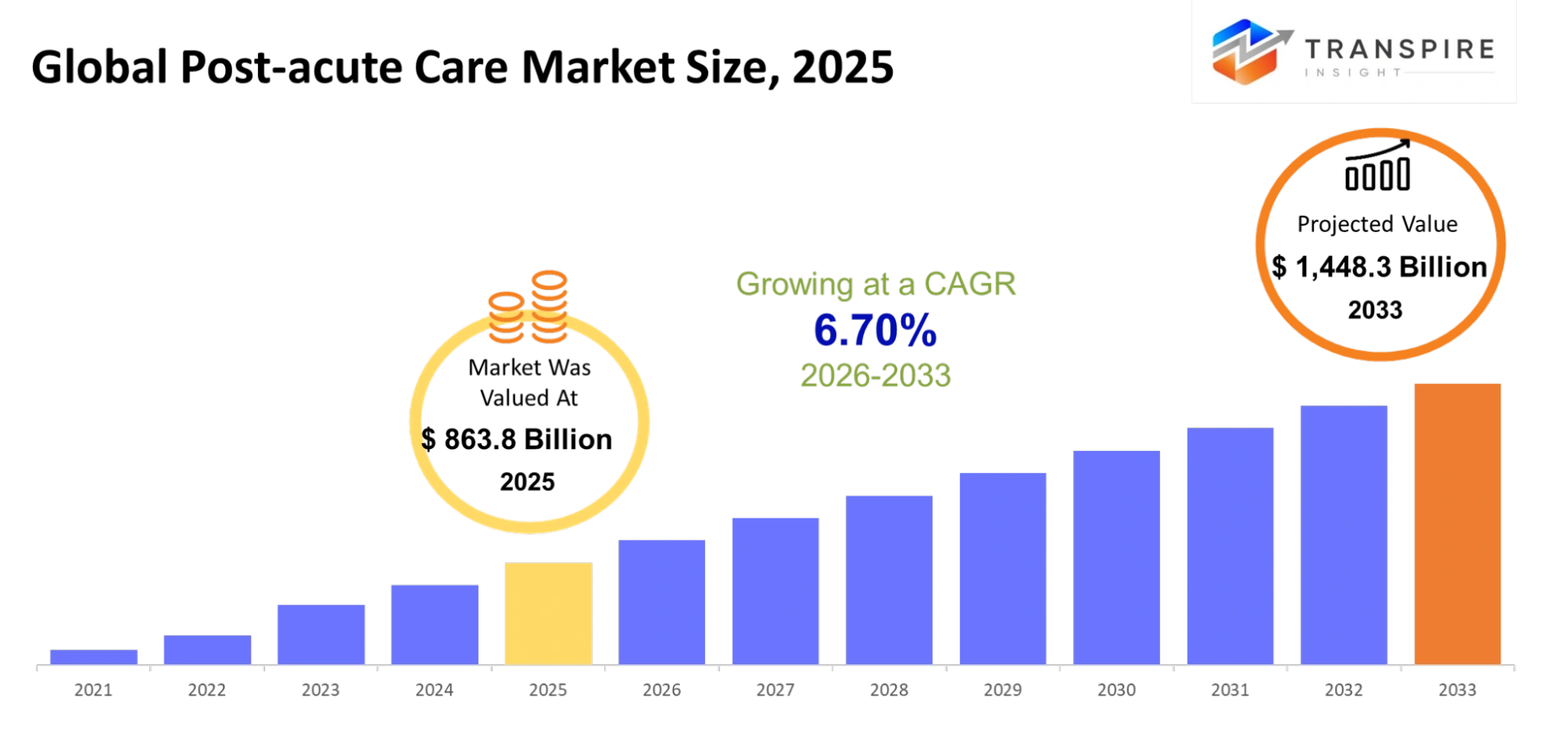
Global Post-acute Care Market Size 2025: USD 863.8 Billion
Global Post-acute Care Market Size 2033: USD 1,448.3 Billion
Global Post-acute Care Market CAGR: 6.70%
Global Post-acute Care Market Segments: By Service Type (Skilled Nursing Facilities, Inpatient Rehabilitation Facilities, Home Health Agencies, Long-Term Care Hospitals), By Age Group (Adult, Geriatric), By Payer (Public Insurance, Private Insurance, Out-of-Pocket).
To learn more about this report,  Download Free Sample Report
Global Post-acute Care Market Summary:
The Global Post-acute Care Market was valued at USD 863.8 billion in 2025 and is projected to reach USD 1,448.3 billion by 2033, growing at a CAGR of 6.70% from 2026 to 2033. Post-acute care covers the range of medical and rehabilitative services that patients need after a hospital stay, before they can return home or transition to a longer-term care setting. That includes skilled nursing facilities, inpatient rehabilitation programs, home health services, and long-term acute care hospitals. Each setting handles a different patient acuity level and care duration, and the mix of demand across them is shifting as payers, providers, and patients themselves press toward lower-cost, less institutionalized options.
The trend toward home health services has become more widespread over the last ten years, and it has accelerated since 2020. Patients prefer to recover from their medical condition at home. Payers, particularly Medicare, have supported this with payment models that favor home-based alternatives when clinically appropriate. Home health agencies have expanded their operational capabilities and increased their capacity to treat more complex patients due to increased demand for home health services, but staffing shortages continue to limit their operational growth.
Inpatient rehabilitation facilities treat patients who need three hours of daily therapy but do not yet possess the capabilities to return home. Patients receive referrals for treatment of joint replacements, brain injuries, and neurological events. Long-term care hospitals treat patients with the highest medical needs who require hospital care for extended periods, ranging from weeks to months, but they represent the least common group of patients hospitals treat.
Key Market Trends & Insights:
- The Global Post-acute Care Market is growing as the US population ages and the number of patients requiring recovery support after hospitalization increases each year.
- Home health agencies are gaining ground as payers incentivize lower-cost care settings and patients push back against institutionalization when their clinical needs can be met at home.
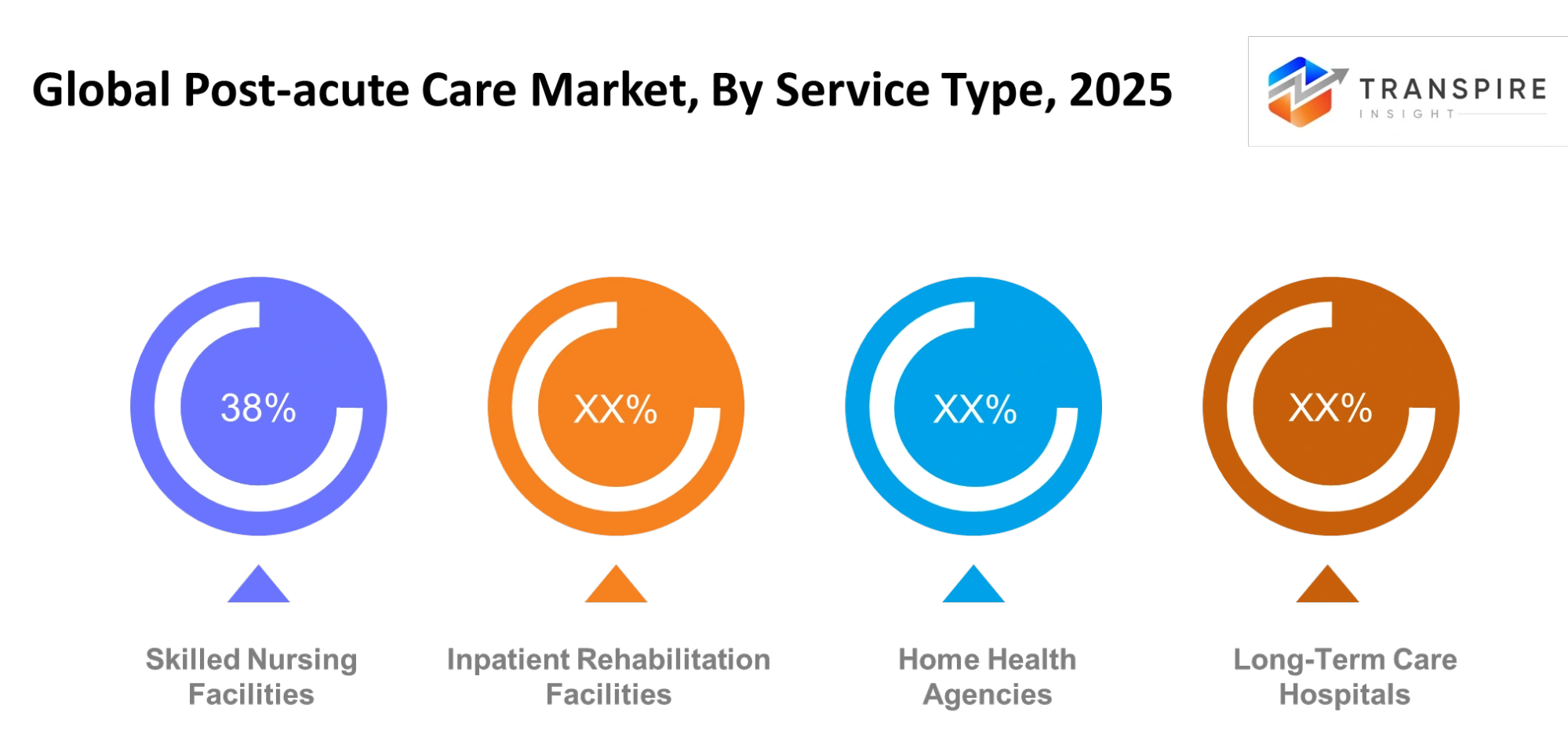
- Skilled nursing facilities hold the largest revenue share at 38%, driven by patients with complex, ongoing nursing needs that home or outpatient settings cannot safely absorb.
- Workforce availability is the most consistent operational constraint across all post-acute settings, with nursing and therapy staffing shortfalls affecting both capacity and margins.
- Public insurance, primarily Medicare and Medicaid, funds the majority of post-acute care spending in the US, meaning reimbursement policy changes have an outsized effect on operator economics across the entire market.
Global Post-acute Care Market Segmentation
By Service Type
- Skilled Nursing Facilities: Skilled nursing facilities are the largest segment of the Global Post-acute Care Market, accounting for approximately 38% of total revenue. They provide 24-hour nursing care alongside rehabilitation therapies for patients who cannot yet manage independently but do not require acute hospital admission. Common admission diagnoses include hip fractures, joint replacements, strokes, cardiac events, and sepsis with residual functional deficits. Reimbursement is primarily through Medicare Part A for short-term post-acute stays and Medicaid for longer-term custodial care, which means facilities must manage two very different payer relationships simultaneously. Staffing ratios, quality ratings under CMS's five-star system, and length-of-stay management are the main operational levers that determine whether a skilled nursing facility is financially viable.
- Inpatient Rehabilitation Facilities: Inpatient rehabilitation facilities provide intensive, multidisciplinary therapy to patients recovering from strokes, brain injuries, spinal cord injuries, amputations, and major orthopedic procedures. Admission requires that patients can tolerate and benefit from at least three hours of combined therapy per day, which filters out the most acute cases to hospitals and the least acute to home health. The segment benefits from Medicare reimbursement under the inpatient rehabilitation facility prospective payment system, which ties payments to patient acuity through a classification system called CMGs. Operators compete on physician relationships and therapy outcomes data, since referring hospitals and case managers can and do track which facilities produce better functional outcomes.
- Home Health Agencies: Home health agencies deliver skilled nursing, physical therapy, occupational therapy, and speech therapy in the patient's home. The segment has grown as both CMS payment policy and patient preference have shifted toward home-based recovery. Under Medicare, home health is covered for patients who are homebound and require intermittent skilled care, conditions that cover a broad patient population in practice. The Patient-Driven Groupings Model, implemented in 2020, changed how Medicare pays home health agencies, moving away from visit-based payment toward a 30-day episode payment tied to patient characteristics. Agencies managing high-acuity patients with efficient visit patterns have done reasonably well under this model. Chronic workforce shortages remain the main growth constraint.
- Long-Term Care Hospitals: Long-term care hospitals serve patients who need hospital-level care for extended periods, typically defined as average lengths of stay exceeding 25 days. Their patient mix includes ventilator-dependent patients, those with complex wounds, medically unstable post-surgical patients, and individuals with multi-organ dysfunction requiring ongoing monitoring and intervention. These facilities are the smallest segment by volume but carry the highest per-patient costs in the post-acute spectrum. Medicare coverage is the primary payer, with qualification dependent on meeting specific criteria around patient acuity and need for continued intensive monitoring. Regulatory oversight is tight and the barriers to entry are high, which limits new supply even when demand is steady.
To learn more about this report, Download Free Sample Report
By Age Group
- Adult: The adult segment covers patients under 65 who need post-acute care following surgery, injury, or serious illness. Orthopedic recovery, neurological rehabilitation after stroke or brain injury at working age, and post-ICU recovery for younger patients with complex conditions are the main referral categories. While smaller than the geriatric segment by volume, adult post-acute patients tend to have higher rehabilitation potential and shorter episodes, which affects both clinical programming and payer mix. Private insurance is more commonly the primary payer for this group.
- Geriatric: Geriatric patients represent the dominant age group across all Global Post-acute Care Market segments. Adults 65 and older are the primary users of skilled nursing facilities, inpatient rehabilitation, and long-term care hospitals, and they account for the majority of home health episodes. Medicare is the primary payer for most geriatric post-acute care, making this segment particularly sensitive to federal reimbursement policy. The US Census Bureau projects the 65-and-older population will grow through at least 2040, which puts a demographic floor under demand for post-acute services regardless of care delivery or payment model changes.
By Payer
- Public Insurance: Public insurance, primarily Medicare and Medicaid, funds the largest share of spending in the Global Post-acute Care Market. Medicare covers short-term post-acute care following qualifying hospital stays and home health services for eligible beneficiaries. Medicaid covers long-term custodial care in skilled nursing facilities for patients who have spent down their assets to eligibility thresholds. Together, these two programs set the reimbursement rates and regulatory conditions that govern how most post-acute providers operate. Changes to Medicare payment rules, coverage criteria, and quality reporting requirements have more effect on this market than almost any other external factor.
- Private Insurance: Private insurance covers a portion of post-acute care for working-age adults and some Medicare-eligible patients who carry supplemental coverage. Long-term care insurance, where it exists, can cover extended skilled nursing or home care stays. Commercial insurers negotiate rates directly with providers, typically at levels above Medicaid but sometimes below Medicare, depending on the segment and geography. Managed care penetration in Medicare through Medicare Advantage plans has grown significantly, and MA plans have shown a pattern of tighter post-acute stay authorization and stronger pressure toward home-based alternatives over institutional care.
- Out-of-Pocket: Out-of-pocket spending applies when patients exhaust their insurance coverage limits or do not qualify for public programs. Private-pay skilled nursing facility stays, custodial home care not covered by Medicare, and care in settings that do not accept insurance are the main categories. The cost of private-pay skilled nursing in major US markets often exceeds USD 100,000 per year, which means this payment category primarily applies to patients with significant personal assets. Assisted living and memory care, while not technically post-acute care settings, capture some patients who might otherwise have transitioned through a post-acute setting.
Country Insights
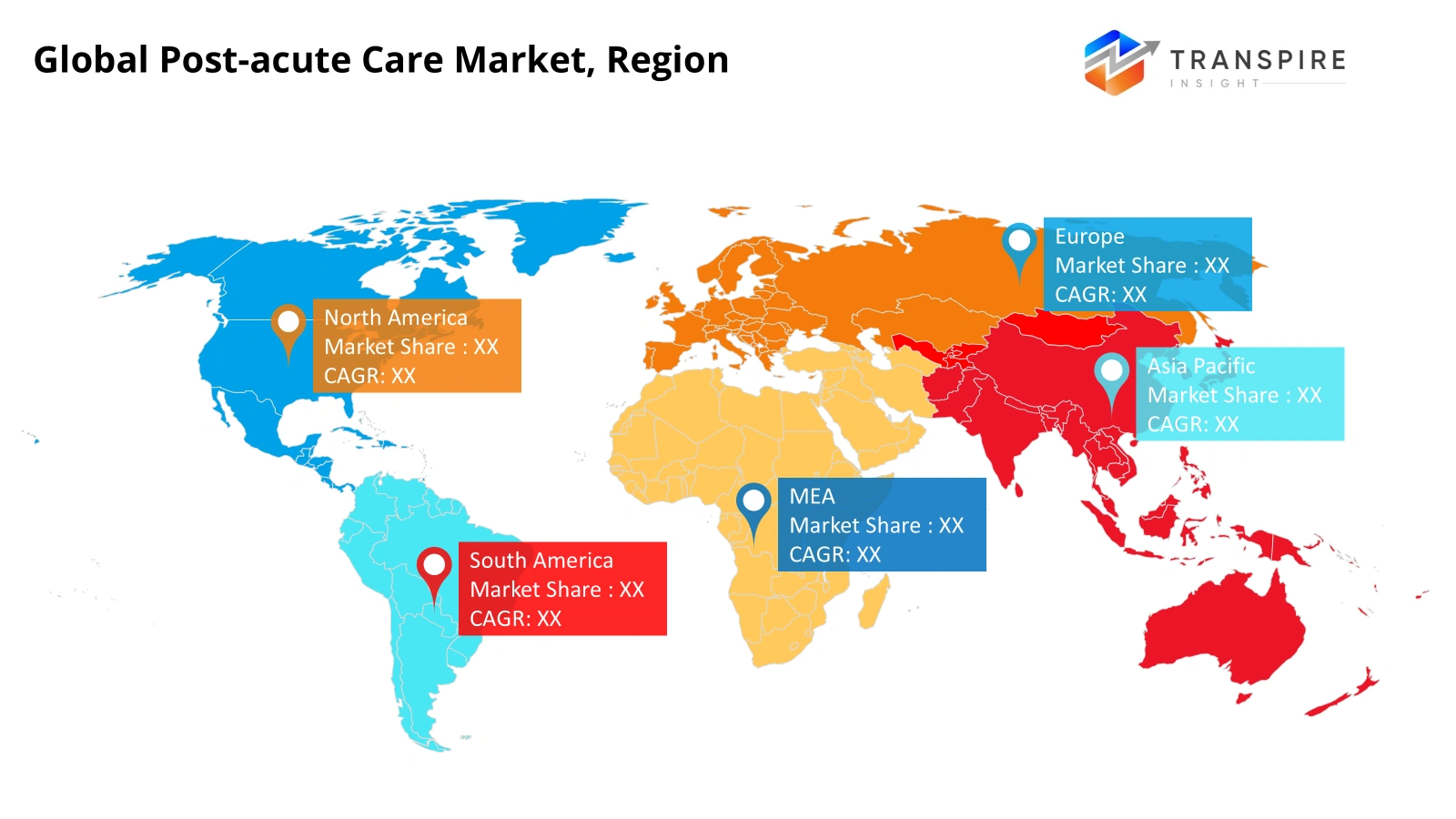
The Global Post-acute Care Market is the largest in the United States by a considerable margin, given the size of the Medicare program, the structure of the US healthcare delivery system, and the historical development of a distinct post-acute sector as a separate industry from acute hospitals. The US accounts for the dominant share of global post-acute care spending and is the primary driver of the revenue figures in this report.
Within the US, state-level Medicaid policies matter considerably. States set their own Medicaid skilled nursing reimbursement rates within federal guidelines, and the variation is significant. Facilities in states with lower Medicaid rates face harder economics when their patient mix skews toward long-stay Medicaid residents. States have also moved at different speeds toward managed Medicaid, which introduces another layer of authorization and rate variability for skilled nursing and home health operators.
Outside the US, post-acute care as a distinct sector operates differently. In Canada and the UK, post-acute recovery is managed largely within publicly funded health systems, with long-term residential care funded through provincial and local authority budgets, respectively. Germany and Japan have developed structured long-term care insurance systems that fund a mix of institutional and home-based services for older adults. These markets are included in global market sizing but differ structurally from the US, affecting operator economics and competitive dynamics.
Asia-Pacific represents an early-stage but growing opportunity. Japan already has a well-developed long-term care insurance framework and a large aging population. China, South Korea, and Australia are investing in aged care infrastructure as demographic trends build demand. The specific regulatory and funding structures vary considerably across these markets.
To learn more about this report, Download Free Sample Report
Recent Development News
Several large post-acute operators in the US have been investing in technology platforms that allow for remote patient monitoring after discharge, an effort to reduce hospital readmissions and extend clinical oversight beyond the walls of the facility. These programs are partly driven by value-based care contracts that penalize unnecessary readmissions.
Home health agencies have continued to push for broader use of telehealth visits as a supplement to in-person skilled nursing and therapy visits under Medicare, a flexibility first introduced during the pandemic that operators argue should be made permanent. CMS has expanded some of these flexibilities on a rolling basis but has not yet made permanent regulatory changes across the board.
Report Metrics
|
Report Metrics |
Details |
|
Market size value in 2025 |
USD 863.8 Billion |
|
Market size value in 2026 |
USD 919.9 Billion |
|
Revenue forecast in 2033 |
USD 1,448.3 Billion |
|
Growth rate |
CAGR of 6.70% from 2026 to 2033 |
|
Base year |
2025 |
|
Historical data |
2021 - 2024 |
|
Forecast period |
2026 - 2033 |
|
Report coverage |
Revenue forecast, competitive landscape, growth factors, and trends |
|
Country scope |
Global |
|
Key company profiled |
Genesis HealthCare Inc., Encompass Health Corporation, Brookdale Senior Living Inc., Kindred Healthcare LLC, LHC Group Inc., Amedisys Inc., Extendicare Inc., Select Medical Holdings Corporation, Sunrise Senior Living LLC, Brookfield Asset Management Healthcare Services, Trinity Health, HCA Healthcare Inc., Fresenius Medical Care AG & Co. KGaA, Brookdale Healthcare Services, Covenant Care. |
|
Customization scope |
Free report customization (country, regional & segment scope). Avail customized purchase options to meet your exact research needs. |
|
Report Segmentation |
By Service Type (Skilled Nursing Facilities, Inpatient Rehabilitation Facilities, Home Health Agencies, Long-Term Care Hospitals), By Age Group (Adult, Geriatric), By Payer (Public Insurance, Private Insurance, Out-of-Pocket). |
Key Post-acute Care Company Insights
The Global Post-acute Care Market includes large multi-setting operators, single-setting specialists, and regional chains that concentrate in particular geographies or care models. The biggest operators manage thousands of facilities and tens of thousands of licensed beds across skilled nursing, home health, and rehabilitation settings. Scale matters for contracting leverage with managed care payers, for corporate overhead efficiency, and for recruitment in a market where labor is the single largest cost line.
Smaller regional operators often compete effectively against national chains by maintaining stronger relationships with local hospital discharge teams and responding more quickly to quality issues that affect referral patterns. The referral relationship with hospital discharge planners and case managers is the main commercial lever in this market. Operators with better quality ratings, fewer readmissions, and faster response to referrals tend to fill beds more consistently than those competing on price or marketing alone.
Company List
- Genesis HealthCare Inc.
- Encompass Health Corporation
- Brookdale Senior Living Inc.
- Kindred Healthcare LLC
- LHC Group Inc.
- Amedisys Inc.
- Extendicare Inc.
- Select Medical Holdings Corporation
- Sunrise Senior Living LLC
- Brookfield Asset Management Healthcare Services
- Trinity Health
- HCA Healthcare Inc.
- Fresenius Medical Care AG & Co. KGaA
- Brookdale Healthcare Services
- Covenant Care
Global Post-acute Care Market Report Segmentation
By Service Type
- Skilled Nursing Facilities
- Inpatient Rehabilitation Facilities
- Home Health Agencies
- Long-Term Care Hospitals
By Age Group
- Adult
- Geriatric
By Payer
- Public Insurance
- Private Insurance
- Out-of-Pocket
Frequently Asked Questions
Find quick answers to common questions.
The Global Post-acute Care Market is expected to reach approximately USD 1,448.3 billion by 2033.
Key segments include Service Type (Skilled Nursing Facilities, Inpatient Rehabilitation Facilities, Home Health Agencies, Long-Term Care Hospitals), Age Group (Adult, Geriatric), and Payer (Public Insurance, Private Insurance, Out-of-Pocket).
Major players include Genesis HealthCare Inc., Encompass Health Corporation, Brookdale Senior Living Inc., Kindred Healthcare LLC, LHC Group Inc., Amedisys Inc., Extendicare Inc., Select Medical Holdings Corporation, Sunrise Senior Living LLC, Brookfield Asset Management Healthcare Services, Trinity Health, HCA Healthcare Inc., Fresenius Medical Care AG & Co. KGaA, Brookdale Healthcare Services, and Covenant Care.
The Global Post-acute Care Market size is approximately USD 863.8 billion in 2025.
The Global Post-acute Care Market is expected to grow at a CAGR of 6.70% from 2026 to 2033.
- Genesis HealthCare Inc.
- Encompass Health Corporation
- Brookdale Senior Living Inc.
- Kindred Healthcare LLC
- LHC Group Inc.
- Amedisys Inc.
- Extendicare Inc.
- Select Medical Holdings Corporation
- Sunrise Senior Living LLC
- Brookfield Asset Management Healthcare Services
- Trinity Health
- HCA Healthcare Inc.
- Fresenius Medical Care AG & Co. KGaA
- Brookdale Healthcare Services
- Covenant Care
Recently Published Reports
-
Apr 2026
AI in Diabetic Retinopathy Market
AI in Diabetic Retinopathy Market Size, Share & Analysis Report By Type (Screening AI Systems, Diagnostic AI Systems, and Predictive AI Models), By Application Segment (Hospitals, Ophthalmology Clinics, Diagnostic Centers, and Research and Development), and Geography (North America, Europe, Asia-Pacific, Middle East and Africa, South and Central America), 2021 - 2031
-
Apr 2026
Psychometric Tests Market
Psychometric Tests Market Size, Share & Analysis Report By Type (Personality Tests, Ability/Aptitude Tests, Skill/Knowledge Tests, and Others), By Application (Talent Acquisition and Talent Management), and Geography (North America, Europe, Asia-Pacific, Middle East and Africa, South and Central America), 2021 – 2031
-
Apr 2026
Rare Biological Sample Collection Market
Rare Biological Sample Collection Market Size, Share & Analysis Report By Type (Isolation Kits & Reagent, Blood Collection Tubes, and Others), By Application (Oncology, Transcriptomics, Pharmacogenomics, and Others), and Geography (North America, Europe, Asia-Pacific, Middle East and Africa, South and Central America), 2021 – 2031
-
Apr 2026
Patient Lift Pendant Market
Patient Lift Pendant Market By Product Type (Wired Pendants, Wireless, Programmable), By Operation Type(Manual, Electric), By End-Users (Healthcare Professionals, Patients), By Application (Hospitals, Homecare, Rehabilitation Centers, Others), By Industry Analysis, Size, Share, Growth, Trends, and Forecasts 2021-2033
Our Clients
.jpg)