
Global Plate and Frame Heat Exchanger Market Size & Forecast:
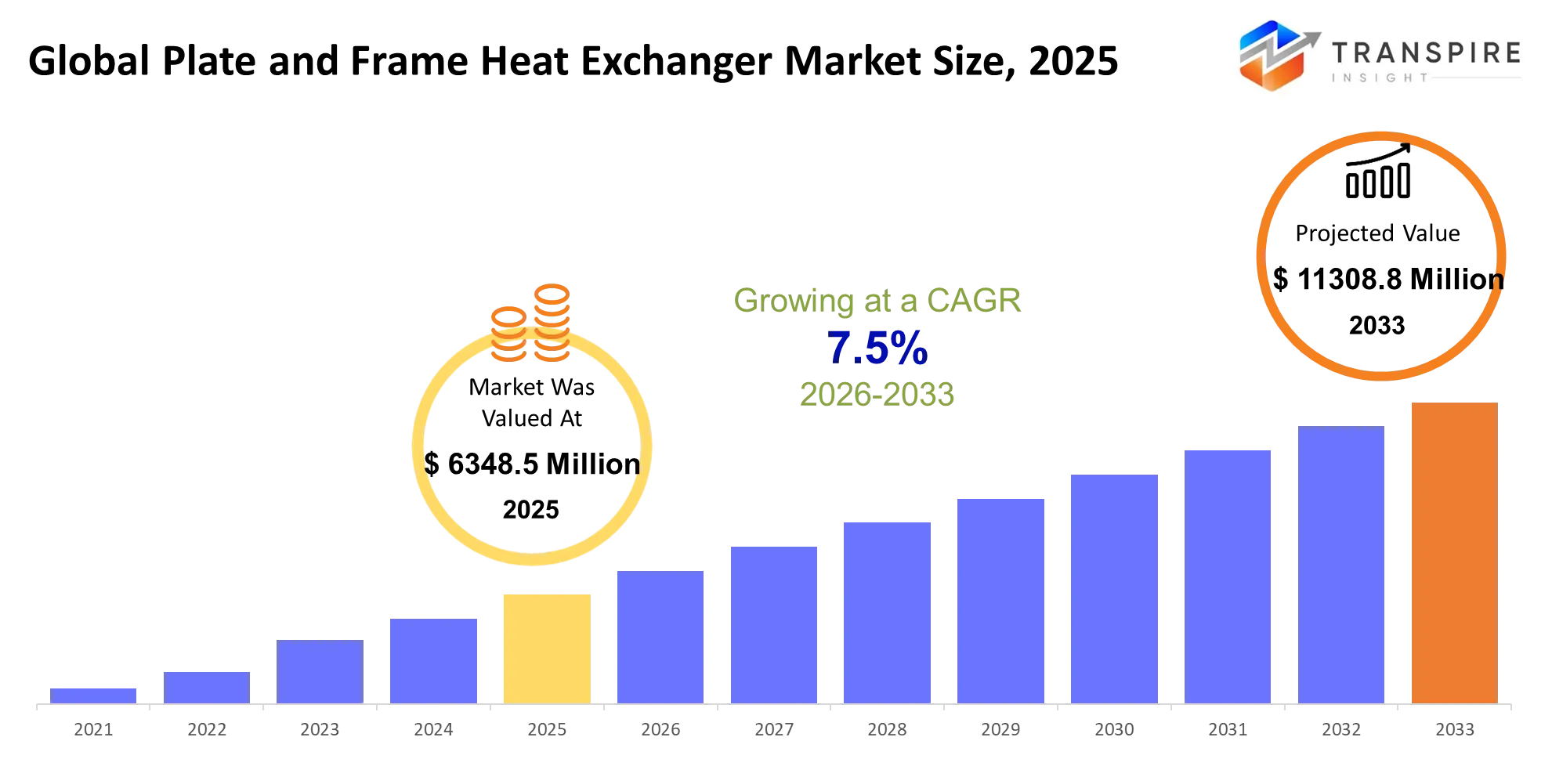
- Global Plate and Frame Heat Exchanger Market Size 2025: USD 6348.5 Million
- Global Plate and Frame Heat Exchanger Market Size 2033: USD 11308.8 Million
- Global Plate and Frame Heat Exchanger Market CAGR: 7.5%
- Global Plate and Frame Heat Exchanger Market Segments: By Type (Gasketed Heat Exchangers, Brazed Heat Exchangers, Welded Heat Exchangers, Semi-welded Heat Exchangers, Compact Heat Exchangers, Others); By Application (Chemical Processing, HVAC Systems, Food & Beverage, Power Generation, Oil & Gas, Others); By End-User (Industrial Facilities, Commercial Buildings, Utilities, Others); By Material (Stainless Steel, Titanium, Nickel Alloys, Others)
Global Plate and Frame Heat Exchanger Market Summary:
As per Transpire Insight Analysis, the global plate and frame heat exchanger market size is estimated at USD 6348.5 Million in 2025 and is anticipated to reach USD 11308.8 Million by 2033, growing at a CAGR of 7.5% from 2026 to 2033. These specialized industrial units regulate thermal energy by channeling hot and cold fluids through a series of compressed, corrugated metal plates, providing critical heating and cooling for manufacturing plants.
Over the last few years, the market has undergone a major structural shift driven by intensive global industrial decarbonization policies and a surge in energy-recovery mandates. This shift was triggered by the rapid deployment of massive, power-dense AI data centers and high-temperature industrial heat pumps - which require ultra-precise liquid-to-liquid cooling systems to handle extreme thermal loads. Consequently, demand is growing rapidly because facilities must systematically replace traditional shell-and-tube hardware with highly compact, gasketed, and brazed plate configurations to maximize energy efficiency and drastically reduce their carbon footprints.
Key Market Insights:
The global plate and frame heat exchanger market - undergoing a complete modernization, evolving from traditional fluid-handling hardware into high-efficiency, space-saving thermal systems optimized for low-carbon footprints. As heavy industries face escalating pressures to cut carbon emissions, standard heating and cooling pipelines are being updated with advanced corrugated geometry to optimize thermal transfer efficiency.
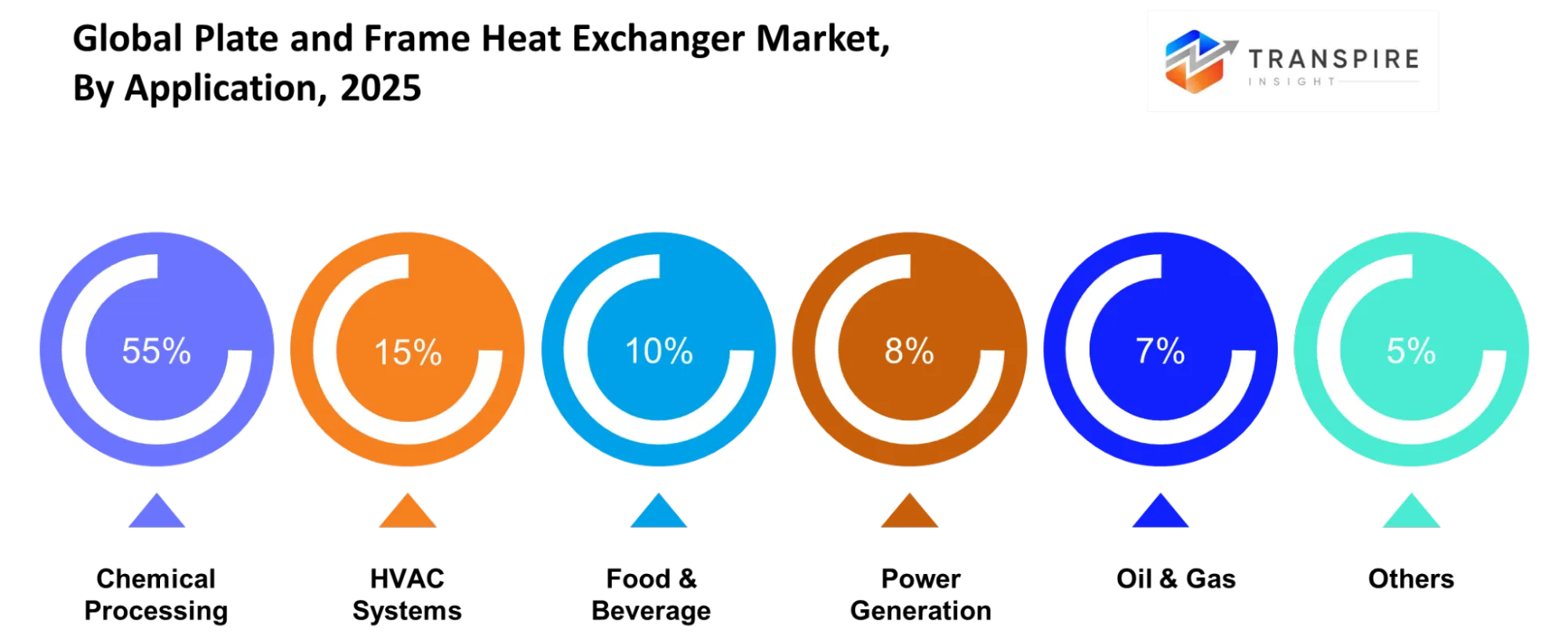
- Accounting for an authoritative 55% share, the chemical processing sector anchors global volume as production facilities upgrade to specialized nickel and titanium alloy configurations to manage high-pressure, highly corrosive chemical synthesis safely.
- The Asia Pacific region stands as the clear marketplace anchor with a 39% market share, heavily propelled by massive greenfield industrial infrastructure rollouts and sweeping factory modernization programs across India and China.
- Expanding at a market-leading 12.8% CAGR, compact heat exchangers dominate the growth path as data centers and urban commercial spaces prioritize ultra-dense, small-footprint cooling units over heavy legacy equipment.
- The Middle East represents the fastest-growing geographical corridor, climbing at a high 11.9% CAGR as regional investments pivot toward massive desert-based hydrogen production, solar collector farms, and water desalination facilities.
- Capturing 15% of total revenue, HVAC systems are adopting advanced brazed plate technology to optimize building climate controls, utilizing Danfoss’s specialized compact exchangers to integrate seamlessly with sustainable urban district heating loops.
- The food and beverage sector locks down a 10% market slice, strictly driving demand for gasketed stainless steel assemblies that allow easy disassembly for daily multi-stage sanitation routines.
- Holding an 8% market share, power generation networks are aggressively integrating Alfa Laval's latest semi-welded cassette technologies to capture and reuse waste heat in massive utility-scale industrial heat pump systems.
- The oil and gas sector claims 7% of global sales, relying on robust, fully welded architectures like Kelvion’s refined K°Bloc arrays to withstand extreme pressure spikes and thermal shocks in harsh offshore processing environments.
What are the Key Drivers, Restraints, and Opportunities in the Global Plate and Frame Heat Exchanger Market?
Driver
The global marketplace is expanding rapidly due to an intensive corporate transition toward high-capacity energy recovery systems. Traditional cooling networks are simply too energy-inefficient to meet strict modern emissions targets. This shift was triggered by the sudden, massive deployment of power-dense AI data centers and large-scale industrial heat pumps, which require ultra-precise fluid-to-fluid thermal balancing to manage heavy continuous heat loads. This operational urgency drives massive system adoption as manufacturing plants completely replace legacy shell-and-tube setups with highly corrugated plate designs to protect their bottom lines. In May 2026, thermodynamic specialist Alfa Laval officially launched its TS45 semi-welded plate heat exchanger, specifically engineered to deliver high-capacity heat transfer for large-scale industrial heat pumps and carbon capture facilities. This product rollout enables global heavy industries to scale up thermal performance within a highly compact installation footprint, effectively replacing inefficient legacy pipelines with high-pressure energy recovery loops.
Restraint
Prohibitive upfront material costs and high mechanical maintenance vulnerabilities persistently limit profit margins for smaller processing operations. High-efficiency heat exchangers require specialized, expensive titanium or nickel alloy plates to safely withstand aggressive chemical fluids and extreme pressure spikes. This structural bottleneck forces operators into frequent, labor-intensive cleaning schedules to prevent catastrophic particulate fouling and gasket degradation, creating substantial operational overhead that locks budget-constrained facilities out of premium thermal hardware upgrades.
Opportunity
The most lucrative growth window lies in embedding specialized hygienic modular frames directly into clean-room food, beverage, and pharmaceutical processing lines. Fusing flexible, flippable plate structures with FDA-compliant materials allows manufacturing plants to rapidly customize their pasteurization and cooling setups on the fly. This technological shift opens highly profitable procurement streams from automated regional bottling facilities and dairy co-packers seeking to drastically shorten batch turnaround times - bypass tedious tear-down maintenance routines, and maintain absolute structural sanitation.
What Has the Impact of Artificial Intelligence Been on the Global Plate and Frame Heat Exchanger Market?
Artificial intelligence is fundamentally reshaping how industrial facilities manage and optimize large-scale thermal processing networks. Instead of relying on rigid, manual inspection schedules—which frequently miss gradual system performance declines—engineering and maintenance teams now utilize machine learning algorithms to maximize continuous thermal output. AI significantly improves operational efficiency through advanced predictive analytics and intelligent automation. High-frequency IoT sensors continuously capture minor variations in fluid temperature and pressure drop across the corrugated plates - feeding this data directly into AI-driven software nodes. These specialized neural networks analyze historical operational baselines to automatically flag micro-fouling, calculate localized scaling patterns, and accurately predict the exact time a unit will require a tear-down maintenance clean before a costly breakdown occurs.
However, a major limitation remains the multi-platform integration gap. Industrial manufacturing environments are frequently filled with fragmented, legacy supervisory control systems that simply cannot cleanly process or share raw sensor streams with modern AI models without extensive, highly customized hardware retrofits.
In January 2026 - thermal engineering leader Kelvion officially launched its K°Focus Carbon Capture & Storage (CCS) online platform. This digital deployment is specifically engineered to guide industrial operators in selecting, monitoring, and optimizing specialized thermal configurations for high-pressure carbon capture and industrial cooling loops, allowing facilities to maximize thermodynamic efficiency while curbing structural energy waste.
Key Market Trends:
Instead of treating heat exchange equipment as isolated fluid-handling hardware, industrial facilities are embedding smart, cloud-connected monitoring systems straight into their plate assemblies. This operational shift successfully eliminates unexpected processing failures—replacing rigid, manual maintenance intervals with dynamically optimized, automated energy-recovery networks.
- Heavy processing facilities are combining traditional gasketed frames for daily cleaning accessibility with specialized, semi-welded cassettes to handle aggressive media safely.
- The widespread industry embrace of laser-welded plate designs has largely resolved the headache of gasket degradation, allowing chemical plants to run corrosive fluids under elevated pressure limits.
- Boutique engineering firms are replacing massive localized shell-and-tube setups with highly corrugated, compact plate frames to squeeze into restricted modular skid layouts.
- Instead of burning through excess fuel to maintain processing temperatures, utility networks lean on multi-stage regenerative pasteurizers that recycle up to 95% of active thermal energy on the fly.
- Traditional fluorinated gas systems are rapidly losing ground to eco-friendly natural refrigerants like propane and ammonia, pushing HVAC manufacturers to adopt highly pressure-resilient brazed plate frames.
- Data center operators are dropping flat, legacy air-cooling systems to run liquid-to-liquid plate heat exchangers directly on localized server racks—creating compact, high-density thermal management loops.
- Rather than funding massive, high-maintenance water cooling towers, remote desert industrial installations rely on forced-ambient hybrid air-cooled condensers to stabilize localized processing temperatures.
- The tedious task of manual torque-wrench frame tightening has shifted toward automated digital hydraulic closure units, securing uniform plate compression across massive industrial arrays almost instantly.
Global Plate and Frame Heat Exchanger Market Segmentation
By Type
Gasketed heat exchangers hold the commanding revenue share, functioning as the foundational operational pillar for the global market. Meanwhile, compact heat exchangers and brazed configurations are emerging as the most disruptive and rapidly expanding technology types, with compact systems surging at a market-leading 12.8% CAGR. The distinct expansion logic behind this structure is anchored directly to legacy industrial capacity—large-scale chemical and processing plants rely on the easy disassembly and manual cleaning accessibility of gasketed frames to maintain baseline production. However, the explosive growth in compact and brazed variants is fueled by the aggressive engineering demand for ultra-dense, small-footprint thermal management units that fit inside restricted modular skids or dense server racks. Moving forward, the boundary between these designs will blur as operators demand hybrid systems. Manufacturers will be forced to engineer compact, high-efficiency corrugated plate packs with highly resilient, specialized sealing technology, enabling facilities to handle extreme thermal densities without risking catastrophic fluid cross-contamination.
By Application
Chemical processing represents the undisputed heavyweight application pocket, locking down an authoritative 55% share of all global revenue. HVAC systems follow at 15%, while food & beverage secures 10%, power generation claims 8%, and oil & gas accounts for 7%. This heavy financial concentration remains ironclad because global chemical manufacturers rely entirely on high-throughput, fluid-to-fluid thermal balancing to safely sustain exothermic reactions and polymer synthesis. However, the true technological accelerator is the HVAC system segment, which is expanding rapidly as cities deploy massive sustainable urban district heating loops and high-temperature industrial heat pumps. Looking ahead, component manufacturers must execute a dual-product fulfillment pipeline. They must engineer highly specialized, corrosion-resistant titanium and nickel alloy plate lines for heavy chemical processing, while simultaneously mass-distributing highly optimized, standardized copper-brazed plate units engineered for the explosive expansion of eco-friendly commercial building climate controls.
By End-User
Industrial facilities act as the foundational financial anchors of day-to-day market procurement because their core manufacturing operations rely continuously on heavy thermal regulation. Concurrently, utilities and commercial buildings are escalating their purchasing volumes as critical high-growth consumers. This market distribution is shifting rapidly as commercial buildings and municipal utilities aggressively replace high-maintenance, legacy shell-and-tube setups with highly efficient plate frames to meet rigid corporate carbon-neutrality mandates. Moving forward, equipment providers will find it impossible to capture long-term market share by merely selling standard, unmonitored metal hardware. Sustainable commercial success will require providing fully bundled, smart thermal solutions—wrapping the physical plate and frame assembly together with automated IoT micro-sensor arrays, predictive AI-driven fouling analysis software, and comprehensive digital lifecycle maintenance agreements.
By Material
Stainless steel holds the dominant volume share, serving as the universal default material across standard commercial, food, and light industrial fluid pipelines due to its excellent balance of thermal conductivity and baseline corrosion resistance. Meanwhile, titanium and advanced nickel alloys represent the high-margin, technologically critical growth segments. This structural material distribution is strictly governed by fluid chemistry and operational severity; regular HVAC loops and sanitary food pasteurization lines utilize grade 304 or 316 stainless steel to ensure absolute hygiene and cost-effective thermal transfer. Conversely, the transition toward aggressive chemical synthesis, offshore oil production, and high-temperature industrial energy recovery requires premium titanium or nickel plates to resist severe pitting, stress corrosion cracking, and structural degradation from brackish or highly acidic media. Looking ahead, metal sourcing and specialized metallurgy will dictate competitive positioning, forcing manufacturers to secure reliable raw material pipelines while innovating thinner, highly corrugated plate geometries that minimize premium material weight without sacrificing structural pressure limits.
What are the Key Use Cases Driving the Global Plate and Frame Heat Exchanger Market?
Chemical plants rely heavily on these units to manage punishing, high-temperature exothermic synthesis and aggressive fluid mixing. Operators route highly corrosive materials through specialized titanium plate packs to lock down rapid, precise thermal balancing—all without risking catastrophic structural metal failures.
Beyond chemical processing, deployment is expanding across municipal district heating loops and automated food lines. Urban utility networks drop these plate arrays into commercial HVAC frameworks to regulate localized climate controls, while sanitary dairy facilities use them for rapid flash pasteurization under strict daily cleaning routines.
The newest engineering front centers on small-footprint, high-density environments. Hyper-scale operators now pack ultra-compact liquid-to-liquid plate networks straight into server racks to isolate and dump the extreme heat generated by AI data centers.
|
Report Metrics |
Details |
|
Market size value in 2025 |
USD 6348.5 Million |
|
Market size value in 2026 |
USD 6818.1 Million |
|
Revenue forecast in 2033 |
USD 11308.8 Million |
|
Growth rate |
CAGR of 7.5% from 2026 to 2033 |
|
Base year |
2025 |
|
Historical data |
2021 - 2024 |
|
Forecast period |
2026 - 2033 |
|
Report coverage |
Revenue forecast, competitive landscape, growth factors, and trends |
|
Regional scope |
United States; Canada; Mexico; United Kingdom; Germany; France; Italy; Spain; Denmark; Sweden; Norway; China; Japan; India; Australia; South Korea; Thailand; Brazil; Argentina; South Africa; Saudi Arabia; United Arab Emirates |
|
Key company profiled |
Alfa Laval, Danfoss, Kelvion, SWEP, API Heat Transfer, SPX Flow, Xylem, Hisaka Works, Tranter, Funke Wärmeaustauscher, Barriquand, HRS Heat Exchangers, Sondex, GEA Group, Armstrong International |
|
Customization scope |
Free report customization (country, regional & segment scope). Avail customized purchase options to meet your exact research needs. |
|
Report Segmentation |
By Type (Gasketed Heat Exchangers, Brazed Heat Exchangers, Welded Heat Exchangers, Semi-welded Heat Exchangers, Compact Heat Exchangers, Others); By Application (Chemical Processing, HVAC Systems, Food & Beverage, Power Generation, Oil & Gas, Others); By End-User (Industrial Facilities, Commercial Buildings, Utilities, Others); By Material (Stainless Steel, Titanium, Nickel Alloys, Others) |
Which Regions are Driving the Global Plate and Frame Heat Exchanger Market Growth?
The Asia Pacific region maintains a commanding grip on the global plate and frame heat exchanger market, capturing a dominant 39% of all worldwide industry revenue. This geographic hegemony is heavily driven by a massive concentration of premier chemical processing complexes and manufacturing hubs operating across India and China. The regional ecosystem is structurally supported by unparalleled greenfield infrastructure rollouts and sweeping national factory modernization programs. Consequently, integrating high-efficiency plate frames has become an absolute operational mandate for Asia Pacific heavy industries seeking to replace legacy shell-and-tube setups and maximize fluid processing capacities.
In January 2026 - Japanese thermal engineering specialist Hisaka Works heavily streamlined its localized engineering support networks and advanced plate customization pipelines throughout its primary manufacturing clusters in China, Singapore, and Malaysia. This targeted structural rollout explicitly delivers ultra-precise, high-pressure gasketed and welded plate heat exchangers to massive regional petrochemical plants, allowing facilities to maximize thermodynamic throughput while cutting local energy waste under intensifying regulatory audits.
Europe serves as a highly stable, predictable secondary pillar for the global market, locking down an essential 28% share of total industry demand. While the Asia Pacific market concentrates heavily on heavy chemical volume, European system adoption is driven entirely by its massive urban district heating networks and commercial HVAC loops. This regional market stability is structurally insulated by rigid environmental mandates and strict carbon-reduction policies that force facility operators to integrate advanced waste-heat recovery systems. To maintain strict compliance and hit decarbonization targets, European firms steadily contract for compact heat exchangers equipped with high-efficiency corrugated plate geometry.
In May 2026 - climate pioneer Danfoss Climate Solutions signed a major distribution agreement with SD Heat Exchangers B.V. to deploy its expansive thermal portfolio across the Benelux market. This strategic European alliance explicitly targets high-growth sustainable infrastructure segments, supplying advanced gasketed plate heat exchangers tailored for regional district energy loops, deep geothermal installations, and hyper-scale data center thermal arrays.
The Middle East has emerged as the fastest-growing territory globally, accelerating at a market-leading 11.9% CAGR while spearheading infrastructure expansion within the Rest of the World bracket. This sudden structural shift is driven by explosive capital investments in massive, desert-based hydrogen production, solar collector fields, and major seawater desalination networks. Historically, regional thermal management relied almost completely on traditional oil-refining hardware, but the territory has now rapidly pivoted toward high-pressure, eco-friendly renewable energy utility networks. Looking ahead, future procurement in this booming corridor relies entirely on deploying fully welded, rugged plate frames capable of handling severe pressure spikes in harsh offshore and desert processing locations.
In May 2026 - Alfa Laval Middle East Ltd. significantly scaled up its regional footprint, supporting large-scale brownfield optimization and emissions reduction programs alongside national energy networks like ADNOC in the United Arab Emirates. This structural engineering deployment heavily drives the localized integration of advanced energy recovery plate frameworks to maximize processing efficiency and safely minimize greenhouse gas emissions across desert petrochemical infrastructures.

Who are the Key Players in the Global Plate and Frame Heat Exchanger Market and how do they Compete?
The global plate and frame heat exchanger market exhibits a highly competitive - technology-driven landscape, dominated by specialized thermodynamic engineering conglomerates. Rather than competing purely on price, global manufacturers clash across mechanical fluid innovation, specialized metallurgy, and localized structural optimization. The intense pressure on global processing facilities to eliminate carbon emissions and minimize fuel usage has shifted the competitive focus toward maximizing heat-recovery coefficients and ensuring zero fluid cross-contamination under elevated operating pressures.
Alfa Laval commands a market-leading position by deploying a comprehensive innovation-centric strategy, emphasizing next-generation plate geometry and structural serviceability. The company differentiates its portfolio by engineering specialized fluid distribution architectures like its unique CurveFlow plate patterns, which optimize internal fluid velocities and drastically reduce particulate fouling. To capture high-growth market share, its expansion approach focuses on standardizing semi-welded cassette technologies tailored explicitly for large-scale industrial heat pump deployment and hydrogen infrastructure rollouts across both Europe and the Asia Pacific.
Kelvion competes through a highly targeted, niche-focused engineering strategy, positioning itself as a primary specialist for heavy-duty, high-severity processing environments. The firm differentiates its brand by manufacturing robust, fully welded architectures—such as its refined K°Bloc arrays—engineered to survive extreme temperature shocks and volatile chemical pressures where traditional gaskets fail. Kelvion’s expansion framework heavily leverages digital integration, rolling out advanced data-centric analytics platforms to capture premium procurement contracts across high-density AI data center cooling loops and automated carbon capture installations.
Company List
- Alfa Laval
- Danfoss
- Kelvion
- SWEP
- API Heat Transfer
- SPX Flow
- Xylem
- Hisaka Works
- Tranter
- Funke Wärmeaustauscher
- Barriquand
- HRS Heat Exchangers
- Sondex
- GEA Group
- Armstrong International
Recent Development News
In August 2025, global alternative asset manager Apollo Funds agreed to acquire a majority stake in thermal management leader Kelvion from Triton. This massive corporate acquisition directly infuses Kelvion with fresh investment capital to rapidly scale its production capacity and capture surging global infrastructure demands across AI cloud networks, carbon capture, and green industrial heat pump markets. [https://www.apollo.com]
In January 2026, brazed plate specialist SWEP officially launched its All-Stainless B4TS frameless heat exchanger model engineered specifically for high-pressure $R744$ ($CO_2$) environments. This targeted product launch enables electronics and semiconductor manufacturers to implement eco-friendly, corrosion-resistant liquid-to-liquid cooling loops utilizing ultra-pure deionized water as a primary coolant. [https://refindustry.com]
In May 2026, manufacturing conglomerate Dover Corporation announced a $30 million global capital investment to heavily expand SWEP's production capacity through 2027. This major infrastructure expansion doubles the manufacturing volume for large-sized brazed plate configurations across its global plants, directly addressing the aggressive structural demand spikes stemming from hyper-scale AI data centers and commercial climate transition networks. [https://www.investing.com]
What Strategic Insights Define the Future of the Global Plate and Frame Heat Exchanger Market?
The market is locking onto an infrastructure-critical path dictated by data center scaling and clean-energy transitions, breaking away from passive industrial component cycles. Future competitive advantage will be won or lost based on how tightly manufacturers integrate into hyper-scale cooling footprints, transforming standard fluid channels into active drivers of facility Power Usage Effectiveness (PUE) metrics.
A persistent hidden risk lies in the structural vulnerability to premium metal spot prices; unexpected supply crunches or regulatory export blocks on raw titanium and specialized nickel alloys can instantly compress manufacturer margins and disrupt delivery timelines. Meanwhile, an exceptional high-margin opportunity is opening up through direct co-engineering partnerships with tech enterprise hyperscalers to deliver heavy-duty, customized brazed plate configurations optimized for high-capacity Coolant Distribution Units (CDUs).
To defend their global footprints, major suppliers must systematically pivot from selling unmonitored metal assemblies toward deploying smart, sensor-embedded thermal nodes tied directly to automated, predictive facility dashboards.
Global Plate and Frame Heat Exchanger Market Segmentation
By Type
- Gasketed Heat Exchangers
- Brazed Heat Exchangers
- Welded Heat Exchangers
- Semi-welded Heat Exchangers
- Compact Heat Exchangers
- Others
By Application
- Chemical Processing
- HVAC Systems
- Food & Beverage
- Power Generation
- Oil & Gas
- Others
By End-User
- Industrial Facilities
- Commercial Buildings
- Utilities
- Others
By Material
- Stainless Steel
- Titanium
- Nickel Alloys
- Others
Regional Outlook
North America
- United States
- Canada
- Mexico
Europe
- Germany
- United Kingdom
- France
- Spain
- Italy
- Rest of Europe
Asia Pacific
- Japan
- China
- Australia & New Zealand
- South Korea
- India
- Rest of Asia Pacific
South America
- Brazil
- Argentina
- Rest of South America
Middle East & Africa
- Saudi Arabia
- United Arab Emirates
- South Africa
- Rest of the Middle East & Africa
Frequently Asked Questions
Find quick answers to common questions.
The global plate and frame heat exchanger market size was valued at USD 6348.5 Million in 2025 and is poised to reach USD 11308.8 Million by 2033, expanding at a 7.5% CAGR from 2026 to 2033.
Key segments for the global plate and frame heat exchanger are Type (Gasketed Heat Exchangers, Brazed Heat Exchangers, Welded Heat Exchangers, Semi-welded Heat Exchangers, Compact Heat Exchangers, Others), Application (Chemical Processing, HVAC Systems, Food & Beverage, Power Generation, Oil & Gas, Others), End-User (Industrial Facilities, Commercial Buildings, Utilities, Others), and Material (Stainless Steel, Titanium, Nickel Alloys, Others).
Growth is primarily driven by an intensive corporate transition toward high-capacity energy recovery systems, alongside the massive, sudden deployment of power-dense AI data centers and large-scale industrial heat pumps requiring ultra-precise fluid-to-fluid thermal balancing.
The global market is led by major manufacturers including Alfa Laval, Danfoss, Kelvion, SWEP, API Heat Transfer, SPX Flow, Xylem, Hisaka Works, Tranter, Funke Wärmeaustauscher, Barriquand, HRS Heat Exchangers, Sondex, GEA Group, and Armstrong International.
Asia Pacific holds a dominant 39% share of global revenue, serving as the market's main anchor due to a massive concentration of premier chemical processing complexes and sweeping national factory modernization programs across India and China.
Profitable opportunities lie in embedding specialized hygienic modular frames directly into clean-room food, beverage, and pharmaceutical processing lines, as well as establishing co-engineering partnerships with tech hyperscalers to deliver heavy-duty, customized brazed plate configurations for multi-megawatt coolant distribution units (CDUs).
- Alfa Laval
- Danfoss
- Kelvion
- SWEP
- API Heat Transfer
- SPX Flow
- Xylem
- Hisaka Works
- Tranter
- Funke Wärmeaustauscher
- Barriquand
- HRS Heat Exchangers
- Sondex
- GEA Group
- Armstrong International
About the Authors

Avinash Kumar
I’m Avinash Kumar, a Senior Research Analyst at Transpire Insight, with expertise in the Electronics and Semiconductor and Energy & Power industry. My work focuses on analyzing emerging technologies, market trends, industry developments, and innovation across these sectors. I specialize in transforming complex technical and market insights into clear, research-backed content that helps professionals, businesses, and decision-makers stay informed. Through continuous industry research and data-driven analysis, I strive to deliver accurate, reliable, and practical perspectives on the latest advancements shaping the semiconductor and energy landscape.

Chakradhar Khansole
Chakradhar serves as the Research Director at Transpire Insight, bringing over 8 years of experience in technology, innovation, and strategic market intelligence. He specializes in transforming complex market data into actionable business insights that enable organizations to make informed, growth-oriented decisions. Recognized for his strategic vision and analytical expertise, Chakradhar leads high-impact research initiatives, delivering comprehensive market assessments, competitive intelligence, and forward-looking industry analysis.
Recently Published Reports
-
Apr 2026
Active Power Filter Market
Active Power Filter Market Size, Share & Analysis Report By Type (Shunt Active Power Filters, Series Active Power Filter, Hybrid Active Power Filter), By Application (Harmonics Mitigation, Reactive Power Compensation, Voltage Regulation, Power Factor Correction), By Phase (Single Phase, Three Phase), By End-User Industry (Manufacturing, Healthcare, Commercial, Automotive, Oil and Gas, Others), and Geography (North America, Europe, Asia-Pacific, Middle East and Africa, South and Central America), 2021 - 2031
-
Apr 2026
Electrical Transformer Market
Electrical Transformer Market Size, Share & Analysis Report By Core (Closed, Shell, and Berry), By Insulation (Gas, Oil, Solid, Air, and Other), By Phase (Single, and Three), By Rating (100 MVA to 500 MVA, 501 MVA to 800 MVA, and 801 MVA to 1200 MVA), and Geography (North America, Europe, Asia-Pacific, Middle East and Africa, South and Central America), 2021 – 2031
-
Apr 2026
Hydraulic Piston Pumps Market
Hydraulic Piston Pumps Market Size, Share & Analysis Report By Type (Axial Piston Pumps, Radial Piston Pumps), By Operating Pressure (Low Pressure, Medium Pressure, High Pressure), By Application (Construction, Mining, Agriculture, Automotive, Oil & Gas, Industrial Machinery, Others), By End-User (OEMs, Aftermarket), and Geography (North America, Europe, Asia-Pacific, Middle East and Africa, South and Central America), 2021 – 2031
-
Apr 2026
Laboratory Gas Generators Market
Laboratory Gas Generators Market Size, Share & Analysis Report By Product (Nitrogen Gas Generator, Hydrogen Gas Generator, Zero Air Gas Generator, Purge Gas Generator, TOC Gas Generators, Others), By Application (Gas Chromatography, Liquid Chromatography-mass Spectrometry (LC-MS), Gas Analyzers, Others), By End-user (Life Science, Chemical & Petrochemical, Food & Beverage, Others), and Geography (North America, Europe, Asia-Pacific, Middle East and Africa, South and Central America), 2021 – 2031