

Global Molded Underfill Material Market Summary:
According to Transpire Insights, a detailed research report on the market reflects that the flip-chip packaging application segment dominates the Global Molded Underfill Material Market, accounting for approximately 58% of the total share worldwide. Namics Corporation leads the market with approximately (around USD 1.1 billion) in annual revenue and an estimated 19–23% global market share, making it the leading contributor to global market development, innovation, advanced molded underfill materials, semiconductor packaging technologies, expanding high-density electronic packaging capabilities, and overall market growth dynamics.
Market Snapshot
- Global Market Value (2025): USD 9.18 Billion.
- Expected Market Value (2026): USD 9.74 Billion.
- Estimated Market Value (2033): USD 14.74 Billion.
- Forecast CAGR (2026–2033): 6.10%.
- Leading Region in 2025: Asia Pacific
- Second-largest Region: North America
- Fastest Growing Region: Europe
Introduction
The discovery, production, and commercial supply of specialized epoxy-based materials for use in semiconductor packaging are the main focuses of the global molded underfill (MUF) materials market. In order for the resin to protect both the top of the chip and the gap beneath it, molded underfill technology integrates underfilling and encapsulation into a single transfer or compression molding phase. This shortens the time and expense of manufacturing while increasing the mechanical strength, thermal dependability, and moisture resistance of semiconductor packages. MUF materials are widely used in advanced packaging applications that require dependable and effective chip protection for long-term performance and endurance, such as flip-chip devices, AI processors, high-performance computing, smart phones, automotive electronics, and electric vehicles.
- For Instance:- Assembly and Packaging Expansion: The demand for sophisticated packaging materials is rising as semiconductor manufacturers diversify their supply chains and increase OSAT (Outsourced Semiconductor Assembly and Test) capacity in areas like Asia-Pacific, North America, and Europe. The use of molded underfill materials for high-performance and compact electronic devices is anticipated to be supported by investments made in new packaging facilities by businesses like Micron Technology, Renesas, and other top semiconductor companies.

Key Market Highlights: -
- Asia Pacific is expected to grow at a rapid CAGR in the Global Molded Underfill Material Market by holding approximately 48% of the share during the forecast period.
- North America is the fastest-growing region in the Global Molded Underfill Material Market during the period, holding approximately 21% share.
- Europeis anticipated to hold approximately 24% share of the Global Molded Underfill Material Market over the predicted timeframe.
- By Product Type, the capillary underfill materials segment dominated the market and holds approximately 65% share in 2025 and is projected to grow at a substantial CAGR during the forecast period.
- By Material Type, the acrylic resin segment dominated the market and holds approximately 38% share in 2025 and is projected to grow at a substantial CAGR during the forecast period.
- By Application, the consumer electronics segment dominated the market and holds approximately 40% share in 2025 and is projected to grow at a substantial CAGR during the forecast period.
- Advanced Packaging Investments: The demand for molded underfill materials used in AI, automotive, and high-performance electronic devices is anticipated to be driven by government and industry organizations' investments in advanced semiconductor packaging and supply chains throughout the US, Europe, and Asia-Pacific.
How is Technology Driving Growth in the Global Molded Underfill Material Market?
The global market for molded underfill material is growing thanks in large part to technology. Reliable underfill materials are becoming more and more necessary due to advancements in semiconductor packing, such as ultra-fine-pitch flip-chip designs, single-step injection and compression molding, and high-density integration. The increased thermal conductivity, reduced warpage, strong adhesion, and quick flow characteristics of today's molded underfill formulations allow manufacturers to create smaller devices with better performance and efficiency. These materials are essential to the production of next-generation semiconductors because they enable the performance and reliability needs of AI processors, 5G infrastructure, automotive electronics, high performance computing, and sophisticated consumer gadgets.
Market Drivers
Market Driver: The growing need for sophisticated semiconductor packaging in industries including 5G infrastructure, artificial intelligence, high-performance computing, data centers, automotive electronics, and consumer goods is driving the global molded underfill material market. Packaging methods must provide exceptional mechanical strength, thermal stability, and moisture resistance as semiconductor manufacturers create smaller and more potent chips. Molded underfill materials safeguard delicate interconnections during operation, lessen warpage, and increase solder joint dependability. Underfill solutions that are effective, void-free, and quick to cure are required due to the rise of high density packaging technologies including flip-chip, 2.5D, and 3D integration. Therefore, molded underfill is a crucial component in the production of semiconductors today.
- For Instance: The UK, is encouraging investment in advanced packaging, photonics, and AI-related infrastructure after acknowledging semiconductor development as a strategic priority. These programs are expected to improve domestic semiconductor capabilities and generate growth prospects in the high-performance packaging materials sector, including molded underfill solutions, in conjunction with industry collaboration and commercialization activities.
- South Korea’s, With large investments in advanced packaging and AI infrastructure, South Korea's thriving semiconductor industry is seeing substantial potential for high-performance packaging materials including molded underfill solutions used in next-generation chip fabrication.
Restrain
High production and raw material costs, strict environmental compliance standards, and intricate thermal management in sophisticated semiconductor packages are additional obstacles facing the global market for molded underfill materials. Additionally, price and production variations might affect chemical supply networks. The low rework ability of cured molded underfill is another significant limitation. Hardened resin is hard to remove without harming sensitive electronic components, which raises repair costs and reduces manufacturing flexibility.
Analysis of Prices and Consumer Behaviour
Due to their growing use in advanced semiconductor packaging, flip-chip applications are leading the industry with around 54.8% of overall demand. Asia Pacific accounts for over 56% of the global market revenue, supported by strong semiconductor manufacturing and packaging investments. About 70% of demand is generated by semiconductor packaging and high-performance computing applications. While manufacturers continue investing in local supply chains and advanced molded underfill technologies worldwide, customer preferences are steadily shifting toward high-reliability, low-warpage, fast-curing, and cost-effective materials that support AI, 5G, automotive, and next-generation electronic devices.
Top Companies in the Global Molded Underfill Material Market
- Henkel
- NAMICS Corporation
- Shin-Etsu Chemical
- Panasonic Industry
- Master Bond
- H.B. Fuller
- Indium Corporation
- Sumitomo Bakelite
- Resonac Holdings
- DuPont
- BASF
- Dow
- Resonac Materials
- AI Technology
- Epoxy Technology
Market Segmentation
The Global Molded Underfill Material Market share is divided into five categories: Product Type, Material Type, Application, End User, and Packaging Technology
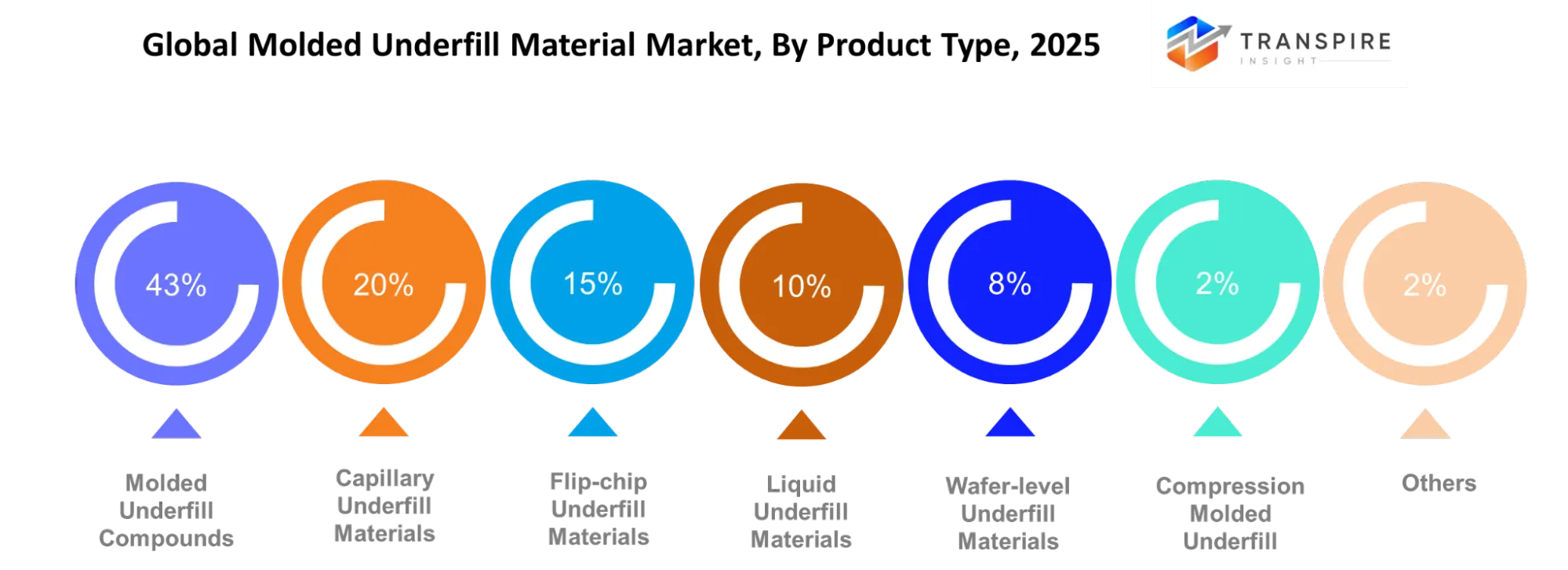
Thecapillary underfill materials dominated the market, accounting for approximately 65%in 2025, and is expected to rise at a significant CAGR during the forecast period.
The Global Molded Underfill Material Marketis segmented by product type into capillary underfill materials, molded underfill compounds, compression molded underfill, liquid underfill materials, epoxy underfill materials, wafer-level underfill materials, flip-chip underfill materials, others. Among these, the capillary underfill materials dominated the market, accounting for approximately 65% in 2025 and expected to increase at a significant CAGR during the forecast period. Capillary underfills are the preferred method because they are very dependable, reasonably priced, and perfect for using capillary action to fill the tiny spaces in sophisticated, high-density semiconductor packaging like flip-chips.
The acrylic resin segmentheld the greatest share of approximately 38% in 2025 and is expected to increase at a substantial CAGR over the forecast period.
The Global Molded Underfill Material Marketis segmented by material type into epoxy resin, silicone resin, polyimide resin, acrylic resin, hybrid polymer, Nano-filled resin, thermosetting resin, others. Among these, the acrylic resin segment held the greatest share of approximately 38% in 2025 and is expected to increase at a substantial CAGR over the forecast period. Leader in the market for molded underfill made of epoxy that have superior adhesion, thermal stability, and dependability. The market is still being driven by the growing need for sophisticated semiconductor packaging for high-performance computing, automotive, 5G, and artificial intelligence applications.
The consumer electronics segmentheld the greatest share of approximately 40%in 2025 and is expected to increase at a high CAGR over the forecast period.
The Global Molded Underfill Material Marketis segmented by application into flip-chip packaging, fan-out packaging, system-in-package, wafer-level packaging, 2.5d/3d ic packaging, automotive electronics, consumer electronics, others. Among these, the consumer electronics segment held the greatest share of approximately 40% in 2025 and is expected to increase at a considerable CAGR over the projected period. Fast smart device adoption, ongoing product innovation, rising disposable incomes, and the global rollout of 5G connection are driving consumer electronics.
Regional Segment Analysis of the Global Molded Underfill Material Market
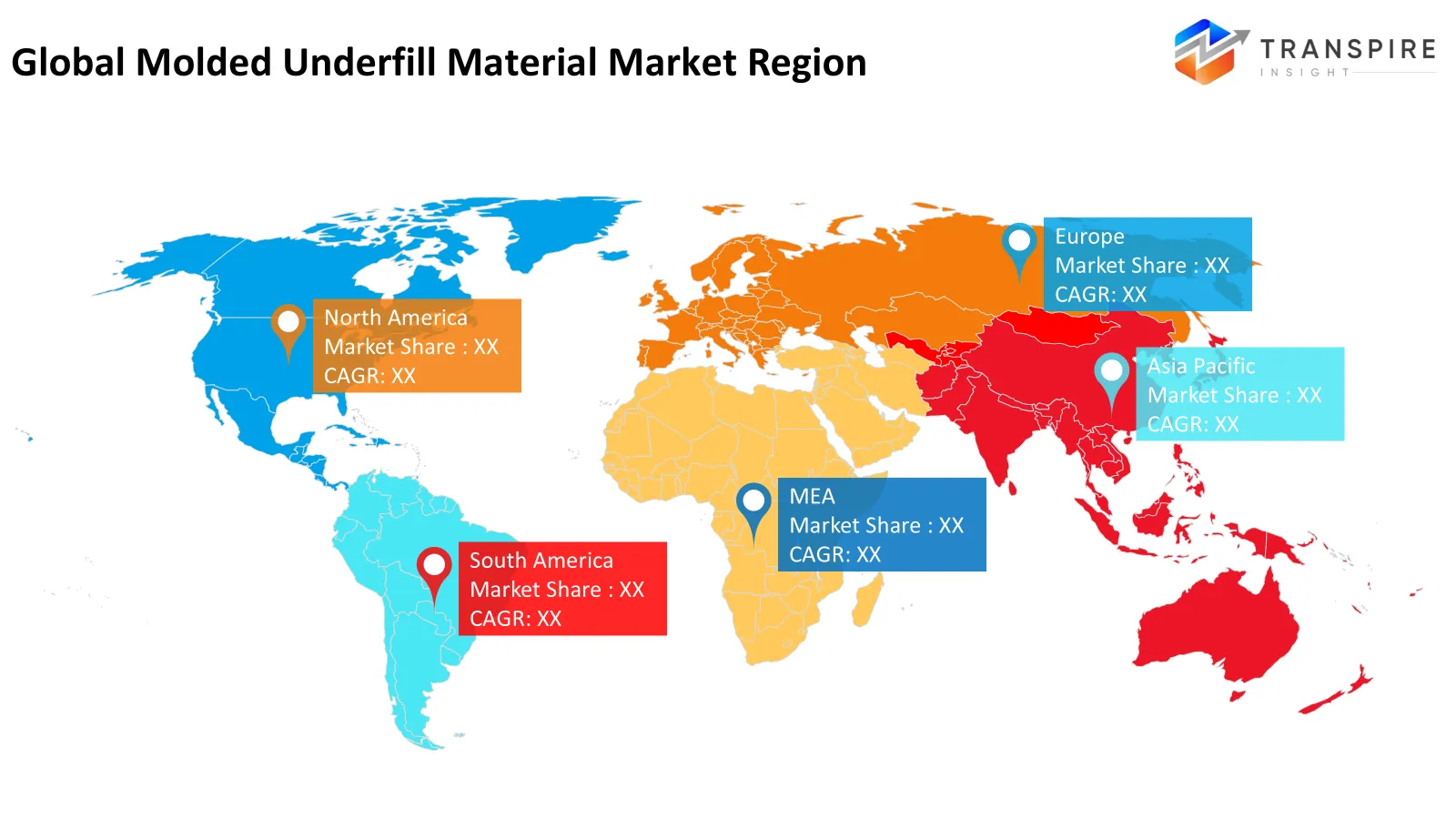
- North America (U.S., Canada, Mexico)
- Europe (Germany, France, U.K., Italy, Spain, Rest of Europe)
- Asia-Pacific (China, Japan, India, Rest of APAC)
- South America (Brazil and the Rest of South America)
- The Middle East and Africa (UAE, South Africa, Rest of MEA)
Asia Pacificis expected to grow at a rapid CAGR in the Global Molded Underfill Material Market by holding approximately 55% of the share during the forecast period.
The Asia Pacific region is a significant contributor to the global market for molded underfill material due to its well-established semiconductor manufacturing ecosystem and rapidly expanding advanced packaging industry. Taiwan, South Korea, China, and Japan are home to the majority of the major chip manufacturers, foundries, and OSATs. The demand for dependable packaging materials, such as molded underfill solutions, in a range of next-generation semiconductor applications is being driven by significant expenditures in AI, 5G, automotive electronics, and high-performance computing, among other areas.
North America is the fastest-growing region in the Global Molded Underfill Material Market during the period, holding approximately 21% share.
Due to rising expenditures in data centers, sophisticated packaging, semiconductor production, and AI infrastructure, North America is seeing the fastest growth in the global market for molded underfill materials. The use of high-performance packaging materials is being driven by the government's policies to boost domestic chip manufacture, the existence of top technological businesses, and strong R&D skills. Reliable molded underfill systems are in high demand for next-generation semiconductor applications due to these features.
Europe is anticipated to hold approximately 24% share of the Global Molded Underfill Material Market over the predicted timeframe.
Because of the strong automotive, industrial, and telecommunications sectors in the region, Europe is anticipated to represent a significant portion of the global market for molded underfill material. Growing investments in semiconductor manufacturing, sophisticated packaging, and research initiatives are driving the market's expansion. Furthermore, the use of high-reliability packaging materials such molded underfill solutions in a variety of electronic applications is being fueled by government initiatives to improve regional semiconductor capabilities and supply-chain resilience.
Strategies for Market Growth in Non-Leading Regions:
By constructing scalable and affordable semiconductor packaging material manufacturing facilities and bolstering regional supply chains for epoxy resins, fillers, and other essential inputs, non-leading regions can spur growth. This will strengthen local manufacturing, packaging, and technical capabilities while lowering dependency on imports. Commercialization and market penetration will be accelerated by strategic partnerships with semiconductor producers, OSAT suppliers, electronics firms, and academic organizations. To increase product performance and manufacturing efficiency, capital investments in workforce training, research and development, and cutting-edge packaging technologies like flip-chip, 2.5D, and 3D integration would be essential. Additionally, localization efforts, government incentives, semiconductor development programs, and digital procurement and distribution channels can enhance accessibility, draw investments, and support the long-term growth of the global market for molded underfill material in emerging economies worldwide.
Future Market Trends for the Global Molded Underfill Material Market: -
- Advanced Packaging and AI Hardware: The need for low-stress, high-reliability molded underfill materials is rising due to rising investments in AI accelerators, high-performance computing, and high-bandwidth memory (HBM).
- Automotive and EV Electronics: Demand for molded underfill solutions that can endure heat cycling and enhance solder joint durability is being driven by the growing usage of semiconductors in electric vehicles and sophisticated driver-assistance systems.
- Next-Generation formulas: For intricate, high-density semiconductor packages, manufacturers are creating sophisticated epoxy formulas with better thermal conductivity, reduced warpage, quicker curing, and increased dependability.
- Automation in Packaging Processes: By increasing production efficiency, yield rates, and process flexibility, advancements in dispensing, molding, and packaging equipment are facilitating the wider use of molded underfill technologies.
Recent Development
- January 2026 – Henkel R&D Expansion: Henkel strengthened its Asia-Pacific electronics packaging operations by establishing a next-generation innovation hub at Singapore Science Park and continued advancing glass-compatible Underfill solutions for chiplet, 3D-IC, and silicon photonics applications.
Market Segment
This study forecasts revenue at global, regional, and country levels from 2020 to 2033. Transpire Insights has segmented the Global Molded Underfill Material Market based on the below-mentioned segments:
Global Molded Underfill Material Market, By Product
- Capillary Underfill Materials
- Molded Underfill Compounds
- Compression Molded Underfill
- Liquid Underfill Materials
- Epoxy Underfill Materials
- Wafer-level Underfill Materials
- Flip-chip Underfill Materials
- Others.
Global Molded Underfill Material Market, By Material Type
- Epoxy Resin
- Silicone Resin
- Polyimide Resin
- Acrylic Resin
- Hybrid Polymer
- Nano-filled Resin
- Thermosetting Resin
- Others.
Global Molded Underfill Material Market, By Application
- Flip-chip Packaging
- Fan-out Packaging
- System-in-Package
- Wafer-level Packaging
- 2.5D/3D IC Packaging
- Automotive Electronics
- Consumer Electronics
- Others.
Global Molded Underfill Material Market, By End User
- Semiconductor Manufacturers
- OSAT Companies
- Consumer Electronics Manufacturers
- Automotive OEMs
- Telecom Equipment Manufacturers
- Industrial Electronics Companies
- Research Institutes
- Others.
Global Molded Underfill Material Market, By Production Process
- FCBGA
- FC-CSP
- WLCSP
- BGA
- QFN
- Advanced Packaging
- Heterogeneous Integration
- Others.
Global Molded Underfill Material Market, By Regional Analysis
North America
- United States
- Canada
- Mexico
Europe
- Germany
- United Kingdom
- France
- Italy
- Spain
- Russia
- Rest of Europe
Asia Pacific
- China
- Japan
- India
- South Korea
- Australia
- Rest of Asia Pacific
South America
- Brazil
- Argentina
- Rest of South America
Middle East & Africa
- Saudi Arabia
- United Arab Emirates
- Qatar
- South Africa
- Rest of the Middle East & Africa
Frequently Asked Questions
Find quick answers to common questions.
Growth is driven by advanced semiconductor packaging, AI, 5G, high-performance computing, automotive electronics, and increasing chip miniaturization.
Flip-chip packaging dominates the market, accounting for approximately 54.8% of global demand due to high-density semiconductor adoption.
Asia Pacific leads because of its strong semiconductor manufacturing base, major OSAT capacity, and investments in AI and electronics.
High material costs, complex thermal management, environmental compliance, supply chain volatility, and limited rework ability restrict market growth.
Future trends include AI hardware, HBM packaging, EV electronics, advanced epoxy formulations, and greater automation in packaging processes.
- Henkel
- NAMICS Corporation
- Shin-Etsu Chemical
- Panasonic Industry
- Master Bond
- H.B. Fuller
- Indium Corporation
- Sumitomo Bakelite
- Resonac Holdings
- DuPont
- BASF
- Dow
- Resonac Materials
- AI Technology
- Epoxy Technology
About the Authors

Kartik bhong
I am Kartik Bhong, a Senior Research Analyst at Transpire Insight, specializing in the Packaging, Manufacturing, and Construction industry. My work focuses on analyzing market trends, emerging technologies, industry regulations, and competitive landscapes to deliver accurate, data-driven insights. I am passionate about transforming complex industry information into clear, practical content that helps businesses, professionals, and decision-makers stay informed and make confident strategic decisions. Through continuous research and a strong commitment to accuracy, I strive to create reliable, well-researched content that reflects the latest developments across these dynamic industries and supports the vision of Transpire Insight in delivering valuable market intelligence.

Chakradhar Khansole
Chakradhar serves as the Research Director at Transpire Insight, bringing over 8 years of experience in technology, innovation, and strategic market intelligence. He specializes in transforming complex market data into actionable business insights that enable organizations to make informed, growth-oriented decisions. Recognized for his strategic vision and analytical expertise, Chakradhar leads high-impact research initiatives, delivering comprehensive market assessments, competitive intelligence, and forward-looking industry analysis.
Recently Published Reports
-
Apr 2026
Pharmaceutical Cold Chain Packaging Market
Pharmaceutical Cold Chain Packaging Market By Material (Plastic,(Polyethylene (PE), Polypropylene (PP), Polyethylene Terephthalate (PET), Expanded Polystyrene (EPS), Polyurethane (PU),Others), Paper, Metal, Others), By Product (Small Boxes, Pallets, Large Sized Pallet Containers, Others), By End Use (Biopharmaceutical Companies, Clinical Research Organizations, Hospitals, Research Institutes, Logistics and Distribution Companies, Others)”, By Industry Analysis, Size, Share, Growth, Trends, and Forecasts 2026-2033
-
Apr 2026
Active & Intelligent Packaging Market
Active & Intelligent Packaging Market By Type (Active Packaging, Smart Packaging), By Material (Polymer-Based, Paper & Board-Based, Metal-Based, Glass-Based), By Technology (Time-Temperature Indicators, Freshness Indicators, RFID, Antimicrobial Packaging, Modified Atmosphere Packaging), By Application (Food & Beverages, Pharmaceutical, Cosmetics & Personal Care, Electronics & Consumer Goods, Others), By Industry Analysis, Size, Share, Growth, Trends, and Forecasts 2026-2033
-
Apr 2026
Biodegradable Cut Flower Packaging Market
Biodegradable Cut Flower Packaging Market By Material Type (Paper & Paperboard, Biodegradable Plastics, Natural Fibers, Molded Pulp, Others), By Product Type (Sleeves, Wraps, Boxes & Cartons, Bags & Pouches, Inserts & Holders), By Application (Roses, Carnations, Tulips, Chrysanthemums, Mixed Flowers, Others) and By Distribution Channel (Direct Sales, Distributors & Wholesalers, Online Channels), By Industry Analysis, Size, Share, Growth, Trends, and Forecasts 2026-2033
-
May 2026
Pharmaceutical Packaging Market
Pharmaceutical Packaging Market By Material Type (Plastic, Glass, Metal, Paper & Paperboard, Others), By Packaging Type (Bottles, Blister Packs, Vials, Ampoules, Pouches & Sachets, Others) and By End User (Hospitals & Clinics, Retail Pharmacies, Online Pharmacies, Pharmaceutical Manufacturers), By Industry Analysis, Size, Share, Growth, Trends, and Forecasts 2026-2033