

Global Location-Based Entertainment Market Size & Forecast:
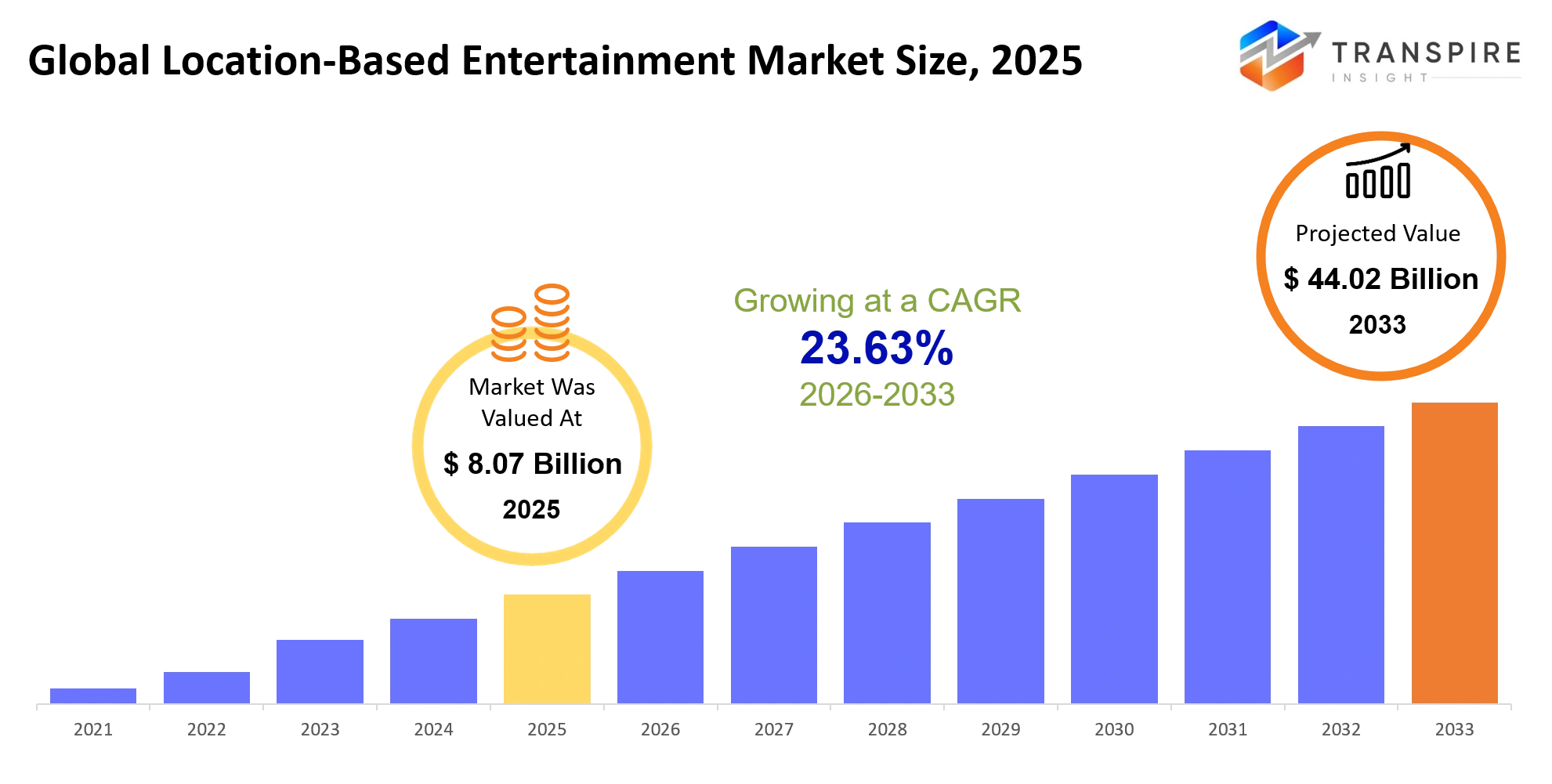
- Global Location-Based Entertainment Market Size 2025: USD 8.07 Billion
- Global Location-Based Entertainment Market Size 2033: USD 44.02 Billion
- Global Location-Based Entertainment Market CAGR: 23.63%
- Global Location-Based Entertainment Market Segments: By Type (Virtual Reality Parks, Augmented Reality Experiences, Arcade Gaming Centers, Escape Rooms, Projection Mapping Attractions, Interactive Museums, Simulation Rides, Others); By Technology (VR, AR, MR, Projection Mapping, Holography, Motion Tracking, AI-based Experiences, Others); By Application (Gaming, Education, Tourism, Sports, Cultural Experiences, Retail Entertainment, Corporate Events, Others); By End User (Families, Children, Teenagers, Adults, Tourists, Corporates, Educational Institutions, Others); By Venue (Indoor Parks, Theme Parks, Malls, Museums, Standalone Centers, Entertainment Zones, Event Venues, Others).
Global Location-Based Entertainment Market Summary:
As per Transpire Insight Analysis, the Global Location-Based Entertainment Market size is estimated at USD 8.07 Billion in 2025 and is anticipated to reach USD 44.02 Billion by 2033, growing at a CAGR of 23.63%from 2026 to 2033.
The location-based entertainment market is changing a lot. People want to have fun in exciting ways that mix technology with real life. Entertainment places are not just offering rides and shows anymore. They are adding reality, augmented reality and interactive stories to make experiences more immersive.
Over the past few years, more money has been invested in these kinds of entertainment venues. This is because technology has improved and people want types of fun. One big change is that more and more places are using virtual reality and augmented reality. These tools help create experiences that make people want to come back. Tourism is back; more people are going to shops, and families are looking for activities to do together. All of this has made people want to visit attractions that're like destinations. People now want to have experiences rather than just watching a movie or playing a game. Because of this, venue owners are adding tech to their attractions. They want to make visitors have a good time, make money often and be better than their competitors in the entertainment industry.
Key Market Insights:
The market is being characterised by immersive technologies, experiential spending, and constant innovation in entertainment formats. Entertainment centres are making investments in digital attraction systems to increase customer engagement and deliver unique experiences.
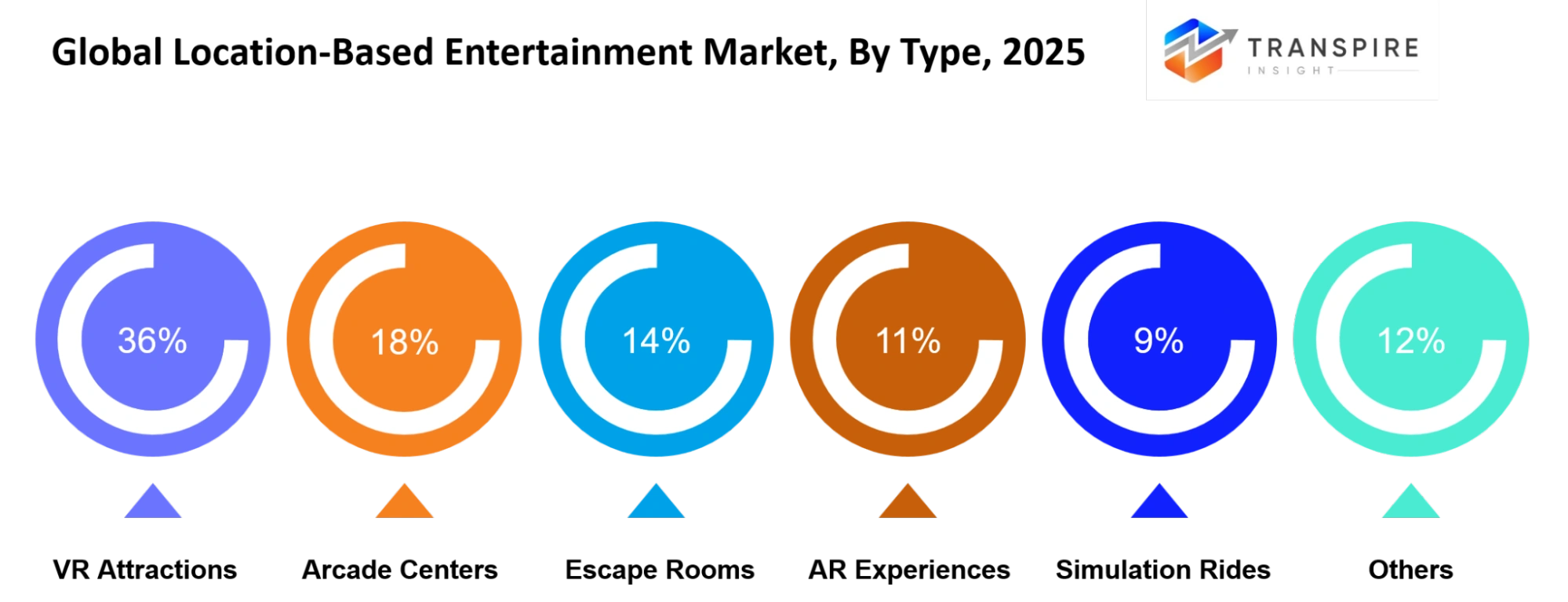
- VR Attractions constitute about 36% of the market share. VR attractions are the leading category due to the high level of consumer demand for immersive games and interactions.
- Arcade Centres make up almost 18% of industry revenue and continuously develop through the use of modern gaming technologies and multiplayer attractions.
- Escape Rooms make up for approximately 14% of the market share and benefit from the growing popularity of teamwork and storytelling entertainment.
- AR Experiences represent around 11% of the market share and are still the most rapidly growing segment, with the expected CAGR of 18.4%.
- Simulation Rides constitute about 9% of the market, with the help of motion and sensory technology improvements.
- Leading entertainment operators use AI-based visitor analytics for attraction optimisation and customer engagement.
- Entertainment providers have implemented mobile booking, electronic ticketing, and contactless payments systems in their facilities.
- Mixed-reality attractions are on the rise as customers desire to experience an environment combining the real and virtual world.
What are the Key Drivers, Restraints, and Opportunities in the Global Location-Based Entertainment Market?
Drivers
The increasing preference of customers for entertainment experiences that cannot be delivered by using digital devices in homes. Virtual reality, augmented reality, and other developments in the field allowed the design of attractions that can ensure high levels of immersion and repeat visits. Development of entertainment centres, malls, and tourism destinations increased the need for such types of attraction and contributed to revenue growth.
Restraints
The high costs associated with the installation and maintenance of advanced facilities are the main restraints for market growth. Moreover, fast developments in technology reduce the lifespan of the equipment and force companies to invest in it again and again.
Opportunities
One of the major market growth opportunities is related to the popularity of augmented reality attractions in entertainment facilities. They are cheaper and easier to install compared to the full-fledged VR attractions, which allows for expanding the number of attractions. Rising incomes in developing countries such as those in Asia-Pacific, the Middle East, and Latin America are also increasing the demand for entertainment services and can become an opportunity for investment. Partnership between technology providers and operators of venues is expected to open new possibilities in the future.
What Has the Impact of Artificial Intelligence Been on the Global Location-Based Entertainment Market?
AI is proving to be a valuable tool in making facilities more efficient and providing a better experience for visitors in the location-based entertainment sector. Entertainment venues are using AI analytics to assess visitor behaviour, determine preferences for attractions, and optimise facility operations. This allows the operators to enhance crowd management, reduce waiting times, and ultimately boost customer satisfaction.
Recommendation systems that use AI are making the visits more personalised as the operators are able to suggest attractions and activities according to the preferences and past behaviour of visitors. Predictive analytics can help operators predict visitor numbers, plan resource allocation, and manage staffing requirements during busy hours. In the case of immersive attractions, AI is incorporated into the design of virtual characters and interactive environments to provide a more realistic experience.
AI facilitates preventive maintenance by determining any potential failure ahead of time, hence reducing downtime. But the implementation process may prove to be difficult for certain operators as it involves considerable expenditure to incorporate AI into their system, collect and manage data, and integrate it with other existing technology. Yet, the adoption of AI continues to increase as operators are trying to gain operational efficiency, personalisation, and increased profits. In March 2026, The Walt Disney Company featured the application of artificial intelligence and machine learning technologies for providing highly personalized and interactive guest experience at its theme parks and entertainment venues. AI-powered technologies are currently being applied for analyzing visitor behavior, managing attractions, and creating immersive stories, indicating the increasing importance of AI in the location-based entertainment industry.
Key Market Trends
The industry is moving towards a trend where the traditional formats of amusement have made way for more innovative and technology-driven methods of entertainment. Increasingly, consumer demands focus on personalisation, interaction, and social entertainment, thereby encouraging operators to invest in state-of-the-art attractions.
- The use of virtual reality attractions has changed from being an alternative form of gaming to becoming part of the mainstream entertainment industry within malls, family entertainment centres, and theme parks.
- There has been a significant uptake in augmented reality attractions as operators look for more scalable solutions that need less infrastructure compared to large-scale VR installations.
- Entertainment centres are increasingly turning to mobile apps to handle activities such as ticketing, bookings, loyalty schemes, and personalised engagement.
- Operators are turning to mixed-reality technology where physical and virtual worlds interact.
- Data analysis and artificial intelligence are becoming essential elements in attracting visitors in terms of management of attractions.
- The consumer demand for social entertainment games and experiences has increased, driving the success of gaming and other attractions.
- LBE providers are collaborating with established media brands and properties to create entertainment attractions.
- The shopping mall environment is changing through the inclusion of entertainment attractions which encourage visitation.
Global Location-Based Entertainment Market Segmentation
By Type
VR Attractions lead the global Location-Based Entertainment market with 36% share because of growing consumer preference for immersive experiences with a high engagement factor. Arcade Centres hold almost 18% of the market and keep their significance in the modernised form. Escape Rooms constitute nearly 14% of market share due to growing demand for entertaining activities involving collaboration and storytelling. AR Experiences comprise about 11% of industry revenues and are expected to grow faster than any other segment in terms of CAGR, estimated at 18.4%. Simulation Rides make up close to 9% of revenues. Other attractions hold 12% share. In the future, operators will be adding various forms of immersive experiences into one venue.
By Technology
Virtual reality still leads as the most popular technology owing to the high level of immersion provided to entertainment venues by virtual reality. On the other hand, augmented reality is developing fast in the entertainment industry as providers search for flexible and scalable implementations. The popularity of mixed reality solutions is growing as well since this type of technology provides for mixing of digital content with actual surrounding areas and helps to engage the visitors better. Attraction developers tend to include projection mapping, holography, motion tracking and AI-based experiences to increase the level of interactivity.
By Application
gaming application sphere dominates owing to the development of interactive entertainment. Educational applications are growing in demand as museums and learning centres use immersive content to boost the knowledge acquisition process and increase engagement of the visitors. Attraction venues that have a tourism-related nature experience development as a result of the growth of experiential travel. Sports and cultural experience attractions become more interactive in order to increase visitors' participation, and retail entertainment attracts an increasing number of visitors owing to the integration of immersive attractions into shopping centres. Another popular application sphere includes corporate events.
By end users
From the end-user perspective, family members form a major part of market demand since they love to participate in group recreational activities. Kids and youths continue to be major consumers of immersion experiences such as games and interactive attractions. Adults are increasingly engaging in high-end VR experiences that have been developed for social engagement and recreational purposes. Tourists continue to contribute more to the demand of entertainment attractions that act as destinations themselves. Educational institutions and corporate establishments are also becoming prominent end users of such technology-based services.
By venue
According to the Venue Classification, indoor parks form a considerable share of the market thanks to their capability to provide a year-round operation and different kinds of entertainment. Theme parks keep putting emphasis on the development of engaging attractions. Shopping centres are becoming one of the key venues in terms of attracting a lot of visitors by offering them some entertaining activities. Museums are becoming more and more technologically equipped to offer new experiences to visitors and attract a wider audience. Entertainment centres, separate zones for entertainment, and event venues also show growth rates, owing to the introduction of flexible and technologically-equipped attractions. In the future, there will be an increasing need for multi-attraction venues combining entertainment, education, and communication.
What are the Key Use Cases Driving the Global Location-Based Entertainment Market?
The key use case of the global location-based entertainment market is immersive gaming, specifically via VR attractions. Customers are demanding more interactive content involving digital content as well as participation, making entertainment venues willing to spend on high-tech gaming facilities and simulation attractions.
Other use cases of location-based entertainment are related to education, tourism, and retail venues. Interactive technologies are used in museums in order to offer a learning experience to visitors, whereas destinations for tourism apply immersive attractions in order to engage customers more actively. Entertainment-based solutions are also being applied in shopping centres in order to attract more clients. Additional use cases relate to corporate training programs, team building, sports simulation, and culture immersion, which can be provided with the help of AR, AI, and MR technologies. reflects demand for scalable immersive solutions in various sectors of the economy.
|
Report Metrics |
Details |
|
Market size value in 2025 |
USD 8.07 Billion |
|
Market size value in 2026 |
USD 9.97 Billion |
|
Revenue forecast in 2033 |
USD 44.02 Billion |
|
Growth rate |
CAGR of 23.63% from 2026 to 2033 |
|
Base year |
2025 |
|
Historical data |
2021 - 2024 |
|
Forecast period |
2026 - 2033 |
|
Report coverage |
Revenue forecast, competitive landscape, growth factors, and trends |
|
Regional scope |
United States; Canada; Mexico; United Kingdom; Germany; France; Italy; Spain; Denmark; Sweden; Norway; China; Japan; India; Australia; South Korea; Thailand; Brazil; Argentina; South Africa; Saudi Arabia; United Arab Emirates |
|
Key company profiled |
Disney, Universal Studios, Merlin Entertainments, Sandbox VR, The VOID, Dreamscape Immersive, Zero Latency, Hologate, Six Flags, LEGOLAND, SeaWorld, HTC Vive, Meta, Nvidia, Microsoft. |
|
Customization scope |
Free report customization (country, regional & segment scope). Avail customized purchase options to meet your exact research needs. |
|
Report Segmentation |
By Type (Virtual Reality Parks, Augmented Reality Experiences, Arcade Gaming Centers, Escape Rooms, Projection Mapping Attractions, Interactive Museums, Simulation Rides, Others); By Technology (VR, AR, MR, Projection Mapping, Holography, Motion Tracking, AI-based Experiences, Others); By Application (Gaming, Education, Tourism, Sports, Cultural Experiences, Retail Entertainment, Corporate Events, Others); By End User (Families, Children, Teenagers, Adults, Tourists, Corporates, Educational Institutions, Others); By Venue (Indoor Parks, Theme Parks, Malls, Museums, Standalone Centers, Entertainment Zones, Event Venues, Others). |
Which Regions are Driving the Global Location-Based Entertainment Market Growth?
North America
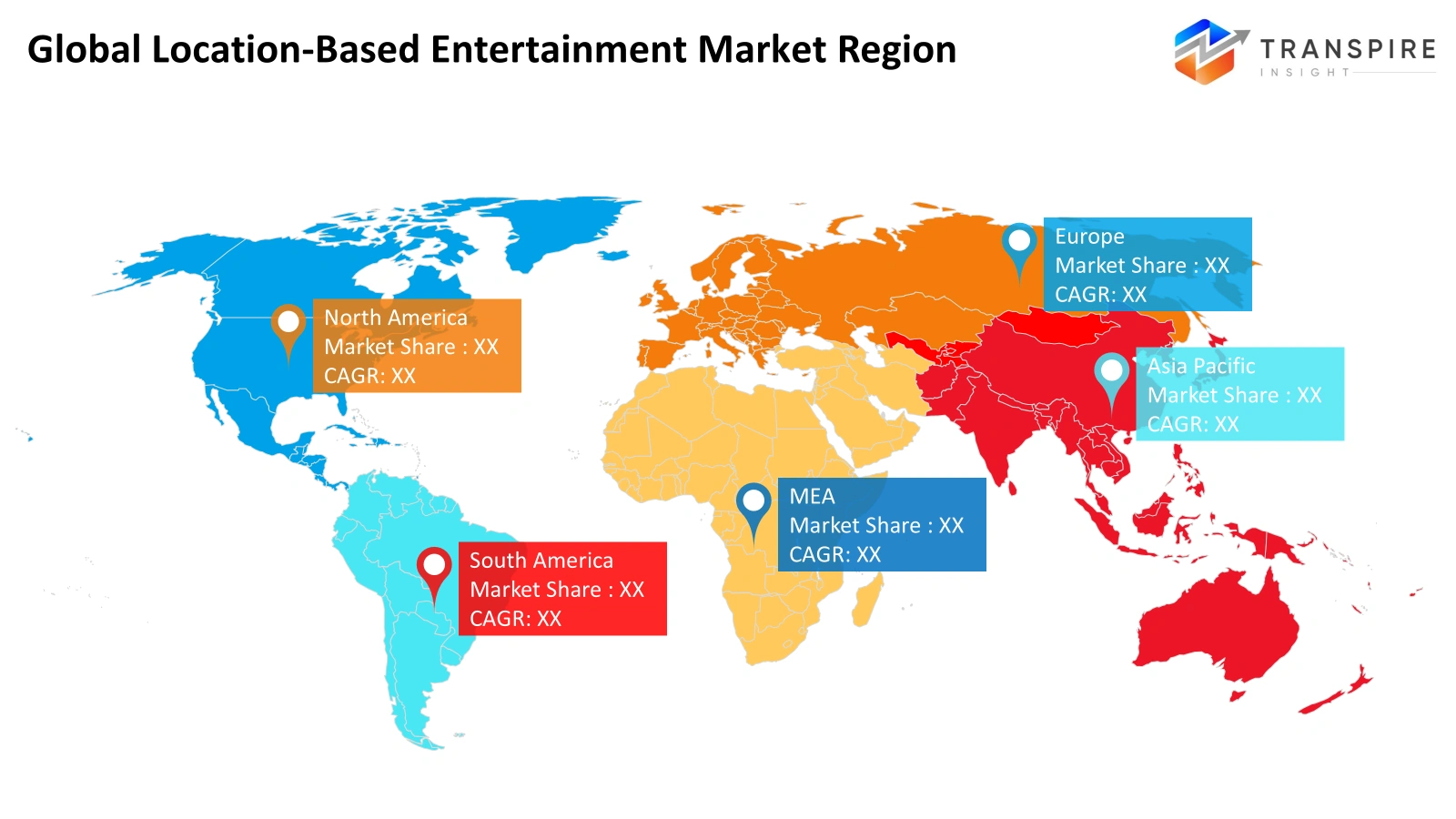
North America comprises almost 29% of the total market of location-based entertainment and has been a leading market for technological innovations in immersive technologies. North America is home to a developed entertainment ecosystem, digital infrastructure, and a consumer base that accepts premium experiences. Technology developers and entertainers are consistently developing next-generation VR, AR, and mixed reality attractions in this region, which has been helping in the steady growth of the market in the US and Canada. In May 2026,Sandbox VR launched its new location in Las Vegas, Nevada, marking its expansion in high-end location-based virtual reality entertainment in North America. It cements the dominance of the region in immersive VR entertainment and fulfills the rising demands of consumers regarding interactive entertainment experiences.
Europe
Europe constitutes about 24% of the market and has a dominant position in the market by virtue of the well-developed tourism sector and entertainment centres in Europe. There have been many instances in which there has been an increasing incorporation of virtual reality in the form of attractions within museums, cultural centres, and theme parks. The growing digitalisation and tourism in the region offer growth prospects for operators.In August 2025, Sandbox VR launched its 8th German venue in Willingen, Germany, providing fully interactive group VR experiences. It highlights the growing interest of Europe in adopting immersive entertainment solutions in entertainment and tourism.
Asia Pacific
The Asia Pacific region holds dominance over the world market for location-based entertainment at around 37% of its size. This is because of the presence of a large consumer base in this region along with growth in the number of middle classes and development in the entertainment industry. China, Japan, and South Korea are leading in implementing the use of immersive technologies in theme parks, gaming centres, and family entertainment centres due to increasing urbanisation and consumer spending.In February 2026, VIVERSE introduced “The Little Prince: Call to Adventure”, which was the world’s first multiplayer VR version of the famous story at ES CON Field, Hokkaido, Japan. It marks the dominance of Asia Pacific in immersive entertainment experiences.
Who are the Key Players in the Global Location-Based Entertainment Marketand how do they Compete?
In the global location-based entertainment industry, competition is mainly based on innovation in technologies, content, partnering, and venue expansion. Competitive companies strive for developing their unique entertainment offering using cutting-edge hardware, software, and storytelling.The Walt Disney Company is concentrated on entertainment experiences driven by innovation, including advanced digital technologies, immersive attractions, and intellectual property content. Differentiation in the company’s strategy is built upon a combination of well-known franchises with quality visitor experiences in entertainment destinations. Venue expansion in the strategy is built around attraction enhancements and market growth in international markets.
Merlin Entertainments, VRstudios, and Sandbox VR offer their visitors immersive and interactive entertainment experiences. The differentiation among these companies is based on unique virtual reality attractions, multiplayer experience, and location entertainment.
Zero Latency VR, Hologate, Dreamscape Immersive, and The VOID are competing using the latest free roam VR technology, mixed reality spaces, and unique content ecosystems. These players rely on the creation of immersive experiences that would promote repeat visits by customers and develop their business through franchising, partnerships, and expansion into foreign markets. Ability to offer new experiences is an important competitive factor for these companies.
Global Location-Based Entertainment Market companies
- Disney
- Universal Studios
- Merlin Entertainments
- Sandbox VR
- The VOID
- Dreamscape Immersive
- Zero Latency
- Hologate
- Six Flags
- LEGOLAND
- SeaWorld
- HTC Vive
- Meta
- Nvidia
- Microsoft
Recent Development News
In January 2025, Sandbox VR teamed up with Netflix to introduce "Rebel Moon: The Descent," a premium immersive entertainment experience in VR inspired by Netflix’s science-fiction series. This partnership expanded the range of immersive experiences and reinforced the development of VR franchises at location-based entertainment centres.
Source: https://en.wikipedia.org
In February 2026, Sandbox VR opened its first location in Arizona, in Gilbert, extending its business geographically into the American location-based entertainment market.
Source: https://www.axios.com
What Strategic Insights Define the Future of the Global Location-Based Entertainment Market?
Future trends in the location-based entertainment industry are set to be influenced by immersive technologies, experiential consumer spending, and personalisation. Entertainment operators that successfully integrate VR, AR, AI and story-driven interactive experiences will likely secure a bigger portion of their visitors' spending. Currently, there is a trend of transition from individual attractions to destination experiences that promote longer periods of interaction and visits. Another hidden threat is linked to the fast pace of changes within the field and shortening equipment lifecycles for venue owners, resulting in higher costs of equipment renewal and depreciation of facilities.
The biggest opportunities in the location-based entertainment business are commercialising mixed-reality and AI-based experiences, especially in the emerging economies where entertainment infrastructure is still expanding. Collaboration between technological developers, content producers, and attraction venues is set to become critical. Companies need to focus on the scalability of immersive platforms, constant content updates and the use of visitor analytics to provide better personalised experiences and ensure high revenues.
Key Segmentations are:
By Type
- Virtual Reality Parks
- Augmented Reality Experiences
- Arcade Gaming Centers
- Escape Rooms
- Projection Mapping Attractions
- Interactive Museums
- Simulation Rides
By Technology
- VR
- AR
- MR
- Projection Mapping
- Holography
- Motion Tracking
- AI-based Experiences
By Application
- Gaming
- Education
- Tourism
- Sports
- Cultural Experiences
- Retail Entertainment
- Corporate Events
By End User
- Families
- Children
- Teenagers
- Adults
- Tourists
- Corporates
- Educational Institutions
By Venue
- Indoor Parks
- Theme Parks
- Malls
- Museums
- Standalone Centers
- Entertainment Zones
- Event Venues
Regional Outlook
North America
- United States
- Canada
- Mexico
Europe
- Germany
- United Kingdom
- France
- Spain
- Italy
- Rest of Europe
Asia Pacific
- Japan
- China
- Australia & New Zealand
- South Korea
- India
- Rest of Asia Pacific
South America
- Brazil
- Argentina
- Rest of South America
Middle East & Africa
- Saudi Arabia
- United Arab Emirates
- South Africa
- Rest of the Middle East & Africa
Frequently Asked Questions
Find quick answers to common questions.
The global location-based entertainment market size was valued at USD 8.07 Billion in 2025 and is poised to reach USD 44.02 Billion by 2033, expanding at a 23.63% CAGR.
Key segments for the global location-based entertainment market are By Type (Virtual Reality Parks, Augmented Reality Experiences, Arcade Gaming Centers, Escape Rooms, Projection Mapping Attractions, Interactive Museums, Simulation Rides, Others); By Technology (VR, AR, MR, Projection Mapping, Holography, Motion Tracking, AI-based Experiences, Others); By Application (Gaming, Education, Tourism, Sports, Cultural Experiences, Retail Entertainment, Corporate Events, Others); By End User (Families, Children, Teenagers, Adults, Tourists, Corporates, Educational Institutions, Others); By Venue (Indoor Parks, Theme Parks, Malls, Museums, Standalone Centers, Entertainment Zones, Event Venues, Others).
Growth is primarily driven by factors including the increased demand for interactive entertainment experiences, growing use of virtual reality and augmented reality technology, an increase in the number of family entertainment centres and amusement parks, rising consumer expenditure on leisure, and the constant investments being made in gaming and attraction solutions.
The global market is led by major manufacturers including Disney, Universal Studios, Merlin Entertainments, Sandbox VR, The VOID, Dreamscape Immersive, Zero Latency, Hologate, Six Flags, LEGOLAND, SeaWorld, HTC Vive, Meta, Nvidia, and Microsoft.
The Asia Pacific region represents around 37% of the world market for LBEs, thereby making it the largest regional market. This is because of the high rate of urbanisation, increased spending power of consumers on entertainment purposes, a large young demographic, growth in the infrastructure of shopping malls and theme parks, and the adoption of new-age technologies such as VR and AR.
The opportunities in the global LBE industry are presented by the development of VR/AR attractions, investments into the development of gaming centres, collaborations between entertainment companies and shopping centres, and increasing interest in interactive attractions in tourism and family entertainment centres. Another set of opportunities arises through AI-based attractions, mixed reality experiences, and the development of the business in developing countries in the APAC and MEA regions.
- Disney
- Universal Studios
- Merlin Entertainments
- Sandbox VR
- The VOID
- Dreamscape Immersive
- Zero Latency
- Hologate
- Six Flags
- LEGOLAND
- SeaWorld
- HTC Vive
- Meta
- Nvidia
- Microsoft
About the Authors

Mayur Shinde
I am Mayur Shinde, a Senior Research Analyst at Transpire Insight, specializing in the Automotive & Transportation and Information & Communication Technology (ICT) Industry. My work focuses on analyzing emerging market trends, technological advancements, competitive landscapes, and industry developments to deliver accurate, data-driven insights. I am passionate about transforming complex market information into clear, actionable content that helps businesses, professionals, and decision-makers stay informed and make confident strategic decisions.

Chakradhar Khansole
Chakradhar serves as the Research Director at Transpire Insight, bringing over 8 years of experience in technology, innovation, and strategic market intelligence. He specializes in transforming complex market data into actionable business insights that enable organizations to make informed, growth-oriented decisions. Recognized for his strategic vision and analytical expertise, Chakradhar leads high-impact research initiatives, delivering comprehensive market assessments, competitive intelligence, and forward-looking industry analysis.
Recently Published Reports
-
Apr 2026
3D Optical Profiler Market
3D Optical Profiler Market Size, Share & Analysis Report By Type (Desktop 3D Optical Profiler, and Portable 3D Optical Profiler), By Technology (Confocal Technology, and White Light Interference), By End-Use Industry (Manufacturing, Research Institutions, Automotive, Aerospace and Defense, Medical Devices, and Other), and Geography (North America, Europe, Asia-Pacific, Middle East and Africa, South and Central America), 2021 - 2031
-
Apr 2026
Depth Sensor Market
Depth Sensor Market Size, Share & Analysis Report By Type (Infrared Depth Sensors, Time-of-Flight (ToF) Sensors, Stereo Vision Sensors, Structured Light Sensors, Ultrasonic Depth Sensors), By Application (Automotive, Robotics, Gaming, Consumer Electronics, Industrial Automation, Healthcare, Security & Surveillance, Others), By End Users (Automotive Manufacturers, Consumer Electronics Companies, Healthcare Providers, Industrial Companies, Security Agencies, Gaming Companies, Robotics Companies, Others), and Geography (North America, Europe, Asia-Pacific, Middle East and Africa, South and Central America), 2021 – 2031
-
Apr 2026
Digital Manufacturing Market
Digital Manufacturing Market Size, Share & Analysis Report By Component (Hardware, Software, and Services), By Technology (Robotics, 3D Printing, Internet of Things (IoT), and Others), By Application (Automotive and Transportation, Aerospace and Defense, Consumer Electronics, Industrial Machinery, and Others), By Process Type (Computer-Based Designing, Computer-Based Simulation, Computer 3D Visualization, Analytics, and Others), and Geography (North America, Europe, Asia-Pacific, Middle East and Africa, South and Central America), 2021 – 2031
-
Apr 2026
Digital Visa Services Market
Digital Visa Services Market Size, Share & Analysis Report By Type (Individual Travelers, Group Travelers), By Application (Tourism, Business Travel, Others), and Geography (North America, Europe, Asia-Pacific, Middle East and Africa, South and Central America), 2021 – 2031