
Global IoT Based Asset Tracking and Monitoring Market Size & Forecast:
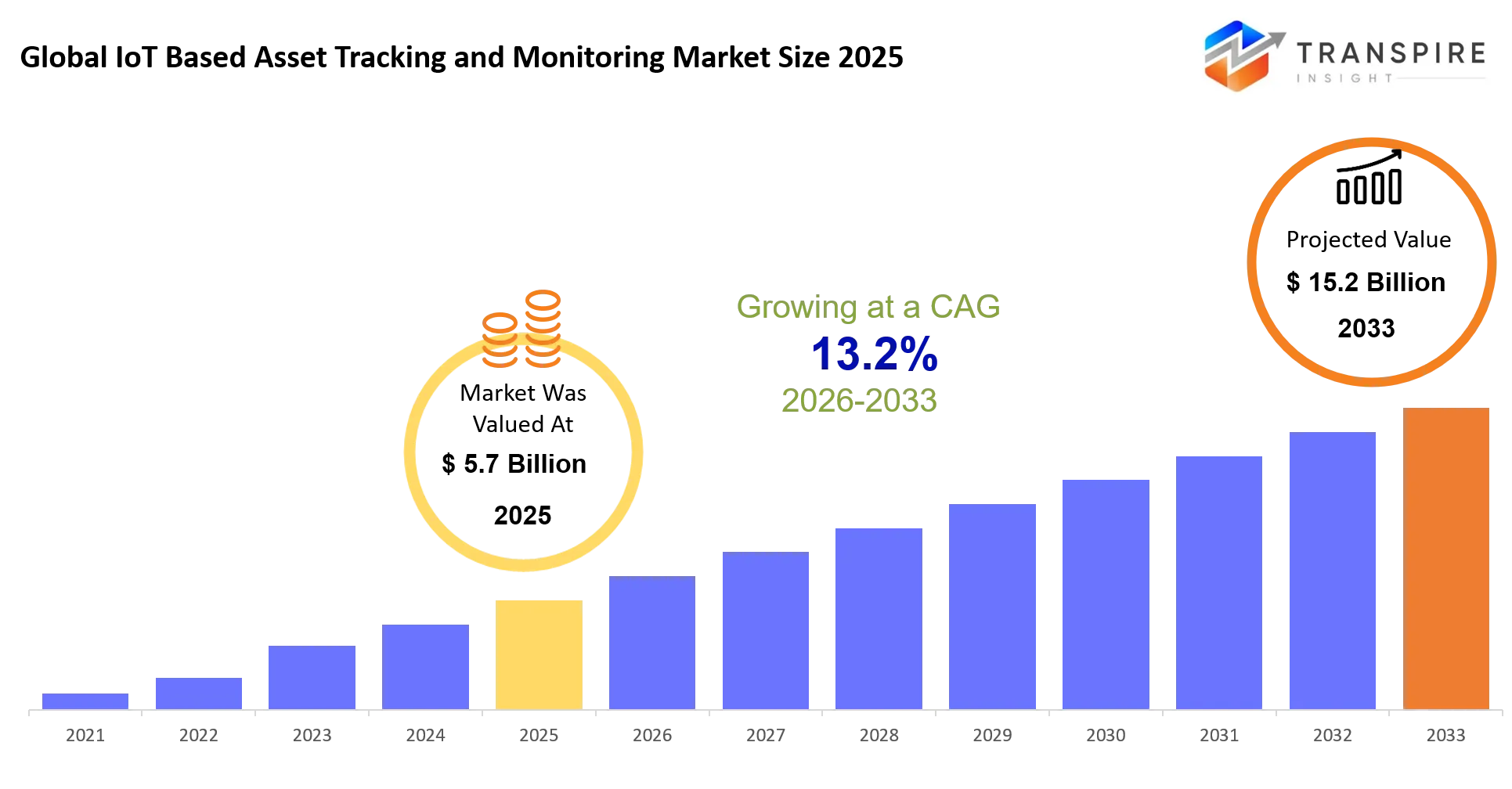
- Global IoT Based Asset Tracking and Monitoring Market Size 2025: USD 5.7 Billion
- Global IoT Based Asset Tracking and Monitoring Market Size 2033: USD 15.2 Billion
- Global IoT Based Asset Tracking and Monitoring Market CAGR: 13.2%
- Global IoT Based Asset Tracking and Monitoring Market Segments: By Component (Hardware, Software, Services, Connectivity, Platforms, Analytics, Sensors, Others); By Technology (RFID, GPS, BLE, LPWAN, Cellular IoT, UWB, NFC, Others); By Application (Transportation, Manufacturing, Healthcare, Retail, Construction, Logistics, Others); By End User (Enterprises, SMEs, Government, Others); By Deployment (Cloud, On-premise, Hybrid, Others)
Global IoT Based Asset Tracking and Monitoring Market Summary
s per Transpire Insight Analysis, the Global IoT Based Asset Tracking and Monitoring Market size is estimated at USD 5.7 Billion in 2025 and is anticipated to reach USD 15.2 Billion by 2033, growing at a CAGR of 13.2% from 2026 to 2033. This industrial technology space provides the connected hardware nodes, gateway architectures, and cloud analytics dashboards needed to dynamically locate, monitor, and manage physical inventory, fleet vehicles, and high-value tools across worldwide supply chains. Over the last few years - severe global shipping logjams and volatile fuel pricing forced industrial operators to abandon passive, episodic scanning routines in favor of continuous, automated data pipelines. This operational strain triggered a massive structural shift - as enterprises migrated rapidly from basic - localized barcode frameworks to active, sensor-rich LPWAN and cellular IoT infrastructures. By feeding real-time positional and environmental telemetry directly into enterprise planning software, managers can instantly reroute delayed shipments and automate inventory auditing loops. This operational visibility mitigates costly asset loss - optimizes asset utilization rates, driving extensive global adoption.
Key Market Insights
The Global IoT Based Asset Tracking and Monitoring Market is fundamentally shifting from siloed, passive barcode scanning frameworks to continuous, edge-intelligent tracking ecosystems that provide automated logistics oversight. Driven by the critical demand for localized supply chain resilience, enterprise network operators are replacing labor-intensive physical auditing steps with high-density active sensor grids and unified cloud tracking platforms to safely optimize real-time asset utilization without bottlenecking daily sorting throughput.
- Locking down a 35% share, GPS Tracking Solutions lead the market, with Samsara deploying its advanced high-density asset gateways to easily track long-haul cargo fleets across major shipping corridors.
- Expanding at an 18.7% CAGR, UWB-based Asset Tracking dominates acceleration as industrial operators swap low-resolution positioning configurations for sub-30cm ultra-wideband localized positioning hardware.
- Capturing 40% of worldwide revenue, North America functions as the largest geographic market, backed by massive cluster capital investments across automated manufacturing plants and freight hubs.
- Commanding a stable 28% market slice, Europe drives system innovation, pushing continental logistics providers to adopt low-power wide-area networks (LPWAN) that comply with strict municipal carbon footprint rules.
- Representing 24% of total industry demand, the Asia Pacific theater relies on expanding industrial infrastructure, compelling regional enterprises to leverage intelligent Bluetooth Low Energy (BLE) micro-tags to automate warehouse auditing workflows.
- Securing 22% of the product matrix, RFID Solutions remain an essential hardware segment, integrating passive and active transponders directly into high-throughput retail fulfillment networks to accelerate inventory cycle counts.
- Accounting for 14% of the technology mix, BLE Solutions face rapid upgrades as enterprise developers leverage localized mesh networks to optimize high-value handheld tool tracking across industrial worksites.
- Securing 11% of total hardware procurement, Cellular IoT expands across cross-border transit loops, allowing shipping lines to maintain secure data pipelines without relying on domestic localized network setups.
- Claiming a targeted 4% market footprint, Latin America moves toward modern smart tracking networks, relying on ruggedized hardware to protect raw material movements across expansive mining corridors.
- Accounting for an integrated 4% market slice, the Middle East & Africa region represents an essential infrastructure corridor, accelerating technical asset deployment via massive intermodal logistics port expansions.
What are the Key Drivers, Restraints, and Opportunities in the Global IoT Based Asset Tracking and Monitoring Market?
Driver
The market is expanding due to the financial urgency to eliminate transit blind spots and mitigate cargo theft across volatile global supply chains. Rising geopolitical trade disruptions and escalating shipping costs make passive warehouse checks completely unviable. This pressure was triggered by multi-day terminal congestion and cross-border shipping blind spots, forcing logistics managers to rapidly transition from manual barcode scanning to automated, active cellular IoT and LPWAN sensor nodes. This operational shift drives extensive hardware and software revenue as enterprise networks invest in end-to-end data pipelines to automatically safeguard and redirect intermodal freight shipments.
In June 2026, connected operations pioneer Samsara officially launched its proprietary single-use smart Tracking Label alongside an Agentic Shipment Center to bridge deep visibility gaps across cross-border transit loops. This paper-thin, flexible Bluetooth-enabled sensor applies directly to high-value cargo pallets to deliver continuous, near-real-time situational and location insights for up to 45 days. By using an expansive mesh network of millions of interconnected mobile gateways to surface automated transit risk alerts, this low-cost hardware rollout allows global shipping companies to maintain absolute operational oversight without relying on fragmented manual container scans, substantially accelerating market adoption.
Restraint
Severe, structural integration fragmentation across legacy enterprise resource planning (ERP) systems acts as a major bottleneck capping market growth. While hardware component costs continue to drop, thousands of manufacturing plants and warehousing systems still rely on disjointed, decades-old data storage frameworks that lack open application programming interfaces (APIs). This compatibility issue persists because completely overhauling core terminal databases introduces immense operational downtime risks, preventing enterprises from cleanly syncing active multi-sensor IoT telemetry data with automated inventory billing or dispatch software.
Opportunity
The most lucrative growth window lies in the massive deployment of sub-30cm, high-precision Ultra-Wideband (UWB) tracking architectures inside complex, automated smart manufacturing floors. Fusing localized UWB micro-tags with intelligent robotics and automated guided vehicles (AGVs) allows assembly facilities to establish real-time spatial awareness. This structural transition unlocks long-term platform subscription revenue as heavy automotive and industrial manufacturing plants invest heavily in dense indoor positioning grids to eliminate parts-bin searching times, optimize assembly line sequencing, and safely coordinate human-robot workspaces.
What Has the Impact of Artificial Intelligence Been on the Global IoT Based Asset Tracking and Monitoring Market?
Artificial intelligence is completely changing how enterprises manage industrial inventories, moving tracking infrastructure away from descriptive location pins into autonomous, predictive decision-making networks. Instead of reviewing historic location logs after an asset is already lost, operators use integrated machine learning algorithms to continuously analyze high-velocity location and environmental telemetry data streams.
On the factory floor, AI models optimize industrial material flow by feeding sensor inputs directly into digital twin software systems. These smart networks constantly track transit velocity, localized humidity levels, and minor mechanical vibration spikes across active machinery and high-value tools. By matching these multi-layer data patterns, the platform predicts early equipment failures and automatically triggers conditional maintenance orders before an asset breakdown halts a production run. However, an operational limitation persists around localized accuracy gaps; AI algorithms trained in simulated environments frequently struggle with dense, metallic background interference on real-world industrial floors, generating false anomalies. Even with these data filtering hurdles, physical automation software is advancing rapidly.
In April 2026, industrial automation leader Zebra Technologies executed a strategic investment in Apera AI to integrate advanced 4D Vision models and light-resilient AI processing into factory robotics pipelines. This automated intelligence allows material-handling robots to perceive, reason, and manipulate complex, unstructured assets under fluctuating factory floor lighting conditions. By combining real-time machine vision with active RFID tracking data, this integration optimizes high-speed sorting and package validation loops across connected logistics hubs.
Key Market Trends
The global IoT based asset tracking and monitoring landscape is undergoing a major structural evolution, shifting away from standalone, siloed hardware pings toward hybrid, multi-layered data orchestration networks. Driven by extreme cost containment mandates and volatile supply chain conditions, enterprise engineering teams are replacing single-protocol tracking transponders with multi-connectivity sensor nodes that fuse GPS, cellular IoT, and low-power mesh architectures to capture both ambient and spatial telemetry simultaneously.
- For years, logistics operators relied entirely on passive barcode scans at terminal gates, but distribution networks are rapidly adopting active, continuous LPWAN and cellular IoT networks to achieve uninterrupted, borderless shipping visibility.
- Instead of deploying unmonitored container enclosures that hide systemic cargo damage, cold chain managers are actively equipping fleets with multi-parameter environmental sensor blocks to track temperature, humidity, and shock impacts in real time.
- Traditional factory asset management teams historically isolated static inventory logs from localized shop-floor machinery, but modern industrial complexes are aggressively embedding ultra-wideband (UWB) sub-30cm micro-tags directly into robotic assembly pathways to optimize work-in-progress workflows.
- Rather than maintaining rigid, calendar-based asset maintenance programs that risk unexpected infrastructure breakdowns, operations directors are shifting toward AI-driven data engines that analyze localized sensor vibration and usage metrics to trigger predictive repairs.
- Industrial construction and heavy mining operators are discarding paper-based tool check-out sheets to implement cloud-managed geofencing boundaries that issue instant security alerts when high-value mobile machinery is moved beyond authorized parameters.
- Commercial maritime shipping firms are moving far beyond fragmented, harbor-restricted short-range tracking arrays, driving a massive deployment of integrated satellite IoT connectivity to capture continuous rolling cargo updates across deep-sea lanes.
- To combat rising internal sabotage and sophisticated industrial data falsification risks, enterprise network architects are abandoning clear-text payload transfers to mandate end-to-end cryptographic encryption directly from the physical hardware sensor to the cloud platform.
- Rather than utilizing thick, heavy-gauge diagnostic enclosures that require separate external batteries, electronics developers are rapidly transitioning toward flexible, paper-thin smart tracking labels with embedded printed batteries to trace individual retail pallets cost-effectively.
- Local public transit authorities and municipal utility networks are overhauling legacy maintenance models, pushing a strategic rollout of smart-city-integrated grid sensors to automate the physical tracking, utilization, and service logging of distributed municipal equipment.
Global IoT Based Asset Tracking and Monitoring Market Segmentation
By Component
Hardware commands the largest share of market capital, holding a dominant portion of global revenue due to the high volume of physical sensor nodes and gateways required for enterprise-wide tracking. Software and Analytics follow as crucial operational layers, with Platforms, Connectivity, and professional Lifecycle Services accounting for the remaining market distribution. This division persists because establishing end-to-end supply chain visibility demands continuous upfront investments in physical tracking devices. Hardware maintains its dominant market position because industrial operators must install active cellular transponders or long-life battery beacons on millions of unmonitored assets. Meanwhile, Software and Analytics categories are accelerating as enterprise managers demand automated cloud data dashboards to convert raw positioning pings into actionable business intelligence. Moving forward, structural components will transition toward hyper-integrated, software-defined hardware. Equipment providers will focus heavily on delivering low-cost, disposable tracking labels paired with native, cloud-hosted AI analytics layers to automate complex warehouse audit loops and minimize deployment friction.
By Technology
GPS Tracking Solutions lead the market with a dominant 35% share of total revenue, while RFID Solutions remain a critical secondary operational standard at 22%. BLE Solutions hold a stable 14%, Cellular IoT sits at 11%, and other ancillary wireless technologies like LPWAN and NFC account for the final 18%. Concurrently, UWB-based Asset Tracking stands as the undisputed market accelerator, driving the fastest growth with an explosive 18.7% CAGR. This distribution is shaped by the practical demands of long-haul logistics versus indoor localized factory positioning. GPS tracking maintains its peak position because long-haul freight operations require continuous, wide-area spatial coordinates to optimize cross-border transit loops. Conversely, UWB-based systems are accelerating rapidly as automated manufacturing hubs demand ultra-precise, sub-30cm location telemetry to safely coordinate automated guided vehicles (AGVs) and complex workplace robotics. Moving forward, wireless communication protocols will fully merge into multi-mode hybrid chips, forcing hardware developers to engineer versatile sensor nodes that transition seamlessly between long-range cellular pipelines and high-precision indoor UWB grids.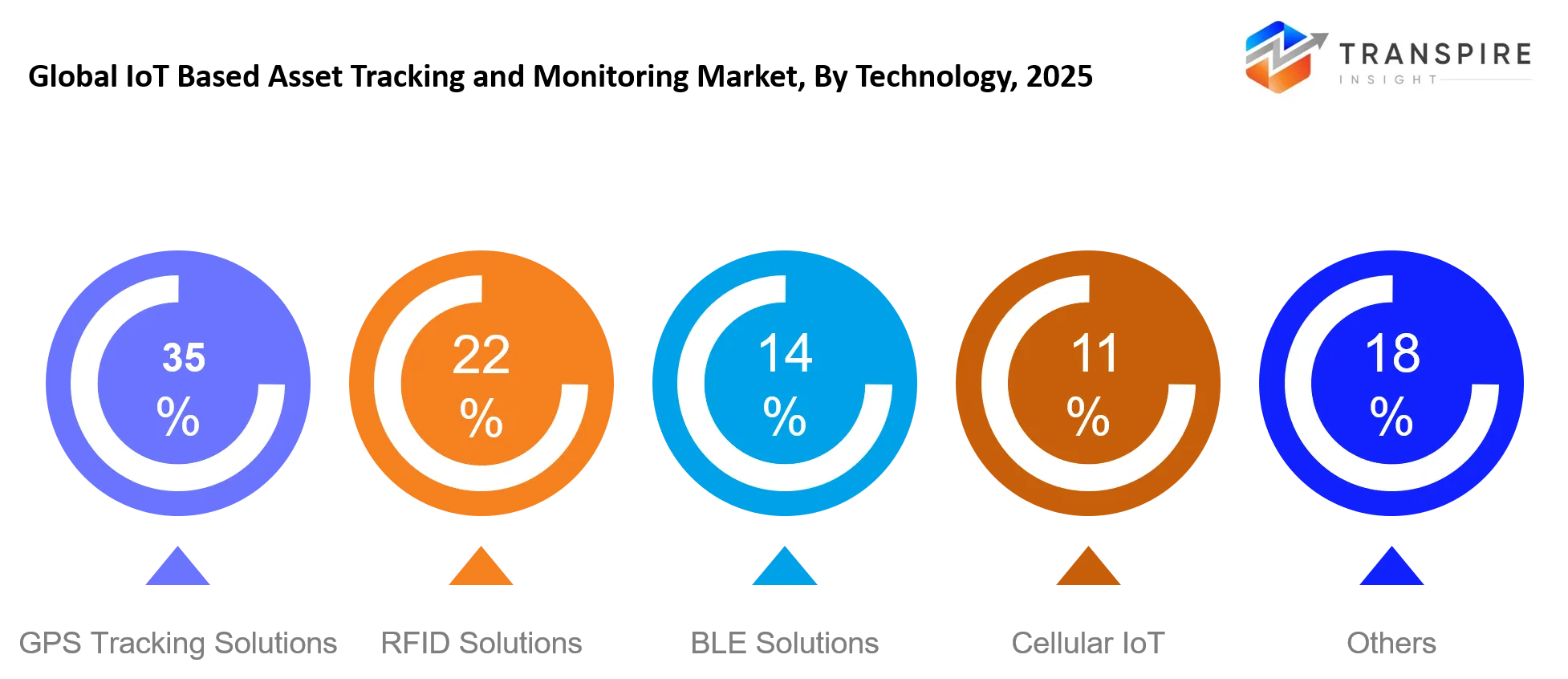
By Application
Transportation and Logistics functions as the undisputed anchor of this segment, locking down the largest portion of tracking system procurement. At the same time, Manufacturing and Healthcare represent the fastest-growing application spaces. The underlying growth logic is tied directly to the rising complexity of just-in-time assembly lines and the high cost of misplaced medical equipment or temperature-sensitive pharmaceutical shipments. Transportation setups demand rugged, high-bandwidth fleet trackers to ensure regulatory compliance and continuous freight security across border checkpoints, while Manufacturing workflows are adopting sensor grids to trace work-in-progress materials through automated assembly tracks. Looking ahead, application development will focus heavily on real-time ambient data processing and system modularity. IoT software suppliers will need to balance two distinct workloads: building highly durable, long-life asset trackers tailored for global shipping container networks while simultaneously refining specialized, sterile, and low-power micro-sensors designed to track high-value surgical tools across busy clinical corridors.
By End User
Enterprises, particularly large-scale multinational manufacturing and global logistics corporations, serve as the primary financial engine of the market, controlling massive capital procurement budgets. Concurrently, SMEs and Government entities are rising as highly active, fast-growing secondary buyers. The market dynamic here relies on the shifting affordability of IoT infrastructure, where large enterprises establish extensive, multi-facility smart tracking networks while agile SMEs leverage plug-and-play, subscription-based cloud platforms to optimize smaller regional fleets. Enterprises use multi-year software licensing contracts to secure custom database integrations, whereas SMEs seek flexible, brand-agnostic hardware options that install easily without deep internal IT expertise. Moving forward, market success will require a total pivot away from fragmented hardware provisioning. Long-term profitability will belong to providers who offer integrated "Asset-Tracking-as-a-Service" models, bundling physical sensor nodes with cellular data plans, automated geo-fencing software, and ongoing predictive maintenance support.
By Deployment
Cloud deployments retain a massive portion of the operational footprint due to their superior scalability, flexible data access, and lower upfront computing infrastructure requirements. Meanwhile, Hybrid and On-premise configurations are leading market growth as critical options for security-sensitive industrial operators. This growth pattern is driven by a broad enterprise transition toward real-time data orchestration designed to eliminate transmission latency and protect proprietary manufacturing data. Pure cloud setups are ideal for distributed global supply chains that require multi-region data visibility, but hybrid deployment models are gaining significant ground because they allow local processing nodes to run edge analytics directly on the factory floor while syncing macro-metrics to the cloud. Looking ahead, the industry will pivot sharply toward easily adaptable edge-to-cloud computing designs. System architects will be forced to transition toward modular software platforms that let operators selectively process critical positioning data locally to optimize bandwidth consumption while maintaining absolute data integrity.
What are the Key Use Cases Driving the Global IoT Based Asset Tracking and Monitoring Market?
Fleet telematics and long-haul freight tracking serve as the foundational use case - utilizing high-density GPS gateways to provide cross-border positional clarity. Logistics providers rely on these continuous data streams to optimize route sequencing, automate geofenced border alerts, and protect intermodal containers from cargo theft.
In expanding industrial applications - manufacturers deploy Bluetooth Low Energy (BLE) micro-tags and active RFID transponders across factory floors to orchestrate work-in-progress inventory. This integration links real-time parts-bin telemetry directly to automated enterprise planning systems, preventing assembly line stalls and eliminating manual warehouse auditing loops.
Concurrently, a high-value emerging use case is taking hold within healthcare facilities and smart construction zones. Operations teams are leveraging ultra-precision Ultra-Wideband (UWB) tracking architectures to instantly locate critical mobile clinical equipment or expensive specialized tools, maximizing asset utilization rates across complex indoor environments.
|
Report Metrics |
Details |
|
Market size value in 2025 |
USD 5.7 Billion |
|
Market size value in 2026 |
USD 6.4 Billion |
|
Revenue forecast in 2033 |
USD 15.2 Billion |
|
Growth rate |
CAGR of 13.2% from 2026 to 2033 |
|
Base year |
2025 |
|
Historical data |
2021 - 2024 |
|
Forecast period |
2026 - 2033 |
|
Report coverage |
Revenue forecast, competitive landscape, growth factors, and trends |
|
Regional scope |
United States; Canada; Mexico; United Kingdom; Germany; France; Italy; Spain; China; Japan; India; Australia; South Korea; Brazil; Argentina; South Africa; Saudi Arabia; United Arab Emirates |
|
Key company profiled |
Samsara, Zebra Technologies, Oracle, Cisco, Siemens, IBM, Honeywell, Bosch, Geotab, Verizon Connect, Trimble, Queclink, Impinj, Wipro, PTC |
|
Customization scope |
Free report customization (country, regional & segment scope). Avail customized purchase options to meet your exact research needs. |
|
Report Segmentation |
By Component (Hardware, Software, Services, Connectivity, Platforms, Analytics, Sensors, Others); By Technology (RFID, GPS, BLE, LPWAN, Cellular IoT, UWB, NFC, Others); By Application (Transportation, Manufacturing, Healthcare, Retail, Construction, Logistics, Others); By End User (Enterprises, SMEs, Government, Others); By Deployment (Cloud, On-premise, Hybrid, Others) |
Which Regions are Driving the Global IoT Based Asset Tracking and Monitoring Market Growth?
North America maintains a commanding grip on the IoT based asset tracking and monitoring market, capturing a dominant 40% of all worldwide industry revenue. This geographic leadership is heavily driven by an extensive, high-density network of intermodal freight corridors combined with aggressive automated manufacturing transitions across the region. The regional ecosystem is structurally supported by major federal supply chain security regulations and rapid logistical hub modernization plans that mandate granular cargo verification. Consequently, integrating high-capacity cellular gateways and permanent RFID tracking infrastructure has become a primary operational standard for domestic logistics providers aiming to eliminate transit blind spots.
Europe serves as a highly stable, predictable secondary pillar for the global market, locking down an essential 28% share of total industry demand. While North American operational expansion focuses heavily on massive interstate shipping lanes and private e-commerce mega-centers, European tracking adoption is driven entirely by strict continental environmental regulations and zero-waste sustainability mandates. This regional market stability is structurally insulated by state-backed circular economy policies that push manufacturing facilities to implement comprehensive life-cycle tracking for reusable transport packaging and structural parts. To maintain strict workflow integrity amidst rising raw material costs, European supply chain executives steadily invest in low-power wide-area networks (LPWAN) and smart-city-integrated grid sensors that log exact asset utilization rates.
In October 2025, industrial technology major Bosch announced the comprehensive unification of its global building and asset integration divisions under the single corporate banner of Bosch Building Technologies to streamline complex industrial tracking deployment. Beginning in January 2026, the strategic consolidation directly merged the localized branch networks of major technical providers like Climatec and Paladin Technologies to scale cross-domain automation and tracking pipelines across mature European factory floors. By integrating real-time sensor technology and cloud data analytics under a single, unified enterprise ecosystem, this structural realignment guarantees localized product support while creating a scalable roadmap for seamless, low-power industrial asset monitoring across connected European warehouse facilities.
The Asia Pacific region has emerged as the fastest-growing territory globally, accelerating at a market-leading CAGR of 19.4% to capture a 24% slice of global sales. This sudden structural shift is driven by massive industrial infrastructure upgrades, expanding electronics and automotive fabrication hubs, and a rapid pivot toward localized smart warehouse automation. Historically, regional inventory management relied heavily on labor-intensive barcode scans at fixed terminal checkpoints, but the territory has now rapidly pivoted toward active, real-time wireless positioning to monitor high-throughput production lines. Looking ahead, future equipment procurement in this booming corridor relies entirely on deploying high-precision Ultra-Wideband (UWB) tracking architectures and intelligent Bluetooth Low Energy (BLE) micro-tags to automate work-in-progress monitoring across dense industrial zones.
In December 2025, digital workflow leader Zebra Technologies highlighted extensive real-time operational intelligence trends across its expanding Asia Pacific hubs by deploying advanced AI-driven machine vision and integrated RFID networks to counter severe manufacturing labor constraints. This targeted technical push optimizes frontline workflows across major manufacturing, logistics, and retail centers by connecting physical warehouse assets, enterprise software systems, and sorting teams in real time. By deploying these automated visibility networks across regional distribution lines, the system rollout drives substantial productivity gains and eliminates inventory shrink across expanding Asian logistics hubs. 
Who are the Key Players in the Global IoT Based Asset Tracking and Monitoring Market and How Do They Compete?
The IoT based asset tracking and monitoring landscape - defined by aggressive competition between full-stack cloud operations platforms and heavy-duty, hardware-integrated automation providers. As enterprises move away from isolated, single-use hardware tags, top market vendors compete heavily on software-led ecosystem integration, processing latency, and data orchestration. Success in this market belongs to firms that seamlessly blend physical tracking networks with edge AI models to predict transit disruptions rather than merely logging historical coordinates.
Samsara drives rapid market expansion through an aggressive technology innovation strategy centered on high-tier connected operations software. Differentiating itself by providing an unified, real-time cloud dashboard, Samsara eliminates fragmented software layers by combining rolling fleet telematics, industrial equipment health metrics, and small asset positioning into a single data ecosystem. The company aggressively expands its user footprint by deploying ultra-compact Bluetooth trackers alongside single-use flexible labels to capture micro-level tool and cargo data.
Zebra Technologies competes through a dominant hardware-centric niche strategy focused strictly on warehouse and manufacturing floor automation. Zebra differentiates its approach by deeply integrating heavy-duty fixed RFID readers, mobile computer endpoints, and complex machine vision cameras directly into active assembly line tracks. Its primary growth playbook relies on expanding its Frontline AI Suite and acquiring specialty computer vision firms to deploy rugged, light-resilient AI models capable of high-speed package validation and automated sorting across complex industrial fulfillment corridors.
Company List
- Samsara
- Zebra Technologies
- Oracle
- Cisco
- Siemens
- IBM
- Honeywell
- Bosch
- Geotab
- Verizon Connect
- Trimble
- Queclink
- Impinj
- Wipro
- PTC
Recent Development News
In July 2025, wireless IoT telematics manufacturer Queclink Wireless Solutions officially introduced its ultra-slim Bluetooth tracking beacon to prevent widespread cargo theft across regional logistics operations. This compact, IP67-waterproof hardware deployment leverages Bluetooth Low Energy (BLE) 5.2 technology to deliver flexible, multi-frequency localized telemetry updates directly to vehicle gateways across harsh transit environments. [https://www.worktruckonline.com
In October 2025, digital positioning leader Trimble unveiled major AI-driven data analysis capabilities and GIS-centric mapping integrations within its proprietary Trimble Unity software suite at its annual Innovate User Conference in Utah. This digital platform upgrade deploys an advanced AI assistant to automate tedious asset permitting and field maintenance workflows - substantially lowering the total cost of ownership for private utilities and public infrastructure operators. [https://news.trimble.com
In December 2025, IoT device innovator Queclink Wireless Solutions successfully launched its initial satellite-enabled vehicle and asset tracker to secure continuous data pipelines across extreme, remote operational sectors. This ruggedized telematics hardware platform integrates wide-voltage electrical architectures with RS232 sensor ports, enabling commercial fleet logistics managers to capture uninterrupted ambient telemetry and location tracking inside rural dead zones entirely lacking standard cellular network coverage. [https://www.worktruckonline.com
What Strategic Insights Define the Future of the Global IoT Based Asset Tracking and Monitoring Market?
The IoT based asset tracking and monitoring market is shifting toward zero-power, energy-harvesting ambient sensor grids that completely eliminate structural battery-replacement overheads. Future development centers on migrating away from standard passive localization data toward deploying active, self-orchestrating decentralized edge nodes capable of real-time multi-sensor contextual inference. However, a major hidden risk lies in critical firmware-level edge vulnerability vectors, leaving millions of globally distributed, lightweight hardware transponders exposed to malicious localized signal spoofing and data interception maneuvers. Concurrently, an emerging opportunity rests in embedding high-precision Ultra-Wideband (UWB) sub-30cm positioning architectures directly into automated dark warehouses to coordinate autonomous mobile robot networks. To retain market leadership, solution architects must immediately transition from standalone tracking components to unified "Hardware-Defined-Software" subscription frameworks that incorporate built-in quantum-resistant cryptography layers to satisfy escalating regional data privacy compliance mandates.
By Component
- Hardware
- Software
- Services
- Connectivity
- Platforms
- Analytics
- Sensors
- Others
By Technology
- RFID
- GPS
- BLE
- LPWAN
- Cellular IoT
- UWB
- NFC
- Others
By Application
- Transportation
- Manufacturing
- Healthcare
- Retail
- Construction
- Logistics
- Others
By End User
- Enterprises
- SMEs
- Government
- Others
By Deployment
- Cloud
- On-premise
- Hybrid
- Others
Regional Outlook
North America
- United States
- Canada
- Mexico
Europe
- Germany
- United Kingdom
- France
- Spain
- Italy
- Rest of Europe
Asia Pacific
- Japan
- China
- Australia & New Zealand
- South Korea
- India
- Rest of Asia Pacific
South America
- Brazil
- Argentina
- Rest of South America
Middle East & Africa
- Saudi Arabia
- United Arab Emirates
- South Africa
- Rest of the Middle East & Africa
Frequently Asked Questions
Find quick answers to common questions.
The Global IoT Based Asset Tracking and Monitoring Market size was valued at USD 5.7 Billion in 2025 and is poised to reach USD 15.2 Billion by 2033, expanding at a 13.2% CAGR.
Key segments for the Global IoT Based Asset Tracking and Monitoring Market are By Component (Hardware, Software, Services, Connectivity, Platforms, Analytics, Sensors, Others), By Technology (RFID, GPS, BLE, LPWAN, Cellular IoT, UWB, NFC, Others), By Application (Transportation, Manufacturing, Healthcare, Retail, Construction, Logistics, Others), By End User (Enterprises, SMEs, Government, Others), By Deployment (Cloud, On-premise, Hybrid, Others).
Growth is primarily driven by the financial urgency to eliminate transit blind spots and mitigate cargo theft across volatile global supply chains. It is accelerated by multi-day terminal congestion and cross-border shipping friction, which are forcing logistics managers to rapidly transition from manual barcode scanning to automated, active cellular IoT and LPWAN sensor nodes to build continuous data pipelines.
The global market is led by major manufacturers including Samsara, Zebra Technologies, Oracle, Cisco, Siemens, IBM, Honeywell, Bosch, Geotab, Verizon Connect, Trimble, Queclink, Impinj, Wipro, PTC.
North America holds a dominant 40% share of the total worldwide revenue, heavily steering manufacturing standards toward high-capacity cellular gateways and permanent RFID infrastructure. The region’s massive volume is fueled by an extensive, high-density network of intermodal freight corridors, aggressive automated manufacturing transitions, and strict federal supply chain security regulations that mandate granular cargo verification.
Lucrative opportunities include the massive deployment of sub-30cm, high-precision Ultra-Wideband (UWB) tracking architectures inside complex, automated smart manufacturing floors and dark warehouses to coordinate autonomous mobile robots. Additional expansion potential exists in fusing these high-precision indoor positioning grids with intelligent robotics and automated guided vehicles (AGVs) to eliminate parts-bin searching times and safely optimize assembly line sequencing.
- Samsara
- Zebra Technologies
- Oracle
- Cisco
- Siemens
- IBM
- Honeywell
- Bosch
- Geotab
- Verizon Connect
- Trimble
- Queclink
- Impinj
- Wipro
- PTC
About the Authors

Mayur Shinde
I am Mayur Shinde, a Senior Research Analyst at Transpire Insight, specializing in the Automotive & Transportation and Information & Communication Technology (ICT) Industry. My work focuses on analyzing emerging market trends, technological advancements, competitive landscapes, and industry developments to deliver accurate, data-driven insights. I am passionate about transforming complex market information into clear, actionable content that helps businesses, professionals, and decision-makers stay informed and make confident strategic decisions.

Chakradhar Khansole
Chakradhar serves as the Research Director at Transpire Insight, bringing over 8 years of experience in technology, innovation, and strategic market intelligence. He specializes in transforming complex market data into actionable business insights that enable organizations to make informed, growth-oriented decisions. Recognized for his strategic vision and analytical expertise, Chakradhar leads high-impact research initiatives, delivering comprehensive market assessments, competitive intelligence, and forward-looking industry analysis.
Recently Published Reports
-
Apr 2026
3D Optical Profiler Market
3D Optical Profiler Market Size, Share & Analysis Report By Type (Desktop 3D Optical Profiler, and Portable 3D Optical Profiler), By Technology (Confocal Technology, and White Light Interference), By End-Use Industry (Manufacturing, Research Institutions, Automotive, Aerospace and Defense, Medical Devices, and Other), and Geography (North America, Europe, Asia-Pacific, Middle East and Africa, South and Central America), 2021 - 2031
-
Apr 2026
Depth Sensor Market
Depth Sensor Market Size, Share & Analysis Report By Type (Infrared Depth Sensors, Time-of-Flight (ToF) Sensors, Stereo Vision Sensors, Structured Light Sensors, Ultrasonic Depth Sensors), By Application (Automotive, Robotics, Gaming, Consumer Electronics, Industrial Automation, Healthcare, Security & Surveillance, Others), By End Users (Automotive Manufacturers, Consumer Electronics Companies, Healthcare Providers, Industrial Companies, Security Agencies, Gaming Companies, Robotics Companies, Others), and Geography (North America, Europe, Asia-Pacific, Middle East and Africa, South and Central America), 2021 – 2031
-
Apr 2026
Digital Manufacturing Market
Digital Manufacturing Market Size, Share & Analysis Report By Component (Hardware, Software, and Services), By Technology (Robotics, 3D Printing, Internet of Things (IoT), and Others), By Application (Automotive and Transportation, Aerospace and Defense, Consumer Electronics, Industrial Machinery, and Others), By Process Type (Computer-Based Designing, Computer-Based Simulation, Computer 3D Visualization, Analytics, and Others), and Geography (North America, Europe, Asia-Pacific, Middle East and Africa, South and Central America), 2021 – 2031
-
Apr 2026
Digital Visa Services Market
Digital Visa Services Market Size, Share & Analysis Report By Type (Individual Travelers, Group Travelers), By Application (Tourism, Business Travel, Others), and Geography (North America, Europe, Asia-Pacific, Middle East and Africa, South and Central America), 2021 – 2031