

Global Industrial Boiler Market Size & Forecast
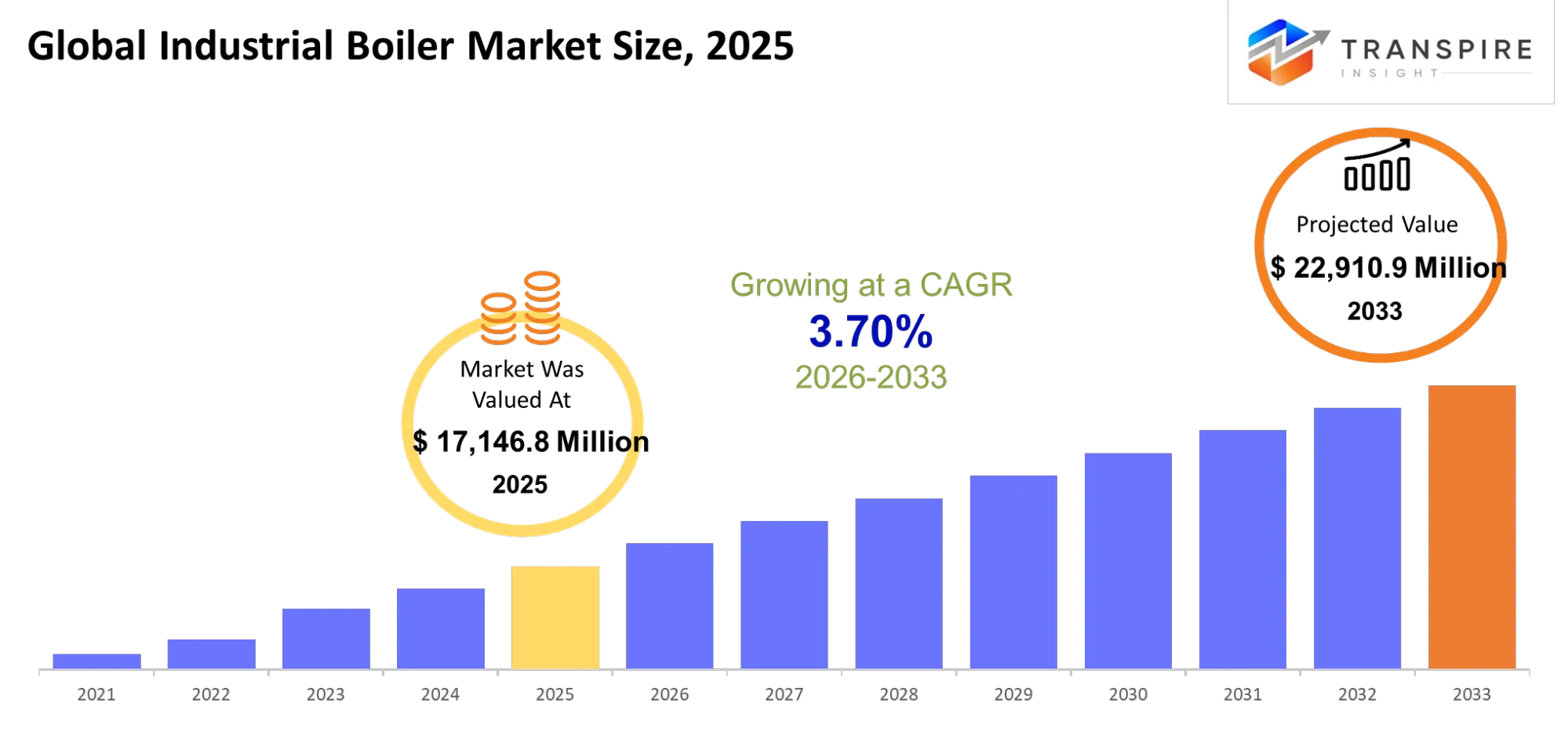
- Global Industrial Boiler Market Size 2025: USD 17,146.8 Million
- Global Industrial Boiler Market Size 2033: USD 22,910.9 Million
- Global Industrial Boiler Market CAGR: 3.70%
- Global Industrial Boiler Market Segments: By Boiler Type (Fire-Tube Boiler, Water-Tube Boiler, Electric Boiler), By Fuel Type (Natural Gas, Coal, Oil, Biomass), By End-User Industry (Power Generation, Chemical & Petrochemical, Food & Beverage, Oil & Gas, Pulp & Paper)
To learn more about this report,  Download Free Sample Report
Global Industrial Boiler Market Summary
The global industrial boiler market was valued at USD 17,146.8 million in 2025 and is projected to reach USD 22,910.9 million by 2033, growing at a CAGR of 3.70%. Industrial boilers are designed as pressure vessels to create steam or really hot water for process heating, electricity generation, and cogeneration use in all sorts of energy-hungry industries. The product group really covers fire-tube boilers, where combustion gases flow through tubes surrounded by water; water-tube boilers, in which water circulates through tubes exposed to flue gases; and electric boilers, which convert electrical energy right into thermal energy - without combustion at all. Their purpose is essential to industrial operations: not a single process industry runs on a large scale without having very reliable and quite efficient steam production infrastructure, which makes industrial boilers a super valuable capital equipment category - with very long installed life cycles and a lot of aftermarket service revenue potential.
The big structural change that has basically set the market's direction over the past 4 years is where industrial decarbonization requirements really intersect with ongoing demand growth from emerging economy industrial development. Here in Western Europe, North America, and Japan, stricter environmental regulations - focusing on industrial combustion emissions (including carbon dioxide taxes, nitrogen oxide concentration limits, and mandatory efficiency standards) - are pushing investment into fleet modernization: aging coal-fired boiler systems are getting replaced with natural gas, biomass, or electric options at a speed we never saw before when regulatory frameworks put some real economic incentives in place. At the same time, in South and Southeast Asia, China, and the Middle East, new industrial capacity in chemicals, food processing, and power generation is adding greenfield boiler demand at a rate that just about offsets the decommissioning volume in the mature markets. The actual result is a market growing at a fairly steady rather than an extremely aggressive pace - but still undergoing a really significant change in the mix of fuel types and in the geographic location of our customers.
Key Global Industrial Boiler Market Insights
- Asia Pacific really leads the industrial boiler industry with roughly 42% of revenue share in 2024 - and it's all thanks to China's ongoing expansion of its industrial capacity, India's manufacturing sector growth under the Production Linked Incentive scheme, and Southeast Asia's rapid industrialization in food processing, chemical, and textile sectors.
- North America ranks as the second biggest regional market - where fleet replacement investment - driven by aging installed bases and even tighter EPA emissions regulations for industrial combustion units - is continuously generating a lot of capital expenditure for high-efficiency natural gas and electric boiler systems.
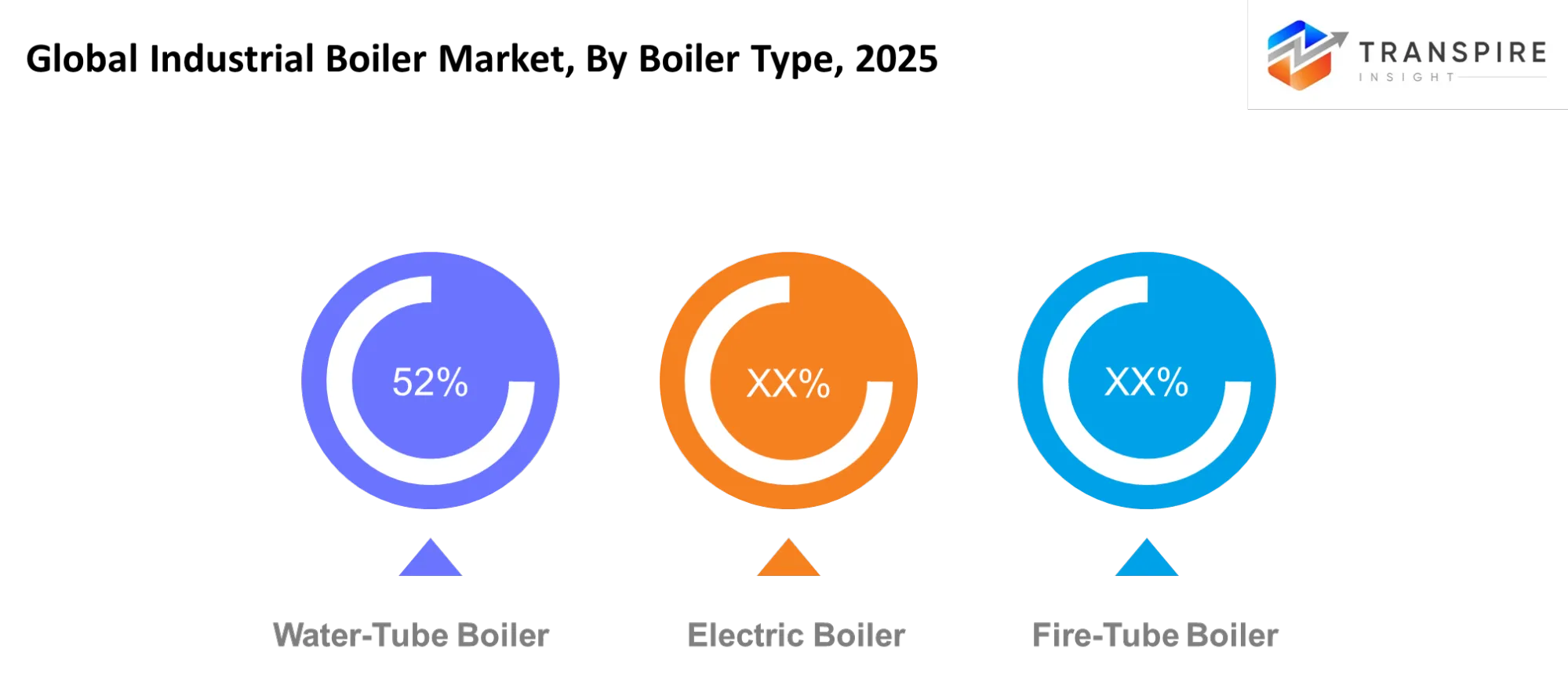
- Water-tube boilers really dominate the product landscape in the industrial boiler market, commanding about 52% of revenue share in 2024 - and it's because they have much better capacity for high-pressure, high-temperature applications in power generation and petrochemical processing where fire-tube designs are quite technically insufficient.
- Fire-tube boilers hold the second biggest position, with their lower cost, simpler maintenance profile, and suitability for lower-pressure applications consistently sustaining a demand in food and beverage, light industrial, and small-scale commercial heating applications.
- Electric boilers really represent the fastest-growing boiler type segment, with decarbonization policies, falling industrial electricity tariffs in renewable-heavy grids, and zero on-site emissions making them more and more viable for process heating applications that don't need the very high temperatures of combustion-based systems.
- Natural gas really is the dominant fuel type in the global industrial boiler industry, accounting for roughly 44% of fuel type revenue in 2024 - and it's all thanks to its combustion efficiency advantage, lower emissions profile relative to coal and oil, and the well-established pipeline infrastructure serving major industrial areas in North America, Europe, and some parts of Asia.
- Biomass really is the fastest-growing fuel type segment, with renewable energy policy incentives, carbon credit monetization, and availability of agricultural and forestry waste feedstocks in Asia, Europe, and Latin America driving new biomass boiler installations ahead of the overall market growth rates.
- Power generation really is the largest end-user industry segment with roughly 28% of revenue share in 2024 - with water-tube boilers serving utility-scale and industrial cogeneration plants in coal, natural gas, and biomass-to-energy facilities all over Asia and developing economy markets.
- Chemical and petrochemical end-users really represent the second biggest segment - requiring high-pressure steam for cracking, distillation, and reactor heating processes that really demand the continuous operational reliability and precision temperature control that top-of-the-line water-tube systems give you.
- Babcock & Wilcox, Thermax Limited, and Doosan Enerbility basically anchor the competitive landscape - with Babcock & Wilcox really leading in North American utility-scale and industrial boiler installations, Thermax holding a strong position all over Asian developing markets, and Doosan Enerbility serving the heavy industrial and power generation sectors in Korea and internationally.
What are the Key Drivers, Restraints, and Opportunities in the Global Industrial Boiler Market?
Market growth is mainly driven by the simultaneous occurrence of greenfield industrial expansion in developing countries and fleet replacement investment in more mature markets - a fundamental combination that maintains demand all over the market's geographical scope without either dynamic relying on the other. In India, Southeast Asia, and the Middle East, the construction of new chemical plants, food processing facilities, and district energy systems results in direct capital expenditure demand for boiler systems that are expected to function for 20-30 years itself.
In North America and Western Europe, the existing base of industrial boilers - a big part of which were commissioned prior to 2005 and have now reached or are approaching the end-of-design-life - is producing replacement demand that is actually amplified instead of diminished by stricter emissions regulations. The regulatory uplift effect is commercially quite meaningful: replacing a 15-year-old boiler with a modern, highly efficient system is a capital cost that can be somewhat justified through fuel savings and avoided emissions compliance costs, and in markets where carbon pricing mechanisms are active - including the EU Emissions Trading System - that justification math becomes quite persuasive.
The biggest structural restraint is the extremely high capital intensity and very long procurement cycle of industrial boiler projects. An industrial boiler system for a power generation or petrochemical application is really not a commodity purchase: lead times from ordering to commissioning for large water-tube boiler systems range from 18 to 36 months, and the overall installed cost including engineering, civil works, and commissioning can exceed USD 50 million for utility-scale installations itself. This creates demand cyclicality: boiler procurement is directly tied to major capital investment cycles in end-user industries, which are themselves highly sensitive to commodity price environments, interest rate levels, and energy policy certainty. When any of these factors creates investment uncertainty - just as occurred in the power generation sector in several markets during 2022-2023 in response to energy market volatility - boiler procurement deferral can actually affect quarterly and annual revenues for equipment manufacturers quite a bit. This cyclical exposure is a structural characteristic of the capital equipment market that no manufacturer can entirely insulate against.
The clearest forward-looking opportunity is the electrification-ready boiler platform - industrial electric boiler systems designed to work at the scale and operational continuity requirements of process industries that currently rely on combustion boilers itself.
What Has the Impact of Artificial Intelligence Been on the Global Industrial Boiler Market?
Predictive maintenance and operational optimization represent the most commercially advanced applications of artificial intelligence within the industrial boiler industry, and the economic argument is clear-cut. Industrial boiler systems constitute significant assets with replacement costs in the millions of dollars and operational criticality that renders unplanned downtime financially disastrous for process industries. Machine learning models trained on sensor data streams including flue gas temperature, steam pressure variation, tube metal temperatures, and combustion stoichiometry can identify degradation patterns weeks or months prior to their manifestation as equipment failure, thereby allowing maintenance intervention that avoids forced outage costs entirely.
Combustion optimization is the second active application area. AI-driven combustion control systems adjust the fuel-air ratio, burner configuration, and heat distribution parameters in real time in response to load variation, fuel quality changes, and ambient conditions, maintaining the optimal thermal efficiency across operating ranges that previously required manual adjustment.
Validated deployments in food and beverage and chemical processing facilities report fuel efficiency improvements of 3–8% from AI combustion optimization relative to conventional control systems — a financially significant gain given the fuel cost exposure of continuous-process industrial operations. Thermax Limited and Forbes Marshall have both commercially deployed AI-assisted combustion management systems in Indian industrial facilities, providing case study evidence that the technology is operationally viable in emerging market industrial environments as well as in Western facilities with more extensive digital infrastructure.
The concrete limitation of current AI adoption in the industrial boiler industry is data infrastructure readiness at the installed base level. The majority of the world's industrial boiler installed base comprises systems installed prior to 2015 that aren't inherently equipped with the sensor density and connectivity necessary to feed machine learning models at the desired data quality and frequency required for reliable predictive analytics. Retrofitting legacy systems with IoT sensor packages is technically possible although economically variable the payback period for a comprehensive sensor retrofit will largely depend on boiler age, criticality, and the remaining operational life of the asset and many operators in cost-sensitive emerging market industrial environments have yet to make that investment. Until the installed base transitions to systems designed with digital connectivity as a standard feature, AI's commercial impact in this market will continue to be concentrated in the premium service tier rather than distributed across the entire installed base.
Key Market Trends
- Babcock & Wilcox completed the commercial deployment of its ClimateBright decarbonization platform between 2021 and 2023, combining biomass and hydrogen co-firing capability with existing natural gas boiler architecture to reduce emissions without full system replacement.
- Siemens Energy's industrial steam and heat division expanded its digitally connected service contract portfolio between 2022 and 2024, with AI-assisted remote monitoring now offered across more than 2,000 industrial boiler installations in Europe and North America.
- India's Production Linked Incentive scheme for chemical, food processing, and pharmaceutical manufacturing generated estimated USD 1.8 billion in new industrial boiler procurement between 2021 and 2024, accelerating Thermax and Forbes Marshall's domestic order books.
- The European Union's Industrial Emissions Directive revision, finalized in 2024, imposed tighter NOₓ and particulate emission limits on industrial combustion installations, creating mandatory upgrade or replacement investment for an estimated 15,000 industrial boiler installations across EU member states.
- Biomass boiler installations in Southeast Asia grew at an above-market rate between 2021 and 2024, driven by Indonesian and Thai government renewable energy incentives and the availability of palm kernel shell and sugarcane bagasse as established boiler fuel feedstocks.
- Miura Co. Ltd. expanded its modular once-through steam generator concept into the North American food and beverage market between 2021 and 2024, capturing share from conventional fire-tube boiler installations through a combination of rapid startup time, compact footprint, and direct-to-operator service contracting.
- Hydrogen co-firing in industrial boilers was piloted across more than 30 industrial facilities in Germany, Japan, and South Korea between 2022 and 2024, establishing the technical feasibility of up to 20% hydrogen blend ratios in existing natural gas boiler systems without burner replacement.
- Doosan Enerbility secured a major contract for supercritical boiler systems for a new power generation complex in Vietnam in 2023, reflecting continued strong demand for high-efficiency coal and gas boiler technology in Southeast Asian markets where baseload generation capacity remains a development priority.
Global Industrial Boiler Market Segmentation
By Boiler Type
Water-tube boilers hold the largest segment position in the global industrial boiler market at approximately 52% revenue share in 2024, and the structural reasons are rooted in the physics of high-pressure, high-temperature steam generation. In applications requiring steam at pressures above 30 bar including utility-scale power generation, petrochemical processing, and large-scale cogeneration water-tube designs are the only technically viable option.
However, in markets where carbon pricing, renewable energy certificate schemes, or industrial decarbonization mandates alter the comparative economics the Nordic countries, parts of Germany, and increasingly the United Kingdom electric boilers have achieved commercial competitiveness for certain industrial heat applications. The technology's advantages are compelling in appropriate contexts: zero on-site combustion emissions, no flue gas treatment requirement, near-instantaneous load response, and a power-to-heat conversion efficiency approaching 99%. IHI Corporation and Bosch Thermotechnology have both invested in expanded electric boiler product ranges in response to anticipated policy-driven demand acceleration through 2033.
To learn more about this report, Download Free Sample Report
By Fuel Type
Natural gas holds the largest fuel type segment position at approximately 44% in 2024, supported by a combination of technical, economic, and regulatory advantages that no alternative fuel currently replicates across the full range of industrial boiler applications. Natural gas combustion achieves the highest thermal efficiency of any fossil fuel in boiler applications, produces lower NOₓ and particulate emissions than coal or oil at equivalent thermal output, and benefits from established pipeline infrastructure in the major industrial zones of North America, Western Europe, Northeast Asia, and the Middle East Gulf region. Regulatory preference for natural gas over coal and oil in new industrial boiler permitting — reflected in NOₓ and SO₂ emission limits that coal and oil boilers can often only meet through expensive post-combustion treatment — has reinforced natural gas's share of new installation decisions even in markets where coal historically dominated.
By End-User Industry
Power generation is the largest end-user industry segment at approximately 28% revenue share in 2024, driven by the scale of individual project procurement — a single utility-scale boiler system for a 500 MW power plant represents a capital equipment value that dwarfs the annual procurement of entire smaller end-user segments. In developing economies where grid capacity expansion remains a priority, coal and natural gas fired water-tube boiler systems for baseload power generation represent the highest-value contract category in the industrial boiler market. Waste-to-energy and biomass-to-energy plant construction in Europe and East Asia add a growing sub-segment of large water-tube boiler procurement that carries renewable energy policy support and therefore a more predictable pipeline than merchant power generation investment.
What are the Key Use Cases Driving the Global Industrial Boiler Market?
The primary use case is continuous process steam production for manufacturing and chemical processing – the category of application that represents the largest portion of global industrial boiler operating hours and results in the most consistent capital replacement and aftermarket service demand. A food processing plant, pharmaceutical manufacturer, or chemical facility operating continuously demands a steam supply system with a reliability specification approaching 99. 8% uptime, and the boiler system is essentially the single piece of equipment whose failure would shut down the entire facility.
The second major use case is utility-scale power generation and industrial cogeneration, driving the highest-value individual procurement decisions in the market. A 500 MW coal or natural gas-fired power plant necessitates a high-pressure water-tube boiler system which may cost USD 80–150 million for the boiler island alone, and project procurement cycles of 3–5 years from conceptual engineering through commissioning create order backlog visibility unique among capital equipment categories.
The emerging use case expected to grow disproportionately by 2033 is decarbonization retrofit and fuel transition projects – the systematic replacement or conversion of coal and oil-fired boiler installations with natural gas, biomass, or electric equivalents to meet regulatory or voluntary carbon reduction commitments. This use case is structurally distinct from conventional replacement procurement since it's triggered by policy timelines rather than equipment lifecycle, it involves a wider range of engineering complexity than like-for-like replacement, and represents recurring business across entire industrial estates rather than isolated facility decisions.
|
Report Metrics |
Details |
|
Market size value in 2025 |
USD 17,146.8 Million |
|
Market size value in 2026 |
USD 17,764.6 Million |
|
Revenue forecast in 2033 |
USD 22,910.9 Million |
|
Growth rate |
CAGR of 3.70% from 2026 to 2033 |
|
Base year |
2025 |
|
Historical data |
2021 – 2024 |
|
Forecast period |
2026 – 2033 |
|
Report coverage |
Revenue forecast, competitive landscape, growth factors, and trends |
|
Regional scope |
United States; Canada; Mexico; United Kingdom; Germany; France; Italy; Spain; Russia; China; Japan; India; Australia; South Korea; Indonesia; Thailand; Brazil; Argentina; South Africa; Saudi Arabia; United Arab Emirates |
|
Key companies profiled |
Bosch Thermotechnology GmbH, Babcock & Wilcox Enterprises Inc., Thermax Limited, Mitsubishi Heavy Industries Ltd., Siemens Energy AG, General Electric Company, Doosan Enerbility Co. Ltd., IHI Corporation, Alfa Laval AB, Cleaver-Brooks Inc., Forbes Marshall Pvt. Ltd., Miura Co. Ltd., Cochran Ltd., John Wood Group plc, Fulton Boiler Works Inc. |
|
Customization scope |
Free report customization (country, regional & segment scope). Avail customized purchase options to meet your exact research needs. |
|
Report Segmentation |
By Boiler Type (Fire-Tube Boiler, Water-Tube Boiler, Electric Boiler), By Fuel Type (Natural Gas, Coal, Oil, Biomass), By End-User Industry (Power Generation, Chemical & Petrochemical, Food & Beverage, Oil & Gas, Pulp & Paper) |
Which Regions are Driving the Global Industrial Boiler Market Growth?
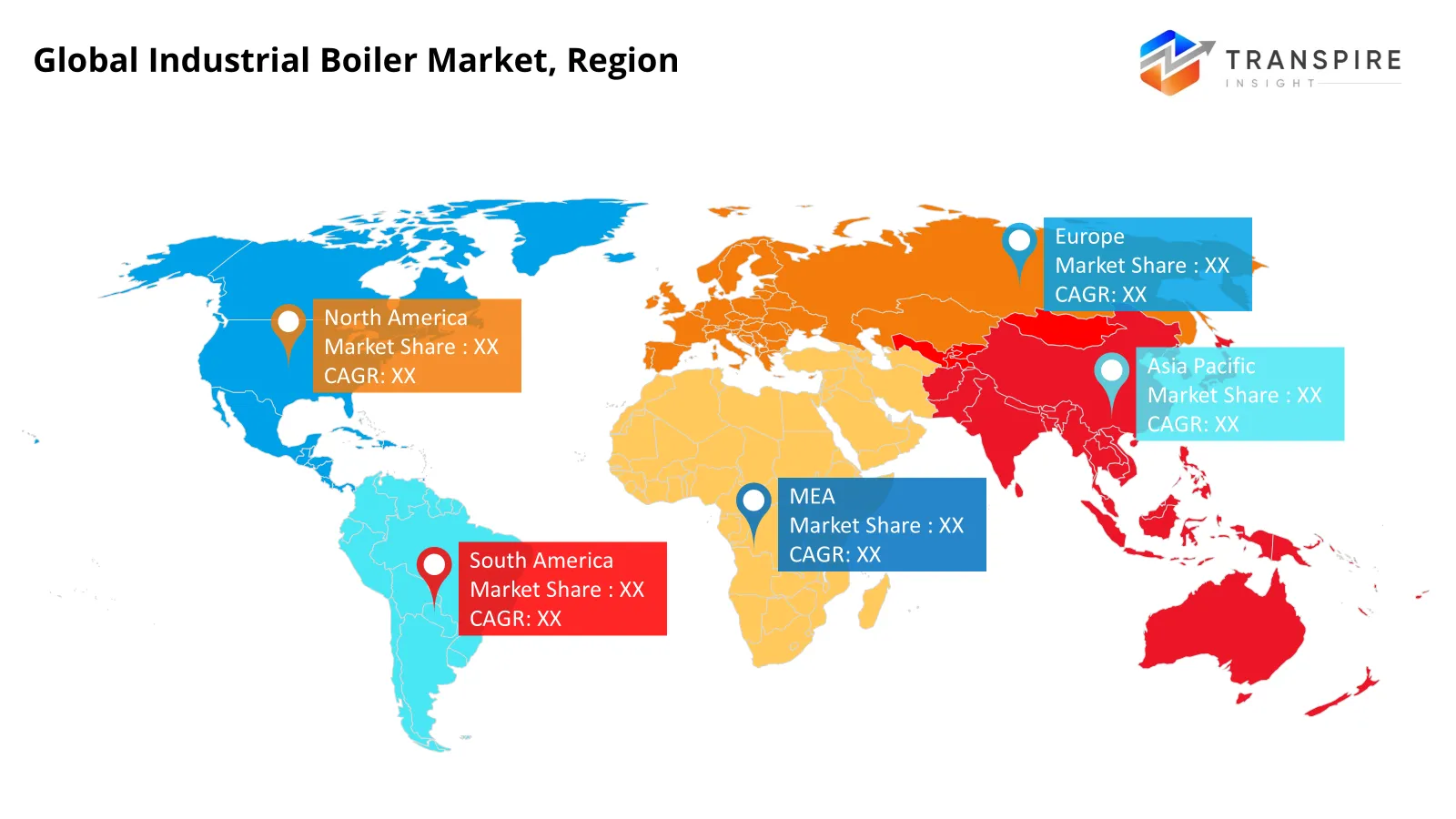
Asia Pacific really sets the pace globally for the industrial boiler market, boasting about 42 percent revenue share in 2024 - and the underlying structure for this supremacy is both the sheer size of its existing installed base and the rapid pace of its ongoing greenfield industrial development. China holds the world's biggest fleet of industrial boilers by installed thermal capacity - an estimated 620,000 units as of 2023 - and although the Chinese government's ongoing coal capacity reduction policy is indeed moderating new coal boiler installations, replacement investment in natural gas and biomass equivalents plus continued expansion of chemical and food processing sectors keeps aggregate procurement volumes steady. India's industrial boiler market is growing at a rate above its regional average, driven by the government's manufacturing capacity expansion programs, rapidly growing food processing and pharmaceutical sectors, and increasing private investment in cogeneration infrastructure by sugar, textile, and chemical industries.
North America really contributes the second-largest regional revenue share - and the nature of its demand really differs quite significantly from Asia Pacific's growth-driven procurement. The North American industrial boiler market is primarily a replacement and upgrade market: a large proportion of its installed base was commissioned in the 1990s and 2000s and is approaching or has exceeded its design life, and the EPA's National Emission Standards for Hazardous Air Pollutants for industrial boilers — the NESHAP rule — has imposed compliance deadlines that have driven mandatory equipment upgrades across tens of thousands of industrial facilities. Manufacturers including Cleaver-Brooks, Fulton Boiler Works, and Babcock & Wilcox really have strong North American distribution and service infrastructure that positions them well for this replacement cycle.
Europe really occupies the third-largest regional position - and it's really distinguished by having the highest regulatory intensity of any region when it comes to industrial decarbonization requirements. The EU Industrial Emissions Directive, the EU Emissions Trading System, and individual member state carbon reduction commitments create a policy environment in which industrial boiler operators face binding economic incentives to transition fuel types and upgrade thermal efficiency that don't really have precise equivalents in other major markets. This regulatory pressure is driving above-average demand for biomass and electric boilers, hydrogen co-firing retrofit projects, and high-efficiency heat recovery system integration within the region's chemical, food, and paper industry boiler installations. German, Scandinavian, and Dutch industrial operators are at the forefront of this transition, with Bosch Thermotechnology and Alfa Laval both really positioned to benefit from the investment cycle their domestic regulatory environments are generating.
To learn more about this report, Download Free Sample Report
Who are the Key Players in the Global Industrial Boiler Market and How Do They Compete?
The global industrial boiler market has a moderate level of consolidation at the utility-scale and heavy industrial level - and it's very fragmented at the light industrial and commercial heating level. The top five manufacturers - Babcock & Wilcox, Mitsubishi Heavy Industries, Doosan Enerbility, GE's steam power division, and IHI Corporation - really hold a significant portion of the high-value water-tube boiler segment for power generation and large petrochemical applications, where engineering complexity, material specifications, and installation capability requirements really create practical barriers to entry - ones that haven't changed much in decades. Below this tier, the competitive landscape includes dozens of regional manufacturers with strong positions in specific end-user industries or geographic markets but very limited global cross-selling capability. The main axes of competition in the market have shifted over the last decade from the price of single units towards total lifecycle cost, service contract capabilities, digital monitoring platform maturity, and actual performance on decarbonization-related retrofit projects.
Thermax Limited occupies a really distinctive competitive position as the number one player in the Indian industrial boiler market - with an expanding presence across Southeast Asia and Africa. The company's competitive advantage is a combination of deep application engineering knowledge - it designs and manufactures boiler systems for a wider range of fuel types and industrial applications than most comparable-scale competitors - and a service and installation network perfectly calibrated for the cost and logistics constraints of emerging market industrial environments.
Miura Co. Ltd. represents the most differentiated competitive model in the fire-tube and light industrial boiler segment globally. Its once-through modular steam generator concept - which achieves full steam output from cold start in approximately three minutes, compared to 30-45 minutes for conventional fire-tube designs - offers a very compelling operational advantage for food and beverage and pharmaceutical applications where production schedules need frequent start-stop operation.
Global Industrial Boiler Market Companies
- Bosch Thermotechnology GmbH
- Babcock & Wilcox Enterprises Inc.
- Thermax Limited
- Mitsubishi Heavy Industries Ltd.
- Siemens Energy AG
- General Electric Company
- Doosan Enerbility Co. Ltd.
- IHI Corporation
- Alfa Laval AB
- Cleaver-Brooks Inc.
- Forbes Marshall Pvt. Ltd.
- Miura Co. Ltd.
- Cochran Ltd.
- John Wood Group plc
- Fulton Boiler Works Inc.
Recent Developments
In January 2026, Babcock & Wilcox Enterprises Inc. announced the award of an engineering, procurement, and construction contract for a 250 MW biomass-to-energy boiler system for a combined heat and power facility in the Netherlands, marking the company's largest European biomass boiler project by thermal capacity. The project incorporates Babcock & Wilcox's BrightLoop chemical looping combustion technology for near-zero CO₂ emission operation and is expected to reach commercial operation in 2028. https://www.babcock.com (Babcock & Wilcox Enterprises).
In February 2026, Thermax Limited announced the commissioning of India's first commercial-scale green hydrogen co-firing industrial boiler installation at a pharmaceutical manufacturing facility in Pune, Maharashtra, where a Thermax natural gas boiler system has been retrofitted to operate on a 15% hydrogen blend. The project was executed in partnership with NTPC Limited and the Ministry of New and Renewable Energy under India's National Green Hydrogen Mission. https://www.thermaxglobal.com (Thermax Limited).
In March 2026, Siemens Energy AG announced an expansion of its industrial steam and heat digital service platform branded SIESTART with the integration of large language model-assisted fault diagnosis capability across its connected industrial boiler monitoring network. The expanded platform serves over 2,400 connected boiler installations across Europe and North America and reduces mean time to diagnostic resolution for remote service cases by an estimated 40% relative to conventional rule-based diagnostic systems. https://www.siemens-energy.com (Siemens Energy AG).
What Strategic Insights Define the Future of the Global Industrial Boiler Market?
Over the next five to seven years, the industrial boiler market's competitive structure will be reshaped by the decarbonization-driven bifurcation of its customer base into two groups with fundamentally different procurement priorities. Industrial operators in carbon-priced markets — covering an increasing proportion of global industrial output as carbon pricing mechanisms spread beyond the EU — will procure boiler systems primarily on the basis of fuel flexibility, carbon compliance certification, and documented pathway to net-zero compatibility. Industrial operators in non-carbon-priced markets will continue to procure primarily on capital cost and fuel efficiency. Manufacturers that develop product architectures and commercial frameworks calibrated for the first group — fuel-flexible systems with documented hydrogen co-firing readiness, biomass compatibility certification, and integration with digital monitoring that generates carbon reporting data — will capture a disproportionate share of the highest-value new installation and replacement contracts globally.
The risk that the market's moderate CAGR masks is the concentration of value migration into the service and digital layer. As boiler hardware commoditizes at the fire-tube and light industrial tier — driven by Chinese manufacturer cost competition and mature manufacturing technology — the manufacturers that capture margin expansion are those that have built proprietary service contracts, remote monitoring data streams, and performance guarantee frameworks around their installed bases. Manufacturers that compete primarily on equipment price without equivalent investment in the service infrastructure are watching their margin erode in real time. The strategic imperative for mid-tier manufacturers is to invest in service capability and digital connectivity now, before installed-base relationships are appropriated by third-party industrial IoT platform operators who do not manufacture equipment but capture the data-driven service economics.
The most actionable near-term strategic recommendation for market participants is to invest in the hydrogen co-firing retrofit certification program as a commercial product — a documented, tested, performance-guaranteed conversion pathway for existing natural gas boiler installations to operate on hydrogen blends up to 30–50% by volume. The industrial base of natural gas boilers in Europe, Japan, and North America represents hundreds of billions of dollars of installed capital that operators cannot afford to replace entirely on a rapid decarbonization timeline. A manufacturer that can offer a certified hydrogen-ready retrofit kit, complete with regulatory compliance documentation and performance warranty, addresses the most urgent capital allocation need of industrial energy managers operating under binding 2030 and 2035 emissions reduction commitments — and does so at a service revenue price point that is more defensible than commodity equipment sales.
Global Industrial Boiler Market Report Segmentation
By Boiler Type
- Fire-Tube Boiler
- Water-Tube Boiler
- Electric Boiler
By Fuel Type
- Natural Gas
- Coal
- Oil
- Biomass
By End-User Industry
- Power Generation
- Chemical & Petrochemical
- Food & Beverage
- Oil & Gas
- Pulp & Paper
Frequently Asked Questions
Find quick answers to common questions.
The Global Industrial Boiler Market size is expected to reach USD 22,910.9 Million by 2033.
The key segments of the Global Industrial Boiler Market are By Boiler Type (Fire-Tube Boiler, Water-Tube Boiler, Electric Boiler), By Fuel Type (Natural Gas, Coal, Oil, Biomass), By End-User Industry (Power Generation, Chemical & Petrochemical, Food & Beverage, Oil & Gas, Pulp & Paper).
Major players in the Global Industrial Boiler Market include Bosch Thermotechnology GmbH, Babcock & Wilcox Enterprises Inc., Thermax Limited, Mitsubishi Heavy Industries Ltd., Siemens Energy AG, General Electric Company, Doosan Enerbility Co. Ltd., IHI Corporation, Alfa Laval AB, Cleaver-Brooks Inc., Forbes Marshall Pvt. Ltd., Miura Co. Ltd., Cochran Ltd., John Wood Group plc, and Fulton Boiler Works Inc.
The Global Industrial Boiler Market size is USD 17,146.8 Million in 2025.
The Global Industrial Boiler Market CAGR is 3.70% from 2026 to 2033.
- Bosch Thermotechnology GmbH
- Babcock & Wilcox Enterprises Inc.
- Thermax Limited
- Mitsubishi Heavy Industries Ltd.
- Siemens Energy AG
- General Electric Company
- Doosan Enerbility Co. Ltd.
- IHI Corporation
- Alfa Laval AB
- Cleaver-Brooks Inc.
- Forbes Marshall Pvt. Ltd.
- Miura Co. Ltd.
- Cochran Ltd.
- John Wood Group plc
- Fulton Boiler Works Inc.
Recently Published Reports
-
Apr 2026
Healthcare Polymer Packaging Market
Healthcare Polymer Packaging Market Size, Share & Analysis Report By Packaging Type (Syringes, IV Bottles and Pouches, Clamshells, Blisters, Bottles & Jars, Containers, Tubes, IV Parental Packaging, Others), By Type (Regulated, Non-regulated), By Polymer Type (LDPE (Low-Density Polyethylene), HDPE (High-Density Polyethylene), Homo-polymer (Homo), Random Copolymer (Random), Block Copolymer (Block), PET, Polystyrene, Polyvinyl Chloride, Polyamide/EVOH, Others), and Geography (North America, Europe, Asia-Pacific, Middle East and Africa, South and Central America), 2021 - 2031
-
Apr 2026
Hydrophilic Tape (Waterstop) Market
Hydrophilic Tape (Waterstop) Market Size, Share & Analysis Report By Type (Bentonite-Based Hydrophilic Tape, Rubber-Based Hydrophilic Tape), By Application (Residential Buildings, Commercial Buildings, Infrastructure Projects), and Geography (North America, Europe, Asia-Pacific, Middle East and Africa, South and Central America), 2021 - 2031
-
Apr 2026
Metalens Market
Metalens Market Size, Share & Analysis Report By Type (Visible Light Metalens, and Infrared Metalens), By Application (Consumer Electronics, Automotive Electronics, Industrial, Medical, and Others), and Geography (North America, Europe, Asia-Pacific, Middle East and Africa, South and Central America), 2021 - 2031
-
Apr 2026
PBT Resin Market
PBT Resin Market Size, Share & Analysis Report By Type (Reinforced PBT Resin, Unreinforced PBT Resin), By Processing Method (Injection Molding, Extrusion, Blow Molding, Others), By End-User (Automotive, Electrical & Electronics, Consumer Appliances, Industrial Machinery, Medical Devices, Packaging, Others), and Geography (North America, Europe, Asia-Pacific, Middle East and Africa, South and Central America), 2021 - 2031