
Global Future of the Hot Food Vending Machine Market Size & Forecast:
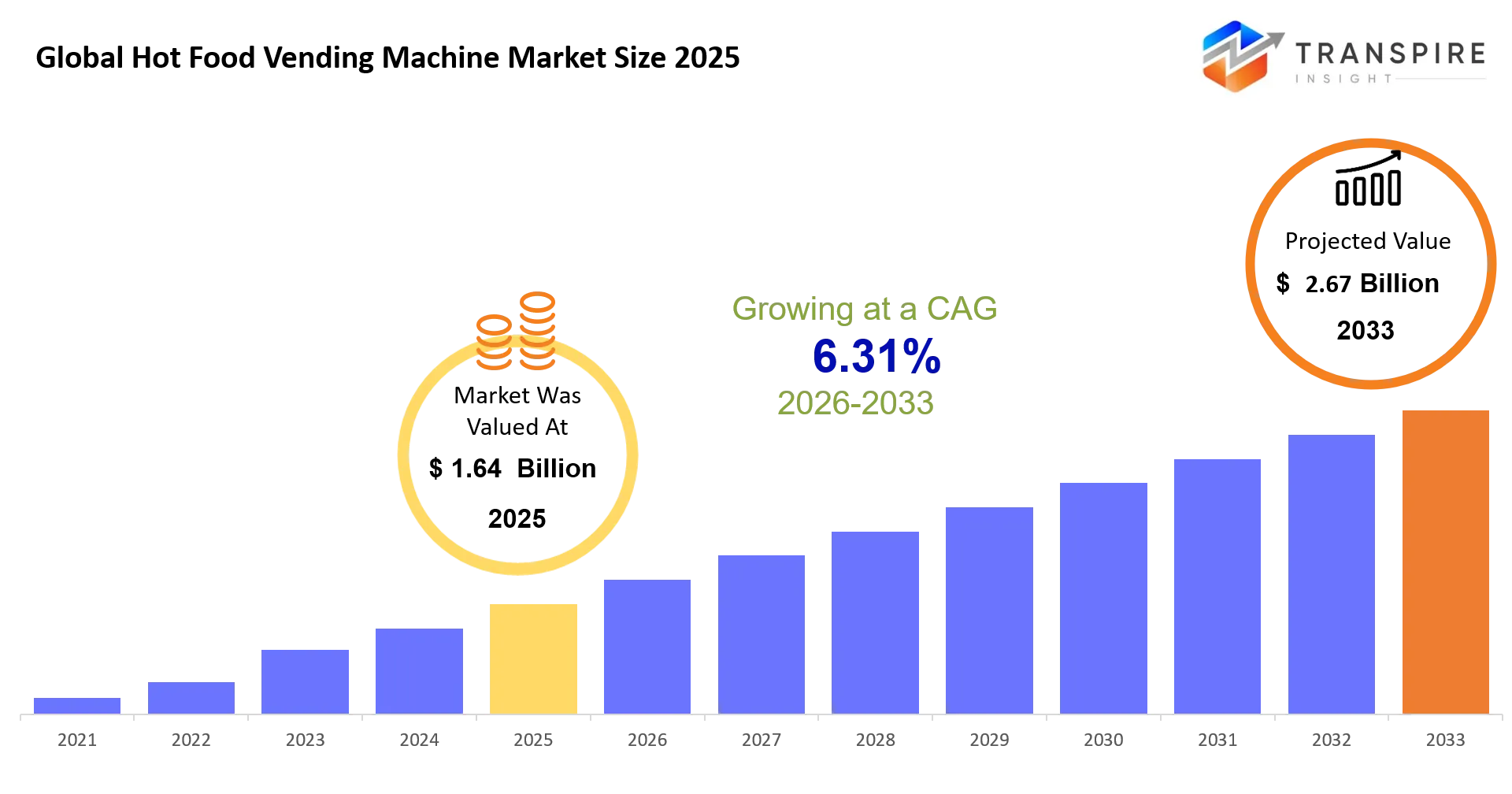
- Global Future of the Hot Food Vending Machine Market Size 2025: USD 1.64 Billion
- Global Future of the Hot Food Vending Machine Market Size 2033: USD 2.67 Billion
- Global Future of the Hot Food Vending Machine Market CAGR: 6.31%
- Global Future of the Hot Food Vending Machine Market Segments: By Machine Type (Microwave Vending Machines, Refrigerated Hot Food Machines, Smart Hot Food Vending Machines, Conveyor-based Machines, Touchscreen Vending Machines, Robotic Vending Machines, Combo Food Machines, Others); By Food Type (Ready Meals, Pizza, Burgers, Sandwiches, Noodles & Pasta, Snacks, Bakery Products, Others); By Payment Mode (Cash, Card Payment, Mobile Wallet, QR Payment, NFC Payment, Smart Card, Biometric Payment, Others); By End User (Corporate Offices, Educational Institutions, Hospitals, Transportation Hubs, Retail Stores, Hotels, Manufacturing Facilities, Others); By Installation (Indoor, Outdoor, Wall-mounted, Free-standing, Smart Kiosks, Compact Units, High-capacity Units, Others)
Global Future of the Hot Food Vending Machine Market Summary
As per Transpire Insight Analysis, the Global Future of the Hot Food Vending Machine Market size is estimated at USD 1.64 Billion in 2025 and is anticipated to reach USD 2.67 Billion by 2033, growing at a CAGR of 6.31% from 2026 to 2033. This automated retail sector manufactures, deploys, and operates unstaffed self-service kiosks engineered with integrated thermal, microwave, or robotic heating mechanisms to store, cook, and dispense hot meals on demand. Over the past few years - a permanent contraction in traditional corporate cafeteria operating hours alongside a sharp rise in 24/7 logistical shifts has forced real estate and facility managers to seek non-staffed dining options. This behavioral progression triggered a major structural shift as food service operators migrated from basic coin-operated snack boxes to IoT-connected cloud platforms capable of monitoring internal temperature safety zones in real time. By feeding instant cashless transactions into internal heating cycles, these machines allow high-footfall institutions to deliver hot, hygienic food around the clock while systematically eliminating kitchen labor overhead.
Key Market Insights
The global hot food vending machine landscape is transitioning from isolated, coin-operated mechanical hardware toward cloud-connected, telemetry-driven automated micro-cafeterias. Driven by acute institutional catering labor deficits and an escalating requirement for round-the-clock contactless meal availability, enterprise networks and municipal hubs are swapping traditional manual canteens for high-efficiency, multi-cooking food cells that dynamically alter internal oven parameters based on real-time ingredient requirements.
- Locking down a dominant 36% market share, Smart Hot Food Vending Machines lead the machine type matrix, with global vendors like Selecta Group expanding their unattended IoT retail lineups to deploy dynamic, app-linked smart fridges that track food shelf-life and unlock automated multi-buy consumer discounts.
- Expanding at a market-accelerating standalone CAGR of 18.2%, Robotic Vending Machines dominate product architectural growth as major corporate offices and high-density industrial plants transition from standard static vending coils to multi-axis articulated arms that physically prep and bake artisanal items on demand.
- Capturing a dominant 35% of total global revenue, Europe functions as the largest regional market, backed by dense urban transit infrastructure corridors, strict labor regulations restricting manual night-shift kitchen staff, and rapid deployment of energy-efficient automated catering kiosks by equipment groups like Evoca.
- Pacing regional market growth with an explosive standalone CAGR of 19.4%, Asia Pacific acts as the fastest-growing territory, fueled by massive smart-city transit expansions across metropolitan hubs and widespread consumer behavioral acceptance of automated QR-code and mobile wallet macro-retail systems.
- Securing a vital 26% market slice, North America drives rapid digital integration, forcing machinery brands like Crane NXT to engineering-deploy advanced telemetry networks that push instantaneous sales tracking and real-time internal heating core data straight to cloud operators.
- Accounting for a targeted 20% share of total industry volume, Microwave Vending Machines remain an essential operational standard, prompting manufacturers like Jofemar to upgrade their localized heating modules with localized microwave magnetrons to achieve 45-second meal cooking times without scorching issues.
- Representing 15% of the machine type matrix, Refrigerated Hot Food Machines face heavy infrastructural optimization as engineering crews integrate dual-zone thermal insulation to safely maintain fresh ingredients at 4 degrees Celsius before transferring them to immediate cooking modules.
- Holding a stable 10% market share, Conveyor-based Machines minimize product dropping accidents on the packaging floor, as manufacturers like FastCorp expand internal vacuum and conveyor belt paths to safely slide complex or liquid-heavy containers from cold storage chambers directly into consumer slots.
- Securing a targeted 8% of total hardware demand, Touchscreen Vending Machines redefine custom food ordering, pushing vendors like Azkoyen Group to roll out interactive user interfaces that showcase granular allergen declarations, nutritional values, and dynamic promotional messaging directly to corporate buyers.
- Claiming an integrated 6% market presence, Combo Food Machines expand across compact corporate satellite branches where space-constrained facilities integrate multi-dish configurations to distribute chilled salads, carbonated beverages, and freshly cooked hot meals simultaneously through a single, uniform spatial footprint.
What Are the Key Drivers, Restraints, and Opportunities in the Global Future of the Hot Food Vending Machine Market?
Driver
The market expansion is heavily propelled by the acute reduction in corporate and institutional kitchen labor alongside an escalating corporate shift toward decentralized, unstaffed corporate dining infrastructures. Operating traditional manned cafeterias places immense operational friction on institutional budgets due to skyrocketing food service wages and strict compliance regulations for night-shift culinary staff, pushing corporate real estate managers toward standalone micro-cafeteria networks. Global automated retail systems address these overhead gaps by supplying climate-controlled, unstaffed food kiosks that safely preserve fresh meals before triggering ultra-fast internal heating cycles. This structural transition in facility management directly increases enterprise machinery leasing values and parts replacement revenues as high-footfall institutions aggressively scale automated dining access while bypassing manual kitchen overhead entirely.
In February 2026, automation pioneer Grupo Azkoyen officially showcased its latest smart automated payment and interactive catering advancements at the Horeca Professional Expo (HIP 2026). The strategic platform roll-out addresses intense labor shortages across the hospitality and retail sectors by expanding their automated smart payment architectures alongside compact self-service food configurations. By integrating cloud-linked telemetry frameworks with customizable multi-dish dispensing options, this enterprise deployment demonstrates how food service operators are scaling high-tech unattended kiosks to ensure seamless, round-the-clock dining access while structurally protecting operational margins against persistent kitchen labor inflation.
Restraint
Severe electrical power supply draw limitations and complex multi-zone thermal configuration dependencies act as a major structural barrier holding back rapid outdoor deployment and footprint scaling. When non-staffed food kiosks attempt to simultaneously execute heavy refrigeration storage cycles at 4 degrees Celsius and rapid, high-wattage microwave or convection baking cycles at over 160 degrees Celsius, the resultant thermal load strains standard facility power grids. This technical friction persists because traditional public transportation hubs and legacy educational hallways lack high-amperage dedicated electrical outlets, leading to frequent circuit breaker trips, inconsistent internal cooking temperatures, and high localized installation costs that severely depress immediate operator returns.
Opportunity
The most lucrative growth window lies in the technical integration of vision-guided multi-axis robotic arms and adaptive, multi-compartment induction heating chambers optimized for complex, variable-sized fresh food configurations. Fusing localized edge-computing AI models with non-contact infrared thermal profiling sensors allows robotic vending structures to instantly modify custom baking times and mechanical grip positions based on raw ingredient moisture content. This technological movement unlocks highly profitable recurring managed service and maintenance revenue pipelines across emerging healthcare and transit sectors, where facility buyers willingly invest in high-capacity kiosks that deliver freshly baked, restaurant-quality meals without triggering mechanical conveyor box jams.
What Has the Impact of Artificial Intelligence Been on the Global Future of the Hot Food Vending Machine Market?
Artificial intelligence is completely reinventing the hot food vending machine market, shifting standard food-dispensing arrangements away from passive, storage-only hardware boxes toward highly optimized, telemetry-driven automated micro-cafeterias. Equipment vendors deploy localized edge-computing algorithms to optimize cooking configurations, automatically altering mechanical induction heating times and multi-stage microwave power levels based on raw ingredient weight and moisture profiles.
Inside high-velocity commercial catering environments, built-in AI architectures drive massive operational improvements through predictive inventory forecasting and real-time freshness tracking. These machine learning pipelines continuously evaluate historical hourly transaction surges, local calendar events, and live ambient weather trends to accurately predict identical ingredient depletion velocities. By anticipating these structural food demand patterns, the smart system proactively throttles internal cold-storage cooling parameters, auto-routes localized replenishment vehicles, and minimizes spoilage by up to 21% to protect tight retail margins.
However, a serious operational limitation persists around high upfront component integration costs and steep mechanical hardware accuracy gaps. Executing precise automated operations requires expensive sensor arrays and multi-axis actuators, creating significant capital friction when syncing advanced software platforms with rigid legacy mechanical coin or drop tracks.
In May 2026, electronics distribution and automation leader Fuji Electric Co., Ltd. officially outlined its comprehensive Food and Beverage Distribution strategic growth framework, highlighting the widespread integration of advanced demand-prediction artificial intelligence across its next-generation smart retail product lines. This technology architecture embeds advanced machine learning data layers straight into unified vending telemetry modules, allowing operators to transition away from rigid, manual restocking intervals. By processing real-time transactional data loops to optimize product line configurations and streamline supply chain distributions, the framework enables commercial operators to maximize daily sales volumes while systematically reducing localized food waste across expanding global corridors.
Key Market Trends
The global hot food vending machine space is moving rapidly away from simple, isolated snack-dispensing hardware loops toward data-driven, intelligent micro-cafeteria networks. Spurred by widespread kitchen labor deficits and an institutional push to deploy automated 24/7 food storefronts, organizations are abandoning basic mechanical coil machines in favor of unified, IoT-enabled hot meal dispensing ecosystems.
- Facility operators are shifting away from manual, multi-person corporate canteens to deploy unstaffed smart micro-cafeterias capable of serving hot meals around the clock without manual overhead.
- Machine developers are moving from standard spiral-drop dispensing rails to implement multi-axis elevator grids and robotic transport tracks that prevent food packaging tilt failures.
- Logistics managers are abandoning static, pre-scheduled manual restocking intervals to adopt cloud-connected telemetry frameworks that analyze real-time SKU-level depletion metrics remotely.
- Culinary suppliers are transitioning from standard ambient, preservative-heavy shelf snacks to distribute fresh, vacuum-sealed ready meals kept inside precise 4°C refrigerated storage chambers.
- Engineering squads are stepping away from traditional single-magnetron microwave chambers to integrate dual-source convection and infrared hybrid ovens that heat meals evenly in under 60 seconds.
- Procurement officers are abandoning standalone cash or coin validator slots to enforce multi-protocol cashless networks incorporating QR codes, mobile wallets, and contactless NFC tap terminals.
- Food safety compliance teams are moving past legacy end-of-day physical inventory checks to implement automated, cloud-enabled freshness monitors that lock out expired items instantly.
- Real estate coordinators are shifting from large-footprint dining infrastructures to deploy ultra-compact, modular smart kiosks that fit within space-constrained hospital waiting rooms and transit lounges.
- Maintenance crews are abandoning reactive on-site diagnostic servicing routines to leverage edge-AI predictive software modules that flag mechanical thermal core discrepancies before system downtime occurs.
Global Future of the Hot Food Vending Machine Market Segmentation
By Machine Type
Smart Hot Food Vending Machines command the largest share of market capital, holding a dominant 36% of global revenue due to their advanced IoT telemetry, real-time freshness tracking capabilities, and widespread deployment across modern corporate and transit infrastructures. Microwave Vending Machines follow at 20%, Refrigerated Hot Food Machines hold 15%, Conveyor-based Machines capture 10%, while Touchscreen Machines, Combo Food Machines, and other variations account for the remaining 19% of the total industry footprint. This structural division is shaped by the operator necessity for unified cloud connectivity that simultaneously addresses remote inventory monitoring and dynamic heat cycle adjustments. Smart Hot Food variants maintain this peak position because mid-market facility managers and multi-location operators seek to minimize unneeded restocking trips and protect food safety margins by utilizing automated web dashboards to oversee active kiosk networks. Moving forward, structural designs will pivot toward fully automated robotic architectures, expanding at an explosive standalone CAGR of 18.2% as developers integrate articulated multi-axis arms that physically assemble and format customized, fresh meals on demand.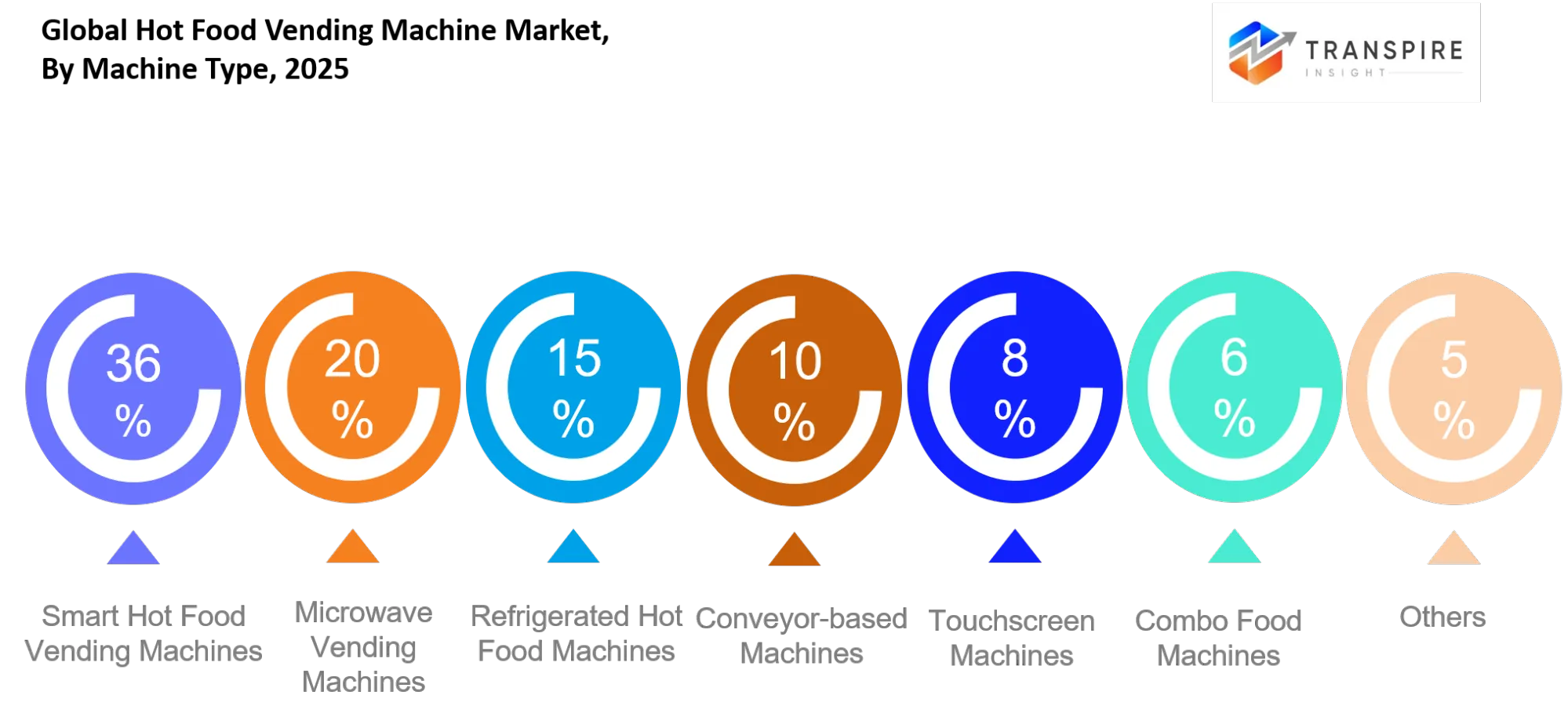
By Food Type
Ready Meals serve as the primary financial engine of this segment, locking down a dominant portion of total industry revenue, while Pizza and Burgers follow closely as highly active, fast-growing consumer culinary preferences. Sandwiches and Noodles & Pasta capture a stable secondary share, with Snacks and Bakery Products expanding steadily across high-traffic transit corridors. The underlying growth logic relies on the corporate and student transition away from traditional manned canteens toward instant, substantive hot meal alternatives during off-peak operational hours. Ready Meals lead the market position because multi-shift industrial workers and healthcare professionals require complete, nutritionally balanced lunch and dinner options available 24/7 without waiting for delivery drivers. Moving forward, food type varieties will focus heavily on premium, health-conscious artisanal and allergen-free culinary preparations, compelling food technology suppliers to design specialized, multi-temperature internal chambers that safely heat plant-based and gourmet meals without altering taste textures.
By Payment Mode
Mobile Wallets and QR Payments function as the absolute anchor of this matrix, while contactless NFC Payments stand out as the fastest-accelerating market driver, expanding at a high standalone CAGR as consumers demand ultra-fast checkout loops. Cash and traditional Card Payments follow as legacy operational standards, while Biometric and Smart Card systems emerge across highly closed institutional environments. This distribution pattern is driven by the macro shift away from friction-heavy physical currency toward unified, digital transaction ecosystems. Mobile Wallet and QR configurations lead the growth dynamic because modern smartphone-dependent consumers demand instantaneous, secure transaction authorizations that interface directly with internal machine cooking triggers. Moving forward, payment processing frameworks will move past manual terminal screens entirely, shifting toward frictionless "just-walk-away" facial recognition and app-linked biometric payment nodes that automatically settle account balances the moment a heated food door is opened.
By End User
Corporate Offices lead the market with a commanding share of global industry volume, driven by dense white-collar corporate setups and a widespread shift toward automated micro-cafeterias in suburban office complexes. Concurrently, Educational Institutions, Hospitals, and Transportation Hubs represent highly active, dense secondary buyer pipelines with continuous foot traffic. The underlying market logic is dictated by the extreme footfall density and irregular schedules found within these environments, where hospital night-shift nursing crews and airport travelers require high-quality hot nutrition when nearby restaurants are locked. Corporate Offices maintain their peak financial position because real estate managers heavily leverage unstaffed food kiosks to provide an attractive employee perk while systematically cutting down expensive onsite kitchen staff overhead. Moving forward, target installation channels will shift aggressively toward mixed-use micro-logistics hubs and manufacturing facilities, forcing equipment developers to supply heavy-duty, high-capacity kiosks engineered to withstand continuous structural use under abrasive, industrial conditions.
By Installation
Free-standing units command the largest share of market capital, holding a dominant position in global revenue due to their large-capacity inventory storage bins, robust insulation structures, and versatile installation placement options across empty hallway footprints. Smart Kiosks follow as a highly active, rapidly accelerating secondary segment, while Wall-mounted and Compact Units present steady spatial alternatives for smaller facility layouts. This division persists because managing large lunch-hour crowds requires heavy internal machinery frames capable of storing hundreds of fresh meal cassettes simultaneously. Free-standing models maintain their peak position because transit nodes and factory breakrooms possess the raw floor space and dedicated high-voltage electrical connections needed to support continuous multi-oven configurations. Looking ahead, structural footprints will pivot heavily toward modular, outdoor weather-proof kiosks, compelling equipment manufacturers to engineer specialized climate-controlled outer shells that safeguard internal refrigeration parameters against extreme outdoor summer heat and freezing winter conditions.
What Are the Key Use Cases Driving the Global Future of the Hot Food Vending Machine Market?
Smart hot food vending machine platforms drive the bulk of this market because deploying cloud-connected telemetry frameworks alongside real-time internal freshness sensors requires unified, intelligent operating logic. Institutional facility managers configure these high-capacity, free-standing kiosks across high-density corporate offices and manufacturing facilities, allowing multi-shift organizations to safely deliver fresh ready meals around the clock without scaling up expensive manual kitchen staff overhead or disrupting continuous production lines.
Outside core office spaces - transit operators and hospital administrative groups leverage dual-zone thermal storage units to implement contactless dining cells across space-constrained waiting rooms and airport lounges. Because these public transport and healthcare environments require rapid, hygienic food turnover without long waiting lines, operators rely on advanced microwave and convection modules to heat pizza or noodle bowls uniformly in under 60 seconds.
Lately - university campuses and large retail chains are aggressively adopting vision-guided robotic vending machines and multi-protocol mobile wallet terminals for personalized consumer food dispensing. Campus dining crews deploy these modular, microservices-driven kiosks to separate late-night student food demand from closed daytime canteens—enabling educational facilities to dynamically minimize ingredient spoilage while maximizing localized transaction volumes through quick QR-code checkouts.
|
Report Metrics |
Details |
|
Market size value in 2025 |
USD 1.64 Billion |
|
Market size value in 2026 |
USD 1.74 Billion |
|
Revenue forecast in 2033 |
USD 2.67 Billion |
|
Growth rate |
CAGR of 6.31% from 2026 to 2033 |
|
Base year |
2025 |
|
Historical data |
2021 - 2024 |
|
Forecast period |
2026 - 2033 |
|
Report coverage |
Revenue forecast, competitive landscape, growth factors, and trends |
|
Regional scope |
United States; Canada; Mexico; United Kingdom; Germany; France; Italy; Spain; China; Japan; India; Australia; South Korea; Brazil; Argentina; South Africa; Saudi Arabia; United Arab Emirates |
|
Key company profiled |
Selecta Group, Crane NXT, Azkoyen Group, Fuji Electric, Bianchi Vending, SandenVendo, Seaga Manufacturing, Jofemar, Rheavendors Group, Westomatic, Royal Vendors, FastCorp, Evoca Group, Sielaff, FAS International |
|
Customization scope |
Free report customization (country, regional & segment scope). Avail customized purchase options to meet your exact research needs. |
|
Report Segmentation |
By Machine Type (Microwave Vending Machines, Refrigerated Hot Food Machines, Smart Hot Food Vending Machines, Conveyor-based Machines, Touchscreen Vending Machines, Robotic Vending Machines, Combo Food Machines, Others); By Food Type (Ready Meals, Pizza, Burgers, Sandwiches, Noodles & Pasta, Snacks, Bakery Products, Others); By Payment Mode (Cash, Card Payment, Mobile Wallet, QR Payment, NFC Payment, Smart Card, Biometric Payment, Others); By End User (Corporate Offices, Educational Institutions, Hospitals, Transportation Hubs, Retail Stores, Hotels, Manufacturing Facilities, Others); By Installation (Indoor, Outdoor, Wall-mounted, Free-standing, Smart Kiosks, Compact Units, High-capacity Units, Others) |
Which Regions are Driving the Global Future of the Hot Food Vending Machine Market Growth?
Europe maintains a commanding grip on the hot food vending machine market, capturing a dominant 35% of all worldwide industry revenue. This geographic leadership is heavily driven by the permanent contraction of manual institutional catering hours and strict labor laws restricting late-night manual kitchen staff overhead across dense urban zones. The regional ecosystem is structurally supported by heavily concentrated corporate offices, massive transportation hubs, and university canteens that demand unstaffed food options around the clock. Consequently, transitioning away from traditional manned corporate canteens toward long-term, energy-efficient automated micro-cafeteria frameworks has become the standard operational baseline for European enterprises securing 24/7 food access.
In October 2025, Swiss unattended retail operator Selecta Group officially optimized its European commercial real estate footprints by introducing advanced cloud-connected smart fridges and hot food modules across high-density logistics corridors. This structural delivery model integrates advanced telemetry software directly into modular automated retail networks, enabling operations crews to replace manual inventory checks with automated multi-buy promotions. By utilizing these real-time data loops to track exact product shelf-life and reduce localized food waste, the expansion allows regional clients to maximize continuous food availability while lowering total canteen operating overhead.
The Asia Pacific region functions as the primary financial growth engine of the global market, locking down an essential 30% share of total industry demand while exploding at a market-leading standalone CAGR of 19.4%. While European operational expansion is propelled by labor-restricting night shifts and corporate office restructuring, Asian hot food vending machine adoption is shaped by massive government-led smart city transit hub upgrades and high consumer behavioral acceptance of automated macro-retail systems. This regional market stability is structurally insulated by dense metropolitan transit networks across expanding economies that demand ultra-fast, hygienic grab-and-go nutrition. To handle volatile passenger footfall surges and minimize line latency, continental station networks steadily invest in robust, automated ready-meal systems featuring integrated high-speed thermal blocks.
In March 2025, electronics manufacturing and automation leader Fuji Electric Co., Ltd. officially deployed its next-generation automated retail hardware architecture at the Osaka Kansai Expo to showcase smart infrastructure capabilities. This technical integration leverages native hydrogen-cartridge chemical power structures alongside advanced high-speed internal cooking cores to achieve stable, off-grid automated food preparation loops entirely independent of fixed grid connections. By allowing high-traffic public operators to seamlessly install automated food systems across dense crowds without high-voltage wiring retrofits, this product launch establishes an ultra-reliable blueprint for real-time meal dispensing across the expanding Asian infrastructure market.
North America serves as a highly stable, predictable tertiary pillar for the global market, locking down an essential 26% share of total industry volume. This geographic territory is driven by rapid commercial warehouse infrastructure expansions and a deep corporate necessity to supply 24/7 food access across automated logistics and distribution centers. Historically, industrial facilities relied on small, snack-only mechanical coils or outsourced catering trucks to feed staff during off-peak times, but a severe local workforce deficit has forced the adoption of fully unstaffed hot meal kiosks. Looking ahead, future retail optimization in this booming corridor relies entirely on deploying centralized multi-protocol cashless networks that connect directly with corporate badge tracking software to minimize consumer checkout friction.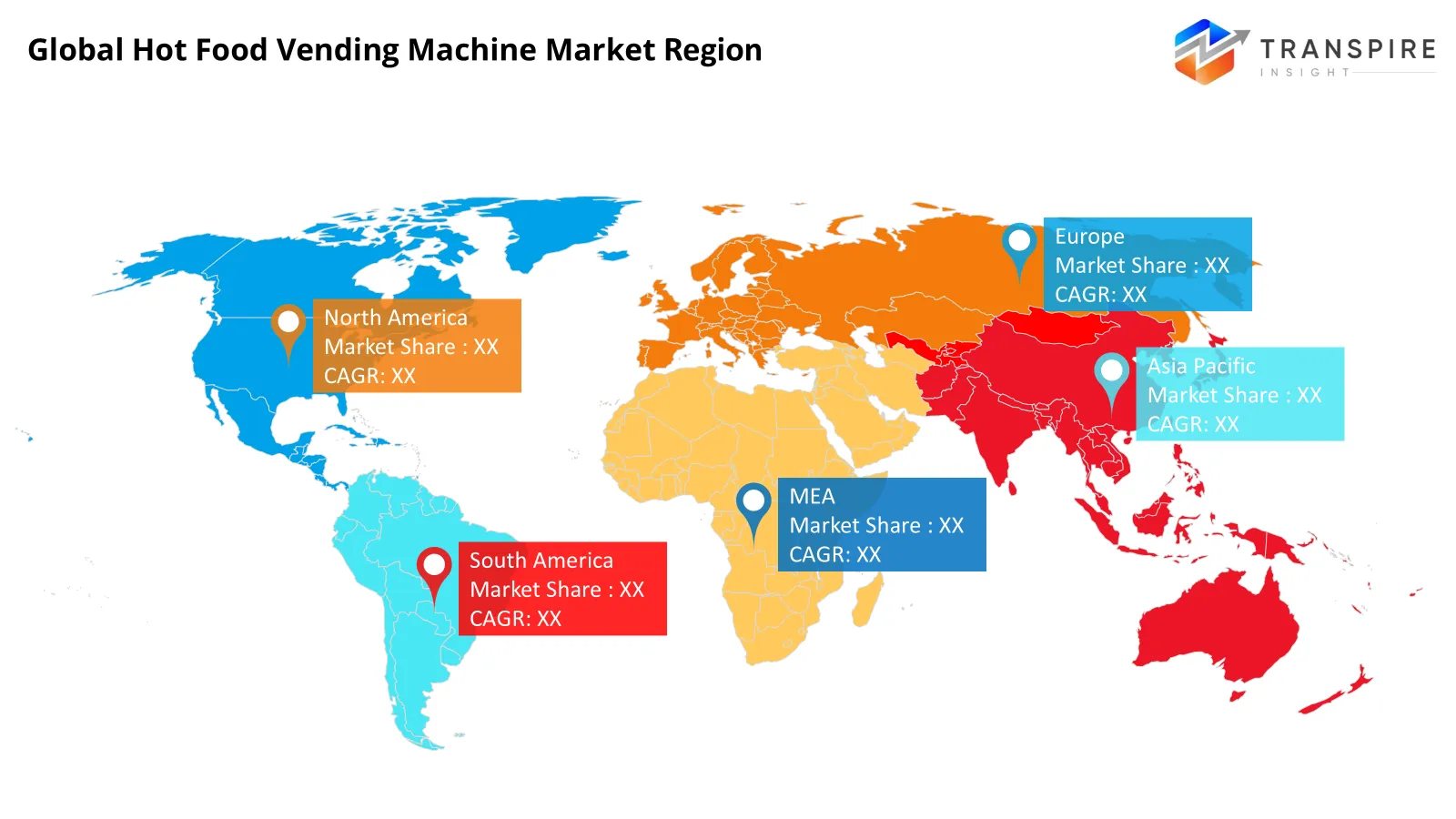
Who Are the Key Players in the Global Future of the Hot Food Vending Machine Market and How Do They Compete?
The global hot food vending machine space is an intense battleground contested by multi-billion-dollar electronic manufacturing conglomerates - legacy European commercial vending networks, and specialized robotic retail technology providers. With institutional facility managers accelerating their transition to unstaffed micro-cafeterias to capture round-the-clock transaction volume, vendors compete on three operational fronts: engineering high-velocity induction and convection thermal cores, deploying cloud-linked telemetry frameworks for real-time freshness tracking, and providing flexible multi-protocol cashless and biometric transaction endpoints.
Selecta Group utilizes a massive scale-and-cost optimization strategy, positioning its extensive unattended retail business around fully managed, data-driven micro-market deployments and low-overhead catering integrations. What makes them stand out is their proprietary "Foodie’s" automated retail ecosystem and a robust proactive replenishment framework, which leverages instant cloud telemetry to execute real-time stock adjustments and minimize product stockouts across diverse corporate locations. The enterprise expands its global market footprint by deploying scalable, module-based hardware nodes like compact smart fridges and high-capacity fresh ready-meal cells to systematically cross-sell comprehensive, automated dining setups to high-turnover industrial and corporate sectors.
Crane NXT runs a highly sophisticated technical innovation strategy focused squarely on high-security payment infrastructure, modular equipment reliability, and cloud-connected telemetry configurations. The vendor differentiates its market presence by embedding its advanced Crane Convenience architectures and specialized bill validation modules directly into integrated, single-system vending frames to eliminate system downtime during heavy consumer meal rushes. They expand their industrial footprint by value-engineering resilient, high-volume automated solutions for transportation hubs, educational spaces, and commercial facilities, deploying durable hardware configurations that combine hard-to-replicate fraud resistance with precise thermal cooking controls worldwide.
Company List
- Selecta Group
- Crane NXT
- Azkoyen Group
- Fuji Electric
- Bianchi Vending
- SandenVendo
- Seaga Manufacturing
- Jofemar
- Rheavendors Group
- Westomatic
- Royal Vendors
- FastCorp
- Evoca Group
- Sielaff
- FAS International
Recent Development News
In November 2025, unattended self-serve retail leader Selecta Group officially renewed its multi-market strategic partnership with Red Bull for the 2025–2027 period across 16 European countries. This commercial collaboration focuses heavily on data-driven growth by integrating product line volumes with shared real-time telemetry dashboards, enabling operators to optimize product placements and capture higher immediate consumer transactions within high-traffic corporate offices and transit lounges. [https://www.selecta.com
In April 2026, authentication and traceability technology provider Crane NXT, Co. successfully finalized the acquisition of Antares Vision S.p.A. for approximately - €362 million in cash. This structural consolidation directly expands Crane NXT's hardware portfolio into the high-volume food, beverage, and life sciences tracking segments, allowing the enterprise to embed advanced automated visual inspection, product authentication, and digital track-and-trace analytics directly into next-generation industrial self-service retail kiosks. [https://investors.cranenxt.com
In February 2026, automated equipment manufacturer Evoca Group officially executed a major executive leadership transition by appointing Norman Rafael as Chief Executive Officer. This corporate development directly drives the international deployment of the company's smart telemetry frameworks and accelerates the commercial scaling of its ISO-certified eco-friendly automated catering systems across global commercial paths. [https://www.evocagroup.com/en]
What Strategic Insights Define the Global Future of the Hot Food Vending Machine Market?
The hot food vending machine market is heading toward autonomous micro-retail ecosystems, where isolated snack boxes transform into fully automated, robotic micro-cafeterias that use edge-AI computing to dynamically alter localized menu selections based on real-time consumer purchasing velocity.
A critical hidden risk lies in "localized grid capacity friction." As operators replace low-wattage candy coils with high-capacity kiosks that combine continuous 4°C refrigeration cycles and sudden, high-voltage multi-oven thermal baking draws, legacy facility electrical systems face severe power overloads, leading to frequent breaker failures and expensive terminal retrofits. Conversely - a major emerging opportunity is the integration of vision-guided robotic arms with dynamic induction cooking cores, allowing kiosks to safely dispense variable-sized artisanal ready meals. Strategic recommendation: Facility operators must abandon legacy transactional hardware leases to execute unified, telemetry-driven managed service contracts backed by automated freshness tracking modules to maximize 24/7 - transaction volume while protecting tight retail margins.
By Machine Type
- Microwave Vending Machines
- Refrigerated Hot Food Machines
- Smart Hot Food Vending Machines
- Conveyor-based Machines
- Touchscreen Vending Machines
- Robotic Vending Machines
- Combo Food Machines
- Others
By Food Type
- Ready Meals
- Pizza
- Burgers
- Sandwiches
- Noodles & Pasta
- Snacks
- Bakery Products
- Others
By Payment Mode
- Cash
- Card Payment
- Mobile Wallet
- QR Payment
- NFC Payment
- Smart Card
- Biometric Payment
- Others
By End User
- Corporate Offices
- Educational Institutions
- Hospitals
- Transportation Hubs
- Retail Stores
- Hotels
- Manufacturing Facilities
- Others
By Installation
- Indoor
- Outdoor
- Wall-mounted
- Free-standing
- Smart Kiosks
- Compact Units
- High-capacity Units
- Others
Regional Outlook
North America
- United States
- Canada
- Mexico
Europe
- Germany
- United Kingdom
- France
- Spain
- Italy
- Rest of Europe
Asia Pacific
- Japan
- China
- Australia & New Zealand
- South Korea
- India
- Rest of Asia Pacific
South America
- Brazil
- Argentina
- Rest of South America
Middle East & Africa
- Saudi Arabia
- United Arab Emirates
- South Africa
- Rest of the Middle East & Africa
Frequently Asked Questions
Find quick answers to common questions.
The Global Future of the Hot Food Vending Machine Market size was valued at USD 1.64 Billion in 2025 and is poised to reach USD 2.67 Billion by 2033, expanding at a 6.31% CAGR.
Key segments for the Global Future of the Hot Food Vending Machine Market are Machine Type (Microwave Vending Machines, Refrigerated Hot Food Machines, Smart Hot Food Vending Machines, Conveyor-based Machines, Touchscreen Vending Machines, Robotic Vending Machines, Combo Food Machines, Others); Food Type (Ready Meals, Pizza, Burgers, Sandwiches, Noodles & Pasta, Snacks, Bakery Products, Others); Payment Mode (Cash, Card Payment, Mobile Wallet, QR Payment, NFC Payment, Smart Card, Biometric Payment, Others); End User (Corporate Offices, Educational Institutions, Hospitals, Transportation Hubs, Retail Stores, Hotels, Manufacturing Facilities, Others); Installation (Indoor, Outdoor, Wall-mounted, Free-standing, Smart Kiosks, Compact Units, High-capacity Units, Others).
Growth is primarily driven by the acute reduction in corporate and institutional kitchen labor overhead, an escalating commercial real estate shift toward unstaffed corporate dining infrastructures, and a widespread institutional requirement to supply contactless, high-efficiency 24/7 hot nutrition to multi-shift workforces without running traditional manned cafeterias.
The global market is led by major manufacturers including Selecta Group, Crane NXT, Azkoyen Group, Fuji Electric, Bianchi Vending, SandenVendo, Seaga Manufacturing, Jofemar, Rheavendors Group, Westomatic, Royal Vendors, FastCorp, Evoca Group, Sielaff, and FAS International.
Europe holds a dominant 35% share of the global market, heavily influencing overall industry dynamics due to its highly integrated public transit infrastructure corridors, strict domestic labor regulations that drive up the costs of night-shift kitchen staffing, and a rapid, widespread cultural and commercial adoption of energy-efficient automated catering kiosks.
Lucrative commercial opportunities exist in the technical integration of vision-guided multi-axis robotic arms and adaptive multi-compartment induction heating chambers that alter baking times based on food moisture, unlocking highly profitable recurring managed service and software maintenance revenue pipelines across expanding transit and healthcare sectors.
- Selecta Group
- Crane NXT
- Azkoyen Group
- Fuji Electric
- Bianchi Vending
- SandenVendo
- Seaga Manufacturing
- Jofemar
- Rheavendors Group
- Westomatic
- Royal Vendors
- FastCorp
- Evoca Group
- Sielaff
- FAS International
About the Authors

Chetan Dhatrak
I’m Chetan Dhatrak, a Senior Research Analyst at Transpire Insight, specializing in the Consumer Goods, Foods and Beverages industry. I focus on analyzing market trends, consumer behavior, competitive landscapes, and industry developments to deliver accurate, data-driven insights. My research at Transpire Insight is built on credible sources and in-depth analysis, helping businesses and readers better understand market dynamics, emerging opportunities, and evolving consumer preferences. I’m committed to creating reliable, well-researched content that supports informed decision-making and reflects the latest developments in the consumer goods and food & beverage sectors.

Chakradhar Khansole
Chakradhar serves as the Research Director at Transpire Insight, bringing over 8 years of experience in technology, innovation, and strategic market intelligence. He specializes in transforming complex market data into actionable business insights that enable organizations to make informed, growth-oriented decisions. Recognized for his strategic vision and analytical expertise, Chakradhar leads high-impact research initiatives, delivering comprehensive market assessments, competitive intelligence, and forward-looking industry analysis.
Recently Published Reports
-
Apr 2026
Bottled Water Market
Bottled Water Market Size, Share & Analysis Report By Product Type (Still Bottled Water, Carbonated Bottled Water, Functional Bottled Water, and Others), By Packaging (PET, Cans, and Others), By Sales Channel (Supermarkets/Hypermarkets, Convenience Stores/Drug Stores, Grocery Stores/Club Stores, Foodservice, and Others) and Geography (North America, Europe, Asia-Pacific, Middle East and Africa, South and Central America), 2021 - 2032
-
Apr 2026
Color Cosmetic Packaging Market
Color Cosmetic Packaging Market Size, Share & Analysis Report By Application (Mascara Packaging, Liquid Packaging, and Liquid Face), By Type (Tubes & Bottles, Pens & Markers, Compacts & Containers, and Droppers & Pumps), and Geography (North America, Europe, Asia-Pacific, Middle East and Africa, South and Central America), 2021 - 2031
-
Apr 2026
External Microphone For Camera Market
External Microphone For Camera Market Size, Share & Analysis Report By Type (Shotgun Microphone, Lavalier Microphone, and Others), By Application (Digital Camera, Professional Video Camera, and Others), and Geography (North America, Europe, Asia-Pacific, Middle East and Africa, South and Central America), 2021 - 2031
-
Apr 2026
Foot Orthotic Insoles Market
Foot Orthotic Insoles Market Size, Share & Analysis Report By Type (Pre-fabricated, and Custom-made), By Material (Thermoplastic, Composite Carbon Fiber, and Others), By Distribution Channel (Drug Stores, Hospitals & Clinics, and Others), and Geography (North America, Europe, Asia-Pacific, Middle East and Africa, South and Central America), 2021 - 2031