
Global High-Barrier Metallized Paper Snack Packaging Market Summary:
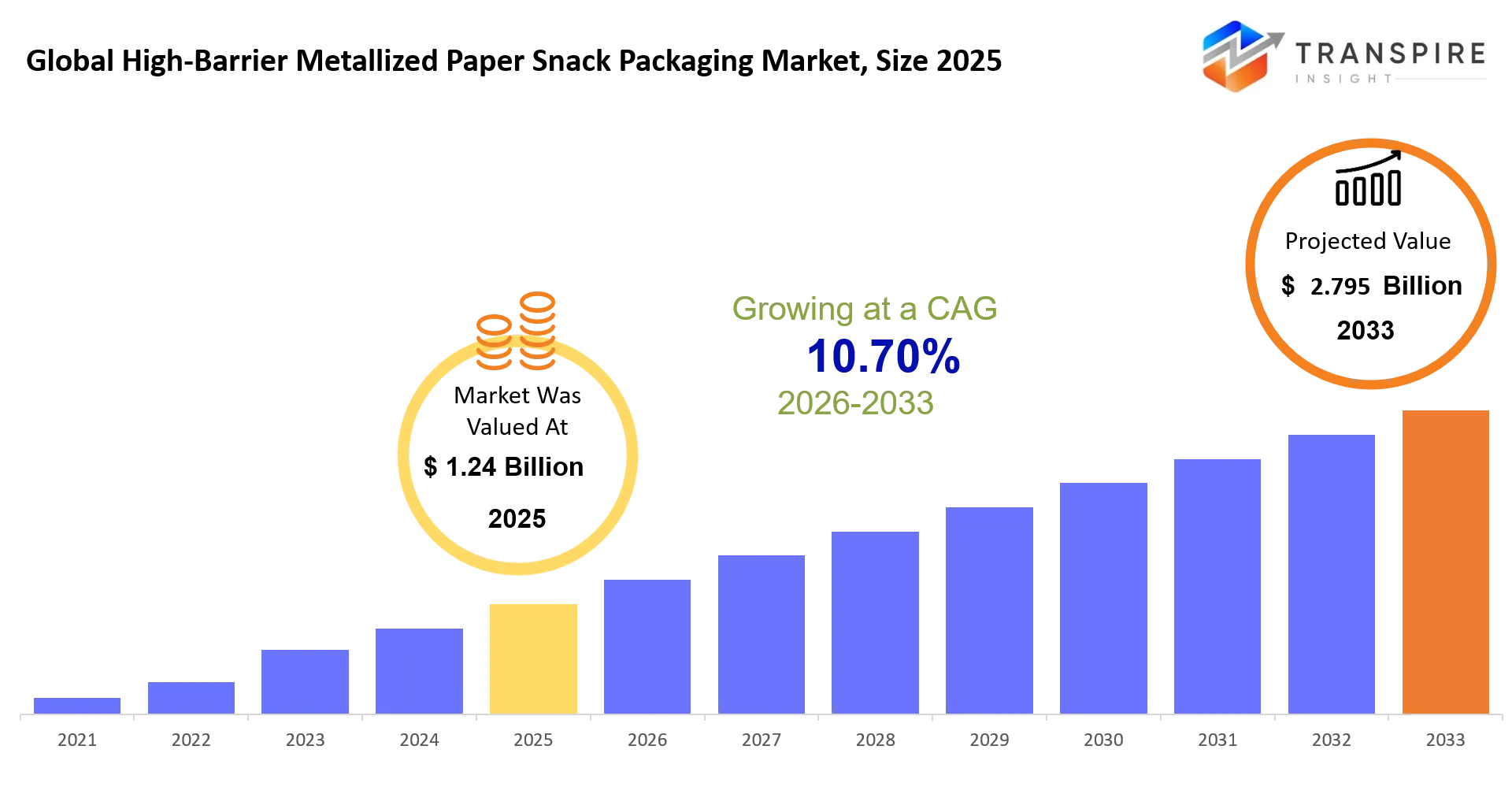
As per Transpire Insight Analysis, The Global High-Barrier Metallized Paper Snack Packaging Market size is estimated at USD 1.24 Billion in 2025 and is anticipated to reach USD 2.795 Billion by 2033, growing at a CAGR of 10.70% from 2026 to 2033.
The snack packaging papers industry serves snack packs that require long shelf life, high aroma retention, an appealing, premium appearance on the shelf, while reducing dependency on traditionally used plastics-based materials. During the last three to five years, this industry has moved from a handful of sustainability concept venture initiatives to broad commercial acceptance – food companies’ increasing capability to harmonize packaging with recyclability and stricter regulatory food contact standards. The leading change in the industry has been the gradual shift toward paper-based high-barrier substrates, as procurement teams have revised specifications during routine equipment selection cycles. Experience and market analysis also suggest that compliance with the landfill diversion initiatives and material reduction mandates is further fueling other snack pack marketers and converters along their packaging modernization initiatives faster. Market growth is further driven by improvements in barrier coating technology for increasing shelf life, ensuring optimal product quality, boosting food safety, shelf presentation, retailer appeal, and consumer value proposition.
Global High-Barrier Metallized Paper Snack Packaging Market Size & Forecast:
- Global Market Size 2025: USD 1.24 Billion
- Expected Market Value Size 2033: USD 2.795 Billion
- Forecast CAGR(2026-2033): 10.70%
- Leading Region in 2025: Europe (38%)
- Fastest Growing Region: Asia Pacific Region(29% and CAGR 17.5%)
- Key Company Profiles: Amcor, Mondi Group, Huhtamaki, Constantia Flexibles, Sonoco Products, Stora Enso, UFlex, Billerud, ProAmpac, Coveris, Sappi, Sealed Air, Smurfit WestRock, Koehler Paper, Innovia Films.
Key Global High-Barrier Metallized Paper Snack Packaging Market Insights:
Europe drives the market by containing both packaging requirements and recycling goals, which propel barrier paper to a quicker commercial pathway than the film-heavy packaging. The Asia Pacific food packaging market is transforming its approach from volume to performance, with the growth of urban retail and the rise in converting capacity.
- Europe accounts for 38%, and suppliers are developing repulpable barrier coatings as brands work towards premium shelf differentiation from compliance.
- Local-sourcing programs are driving the shaping of North America at 24%, with converters reducing lines and increasing reliability.
- Asia Pacific is 29%, while companies are increasing the size of moisture-stable structures due to the changing climate and higher expectations of pack performance.
- At 5%, Middle East & Africa is still import-led, and market activity is focused in GCC and South Africa, where premium snack imports warrant it.
- The pouches will remain the format leader with 41% of the market, and brands are prioritising high-barrier convenience over rigid materials.
- Stand-up pouches are trending upward at 19%, as brands look to achieve better shelf presence and consumer recognition.
- Optimisation of 15% flow wraps and 10% rollstock films for high-speed packing lines and material minimisation.
- The 5% laminated paper packaging niche is the fastest-growing niche, and the industry is investing in future-compliant recyclable multilayer packaging.
- Private label and snack makers are expanding adoption as they begin to guarantee barriers across a range of SKU families.
What are the Key Drivers, Restraints, and Opportunities in the Global High-Barrier Metallized Paper Snack Packaging Market?
Driver:
The biggest catalyst for growth was the move to fibre-based high-barrier packaging that provides plastic-like protective performance with improved recycling. This was driven by packaging waste regulations, retailer sustainability scorecards, and brand targets to reduce virgin plastics within defined conversion deadlines. It ensures oxygen, water vapour, and aroma barrier protection without compromising shelf appeal, enabling snack brands to protect quality, win retail listings and obtain more valuable packaging contracts.
In February 2026, ProAmpac expanded its ProActive Recyclable RP-2000 High Barrier Series to provide snack and dry-food brands with curbside-recyclable, fibre-based platforms that protect product quality without relying on traditional multilayer plastics.
Restraint:
The integral limitation is the technical difficulty of attaining high barriers while maintaining paper recyclability. While metallization, barrier coatings, sealing compatibility, and food-contact requirements demand conversion technologies with large capital investment, process validation, and customer qualification before commercial production, this structural manufacturing obstacle hampers the move to large-scale conversion in cost-sensitive markets.
Opportunity:
The most promising near-term opportunities are mono-material barrier technology, water-based coatings and AI-enabled converting systems that enhance barrier consistency and facilitate recycling. Recently, there have been increased investments in advanced coating lines throughout Europe and APAC to replace multi-layer plastic laminates with recyclable metallic paper. As the industry resources global snack brands to increase their portfolio of eco-friendly packaging, such upgrades could enable export sales, grow private-label penetration, and establish a new growth momentum in premium food packaging.
In May 2026, Melodea revealed PFAS-free, water-based barrier coatings. The innovation enables brands to replace non-recyclable multi-layer films with compliant mono-material paper packaging for food.
What Has the Impact of Artificial Intelligence Been on the Global High-Barrier Metallized Paper Snack Packaging Market?
Artificial intelligence is transforming the snack packaging paper market by enhancing manufacturing efficiency, quality, and consistency. Intelligent software systems dynamically optimize barrier coating deposition thickness, laminate type, print quality, and machine settings, enabling producers to reduce material usage without sacrificing barrier reliability. Machine learning algorithms can anticipate substrate imperfections, moisture-related failures, and equipment malfunctions to proactively correct issues and optimize throughput. AI-enabled inspection systems detect defects online and in real-time, securing uniform packaging quality while reducing manual audits. Artificial intelligence facilitates recipe adjustments, forecasts production demand, plans inventories, and schedules maintenance, allowing for rapid adjustment to evolving snack product lines and shorter production cycles. Despite such benefits, widespread adoption of AI faces hurdles in terms of high costs associated with retrofitting existing converting systems with advanced technologies and the diffuse nature of production intelligence systems. Since AI efficiency is predicated on the collection of precise, quality data, larger and more technologically sophisticated processing facilities establish a lead over smaller operations, which experience slower implementation and limited ROI.
In May 2026, Broadcom expanded its AI packaging partnership with Applied Materials. This collaboration impacts the sector by accelerating the development of micro-level AI-assisted packaging solutions and infrastructure hardware, ultimately supporting greater manufacturing scale and higher-precision control in processing lines.
Key Global High-Barrier Metallized Paper Snack Packaging Market Trends:
The market is moving from the “eco-friendly substitute” to the “performance-led premium packaging” offering, shifting the reasoning behind packaging material enhancements. Sustainability has shifted from messaging to specification, where recyclability is now impacting procurement decisions earlier in the design process.
- As brands commit to packaging reformulation over the long haul, paper-based barrier systems are taking the place of trial projects that feature repeat purchasing.
- High-barrier formats are now being developed both for shelf life and for shelf impact and have a greater connection to premium brand development.
- The procurement is increasingly centralised, and windows are increasing annually for conversions when thresholds for sustainability are approved.
- Performing barrier technologies are being used with a mix of materials, as single-material solutions still have issues with moisture and oxygen performance.
- Businesses in the supply chain are becoming more localised to reduce import exposure and delivery times.
- Requirements for retailers' sustainability are now cascading up the supply chain, affecting the choice of products to list and private label negotiations.
- As converter requirements for increasing complexity of barrier layers and decreasing run lengths increase, automation and digital quality control are becoming more significant.
- Metallized paper is being used to communicate quality, rather than just compliance, in premium snack brands, expanding its use beyond value segments.
Global High-Barrier Metallized Paper Snack Packaging Market Segmentation
By Product Type:
Metallized Paper Pouches were the leading packaging type with 41% market share owing to their superior barrier from moisture, lightweight design, shelf-ready appeal, and high filling line efficiency. Stand-up Pouches 19%, Flow Wraps 15%, Rollstock Films 10%, Gusseted Bags 7%, Laminated Paper Packaging 5%, and Others 3% are also growing rapidly in premium snack segments. Laminated Paper Packaging is expected to have the fastest CAGR of 16.7% as brands charter toward recyclable high-barrier paper design to replace the traditional plastic laminates.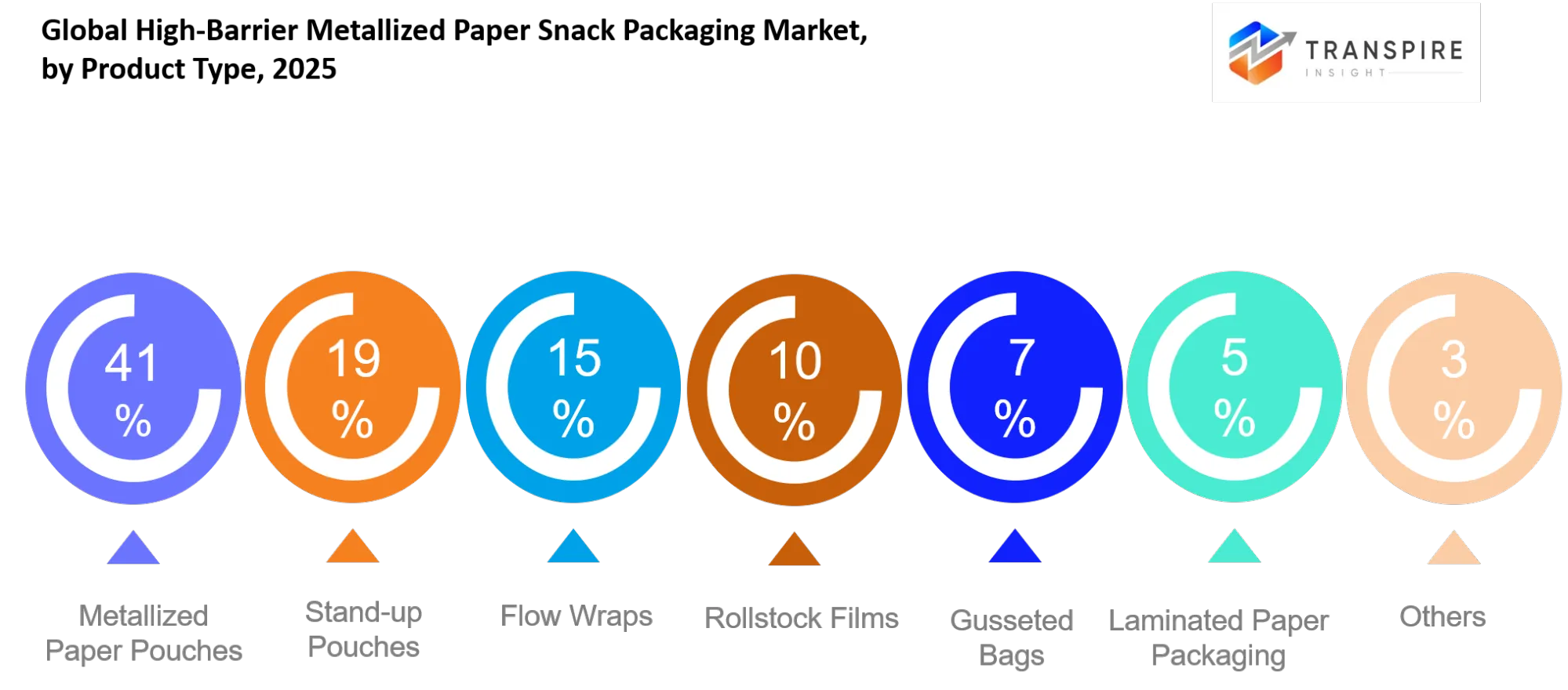
By Barrier Type:
Moisture Barrier packaging holds the top spot because preserving crispness and snack shelf life remains the industry's most important technical challenge. Obvious significance continues for Oxygen and Aroma Barrier pack formats for flavour-sensitive products, while Light and Grease Barrier formats are a major support for high-end, oil-based products and other natural products. Multi-layer and high-performance barrier formats can expect stronger market penetration as sustainable barrier coating technologies continue to develop.
By End User:
Snack Food Manufacturers represent the largest end-user segment as major global brands rapidly convert packaging portfolios toward recyclable paper solutions. Bakery Products, Confectionery, Ready-to-Eat Foods, Dry Food Producers, Pet Food Manufacturers, Private Label Brands, and Others increasingly utilize metallized paper packaging to meet sustainability targets while maintaining product freshness, premium branding, and regulatory compliance.
By Application:
Chips Packaging remains the largest application due to strict moisture and aroma protection requirements. Nuts & Seeds Packaging, Biscuits Packaging, Popcorn Packaging, Granola & Cereal Packaging, Protein Snacks, Dried Fruit Packaging, and Others are expanding steadily as manufacturers seek sustainable packaging that preserves product quality and extends shelf life.
By Distribution Channel:
Direct Sales dominate because large food manufacturers prefer long-term supply agreements with packaging converters. Packaging Distributors, Online B2B Platforms, Food Packaging Suppliers, OEM Packaging Partners, Exporters, Wholesalers, and Others are expanding as global sustainable packaging demand creates broader procurement and international trade opportunities.
What are the Key Use Cases Driving the Global High-Barrier Metallized Paper Snack Packaging Market?
Buckwheat Mediterranean grain blend ingredients find their primary use in the breakfast cereal & granola market and the instant ready-to-mix health blend market, where they offer a delicious, wholesome, clean-label, reduced-cost, and more appealing combination.
Increasing demand has been noted in bakery applications, snack bars, and savoury food side mixes as producers are seeking to add nutritional value and differentiation through the use of these mixes.
New applications are appearing in a plant-based foodservice market, functional meal solutions, and exporting health and wellness-focused product formulations. The use of these blends in private-label and natural or organic-oriented food markets continues to drive new market segments domestically and globally.
|
Report Metrics |
Details |
|
Market size value in 2025 |
USD 1.24 Billion |
|
Market size value in 2026 |
USD 1.372 Billion |
|
Revenue forecast in 2033 |
USD 2.795 Billion |
|
Growth rate |
CAGR of 10.70% from 2026 to 2033 |
|
Base year |
2025 |
|
Historical data |
2021 - 2024 |
|
Forecast period |
2026 - 2033 |
|
Report coverage |
Revenue forecast, competitive landscape, growth factors, and trends |
|
Regional scope |
United States; Canada; Mexico; United Kingdom; Germany; France; Italy; Spain; Denmark; Sweden; Norway; China; Japan; India; Australia; South Korea; Thailand; Brazil; Argentina; South Africa; Saudi Arabia; United Arab Emirates |
|
Key company profiled |
Amcor, Mondi Group, Huhtamaki, Constantia Flexibles, Sonoco Products, Stora Enso, UFlex, Billerud, ProAmpac, Coveris, Sappi, Sealed Air, Smurfit Westrock, Koehler Paper, Innovia Films |
|
Customization scope |
Free report customisation (country, regional & segment scope). Avail customised purchase options to meet your exact research needs. |
|
Report Segmentation |
By Product Type (Metallized Paper Pouches, Stand-up Pouches, Flow Wraps, Sachets, Rollstock Films, Gusseted Bags, Laminated Paper Packaging, Others); By Barrier Type (Moisture Barrier, Oxygen Barrier, Aroma Barrier, Light Barrier, Grease Barrier, Multi-layer Barrier, High-performance Barrier, Others); By End User (Snack Food Manufacturers, Bakery Products, Confectionery, Ready-to-Eat Foods, Dry Food Producers, Pet Food Manufacturers, Private Label Brands, Others); By Application (Chips Packaging, Nuts & Seeds Packaging, Biscuits Packaging, Popcorn Packaging, Granola & Cereal Packaging, Protein Snacks, Dried Fruit Packaging, Others); By Distribution Channel (Direct Sales, Packaging Distributors, Online B2B Platforms, Food Packaging Suppliers, OEM Packaging Partners, Exporters, Wholesalers, Others) |
Which Regions Are Driving Growth in the Global High-Barrier Metallised Paper Snack Packaging Market?
Europe represents 38% of the worldwide high-barrier metallized paper snack pack market, influenced by strict environmental laws and legislation, efficient recycling systems, and huge demand for eco-packaged snacks. The market in this region benefits from advanced paper-converting technology, a high rate of circular economy initiatives, and retailers' dedication to reducing plastic packaging, which motivate consumer acceptance of high-barrier paper packaging and enable producers to scale up production.
In April 2026, UPM and Felix Schoeller developed a customizable, recyclable barrier solution for flexible food packaging. This innovation enables brands to replace hard-to-recycle composite films with repulpable materials, supporting compliance with the EU Packaging and Packaging Waste Regulation (PPWR).
North America accounts for 24% of the high-barrier metallized paper snack packaging market; its key strengths include domestic sourcing, plant-based premium snack product markets, and diversified industrial supply chains. Market growth is based more on brand protection via sustainability as well as supply chain risk mitigation than on regulation, according to the company. Latin America (4%) and Middle East & Africa (5%) are smaller markets because of weaker converting capacity, greater importer reliance, and slower ECM adoption.
Asia Pacific accounts for 29% of the Global High-Barrier Metallized Paper Snack Packaging Market and is the fastest-growing region, projected to expand at a CAGR of 17.5%. India and China are driving demand as retail formalization and urban consumption accelerate. Growth is supported by new converting investments and faster adoption of performance-based paper packaging. The region offers the greatest long-term potential for suppliers localizing production and delivering climate-resilient, high-barrier packaging solutions.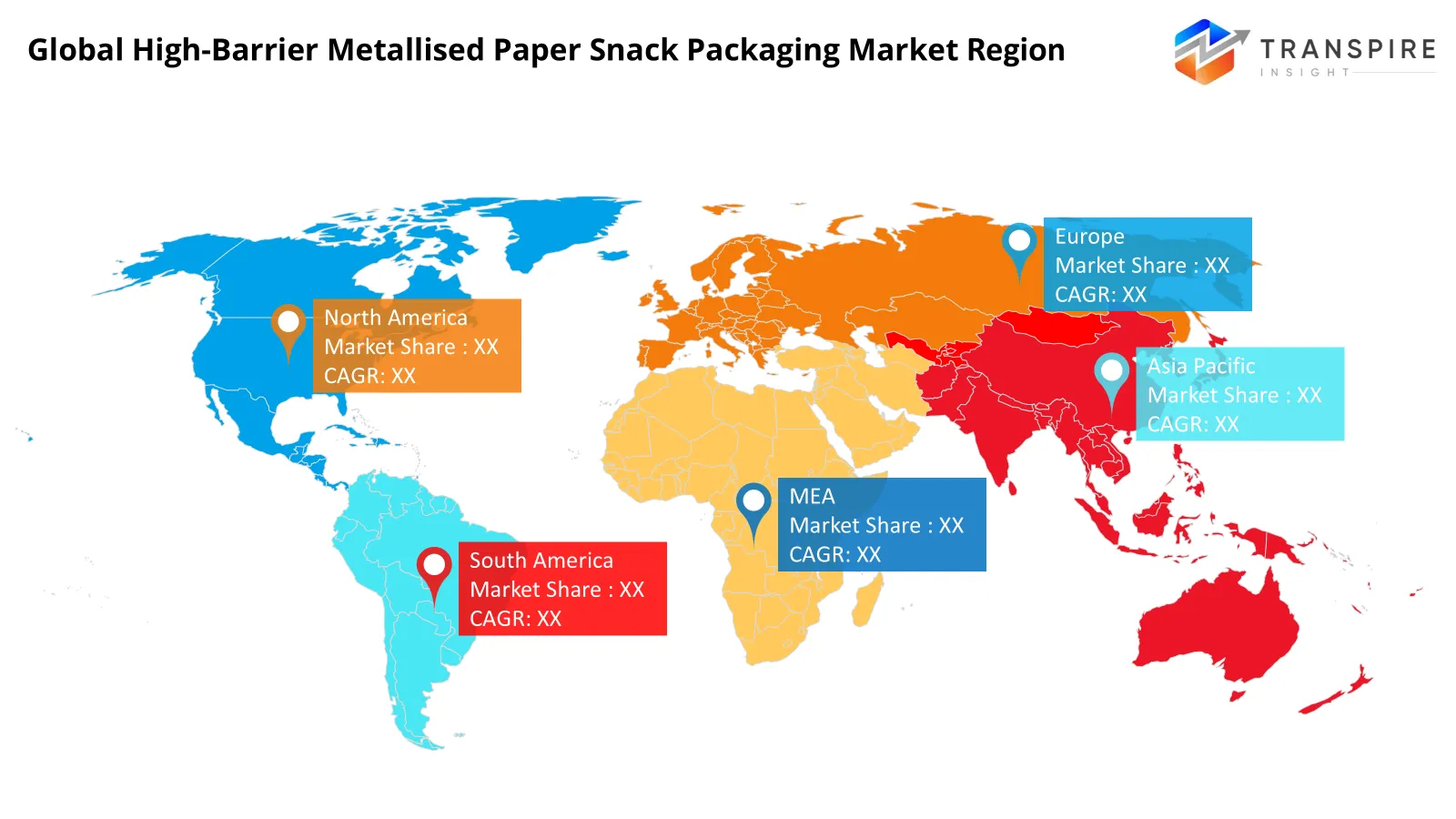
Who are the Key Players in the Global High-Barrier Metallized Paper Snack Packaging Market and how do they compete?
High-barrier metallized paper snack packaging is a competitive, capability-led market worldwide; firms differentiate on barrier levels, print quality, sustainability, and customer service/ supply, rather than pricing alone. Meeting customer needs for high-performance products requires a synergy of technical know-how in papermaking, along with modern coating, laminating, metallising, and converting technologies. Competition amongst some key firms, involving product innovation, high/ multi-layer barrier protection, custom packaging for premium snacks, comes from the Amcor, Constantia Flexibles, Coveris, Sealed Air, and ProAmpac organisations.
Conversely, the Mondi Group, Smurfit Westrock, Stora Enso, Billerud, Sappi, and Koehler Paper offer sustainability / fibre-based packaging solutions, recyclable solutions, and extensive regional manufacturing facilities for the global offerings. Huhtamaki, Sonoco Products, UFlex, and Innovia Films compete on specialist, high-value packs for particular snack types or particular customers. Future competitive advantage will depend increasingly on copacking partnerships, recycled-content developments, digital print, and tailor-made high-barrier paper snack packs, with capacity for enhancing new, sustainable brand positioning in a high-growth segment.
Key Players are:
- Amcor
- Mondi Group
- Huhtamaki
- Constantia Flexibles
- Sonoco Products
- Stora Enso
- UFlex
- Billerud
- ProAmpac
- Coveris
- Sappi
- Sealed Air
- Smurfit Westrock
- Koehler Paper
- Innovia Films
Recent Development News
- In April 2026, Lecta announced its upcoming "Next-Gen Barrier Papers" lineup at Interpack 2026, including the expansion of its ultra-low-aluminium (0.08 gsm) high-barrier Metalvac flexible lines. This design provides snacks, chocolate, and confectionery products with high-level protection against water vapour, oxygen, and light while remaining perfectly compatible with the standard paper recycling stream.
- In April 2026, Koehler Paper unveiled its "Koehler NexPlus® OGR" functional packaging paper during the Interpack 2026 trade exhibition. This advanced fibre-based solution offers robust, dispersion-coated barriers against moisture, grease, and oils without utilising any fluorochemicals (PFAS-free).
What Strategic Insights Define the Future of the Global High-Barrier Metallized Paper Snack Packaging Market?
The growing high-barrier metallized paper snack packaging markets are transitioning primarily to hybrid, paper-based structures that enable sustained recyclability while simultaneously providing high barrier performance to moisture, oxygen, and aroma. Packaging converters or suppliers that can deliver uniformity of quality on a large commercial scale will be best positioned for sustained sales growth. Industry risks include the potential for sustainability and recyclability claims of over-promising end-of-life performance, which will result in consumer perceptions, reputation, and perhaps regulatory issues for packaging suppliers and snack brands. Encouraging developments in the rapidly growing climate-sensitive Asia Pacific region and Chinese/private-label premium snack products offer the most promising potential in localised manufacturing with shorter lead times, lower logistics costs, and increased supply chain security. In order to encourage further growth opportunities, snack brands should collaborate more closely with packaging manufacturers as their packaging suppliers.
Key Segmentations are:
By Product Type
- Metallized Paper Pouches
- Stand-up Pouches
- Flow Wraps
- Sachets
- Rollstock Films
- Gusseted Bags
- Laminated Paper Packaging
- Others
By Barrier Type
- Moisture Barrier
- Oxygen Barrier
- Aroma Barrier
- Light Barrier
- Grease Barrier
- Multi-layer Barrier
- High-performance Barrier
- Others
By End User
- Snack Food Manufacturers
- Bakery Products
- Confectionery
- Ready-to-Eat Foods
- Dry Food Producers
- Pet Food Manufacturers
- Private Label Brands
- Others
By Application
- Chips Packaging
- Nuts & Seeds Packaging
- Biscuits Packaging
- Popcorn Packaging
- Granola & Cereal Packaging
- Protein Snacks
- Dried Fruit Packaging
- Others
By Distribution Channel
- Direct Sales
- Packaging Distributors
- Online B2B Platforms
- Food Packaging Suppliers
- OEM Packaging Partners
- Exporters
- Wholesalers
- Others
Regional Outlook
North America
- United States
- Canada
- Mexico
Europe
- Germany
- United Kingdom
- France
- Spain
- Italy
- Rest of Europe
Asia Pacific
- Japan
- China
- Australia & New Zealand
- South Korea
- India
- Rest of Asia Pacific
South America
- Brazil
- Argentina
- Rest of South America
Middle East & Africa
- Saudi Arabia
- United Arab Emirates
- South Africa
- Rest of the Middle East & Africa
Frequently Asked Questions
Find quick answers to common questions.
The Global High-Barrier Metallized Paper Snack Packaging Market size was valued at USD 1.24 Billion in 2025 and is poised to reach USD 2.795 Billion by 2033, expanding at a 10.70% CAGR.
Key segments for the Global High-Barrier Metallized Paper Snack Packaging Market are By Product Type (Metallized Paper Pouches, Stand-up Pouches, Flow Wraps, Sachets, Rollstock Films, Gusseted Bags, Laminated Paper Packaging, Others); By Barrier Type (Moisture Barrier, Oxygen Barrier, Aroma Barrier, Light Barrier, Grease Barrier, Multi-layer Barrier, High-performance Barrier, Others); By End User (Snack Food Manufacturers, Bakery Products, Confectionery, Ready-to-Eat Foods, Dry Food Producers, Pet Food Manufacturers, Private Label Brands, Others); By Application (Chips Packaging, Nuts & Seeds Packaging, Biscuits Packaging, Popcorn Packaging, Granola & Cereal Packaging, Protein Snacks, Dried Fruit Packaging, Others); By Distribution Channel (Direct Sales, Packaging Distributors, Online B2B Platforms, Food Packaging Suppliers, OEM Packaging Partners, Exporters, Wholesalers, Others).
Growth is primarily driven by the shift to fiber-based high-barrier packaging, stricter packaging waste rules, retailer sustainability scorecards, brand commitments to reduce virgin plastic, and the need to preserve oxygen, moisture, and aroma protection while supporting premium shelf appeal and higher-value packaging contracts.
The Global High-Barrier Metallized Paper Snack Packaging Market is led by major manufacturers, including Amcor, Mondi Group, Huhtamaki, Constantia Flexibles, Sonoco Products, Stora Enso, UFlex, Billerud, ProAmpac, Coveris, Sappi, Sealed Air, Smurfit Westrock, Koehler Paper, Innovia Films.
Europe, with a 38% share, influences market dynamics through strict recycling and packaging rules, strong premium snack demand, advanced converting infrastructure, and retailer-led sustainability pressure that accelerates adoption of high-barrier metallized paper formats.
Commercial opportunities include mono-material barrier technologies, water-based coatings, AI-enabled converting systems, advanced coating investments in Europe and Asia-Pacific, export expansion, private-label growth, and wider use in premium food packaging applications.
- Amcor
- Mondi Group
- Huhtamaki
- Constantia Flexibles
- Sonoco Products
- Stora Enso
- UFlex
- Billerud
- ProAmpac
- Coveris
- Sappi
- Sealed Air
- Smurfit Westrock
- Koehler Paper
- Innovia Films
About the Authors

Kartik bhong
I am Kartik Bhong, a Senior Research Analyst at Transpire Insight, specializing in the Packaging, Manufacturing, and Construction industry. My work focuses on analyzing market trends, emerging technologies, industry regulations, and competitive landscapes to deliver accurate, data-driven insights. I am passionate about transforming complex industry information into clear, practical content that helps businesses, professionals, and decision-makers stay informed and make confident strategic decisions. Through continuous research and a strong commitment to accuracy, I strive to create reliable, well-researched content that reflects the latest developments across these dynamic industries and supports the vision of Transpire Insight in delivering valuable market intelligence.

Chakradhar Khansole
Chakradhar serves as the Research Director at Transpire Insight, bringing over 8 years of experience in technology, innovation, and strategic market intelligence. He specializes in transforming complex market data into actionable business insights that enable organizations to make informed, growth-oriented decisions. Recognized for his strategic vision and analytical expertise, Chakradhar leads high-impact research initiatives, delivering comprehensive market assessments, competitive intelligence, and forward-looking industry analysis.
Recently Published Reports
-
Apr 2026
Pharmaceutical Cold Chain Packaging Market
Pharmaceutical Cold Chain Packaging Market By Material (Plastic,(Polyethylene (PE), Polypropylene (PP), Polyethylene Terephthalate (PET), Expanded Polystyrene (EPS), Polyurethane (PU),Others), Paper, Metal, Others), By Product (Small Boxes, Pallets, Large Sized Pallet Containers, Others), By End Use (Biopharmaceutical Companies, Clinical Research Organizations, Hospitals, Research Institutes, Logistics and Distribution Companies, Others)”, By Industry Analysis, Size, Share, Growth, Trends, and Forecasts 2026-2033
-
Apr 2026
Active & Intelligent Packaging Market
Active & Intelligent Packaging Market By Type (Active Packaging, Smart Packaging), By Material (Polymer-Based, Paper & Board-Based, Metal-Based, Glass-Based), By Technology (Time-Temperature Indicators, Freshness Indicators, RFID, Antimicrobial Packaging, Modified Atmosphere Packaging), By Application (Food & Beverages, Pharmaceutical, Cosmetics & Personal Care, Electronics & Consumer Goods, Others), By Industry Analysis, Size, Share, Growth, Trends, and Forecasts 2026-2033
-
Apr 2026
Biodegradable Cut Flower Packaging Market
Biodegradable Cut Flower Packaging Market By Material Type (Paper & Paperboard, Biodegradable Plastics, Natural Fibers, Molded Pulp, Others), By Product Type (Sleeves, Wraps, Boxes & Cartons, Bags & Pouches, Inserts & Holders), By Application (Roses, Carnations, Tulips, Chrysanthemums, Mixed Flowers, Others) and By Distribution Channel (Direct Sales, Distributors & Wholesalers, Online Channels), By Industry Analysis, Size, Share, Growth, Trends, and Forecasts 2026-2033
-
May 2026
Pharmaceutical Packaging Market
Pharmaceutical Packaging Market By Material Type (Plastic, Glass, Metal, Paper & Paperboard, Others), By Packaging Type (Bottles, Blister Packs, Vials, Ampoules, Pouches & Sachets, Others) and By End User (Hospitals & Clinics, Retail Pharmacies, Online Pharmacies, Pharmaceutical Manufacturers), By Industry Analysis, Size, Share, Growth, Trends, and Forecasts 2026-2033