
Asia Pacific Biaxially Oriented Polypropylene Films Market Size & Forecast:
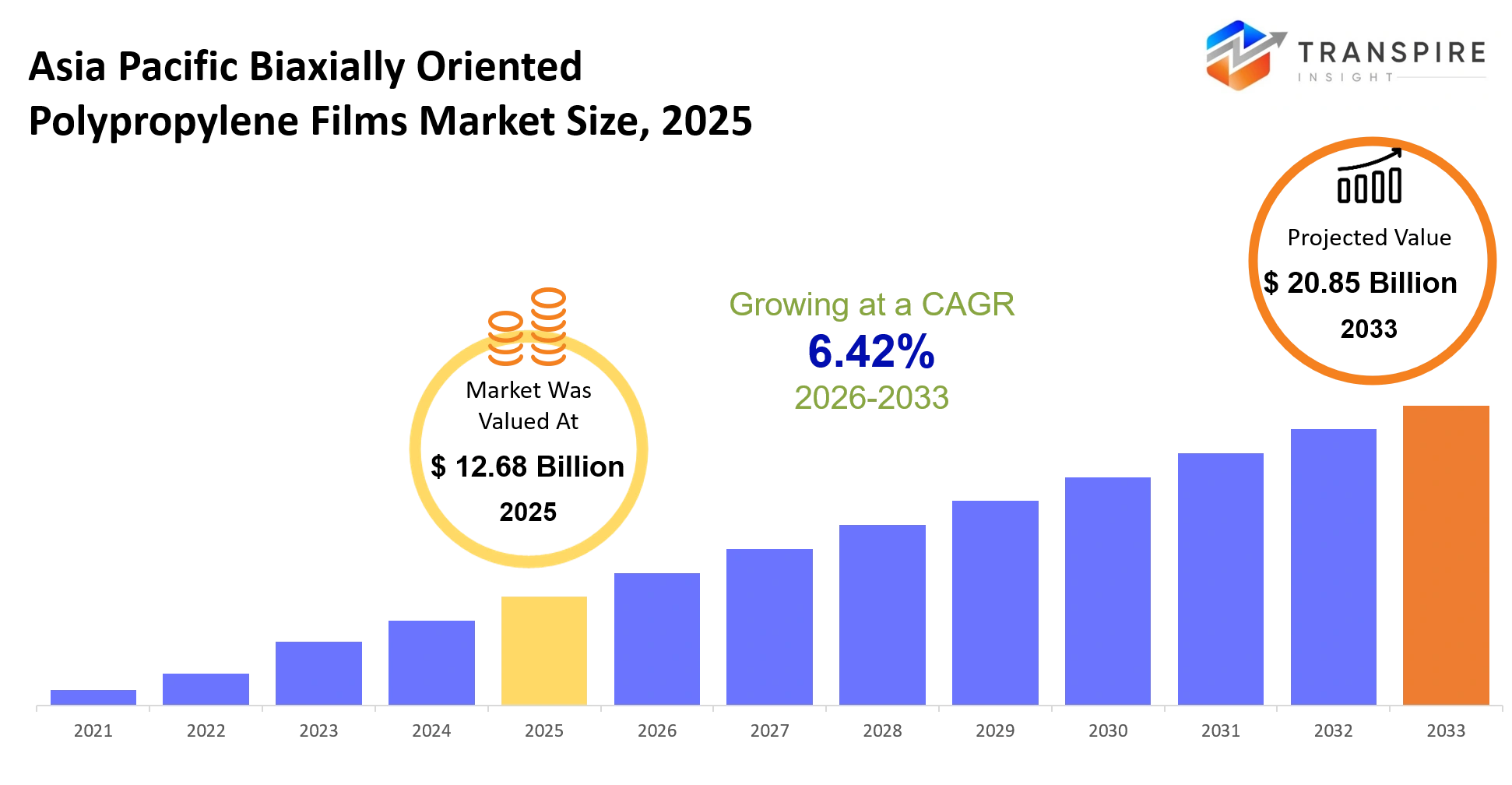
- Asia Pacific Biaxially Oriented Polypropylene Films Market Size 2025: USD 12.68 Billion
- Asia Pacific Biaxially Oriented Polypropylene Films Market Size 2033: USD 20.85 Billion
- Asia Pacific Biaxially Oriented Polypropylene Films Market CAGR: 6.42%
- Asia Pacific Biaxially Oriented Polypropylene Films Market Segments: By Product Type (Transparent Films, Metallized Films, Matte Films, White Opaque Films, Others); By Application (Food Packaging, Labeling, Tobacco Packaging, Industrial Packaging, Others); By End User (Food Industry, Packaging Industry, Consumer Goods Industry, Others)
To learn more about this report,  Download Free Sample Report
Asia Pacific Biaxially Oriented Polypropylene Films Market Summary
The Asia Pacific Biaxially Oriented Polypropylene Films Market was valued at USD 12.68 Billion in 2025. It is forecast to reach USD 20.85 Billion by 2033. That is a CAGR of 6.42% over the period.
In practice, biaxially oriented polypropylene films are these thin, high strength plastic sheets that help keep packaged food sealed, make sure electronics stay safe, and keep labels readable even when they get jostled a bit during long-distance shipping across the Asia Pacific region’s massive manufacturing and export networks. The market has kinda become more central for packaging efficiency lately, because brands are trending toward lighter, less expensive materials that still stand up when exposed to heat , moisture, and everyday handling stress. In the past few years, a fairly clear structural change has slowly redirected production toward higher throughput, energy saving film lines, with tighter yield control and less material getting wasted.
At the same time, stricter plastic waste management regulations in places like India and China have pushed producers to rethink film compositions for recyclability, plus there’s been a movement toward downgauging, where you use less thickness without giving up performance, at least as much. A big disruption showed up during the pandemic era supply chain instability, which basically forced converters to localize sourcing and lock in regional suppliers. That shift has strengthened domestic film producers and sped up capacity expansion , and as a result it’s also improved revenue visibility and supported long-term contract adoption in both packaging and industrial uses.
Key Market Insights
- In Asia Pacific, the Biaxially Oriented Polypropylene Films market size actually exceeded USD 12.6 billion in 2025, sort of pushed by packaging demand across FMCG and export manufacturing hubs.
- China, on the other hand, still sits at the top, with almost 38% market share in 2025, mostly because of huge scale packaging activity and extrusion capacity.
- India looks like the speedster region, since 2024–2030 packaging modernization keeps rolling, plus export-linked manufacturing keeps expanding.
- When it comes to product types, Standard BOPP packaging films seem to lead, taking more than 55% share, largely because they are used everywhere for food and consumer goods packaging.
- Metallized BOPP films follow as the second major segment , and they are broadly applied in barrier packaging, as well as label protection type work.
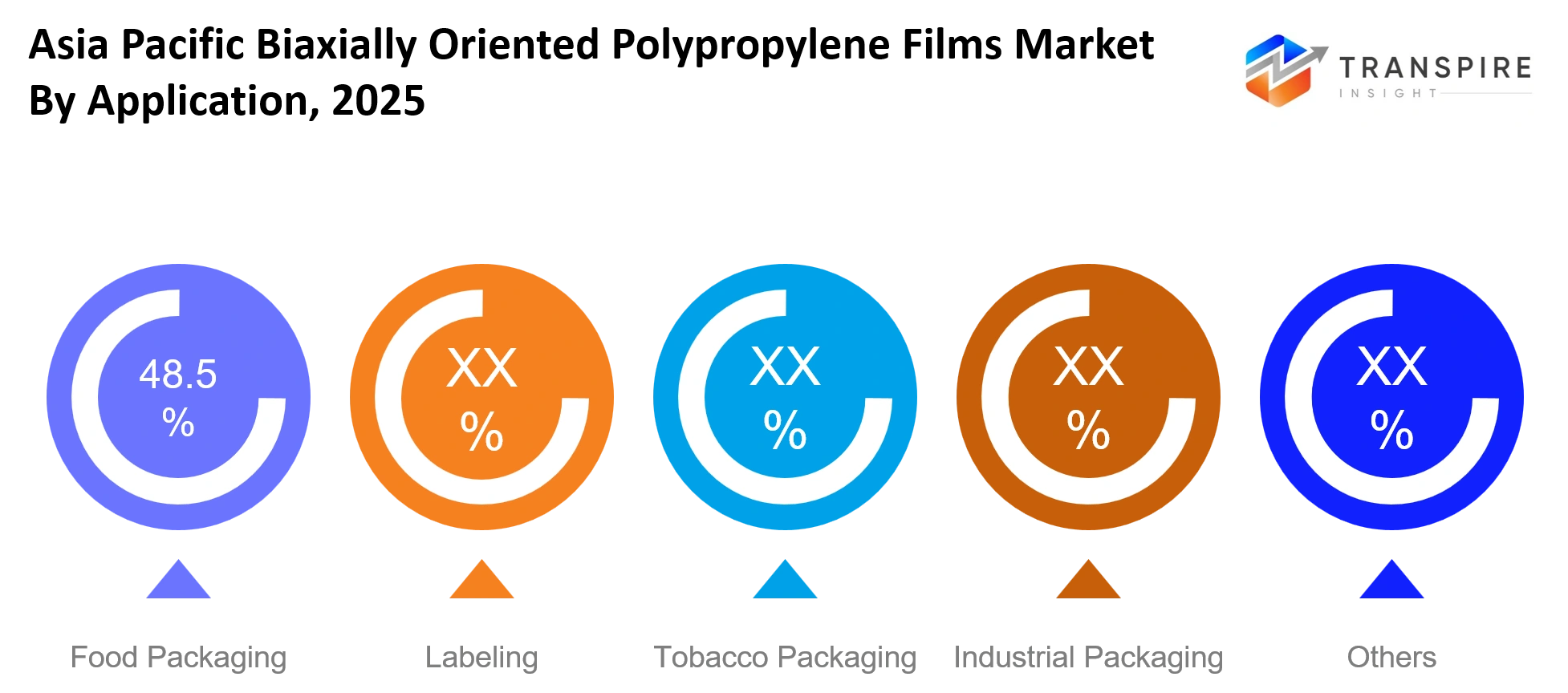
- For applications, Food packaging is around 60% share, which tracks with rising processed food consumption and the continued expansion of cold-chain logistics.
- Meanwhile, Labeling and lamination films are the fastest-growing application , as retail branding becomes more intense across e-commerce platforms.
- On the end-user side, FMCG companies stay dominant, holding above 50% demand share across the Asia Pacific Biaxially Oriented Polypropylene Films market.
- E-commerce packaging is also moving the quickest, driven by parcel volumes climbing and by the need for lighter weight packaging.
- The competitive landscape includes Cosmo Films, Jindal Poly Films, Uflex, Taghleef Industries, Polyplex, and Toray Industries, and they mostly compete through capacity build-outs and higher-barrier film innovation, rather than just price alone.
What are the Key Drivers, Restraints, and Opportunities in the Asia Pacific Biaxially Oriented Polypropylene Films Market?
The primary driver of the Asia Pacific biaxially oriented polypropylene films market is the fast growth of packaged food plus e-commerce logistics. It really needs materials that are light in weight and also cost efficient, with solid barrier results. This movement is reinforced by automation on packaging lines and the growing push on manufacturers to cut down material usage per unit without lowering durability. Converters are gradually increasing their take up of more advanced film extrusion technologies that help raise yield and shrink scrap losses, and that directly lifts production efficiency along with revenue per ton.
One major restraint is the volatility in polypropylene feedstock prices , and this is tightly tied to crude oil up and down swings as well as petrochemical supply disruptions. Because of this kind of structural link, margin stability for film makers stays limited, and pricing uncertainty flows through to downstream converters. Since raw material costs make up a big part of total production expenses, manufacturers find it hard to push through the full cost hikes to FMCG buyers. Then you get periodic profit squeeze , and sometimes delayed decisions on capacity expansion.
Meanwhile an emerging opportunity is recyclable mono-material packaging formats, especially across India and Southeast Asia, where regulatory pressure is pushing brands to redesign their packaging structures. Investments in improved recyclable BOPP grades along with high barrier coatings are getting more attention among bigger packaging converters. Firms that align early with circular packaging requirements are likely to win longer-term arrangements with global FMCG brands that run regional supply chains.
What Has the Impact of Artificial Intelligence Been on the Asia Pacific Biaxially Oriented Polypropylene Films Market?
Artificial intelligence is getting more and more mixed into BOPP film manufacturing lines, to help with extrusion stability, thickness uniformity, and also defect detection. In today’s production setups, AI based vision systems keep watching film surfaces, in real time, and they can spot tiny flaws , bubble formation, and even coating inconsistencies, so there’s less need for manual inspection. Plus , machine learning is used to tune extrusion temperature, line speed, and the cooling settings. This ends up supporting steadier output during those big production runs, even when the plant is running hard.
On the maintenance side, predictive analytics is being used to plan upkeep for important equipment like extrusion dies and stretching units. AI systems can examine vibration behavior and thermal readings, then they forecast equipment wear and help avoid sudden breakdowns. As a result, some advanced facilities see operational uptime going up by double digit margins. And yes, a few manufacturers also mention less material wastage, mainly because process control gets better and defects are corrected earlier.
Still, overall adoption is not fully widespread, especially not in smaller and mid scale plants. The reason is the integration expenses, and also the fact that there’s no unified or standardized production data. Also, real life conditions vary a lot, like humidity swings and raw material inconsistency, which makes model accuracy weaker. That kind of uncertainty tends to slow down full automation roll outs, across the Asia Pacific packaging film ecosystem.
Key Market Trends
- In 2024 to 2025, there was a noticeable shift toward mono material recyclable films, up by more than 25% in adoption across FMCG packaging lines, sort of.
- At the same time, metallized film demand climbed sharply, because brands kept upgrading barrier protection for shelf life longer products , especially in muggy humid climates.
- China and India also expanded their BOPP capacity additions. New extrusion lines got commissioned somewhere between 2023 and 2025, yes.
- For e commerce packaging, the demand really took off. That pushed lightweight film usage up by almost 30% in logistics applications.
- In the extrusion plants, automation helped a lot. It reduced defect rates and made yield consistency more steady across the big scale producers in 2025 .
- India tightened rules on plastic waste, and that basically accelerated the move toward downgauged and recyclable film structures .
- Meanwhile, retailers wanted high clarity films more and more, driven by branding competition in digital commerce channels, in labeling.
- Also, raw material price swings during 2024-2025 pressured manufacturers into longer term polypropylene sourcing contracts, not just short deals.
- Sustainability pushed innovation too, which led to faster take-up of bio enhanced and low carbon film production processes.
- And competition got more intense , because Asian producers expanded exports into Middle Eastern and African packaging markets.
Asia Pacific Biaxially Oriented Polypropylene Films Market Segmentation
By Product Type
Transparent Films help keep packaged goods easy to see and they make product identification simpler on retail shelves, so people can find it fast or well, you know. Demand stays high especially for food and FMCG packaging, where visual appeal and clear product details really affect the purchase choice. In the Asia Pacific Biaxially Oriented Polypropylene Films Market there is also a noticeable reliance on this kind of material, mostly because it is cost effective and can be used broadly in flexible packaging. There is more momentum too, from lightweight wrapping requirements across export-led supply chains where weight and handling really matter.
Metallized Films bring better barrier protection from moisture, oxygen, and light exposure, and this basically helps the shelf life last longer. Adoption is strongest in snack packaging and the more premium food sections, since freshness still stays a make or break factor. The Asia Pacific Biaxially Oriented Polypropylene Films Market gains from these uses because the demand for durable packaging is rising in humid climates, and that’s where the added protection counts. Matte Films and White Opaque Films, meanwhile, are linked with more premium branding and labeling goals, especially for cosmetics and specialty consumer products. There are also other options such as customized film grades, built for industrial and niche packaging applications.
By Application
Food Packaging still comes out on top, kinda dominant, because people keep buying more packaged snacks, frozen foods, and ready-to-eat meals across many urban Asia Pacific markets. The demand goes up too, as retail keeps expanding and cold chain logistics get better, which helps the distribution coverage. Basically, the Asia Pacific Biaxially Oriented Polypropylene Films Market depends a lot on this part, mainly due to steady FMCG production growth and also the export packaging needs. The reason it keeps working is that the material performance stays solid, so it protects products from contamination and moisture.
Labeling keeps growing as brands compete harder, especially in retail and e-commerce channels. Films that are clear and durable help with crisp printing and make it easier to stand out on store shelves, and in a way that looks more premium. Tobacco Packaging is another area where specialized films matter, since they help maintain seal integrity and also keep a controlled level of visibility, for those regulated packaging types. Industrial Packaging also uses these films for protective wrapping and smoother handling of manufactured goods across logistics networks and export routes. Then there are other uses too, including specialty applications like lamination, plus promotional packaging formats that companies use to catch attention.
To learn more about this report, Download Free Sample Report
By End User
The Food Industry seems to be the biggest end user group, because there’s always this steady pull for packaged and processed foods across the Asia Pacific markets. There is also a strong dependence on flexible wrapping which, in practice, helps keep consumption steady using biaxially oriented polypropylene films. The Asia Pacific Biaxially Oriented Polypropylene Films Market tends to lean on large food processing and distribution networks, they need durable yet cost-effective packing materials. Demand stays pretty stable, since basic consumption routines don’t really pause.
Then the Packaging Industry shows solid usage, mostly from converting operations that feed FMCG, retail, and industrial packing solutions. With high production volumes, companies keep procuring film materials for lots of downstream needs. The Consumer Goods Industry uses these films for protecting products, brand presentation, and shelf attraction, especially in cosmetics, home care, and personal care. And also there are Others, like logistics operators and industrial manufacturers, who rely on protective covering and secondary packaging for transport safety, and for export handling too.
What are the Key Use Cases Driving the Asia Pacific Biaxially Oriented Polypropylene Films Market?
In Asia Pacific, the big dominant use case for biaxially oriented polypropylene films is kind of flexible food packaging, where these films help shield snacks, confectionery, and frozen foods from moisture and contamination, especially over long distribution cycles. That application pulls in the highest demand mainly because FMCG production and retail consumption are so large across the urban markets.
Then there are the secondary use cases, like labeling and lamination in consumer goods and pharmaceutical packaging, where clarity matters, printability counts, and durability is needed, so brands can stay aligned with compliance and brand look. Also, industrial wrapping for textiles and electronics is growing too, as manufacturing exports increase across Southeast Asia.
On the newer side, emerging use cases show up in recyclable mono-layer packaging formats, plus high-barrier films aimed at premium e-commerce shipments. In a lot of these cases brands are trying to reduce plastic complexity, while still keeping the protection standards at a level that customers expect.
|
Report Metrics |
Details |
|
Market size value in 2025 |
USD 12.68 Billion |
|
Market size value in 2026 |
USD 13.49 Billion |
|
Revenue forecast in 2033 |
USD 20.85 Billion |
|
Growth rate |
CAGR of6.42% from 2026 to 2033 |
|
Base year |
2025 |
|
Historical data |
2021 - 2024 |
|
Forecast period |
2026 - 2033 |
|
Report coverage |
Revenue forecast, competitive landscape, growth factors, and trends |
|
Regional scope |
Asia Pacific (India, China, Japan, Australia, South Korea, Rest of Asia Pacific) |
|
Key company profiled |
Cosmo Films, Jindal Poly Films, Taghleef Industries, Toray Industries, Oben Group, Uflex, SRF Limited, Vibac, Polyplex, Treofan, Innovia Films, Futamura, Inteplast, Mitsui Chemicals, Dunmore |
|
Customization scope |
Free report customization (country, regional & segment scope). Avail customized purchase options to meet your exact research needs. |
|
Report Segmentation |
By Product Type (Transparent Films, Metallized Films, Matte Films, White Opaque Films, Others); By Application (Food Packaging, Labeling, Tobacco Packaging, Industrial Packaging, Others); By End User (Food Industry, Packaging Industry, Consumer Goods Industry, Others) |
Which Regions are Driving the Asia Pacific Biaxially Oriented Polypropylene Films Market Growth?
Asia Pacific’s leading region is China, backed up by its broad packaging manufacturing base and that kinda fully connected petrochemical supply chain. Big scale FMCG making and export oriented industries keep the demand steady for biaxially oriented polypropylene films. Also, solid infrastructure in the coastal industrial zones helps move goods out, fast, to overseas markets. And with ongoing investment into extrusion capacity, the whole thing stays pretty dominant in the regional ecosystem, even when conditions shift.
India and Southeast Asia work like a dependable secondary region, with steady growth coming from both domestic consumption and more manufacturing expansion. In contrast to China’s export leaning setup, this area is carried more by rising internal FMCG demand and tighter organized retail penetration. Meanwhile, the rules around packaging waste are slowly being put in place, so modernization happens gradually rather than some quick disruption. That situation is basically a dependable demand base for film converters.
The fastest growing region is Southeast Asia, especially Vietnam, Indonesia, and Thailand. Here the push is driven by foreign manufacturing relocation and export diversification strategies. New industrial parks and packaging related investments have picked up speed since 2023, and that strengthens local film consumption. On top of that, government incentives tied to export manufacturing have improved capacity utilization across the packaging supply chains. Overall, this momentum points to strong entry openings for global film producers who are expanding into newer production hubs, through 2033.
Who are the Key Players in the Asia Pacific Biaxially Oriented Polypropylene Films Market and How Do They Compete?
The Asia Pacific biaxially oriented polypropylene films market is sort of moderately consolidated, in the sense that established polymer and packaging manufacturers control a lot of the production capacity, while regional converters still compete pretty aggressively on pricing, and also on customization. For the most part competition is nudged by cost efficiency, extrusion tech advancements, and easier access to integrated polypropylene supply chains, more than by branding, or “service differentiation” which some people mention but doesn’t really move the needle.
Companies like Cosmo Films tend to put a lot of weight on high clarity and specialty coated films, and they strengthen their position through product innovation, and sustainable packaging grades that match FMCG requirements. Jindal Poly Films keeps a cost leadership mindset, backed by large-scale production facilities and export oriented supply contracts across Asia and Europe. Uflex, on the other hand, differentiates by pushing integrated packaging solutions, basically linking film manufacturing with downstream flexible packaging conversion capabilities, which makes the whole workflow feel more “joined”.
At the same time, Taghleef Industries is expanding via geographic diversification, plus acquisitions, which helps build out their specialty film portfolio for label and industrial applications. Polyplex also leans on capacity expansion and export competitiveness, especially where high-growth Asian packaging hubs are. And then global players, like Toray Industries and Mitsui Chemicals, make use of advanced polymer R&D and material science know how, to develop next generation high-barrier, and more recyclable film technologies.
Company List
- Cosmo Films
• Jindal Poly Films
• Taghleef Industries
• Toray Industries
• Oben Group
• Uflex
• SRF Limited
• Vibac
• Polyplex
• Treofan
• Innovia Films
• Futamura
• Inteplast
• Mitsui Chemicals
• Dunmore
Recent Development News
In May 2025, Jindal Poly Films announced expansion of its Nashik production facility for BOPP films. The company invested ₹700 crore to add new biaxially oriented polypropylene production lines, significantly increasing regional capacity and strengthening supply reliability for FMCG and export packaging demand across Asia Pacific.http://timesofindia.indiatimes.com
In April 2026, Taghleef Industries showcased its specialty BOPP film portfolio at Propak Asia 2026. The company highlighted advanced biaxially oriented polypropylene and CPP films designed for high-barrier food packaging, reflecting rising demand in Southeast Asia for recyclable and high-performance flexible packaging materials.https://www.ti-films.com/
In 2024 (disclosed in 2025 industry filings), Jindal Poly Films completed strategic capacity and structural expansion initiatives across its packaging business. The restructuring and production upgrades strengthened its position in high-volume BOPP supply chains and improved efficiency across integrated film manufacturing operations serving Asia Pacific demand.http://www.jindalgroup.com
What Strategic Insights Define the Future of the Asia Pacific Biaxially Oriented Polypropylene Films Market?
The Asia Pacific biaxially oriented polypropylene film market is sort of shifting , like structurally toward higher-value, sustainability aligned packaging materials, with FMCG expansion playing a role and regional manufacturing moving closer ( or relocating more). In the next 5–7 years, the growth won’t be just about bigger volumes, it will be more about those premium film grades that can provide recyclability and performance efficiency, at the same time.
One risk that is less obvious, but still important, is how dependent the supply can be on polypropylene feedstock, since it ties back to crude oil volatility. That kind of swing can throw off pricing stability, and make long-term contract plans feel slower or harder than expected.
Still, there is also an emerging chance, especially in India and Southeast Asia. There, packaging waste rules and export driven manufacturing clusters are basically pushing demand for advanced downgauged films. Firms that start early with recyclable mono-material technologies, plus local production capacity, should end up with better procurement agreements from global FMCG brands. Those brands are actively chasing supply chain resilience and regulatory compliance that actually matches what’s needed.
Asia Pacific Biaxially Oriented Polypropylene Films Market Report Segmentation
By Product Type
- Transparent Films
- Metallized Films
- Matte Films
- White Opaque Films
- Others
By Application
- Food Packaging
- Labeling
- Tobacco Packaging
- Industrial Packaging
- Others
By End User
- Food Industry
- Packaging Industry
- Consumer Goods Industry
- Others
Frequently Asked Questions
Find quick answers to common questions.
The expected Asia Pacific Biaxially Oriented Polypropylene Films Market size for the market will be USD 20.85 Billion in 2033.
Key segments for the Asia Pacific Biaxially Oriented Polypropylene Films Market are By Product Type (Transparent Films, Metallized Films, Matte Films, White Opaque Films, Others); By Application (Food Packaging, Labeling, Tobacco Packaging, Industrial Packaging, Others); By End User (Food Industry, Packaging Industry, Consumer Goods Industry, Others).
Major Asia Pacific Biaxially Oriented Polypropylene Films Market players are Cosmo Films, Jindal Poly Films, Taghleef Industries, Toray Industries, Oben Group, Uflex, SRF Limited, Vibac, Polyplex, Treofan, Innovia Films, Futamura, Inteplast, Mitsui Chemicals, Dunmore.
The Asia Pacific Biaxially Oriented Polypropylene Films Market size is USD 12.68 Billion in 2025.
The Asia Pacific Biaxially Oriented Polypropylene Films Market CAGR is 6.42% from 2026 to 2033.
• Cosmo Films
• Jindal Poly Films
• Taghleef Industries
• Toray Industries
• Oben Group
• Uflex
• SRF Limited
• Vibac
• Polyplex
• Treofan
• Innovia Films
• Futamura
• Inteplast
• Mitsui Chemicals
• Dunmore
About the Authors

Pankaj Ghogare Patil
I am Pankaj Ghogare Patil, a Senior Research Analyst at Transpire Insight, specializing in the Pharmaceutical, Chemicals & Materials, Healthcare IT, and Biotechnology industry. My expertise lies in conducting comprehensive market research, analyzing industry trends, evaluating competitive landscapes, and translating complex data into actionable insights. At Transpire Insight, I closely follow emerging technologies, regulatory developments, and market innovations to create accurate, well-researched, and informative content that helps businesses and professionals make informed decisions. I am committed to producing credible, evidence-based articles that reflect industry best practices while making technical topics accessible and valuable for a broad audience.

Chakradhar Khansole
Chakradhar serves as the Research Director at Transpire Insight, bringing over 8 years of experience in technology, innovation, and strategic market intelligence. He specializes in transforming complex market data into actionable business insights that enable organizations to make informed, growth-oriented decisions. Recognized for his strategic vision and analytical expertise, Chakradhar leads high-impact research initiatives, delivering comprehensive market assessments, competitive intelligence, and forward-looking industry analysis.
Recently Published Reports
-
May 2026
Healthcare Polymer Packaging Market
Healthcare Polymer Packaging Market Size, Share & Analysis Report By Packaging Type (Syringes, IV Bottles and Pouches, Clamshells, Blisters, Bottles & Jars, Containers, Tubes, IV Parental Packaging, Others), By Type (Regulated, Non-regulated), By Polymer Type (LDPE (Low-Density Polyethylene), HDPE (High-Density Polyethylene), Homo-polymer (Homo), Random Copolymer (Random), Block Copolymer (Block), PET, Polystyrene, Polyvinyl Chloride, Polyamide/EVOH, Others), and Geography (North America, Europe, Asia-Pacific, Middle East and Africa, South and Central America), 2021 - 2031
-
Apr 2026
Hydrophilic Tape (Waterstop) Market
Hydrophilic Tape (Waterstop) Market Size, Share & Analysis Report By Type (Bentonite-Based Hydrophilic Tape, Rubber-Based Hydrophilic Tape), By Application (Residential Buildings, Commercial Buildings, Infrastructure Projects), and Geography (North America, Europe, Asia-Pacific, Middle East and Africa, South and Central America), 2021 - 2031
-
Apr 2026
Metalens Market
Metalens Market Size, Share & Analysis Report By Type (Visible Light Metalens, and Infrared Metalens), By Application (Consumer Electronics, Automotive Electronics, Industrial, Medical, and Others), and Geography (North America, Europe, Asia-Pacific, Middle East and Africa, South and Central America), 2021 - 2031
-
Apr 2026
PBT Resin Market
PBT Resin Market Size, Share & Analysis Report By Type (Reinforced PBT Resin, Unreinforced PBT Resin), By Processing Method (Injection Molding, Extrusion, Blow Molding, Others), By End-User (Automotive, Electrical & Electronics, Consumer Appliances, Industrial Machinery, Medical Devices, Packaging, Others), and Geography (North America, Europe, Asia-Pacific, Middle East and Africa, South and Central America), 2021 - 2031