
Global Healthy Soup Market Summary:
According to Transpire Insights, a detailed research report on the market reflects that the ready-to-eat soup application segment dominates the Global Healthy Soup Market, accounting for approximately 64% of the total share worldwide. The Campbell's Company leads the market with approximately (around USD 10.4 billion) in annual revenue and an estimated 18–22% global market share, making it the leading contributor to global market development, innovation, advanced healthy soup production, expanding manufacturing capabilities, and growth dynamics.
Market Snapshot
- Market Value (2025): USD 20.2 Billion.
- Expected Market Value (2026): USD 21.18 Billion.
- Estimated Market Value (2033): USD 30.46 Billion.
- Forecast CAGR (2026–2033): 5.33%.
- Leading Region in 2025: North America
- Second-largest Region: Europe
- Fastest Growing Region: Asia-Pacific
Introduction
In order to encourage healthier lives, the global healthy soup market includes the production, distribution, and sale of ready-to-eat, ready-to-cook, and dry healthy soup products. Soups with clean labels, natural, organic, non-GMO, and minimally processed ingredients that yet provide good nutritional value with vegetables, legumes, whole grains, lean proteins, and functional ingredients are the market's main focus. Additionally, it provides goods designed to meet certain nutritional requirements, including low-sodium, high-protein, vegan, vegetarian, and gluten-free diets. The popularity of plant-based nutrition, growing health consciousness, and the need for quick meal solutions are driving the market's expansion. The substantial benefits that healthy soups provide, such as enhanced nutritional intake, hydration, digestive support, weight management, and functional wellness, will make them a desirable choice for health-conscious consumers searching for quick and nourishing meals.
For instance:- North America:
Supply Chain & Manufacturing: Businesses are investing in AI-enabled supply chains, warehouse automation, and production modernization to increase the availability of healthy soup products across retail channels while cutting costs.
Clean-Label Innovation: As a result of consumer demand for low-sodium, plant-based, organic, and preservative-free soups, more money is being spent on premium ingredients, innovative products, and environmentally friendly packaging..

Key Market Highlights: -
- North America is expected to grow at a rapid CAGR in the Global Healthy Soup Market by holding approximately 30% of the share during the forecast period.
- Europe is anticipated to hold close to 38% share of the Global Healthy Soup Market over the predicted timeframe.
- Asia Pacific is anticipated to hold nearly 32% share of the Global Healthy Soup Market over the predicted timeframe.
- By Product Type, the Ready-to-Eat (RTE) Soup segment dominated the market and holds around 48% share in 2025 and is projected to grow at a substantial CAGR during the forecast period.
- By Ingredient Type, the Vegetable-based segment dominated the market and holds roughly 31% share in 2025 and is projected to grow at a substantial CAGR during the forecast period.
- By Distribution Channel, the Supermarkets & Hypermarkets dominated the market and held nearly 35% share in 2025 and is projected to grow at a substantial CAGR during the forecast period.
- 2026: By improving cold-chain infrastructure, expanding the supply of raw materials, reducing post-harvest losses, and assisting in the manufacturing and distribution of nutritious soup products, the Pradhan Mantri Kisan SAMPADA Yojana (PMKSY) continues to strengthen India's food processing industry.
How is Technology Driving Growth in the Global Healthy Soup Market?
Technology plays a significant role in the growth of the Global Healthy Soup Market by improving product quality, nutritional value, manufacturing efficiency, and consumer convenience. Advanced food processing technologies such as retort processing, high-pressure processing (HPP), quick freezing, and dehydration preserve the nutrients, taste, and freshness of food while extending its shelf life with little artificial preservatives. Manufacturers can use artificial intelligence (AI) and data analytics to optimize recipes, track consumer preferences, and speed up product creation. Automation and intelligent manufacturing can increase production efficiency while maintaining consistent product quality. Furthermore, innovations in cold-chain logistics, sustainable packaging, and the expansion of e-commerce platforms enable product availability, faster distribution, and consumer access to fulfill the growing global demand for nutritious, clean-label, ready-to-eat, and functional soup products.
Market Drivers
The global healthy soup market is being driven by increased customer demand for healthy, quick, and ready-to-eat meal options that promote healthy lifestyles. Health-conscious consumers have increased demand for clean-label, low-sodium, organic, plant-based, and protein-rich soups. In response to shifting dietary preferences, producers are investing in product innovation, such as the inclusion of useful ingredients, fortified formulations, and premium vegetable-based recipes. More extensive supermarket networks, e-commerce outlets, and cold-chain infrastructure are making items more accessible globally. Furthermore, expanding urbanization, fast-paced lives, and rising disposable incomes are encouraging consumers to choose healthful soups as quick lunch options. Investments in sustainable packaging, innovative food processing technologies, and environmentally friendly manufacturing methods are boosting market expansion and long-term economic prospects in both developed and emerging economies.
For Instance: Asia-Pacific:
Growing Demand from Customers Due to increased disposable incomes, urbanization, and growing health consciousness, the region is seeing an increase in customer demand for quick, ready-to-eat, and healthful soup products.
Infrastructure & Distribution: Investments in contemporary retail, cold-chain logistics, and growing e-commerce platforms are enhancing product availability and fostering the expansion of high-end, healthful soup brands.
Restrain
Increasing Challenges for Packaged Soup Products in the Global Healthy Soup Market Due to the presence of high sodium, preservatives, and processed ingredients that are discouraging health-conscious consumers. Furthermore, the growing preference for fresh, homemade meals is reducing demand for commercially prepared soups. Manufacturers face additional obstacles from rising expenses for clean-label formulas, premium natural ingredients, and sustainable packaging. These challenges, together with strict food safety laws and shifting customer expectations, may impede market expansion throughout the projection period.
Analysis of Prices and Consumer Behaviour
Ready-to-eat soup dominates the healthy soup market, accounting for 48% of total sales, owing to high demand from health-conscious customers, busy professionals, and households seeking convenient and nutritious meal alternatives. Premium clean-label, organic, and functional healthy soups are expected to cost 30-35% more than ordinary soup products because they are made with high-quality natural ingredients, innovative food processing methods, and nutritional fortification. Supermarkets and hypermarkets, which account for over 35% of total healthy soup sales, rely heavily on product availability, promotional offers, and established retail networks. Because of rising customer demand for plant-based, low-calorie, and nutrient-dense foods, the plant-based soup category now accounts for about 31% of total market demand. According to consumer purchasing behavior, nearly 58% of consumers prioritize clean-label ingredients, nutritional value, and low-sodium formulations. Additionally, approximately 34% of consumers prefer to buy healthy soup products from supermarkets, hypermarkets, and online retail platforms because of the product variety, competitive pricing, and convenient purchasing options available.
Top Companies in the Global Healthy Soup Market
- Campbell Soup Company
- Nestlé
- Unilever
- The Kraft Heinz Company
- General Mills
- Amy's Kitchen
- Pacific Foods
- Baxters Food Group
- Knorr
- Kettle Cuisine
- Progresso
- Imagine Foods
- Ottogi
- Dr. McDougall's
- Tasty Bite
Global Healthy Soup Market Segmentation
The Global Healthy Soup Market share is divided into five categories: by product type, by ingredient type, by distribution channel, by end user, by packaging type
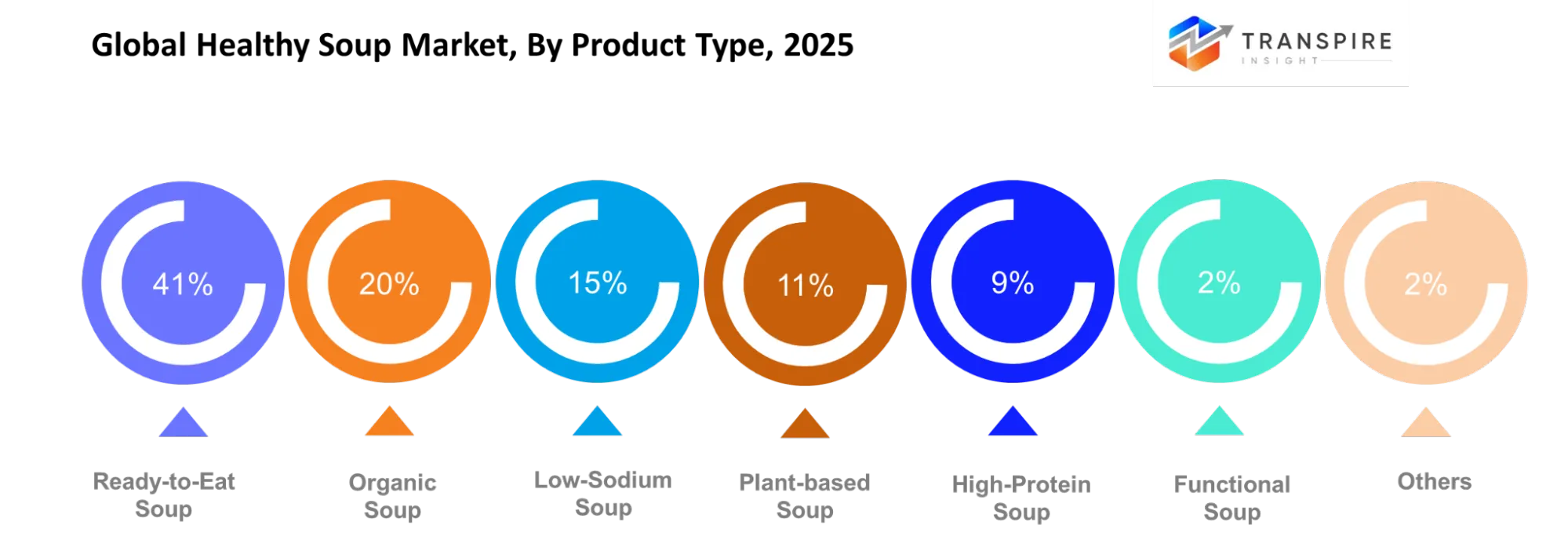
The Ready-to-Eat (RTE) Soup segment dominated the market, accounting for around 48% in 2025 and is expected to rise at a significant CAGR during the forecast period.
The Global Healthy Soup Market is segmented by product type into ready-to-eat soup, ready-to-cook soup, organic soup, low-sodium soup, plant-based soup, high-protein soup, functional soup, others.Among these, the Ready-to-Eat (RTE) Soup segment dominated the market, accounting for around 48% in 2025 and expected to increase at a significant CAGR during the forecast period. Ready-to-Eat (RTE) Soup is the market leader, driven by rising consumer demand for convenient and nutritious meal options, hectic lives, increased health consciousness, expanded retail distribution, and ongoing innovation in clean label, plant-based, and functional soup formulations.
The Vegetable-based dominated the market, accounting for roughly 31%in 2025, and is expected to rise at a significant CAGR during the forecast period.
The Global Healthy Soup Market is segmented by ingredient type into vegetable-based, chicken-based, seafood-based, lentil-based, mushroom-based, mixed grain-based, others. Among these, the Vegetable-based segment dominated the market, accounting for roughly 31%in 2025 and expected to increase at a significant CAGR during the forecast period. The Vegetable-based sector dominates the market due to expanding consumer desire for plant-based, nutrient-dense, low-calorie foods, which is fueled by rising health awareness, clean-label demand, and the growing adoption of vegetarian and vegan diets.
The Supermarkets & Hypermarkets dominated the market, accounting for nearly 35% in 2025 and is expected to rise at a significant CAGR during the forecast period.
The Global Healthy Soup Market is segmented by distribution channel into supermarkets & hypermarkets, convenience stores, online retail, specialty stores, direct sales, others. Among these, the Supermarkets & Hypermarkets segment dominated the market, accounting for nearly 35% in 2025 and expected to increase at a significant CAGR during the forecast period. The Supermarkets & Hypermarkets category dominates the market due to the availability of a diverse range of products, robust distribution channels, competitive pricing, lucrative promotional offers, and consumers' preference for simple one-stop shopping.
Regional Segment Analysis of the Global Healthy Soup Market
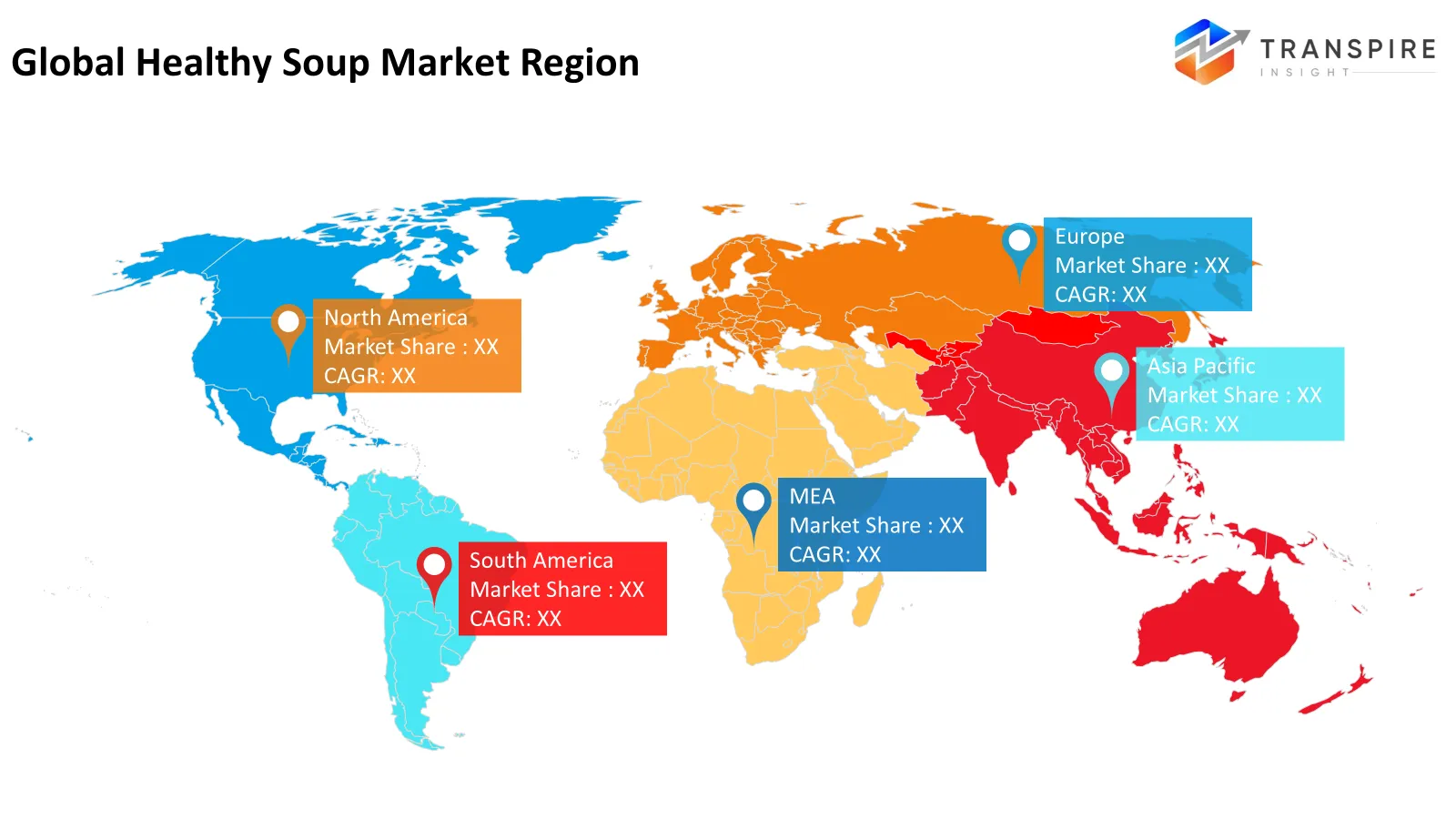
- Europe (Germany, France, U.K., Italy, Spain, Rest of Europe)
- North America (U.S., Canada, Mexico)
- Asia-Pacific (China, Japan, India, Rest of APAC)
- South America (Brazil and the Rest of South America)
- The Middle East and Africa (UAE, South Africa, Rest of MEA)
North America is expected to grow at a rapid CAGR in the Global Healthy Soup Market, holding approximately 30% of the share during the forecast period
Over the course of the forecast period, the North America region is expected to hold a nearly 30% market share and see a rapid compound annual growth rate (CAGR) in the global healthy soup market. High consumer awareness of healthy eating, high demand for quick, ready-to-eat meals, and growing desire for clean-label, organic, and low-sodium soup products are factors contributing to the region's supremacy. Ongoing product innovation, cutting-edge food processing technologies, established supermarket and e-commerce distribution networks, and the presence of top manufacturers like General Mills, Inc., The Campbell's Company, and The Kraft Heinz Company all contribute to the region's leadership.
Europe is the fastest-growing region in the Global Healthy Soup Market during the period, holding close to 38%share.
Throughout the forecast period, Europe is anticipated to occupy nearly 38% of the market share, making it the region with the quickest rate of growth in the global healthy soup market. The rationale given is the region's growing consumer demand for clean-label, organic, plant-based, and low-sodium food items, supported by trends in sustainable consumption and high health consciousness. Manufacturers are compelled by strict food safety regulations to create healthier formulations with natural ingredients. Additionally, Europe continues to lead the market for healthy soups due to the expansion of retail networks, the rapid growth of private-label brands, innovative product introductions, and rising investments in eco-friendly packaging and functional nutrition.
Asia Pacific is the fastest-growing region in the Global Healthy Soup Market during the period, holding nearly 32%share.
With a market share of around 32% throughout the projection period, the Asia Pacific region is the one with the quickest rate of growth in the global healthy soup market. The region is expanding due to a number of factors, including rapid urbanization, rising disposable incomes, more health consciousness, and an increase in the desire for quick, ready-to-eat meals. The burgeoning market is also being supported by the growing middle class, shifting dietary tastes, and widespread use of plant-based and functional food items. Additionally, the region's standing in the worldwide market for healthy soups is being strengthened by investments made in food processing, contemporary retail infrastructure, e-commerce platforms, and product innovation by both domestic and foreign manufacturers.
Strategies for Market Growth in Non-Leading Regions:
Small and medium-sized food firms would value the scalable and effective healthy soup manufacturing technology in non-leading countries. By building healthy soup production facilities in the area and sourcing vegetables, legumes, herbs, and other nutritious ingredients locally, production costs and reliance on imports can be reduced. Expanding strategic alliances with regional farmers, ingredient suppliers, retail chains, foodservice providers, and e-commerce distributors will increase the market penetration of healthy soup products. To create expertise in clean-label formulation, food processing, quality control, healthy recipe development, and nutritional standardization, training programs and technical skill development would be necessary. Contract manufacturing agreements, long-term supply, and flexible financing will all contribute to lowering the cost of nutritious soup products and encouraging greater customer uptake. Together with digital sales channels and online retail platforms, the creation of cooperative initiatives with governments, agricultural organizations, and food processing industries in developing regions will help to improve product accessibility and enable sustainable growth of the global market.
Future Market Trends for the Global Healthy Soup Market: -
Functional and Clean-Label Innovation: Manufacturers are creating healthy soups with plant-based proteins, reduced sodium, functional ingredients, and clean-label formulations in response to customer demand for wholesome and wellness-focused food products.
Rise of Plant-Based Products: Demand for plant-based, dairy-free, natural ingredient, high-protein soups is being driven by the growing popularity of vegan and flexitarian diets as well as sustainable sourcing methods.
To increase convenience, lessen their impact on the environment, and satisfy shifting customer sustainability expectations, businesses are investing in ready-to-eat formats, recyclable packaging, and eco-friendly materials.
Recent Development
- January 2026: Alternative and Plant-Based Proteins to satisfy the growing demand for clean-label, meatless, and nutrient-dense meal options, brands are adding veggies, legumes, and alternative proteins to their vegan and flexitarian soup portfolios.
- March 2026: Functional Soups: Producers are incorporating vitamins, minerals, probiotics, collagen, and superfoods into soups and broths to improve immunity, digestive health, and general wellness.
- May 2026: Low-Sodium Reformulations to comply with evolving health standards and consumer demands, food makers are creating reduced-sodium and low-fat soup formulations while maintaining taste and nutritional quality.
- September 2026: Packaging technologies: To boost convenience, enhance sustainability, and lessen environmental effect, businesses are investing in technologies including resealable pouches, lightweight mono-material packaging, and chilled soup shapes.
Market Segment
This study forecasts revenue at global, regional and country levels from 2020 to 2033. Transpire Insights has segmented the Global Healthy Soup Market based on the below-mentioned segments:
Global Healthy Soup Market, By Product Type
- Ready-to-Eat Soup
- Ready-to-Cook Soup
- Organic Soup
- Low-Sodium Soup
- Plant-based Soup
- High-Protein Soup
- Functional Soup
- Others
Global Healthy Soup Market, By Ingredient Type
- Vegetable-based
- Chicken-based
- Seafood-based
- Lentil-based
- Mushroom-based
- Mixed Grain-based
- Others
Global Healthy Soup Market, By Distribution Channel
- Supermarkets & Hypermarkets
- Convenience Stores
- Online Retail
- Specialty Stores
- Direct Sales
- Others
Global Healthy Soup Market, By End User
- Households
- Foodservice Industry
- Hospitals
- Corporate Cafeterias
- Fitness Consumers
- Others
Global Healthy Soup Market, By Packaging Type
- Cans
- Pouches
- Cups
- Cartons
- Glass Bottles
- Others
Global Healthy Soup Market, By Regional Analysis
North America
- United States
- Canada
- Mexico
Europe
- Germany
- United Kingdom
- France
- Italy
- Spain
- Russia
- Rest of Europe
Asia Pacific
- China
- Japan
- India
- South Korea
- Australia
- Rest of Asia Pacific
South America
- Brazil
- Argentina
- Rest of South America
Middle East & Africa
- Saudi Arabia
- United Arab Emirates
- Qatar
- South Africa
- Rest of the Middle East & Africa
Frequently Asked Questions
Find quick answers to common questions.
Rising health awareness, demand for convenient meals, clean-label ingredients, plant-based nutrition, and product innovation are driving market growth.
Ready-to-Eat (RTE) Soup leads the market with around 48% share due to convenience, nutrition, and busy consumer lifestyles.
North America leads the market, supported by strong health awareness, advanced food processing, innovative products, and established retail networks.
Advanced processing, AI-driven product development, automation, cold-chain logistics, and sustainable packaging improve quality, efficiency, and consumer accessibility.
Plant-based soups, functional ingredients, clean-label formulations, low-sodium recipes, and sustainable packaging are the key trends shaping the market.
- Campbell Soup Company
- Nestlé
- Unilever
- The Kraft Heinz Company
- General Mills
- Amy's Kitchen
- Pacific Foods
- Baxters Food Group
- Knorr
- Kettle Cuisine
- Progresso
- Imagine Foods
- Ottogi
- Dr. McDougall's
- Tasty Bite
About the Authors

Chetan Dhatrak
I’m Chetan Dhatrak, a Senior Research Analyst at Transpire Insight, specializing in the Consumer Goods, Foods and Beverages industry. I focus on analyzing market trends, consumer behavior, competitive landscapes, and industry developments to deliver accurate, data-driven insights. My research at Transpire Insight is built on credible sources and in-depth analysis, helping businesses and readers better understand market dynamics, emerging opportunities, and evolving consumer preferences. I’m committed to creating reliable, well-researched content that supports informed decision-making and reflects the latest developments in the consumer goods and food & beverage sectors.

Chakradhar Khansole
Chakradhar serves as the Research Director at Transpire Insight, bringing over 8 years of experience in technology, innovation, and strategic market intelligence. He specializes in transforming complex market data into actionable business insights that enable organizations to make informed, growth-oriented decisions. Recognized for his strategic vision and analytical expertise, Chakradhar leads high-impact research initiatives, delivering comprehensive market assessments, competitive intelligence, and forward-looking industry analysis.
Recently Published Reports
-
Apr 2026
Baby Infant Formula Market
Baby Infant Formula Market Size, Share & Analysis Report By ype (Infant Milk, Follow On Milk, Specialty Baby Milk, Growing-Up Milk), By Ingredient (Carbohydrate, Fat, Protein, Minerals, Vitamins, and Others), By Product Form (Powder, Liquid, and Ready-to-feed), By Distribution Channels (Supermarket/Hypermarket, Specialty Store, Pharmacies, Online Retail, and Others), and Geography (North America, Europe, Asia-Pacific, Middle East and Africa, South and Central America), 2021 - 2031
-
Apr 2026
Edible Insects for Animal Feed Market
Edible Insects for Animal Feed Market Size, Share & Analysis Report By Type (Insect Powder, Insect Meal, Insect Bar, Insect Paste, Insect Oil, and Others), By Insect Type (Beetles, Cricket, Caterpillar, Hymenoptera, Orthoptera, Tree Bugs, and Others), By Application (Livestock, Pet Food, and Aquaculture), By Livestock Type (Poultry, Swine, and Others), and Geography (North America, Europe, Asia-Pacific, Middle East and Africa, South and Central America), 2021 - 2031
-
Apr 2026
Food Industry Disinfection and Bacterial Control Market
Food Industry Disinfection and Bacterial Control Market Size, Share & Analysis Report By Type (Chemical Disinfectants, Physical Disinfectants, and Biocides and Antimicrobials), By Application (Food Processing Equipment Surface Disinfection, Food Preparation Areas Surface Disinfection, Storage Areas Surface Disinfection, Anti-microbial Coatings Food Preservation, and Preservative Solutions Food Preservation), By End User (Meat and Poultry Processing, Dairy Processing, Seafood Processing, Bakery and Confectionery, Restaurants and Commercial Kitchens, and Food Service Providers), By Sales Channel (Online, Offline), and Geography (North America, Europe, Asia-Pacific, Middle East and Africa, South and Central America), 2021 - 2031
-
May 2026
Freeze Dried Food Market
Freeze Dried Food Market Size, Share & Analysis Report By Product Type (Fruits, Vegetables, Freeze-Dried Dairy Products, Freeze-Dried Meat and Seafood, Freeze-Dried Pet Food, and Prepared Meal), By Nature (Organic, and Conventional), By Form (Powdered, Granules, and Diced), By End Use (Breakfast Cereals, Dairy Products, Bakery & Confectionery, Nutritional Bars & Supplements, Powdered Beverages, Snacks, and Retail (Household)), and Geography (North America, Europe, Asia-Pacific, Middle East and Africa, South and Central America), 2021 - 2031