

Global Food Emulsifier Market Summary:
According to Transpire Insights' detailed research report on the Food Emulsifier Market, the mono- and diglycerides segment dominates the global market, accounting for approximately 46.2% of total market share. With an estimated 8–13% global market share and annual revenue exceeding USD 1.95 billion, Cargill is the leading industry player, driving significant market growth.
Market Snapshot
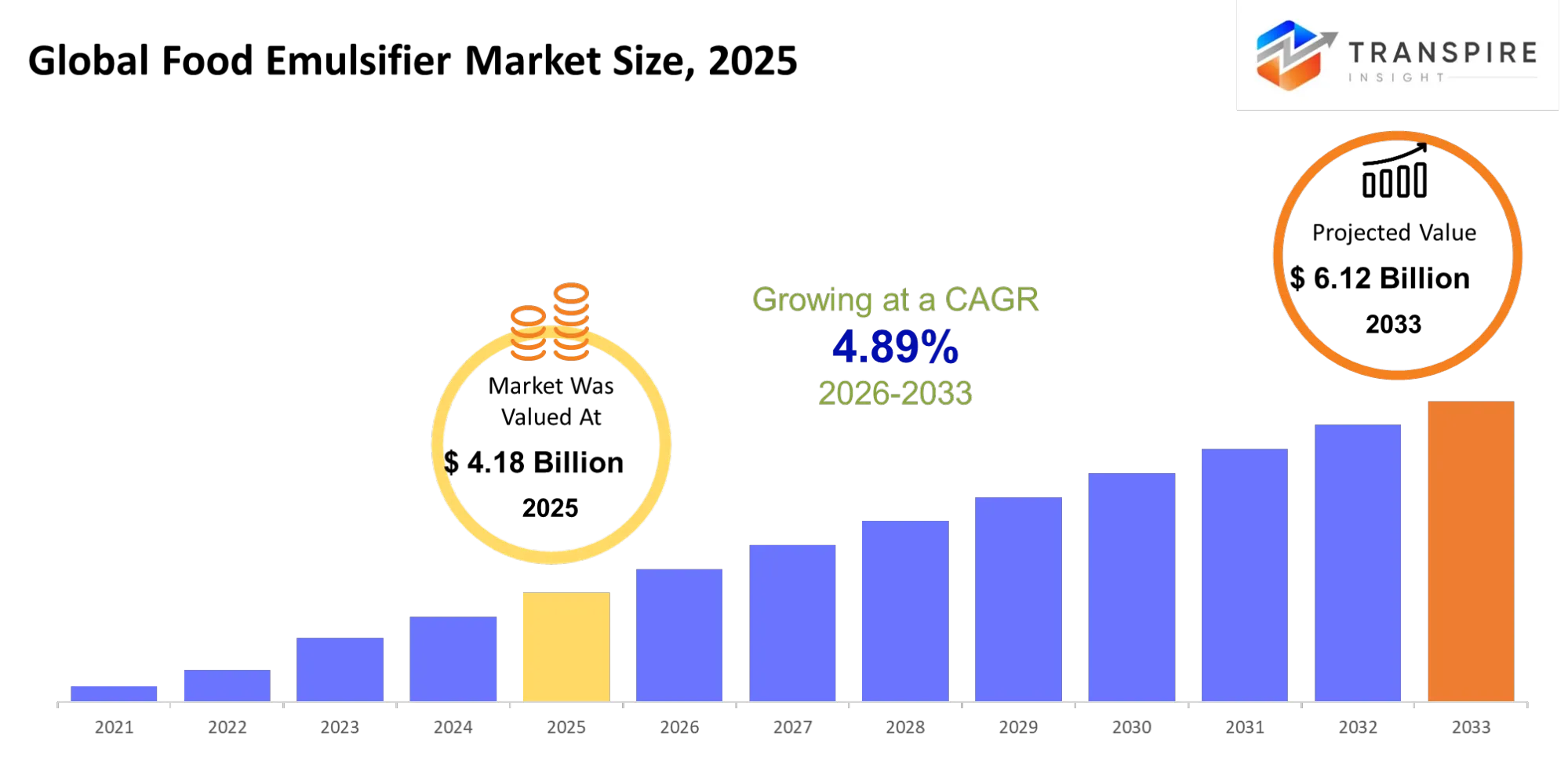
- The size of Food Emulsifier Market in 2025 will be USD 4.18 Billion.
- The size of Food Emulsifier Market in 2026 will be USD 4.38 Billion.
- The estimated size of Food Emulsifier Market in 2033 is USD 6.12 Billion.
- The Compound Annual Growth Rate (CAGR) for Food Emulsifier Market is 4.89%.
- Forecast Period for the Market: 2026–2033
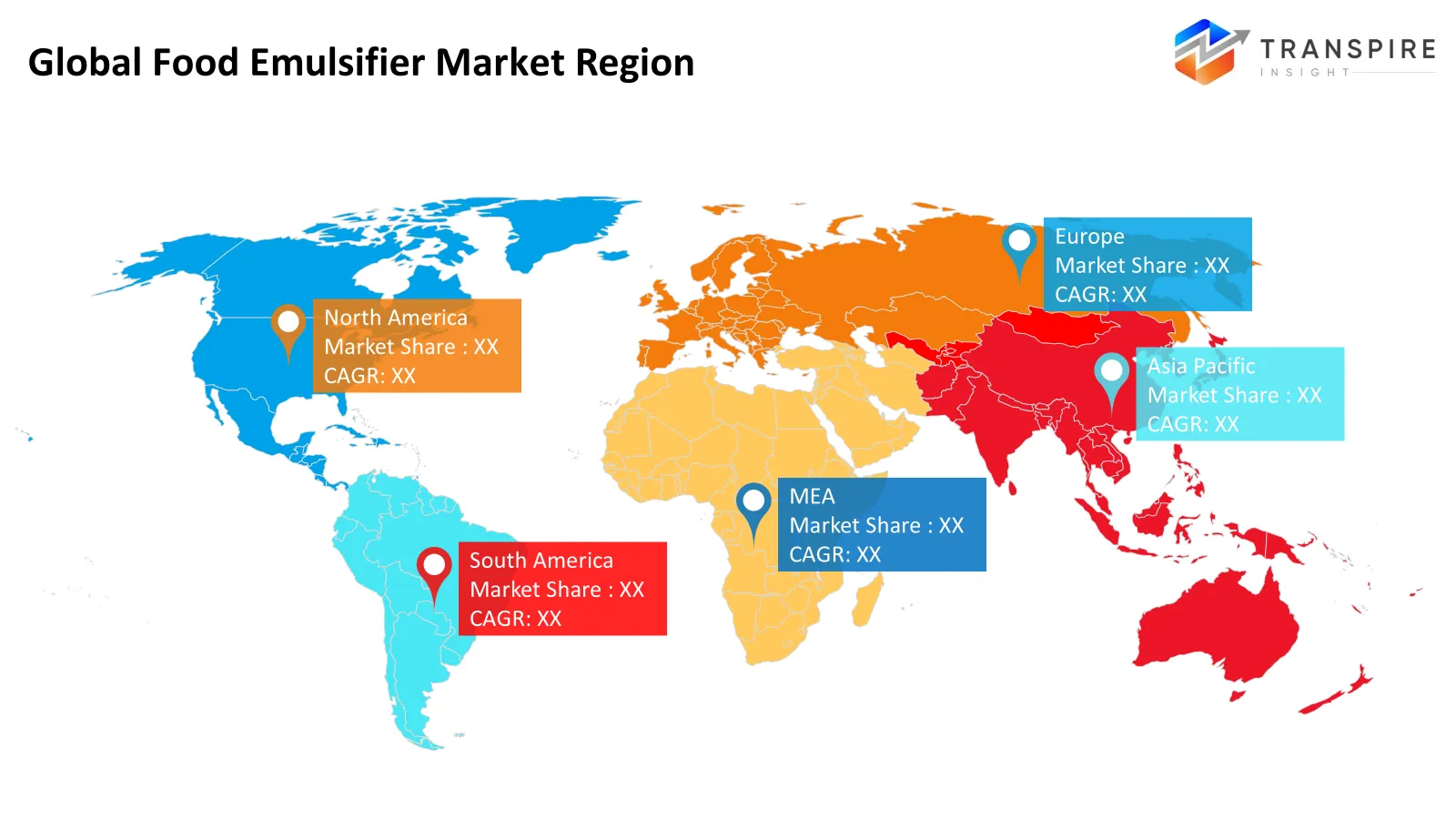
- North America is the largest regional market.
- Europe is the second-largest region.
- Asia – Pacific is the region with the fastest growth.
Introduction
The Food Emulsifier Market comprises ingredients that enable the stable mixing of oil and water in food products, improving texture, consistency, shelf life, and overall product quality. Food emulsifiers are widely used across bakery, dairy, confectionery, beverages, processed foods, sauces, dressings, and convenience foods due to their ability to enhance product stability, processing efficiency, and sensory appeal. Mono- and Diglycerides are among the most widely used food emulsifiers, offering excellent emulsification, improved dough handling, extended freshness, and enhanced texture in a broad range of food applications. Improved Stability ensures uniform blending of oil and water, preventing phase separation and maintaining consistent product quality throughout shelf life. Enhanced Texture improves softness, creaminess, mouthfeel, and overall sensory appeal in a wide range of food and beverage products. extended Shelf Life minimizes staling, moisture loss, and ingredient separation, helping preserve freshness and product quality for longer periods.Processing efficiency optimizes mixing, aeration, and production performance, improving manufacturing consistency while reducing formulation and processing costs.
- For instance: Growing demand for processed, convenience, bakery, and clean-label food products is accelerating the adoption of food emulsifiers, as manufacturers increasingly invest in advanced emulsification solutions to improve product stability, extend shelf life, enhance texture, and meet evolving consumer preferences.
Key Market Highlights: -
- North America is expected to grow at a rapid CAGR in the Global Food Emulsifier Market, holding approximately 33% share during the forecast period.
- Europe is the fastest-growing region in the Global Food Emulsifier Market during the period, holding approximately 28% share.
- Asia–Pacific is anticipated to hold approximately34% of the Global Food Emulsifier Market over the forecast period.
- By Product Type, the Mono- & Diglycerides segment dominated the market, holding projected43% share in 2025, and is projected to grow at a substantial CAGR during the forecast period.
- By Source, the plant-based ingredients segment dominated the market, held approximately50% share in 2025, and is projected to grow at a substantial CAGR during the forecast period.
- By Application, the Bakery Products segment dominated the market, holding approximately25% share in 2025, and is projected to grow at a substantial CAGR during the forecast period.
- PMKSY (Pradhan Mantri Kisan SAMPADA Yojana) strengthens food processing infrastructure through investments in cold chains, mega food parks, and agro-processing facilities. This expansion of the food processing sector indirectly drives demand for food emulsifiers used in packaged and processed food products.
How is Technology Driving Growth in the Food Emulsifier Market?
Technological advancements are playing a pivotal role in accelerating the growth of the Food Emulsifier Market by enabling the development of innovative, high-performance emulsification solutions that improve food quality, production efficiency, and sustainability. Manufacturers are increasingly investing in advanced processing technologies, enzyme-based modification, precision formulation, and microencapsulation techniques to create emulsifiers that deliver superior stability, enhanced texture, and longer shelf life while meeting evolving consumer expectations for healthier and cleaner-label products.
Market Drivers
The Global Food Emulsifier Market is experiencing significant growth due to the increasing demand for processed and convenience foods, rising consumption of bakery and confectionery products, and growing consumer preference for clean-label and functional food ingredients. Food manufacturers are increasingly adopting advanced emulsifier technologies to improve product texture, stability, shelf life, and overall quality while meeting evolving consumer and regulatory requirements. The market is also benefiting from innovations in enzyme-modified emulsifiers, plant-based ingredients, and sustainable food processing technologies, which enhance product performance and support healthier formulations. Government regulations promoting food safety, ingredient transparency, and the use of natural food additives are further supporting market growth. These factors are driving strong demand for food emulsifiers across the bakery, dairy, confectionery, beverage, processed food, and convenience food industries.
- For Instance: – US, the growing demand for clean-label, functional, and convenience food products is driving investments in advanced food emulsifier technologies, enabling manufacturers to improve product stability, enhance texture, extend shelf life, and reduce reliance on synthetic additives.
- Europe, stringent food safety regulations, increasing consumer preference for natural ingredients, and the rising adoption of plant-based food products are accelerating the use of plant-derived and enzyme-based food emulsifiers across the bakery, dairy, confectionery, and processed food industries.
Restrain
The global Food Emulsifier Market is restrained by stringent food safety regulations, fluctuating raw material prices, and increasing consumer concerns regarding synthetic food additives. Manufacturers also face challenges related to complex regulatory compliance, formulation compatibility, and the higher production costs associated with natural and clean-label emulsifiers. Additionally, supply chain disruptions for key raw materials, limited availability of specialty ingredients, and volatility in agricultural commodity prices further hinder market growth globally.
Analysis of Prices and Consumer Behaviour
Industrial-grade food emulsifiers dominate the market, contributing approximately 69% of total revenue due to strong demand from the bakery, dairy, confectionery, processed food, and beverage industries. Natural, enzyme-based, and clean-label emulsifiers are priced 30–40% higher due to their premium raw materials, advanced processing technologies, and regulatory compliance requirements. Mono- and Diglycerides account for nearly 48% of total unit sales, driven by their extensive use across a wide range of food applications and cost-effective performance. Around 72% of demand comes from the bakery, dairy, processed food, and convenience food sectors. Buyer behavior indicates that nearly 57% of customers prioritize clean-label formulations, product stability, and extended shelf life, while approximately 35% prefer multifunctional emulsifiers that improve processing efficiency and reduce overall formulation costs.
Top Companies in the Global Food Emulsifier Market
- Cargill
- ADM
- Kerry Group
- Ingredion
- BASF
- Corbion
- Palsgaard
- DSM-Firmenich
- Evonik
- Lonza
- Bunge
- Riken Vitamin
- Lasenor
- Stern-Wywiol Gruppe
- Estelle Chemicals
Global Food Emulsifier Market Segmentation
The Global Food Emulsifier Market share is divided into five categories: Product type, Source, Application, End User, Distribution Channel.
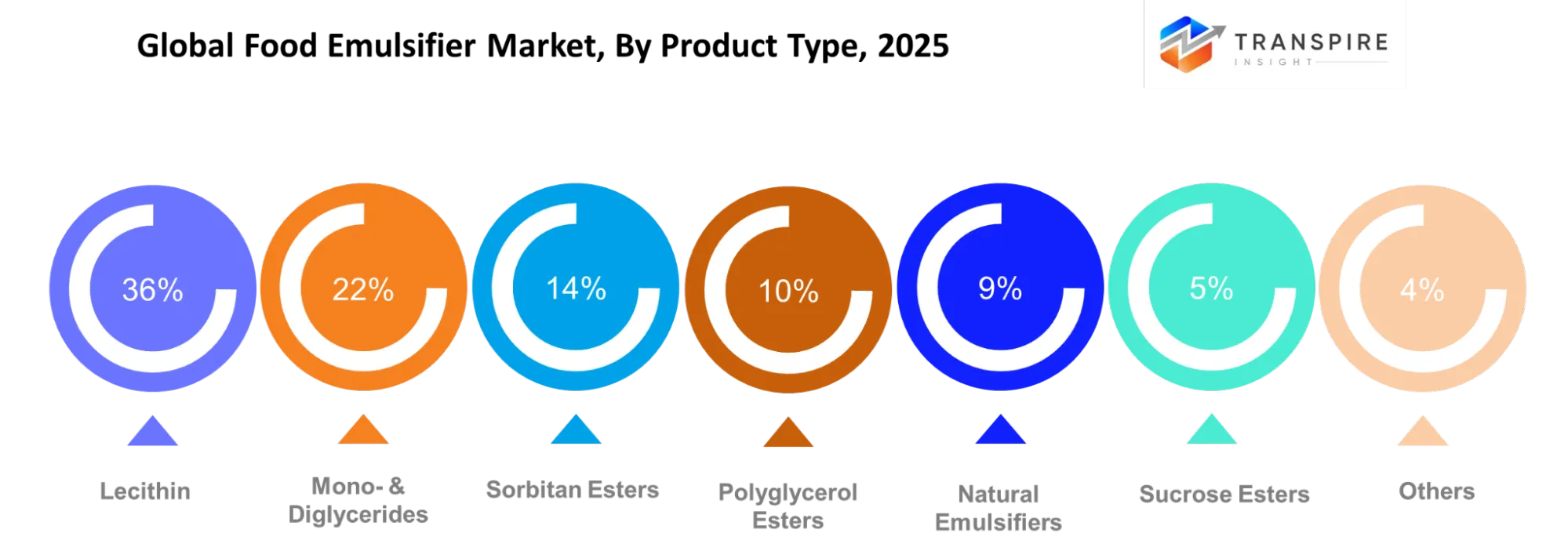
The Mono- & Diglycerides dominated the market, accounting for approximately 43% in 2025, and is expected to rise at a significant CAGR during the forecast period.
The global food emulsifier market is segmented by product type: lecithin, mono- & diglycerides, sorbitan esters, polyglycerol esters, stearoyl lactylates, sucrose esters, natural emulsifiers, and others. Among these, the mono- & diglycerides dominate the market, accounting for approximately 43% in 2025 and are expected to increase at a significant CAGR during the forecast period. The most common are mono- and diglycerides because they are adaptable and affordable emulsifiers that increase food consistency, extend shelf life, and have a strong industrial demand for bread, dairy, and processed food applications.
The plant-based ingredientsdominated the market, accounting for nearly 50% in 2025, and is expected to rise at a substantial CAGR over the forecast period.
The Global Food Emulsifier Market is segmented by source into plant-based, animal-based, synthetic, sunflower-based, soy-based, palm-based, marine-based, and others. Among these, the plant-based ingredients segment held the largest share, at approximately50% in 2025, and is expected to grow at a substantial CAGR over the forecast period. Their demand is being driven internationally by the growing popularity of sustainable products, vegan and flexitarian diets, the rising incidence of lactose intolerance, and growing consumer awareness of the health, wellness, and environmental advantages of plant-based ingredients.
The Bakery Productsdominated the market, accounting for nearly 25% in 2025 and is expected to rise at a significant CAGR during the forecast period.
The Global Food Emulsifier Market is segmented by application into bakery products, dairy products, confectionery, processed foods, beverages, infant nutrition, convenience foods, and others. Among these, the bakery products segment held the largest share, at approximately25% in 2025, and is expected to grow at a considerable CAGR over the projected period. Because of their high daily consumption, innovative shelf-life extension, and growing desire for convenient, ready-to-eat food, bakery items are at the top. This industry expansion is also being aided by consumers' growing desire for healthier and gluten-free goods.
Regional Segment Analysis of the Global Food Emulsifier Market
- North America (U.S., Canada, Mexico)
- Europe (Germany, France, U.K., Italy, Spain, Rest of Europe)
- Asia-Pacific (China, Japan, India, Rest of APAC)
- South America (Brazil and the Rest of South America)
- The Middle East and Africa (UAE, South Africa, Rest of MEA)
North America is expected to grow at a rapid CAGR in the Global Food Emulsifier Market by holding approximately 33% of the share during the forecast period.
Due to substantial investments in food research and product innovation, a well-established bakery and dairy industry, and a robust demand for processed and convenience foods, North America dominates the worldwide food emulsifier market. As customers look for healthier and more sustainable food ingredients, the region is also seeing an increase in the use of clean-label and plant-based emulsifiers. Furthermore, producers are encouraged to provide superior emulsifier solutions by strict food safety and labeling laws, which further supports long-term market growth throughout the region.
Europe is the fastest-growing region in the Global Food Emulsifier Market during the period, holding approximately 28% share.
Because of its well-established food processing sector and strong demand for processed and convenience foods, Europe has a sizable market share in the worldwide food emulsifier market. Advanced emulsifier solutions are being used throughout the region due to growing customer preferences for clean-label, plant-based, and low-fat goods. Additionally, manufacturers are motivated to produce high-quality complying ingredients by the strict EU food safety and labelling regulations. Stable market expansion in Europe is also supported by ongoing innovation in food formulations and the creation of sustainable ingredients.
Asia–Pacific is anticipated to hold approximately a 34% share of the Global Food Emulsifier Market over the forecast period.
Asia-Pacific is the fastest growing region in the global food emulsifier market owing to rapid urbanization, population growth, rising disposable incomes and changing dietary preferences. Increasing consumption of processed, packaged and convenience foods has led to a significant rise in the demand for food emulsifiers in the region. Further, the growth of food and beverage manufacturing industry in major economies such as China and India is also supporting the market growth. Growing investments in food processing and product innovation also underpin long-term demand for emulsifier ingredients in the region.
Strategies for Market Growth in Non-Leading Regions:
Growth in non-leading regions can be accelerated by expanding affordable and clean-label food emulsifier solutions tailored for regional food manufacturers. Establishing local production and sourcing facilities can reduce import dependency and lower manufacturing costs. Strategic partnerships with food processors, ingredient distributors, and bakery manufacturers will improve market penetration. Technical support and formulation training programs can enhance product adoption. Flexible pricing strategies and distribution networks can improve accessibility. Additionally, government support for food processing industries, investments in sustainable ingredients, and the expansion of B2B digital platforms will strengthen market accessibility and drive sustainable market growth in emerging economies globally.
Future Market Trends for Food Emulsifier Market: -
- Clean-Label and Natural Emulsifier Adoption: Growing consumer preference for clean-label foods is accelerating the adoption of natural and plant-based emulsifiers, supporting healthier formulations, regulatory compliance, and improved product appeal across food applications.
- Plant-Based Ingredient Innovation: Manufacturers are expanding plant-based emulsifier portfolios using sustainable sources such as soy and sunflower to meet rising demand for vegan, sustainable, and functional food products.
- Growth in Convenience and Functional Foods:Increasing consumption of convenience and functional foods is driving demand for emulsifiers that enhance texture, stability, shelf life, and overall product quality.
- Advanced Food Processing Technology: Innovations in food processing and formulation technologies are improving emulsifier performance, enabling greater product consistency, manufacturing efficiency, and ingredient functionality.
Recent Development
- July 2026:Nexira launched Eficacia Advanced, a next-generation natural emulsifier made from 100% acacia gum. Developed for food and beverage flavor applications, the solution delivers high emulsion stability while reducing formulation costs by up to 50%, addressing the growing industry demand for clean-label, high-performance, and cost-efficient emulsifier ingredients.
- March 2026:Cargill showcased advanced formulation solutions for bakery and processed food applications at AAHAR 2026. The innovations support clean-label product development, ingredient reformulation, and improved product functionality, enabling manufacturers to address evolving consumer preferences and supply chain challenges in the global food emulsifier market.
Market Segment
This study forecasts revenue at the global, regional, and country levels from 2020 to 2033. Transpire Insights has segmented the global Food Emulsifier Market based on the following segments:
Global Food Emulsifier Market, By Product Type
- Lecithin
- Mono- & Diglycerides
- Sorbitan Esters
- Polyglycerol Esters
- Stearoyl Lactylates
- Sucrose Esters
- Natural Emulsifier
- Others
Global Food Emulsifier Market, By Source
- Plant-based
- Animal-based
- Synthetic
- Sunflower-based
- Soy-based
- Palm-based
- Marine-based
- Others
Global Food Emulsifier Market, By Application
- Bakery Products
- Dairy Products
- Confectionery
- Processed Foods
- Beverages
- Infant Nutrition
- Convenience Foods
- Others
Global Food Emulsifier Market, By End User
- Food Manufacturers
- Beverage Companies
- Bakery Chains
- Dairy Processors
- Confectionery Producers
- Nutraceutical Companies
- Foodservice Industry
- Others
Global Food Emulsifier Market, By Distribution Channel
- Direct Sales
- Food Ingredient Distributors
- Online B2B Platforms
- Specialty Ingredient Suppliers
- Exporters
- Wholesalers
- Retail Supply
- Others
Global Food Emulsifier Market, By Regional Analysis
North America
- United States
- Canada
- Mexico
Europe
- Germany
- United Kingdom
- France
- Italy
- Spain
- Russia
- Rest of Europe
Asia Pacific
- China
- Japan
- India
- South Korea
- Australia
- Rest of Asia Pacific
South America
- Brazil
- Argentina
- Rest of South America
Middle East & Africa
- Saudi Arabia
- United Arab Emirates
- Qatar
- South Africa
- Rest of the Middle East & Africa
Frequently Asked Questions
Find quick answers to common questions.
They offer excellent emulsifying performance, cost-effectiveness, regulatory acceptance, and broad usage across bakery, dairy, confectionery, and processed food applications.
Rising demand for processed and convenience foods, increasing clean-label preferences, growth in bakery and dairy products, and advancements in food processing technologies are driving market expansion.
Rapid urbanization, expanding food processing industries, rising disposable incomes, and growing consumption of packaged and convenience foods are accelerating regional market growth.
Food manufacturers are increasingly adopting natural and plant-based emulsifiers to meet consumer demand for healthier, transparent-label products while maintaining texture, stability, and shelf life.
The Bakery Products segment leads the market due to extensive emulsifier use for improving dough stability, texture, softness, volume, and shelf life in baked goods.
- Cargill
- ADM
- Kerry Group
- Ingredion
- BASF
- Corbion
- Palsgaard
- DSM-Firmenich
- Evonik
- Lonza
- Bunge
- Riken Vitamin
- Lasenor
- Stern-Wywiol Gruppe
- Estelle Chemicals
About the Authors

Chetan Dhatrak
I’m Chetan Dhatrak, a Senior Research Analyst at Transpire Insight, specializing in the Consumer Goods, Foods and Beverages industry. I focus on analyzing market trends, consumer behavior, competitive landscapes, and industry developments to deliver accurate, data-driven insights. My research at Transpire Insight is built on credible sources and in-depth analysis, helping businesses and readers better understand market dynamics, emerging opportunities, and evolving consumer preferences. I’m committed to creating reliable, well-researched content that supports informed decision-making and reflects the latest developments in the consumer goods and food & beverage sectors.

Chakradhar Khansole
Chakradhar serves as the Research Director at Transpire Insight, bringing over 8 years of experience in technology, innovation, and strategic market intelligence. He specializes in transforming complex market data into actionable business insights that enable organizations to make informed, growth-oriented decisions. Recognized for his strategic vision and analytical expertise, Chakradhar leads high-impact research initiatives, delivering comprehensive market assessments, competitive intelligence, and forward-looking industry analysis.
Recently Published Reports
-
Apr 2026
Baby Infant Formula Market
Baby Infant Formula Market Size, Share & Analysis Report By ype (Infant Milk, Follow On Milk, Specialty Baby Milk, Growing-Up Milk), By Ingredient (Carbohydrate, Fat, Protein, Minerals, Vitamins, and Others), By Product Form (Powder, Liquid, and Ready-to-feed), By Distribution Channels (Supermarket/Hypermarket, Specialty Store, Pharmacies, Online Retail, and Others), and Geography (North America, Europe, Asia-Pacific, Middle East and Africa, South and Central America), 2021 - 2031
-
Apr 2026
Edible Insects for Animal Feed Market
Edible Insects for Animal Feed Market Size, Share & Analysis Report By Type (Insect Powder, Insect Meal, Insect Bar, Insect Paste, Insect Oil, and Others), By Insect Type (Beetles, Cricket, Caterpillar, Hymenoptera, Orthoptera, Tree Bugs, and Others), By Application (Livestock, Pet Food, and Aquaculture), By Livestock Type (Poultry, Swine, and Others), and Geography (North America, Europe, Asia-Pacific, Middle East and Africa, South and Central America), 2021 - 2031
-
Apr 2026
Food Industry Disinfection and Bacterial Control Market
Food Industry Disinfection and Bacterial Control Market Size, Share & Analysis Report By Type (Chemical Disinfectants, Physical Disinfectants, and Biocides and Antimicrobials), By Application (Food Processing Equipment Surface Disinfection, Food Preparation Areas Surface Disinfection, Storage Areas Surface Disinfection, Anti-microbial Coatings Food Preservation, and Preservative Solutions Food Preservation), By End User (Meat and Poultry Processing, Dairy Processing, Seafood Processing, Bakery and Confectionery, Restaurants and Commercial Kitchens, and Food Service Providers), By Sales Channel (Online, Offline), and Geography (North America, Europe, Asia-Pacific, Middle East and Africa, South and Central America), 2021 - 2031
-
May 2026
Freeze Dried Food Market
Freeze Dried Food Market Size, Share & Analysis Report By Product Type (Fruits, Vegetables, Freeze-Dried Dairy Products, Freeze-Dried Meat and Seafood, Freeze-Dried Pet Food, and Prepared Meal), By Nature (Organic, and Conventional), By Form (Powdered, Granules, and Diced), By End Use (Breakfast Cereals, Dairy Products, Bakery & Confectionery, Nutritional Bars & Supplements, Powdered Beverages, Snacks, and Retail (Household)), and Geography (North America, Europe, Asia-Pacific, Middle East and Africa, South and Central America), 2021 - 2031