

United States Emulsifier for Bakery Products Market Size & Forecast:
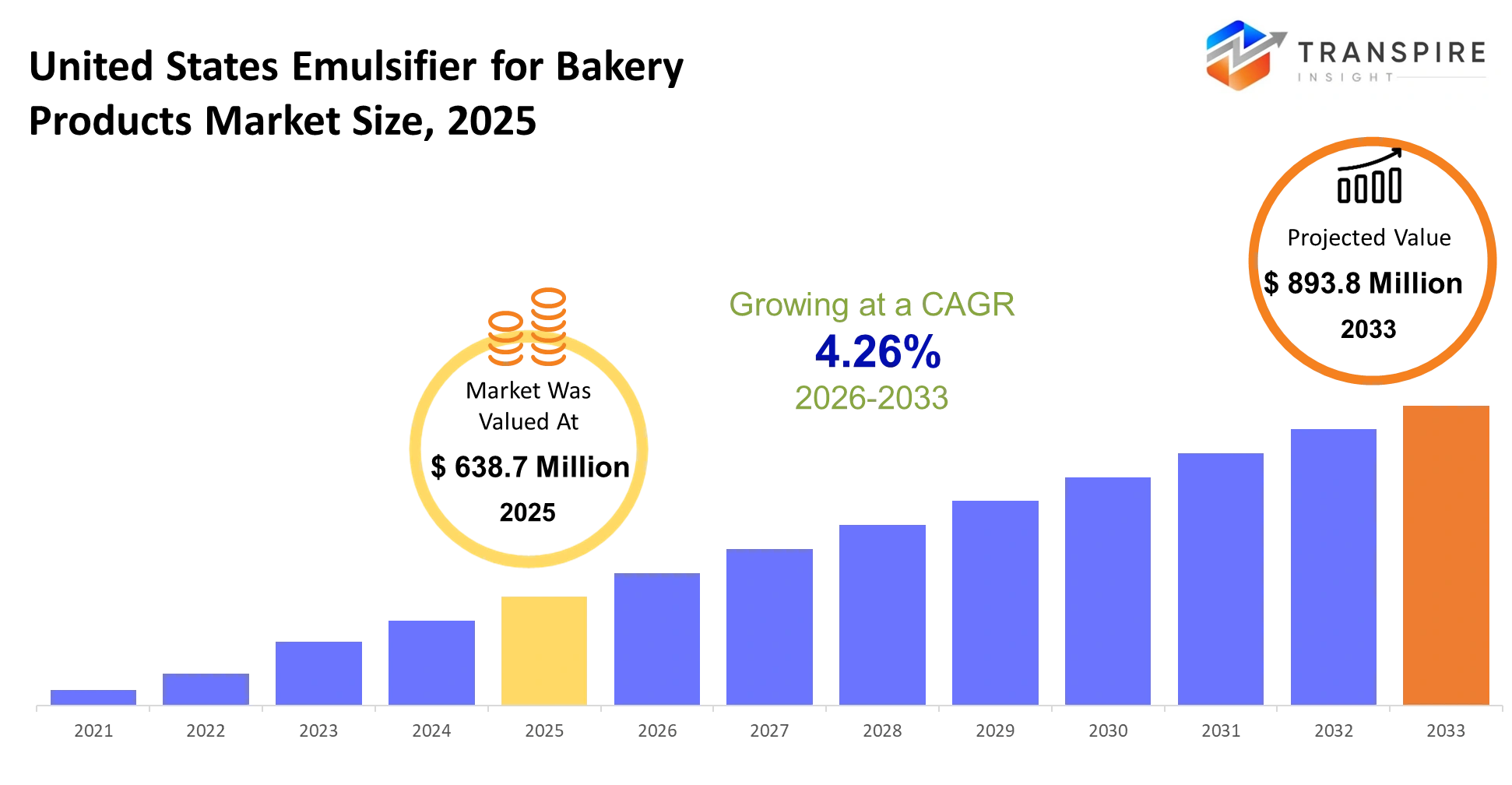
- United States Emulsifier for Bakery Products Market Size 2025: USD 638.7 Million
- United States Emulsifier for Bakery Products Market Size 2033: USD 893.8 Million
- United States Emulsifier for Bakery Products Market CAGR: 4.26%
- United States Emulsifier for Bakery Products Market Segments:By Type (Mono & Diglycerides, Lecithin, DATEM, SSL, CSL, Polysorbates, Enzymes), By Application (Bread, Cakes, Pastries, Biscuits, Cookies, Dough, Fillings), By Form (Liquid, Powder, Paste, Gel, Granules, Tablets, Blends), By Function (Stabilizing, Texture, Shelf-life, Aeration, Dough Conditioning, Moisture Retention, Anti-staling), By End-User (Bakeries, Food Manufacturers, Retail, Hotels, Restaurants, Industrial, Artisanal).
To learn more about this report,  Download Free Sample Report
United States Emulsifier for Bakery Products Market Summary:
The United States Emulsifier for Bakery Products Market size is estimated at USD 638.7 Million in 2025 and is anticipated to reach USD 893.8 Million by 2033, growing at a CAGR of 4.26% from 2026 to 2033. The United States Emulsifier for Bakery Products Market is experiencing consistent growth because consumers demand baked products which maintain better quality and texture and shelf life and product consistency. Emulsifiers serve as essential components The baking industry needs these substances to stabilize dough while they maintain product freshness. The market experiences fresh growth because customers select bakery items that have clean product labels and superior baked products. The industrial sector requires advanced emulsifier systems because manufacturers need to improve their operations while creating distinct product identities.
What Has the Impact of Artificial Intelligence Been on the United States Emulsifier for Bakery Products Market?
Artificial intelligence technology transforms the United States emulsifier for bakery products market through its ability to improve decision-making and operational processes. Organizations can utilize advanced data analysis methods together with machine learning to transform their complete data assets into usable business insights which improve their market research processes and help them discover upcoming market developments.
The United States Emulsifier for Bakery Products Market uses AI technology to provide accurate demand forecasts which assist manufacturers in matching their production levels with changing consumer demands. Predictive analytics helps product development teams by predicting market shifts toward clean-label and functional emulsifiers, which enhances their competitive advantage.
The United States Emulsifier for Bakery Products Market benefits from artificial intelligence, which improves manufacturing processes through intelligent automated systems and continuous monitoring technology. The systems enable businesses to optimize their ingredient consumption while minimizing waste and delivering uniform product standards.
AI-based solutions for supply chain optimization decrease operational disruptions. The solutions also reduce operational costs while improving inventory handling. The United States Emulsifier for Bakery Products Market enables businesses to develop fresh products. The market allows companies to build customized solutions which help them maintain their market position in an industry that depends on data.
Key Market Trends & Insights:
- The Midwest region of the United States controls the bakery product emulsifier market because it has established itself as the industrial bakery capital, which gives it 35% market share for 2024.
- The Western region experiences the highest growth rate because its premium bakery products will create a compound annual growth rate that exceeds 6.2% during 2025-2030 period.
- Mono- and diglycerides control more than 40% of the 2024 market because they serve a widespread purpose in enhancing product texture together with extending shelf life.
- Lecithin occupies the second-largest market position because its natural and plant-based emulsifier demand continues to increase.
- Enzyme-based emulsifiers represent the quickest developing market section which will achieve 6.8% compound annual growth rate until 2030 because of clean-label product demand.
- Bread and buns dominate the united states emulsifier for bakery products market which contributes approximately 45% market share during 2024 because of their widespread consumption.
- Cakes and pastries represent the fastest-growing application segment, driven by premiumization and artisanal product demand.
- Industrial bakeries command the market with their 60% share because they operate large factories and use automated systems.
- The demand for artisan and in-store bakeries is experiencing fast growth because consumers increasingly want fresh and personalized baked products.
- Companies develop new products which include enzyme-based and clean-label emulsifiers to meet changing demands of their customers.
- The distribution networks receive better support through strategic partnerships, while regional expansion also helps to bolster market presence throughout the United States bakery product emulsifier market.
- Business operations achieve better production results and lower expenses through smart automation combined with AI-powered systems, which also help them compete against their rivals.
United States Emulsifier for Bakery Products Market Segmentation
By Type
The United States uses mono and diglycerides as common ingredients because these substances serve the purpose of improving baked goods through their capacity to enhance both texture and volume. The natural alternative will receive increased recognition because it derives from soy or sunflower sources.
The common applications of DATEM and SSL and CSL enable the improvement of dough strength while creating superior crumb structure. The mixing process achieves uniformity through polysorbates, while enzymes deliver clean-label products that provide functional advantages.
The food industry will see increased demand for enzymes because producers will start using simpler ingredient lists. The demand for lecithin will increase because of the plant-based trend and growing consumer knowledge.The production process needs traditional emulsifiers because they provide affordable solutions that produce predictable outcomes. Each type will serve a specific purpose, allowing manufacturers to select based on product requirements and processing conditions. The Bakery Products Market experiences continuous growth because customers prefer baked goods that provide superior product quality and texture and extended shelf life and uniformity in product characteristics.
The baking industry needs emulsifiers because they help maintain dough stability and extend product freshness. The market is experiencing innovation because consumers prefer clean-label bakery products and high-quality baked goods. Advanced emulsifier solutions are becoming more requested by manufacturers who want to improve their operational efficiency while creating unique product identities.
By Application
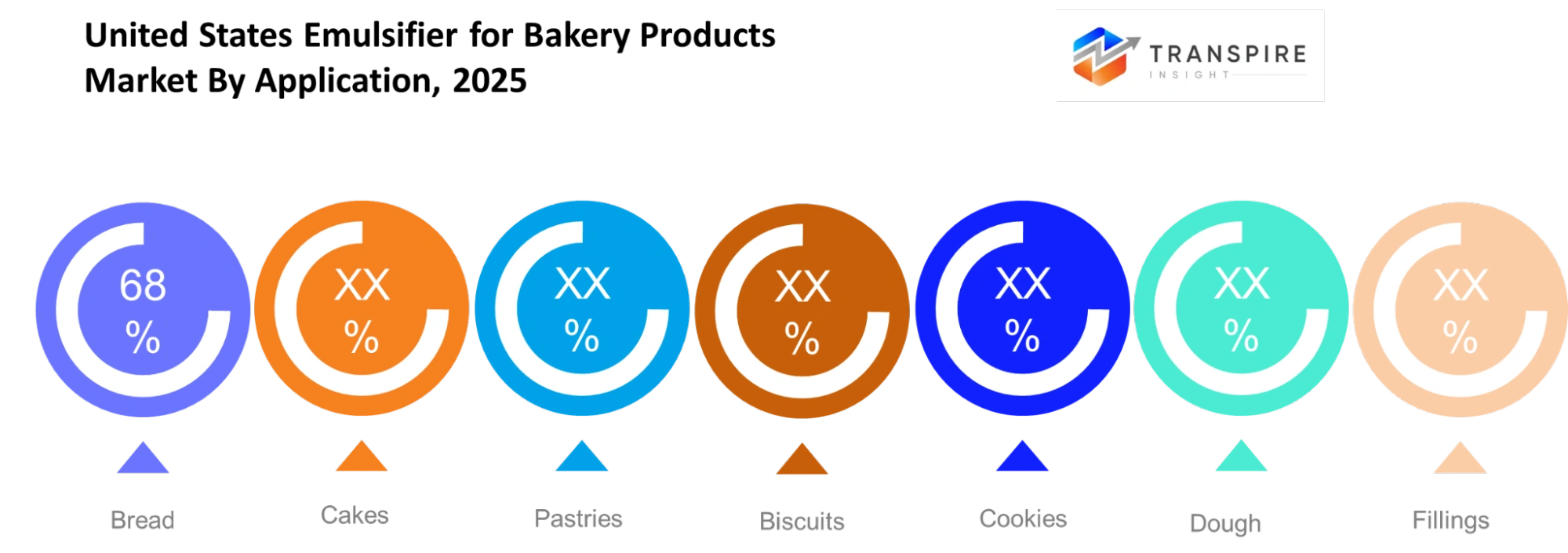
Bread will remain a leading application because people consume it every day and require its softness to maintain freshness throughout its storage period. Emulsifiers will be necessary for cakes and pastries because they help maintain their light texture and prevent structural damage during storage. The dough used in biscuits and cookies will improve through better dough handling methods which produce consistent baking results. The ingredients will help dough and fillings maintain their stability while preventing any separation.
The market for premium baked goods will create a need for specialized solutions which improve both taste and visual presentation. The rise of ready-to-eat products and packaged goods will lead to increased usage across various applications. Each category needs its own unique formulations which will help achieve quality standards and enable processing requirements. Manufacturers will adjust their ingredient combinations to achieve two goals which include meeting consumer preferences and achieving their production objectives.
To learn more about this report, Download Free Sample Report
By Form
Liquid emulsifiers enable simple mixing and rapid dispersion during industrial production processes. The dry powder form provides extended shelf stability which simplifies storage operations in dry mixing applications. The controlled application of paste and gel formats makes them suitable for particular cooking instructions. The use of granules and tablets enables accurate medication distribution, which ensures uniformity in manufacturing processes.
The use of blended forms enables improved operational efficiency through decreased time requirements for material preparation. The selected form will be determined by the specific processing techniques, the expected storage environments, and the characteristics of the product. Manufacturers will select formats that support convenience and cost control. The ability to choose different forms will enable bakeries to fulfill their various operational requirements.
By Function
Baked products maintain their original structure because stabilizing functions stop their components from splitting apart. The texture improvement process creates a soft texture which delivers an enjoyable mouthfeel to consumers who use it to measure their satisfaction. The ability to extend shelf life will decrease waste while enabling products to be distributed over extended distances.
Dough conditioning improves handling and processing abilities which lead to increased production efficiency. Products remain fresh for extended periods because their moisture content protects them from becoming dry. Anti-staling properties enable products to maintain their quality for extended durations which creates advantages for packaged products.
By End-User
Bakeries and food manufacturers will continue to use their products because they require high production volumes and need to maintain their product quality. The retail and food service industries which include hotels and restaurants will utilize these ingredients to preserve their product quality. Industrial facilities will prioritize efficient operations while managing expenses and producing standardized results throughout their production process.
The retail and food service sectors will expand their operations which creates opportunities for all end users to increase their product usage.Consumers will base their purchasing decisions on their need for fresh and packaged baked goods. The needs of each end user group will depend on their operational size and the specific products they handle.
What are the Main Challenges for the United States Emulsifier for Bakery Products Market Growth?
The United States market for bakery product emulsifiers faces ongoing technical and operational difficulties which particularly affect the ability to deliver stable product performance in various baking processes. The stability and operational properties of emulsifiers depend on two factors which include the quality of raw materials and their processing requirements. The production process for complex formulations becomes more difficult because it requires exact control which results in production delays that make scaling up operations impossible.
The United States market for bakery product emulsifiers faces market growth restrictions because of both manufacturing and commercialisation obstacles. Business operations face higher expenses because companies must follow food safety rules and Good Manufacturing Practices (GMP) standards which require more time to get their products approved. Manufacturers face additional financial challenges because raw material prices and energy expenses continue to increase.
Small and medium-sized bakeries face significant challenges when they need to implement new systems because they lack sufficient technical expertise and proper facilities. The United States bakery product emulsifier market struggles with two problems which include a shortage of skilled workers and a lack of knowledge about advanced product formulations. Organizations face financial limitations which prevent them from spending money on advanced processing systems.
The United States bakery emulsifier market experiences increased complexity because of intense market competition and changing risk conditions. The market faces pricing challenges because enzymes and hydrocolloids, which serve as alternative ingredients, become more popular. The ongoing development of new regulatory standards together with increasing consumer demand for clean-label products creates continuous threats to businesses.
Country Insights
The Midwest region maintains its economic strength because it contains numerous large bakeries and food processing facilities. The market maintains constant product need for packaged bread and related items which creates continuous demand for emulsifiers. The region will achieve efficient operations through its industrial facilities and supply chain systems which ensure dependable production and distribution services.
The Western region shows continuous growth because multiple people demand superior clean-label bakery products. Health-conscious consumers choose their products based on their preference for plant-based ingredients. Advanced emulsifier solutions will see greater application in urban areas through the development of innovative specialty baked goods.
The Southern and Northeastern regions continue to grow through the development of new bakery retail stores and food service establishments. The market will expand because consumers want convenient food options which include ready-to-eat bakery products. The growth of small and medium bakeries will lead to higher product consumption because distribution network improvements and regional production sites become more accessible.
Recent Development News
In March 2026, Natural Surfactants and Polyglycerol Esters Drive Emulsifiers Market Growth: Archer Daniels Midland (ADM) launched product expansion. The company expanded its clean-label emulsifier portfolio with plant-based lecithin and enzyme-modified systems to support bakery reformulation demand in the United States.
Source: https://www.openpr.com
In April 2026, Cargill expands its speciality fats portfolio to support bakery and food innovation: Cargill announced expansion. The company expanded its specialty fats portfolio with a new production line to support bakery, confectionery, and dairy applications, strengthening ingredient innovation and formulation flexibility
Source: https://www.apfoodonline.com
|
Report Metrics |
Details |
|
Market size value in 2025 |
USD 638.7 Million |
|
Market size value in 2026 |
USD 667.3 Million |
|
Revenue forecast in 2033 |
USD 893.8 Million |
|
Growth rate |
CAGR of 4.26% from 2026 to 2033 |
|
Base year |
2025 |
|
Historical data |
2021 – 2024 |
|
Forecast period |
2026 – 2033 |
|
Report coverage |
Revenue forecast, competitive landscape, growth factors, and trends |
|
Country scope |
United States |
|
Key company profiled |
Cargill, ADM, Kerry, BASF, Palsgaard, Corbion, DuPont, Ingredion, Lonza, Evonik, DSM, Tate & Lyle, Stepan, Stern Ingredients, Riken Vitamin |
|
Customization scope |
Free report customization (country, regional & segment scope). Avail customized purchase options to meet your exact research needs. |
|
Report Segmentation |
By Type (Mono & Diglycerides, Lecithin, DATEM, SSL, CSL, Polysorbates, Enzymes), By Application (Bread, Cakes, Pastries, Biscuits, Cookies, Dough, Fillings), By Form (Liquid, Powder, Paste, Gel, Granules, Tablets, Blends), By Function (Stabilizing, Texture, Shelf-life, Aeration, Dough Conditioning, Moisture Retention, Anti-staling), By End-User (Bakeries, Food Manufacturers, Retail, Hotels, Restaurants, Industrial, Artisanal). |
How Can New Companies Establish a Strong Foothold in the United States Emulsifier for Bakery Products Market?
The United States emulsifier market for bakery products provides new businesses with an opportunity to create a strong market presence through their dedication to specialized segments which include clean-label, plant-based and enzyme-based products. The new players in the market will create their unique identity through the development of specialized bakery solutions which remain unmet in the current market.
The United States emulsifier market for bakery products will see innovation strategies as the main method that companies use to achieve their competitive advantages. Startups that develop advanced formulations through their work on enzyme-based emulsifiers and multi-functional blends, will develop products that solve two industry challenges, which include maintaining product freshness and ensuring consistent texture.
The company will achieve faster market entry through its strategic partnerships, which establish connections with bakery manufacturers and ingredient distributors and research institutions. The new companies use partnerships to expand their production capabilities and create distribution networks while testing their products in the market.
The United States bread emulsifier market will benefit from partnerships between industrial bakeries and food service companies because these relationships will establish trust and extend business reach. The partnerships will help our company establish commercial pathways while reducing the time needed to bring products to market.
The company will enhance its market presence through technology differentiation and operational efficiency. The implementation of smart automation together with predictive analytics and supply chain optimization will decrease expenses while enhancing operational reliability.
Key United States Emulsifier for Bakery Products Market Company Insights
Companies that lead markets will use their resources to develop better products while reducing expenses and ensuring constant product availability. Cargill, ADM, Kerry Group, Ingredion, and Corbion will pursue their business expansion by introducing new products that feature clean-label and enzyme-based technologies. Companies will reach better performance results through their ongoing research and development investments which will help them adapt to the evolving requirements of the baking industry.
The market will face intense competition because both international companies and local distributors provide matching functional solutions. The effort of smaller businesses to enter the market will focus on developing specific niche products which they will sell using various pricing methods. Bakery producers and distributors will use strategic partnerships to improve their distribution networks while technology implementation will enhance their operational efficiency and quality assurance processes and help them maintain market position.
Company List
- Cargill
- ADM
- Kerry
- BASF
- Palsgaard
- Corbion
- DuPont
- Ingredion
- Lonza
- Evonik
- DSM
- Tate & Lyle
- Stepan
- Stern Ingredients
- Riken Vitamin
What are the Key Use-Cases Driving the Growth of the United States Emulsifier for Bakery Products Market?
The strong bread production requirements need emulsifiers which help bakers maintain dough stability while achieving bigger bread loaves that stay fresh for longer periods. The baking industry depends on these materials because they help maintain product quality from baking through delivery to customers. The system requires high-capacity production because it needs to operate at maximum output while generating minimum waste for optimal success.
Emulsifiers enable cakes and pastries to achieve their desired texture through their ability to create air bubbles and preserve moisture. The United States market for bakery emulsifiers experiences growth because restaurants and supermarkets show increasing demand for high-end desserts that can be consumed without preparation. The development of low-fat and sugar-reduced products has made health-related products more popular with consumers who want healthier food options.
Biscuits and cookies and frozen dough products represent a significant market for processed and packaged food products. Emulsifiers enhance mixing process efficiency while they keep product quality intact from storage through transportation. The United States market for bakery emulsifiers keeps growing because more people consume convenient foods which result from their active lives and the increasing number of people who live in urban areas.
New food production methods and specialty bakery products are driving market expansion. Companies that operate on an industrial scale use advanced emulsifier combinations to achieve better production results while spending lower production costs. The market will experience growth through emerging innovations which provide scalable solutions that meet clean-label requirements and deliver functional advantages.
United States Emulsifier for Bakery Products Market Report Segmentation
By Type
- Mono & Diglycerides
- Lecithin
- DATEM
- SSL
- CSL
- Polysorbates
- Enzymes
By Application
- Bread
- Cakes
- Pastries
- Biscuits
- Cookies
- Dough
- Fillings
By Form
- Liquid
- Powder
- Paste
- Gel
- Granules
- Tablets
- Blends
By Function
- Stabilizing
- Texture
- Shelf-life
- Aeration
- Dough Conditioning
- Moisture Retention
- Anti-staling
By End-User
- Bakeries
- Food Manufacturers
- Retail
- Hotels
- Restaurants
- Industrial
- Artisanal
Frequently Asked Questions
Find quick answers to common questions.
The approximate United States Emulsifier for Bakery Products Market size for the market will be USD 893.8 Million in 2033.
The key segments of the United States Emulsifier for Bakery Products Market are By Type (Mono & Diglycerides, Lecithin, DATEM, SSL, CSL, Polysorbates, Enzymes), By Application (Bread, Cakes, Pastries, Biscuits, Cookies, Dough, Fillings), By Form (Liquid, Powder, Paste, Gel, Granules, Tablets, Blends), By Function (Stabilizing, Texture, Shelf-life, Aeration, Dough Conditioning, Moisture Retention, Anti-staling), By End-User (Bakeries, Food Manufacturers, Retail, Hotels, Restaurants, Industrial, Artisanal).
Major players in the United States Emulsifier for Bakery Products Market are Cargill, ADM, Kerry, BASF, Palsgaard, Corbion, DuPont, Ingredion, Lonza, Evonik, DSM, Tate & Lyle, Stepan, Stern Ingredients, Riken Vitamin.
The current market size of the United States Emulsifier for Bakery Products Market is USD 638.7 Million in 2025.
The United States Emulsifier for Bakery Products Market CAGR is 4.26%.
- Cargill
- ADM
- Kerry
- BASF
- Palsgaard
- Corbion
- DuPont
- Ingredion
- Lonza
- Evonik
- DSM
- Tate & Lyle
- Stepan
- Stern Ingredients
- Riken Vitamin
Recently Published Reports
-
Apr 2026
Baby Infant Formula Market
Baby Infant Formula Market Size, Share & Analysis Report By ype (Infant Milk, Follow On Milk, Specialty Baby Milk, Growing-Up Milk), By Ingredient (Carbohydrate, Fat, Protein, Minerals, Vitamins, and Others), By Product Form (Powder, Liquid, and Ready-to-feed), By Distribution Channels (Supermarket/Hypermarket, Specialty Store, Pharmacies, Online Retail, and Others), and Geography (North America, Europe, Asia-Pacific, Middle East and Africa, South and Central America), 2021 - 2031
-
Apr 2026
Edible Insects for Animal Feed Market
Edible Insects for Animal Feed Market Size, Share & Analysis Report By Type (Insect Powder, Insect Meal, Insect Bar, Insect Paste, Insect Oil, and Others), By Insect Type (Beetles, Cricket, Caterpillar, Hymenoptera, Orthoptera, Tree Bugs, and Others), By Application (Livestock, Pet Food, and Aquaculture), By Livestock Type (Poultry, Swine, and Others), and Geography (North America, Europe, Asia-Pacific, Middle East and Africa, South and Central America), 2021 - 2031
-
Apr 2026
Food Industry Disinfection and Bacterial Control Market
Food Industry Disinfection and Bacterial Control Market Size, Share & Analysis Report By Type (Chemical Disinfectants, Physical Disinfectants, and Biocides and Antimicrobials), By Application (Food Processing Equipment Surface Disinfection, Food Preparation Areas Surface Disinfection, Storage Areas Surface Disinfection, Anti-microbial Coatings Food Preservation, and Preservative Solutions Food Preservation), By End User (Meat and Poultry Processing, Dairy Processing, Seafood Processing, Bakery and Confectionery, Restaurants and Commercial Kitchens, and Food Service Providers), By Sales Channel (Online, Offline), and Geography (North America, Europe, Asia-Pacific, Middle East and Africa, South and Central America), 2021 - 2031
-
May 2026
Freeze Dried Food Market
Freeze Dried Food Market Size, Share & Analysis Report By Product Type (Fruits, Vegetables, Freeze-Dried Dairy Products, Freeze-Dried Meat and Seafood, Freeze-Dried Pet Food, and Prepared Meal), By Nature (Organic, and Conventional), By Form (Powdered, Granules, and Diced), By End Use (Breakfast Cereals, Dairy Products, Bakery & Confectionery, Nutritional Bars & Supplements, Powdered Beverages, Snacks, and Retail (Household)), and Geography (North America, Europe, Asia-Pacific, Middle East and Africa, South and Central America), 2021 - 2031