Global Emergency Exit Hatch Lightweight Composite Structures Market Summary:
According to Transpire Insights, a detailed research report on the market reflects that the aerospace application segment dominates the global Global Emergency Exit Hatch Lightweight Composite Structures Market, accounting for approximately 74% of the total share worldwide. Collins Aerospace leads the market with approximately (around USD 28.7 billion) in annual revenue and an estimated 18–22% global market share, making it the leading contributor to global market development, innovation, advanced emergency exit hatch lightweight composite structures production, expanding manufacturing capabilities, and growth dynamics.
Market Snapshot
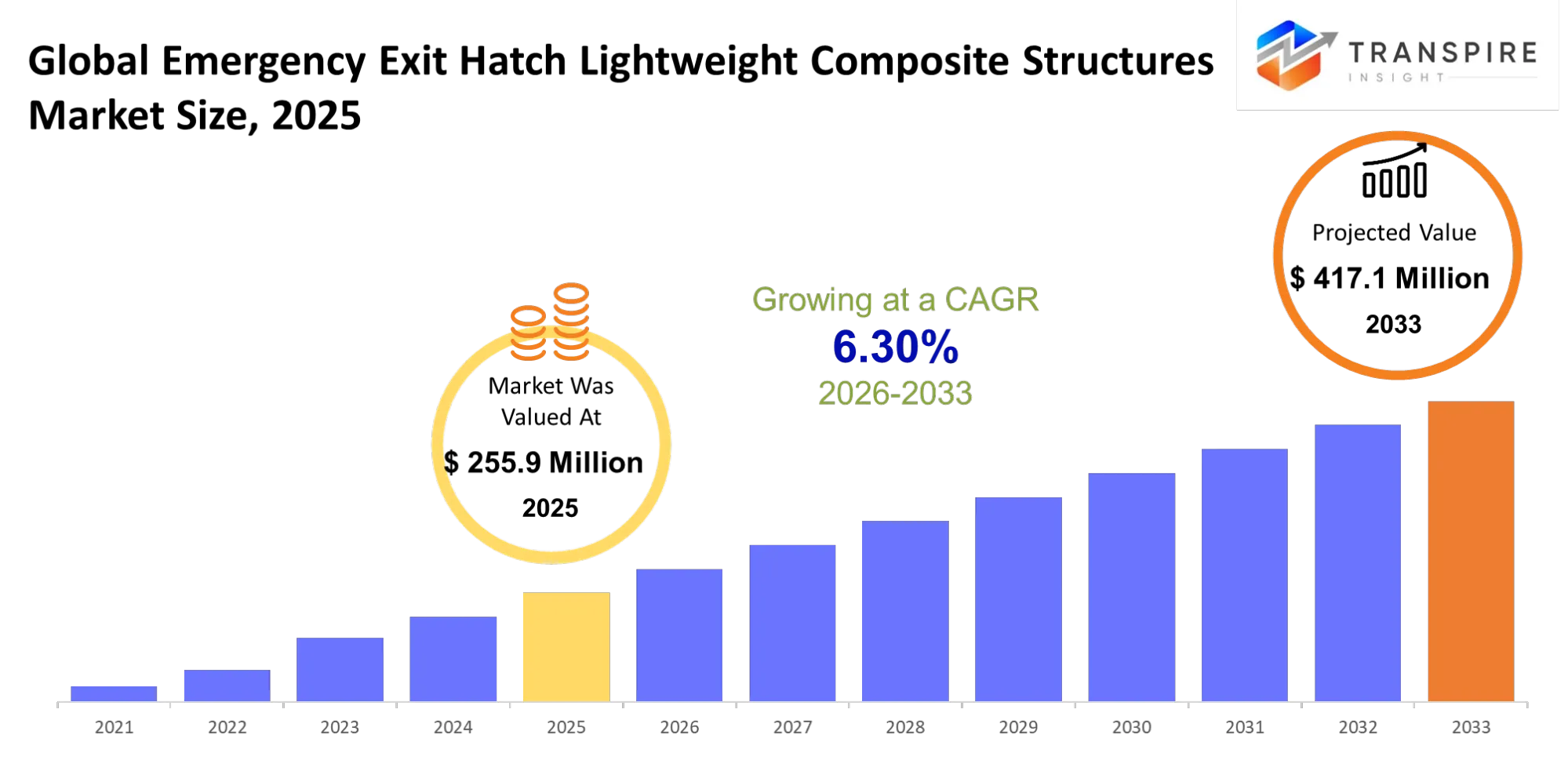
- Market Value (2025): USD 255.9 Million.
- Expected Market Value (2026): USD 271.9 Million.
- Estimated Market Value (2033): USD 417.1 Million.
- Forecast CAGR (2026–2033): 6.30%.
- Leading Region in 2025: Asia-Pacific.
- Second-largest Region: North America.
- Fastest Growing Region: Europe.
Introduction
In aircraft, maritime, or heavy transportation, an emergency escape hatch lightweight composite construction is an approved exit or door assembly used for quick evacuation. Modern, lightweight materials like carbon fiber or glass-reinforced plastics combined with robust polymer matrices are used in its production. Lightweight Composite Structures, Advanced materials composed of two or more constituent materials with distinct physical and chemical properties, such as carbon-fiber reinforced polymers. Their high strength-to-weight ratio, which lowers the total weight of the aircraft, makes them extremely valuable. Emergency Exit Hatch, Specialized egress points intended for rapid deployment in the event of an aviation emergency, such as crew doors, overwing exits and cockpit escape doors.
Weight Reduction: Significantly lighter than conventional steel or aluminum, which directly increases load capacity and fuel efficiency.Exceptional strength composites offer more tensile and structural strength than many soft metals despite their small bulk. Corrosion resistance, composites do not rust or corrode like steel or aluminum do, which is crucial for outdoor use in marine situations. Because they are non-conductive, thermal and electrical insulation reduces energy transmission and protects against inclement weather.
- For instance:-By 2033, the escape hatch market in North America is expected to grow from its current $890 million valuation to $1.45 billion. In order to maximize fuel efficiency, improve crashworthiness, and update infrastructure, investments are primarily concentrated on research and development for carbon-fiber.
Key Market Highlights: -
- Asia Pacific is anticipated to hold approximately 30% share of the Global Emergency Exit Hatch Lightweight Composite Structures Market over the predicted timeframe.
- North America is expected to grow at a rapid CAGR in the Global Emergency Exit Hatch Lightweight Composite Structures Market by holding approximately25% of the share during the forecast period.
- Europe is anticipated to hold approximately28% share of the Global Emergency Exit Hatch Lightweight Composite Structures Market over the predicted timeframe.
- By product type, the Emergency Roof Hatches segment dominated the market and holds approximately 35% share in 2025 and is projected to grow at a substantial CAGR during the forecast period.
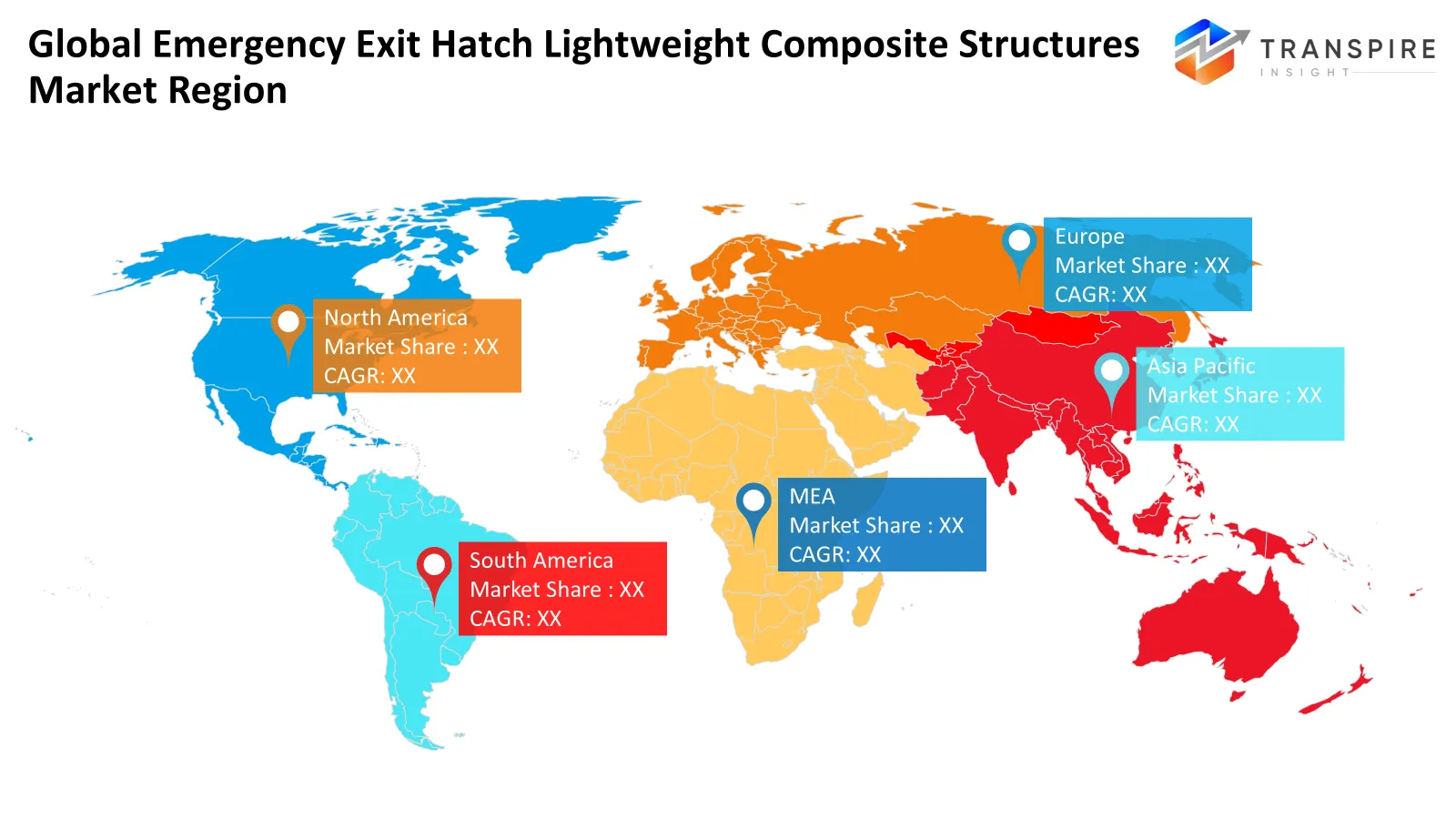
- By material, the Glass Fiber Composites segment dominated the market and holds approximately 55% share in 2025 and is projected to grow at a substantial CAGR during the forecast period.
- By end user, the Commercial Airlines segment dominated the market and holds approximately 70% share in 2025 and is projected to grow at a substantial CAGR during the forecast period.
- By application, the Passenger Cabins segment dominated the market and holds approximately 65% share in 2025 and is projected to grow at a substantial CAGR during the forecast period.
- Swavlamban 2.0 this program which is run by the Department of Defense Production, promotes the indigenization of essential components by MSMEs and academic institutions. For platforms like the Indian Navy and Air Force, it particularly targets sophisticated lightweight structures (including composites).
How is Technology Driving Growth in the Global Emergency Exit Hatch Lightweight Composite Structures Market?
Advanced Manufacturing & Automation, the production of lightweight, high-strength composite emergency exit hatches with exceptional durability and thermal resistance is made possible by technologies like Automated Layup Technology (ALT), Resin Transfer Molding (RTM), and Additive Manufacturing. These technologies also reduce costs and cycle times. Regulatory-Driven Lightweighting, the use of fiber-reinforced polymer (FRP) composite emergency exit hatches to lower vehicle and aircraft weight, increase fuel efficiency, and support sustainability goals is being driven by strict fuel efficiency and emission regulations in the automotive and aerospace industries. Smart Integration & Improved Safety, by providing real-time structural health monitoring, latch status tracking, and dependable operation during emergency scenarios, the integration of IoT-enabled monitoring systems and cutting-edge design techniques improves emergency exit hatch performance.
Market Drivers
Advanced Manufacturing & Automation, the production of lightweight, high-strength composite emergency exit hatches with exceptional durability and thermal resistance is made possible by technologies like Automated Layup Technology (ALT), Resin Transfer Molding (RTM) and Additive Manufacturing. These technologies also reduce costs and cycle times. Regulatory-Driven Lightweighting, the use of fiber-reinforced polymer (FRP) composite emergency exit hatches to lower vehicle and aircraft weight, increase fuel efficiency, and support sustainability goals is being driven by strict fuel efficiency and emission regulations in the automotive and aerospace industries. Smart Integration & Improved Safety, by providing real-time structural health monitoring, latch status tracking, and dependable operation during emergency scenarios, the integration of IoT-enabled monitoring systems and cutting-edge design techniques improves emergency exit hatch performance.
Lightweight Performance, compared to traditional metal alternatives, composite emergency exit hatches significantly reduce weight, which enhances fuel economy, boosts payload capacity and supports reduced emissions. High strength & safety, under challenging operating conditions, advanced composite materials offer improved impact resistance, structural integrity and dependable performance with an outstanding strength-to-weight ratio. Corrosion and environmental resistance, composite hatches are ideal for aerospace, maritime, rail and emergency infrastructure applications because they are naturally resistant to corrosion, moisture and severe environmental conditions.
- For Instance: - The United States is growing quickly due to strict commercial building fire requirements and aerospace fuel-efficiency regulations. With the U.S. composites industry as a whole valued at about $16.4 billion, expenditures are increasingly concentrated on advanced thermoplastics and carbon-fiber epoxies.
Restrain
The Global Emergency Exit Hatch Lightweight Composite Structures Market include high material and manufacturing costs, stringent fire and safety regulations, complex design and repair requirements, and limited composite recyclability. These factors increase lifecycle expenses and create barriers to wider adoption of lightweight composite emergency exit hatch structures.
Analysis of Prices and Consumer Behaviour
The price of the market is affected by the high price of advanced materials including carbon-fiber composites, fiber-glass composites, and aramid fibers as well as technologies like automated fiber placement (AFP), resin transfer molding (RTM), and autoclave curing.Consumer behavior in the market is affected by various factors including the need for weight reduction, safety, durability, and life cycle cost-effectiveness. The demand for lightweight composite emergency exit hatch structures is increasing among aerospace, marine, transportation, and defense service providers so as to increase fuel efficiency, meet regulations, and to reduce maintenance costs. However, the high cost of lightweight composites compared to traditional aluminum and steel products is still an important factor when it comes to making purchase decisions.
Top Companies in the Global Emergency Exit Hatch Lightweight Composite Structures Market
- Airbus
- Boeing
- Spirit AeroSystems
- Collins Aerospace
- GKN Aerospace
- FACC AG
- Hexcel
- Toray Industries
- Solvay, Triumph Group
- Daher Aerospace
- Saab
- Leonardo
- Mitsubishi Heavy Industries
- Teijin
Global Emergency Exit Hatch Lightweight Composite Structures Market Segmentation
The Global Emergency Exit Hatch Lightweight Composite Structures Marketshare is divided into five categories: product type, material, aircraft type, end user, application
The Emergency Roof Hatches dominated the market, accounting for nearly 35% in 2025 and is expected to rise at a significant CAGR during the forecast period.
The Global Emergency Exit Hatch Lightweight Composite Structures Market is segmented by product types into, Passenger Exit Hatches, Cargo Exit Hatches, Emergency Roof Hatches, Composite Door Panels, Lightweight Hatch Frames, Reinforced Composite Hatches, Fire-resistant Hatches, Others. Among these, the Emergency Roof Hatches segment dominated the market, accounting for nearly 35% in 2025 and expected to increase at a significant CAGR during the forecast period. Due to its lightweight design, quick emergency access, increased safety, and better structural performance under strict regulations, emergency roof hatches are in high demand in aerospace, defense, and transportation applications.
The Commercial Airlines dominated the market, accounting for nearly 70% in 2025, and is expected to rise at a significant CAGR during the forecast period.
The Global Emergency Exit Hatch Lightweight Composite Structures Market is segmented by end user into, Aircraft OEMs, MRO Providers, Defense Aviation, Commercial Airlines, Business Aviation, Space Organizations, Component Suppliers, Others. Among these, the Commercial Airlines segment dominated the market, accounting for nearly 70% in 2025 and expected to increase at a significant CAGR during the forecast period. Because due to increased aircraft deliveries, fleet modernization, passenger expansion, and the need for lightweight composite emergency exit hatches that enhance operational performance, safety, and fuel efficiency, commercial airlines are in the lead.
The Passenger Cabins dominated the market, accounting for nearly 65% in 2025 and is expected to rise at a significant CAGR during the forecast period.
The Global Emergency Exit Hatch Lightweight Composite Structures Market is segmented by application into, Passenger Cabins, Emergency Evacuation Systems, Crew Access Panels, Cargo Compartments, Maintenance Access, Cabin Safety Systems, Structural Reinforcement, Others. Among these, the Passenger Cabins segment dominated the market, accounting for nearly 65% in 2025 and expected to increase at a significant CAGR during the forecast period. Due to rising aircraft production, fleet growth, passenger demand, and the use of lightweight composite hatch structures that increase safety, save weight, and improve operating efficiency, passenger cabins now predominate.
Regional Segment Analysis of the Global Emergency Exit Hatch Lightweight Composite Structures Market
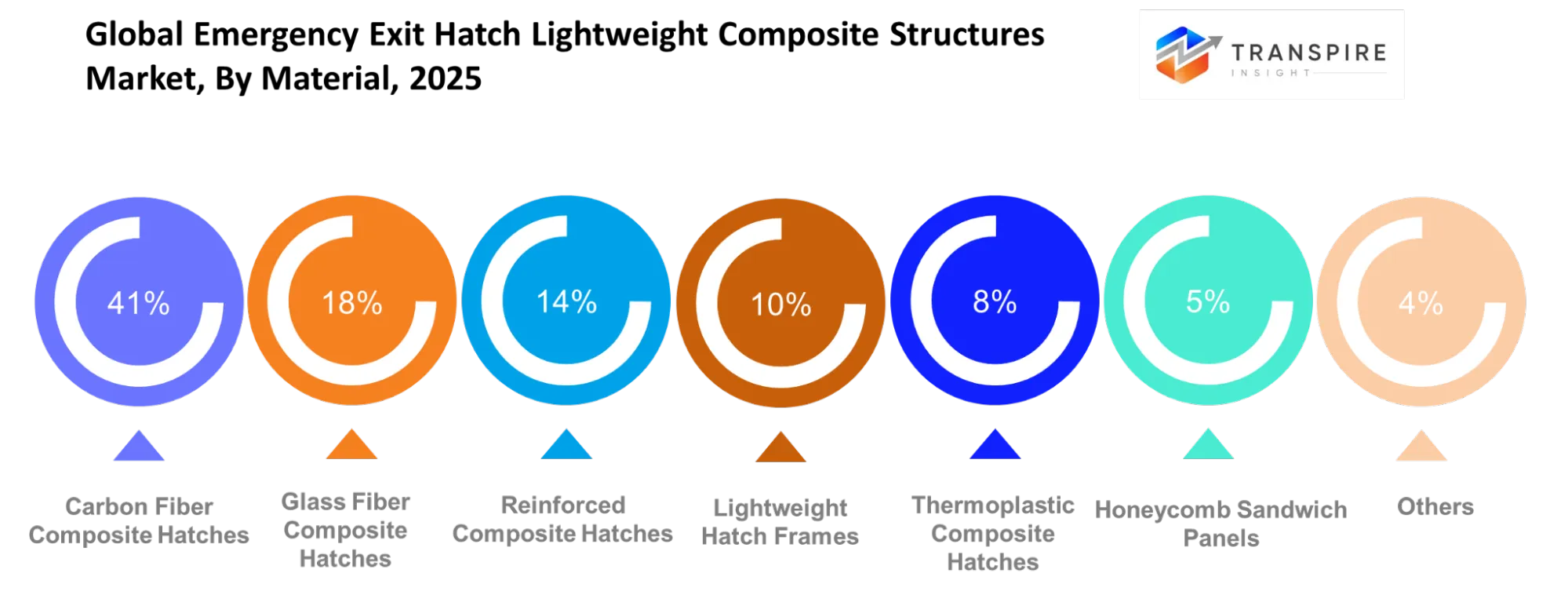
- Europe (Germany, France, U.K., Italy, Spain, Rest of Europe)
- North America (U.S., Canada, Mexico)
- Asia-Pacific (China, Japan, India, Rest of APAC)
- South America (Brazil and the Rest of South America)
- The Middle East and Africa (UAE, South Africa, Rest of MEA)
Asia Pacific is the fastest-growing region in the Global Emergency Exit Hatch Lightweight Composite Structures Marketduring the period, holding approximately 30% share.
Asia pacific is expected to grow at a rapid CAGR in the Global Emergency Exit Hatch Lightweight Composite Structures Market holding approximately 30% share during the forecast period. Growing aerospace production, increased aircraft deliveries, defense modernization, growing composite use, and investments in lightweight structures in China, Japan, India, and emerging markets are the main drivers of Asia Pacific growth.
North America is expected to grow at a rapid CAGR in the Global Emergency Exit Hatch Lightweight Composite Structures Market, holding approximately 25% of the share during the forecast period
North America is expected to grow at a rapid CAGR in the Global Emergency Exit Hatch Lightweight Composite Structures Market holding approximately 25% share during the forecast period. Advanced aerospace production, robust aircraft demand, defense modernization initiatives, regulatory compliance, and the growing use of lightweight composite materials for increased efficiency and safety are the main drivers of North America's growth.
Europe is the fastest-growing region in the Global Emergency Exit Hatch Lightweight Composite Structures Marketduring the period, holding approximately 28% share.
Europe is the fastest-growing region in the Global Emergency Exit Hatch Lightweight Composite Structures Market during the forecast period, holding approximately 28% share during the forecast period. Strong aerospace manufacturing, aircraft modernization initiatives, strict safety standards, sustainability objectives, and the growing use of lightweight composite technology in the transportation, defense, and aviation industries are the main drivers of Europe's growth.
Strategies for Market Growth in Non-Leading Regions:
The growth of non-leading areas through advanced and efficient production methods of Emergency Exit Hatch Lightweight Composite is advantageous for small and medium manufacturers. Development of composite material processing domestically and manufacturing lightweight composites show the potential of reduced dependance on imports. Conclusion of joint ventures with regional airspace suppliers of composite materials, military organizations and transport companies will enhance the market penetration of Emergency Exit Hatch Lightweight Composite. Training programs and enhancement of technical skills will be useful for improving knowledge of the production process of composite materials, processing, quality control, standards and certification requirements.
Future Market Trends for the Global Emergency Exit Hatch Lightweight Composite Structures Market: -
- Aerospace MRO and Fleet Expansion: There is consistent line-fit supply and heavy-check replacement work in the commercial aerospace sector, particularly in North America. The market for emergency hatch composite structures in the aerospace industry alone is expected to expand at a consistent 6.0% CAGR due to large active fleets and OEM depth.
- Multifunctional Integration: Structural battery composites (SBCs) are being incorporated into next-generation designs. Energy storage capabilities are being investigated for lightweight structural components (such hatches and panels), which would lighten the vehicle overall and redefine future design efficiency.
- Transition to Thermoplastics: Thermoplastic composites are quickly replacing conventional thermosets in the automotive and aerospace industries. These materials provide the unique benefits of complete recyclability, streamlined manufacturing cycles, and increased impact resistance—all crucial for emergency exits.
- Innovations in Maritime Newbuilding: The use of composites in maritime applications is being encouraged by regulatory organizations like as DNV. Composites, which were previously limited to modest decorative features, are now being used more frequently in heavy-duty maritime applications such as structural hatch coverings, citadel access doors, and emergency escape tunnels.
Recent Development
- In June 2026 – Airbus Advances Composite Aircraft Door Technology: Airbus highlighted the completion of the advanced carbon-fiber composite Main Deck Cargo Door for the A350F freighter, featuring lightweight composite construction, electrically operated locking systems, and enhanced structural performance.
- In May 2026 – NASA Accelerates Advanced Composite Manufacturing: NASA's Hi-Rate Composite Aircraft Manufacturing (HiCAM) program entered its Demonstration Phase, focusing on scaling advanced composite manufacturing technologies for future commercial aircraft structures. The initiative supports faster production of lightweight composite aerostructures, including aircraft doors and emergency exit hatch components, strengthening innovation across the aerospace supply chain.
This study forecasts revenue at global, regional and country levels from 2020 to 2033. Transpire Insights has segmented the Global Emergency Exit Hatch Lightweight Composite Structures Market based on the below-mentioned segments:
Global Emergency Exit Hatch Lightweight Composite Structures Market, By Product Type
- Passenger Exit Hatches
- Cargo Exit Hatches
- Emergency Roof Hatches
- Composite Door Panels
- Lightweight Hatch Frames
- Reinforced Composite Hatches
- Fire-resistant Hatches
- Others
Global Emergency Exit Hatch Lightweight Composite Structures Market, By Material
- Carbon Fiber Composites
- Glass Fiber Composites
- Aramid Fiber Composites
- Thermoplastic Composites
- Hybrid Composites
- Honeycomb Sandwich Panels
- High-performance Resin Composites
- Others
Global Emergency Exit Hatch Lightweight Composite Structures Market, By Aircraft Type
- Commercial Aircraft
- Regional Aircraft
- Business Jets
- Military Aircraft
- Cargo Aircraft
- Helicopters
- Urban Air Mobility Aircraft
- Others
Global Emergency Exit Hatch Lightweight Composite Structures Market, By End User
- Aircraft OEMs
- MRO Providers
- Defense Aviation
- Commercial Airlines
- Business Aviation
- Space Organizations
- Component Suppliers
- Others
Global Emergency Exit Hatch Lightweight Composite Structures Market, By Application
- Passenger Cabins
- Emergency Evacuation Systems
- Crew Access Panels
- Cargo Compartments
- Maintenance Access
- Cabin Safety Systems
- Structural Reinforcement
- Others
Global Emergency Exit Hatch Lightweight Composite Structures Market, By Regional Analysis
North America
- United States
- Canada
- Mexico
Europe
- Germany
- United Kingdom
- France
- Italy
- Spain
- Russia
- Rest of Europe
Asia Pacific
- China
- Japan
- India
- South Korea
- Australia
- Rest of Asia Pacific
South America
- Brazil
- Argentina
- Rest of South America
Middle East & Africa
- Saudi Arabia
- United Arab Emirates
- Qatar
- South Africa
- Rest of the Middle East & Africa
Frequently Asked Questions
Find quick answers to common questions.
The market is valued at USD 255.9 million in 2025 and is expected to reach USD 417.1 million by 2033, growing at a 6.30% CAGR.
Market growth is driven by aircraft weight reduction requirements, fuel efficiency regulations, aerospace expansion, defense modernization, and advancements in lightweight composite manufacturing technologies.
Glass Fiber Composites dominate with approximately 55% share in 2025, supported by cost efficiency, high strength-to-weight ratio, durability, and corrosion resistance advantages.
Asia Pacific holds approximately 30% share, driven by aerospace manufacturing growth, aircraft deliveries, defense investments, and increasing adoption of advanced lightweight composite structures.
Technologies including Automated Layup, RTM, IoT monitoring, and smart hatch systems enhance manufacturing efficiency, reduce costs, improve safety, and strengthen composite hatch performance.
- Airbus
- Boeing
- Spirit AeroSystems
- Collins Aerospace
- GKN Aerospace
- FACC AG
- Hexcel
- Toray Industries
- Solvay, Triumph Group
- Daher Aerospace
- Saab
- Leonardo
- Mitsubishi Heavy Industries
- Teijin
About the Authors

Tejashri Dhatrak
I am Tejashri Dhatrak, a Senior Research Analyst at Transpire Insight, specializing in the Aerospace and Defence sector. My work focuses on analyzing industry trends, defence technologies, market developments, and emerging innovations that shape the global aerospace and security landscape. At Transpire Insight, I research complex topics, evaluate credible sources, and transform technical insights into accurate, well-structured, and easy-to-understand content for industry professionals and decision-makers. My goal is to provide reliable, research-backed information that helps readers stay informed about defence capabilities, aerospace advancements, strategic developments, and the evolving dynamics of the global defence ecosystem.

Chakradhar Khansole
Chakradhar serves as the Research Director at Transpire Insight, bringing over 8 years of experience in technology, innovation, and strategic market intelligence. He specializes in transforming complex market data into actionable business insights that enable organizations to make informed, growth-oriented decisions. Recognized for his strategic vision and analytical expertise, Chakradhar leads high-impact research initiatives, delivering comprehensive market assessments, competitive intelligence, and forward-looking industry analysis.
Recently Published Reports
-
Apr 2026
Aerospace Fluoropolymers Market
Aerospace Fluoropolymers Market Size, Share & Analysis Report By Type (PTFE, FEP, PFA, ETFE, and Others), By Application (Electrical Insulation, Seals & Gaskets, Coatings, and Others), By End User (Commercial Aviation, Military Aviation, General Aviation, and Others), and Geography (North America, Europe, Asia-Pacific, Middle East and Africa, South and Central America), 2021 - 2031
-
Apr 2026
Airborne SATCOM System Market
Airborne SATCOM System Market Size, Share & Analysis Report By Type (SATCOM Terminals, Transceivers, Airborne Radio, Modems and Routers, SATCOM Radomes, and Other), By Application (Government and Defense and Commercial), and Geography (North America, Europe, Asia-Pacific, Middle East and Africa, South and Central America), 2021 – 2031
-
Apr 2026
Ship Leasing Market
Ship Leasing Market Size, Share & Analysis Report By Vessel Type (Container Ships, Bulk Carriers, Tankers, and Specialized Vessels), By Lease Duration (Short-Term Lease (Less than 1 year), Medium-Term Lease (1-5 years), and Long-Term Lease (More than 5 years)), By Lease Type (Bareboat Charter, Time Charter, Financial Lease, and Others), By End-User Industry (Oil and Gas, Manufacturing and Industrial, Automotive, Agriculture and Food, Retail and Consumer Goods, and Others), and Geography (North America, Europe, Asia-Pacific, Middle East and Africa, South and Central America), 2021 – 2031
-
Apr 2026
Thread Rolling Dies Market
Thread Rolling Dies Market Size, Share & Analysis Report By Type (Flat Thread Rolling Dies, Circular (Cylindrical) Dies, Tangential Thread Rolling Dies, Planetary Thread Rolling Dies, and Other Types), By Material Type (High-Speed Steel (HSS), Carbide, Tool Steel, Alloy Steel, and Other Specialized Alloys), By Distribution Channel (Direct Sales, Distributors and Dealers, and Online Platforms), By Application (Automotive Industry, Aerospace and Defense, Construction and Infrastructure, Industrial Machinery, Electronics and Electrical Components, Medical Devices, and Fastener Production), and Geography (North America, Europe, Asia-Pacific, Middle East and Africa, South and Central America), 2021 – 2031
Our Clients