

Global Electrophoresis Reagents Market Size & Forecast:
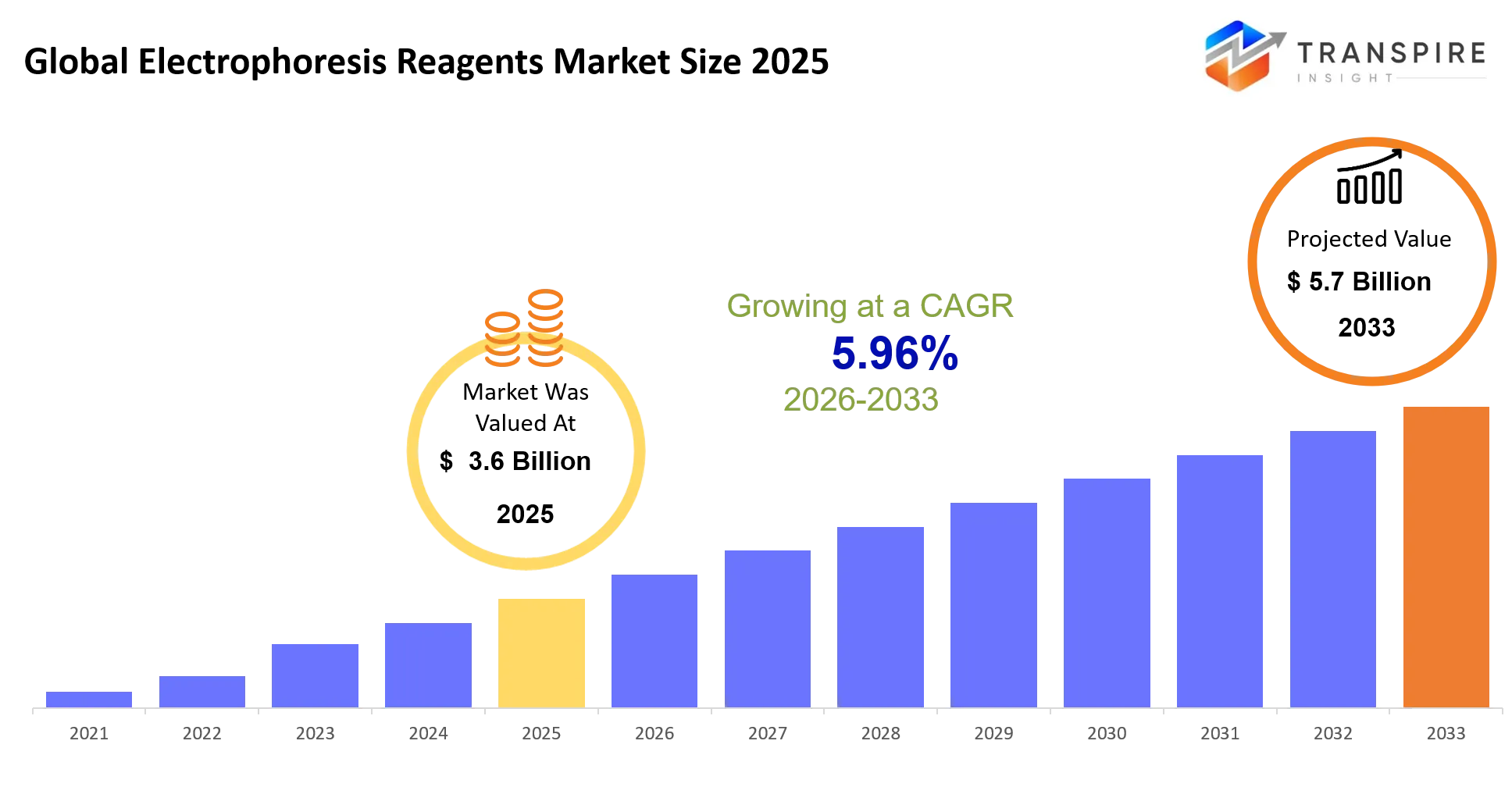
- Global Electrophoresis Reagents Market Size 2025: USD 3.6 Billion
- Global Electrophoresis Reagents Market Size 2033: USD 5.7 Billion
- Global Electrophoresis Reagents Market CAGR: 5.96%
- Global Electrophoresis Reagents Market Segments: By Product (Buffers, Dyes, Gels, Stains, Markers, Kits, Others); By Technique (Gel Electrophoresis, Capillary, 2D, PFGE, Others); By Application (Genomics, Proteomics, Diagnostics, Research, Others); By End User (Academic, Pharma, Biotech, CROs, Others); By Type (DNA, RNA, Protein, Others)
Global Electrophoresis Reagents Market Summary:
As per Transpire Insight Analysis, the Global Electrophoresis Reagents Market size is estimated at USD 3.6 Billion in 2025 and is anticipated to reach USD 5.7 Billion by 2033, growing at a CAGR of 5.96% from 2026 to 2033. This industry supplies the critical running buffers, conductive gels, and fluorescent stains needed to physically separate and track DNA, RNA, and proteins by their electrical charge and size. Over the last few years - clinical diagnostics and drug discovery labs have heavily accelerated their testing speeds, ditching slow manual setups for automated high-throughput systems. This operational pivot coincided with a major real-world trigger: the explosive global scaling of mRNA vaccines and targeted oncology biotherapeutics. Because therapeutic pipelines mandate strict - batch-by-batch molecular purity validation, pharmaceutical manufacturers are buying massive quantities of stabilized running buffers and capillary matrix cartridges. This extreme validation requirement directly forces chemical suppliers to scale production to keep high-speed drug assembly lines fully operational.
Key Market Insights:
The global electrophoresis reagents industry is rapidly shifting toward pre-cast, ready-to-use, and automated clinical profiling kits that completely optimize molecular separation workflows. As biopharmaceutical pipelines pivot intensely toward personalized medicine, manufacturers are designing high-sensitivity fluorescent stains and ultra-pure running media to guarantee molecular reproducibility during liquid biopsies and mRNA purity validation.
- Buffers command a massive 37% market share as the backbone of molecular separation. Bio-Rad Laboratories is expanding pre-mixed, highly stabilized running buffers to eliminate manual prep errors in high-throughput labs.
- Gels lock down a solid 21% market footprint for macromolecular isolation. Thermo Fisher Scientific is pushing pre-cast polyacrylamide and agarose grids to bypass the safety hazards of handling raw acrylamide powder.
- Capillary Electrophoresis Reagents lead technique growth, soaring at an 11.7% CAGR. Agilent Technologies is engineering specialized microfluidic polymers to feed the rising data demand for automated clinical sequencing.
- Dyes account for a steady 14% revenue slice to track nucleic acid migration. Merck KGaA is introducing high-visibility tracking dyes that map fragment positions in real time without stalling downstream enzymatic reactions.
- Stains retain a clear 10% share of global demand under strict lab safety codes. Promega Corporation is rolling out non-toxic fluorescent stains to fully replace carcinogenic ethidium bromide without sacrificing detection limits.
- Markers capture an 8% niche segment share to provide precise sizing baselines. New England Biolabs is engineering pre-dyed, multi-color molecular weight ladders that guarantee flawless calibration under fluctuating voltage.
- North America heavily dominates global consumption, holding 40% of total revenue. Driven by massive bio-investments, Danaher Corporation is upgrading regional reagent pipelines to support high-volume antibody production.
- Europe defends a robust 28% regional grip backed by expanding genomic consortia. Diagnostic suppliers like Qiagen are launching IVDR-compliant analytical reagents to meet strict continental clinical validation laws.
- Asia-Pacific charges forward as the fastest-growing territory, surging at a 12.8% CAGR with a 24% market stake. Regional suppliers like Takara Bio are scaling local logistics to feed booming contract research operations across India and China.
What are the Key Drivers, Restraints, and Opportunities in the Global Electrophoresis Reagents Market?
Driver
The explosive scaling of large-molecule therapeutics and targeted genomic profiling is forcing this market to accelerate. Because complex mRNA vaccines, gene therapies, and biosimilars mandate strict, batch-by-batch molecular weight and purity validation to pass global regulatory standards, pharmaceutical facilities have drastically increased their procurement of high-volume, stabilized running buffers and pre-cast gel matrices. This technical shift from small-molecule chemical testing to automated macromolecular analysis guarantees large, recurring consumable supply contracts for life science chemical suppliers.
In May 2026, Thermo Fisher Scientific officially launched its Invitrogen E-Gel Power Snap Lite Electrophoresis System, introducing a compact, all-in-one ready-to-use platform that completely eliminates manual gel casting and buffer preparation to accelerate routine nucleic acid verification workflows. [https://www.contractpharma.com/breaking-news/thermo-fisher-launches-e-gel-power-snap-lite-system/]
Restraint
Severe raw material supply shocks and price volatility surrounding high-grade acrylamide feedstock continue to stall bulk reagent manufacturing. Fusing and refining raw chemical substrates into ultra-pure, non-toxic, and electrophoretically stable polyacrylamide matrix media requires precise, uninterrupted chemical synthesis pipelines. When global logistics blockages trigger monomer shortages, production expenses instantly surge - forcing major reagent houses to implement strict price hikes that squeeze academic research budgets and disrupt long-term laboratory testing cycles.
Opportunity
The integration of automated, multi-capillary microfluidic arrays into companion diagnostics represents a major untapped profit pipeline. Standard manual gel casting is too slow and variable for immediate point-of-care disease screening or real-time clinical trial validation. By engineering pre-packaged - low-volume capillary matrix reagent kits that slot straight into desktop microfluidic chips, chemical brands can entirely bypass slow, grant-funded academic labs and secure highly profitable, multi-year clinical supply contracts directly with global hospital networks.
What Has the Impact of Artificial Intelligence Been on the Global Electrophoresis Reagents Market?
Artificial intelligence is completely transforming how research laboratories analyze macromolecular separation data. Instead of relying on manual, highly subjective visual inspection of raw gel bands, diagnostic labs are feeding digital imagery into machine learning platforms to execute rapid, automated lane segmentation. These AI engines instantly calculate exact molecular weights, recognize subtle protein charge variants, and clean up complex backgrounds caused by bad voltage or overloaded reagents.
Beyond basic quantification, AI brings massive predictive capabilities to method development. Advanced algorithms can accurately simulate how a custom nucleic acid fragment will migrate through various concentrations of agarose or polyacrylamide gels under varying buffer strengths before a single chemical is formulated. Operationally, manufacturers are integrating computer vision into gel documentation setups to track real-time staining saturation, dramatically cutting down on manual exposure adjustments. However, a major integration gap remains a severe roadblock. Standardizing diverse, unstructured data models generated across different instrument hardware and legacy reagent brands is incredibly difficult, often requiring costly custom software architecture. In May 2025, Nature Communications broke down exactly how researchers co-led by the University of Edinburgh launched "GelGenie," an AI-powered image analysis framework that automates gel band extraction. The shift completely bypasses manual data manipulation by utilizing a lightweight neural network trained on hundreds of human-labeled samples, letting scientists instantly extract exact band data regardless of uneven staining or torn gel chunks.
Key Market Trends:
The days of manual gel pouring and slow, single-sample molecular verification are entirely over. Driven by strict regulatory quality mandates and advanced manufacturing needs, the industry has aggressively shifted toward hyper-automated, microfluidic separation matrices that protect biotherapeutic pipelines from batch variation.
- Biotech facilities are systematically abandoning raw acrylamide powders. They now force lab suppliers to provide specialized pre-cast, ready-to-run polyacrylamide gel cassettes to eliminate hazardous workplace chemical exposure and manual casting errors.
- Clinical diagnostics labs are completely rejecting traditional manual slab gels for blood profiling. To accelerate critical myeloma screening, pathology networks are switching directly to multi-channel capillary zones running pre-packaged automated polymer kits.
- Pharmaceutical quality control units are entirely walking away from batch-based molecule checking. Regulatory compliance boards now mandate continuous capillary sodium dodecyl sulfate (CE-SDS) testing using automated reagent cartridges to track therapeutic antibody purity in real time.
- Genomic core facilities are no longer relying on slow, classic nucleic acid validation. Researchers now demand microfluidic chip-based electrophoresis setups containing low-volume microchip polymers to drastically cut down precious DNA sample consumption.
- Oncology research centers are heavily purging toxic ethidium bromide stains from their workflows. Driven by intense laboratory safety overhauls, lab managers are transitioning exclusively to eco-friendly, non-toxic fluorescent intercalating dyes that enhance UV tracking limits.
- Forensic profiling setups are systematically dropping manual calibration ladders. Crime labs now strictly require multi-color, pre-dyed fragments and sizing markers that integrate seamlessly into high-voltage digital imaging systems to prevent sample identification errors.
- Contract research organizations are rapidly phasing out generic unbuffered running media. Scientists are switching to ultra-pure, high-tolerance batch running buffers to eliminate fluctuating voltage artifacts during high-density transcriptomic sequencing runs.
- Life science R&D teams have entirely ditched subjective visual band estimation. Scientists are now feeding digital gel documentation images into specialized convolutional neural networks to instantly execute automated lane tracking and precise mass calculation.
- Vaccine developers are throwing out uncalibrated agarose matrices for heavy-chain RNA assays. Production engineers are moving directly to high-resolution, gradient-packed specialty gel kits to verify clean mRNA vaccine strands before moving to mass encapsulation lines.
Global Electrophoresis Reagents Market Segmentation
By Product
Buffers command the foundational market position here, pulling down a dominant 37% share of total revenue because they are the mandatory, high-volume chemical media needed to maintain steady pH and electrical conductivity in every single test run. Right behind them, Gels lock in a solid 21% share as the primary physical matrix, while specialized Dyes (14%), Stains (10%), and Markers (8%) serve as critical visual trackers and sizing baselines. The unique growth logic is highly specialized: while bulk running buffers generate massive, predictable sales volume via constant replenishment, pre-cast gels and premium kits are surging because modern labs are aggressively trying to eliminate manual preparation errors and raw chemical hazards. Moving forward, the product space will heavily favor all-in-one pre-packaged reagent kits, forcing bulk raw powder suppliers to pivot entirely to automated, plug-and-play consumable cartridges.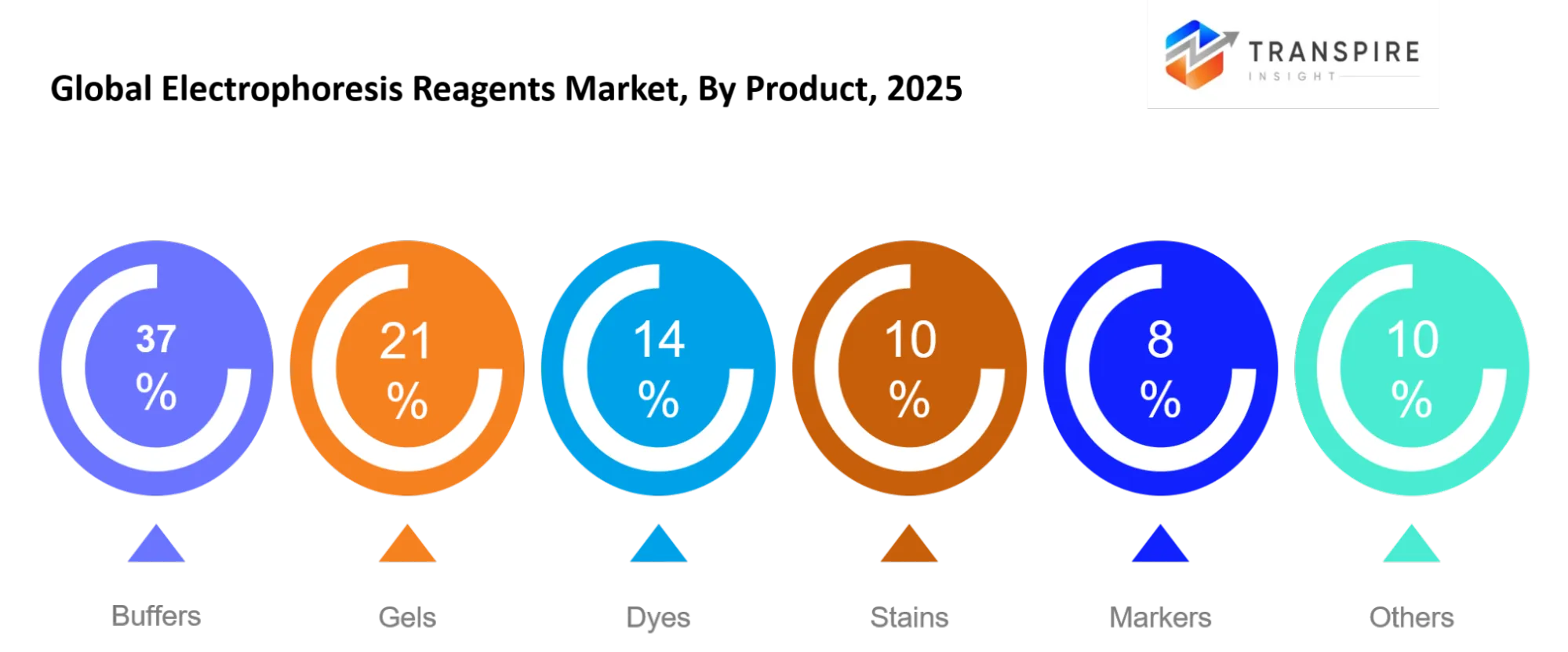
By Technique
Traditional Gel Electrophoresis anchors the industry infrastructure, holding the largest historical volume footprint due to its ultra-low operating cost across thousands of legacy academic benches. However, Capillary Electrophoresis Reagents act as the undisputed economic powerhouse, tearing ahead at an industry-leading 11.7% CAGR. The growth logic is completely split by operational intent: standard slab gels spin off steady revenue through basic everyday research, whereas capillary matrix polymers are exploding because biopharmaceutical production lines desperately require rapid, automated, high-resolution separation to check monoclonal antibody and mRNA purity. Future market dynamics will see a massive commercial contraction in manual slab gel setups, forcing chemical manufacturers to dedicate their R&D pipelines almost exclusively to microfluidic chip matrices and linear polymer cartridges.
By Application
Genomics holds the dominant market position, acting as the primary volume engine as global clinical networks and crop science labs scale up high-density nucleic acid verification. Proteomics and Diagnostics follow as the highest-margin application zones, where tracking complex protein charge variants and circulating cancer biomarkers requires premium-grade separation media. The unique growth logic is tied straight to strict molecular reproducibility regulations; pharmaceutical developers cannot advance a drug candidate through clinical trials without validating batch-by-batch purity via strict electrophoretic profiling. Ultimately, this application space will polarize. Routine research will continue using low-cost bulk buffers, while the expanding targeted oncology and companion diagnostics segments will force chemical developers to engineer ultra-sensitive, expensive companion reagent kits tailored for localized hospital labs.
By End User
Pharmaceutical & Biotechnology Companies act as the heavyweight buyers in this market, dictating shipping schedules and purity grades for the entire life science chemical sector. Academic and Research Institutions handle a massive volume of basic exploratory workflows, while Contract Research Organizations (CROs) present a rapidly expanding, high-throughput commercial customer base. The unique growth logic comes straight from non-discretionary corporate spending: while academic labs depend heavily on fluctuating, uncertain government research grants, biopharma giants buy reagents on fixed, massive commercial contracts to keep therapeutic manufacturing pipelines running 24/7. The biggest future implication is a structural shift in procurement, where major drugmakers will completely bypass generic third-party chemical distributors to establish direct, locked-in supply contracts for customized, validation-certified buffer lines.
By Type
DNA and Protein separation hold the twin pillars of market dominance, accounting for the vast majority of daily laboratory consumption due to standard PCR validation, Western blotting, and routine blood serum profiling. Meanwhile, RNA separation stands out as the most technologically aggressive and volatile segment. The unique growth logic is driven entirely by the global therapeutic pipeline shift toward personalized genetic medicine; validating an mRNA strand or gene-editing vector requires far tighter structural integrity checkouts than classic protein sizing. Moving forward, the market will experience a severe demand shift away from basic, generic nucleic acid ladders toward highly specialized, hyper-stable denaturing reagents designed to map fragile, single-stranded RNA structures without degradation.
What are the Key Use Cases Driving the Global Electrophoresis Reagents Market?
Routine genomic sequencing and therapeutic purity verification represent the core use-case driving the massive consumption of high-volume running buffers and pre-cast gel matrices. Pharmaceutical and biotechnology facilities utilize these essential chemical media during continuous batch-release testing to validate the strict molecular weight and identity profiles of monoclonal antibodies, mRNA vaccines, and recombinant proteins before commercial distribution.
Beyond routine pharmaceutical production, these specialized separation media are heavily expanding into high-speed clinical diagnostics and precision oncology profiling. Pathology laboratories and medical networks rely strictly on automated capillary-compatible polymer cartridges to execute micro-volume serum protein electrophoresis (SPEP) and liquid biopsy screening, allowing doctors to isolate and identify tracking biomarkers for multiple myeloma and genetic conditions rapidly.
In emerging applications, these reagents are finding critical utility within food safety verification and agricultural strain mapping. Modern industrial food laboratories deploy high-resolution gradient gel kits to screen for commercial crop contamination, verify organic plant genetics, and execute meat species authentication across global export supply chains.
|
Report Metrics |
Details |
|
Market size value in 2025 |
USD 3.6 Billion |
|
Market size value in 2026 |
USD 3.8 Billion |
|
Revenue forecast in 2033 |
USD 5.7 Billion |
|
Growth rate |
CAGR of 5.96% from 2026 to 2033 |
|
Base year |
2025 |
|
Historical data |
2021 - 2024 |
|
Forecast period |
2026 - 2033 |
|
Report coverage |
Revenue forecast, competitive landscape, growth factors, and trends |
|
Regional scope |
United States; Canada; Mexico; United Kingdom; Germany; France; Italy; Spain; Denmark; Sweden; Norway; China; Japan; India; Australia; South Korea; Thailand; Brazil; Argentina; South Africa; Saudi Arabia; United Arab Emirates |
|
Key company profiled |
Bio-Rad, Thermo Fisher, Merck, Agilent, Danaher, Promega, Takara Bio, Lonza, Qiagen, Cytiva, GenScript, New England Biolabs, PerkinElmer, Cleaver Scientific, Analytik Jena |
|
Customization scope |
Free report customization (country, regional & segment scope). Avail customized purchase options to meet your exact research needs. |
|
Report Segmentation |
By Product (Buffers, Dyes, Gels, Stains, Markers, Kits, Others); By Technique (Gel Electrophoresis, Capillary, 2D, PFGE, Others); By Application (Genomics, Proteomics, Diagnostics, Research, Others); By End User (Academic, Pharma, Biotech, CROs, Others); By Type (DNA, RNA, Protein, Others) |
Which Regions are Driving the Global Electrophoresis Reagents Market Growth?
North America heavily dominates the global market, controlling an enormous 40% share of overall reagent revenue. This massive footprint comes down to a hyper-funded biopharmaceutical sector and a dense concentration of elite clinical research centers across the United States. With massive capital investments pouring directly into personalized gene therapies, local drug developers require endless bulk quantities of certified running buffers to validate complex biomolecular pipelines. Because the region operates under strict regulatory frameworks, life science conglomerates maintain extensive, locked-in supply contracts that guarantee highly stable, multi-year consumable replenishment cycles.
Europe secures a highly stable footprint as the second-largest territory, holding a clear 28% stake by prioritizing strict clinical standardization and data reproducibility over raw production volume. While North America focuses on private biopharma drug pipeline expansion, Europe operates under stringent centralized frameworks like the In Vitro Diagnostic Regulation (IVDR). This harsh legislative environment forces clinical pathology laboratories and diagnostic houses to completely purge non-certified chemical inputs from their diagnostic workflows. The region provides equipment suppliers with a highly consistent, premium-margin demand pipeline for IVDR-compliant nucleic acid isolation kits and analytical running matrices that can flawlessly survive brutal medical audits. In May 2022, Qiagen officially launched its high-sensitivity QIAxcel Connect system across European clinical networks - deploying a specialized capillary electrophoresis setup that utilizes pre-packaged gel cartridges to eliminate manual buffer handling.
The Asia-Pacific region charges ahead as the fastest-growing market on earth, surging forward with an exceptional 12.8% CAGR while capturing 24% of the global landscape. This rapid acceleration is triggered by a massive regional shift toward contract research outsourcing and local biosimilar manufacturing across China and India. Global pharmaceutical brands are heavily diverting their high-throughput analytical workloads to massive Asian contract research organizations to slash operational overhead. This immense functional migration gives chemical manufacturers a massive future opportunity to supply continuous, high-volume streams of pre-cast gels and microfluidic capillary polymers directly to rapidly expanding local biotechnology parks. In April 2023, Takara Bio officially announced that its Indian manufacturing subsidiary obtained ISO 13485 certification for medical device quality management - allowing it to scale up high-volume molecular biology reagent distribution across regional laboratories.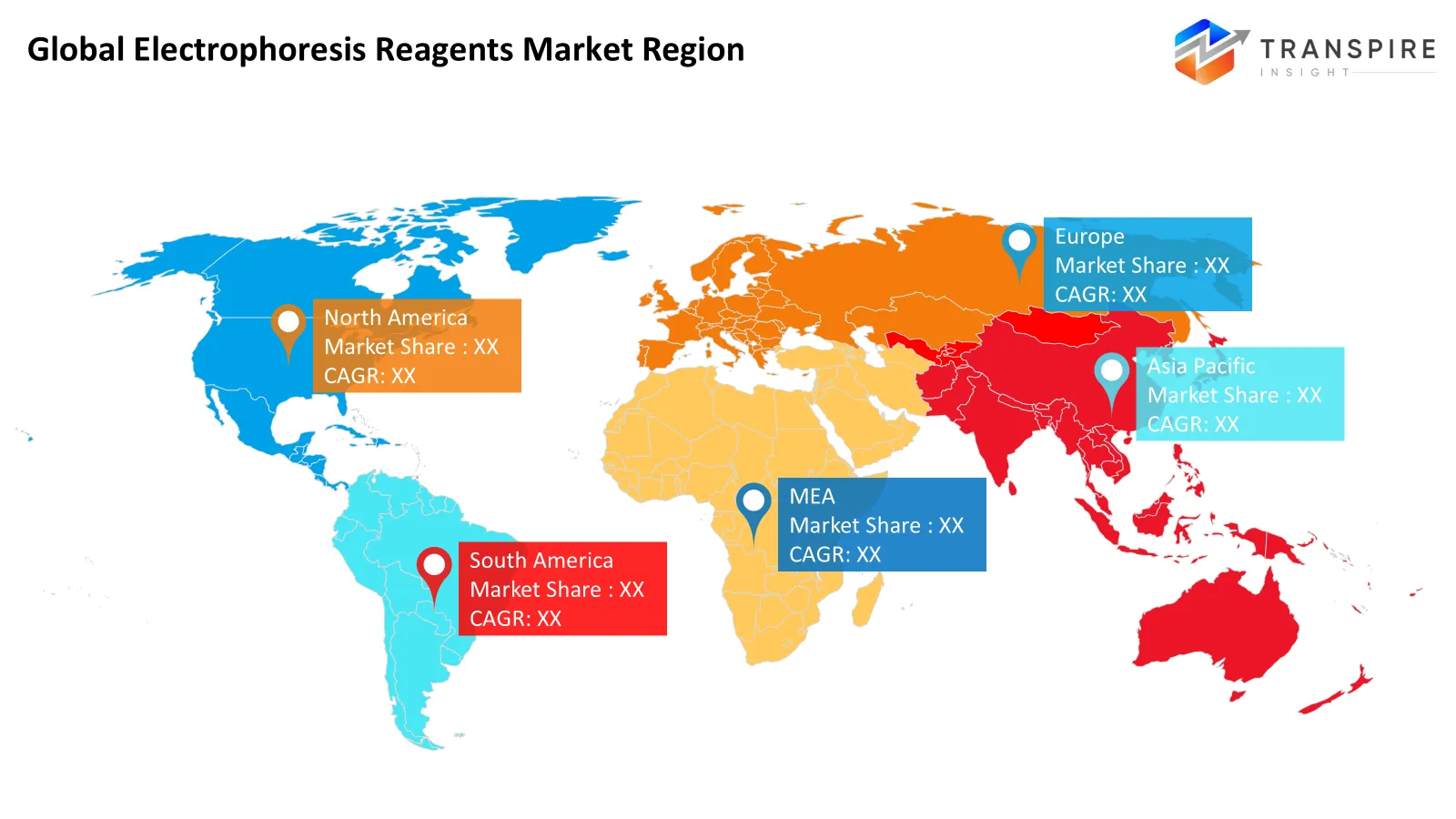
Who are the Key Players in the Electrophoresis Reagents Market and how do they Compete?
The Global Electrophoresis Reagents Market features an intensely consolidated competitive landscape, where a small tier of multinational life science conglomerates dominates via closed ecosystem strategies. Rather than competing purely on individual chemical pricing, major player rivalries are centered around locking laboratories into long-term proprietary consumable streams by pairing specialized running buffers, pre-cast matrices, and capillary polymers with specialized instrument hardware.
Thermo Fisher Scientific competes primarily through a dominant product diversification and complete workflow innovation strategy. By developing all-in-one automated setups like its Invitrogen E-Gel precast dry matrix lines, the company differentiates itself by eliminating traditional manual liquid buffer preparation entirely. Its growth approach relies on high-margin consumable tie-ins, locking clinical diagnostics and pharmaceutical quality control laboratories into recurring cartridge replacement agreements.
Bio-Rad Laboratories executes a dual innovation and high-volume niche defense strategy, leveraging its historic infrastructure in structural molecular biology. The company stands out by engineering proprietary chemistries like its TGX Stain-Free polyacrylamide grids, which allow instant protein visualization without classical chemical staining delays. Bio-Rad drives its expansion by embedding these premium consumables into high-capacity academic and contract research pipelines via bulk supply contracts.
Company List
- Bio-Rad
- Thermo Fisher
- Merck
- Agilent
- Danaher
- Promega
- Takara Bio
- Lonza
- Qiagen
- Cytiva
- GenScript
- New England Biolabs
- PerkinElmer
- Cleaver Scientific
- Analytik Jena
Recent Development News
In April 2026, Thermo Fisher Scientific rolled out, sort of officially, its Applied Biosystems PowerFlex Thermal Cycler , basically introducing an advanced molecular amplification platform meant to boost PCR workflow flexibility. With this release, research teams and clinical labs can tune high-throughput nucleic acid replication before the later, downstream analysis , so they end up with high-yield, clean amplicon fragments that fit right into automated slab gel and capillary matrix separation reagent pipelines . [https://newsroom.thermofisher.com
In July 2025, LICORbio finalized its full strategic acquisition of Germany's SERVA Electrophoresis, a legacy developer of high-performance separation media and workflow instrumentation. This structural combination unifies SERVA's deep catalog of specialized precast gels, running buffers, and staining reagents directly into LICORbio's digital imaging infrastructure, creating a single closed-loop distribution pipeline optimized for rapid end-to-end proteomic and genomic analysis. [https://www.licorbio.com
In May 2026, Thermo Fisher Scientific officially rolled out the Invitrogen E-Gel Power Snap Lite Electrophoresis System, a compact, all-in-one hardware architecture built for fast nucleic acid screening. By integrating automated visualization alongside precast gel cassettes, this layout lets low-throughput molecular labs completely bypass the time-consuming processes of manual gel casting and liquid buffer preparation to accelerate everyday PCR verification. [https://clpmag.com
What Strategic Insights Define the Future of the Electrophoresis Reagents Market?
The future of this industry is rapidly heading toward complete microfluidic decentralization, moving separation chemistry away from centralized core benches directly into point-of-care clinical setups. However, a significant hidden risk lies in the extreme vulnerability of acrylamide and high-grade polymer supply chains to specialized raw material feedstock shocks, which can instantly halt high-throughput diagnostic pipelines.
An immense emerging opportunity centers on the development of eco-friendly, bio-based separation matrices and non-toxic fluorescent stains that satisfy tightening global green laboratory mandates without compromising molecular migration accuracy.
To maintain market dominance, chemical suppliers must execute a strict ecosystem locking strategy. Manufacturers should prioritize engineering pre-packaged, low-volume capillary reagent cartridges tailored exclusively for automated desktop hardware, effectively securing highly profitable, long-term consumable replenishment contracts across expanding hospital networks.
key segmantation are:
By Product
- Buffers
- Dyes
- Gels
- Stains
- Markers
- Kits
- Others
By Technique
- Gel Electrophoresis
- Capillary Electrophoresis
- 2D Electrophoresis
- Pulse-Field Gel Electrophoresis (PFGE)
- Others
By Application
- Genomics
- Proteomics
- Diagnostics
- Research
- Others
By End User
- Academic & Research Institutions
- Pharmaceutical Companies
- Biotechnology Companies
- Contract Research Organizations (CROs)
- Others
By Type
- DNA
- RNA
- Protein
- Others
Regional Outlook
North America
- United States
- Canada
- Mexico
Europe
- Germany
- United Kingdom
- France
- Spain
- Italy
- Rest of Europe
Asia Pacific
- Japan
- China
- Australia & New Zealand
- South Korea
- India
- Rest of Asia Pacific
South America
- Brazil
- Argentina
- Rest of South America
Middle East & Africa
- Saudi Arabia
- United Arab Emirates
- South Africa
- Rest of the Middle East & Africa
Frequently Asked Questions
Find quick answers to common questions.
The Global Electrophoresis Reagents Market size was valued at USD 3.6 Billion in 2025 and is poised to reach USD 5.7 Billion by 2033, expanding at a 5.96% CAGR.
Key Segments for the Electrophoresis Reagents Market are Product (Buffers, Dyes, Gels, Stains, Markers, Kits, Others), Technique (Gel Electrophoresis, Capillary, 2D, PFGE, Others), Application (Genomics, Proteomics, Diagnostics, Research, Others), End User (Academic, Pharma, Biotech, CROs, Others), and Type (DNA, RNA, Protein, Others).
Growth is primarily driven by the Explosive scaling of large-molecule therapeutics like mRNA vaccines, gene therapies, and biosimilars that require strict, batch-by-batch molecular weight validation, alongside a heavy technical transition toward automated macromolecular analysis and point-of-care clinical diagnostics.
The Global Market is led by major manufacturers including Bio-Rad, Thermo Fisher, Merck, Agilent, Danaher, Promega, Takara Bio, Lonza, Qiagen, Cytiva, GenScript, New England Biolabs, PerkinElmer, Cleaver Scientific, Analytik Jena.
North America heavily dominates the global industry, controlling an enormous 40% share of total revenue. This dominance is driven by a hyper-funded biopharmaceutical sector, a dense concentration of elite clinical research networks across the United States, and extensive, locked-in corporate supply contracts for therapeutic validation.
Commercial opportunities exist in integrating automated, multi-capillary microfluidic arrays into companion diagnostics via pre-packaged desktop reagent cartridges, alongside developing eco-friendly, bio-based separation matrices and non-toxic fluorescent stains to satisfy tightening global green laboratory mandates.
- Bio-Rad
- Thermo Fisher
- Merck
- Agilent
- Danaher
- Promega
- Takara Bio
- Lonza
- Qiagen
- Cytiva
- GenScript
- New England Biolabs
- PerkinElmer
- Cleaver Scientific
- Analytik Jena
About the Authors

Pankaj Ghogare Patil
I am Pankaj Ghogare Patil, a Senior Research Analyst at Transpire Insight, specializing in the Pharmaceutical, Chemicals & Materials, Healthcare IT, and Biotechnology industry. My expertise lies in conducting comprehensive market research, analyzing industry trends, evaluating competitive landscapes, and translating complex data into actionable insights. At Transpire Insight, I closely follow emerging technologies, regulatory developments, and market innovations to create accurate, well-researched, and informative content that helps businesses and professionals make informed decisions. I am committed to producing credible, evidence-based articles that reflect industry best practices while making technical topics accessible and valuable for a broad audience.

Chakradhar Khansole
Chakradhar serves as the Research Director at Transpire Insight, bringing over 8 years of experience in technology, innovation, and strategic market intelligence. He specializes in transforming complex market data into actionable business insights that enable organizations to make informed, growth-oriented decisions. Recognized for his strategic vision and analytical expertise, Chakradhar leads high-impact research initiatives, delivering comprehensive market assessments, competitive intelligence, and forward-looking industry analysis.
Recently Published Reports
-
Jul 2026
Alopecia Treatment Market
Alopecia Treatment Market Size, Share & Analysis Report By Disease Type (Alopecia Areata, Cicatricial Alopecia, Traction Alopecia, Alopecia Totalis, Androgenetic Alopecia, Alopecia Universalis, and Other Disease Types), By Treatment Type (Topical Treatments, Oral Medications, Injectable Therapies, and Hair Transplantation), By Gender (Male, and Female), By Distribution Channel (Hospitals and Clinics, Retail Pharmacies, and Online Retailers), and Geography (North America, Europe, Asia-Pacific, Middle East and Africa, South and Central America), 2021 - 2031
-
Jul 2026
Medical Ultrasound Probe Market
Medical Ultrasound Probe Market Size, Share & Analysis Report By Type (Linear Type, Convex Type, Endocavitary Probe, Phased Array/Cardiac Probe, Transesophageal (TEE) Probe, and Others), By Application (Ophthalmology, Cardiology, Musculoskeletal, Oncology, Obstetrics & Gynecology, General Imaging, and Others), By End User (Hospitals & Clinics, Diagnostic Centers, Ambulatory Surgical Centers, and Others), and Geography (North America, Europe, Asia-Pacific, Middle East and Africa, South and Central America), 2021 – 2031
-
May 2026
Biosimilars Market
Biosimilars Market By Product Type (Monoclonal Antibodies, Recombinant Hormones, Erythropoietin, G-CSF, Others), By Indication (Oncology, Autoimmune Diseases, Blood Disorders, Diabetes, Others), By Manufacturing Type (In-House Manufacturing, Contract Manufacturing), By Distribution Channel (Hospital Pharmacies, Retail Pharmacies, Online Pharmacies), By Industry Analysis, Size, Share, Growth, Trends, and Forecasts 2021-2033
-
Apr 2026
Gastrointestinal Endoscopy Market
Gastrointestinal Endoscopy Market By Type (Rigid Gastrointestinal Endoscope, Flexible Gastrointestinal Endoscopes, Disposable Gastrointestinal Endoscope), By Procedure Type (Colonoscopy, Gastroscopy, Duodenoscopy, Enteroscopy, Flexible Sigmoidoscopy, Others), By Application (Diagnosis, Treatment), By End-Users (Hospitals, Ambulatory Surgical Centers, Specialty Clinics, Laboratories, Others), By Industry Analysis, Size, Share, Growth, Trends, and Forecasts 2021-2033