
United Kingdom Forensic DNA Analysis Market Size & Forecast:
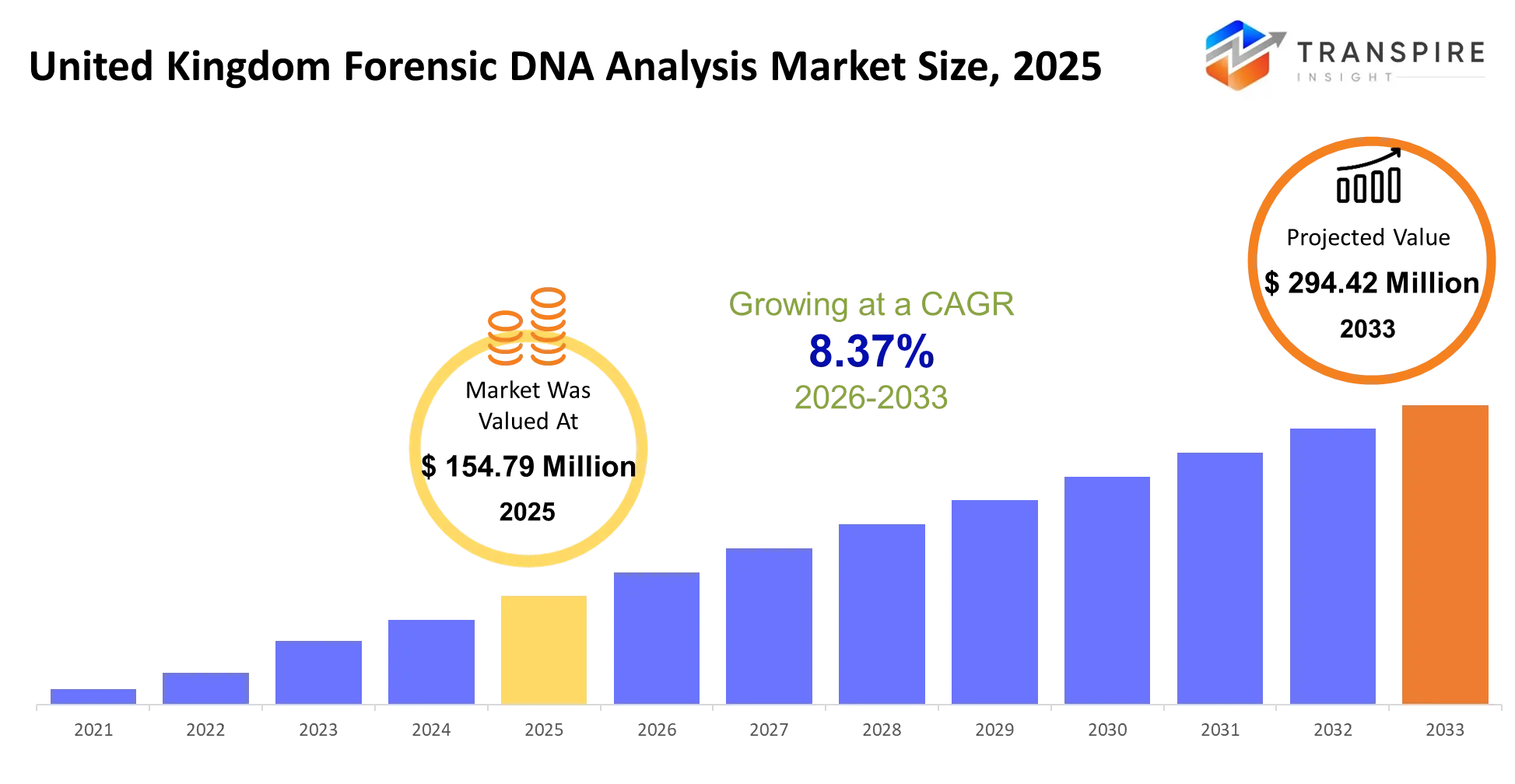
- United Kingdom Forensic DNA Analysis Market Size 2025: USD 154.79 Million
- United Kingdom Forensic DNA Analysis Market Size 2033: USD 294.42 Million
- United Kingdom Forensic DNA Analysis Market CAGR: 8.37%
- United Kingdom Forensic DNA Analysis Market Segments: By Product Type (PCR Kits, Sequencing Kits, Extraction Kits, Instruments, Others); By Technology (PCR-based Analysis, STR Analysis, Next-generation Sequencing, Capillary Electrophoresis, Others); By Application (Criminal Investigations, Paternity Testing, Disaster Victim Identification, Missing Person Identification, Others); By End User (Forensic Laboratories, Law Enforcement Agencies, Research Institutes, Others)
To learn more about this report,  Download Free Sample Report
United Kingdom Forensic DNA Analysis Market Summary
The United Kingdom Forensic DNA Analysis Market was valued at USD 154.79 Million in 2025. It is forecast to reach USD 294.42 Million by 2033. That is a CAGR of 8.37% over the period.
In the United Kingdom, forensic DNA work turns biological traces found at crime scenes into identity evidence, which gets used to connect suspects, clear the innocent, and crack cold cases. Over the last five years , the market kind of moved away from STR based profiling and toward next generation sequencing, plus more automated lab workflows. Alongside that , there’s been a higher reliance on accredited private forensic providers. That shift helps with tricky or complex samples, it also cuts down turnaround times a bit, so more police forces are taking it up.
Then COVID-19 disruption happened and it created big backlogs in forensic laboratories, and it also showed the real capacity limits in public testing setups. Because of this, money and attention started flowing into faster DNA platforms and digital case management systems. So in the end demand is being pulled by the need for swifter, scalable, and more dependable evidence handling across the whole criminal justice system, meaning agencies are now motivated to modernize their workflows, and to widen partnerships with specialized forensic service providers.
Key Market Insights
- In the United Kingdom, the Forensic DNA Analysis Market seems to be drifting away from old school STR profiling towards next-generation sequencing and more automated high-throughput DNA systems, seen across many forensic labs.
- At the same time digital transformation is creeping into the daily forensic workflow, with AI-enabled sample tracking for instance, helping improve accuracy and trimming turnaround times by about 30–40% in some major labs, not always everywhere but you can observe it.
- England still holds over 70% share in the United Kingdom Forensic DNA Analysis Market because of centralized forensic laboratories and a high volume of crime investigations.
- Meanwhile Scotland and Wales feel like the quicker movers, with rising investment in forensic infrastructure going forward, at least through the 2030 forecast window.
- When you look at segmentation, instrumentation systems take the second-largest slice of the market. This is largely backed by ongoing upgrades in sequencing platforms, plus PCR based technologies, which are being adopted across UK forensic labs.
- Software and bioinformatics solutions are kinda the fastest growing segment, because more laboratories are adopting an integrated digital evidence management platform sort of.
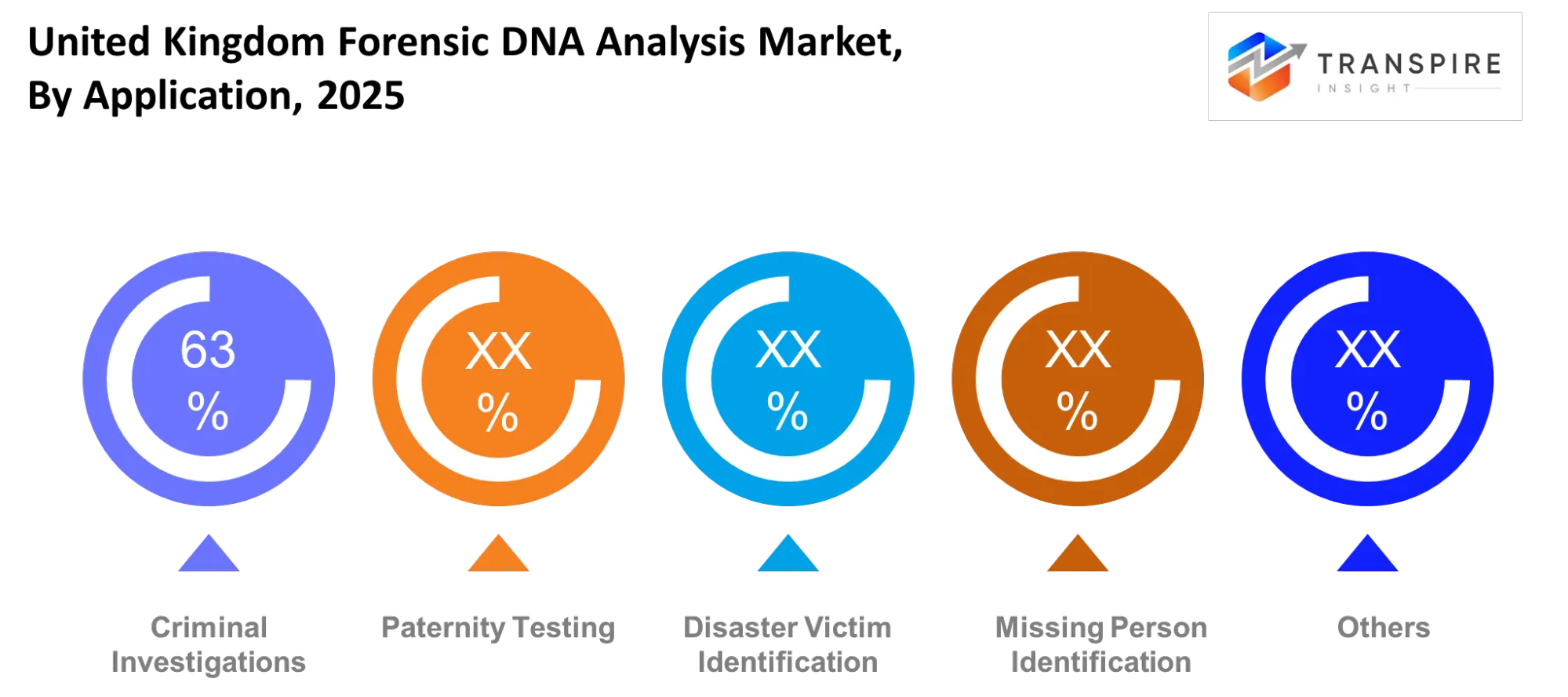
- Criminal investigation is still the main use case, and it’s contributing over 60% share in the United Kingdom Forensic DNA Analysis Market.
- Disaster victim identification is showing up as the fastest growing application, thanks to better DNA matching technologies and a stronger emergency response readiness.
- Government forensic laboratories are leading the United Kingdom Forensic DNA Analysis Market, with more than 55% share, mostly from national crime database integration.
- Private forensic service providers are the fastest-growing end user category as outsourcing and lab efficiency requirements keep increasing.
What are the Key Drivers, Restraints, and Opportunities in the United Kingdom Forensic DNA Analysis Market?
The United Kingdom Forensic DNA Analysis Market is mainly driven by the modernization of criminal justice workflows, and honestly law enforcement agencies are under pressure to shorten investigation timelines, plus get better conviction accuracy. That movement toward rapid DNA testing and next generation sequencing happened because there are growing case backlogs in public forensic labs, and courts are also leaning into stricter evidentiary standards. Because of this , police forces and forensic providers are increasingly putting money into automated extraction systems, and also into integrated digital case management platforms. In practice it has expanded the buying period for instruments, consumables,and bioinformatics software across the United Kingdom Forensic DNA Analysis Market. So labs can run more samples, and technology vendors see faster revenue inflows, maybe even earlier than expected.
One major constraint is the high price, along with the long validation time tied to advanced sequencing platforms and accredited forensic workflows. Public forensic institutions have to satisfy strict ISO requirements , and court admissibility rules. That whole compliance setup slows adoption, even if the newer options are clearly better. As a structural thing, this limits short-term scalability, and delays the full swap from legacy STR systems. So market growth becomes uneven, with different regions and agencies moving at different speeds.
Meanwhile there is an opportunity that is starting to show up, especially with portable real time DNA analysis devices for field based investigations. There are pilot programs that use rapid DNA instruments in police custody suites in England. These pilots are showing faster suspect identification, which reduces dependence on centralized laboratories,and it also creates new procurement routes for decentralized forensic technologies.
What Has the Impact of Artificial Intelligence Been on the United Kingdom Forensic DNA Analysis Market?
Artificial intelligence is kinda reshaping the United Kingdom Forensic DNA Analysis Market by changing how forensic labs manage samples, confirm findings, and keep equipment in shape for genetic profiling workflows. In real day-to-day work, AI-enabled laboratory information management systems automate things like sample tracking, contamination checks, and quality control alerts, which trims down on manual supervision, especially in busy high-volume DNA testing sites. As a result, processing feels more consistent, and administrative delays drop , mainly for big government forensic laboratories that have to handle backlogged case inventories.
On top of that, predictive analytics is showing up more and more for instrument care and workflow tuning. Machine learning models look at sequencing machine performance traces to foresee failures in PCR systems and capillary electrophoresis instruments before they actually break. That means forensic providers can arrange maintenance earlier, and equipment availability can improve by roughly 15–25% , while those annoying and costly interruptions in case processing become less common. AI also helps by spotting bottlenecks during DNA extraction and amplification, so labs can raise throughput without needing a proportional increase in staffing, you know.
Still, adoption doesn’t go completely smoothly because training datasets are limited and standardization is hard, plus validation requirements are strict for evidence that has to be court-admissible. Forensic agencies have to be sure AI-assisted outputs satisfy legal reliability thresholds, and this kind of scrutiny slows integration , and it pushes implementation costs higher across the United Kingdom Forensic DNA Analysis Market. Even with those hurdles, though, continued spending on digital forensics infrastructure keeps expanding AI’s practical role in boosting accuracy, efficiency, and operational scalability over time.
Key Market Trends
- UK forensic labs have sort of shifted from hand driven DNA extraction routines into automated setups, which cut processing time by around 35% since 2020, though it’s not all uniform across sites.
- Since 2022, the take up of next-generation sequencing platforms has grown a lot, which helps with more detailed profiling for tangled forensic specimens.
- After 2021, police forces in England and Wales rolled out more rapid DNA testing units, partly because the backlog pressure showed what centralized lab capacity could not quite handle.
- From 2023, a more strict stance on evidence admissibility made forensic vendors lean toward ISO certified digital traceability systems, plus software tools that are validated.
- Between 2022 and 2025 private forensic service providers have expanded their involvement, capturing extra outsourcing demand from public forensic labs that needed to scale up.
- By adding AI driven sample tracking systems, contamination detection seems to have improved and rates of human blunders dropped, across the broader UK forensic workflow.
- After 2023, demand picked up for portable DNA analysis devices, especially for custody suite deployments that enable swifter suspect identification.
- Eurofins Scientific and LGC Group also put more money into automated genotyping platforms, trying to stay competitive in high volume case processing, you know.
- Cold case review programs broadened after 2022, they use better DNA database matching methods to revisit cases that were previously left unsolved.
United Kingdom Forensic DNA Analysis Market Segmentation
By Product Type:
PCR kits , sequencing kits , extraction kits , instruments , and other consumables all support DNA profiling workflows that are used in criminal justice settings. PCR kits still get picked a lot, mostly because they deliver reliable amplification of genetic material even when samples are small or kind of degraded. Sequencing kits and extraction kits help with more advanced analytical needs, while instruments let labs run more automation, so results can come quicker across forensic laboratories in the United Kingdom Forensic DNA Analysis Market. Ongoing upgrades to laboratory infrastructure will keep pushing accuracy upward and also help lower turnaround times.
The need for consumables should stay fairly steady , because nearly every forensic case means repeat usage of kits and reagents. Meanwhile, instruments are getting adopted more strongly, tied to automation trends and backlog reduction programs happening in public labs. Growth in sequencing kits is being backed by better resolution requirements for more complicated forensic evidence, and that, in turn, will keep influencing purchasing choices across both government agencies and private forensic service providers.
By Technology:
PCR based analysis and STR profiling are kind of the backbone of forensic DNA identification, helping with most routine criminal casework . STR analysis stays widely trusted in courts because standardized validation protocols are already kind of settled. Next generation sequencing is being rolled out bit by bit for high complexity matters, while capillary electrophoresis keeps doing its job for fragment separation and DNA profiling accuracy across the usual workflows in the United Kingdom Forensic DNA Analysis Market
Technology adoption seems like it will lean more toward sequencing based platforms, since forensic institutions want sharper resolution and less room for ambiguity , especially with mixed DNA samples. Still , PCR and STR technologies will remain dominant in practice because regulatory acceptance is more straightforward and costs stay comparatively efficient. On the automation side, capillary electrophoresis systems are being upgraded to boost throughput and cut down manual handling, which should help laboratories keep performance consistent across national forensic networks .
By Application:
Criminal investigations still sit as the main use, helping with suspect identification, and evidence alignment in ongoing files, though it depends on the jurisdiction. Paternity testing, meanwhile, brings extra legal and civil scenarios as well. Disaster victim identification and missing person identification have become more important lately too, mostly because DNA database matching got better, and faster than before. Beyond that, other needs keep showing up for specialized forensics and research requirements inside law enforcement systems.
The momentum for criminal investigations is expected to keep rising, largely due to growing case complexity and the pressure for quicker resolution. Disaster victim identification will likely keep expanding as emergency response teams start adopting more advanced DNA matching tools. Missing person identification should benefit from tighter database integration, plus cross-border cooperation, which should lead to faster, and more reliable identification results across different forensic networks.
To learn more about this report, Download Free Sample Report
By End User:
Forensic laboratories are the core end users here. They process huge volumes of DNA evidence, so that legal proceedings can move forward. Law enforcement agencies depend on those forensic outputs for investigations and also for suspect confirmation. Research institutes are not just background players, they help with method refinement and validation studies, and that kind of work supports technology progress across forensic science systems in the United Kingdom Forensic DNA Analysis Market.
Forensic laboratories will likely stay dominant, since centralized evidence handling is still their main job. Law enforcement agencies will use rapid DNA tools more directly, for swifter decisions at crime scenes and in custody environments. Research institutes should keep pushing innovation in sequencing approaches, and analytical validation, which in turn improves the overall reliability of the system and makes future technology adoption feel more practical.
What are the Key Use Cases Driving the United Kingdom Forensic DNA Analysis Market?
In the UK forensic DNA analysis market, core demand is sort of pulled by criminal investigations, where law enforcement agencies use DNA profiling to connect a suspect with a crime scene ,and help move through violent crimes. That is still the main use case because the evidentiary weight is very high ,and courts tend to accept it without much pushback.
But the use is widening too, including paternity and kinship testing ,which gets used by law services and immigration authorities. Also disaster victim identification is something coroners and police forensic groups handle, helping resolve both civil matters and criminal matters , depending on what the case needs.
More new scenarios are starting to show up, like rapid DNA testing right at the scene, plus portable sequencing methods. On top of that AI assisted interpretation of genetic data is being discussed a lot ,and it is expected to lift both turnaround speed and accuracy during investigations.
|
Report Metrics |
Details |
|
Market size value in 2025 |
USD 154.79 Million |
|
Market size value in 2026 |
USD 167.75 Million |
|
Revenue forecast in 2033 |
USD 294.42 Million |
|
Growth rate |
CAGR of 8.37% from 2026 to 2033 |
|
Base year |
2025 |
|
Historical data |
2021 - 2024 |
|
Forecast period |
2026 - 2033 |
|
Report coverage |
Revenue forecast, competitive landscape, growth factors, and trends |
|
Regional scope |
Middle East and Africa (Saudi Arabia, United Arab Emirates, South Africa, Rest of Middle East and Africa) |
|
Key company profiled |
Thermo Fisher Scientific, Qiagen, Promega Corporation, Illumina, Agilent Technologies, Bio-Rad Laboratories, Danaher Corporation, PerkinElmer, GE HealthCare, Abbott Laboratories, Eurofins Scientific, NMS Labs, Labcorp, Verogen, Bode Technology |
|
Customization scope |
Free report customization (country, regional & segment scope). Avail customized purchase options to meet your exact research needs. |
|
Report Segmentation |
By Product Type (PCR Kits, Sequencing Kits, Extraction Kits, Instruments, Others); By Technology (PCR-based Analysis, STR Analysis, Next-generation Sequencing, Capillary Electrophoresis, Others); By Application (Criminal Investigations, Paternity Testing, Disaster Victim Identification, Missing Person Identification, Others); By End User (Forensic Laboratories, Law Enforcement Agencies, Research Institutes, Others) |
Which Regions are Driving the United Kingdom Forensic DNA Analysis Market Growth?
North America still shows up as the leading region in the forensic DNA analysis market, mostly because it has a pretty advanced criminal justice setup and also strong federal budget backing for forensic programs. The United States really takes the lead here, through broad use of national DNA repositories like CODIS, which helps connect cases across state lines, so cross linkage feels faster and more consistent. There is also established coordination between federal bodies and local law enforcement, this tends to speed up the way cases are worked through and it can raise the overall testing volumes. On top of that, a fairly mature web of private forensic labs plus biotechnology suppliers, kind of locks in leadership because the tools and services keep showing up reliably.
Europe comes next, and it behaves more like a steady, well-regulated market. It benefits from coordinated cross border forensic cooperation frameworks, for example the Prüm system. Unlike North America though, growth there is influenced more by tight data privacy rules and by judicial standardization, meaning adoption of DNA tools is consistent but still carefully supervised. Nations like Germany, France, and the United Kingdom keep strong public forensic institutions that focus on accuracy and the ability to stand up in court. That ongoing institutional spending helps Europe remain a dependable contributor to worldwide market revenues.
Asia Pacific is the fastest expanding region, largely because law enforcement is modernizing quickly and forensic infrastructure is growing in places such as China and India. Regional governments are putting real weight behind the expansion of national DNA databases, and also the construction of new forensic laboratories so criminal investigations can move with more capability. Policy changes lately that support digital policing, plus the higher role of scientific evidence in court, have pushed adoption forward. All this gives tech providers and investors noticeable openings during the 2026–2033 time window.
Who are the Key Players in the United Kingdom Forensic DNA Analysis Market and How Do They Compete?
In the UK forensic DNA analysis market, there is a kind of moderate consolidation, where big life science players supply core sequencing platforms but only a small set of accredited forensic laboratories do the actual casework. What really drives competition seems to be analytical precision, turnaround speed, and strict adherence to UKAS and ISO standards, though sometimes the “fit” of the whole solution matters just as much. How well a provider links into national DNA databases and police workflow systems also shifts differentiation between suppliers. Even vendors that look similar on paper often go different directions on how smoothly their platforms and services land inside evidentiary rules and courtroom expectations.
Thermo Fisher Scientific leans heavily on cost efficient forensic kits and capillary electrophoresis systems within Applied Biosystems, and they keep pushing their advantage via long term contracts with UK forensic labs. Illumina takes a different angle, emphasizing high throughput sequencing platforms that can improve resolving power on complicated specimens, and that helps extend partnerships with research-backed policing initiatives. Qiagen differentiates with automation in sample preparation, reducing carryover risk and compressing processing time, so their approach is easier to adopt in high volume forensic workflows.
Eurofins Scientific is expanding through acquisition-led growth, pulling in regional forensic service labs across Europe and the UK, to grow outsourced DNA casework capacity. LGC Group leans on its already established UK forensic services footprint, and on close collaboration with law enforcement agencies, to stay strong in certain niche specializations for accredited evidence processing. Both organizations are also putting money into digital chain of custody tools and wider laboratory networks, aiming to match rising demand for fast, court-admissible DNA analysis, not just “more testing” but testing that survives scrutiny later.
Company List
- Thermo Fisher Scientific
- Qiagen
- Promega Corporation
- Illumina
- Agilent Technologies
- Bio-Rad Laboratories
- Danaher Corporation
- PerkinElmer
- GE HealthCare
- Abbott Laboratories
- Eurofins Scientific
- NMS Labs
- Labcorp
- Verogen
- Bode Technology
Recent Development News
In September 2026, Forensic Genomics announced participation in an international forensic DNA analysis dialogue series featuring leading researchers in mitochondrial DNA and forensic sequencing technologies. The initiative highlights advancements in sequencing-based identification methods and supports collaboration across UK and global forensic laboratories, strengthening applied DNA interpretation capabilities in criminal investigations.
Source https://pmc.ncbi.nlm.nih.gov/
In July 2026, UK-based forensic genetics expert Dr. Turi King participated in a forensic DNA analysis research dialogue focused on the application of DNA techniques in historical and criminal identification cases, emphasizing the growing integration of whole genome sequencing and genealogical methods in forensic workflows.Source https://pmc.ncbi.nlm.nih.gov/
What Strategic Insights Define the Future of the United Kingdom Forensic DNA Analysis Market?
The UK forensic DNA analysis market is slowly moving toward quicker, more decentralized testing, with digitized policing in the background and a pretty obvious demand for faster judicial turnaround times. The main structural push seems to be that labs are no longer the only hub, instead the work is getting more integrated with almost real time forensic workflows that are placed inside law enforcement operations. This shift is also being helped by case backlogs, plus the courts are feeling pressure to process evidence sooner, and not just in a “sometime later” way.
A less noticed risk though is the regulatory tightening around genetic data privacy, and also the idea of secondary use of DNA databases. If that keeps growing, it could cap cross case matching and, over time, reduce how useful the database is supposed to be. At the same time, rapid DNA systems that get deployed at crime scenes are showing up, plus AI assisted interpretation for messy or complex mixtures that look like genuinely high potential opportunities.
Market players should, in my view, focus on interoperable platforms that blend rapid testing with compliant data governance frameworks. They should also position themselves early within police procurement ecosystems, because once those buying cycles lock in, it can be hard to slide in later.
United Kingdom Forensic DNA Analysis Market Report Segmentation
By Product Type
- PCR Kits
- Sequencing Kits
- Extraction Kits
- Instruments
By Technology
- PCR-based Analysis
- STR Analysis
- Next-generation Sequencing
- Capillary Electrophoresis
By Application
- Criminal Investigations
- Paternity Testing
- Disaster Victim Identification
- Missing Person Identification
By End User
- Forensic Laboratories
- Law Enforcement Agencies
- Research Institutes
Frequently Asked Questions
Find quick answers to common questions.
The United Kingdom Forensic DNA Analysis Market size is USD 294.42 Million in 2033.
Key segments for the United Kingdom Forensic DNA Analysis Market are By Product Type (PCR Kits, Sequencing Kits, Extraction Kits, Instruments, Others); By Technology (PCR-based Analysis, STR Analysis, Next-generation Sequencing, Capillary Electrophoresis, Others); By Application (Criminal Investigations, Paternity Testing, Disaster Victim Identification, Missing Person Identification, Others); By End User (Forensic Laboratories, Law Enforcement Agencies, Research Institutes, Others).
Major United Kingdom Forensic DNA Analysis Market players are Thermo Fisher Scientific, Qiagen, Promega Corporation, Illumina, Agilent Technologies, Bio-Rad Laboratories, Danaher Corporation, PerkinElmer, GE HealthCare, Abbott Laboratories, Eurofins Scientific, NMS Labs, Labcorp, Verogen, Bode Technology.
The United Kingdom Forensic DNA Analysis Market size is USD 154.79 Million in 2025.
The United Kingdom Forensic DNA Analysis Market CAGR is 8.37% from 2026 to 2033.
- Thermo Fisher Scientific
- Qiagen
- Promega Corporation
- Illumina
- Agilent Technologies
- Bio-Rad Laboratories
- Danaher Corporation
- PerkinElmer
- GE HealthCare
- Abbott Laboratories
- Eurofins Scientific
- NMS Labs
- Labcorp
- Verogen
- Bode Technology
Recently Published Reports
-
Apr 2026
Cord Blood Banking Services Market
Cord Blood Banking Services Market Size, Share & Analysis Report By Type of Service (Collection, Processing, Storage), By Bank Type (Private Banks, Public Banks, and Hybrid Banks), By Component (Cord Blood, and Cord Tissue), By End User (Hospitals, Research Institutions, Biotechnology Companies, and Others) and Geography (North America, Europe, Asia-Pacific, Middle East and Africa, South and Central America), 2021 - 2031
-
Apr 2026
ELISA Processors Market
ELISA Processors Market Size, Share & Analysis Report By Type (Optical Filter ELISA Analyzer, and Optical Grating ELISA Analyzers), By Mode (Automated ELISA Analyzers, and Semi-Automated ELISA Analyzers), By Applications (Immunology, Vaccine development, Drug Monitoring, and Others), By End Users (Biotechnology Companies, Pharmaceutical Companies, Contract Research Organization, and Diagnostic Laboratories) and Geography (North America, Europe, Asia-Pacific, Middle East and Africa, South and Central America), 2021 - 2031
-
May 2026
Microscope Slide Scanner Market
Microscope Slide Scanner Market Size, Share & Analysis Report By Type (Portable Microscope Slide Scanner, and Desktop Microscope Slide Scanner), By Application (Biological Research, Medicine, Veterinary, and Other) and Geography (North America, Europe, Asia-Pacific, Middle East and Africa, South and Central America), 2021 - 2031
-
Apr 2026
Microwave Cookware Market
Microwave Cookware Market Size, Share & Analysis Report By Material Type (Plastic, Glass, Ceramic, Silicone, and Metal), By Application (Cooking, Reheating, and Defrosting), By End User (Household, Commercial (Restaurants, Hotels, and Cafes), and Food Service Industry), By Sales Channel (Online Retail, Offline Retail (Supermarkets, Hypermarkets, Specialty Stores), and Direct Sales (Company Outlets)) and Geography (North America, Europe, Asia-Pacific, Middle East and Africa, South and Central America), 2021 - 2031