
Europe Digital Forensics Market Size & Forecast:
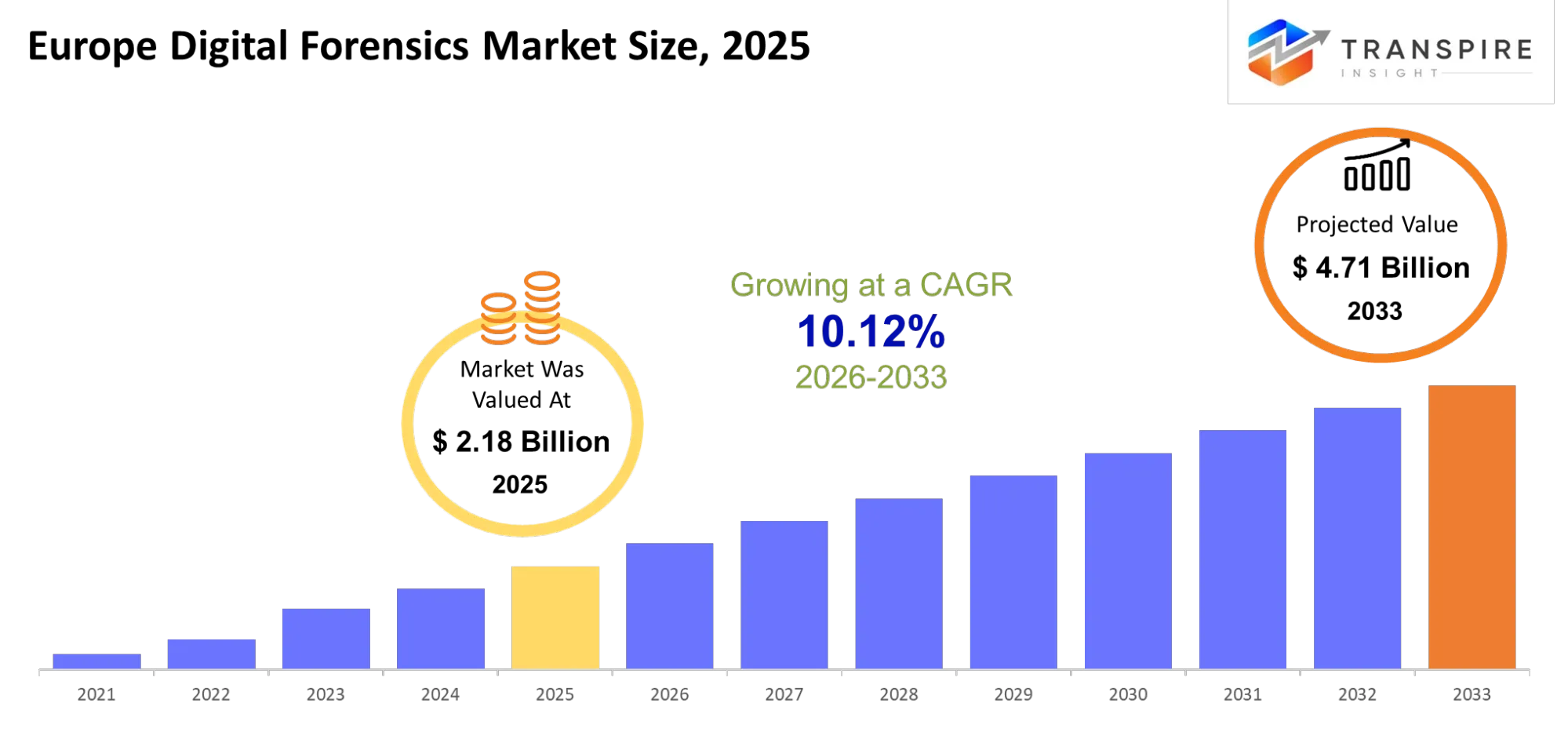
- Europe Digital Forensics Market Size 2025: USD 2.18 Billion
- Europe Digital Forensics Market Size 2033: USD 4.71 Billion
- Europe Digital Forensics Market CAGR: 10.12%
- Europe Digital Forensics Market Segments: By Type (Computer Forensics, Network Forensics, Mobile Forensics, Others), By Application (Cybercrime Investigation, Data Recovery, Fraud Detection, Others), By End-User (Law Enforcement, Government, Enterprises, Others), By Tool (Software, Services, Others).
To learn more about this report,  Download Free Sample Report
Europe Digital Forensics Market Summary:
The Europe Digital Forensics Market size is estimated at USD 2.18 Billion in 2025 and is anticipated to reach USD 4.71 Billion by 2033, growing at a CAGR of 10.12% from 2026 to 2033. The Europe Digital Forensics Market operates at the frontline of cyber incident response, helping organizations investigate data breaches, trace unauthorized access, and produce legally defensible evidence from their digital systems. The system allows law enforcement agencies and financial institutions and industrial operators to investigate incidents which occurred after cyberattacks or internal breaches while they keep their operations running.
The market has experienced a shift during the previous three to five years from its initial reactive model which handled investigations of post-incident events to its present continuous forensic readiness system which operates within cybersecurity frameworks. The data protection enforcement requirements of GDPR and specific industry compliance regulations drive this shift. The surge of ransomware attacks during and after the COVID-19 pandemic created a key trigger which revealed deficiencies in essential infrastructure and business incident response capabilities.
The development of sophisticated attacks together with their legal complexities drove organizations to purchase advanced forensic tools and managed services. The mid-sized companies now use forensics because it has become available for both large enterprises and mid-sized businesses which has resulted in ongoing revenue expansion and better security system integration.
Key Market Insights
- The digital forensics market in Europe is primarily controlled by Western Europe which will maintain its lead through 2024 because of its well-established cybersecurity systems.
- Northern Europe grows at the fastest rate among all regions because its advanced digital governance frameworks will enable it to achieve a growth rate above 12% until 2030.
- The market for digital forensic software reached more than 50% market share in 2024 because the software provides automated tools and AI-driven evidence analysis functions.
- The services segment accounts for the second-biggest market share because organizations require incident response services and managed forensic solutions.
- The cloud forensics market segment grows at the fastest rate because organizations shift their essential business operations to cloud computing solutions which will continue until 2030.
- Law enforcement applications lead the market with approximately 40% share in 2024 because they support requirements for cybercrime investigation.
- Corporate investigations represent the fastest-growing application, fueled by insider threats and compliance-driven audits across enterprises.
- Digital forensics serves as a national security and cyber intelligence tool for government and defense organizations which control more than 35% of the market.
- BFSI becomes a fast-growing end-user segment because organizations need to improve their fraud detection methods and meet regulatory compliance standards.
What are the Key Drivers, Restraints, and Opportunities in the Europe Digital Forensics Market?
The Europe Digital Forensics Market experiences its main growth driver because organizations face stricter requirements for data protection and cyber resilience compliance. Organizations now need to build audit-ready systems for handling security breaches because GDPR enforcement and NIS2 regulations require them to do so. Organizations invested in forensic technologies and services after the new regulations because these tools enable them to create legally acceptable digital evidence. Organizations are now investing in forensic readiness as an essential part of their cybersecurity expenses because increasing penalties for non-compliance create a continuous revenue stream for vendors through compliance requirements.
The lack of skilled digital forensic professionals who can conduct complex multi-jurisdictional investigations stands as a major structural obstacle. Digital forensics requires experts who understand legal requirements and data reconstruction methods and current cloud and Internet of Things technologies. The training pipelines cannot handle the complex needs of this field because certification processes in Europe remain divided into different systems. The talent shortage in the industry results in delays for deployment processes which restrict advanced technology deployment while reducing market growth because it hampers service expansion and increases business costs.
Organizations now have a significant opportunity because they can develop their cloud services and remote forensics capabilities. Organizations need solutions that enable remote investigation of security incidents because they increasingly deploy their operations across hybrid and multi-cloud systems. Eastern European countries that experience digital infrastructure development will see new business opportunities through investments in AI-based cloud forensics systems. Organizations that combine automated processes with cloud-based investigation systems will achieve quicker customer adoption and wider market reach.
What Has the Impact of Artificial Intelligence Been on the Europe Digital Forensics Market?
Artificial intelligence is transforming digital forensics operations throughout Europe because it enables automated handling of evidence processing and evidence categorization and evidence link establishment at large volumes. AI-powered triage systems help investigators process extensive data collections which include endpoint data and cloud log information and mobile device content, which results in faster case processing because it decreases the time needed for manual examination. Law enforcement agencies use automated systems to maintain their forensic capabilities because these systems track network traffic and safeguard essential data during real-time operations to maintain their legal obligations.
The implemented changes boost efficiency because they decrease investigation duration while they expand the number of cases that police departments can complete within required legal timeframes. Machine learning models apply their capabilities to identify unexpected behavior patterns which enable organizations to forecast potential insider threats and advanced persistent attacks. These systems analyze historical incident data to forecast risk scenarios and prioritize investigative resources. Organizations report faster incident containment and reduced financial impact due to earlier detection and response.
The technologies enhance operational performance by delivering precise evidence results which minimize incorrect positive outcomes while enabling international collaboration through common digital evidence standards. European countries face a major challenge because organizations need to spend substantial resources for implementing AI systems which need to function across different IT infrastructures and legal systems that exist in various European regions followed by their eventual adoption of proven operational benefits.
Key Market Trends
- Companies now use active digital security methods to protect their systems by collecting evidence through their cybersecurity systems since 2020.
- Organizations started spending more money on legally valid forensic solutions after 2021 when GDPR enforcement expanded to protect themselves from penalties and improve their audit processes.
- Ransomware attacks increased by more than 60% from 2020 to 2023 which led organizations to implement automated forensic triage systems that enable them to detect security breaches more quickly.
- The process of cloud migration throughout Europe has created a need for new investigation methods which use cloud-based systems to collect and analyze evidence instead of traditional device-based forensics.
- Since 2022 both IBM and Cellebrite have added AI capabilities to their forensic platforms which now let investigators spend 40% less time checking data during complex investigations.
- Since 2021 law enforcement organizations throughout Western Europe developed new systems for sharing digital evidence across international borders which enhanced cooperation during cybercrime investigations.
- Since 2022 mid-sized enterprises have increased their use of managed forensic services which allow them to access investigation capabilities through subscription services instead of owning forensic tools.
- The demand for mobile forensics has increased because encrypted communication applications require vendors to develop new decryption methods and data extraction techniques.
- Eastern Europe has developed into a new area of expansion since 2023 because cybersecurity investments have increased and digital investigation systems have been modernized.
Europe Digital Forensics Market Segmentation
By Type
In organizations and public institutions the primary method of computer forensics investigation. Organizations have begun to implement network forensics as their second method for monitoring inbound and outbound traffic to identify advanced security breaches after the increase of ransomware attacks which began in 2020. The use of encrypted messaging applications has created a need for mobile forensics because those apps require extraction technology that can handle advanced extraction needs.
The sub-segment develops new methods to handle various data types which exist in multiple data environments instead of tackling single-use cases. Digital ecosystem development drives market expansion because digital systems now produce evidence which exists across different platforms. Integrated forensic frameworks will replace existing systems by combining endpoint network and mobile analysis functions while vendors must develop products which work together across different platforms and support their needs for growing system requirements.
By Application
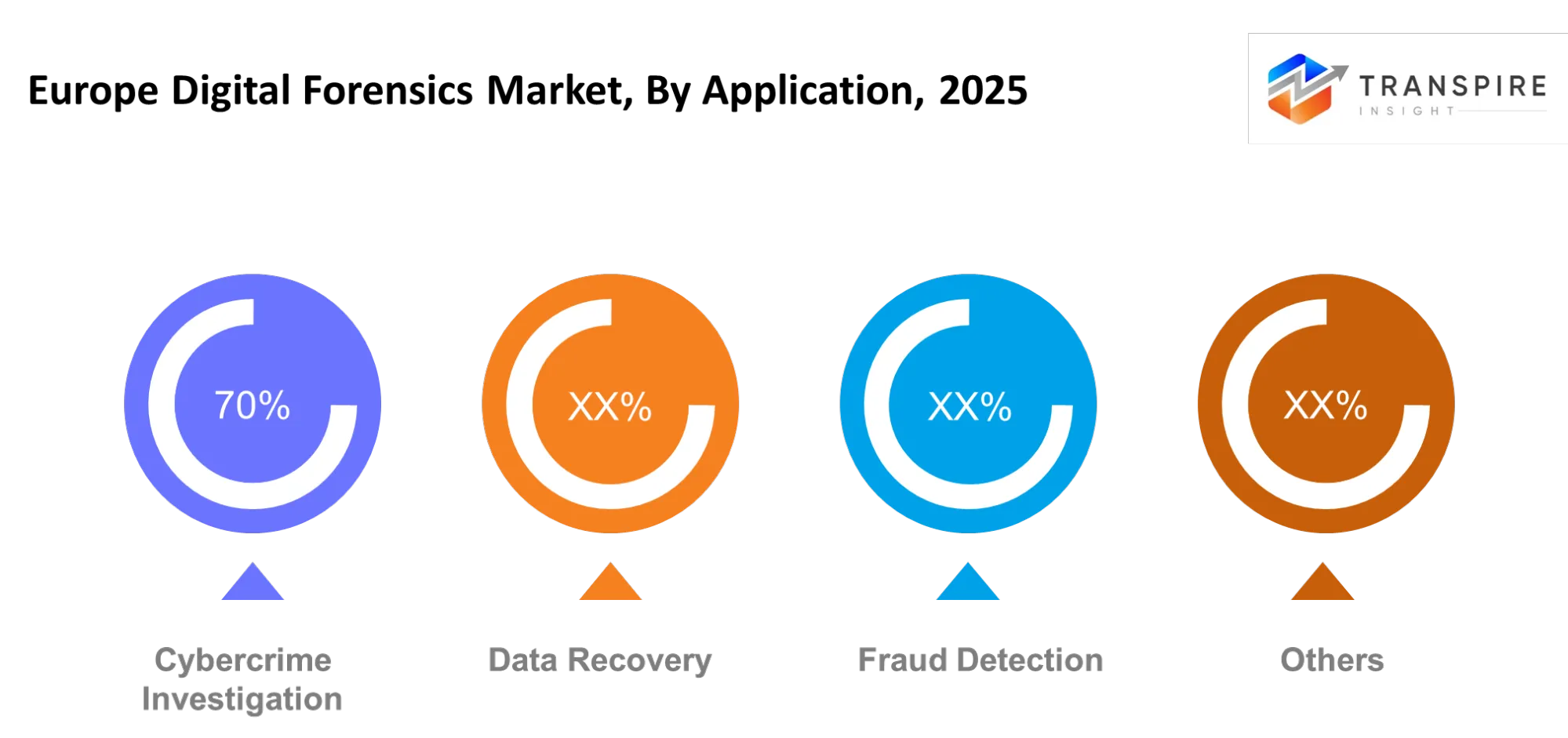
The European cybercrime investigation field experiences its highest demand because of increasing financial fraud incidents and data breaches and attacks sponsored by governments. Financial institutions establish internal monitoring systems to meet the enhanced regulatory requirements which direct their operations. The importance of data recovery remains intact but its development progresses at a slower rate because organizations now prioritize their preventive measures instead of their post-incident restoration efforts.
Organizations now investigate through two phases which first detects security risks and then collects evidence for their investigations. The need for quicker reporting and accountability has become a mandatory requirement which drives this transition. The future will bring closer alignment between forensic tools and cybersecurity operation centers which will prompt vendors to create integrated solutions for detection and investigation and reporting processes that operate within a unified workflow.
To learn more about this report, Download Free Sample Report
By End-User
The law enforcement agencies maintain the biggest share of the market because they conduct criminal investigations and legal proceedings. Government institutions also hold a significant position, using forensic capabilities for national security and intelligence operations. Enterprises represent the fastest-growing segment because cyber threats endanger their business operations and financial results.
Organizations now adopt forensic capabilities through internal development because they prefer to use their own resources instead of hiring external specialists. Organizations have increased their budget for incident response and compliance activities since 2021. The future will lead to better access for mid-sized organizations which will require vendors to develop solutions that maintain operational efficiency while providing advanced technical features.
By Tool
The software solutions used for digital evidence processing through automated systems and analytical capabilities and their ability to expand system capacity become the dominant method for handling digital evidence through the Tool. Services maintain their vital role because complex investigations need expert analysis and legal requirements to be met. Organizations now prefer software solutions which provide faster results and eliminate their need for manual work as their main operational model.
The enterprise cloud adoption has created a rise in demand for cloud-based forensic tools which enable remote investigations and provide access to data at all times. The existing system faces two main constraints which involve difficulties with integrating old systems and the different legal requirements that exist between different regions. The upcoming period will show an increase in AI-based tools and managed services which will drive service providers to integrate automation with their specialized knowledge for complete forensic solutions.
What are the Key Use Cases Driving the Europe Digital Forensics Market?
The primary purpose of cybercrime investigation exists to combat ransomware attacks and financial crimes and data breaches which affect banking systems and public sector networks. The application generates its highest level of demand because organizations need to reconstruct their incidents for legal purposes which require them to comply with European regulations.
BFSI organizations and large enterprises use corporate investigations and compliance audits as their main operational methods. Companies have developed their internal forensic systems because they need to handle internal fraud case investigations and employee misconduct assessments and regulatory compliance reporting.
Investigators now use cloud-native systems and IoT forensics to investigate smart manufacturing facilities and essential infrastructure systems. Forensic tools keep developing their capabilities to gather and analyze data from multiple sources as connected devices spread throughout energy grid systems and industrial operations.
|
Report Metrics |
Details |
|
Market size value in 2025 |
USD 2.18 Billion |
|
Market size value in 2026 |
USD 2.399 Billion |
|
Revenue forecast in 2033 |
USD 4.71 Billion |
|
Growth rate |
CAGR of 10.12% from 2026 to 2033 |
|
Base year |
2025 |
|
Historical data |
2021 - 2024 |
|
Forecast period |
2026 - 2033 |
|
Report coverage |
Revenue forecast, competitive landscape, growth factors, and trends |
|
Regional scope |
Europe (Germany, United Kingdom, France, Italy, Spain and Rest of Europe) |
|
Key company profiled |
Cellebrite, Oxygen Forensics, Magnet Forensics, AccessData, Paraben, FireEye, IBM, Cisco, Guidance Software, MSAB, OpenText, LogRhythm, Nuix, Exterro, ADF Solutions |
|
Customization scope |
Free report customization (country, regional & segment scope). Avail customized purchase options to meet your exact research needs. |
|
Report Segmentation |
By Type (Computer Forensics, Network Forensics, Mobile Forensics, Others), By Application (Cybercrime Investigation, Data Recovery, Fraud Detection, Others), By End-User (Law Enforcement, Government, Enterprises, Others), By Tool (Software, Services, Others) |
Which Regions are Driving the Europe Digital Forensics Market Growth?
The market development in Western Europe emerges from the strong enforcement of regulatory frameworks which require organizations to operate their digital investigation systems at advanced levels according to GDPR and NIS2 regulations. The advanced cybersecurity systems of Germany and the United Kingdom and France enable their law enforcement agencies to operate with greater effectiveness. The existing forensic vendor ecosystem together with legal professionals and incident response teams enables organizations to implement new solutions at a fast pace. The combination of policy demands together with institutional capacity established a permanent requirement for advanced forensic products.
Northern Europe functions as an orderly and dependable market, where Sweden, Denmark, and Finland focus on establishing systematic digital governance together with open government processes. The region expands through security enhancements which organizations dedicate to building their digital protection systems instead of following enforcement practices common in Western Europe. The public and private sectors dedicate their financial resources toward establishing forensic readiness because it serves as a vital component of their comprehensive risk management framework. The organization maintains stable revenue streams through a consistent method which results in decreased fluctuations across its user adoption rates.
The fastest growth rate in Eastern Europe results from recent investments dedicated to cybersecurity infrastructure development and the region's adaptation to European regulatory systems. The digital transformation activities of Poland and Romania have increased their cybersecurity exposure since 2022 while creating a requirement for forensic expert resources. Local investigation capabilities and vendor activities received a boost through initiatives backed by the government and funding from the EU. The market expansion period creates advantageous conditions for new business ventures and investors who want to enter the market which will remain unfulfilled until 2033.
Who are the Key Players in the Europe Digital Forensics Market and How Do They Compete?
The Europe Digital Forensics Market displays a semi-consolidated structure because established vendors control most market share while niche specialists and regional companies enter the market with their specialized capabilities. The competition focuses on three main factors which include the technological capabilities of competitors and their processing speed for evidence and their capacity to process evidence from multiple sources that operate in cloud and mobile and network environments. The established companies maintain their market position through ongoing product development and their product integration with complete cybersecurity systems while the new companies develop products that address missing functions like extracting data from encrypted files and conducting investigations of cloud-based systems. Mid-sized companies increasingly adopt managed forensics and incident response services which serve as crucial elements for their operations.
IBM uses AI-based forensic analytics which it combines with its complete security system to create a unique value proposition that enables quicker threat intelligence connections with forensic evidence. Cellebrite specializes in mobile forensics through its advanced data extraction technology which law enforcement uses to access encrypted devices. Magnet Forensics creates investigation platforms which public agencies and corporate teams can use to perform investigations more effectively because of their intuitive design.
OpenText uses its enterprise information management system to combine forensics and compliance and legal procedures which helps it establish dominance in large enterprise markets. MSAB develops its business by forming alliances with police departments throughout Europe to provide them with secure mobile data extraction solutions. These companies establish competitive superiority through their regional growth initiatives and their cloud system development and their ongoing advancements in processing intricate digital evidence.
Company List
- Cellebrite
- Oxygen Forensics
- Magnet Forensics
- AccessData
- Paraben
- FireEye
- IBM
- Cisco
- Guidance Software
- MSAB
- OpenText
- LogRhythm
- Nuix
- Exterro
- ADF Solutions
Recent Development News
In May 2026, Airbus to Acquire French Cybersecurity Firm Quarkslab: Aerospace and defense company Airbus announced plans to acquire French cybersecurity and digital forensics specialist Quarkslab. The move is aimed at strengthening Airbus’ cyber investigation, malware analysis, and incident-response capabilities across Europe’s defense and critical infrastructure sectors. The acquisition highlights growing consolidation in the European digital forensics and cyber intelligence ecosystem.
Source: https://www.securityweek.com
In April 2026, European Commission Awards €180 Million Sovereign Cloud Contract: The European Commission awarded a €180 million sovereign cloud services contract to four European providers in April 2026. The initiative is expected to significantly improve secure evidence storage, regulatory compliance, and forensic data processing capabilities for government-led cyber investigations and digital evidence management across the EU.
Source: https://www.reuters.com
What Strategic Insights Define the Future of the Europe Digital Forensics Market?
The Europe Digital Forensics Market is developing its core operations by embedding real-time investigative capabilities into its cybersecurity and IT systems. The continuous monitoring of systems with evidence preservation for regulatory compliance needs and hybrid IT systems increases system disruptions which need permanent incident response teams. The next five to seven years will see forensic functions integrated into security systems of enterprises as fundamental elements instead of existing as independent components.
The European jurisdictions face a hidden danger from data sovereignty rules because they create multiple data-sharing limits which restrict evidence transfer between nations and decrease unified forensic platform capabilities. The different regulatory interpretations together with their enforcement discrepancies will force vendors to incur higher costs for localized operations while their product deployment will take longer.
AI-driven cloud forensics which delivers services to decentralized environments has emerged as a new opportunity in Eastern Europe because digital infrastructure in the region undergoes rapid growth. The market shift can be captured by vendors who dedicate their resources to developing cloud-native solutions which meet compliance standards. The main goal of the organization is to create interoperable platforms which will operate according to regional legal systems while supporting operations in different legal areas.
Europe Digital Forensics Market Report Segmentation
By Type
- Computer Forensics
- Network Forensics
- Mobile Forensics
- Others
By Application
- Cybercrime Investigation
- Data Recovery
- Fraud Detection
- Others
By End-User
- Law Enforcement
- Government
- Enterprises
- Others
By Tool
- Software
- Services
- Others
Frequently Asked Questions
Find quick answers to common questions.
The approximate Europe Digital Forensics Market size for the market will be USD 4.71 Billion in 2033.
The key segments of the Europe Digital Forensics Market are By Type (Computer Forensics, Network Forensics, Mobile Forensics, Others), By Application (Cybercrime Investigation, Data Recovery, Fraud Detection, Others), By End-User (Law Enforcement, Government, Enterprises, Others), By Tool (Software, Services, Others).
Major players in the Europe Digital Forensics Market are Cellebrite, Oxygen Forensics, Magnet Forensics, AccessData, Paraben, FireEye, IBM, Cisco, Guidance Software, MSAB, OpenText, LogRhythm, Nuix, Exterro, ADF Solutions.
The current market size of the Europe Digital Forensics Market is USD 2.18 Billion in 2025.
The Europe Digital Forensics Market CAGR is 10.12%.
- Cellebrite
- Oxygen Forensics
- Magnet Forensics
- AccessData
- Paraben
- FireEye
- IBM
- Cisco
- Guidance Software
- MSAB
- OpenText
- LogRhythm
- Nuix
- Exterro
- ADF Solutions
Recently Published Reports
-
Apr 2026
3D Optical Profiler Market
3D Optical Profiler Market Size, Share & Analysis Report By Type (Desktop 3D Optical Profiler, and Portable 3D Optical Profiler), By Technology (Confocal Technology, and White Light Interference), By End-Use Industry (Manufacturing, Research Institutions, Automotive, Aerospace and Defense, Medical Devices, and Other), and Geography (North America, Europe, Asia-Pacific, Middle East and Africa, South and Central America), 2021 - 2031
-
Apr 2026
Depth Sensor Market
Depth Sensor Market Size, Share & Analysis Report By Type (Infrared Depth Sensors, Time-of-Flight (ToF) Sensors, Stereo Vision Sensors, Structured Light Sensors, Ultrasonic Depth Sensors), By Application (Automotive, Robotics, Gaming, Consumer Electronics, Industrial Automation, Healthcare, Security & Surveillance, Others), By End Users (Automotive Manufacturers, Consumer Electronics Companies, Healthcare Providers, Industrial Companies, Security Agencies, Gaming Companies, Robotics Companies, Others), and Geography (North America, Europe, Asia-Pacific, Middle East and Africa, South and Central America), 2021 – 2031
-
Apr 2026
Digital Manufacturing Market
Digital Manufacturing Market Size, Share & Analysis Report By Component (Hardware, Software, and Services), By Technology (Robotics, 3D Printing, Internet of Things (IoT), and Others), By Application (Automotive and Transportation, Aerospace and Defense, Consumer Electronics, Industrial Machinery, and Others), By Process Type (Computer-Based Designing, Computer-Based Simulation, Computer 3D Visualization, Analytics, and Others), and Geography (North America, Europe, Asia-Pacific, Middle East and Africa, South and Central America), 2021 – 2031
-
Apr 2026
Digital Visa Services Market
Digital Visa Services Market Size, Share & Analysis Report By Type (Individual Travelers, Group Travelers), By Application (Tourism, Business Travel, Others), and Geography (North America, Europe, Asia-Pacific, Middle East and Africa, South and Central America), 2021 – 2031