

Global Ductless Heating and Cooling Systems Market Size & Forecast:
- Global Ductless Heating and Cooling Systems Market Size 2025: USD 80.77 Billion
- Global Ductless Heating and Cooling Systems Market Size 2033: USD 114.97 Billion
- Global Ductless Heating and Cooling Systems Market CAGR: 4.51%
- Global Ductless Heating and Cooling Systems Market Segments: By Type (Mini-split Systems, Multi-zone Systems, Ceiling Cassette Systems, Wall-mounted Systems, Floor-mounted Systems, Smart Ductless Systems, Others); By Application (Residential Buildings, Commercial Buildings, Hotels & Hospitality, Healthcare Facilities, Educational Institutions, Others); By End-User (Households, Offices, Retail Stores, Industrial Facilities, Others); By Technology (Inverter Technology, Non-inverter Technology, IoT-enabled Systems, Hybrid Systems, Others)

To learn more about this report,  Download Free Sample Report
Global Ductless Heating and Cooling Systems Market Summary:
The Global Ductless Heating and Cooling Systems Market size is forecast to be valued at USD 80.77 billion in 2025 and projected to reach USD 114.97 Billion by 2033 on account of increased preference for energy efficient temperature regulation solutions in residential and commercial structures. In the past few years, there has been a significant change from the traditional replacement of HVAC products towards advanced, smart and connected invertor cooling systems which help in reducing energy consumption. One of the biggest shifts in the structure of the market in recent times has been the introduction of energy efficiency laws as well as carbon emission policy measures, especially in areas where green buildings are being promoted and electrical solutions are encouraged. Post pandemic factors including the increasing trend of home remodeling, remote working trends and climate changes have added to the momentum. Urban development and renovation works have resulted in increased usage of ductless heating and cooling systems owing to reduced installation costs, zoned cooling systems and enhanced energy savings.
Global Ductless Heating and Cooling Systems Market Insights:
- This market will transition from the HVAC industry based on replacing products to becoming an energy management system enabled by electrification and sustainability trends. The growing popularity of inverter systems, connected controls, and environmentally friendly refrigerants has transformed the consumer behavior of residential and commercial clients.
- The residential sector constitutes almost 55% of the overall demand in the market, driven by the increase in home renovations and the popularity of smart homes.
- The inverter technology ductless air conditioners make up more than 70% of sales, as manufacturers like Daikin Industries and Mitsubishi Electric concentrate on highly efficient compressors.
- The Asia-Pacific region accounts for about 42% of global market share, owing to the rapid growth of urban housing construction and middle-class consumers' purchases of energy-efficient household items.
- Over 60% of commercial customers have become concerned about energy consumption in their HVACs, which motivates LG Electronics to provide AI-controlled climate systems.
- Growth in smart HVAC integration currently exceeds 15% due to the higher popularity of Wi-Fi enabled temperature control systems.
- Ductless multi-zone HVAC system demand is soaring in hospitality and office infrastructure construction due to a drop in energy costs by around 30%.
- The use of environmentally friendly refrigerants like R-32 is expected to rise in response to increased regulatory push against CO2 emissions in Europe and the US.
- As much as 40% of retrofit HVAC system installations involve ductless systems due to reduced need for structural alterations during the process.
- The likes of Carrier Global and Panasonic Corp. are exploring air quality monitoring technology amid rising awareness about health issues among consumers.
- HVAC system with heat pumps is increasingly popular in colder climate zones as countries offer financial incentives to promote electrification efforts.
What are the Key Drivers, Restraints, and Opportunities in the Global Ductless Heating and Cooling Systems Market?
Driver:
The key drivers that have influenced the growth of the market for ductless heating and cooling systems are the move towards efficient energy infrastructure in buildings and electric heating systems around the world. Stricter building efficiency requirements and rebates have been issued by governments of the United States, Japan, and many other nations due to rising energy costs and carbon reduction goals. These requirements have spurred the use of more energy-efficient inverter systems, offering zoned climate controls. Building owners have replaced older duct-based systems for lower maintenance and reduced costs, leading to growth in product sales for HVAC firms.
Restraint:
The high cost associated with installation and equipment remains one of the factors limiting more widespread use of the technology, especially in developing nations where consumers are highly sensitive to prices. Moreover, some older structures may need electrical work or more than one unit inside, leading to higher costs overall. There is also a lack of trained HVAC mechanics who are able to install and maintain inverter technology.
Opportunity:
The key future opportunity for development will be in smart interconnected HVAC systems that use AI technology, in tandem with renewable energy systems. Companies like Daikin Industries and LG Electronics have started researching predictive temperature controls and cloud monitoring that utilize artificial intelligence. Urban sprawl across countries like India and Southeast Asia, along with green building investments, are predicted to fuel significant demand for compact ductless systems.
What Has the Impact of Artificial Intelligence Been on the Global Ductless Heating and Cooling Systems Market?
The Global Ductless Heating and Cooling Systems Market is revolutionized by Artificial Intelligence with increased energy optimization, predictive servicing, and automated climate control. The ductless heating and cooling system equipped with AI uses sensors along with cloud-based analytics and machine learning algorithms to monitor occupancy, humidity levels, outdoor temperature, and preferences of users. As a result, there is automatic adjustment in the speed of fans and compressors which reduces the consumption of electricity. The AI-powered smart HVAC solutions in commercial properties of Daikin Industries were enhanced in March 2025 for automated energy balancing and remote diagnostics.
AI technology is now providing a strong competitive edge with its predictive features. In September 2024, LG Electronics released advanced AI air-solution technology that was able to predict the need for maintenance of equipment before any operational failure occurs. In addition to that, AI helps in minimizing operational disruptions, extending the lifespan of HVAC equipment, and saving service costs. There are also advancements in operational efficiency using AI-zoning systems that control the room's temperature independently.
Global Ductless Heating and Cooling Systems Market Trends:
- From simple air coolers for rooms to highly advanced and energy efficient systems integrated into smart buildings' technology, Global Ductless Heating and Cooling Systems Market is making this transition towards more sophisticated, energy efficient climate systems.
- With growing consumer preference for systems that ensure both quiet operation and energy optimization, the HVAC market saw a shift over the last five years in favor of inverter systems compared to old fixed-speed models.
- The market has evolved from simple cooling devices to smart connected HVAC ecosystems which come equipped with various features including application-based and voice-controlled technologies.
- Increased prevalence of telecommuting has greatly influenced consumer behavior as they preferred climate control systems for individual rooms over central air conditioning systems for entire buildings.
- As the industry is under stricter environmental regulations, companies now manufacture HVAC products using low global warming potential refrigerants like R-32.
- Operators of commercial buildings are increasingly turning to multi-zone ductless systems in order to better manage their energy and lower costs related to operations.
- The field of predictive maintenance has undergone a technological transformation with new AI-based diagnostic solutions now available that can predict airflow problems, refrigerant problems, and excessive pressure within compressors.
- HVAC companies have transitioned from competing on a hardware basis to competing in software, including remote monitoring services and subscription-based maintenance plans.
- The pattern of demand for HVAC systems has changed with more emphasis on retrofits due to older urban buildings having less space for a duct network.
- The trend toward integrating heat pumps has become stronger due to the government support of electrically driven heating solutions to avoid fossil fuel heating systems.
- Smart home products have influenced consumer behavior when choosing an HVAC system with preference for products supporting IoT integration, energy dashboards, and occupancy sensors.
Global Ductless Heating and Cooling Systems Market Segmentation
By Type
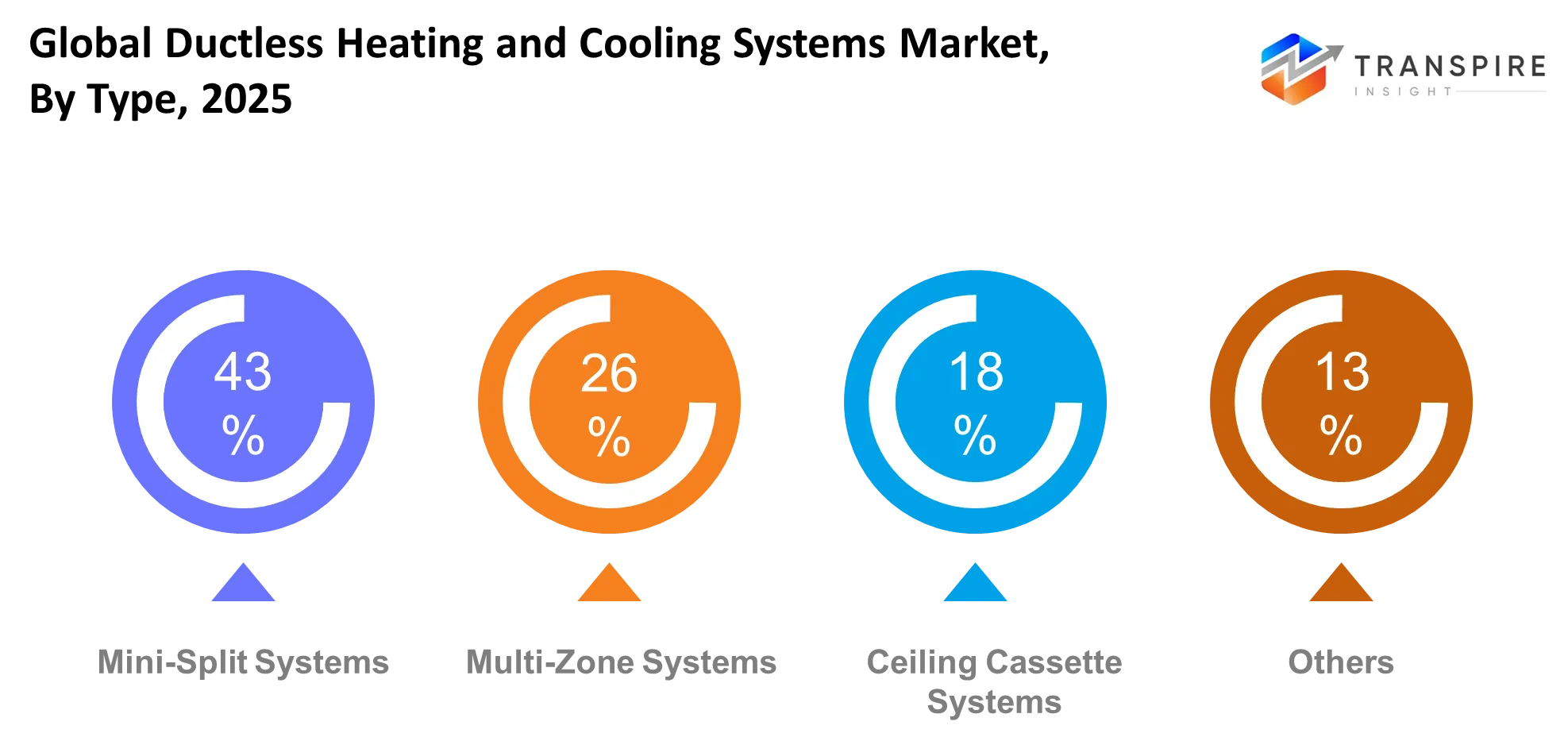
Global Ductless Heating and Cooling Systems Market has been categorized based on type, application, end users, and distribution channels. Each segment makes different contributions to the growth of the industry in terms of development and implementation of innovations. The type of ductless heating and cooling system segments include single zone and multi zone. Presently, single zone systems dominate the market owing to factors such as low cost, ease of installation, and utilization of these systems in residential apartments, office complexes, and renovations. Growth drivers associated with single zone HVAC systems include urbanization, construction of housing projects in cities, and need for temperature control in separate rooms to conserve energy. However, multi zone systems are anticipated to witness increased momentum in the coming years due to commercial applications and demand for centralized temperature control.
To learn more about this report, Download Free Sample Report
By Application
Home use represents the major market segment owing to the trend that sees more and more consumers switching from traditional HVAC systems to compact and energy-saving ductless systems. This tendency is being further fueled by the fact that people have been working remotely and engaging in remodeling activities during the past few years. At the same time, commercial utilization is growing continuously due to companies’ focus on decreasing their expenses, installing ductless systems easily, and complying with sustainability policies.
By End user
Demand from new constructions remains strong with the incorporation of energy-efficient heating, ventilation, and air conditioning (HVAC) systems into building design. On the other hand, the retrofit market is gaining momentum as older buildings tend to lack ductwork, thus favoring ductless systems. This will change future competition strategy, as manufacturers are likely to adopt smaller unit sizes, easy installation, and maintenance features in their product offering.
What are the Key Use Cases Driving the Global Ductless Heating and Cooling Systems Market?
The key use case scenario responsible for shaping the market of Ductless Heating and Cooling Systems is temperature regulation in residential settings, including apartment buildings, single family houses, and remodeling activities in which installation of standard ductwork systems wouldbe expensive and difficult. Consumers are choosing ductless solutions for their capacity to provide zone-controlled heating/cooling, energy-efficient operation, and quiet running.
New use cases are being identified in commercial domains, including office premises, retail outlets, hospitality industry, and medical institutions. Companies install multizone systems to benefit from energy saving, temperature control on an individual level, and flexibility in system installations without changing building structures.
Novel application cases arise in smart buildings and sustainable infrastructure projects involving integration of AI technology with the Internet of Things and renewable energy sources. Higher education institutions, modular housing projects, and green-certified buildings increasingly utilize modern heat pump- based ductless systems.
|
Report Metrics |
Details |
|
Market size value in 2025 |
USD 80.77 Billion |
|
Market size value in 2026 |
USD 84.41 Billion |
|
Revenue forecast in 2033 |
USD 114.97 Billion |
|
Growth rate |
CAGR of 4.51% from 2026 to 2033 |
|
Base year |
2025 |
|
Historical data |
2020 - 2024 |
|
Forecast period |
2026 - 2033 |
|
Report coverage |
Market trends, growth drivers, restraints, opportunities, competitive landscape, AI impact analysis, regional insights, and segmentation analysis |
|
Regional scope |
North America, Europe, Asia-Pacific, Latin America, Middle East & Africa |
|
Key company profiled |
Daikin, Mitsubishi Electric, LG Electronics, Panasonic, Fujitsu General, Samsung, Carrier, Trane Technologies, Toshiba, Gree Electric, Hitachi, Midea Group, Lennox, Bosch, Haier |
|
Customization scope |
Customized regional analysis, company profiling, segment-specific insights, and competitive benchmarking available |
|
Report Segmentation |
By Type (Mini-split Systems, Multi-zone Systems, Ceiling Cassette Systems, Wall-mounted Systems, Floor-mounted Systems, Smart Ductless Systems, Others); By Application (Residential Buildings, Commercial Buildings, Hotels & Hospitality, Healthcare Facilities, Educational Institutions, Others); By End-User (Households, Offices, Retail Stores, Industrial Facilities, Others); By Technology (Inverter Technology, Non-inverter Technology, IoT-enabled Systems, Hybrid Systems, Others). |
Which Regions are Driving the Global Ductless Heating and Cooling Systems Market Growth?
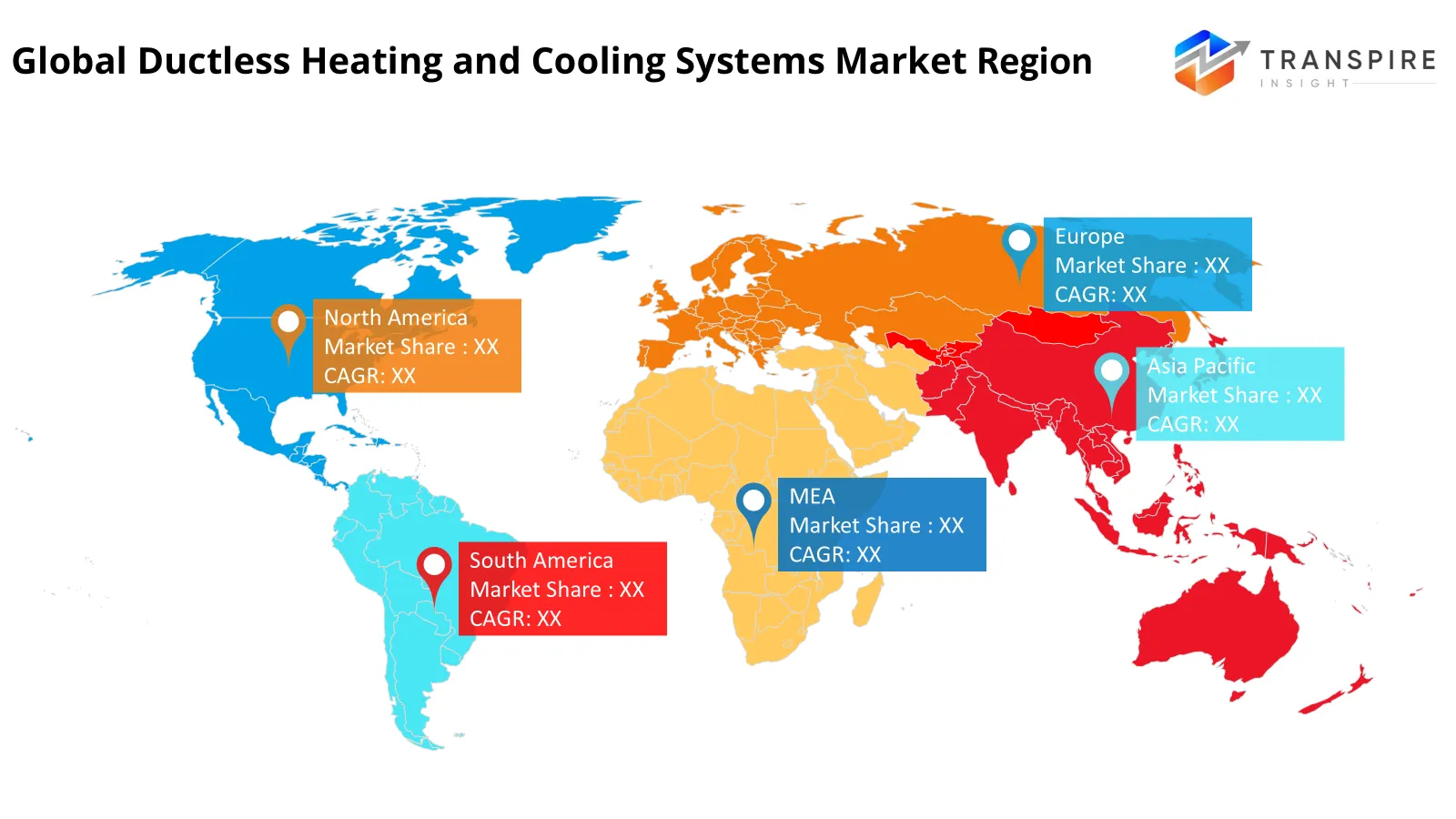
The Asia-Pacific is the largest market for Ductless Heating and Cooling Systems due to extensive urban infrastructure development, high HVAC manufacturing capacity, and growing residential demand for energy-efficient cooling. The dominance of countries like China, Japan, and India in the Asia-Pacific is due to continued urbanization that has made compact housing common alongside growing summer temperatures, which has further boosted inverter-driven ductless system installations. In March 2025, Daikin Industries announced extended investment in heat pump and energy-efficient HVAC solutions in the Asian region.
Europe is the second-largest region for this market, owing mainly to its efforts towards reducing carbon footprint and switching from gas-based heating systems to electric heat pump technology. While Asia-Pacific has demand led by infrastructure development, Europe is witnessing its market driven by strict climate change regulations, retrofitting buildings, and carbon neutrality goals. Nations such as Germany, France, and the UK keep supporting low carbon footprint heating technology through subsidies. In February 2025, The United Kingdom initiated regional installation programs of heat pumps within residential decarbonization schemes.
The growth rate of North America will be higher compared to other regions because of faster deployment of smart home technologies, aging HVAC systems that need replacement, and more stringent electricity efficiency regulations. In September 2024, extreme climatic conditions along with increased awareness of energy optimization contributed towards more investments in AI-based ductless climate control systems. In September 2024, LG Electronics introduced advanced HVAC management solutions using AI in the North American region.
To learn more about this report, Download Free Sample Report
Who are the Key Players in the Driving the Global Ductless Heating and Cooling Systems Market and how do they Compete?
The Competition in the Ductless Heating & Cooling Systems Market rests on inverter performance, intelligent HVAC system design, energy conservation, and regional distribution capabilities instead of just prices. Increasingly, manufacturers compete using AI-powered climate control, low-GWP refrigerant technology, and intelligent maintenance network systems for their customers' desire to save money in the long run while meeting regulatory requirements for sustainability. Product innovation in the form of heat pump technology and customized multi-zone systems also adds to manufacturer differentiation.
Daikin Industries competes mainly based on technological innovation and superior energy efficiency. The company concentrates intensely on inverter compressor technology, low-GWP refrigerants, and AI-based building management systems that are relevant to commercial buildings and smart buildings. It differentiates itself from other firms through vertical integration and an extensive global distribution network. Daikin remains committed to regional production facilities and partnerships across the Asia Pacific, Europe, and North America regions.
Mitsubishi Electric distinguishes itself by its focus on superior performance zoning systems and quiet operation technology that is suitable for domestic use and light commercial applications. On the other hand, LG Electronics sets itself apart from others using its smart-home solutions and AI predictive maintenance system. Additionally, Carrier Global is known to develop commercial HVAC solutions that incorporate energy services.
Global Ductless Heating and Cooling Systems Market Companies:
- Daikin
- Mitsubishi Electric
- LG Electronics
- Panasonic
- Fujitsu General
- Samsung
- Carrier
- Trane Technologies
- Toshiba
- Gree Electric
- Hitachi
- Midea Group
- Lennox
- Bosch
- Haier
Recent Development News:
- In February 2026, LG Electronics introduced its new HVAC line-up at the AHR Expo 2026 event, which consisted of AI-powered ductless and heat pumps. This helped boost LG’s presence in the smart HVAC market. At the same time, there was increasing demand for more efficient HVAC systems in North America and Europe. https://www.prnewswire.com
- In April 2026, The acquisition of Duckt-Strip by RectorSeal was aimed at enhancing the range of products provided by RectorSeal for ductless HVAC installations. It enabled greater efficiency in installations for contractors using Rip-n-Strip™ cable technology. https://rectorseal.com
What Strategic Insights Define the Future of the Global Ductless Heating and Cooling Systems Market?
The market for Ductless Heating & Cooling Systems is slowly moving towards becoming a technology-based energy management sector, wherein heating, ventilation and air conditioning systems become integral parts of smart buildings. The future of competitive edge will revolve around software compatibility, predictive maintenance capabilities, and integration with renewable energy systems. Increasing penetration of heat pumps and electric heating systems in both existing infrastructure and green building constructions is likely to drive demand growth in this regard.
The biggest risk lies in the reliance on semiconductor parts and smart device technology. Any disruption in supply chain or cyber threats to artificial intelligence systems that operate HVAC systems will result in increased operational risks and complexity for commercial end-users. On the other hand, the opportunity lies in the integration of HVAC systems with grid-interactive buildings for optimized use of energy during high peak times through artificial intelligence.
In order to stay ahead, manufacturers must focus on creating an interoperable platform for their smart machines, use local sourcing of components and upskill their technicians. Those firms that can create a business ecosystem based on remote diagnostics, energy analysis and maintenance subscriptions will have the advantage in coming years.
Global Ductless Heating and Cooling Systems Market Report Segmentation
By Type
- Mini-split Systems
- Multi-zone Systems
- Ceiling Cassette Systems
- Wall-mounted Systems
- Floor-mounted Systems
- Smart Ductless Systems
- Others
By Application
- Residential Buildings
- Commercial Buildings
- Hotels & Hospitality
- Healthcare Facilities
- Educational Institutions
- Others
By End-User
- Households
- Offices
- Retail Stores
- Industrial Facilities
- Others
By Technology
- Inverter Technology
- Non-inverter Technology
- IoT-enabled Systems
- Hybrid Systems
- Others
Frequently Asked Questions
Find quick answers to common questions.
The approximate Global ductless heating and cooling systems market size for the market will be USD 114.97 Billion in 2033.
Key segments for the the Global ductless heating and cooling systems market are By Type (Mini-split Systems, Multi-zone Systems, Ceiling Cassette Systems, Wall-mounted Systems, Floor-mounted Systems, Smart Ductless Systems, Others); By Application (Residential Buildings, Commercial Buildings, Hotels & Hospitality, Healthcare Facilities, Educational Institutions, Others); By End-User (Households, Offices, Retail Stores, Industrial Facilities, Others); By Technology (Inverter Technology, Non-inverter Technology, IoT-enabled Systems, Hybrid Systems, Others).
Major Global ductless heating and cooling systems market players are Daikin, Mitsubishi Electric, LG Electronics, Panasonic, Fujitsu General, Samsung, Carrier, Trane Technologies, Toshiba, Gree Electric, Hitachi, Midea Group, Lennox, Bosch, Haier.
The Global ductless heating and cooling systems market size is USD 80.77 Billion in 2025.
The Global ductless heating and cooling systems market CAGR is 4.51%.
- Daikin
- Mitsubishi Electric
- LG Electronics
- Panasonic
- Fujitsu General
- Samsung
- Carrier
- Trane Technologies
- Toshiba
- Gree Electric
- Hitachi
- Midea Group
- Lennox
- Bosch
- Haier
About the Authors

Avinash Kumar
I’m Avinash Kumar, a Senior Research Analyst at Transpire Insight, with expertise in the Electronics and Semiconductor and Energy & Power industry. My work focuses on analyzing emerging technologies, market trends, industry developments, and innovation across these sectors. I specialize in transforming complex technical and market insights into clear, research-backed content that helps professionals, businesses, and decision-makers stay informed. Through continuous industry research and data-driven analysis, I strive to deliver accurate, reliable, and practical perspectives on the latest advancements shaping the semiconductor and energy landscape.

Chakradhar Khansole
Chakradhar serves as the Research Director at Transpire Insight, bringing over 8 years of experience in technology, innovation, and strategic market intelligence. He specializes in transforming complex market data into actionable business insights that enable organizations to make informed, growth-oriented decisions. Recognized for his strategic vision and analytical expertise, Chakradhar leads high-impact research initiatives, delivering comprehensive market assessments, competitive intelligence, and forward-looking industry analysis.
Recently Published Reports
-
Apr 2026
Fiber Optic Faceplates Market
Fiber Optic Faceplates Market Size, Share & Analysis Report By Type (< 300 mm2, 300-350 mm2, and > 350 mm2, By Application (Night Vision, Holographic Imaging, Medical, and Others), and Geography (North America, Europe, Asia-Pacific, Middle East and Africa, South and Central America), 2021 - 2031
-
Apr 2026
High Temperature Superconductors Market
High Temperature Superconductors Market Size, Share & Analysis Report By Type (1G HTS, and 2G HTS), By Application (Power Cable, Fault Current Limiter, and Transformer), and Geography (North America, Europe, Asia-Pacific, Middle East and Africa, South and Central America), 2021 - 2031
-
Apr 2026
Industrial Plugs and Socket Market
Industrial Plugs and Socket Market Size, Share & Analysis Report By Type (Industrial Plugs, Industrial Sockets), By Current (Up to 32 A, 32 to 125 A, Above 125 A), By Protection (Dustproof and Splash Proof, Waterproof, Explosion Proof), By End User (Heavy Industries, Oil and Gas, Chemicals and Pharmaceuticals, Power Generation, Others), and Geography (North America, Europe, Asia-Pacific, Middle East and Africa, South and Central America), 2021 - 2031
-
Apr 2026
InGaAs Avalanche Photodiodes Market
InGaAs Avalanche Photodiodes Market Size, Share & Analysis Report By Type (1100 - 1700 nm, and 1000 - 1600 nm), By Application (Missile Warning System, Muzzle Flash Detection, Wafer Defect Inspection, Laser Rangefinders, and Others), and Geography (North America, Europe, Asia-Pacific, Middle East and Africa, South and Central America), 2021 - 2031