

Global Drilling Fluids Market Size & Forecast:
- Global Drilling Fluids Market Size 2025: USD 10.7 Billion
- Global Drilling Fluids Market Size 2033: USD 16.32 Billion
- Global Drilling Fluids Market CAGR: 5.42%
- Global Drilling Fluids Market Segments: By Product (Water-based, Oil-based, Synthetic-based, Foam-based, Completion Fluids, Workover Fluids, Others); By Application (Onshore, Offshore, Deepwater, Shale Gas, Conventional Wells, Others); By Function (Lubrication, Pressure Control, Cooling, Cleaning, Others); By End User (Oil Companies, Service Companies, Others); By Additive (Viscosifiers, Weighting Agents, Corrosion Inhibitors, Others)
Global Drilling Fluids Market Summary:
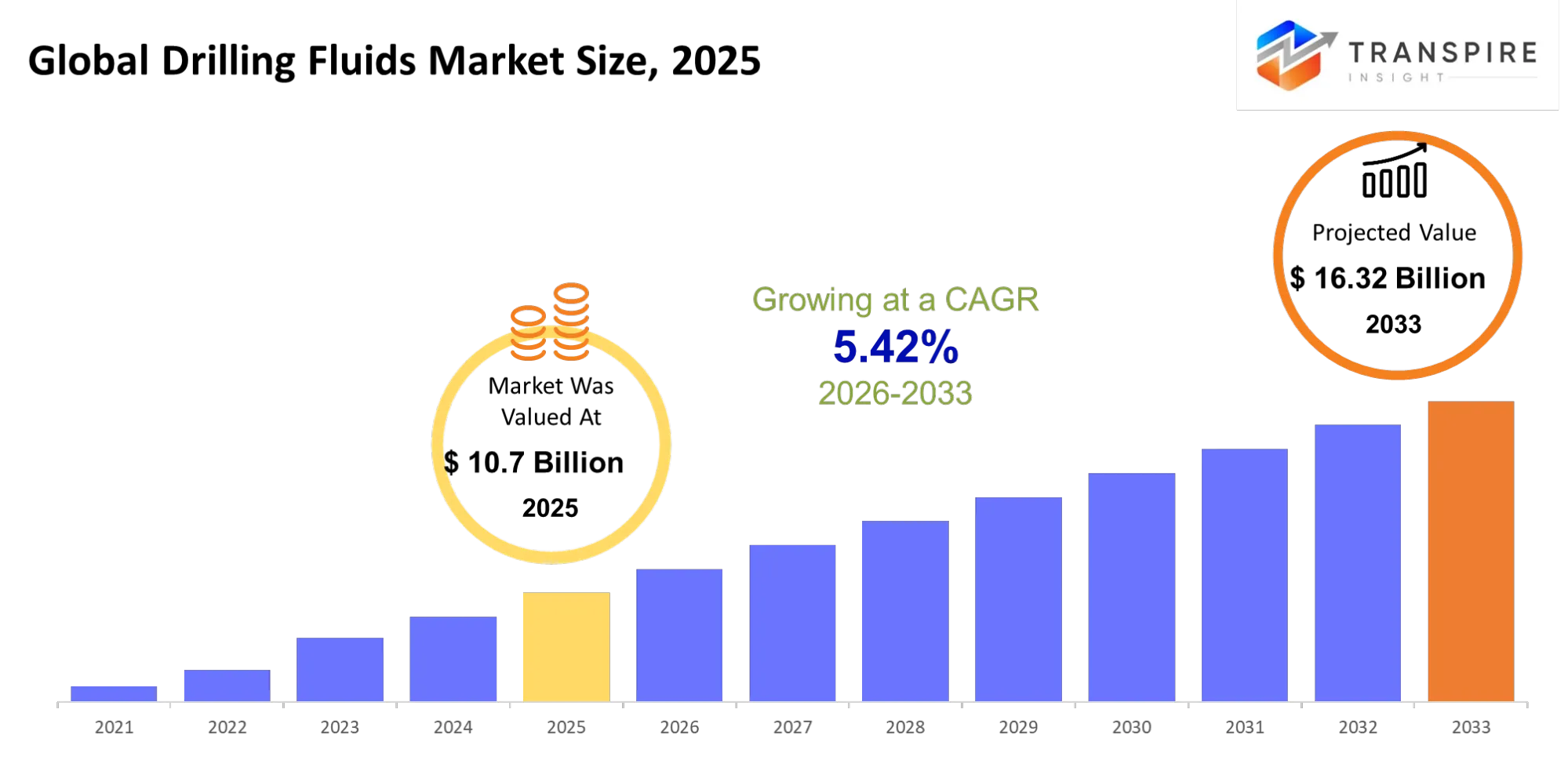
As per Transpire Insight Analysis, the Global Drilling Fluids Market size is estimated at USD 10.7 billion in 2025 and is anticipated to reach USD 16.32 billion by 2033, growing at a CAGR of 5.42% from 2026 to 2033.
From straightforward wellbore support, drilling fluid has morphed into sophisticated engineering systems that allow drilling faster, enhance stability, control formation pressures, carry cuttings and safeguard costly equipment through complicated oil and gas operations. The market has morphed over the past 3-5 years to the acceptance of both ecologically sound and digitally-based systems following increasing demands due to the rise of deepwater exploration, development of unconventional reserves and increasingly tougher regulatory standards that affect purchasing choices. Key shifts in the structural development include the widespread use of low-toxicity and synthetic drilling fluids monitored in real-time, sensor-based systems. The rise of investment in offshore initiatives, alongside increased upstream spending from high energy demand and security issues, has already driven drilling efficiency, and more demanding operations with technically intricate and increasingly longer and deeper wells mean customized fluid packages continue to gain traction, as high-quality drilling fluid performance reduces the overall operational expenditure and non-productive rig time.
Key Global Drilling Fluids Market Insights:
The market for drilling fluids is shifting to intelligent fluid systems, in which operators' efficiency, sustainability, and digital optimisation are the main competitive factors. Advanced chemistry, AI-driven monitoring, and customized formulations are increasingly playing a role in differentiating to improve drilling productivity while meeting stricter environmental standards.
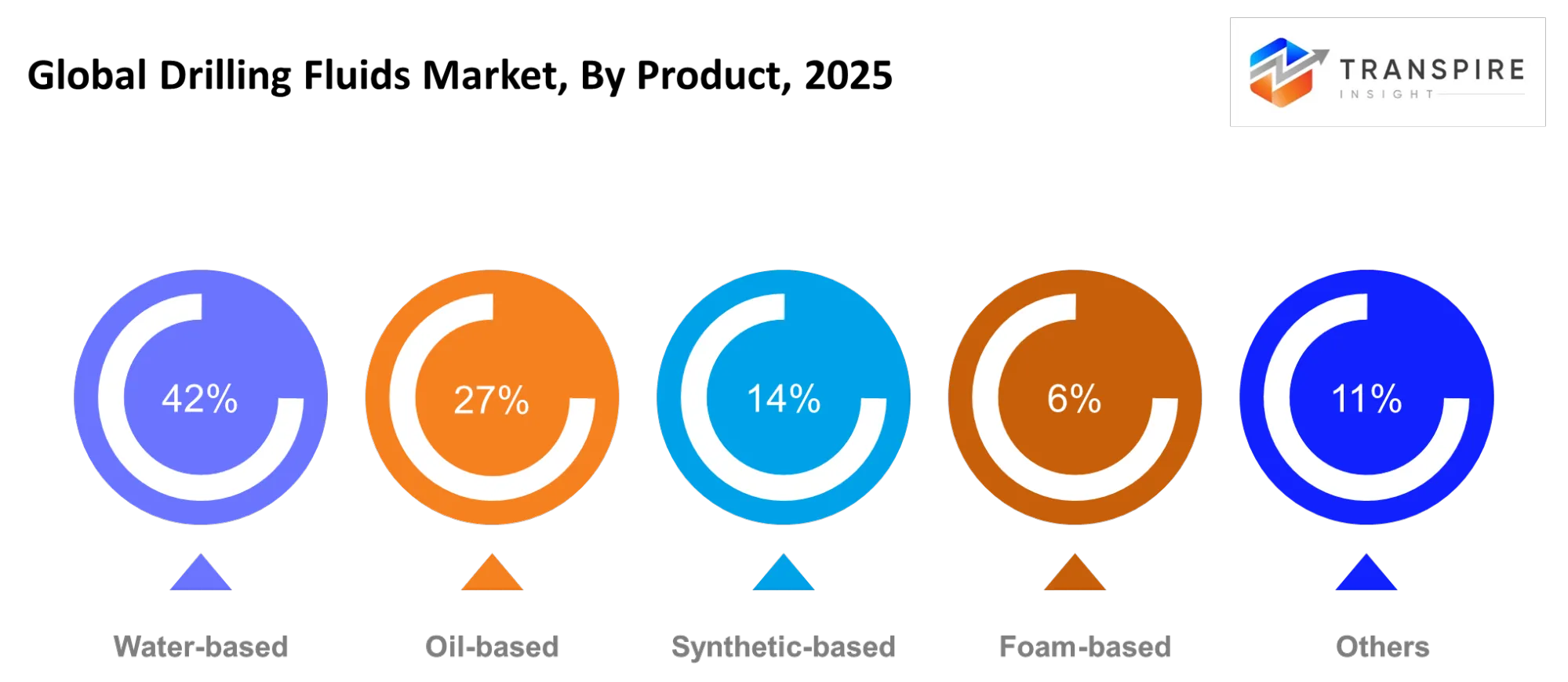
- Water-based fluids account for 42% of the market, and companies are bringing biodegradable additive packages to the market to improve their environmental credentials and lower disposal costs.
- Oil-based fluids make up 27%, and the oil service industry is also making strides to develop invert-emulsion technologies that inhibit shale and control wellbore stability in HPHT drilling.
- The synthetic-based fluid market share is 14% and growing 11.9% per annum, with companies investing in low-toxicity formulations for offshore applications.
- Middle East & Africa accounts for 38% of global demand, with fluid makers investing in locally dedicated product development in the region.
- North America accounts for 25% of the market, where the use of digital mud monitoring, automated fluid management, and AI-assisted drilling optimisation is now commonplace.
- Asia Pacific is the largest regional market with 19%, with suppliers scaling up domestic manufacturing facilities and technical service centres in the region to aid offshore exploration.
- Viscosifiers continue to be the primary class of additives, with companies actively developing nanotechnology-based additives that are effective in drilling under extreme conditions.
- Oilfield service companies are scaling back their integrated drilling fluid solutions, which integrate real-time analytics, predictive maintenance and automated chemical dosing to reduce non-productive drilling time and enhance well economics.
What are the Key Drivers, Restraints, and Opportunities in the Global Drilling Fluids Market?
Driver:
While overall well numbers may be stagnant or showing slight increases, increased global drilling complexity is leading to enhanced spending in the sector. Deeper operations in offshore deepwater reservoirs, development of extended reach and unconventional shale fields, which are areas that classical fluid systems do not adequately perform (particularly on wellbore integrity and wellbore pressure management), push the development of premium drilling fluids that can lower risks, increase the rate of penetration and equipment longevity. Spending in offshore developments (Middle East, South America, West Africa) continues to drive high-performance fluids and specialised service.
In May 2026, Baker Hughes secured a major integrated well construction contract extension from Petrobras. This partnership expands the deployment of advanced drilling and completion fluids across several complex pre-salt offshore fields in Brazil's Santos Basin.
Restraint:
The primary barrier continues to be stringent regulations for drilling waste disposal, and a host of regulations on the chemical composition. For conventional oil-based formulations, the formulations may require costly handling, transportation, or disposal. In addition, the global variation in regulatory standards limits the ability to supply globally, necessitating manufacturers to reformulate for each market region, driving added complexity within supply chains.
Opportunity:
Smart drilling fluid systems that synergise cutting-edge chemistry with digital optimisation. Cloud-based monitoring, automated dosing technology and intelligent chemistry can optimise performance throughout the drilling process, while, thanks to national energy transition strategies promoting a cleaner extraction of fossil fuels but with continued production requirements, this growing investment in both carbon-aware drilling technology, geothermal and more environmentally responsible synthetic-based fluids can open a lucrative new range of opportunities for the company.
In March 2026, Expro partnered with Vulcan Energy to deliver geothermal well testing services for the groundbreaking Lionheart Project in Germany. This partnership utilises integrated fluid management and data-driven well engineering to optimise high-temperature geothermal resource extraction.
What Has the Impact of Artificial Intelligence Been on the Global Drilling Fluids Market?
AI is making smart, predictive operational optimisation of drilling fluids possible, replacing the traditional model of reactive maintenance. Through sophisticated algorithms analysing drilling parameters-pressure, temperature, torque, circulation rate, mud density and rheology collected via rig sensors, these systems detect fluid performance issues well before they have an impact on operations and allow engineers to modify additive levels, mud weight and circulation parameters in real time. Further benefits come in the form of equipment wear forecasting, lost circulation prediction, differential sticking risk identification, and wellbore instability forecasting, ultimately cutting drilling downtime significantly. Machine learning algorithms can make better choices by incorporating geologic and historical drilling information to tailor fluid systems appropriate for individual reservoirs. Automation optimisation technologies also reduce chemical consumption by precisely engineering the amount of each chemical additive rather than using engineers' judgments alone. However, widespread adoption of AI technology will likely be slowed by the high initial cost of technology, the uneven quality of in-field data, and the integration and use of legacy drilling rigs and equipment. Smaller drilling contractors often do not have the underlying IT infrastructure necessary for the integration of most AI fluid-optimisation systems.
In February 2026, SLB launched its Lumi™ data and AI platform along with the Tela™ agentic AI assistant. This launch introduces AI foundation models and agentic workflows that combine real-time downhole sensor data with physics-based models to predict drilling risks, optimise mud performance, and reduce fluid-related operational failures autonomously.
https://www.slb.com/newsroom/features/2026/2026-0225-thrive-feature
Key Global Drilling Fluids Market Trends:
The focus of the innovation is shifting from a supply approach to a standardised chemical approach to intelligent fluid performance, environmental sustainability and basin-specific customisation. Drilling is increasingly being focused on efficiency using digital monitoring, advanced additives and lower environmental impact drilling fluids.
- Synthetic drilling fluids have gradually superseded traditional drilling fluids in offshore operations because of their better environmental characteristics and higher thermal stability.
- Technically complex drilling operations now routinely require real-time monitoring of fluids.
- The use of nanotechnology-based additives has replaced traditional chemicals to enhance viscosity control and filtration properties in extreme conditions.
- Chemical dosing systems are decreasing manual methods and increasing the consistency of fluid property management during drilling operations with automated chemical dosing systems.
- Regional fluid formulation centres are growing and moving towards offering solutions tailored to the geology rather than just packaging drilling fluids.
- Circular waste management is promoting drilling fluid recovery, treatment and reuse to decrease disposal costs.
- New cloud-based drilling platform solutions allow multiple rigs to be serviced in parallel remotely by fluid engineers.
- The research investment is shifting toward biodegradable lubricants for future compliance, low-toxicity additives, and drilling chemicals that minimise carbon usage.
Global Drilling Fluids Market Segmentation
By Product:
Water-based fluids constitute a 42% Share in the drilling fluid market size by their cheap cost, environmentally friendly nature, and their wider application in traditional onshore drillings, thereby its Largest share in the market size. Oil-based fluids 27% of the market. High-pressure & high-temperature (HPHT) oil-Based wells are used. The Synthetic-based Fluids and fastest growing part of the market, expected To Grow with 11.9% of CAGR due to increased offshore and deepwater drilling. Foam-based fluid of 6% to be used in under Balanced Drilling, while the remaining 11% includes completion fluids, workover fluids, and various specialty Products.
By Application:
The primary market driver for onshore drilling is worldwide oil exploration and production with extensive conventional oil and shale gas developments. Offshore drilling drilling sees greater investment from operators tapping higher yield reservoirs that need a better level of drill bit lubricity and advanced drilling fluid systems, and even shale gas requires more lubricant based solutions, as well as higher-pressure controls to help with longer horizontal wells and it the same goes for conventional drilling that increasingly sees better drill-in fluid formulations as exploration continues with challenging, technically demanding prospect exploration, where numerous other opportunities are growing.
By Function:
Pressure control is still the premier application as mud sustains wellbore integrity, counteracts formation pressures, and controls blowout. Lubrication is the next highest application as fluid reduces drill-off, extends bit life, and aids in efficient drilling of wells in complex environments. Cooling is growing in importance as increased wellbore depth equates to increased heat; Cleaning fluid carries drill solids efficiently uphole and keeps the drilling operation going smoothly. As the challenges and intricacies of the modern-day drilling operation increase, Fluid loss control, formation stabilisation, and corrosion inhibition have been gaining importance.
By End-User:
Oil companies remain the largest consumers of drilling fluids due to continuous investments in upstream exploration and production activities requiring customised fluid systems. The continued drive to enhance operational performance is leading service companies to bolster their offerings through a comprehensive suite of fluids engineering, testing capabilities, remote monitoring and onsite support services. Geothermal operators and other specialty contractors also play a vital role in the expanding global alternative energy and unconventional exploration space with increasingly sophisticated drilling fluid innovations.
By Addictive:
Viscosifiers account for the largest share owing to their essential role in controlling drilling fluid rheology and improving cuttings transport efficiency across diverse drilling environments. Weighting agents continue to be a necessity in maintaining hydrostatic pressure throughout high-pressure, high-temperature wells. Corrosion inhibitors are now the fastest-growing additive market as operators work to enhance the operational life of their assets, thereby reducing the overall cost of operating in adverse conditions. Filtration reducers, shale sstabilisers lubricants, biocides and a broad suite of specialty performance chemicals continue to trend toward environmentally friendlier additive formulations that simultaneously ensure operational success and meet tighter environmental regulations.
What are the Key Use Cases Driving the Global Drilling Fluids Market?
Conventional onshore drilling is still the largest use of water-based fluids (42%), which is useful in managing pressure and stabilising the borehole, while cooling bits, transporting solids and controlling costs across large-scale exploratory efforts.
Applications have quickly spread offshore, in deepwater and shale gas developments, using premium oil-based and synthetic fluid systems to enhance well-bore drilling accuracy, equipment serviceability, and enable long-range horizontal drilling in extreme conditions.
Novel applications are under consideration and development in such areas as geothermal energy drilling, AI-enhanced fluid control to maximise drilling operation efficiency, and eco-friendly operations based on biodegradability additives, reusable fluid systems, and a wider use of corrosion-fighting fluid chemistries.
|
Report Metrics |
Details |
|
Market size value in 2025 |
USD 10.7 Billion |
|
Market size value in 2026 |
USD 11.28 Billion |
|
Revenue forecast in 2033 |
USD 16.32 Billion |
|
Growth rate |
CAGR of 5.32% from 2026 to 2033 |
|
Base year |
2025 |
|
Historical data |
2021 - 2024 |
|
Forecast period |
2026 - 2033 |
|
Report coverage |
Revenue forecast, competitive landscape, growth factors, and trends |
|
Regional scope |
United States; Canada; Mexico; United Kingdom; Germany; France; Italy; Spain; Denmark; Sweden; Norway; China; Japan; India; Australia; South Korea; Thailand; Brazil; Argentina; South Africa; Saudi Arabia; United Arab Emirates |
|
Key company profiled |
Halliburton, Schlumberger, Baker Hughes, M-I SWACO, Newpark Resources, Tetra Technologies, CES Energy, Weatherford, Chevron Phillips, BASF, Clariant, Dow, Scomi, NOV, Anchor Drilling Fluids |
|
Customization scope |
Free report customisation (country, regional & segment scope). Avail customised purchase options to meet your exact research needs. |
|
Report Segmentation |
By Product (Water-based, Oil-based, Synthetic-based, Foam-based, Completion Fluids, Workover Fluids, Others); By Application (Onshore, Offshore, Deepwater, Shale Gas, Conventional Wells, Others); By Function (Lubrication, Pressure Control, Cooling, Cleaning, Others); By End User (Oil Companies, Service Companies, Others); By Additive (Viscosifiers, Weighting Agents, Corrosion Inhibitors, Others) |
Which Regions are Driving the Global Drilling Fluids Market Growth?
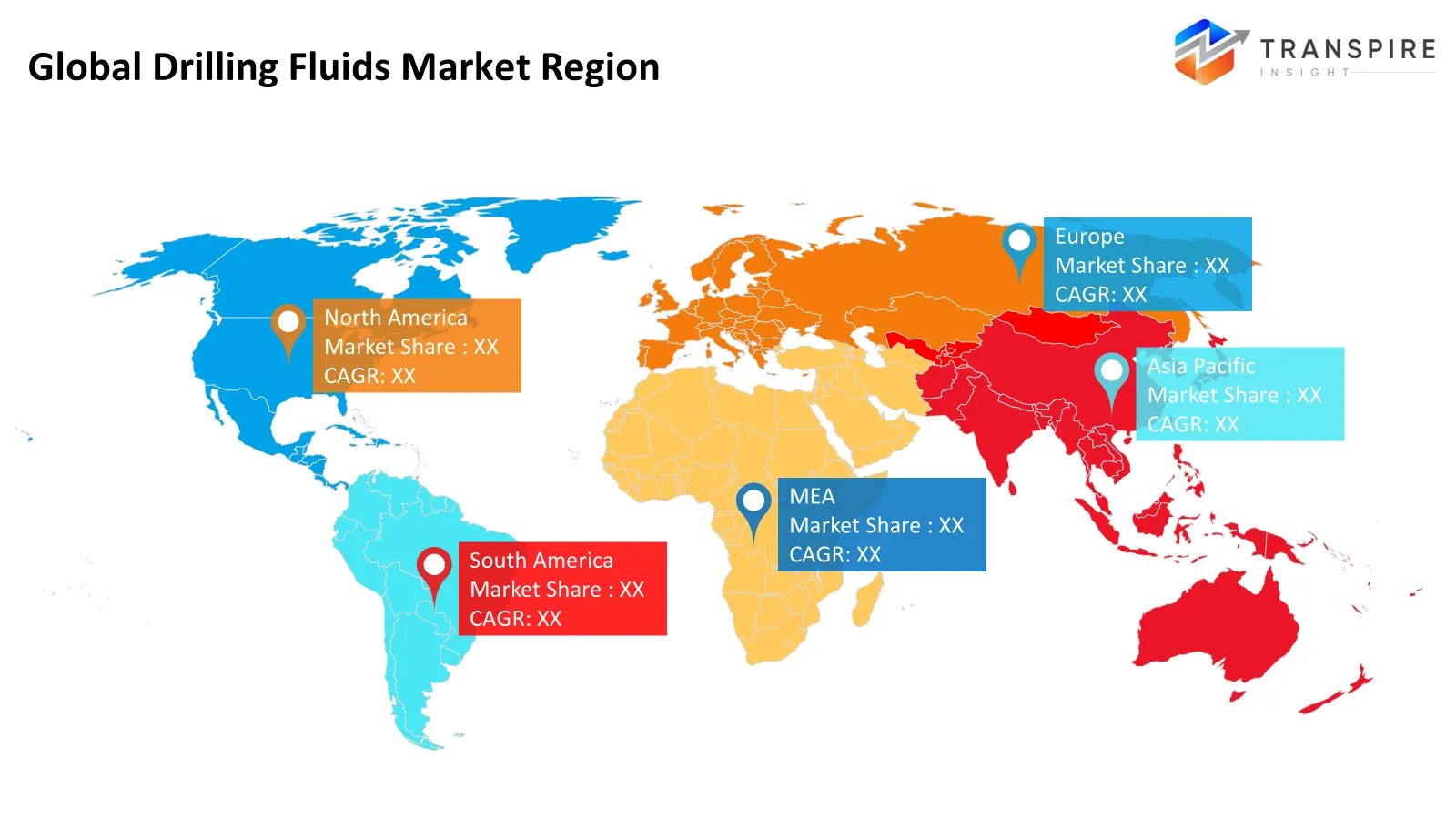
The Middle East and Africa’s 38% share makes it the highest regional contributor with large oil and gas deposits concentrated throughout the region, leading to ongoing investment in upstream activities. Supported by long-range national energy agendas that drive production growth, integrated refining and export capacity also fuel drilling in the upstream segment, covering offshore and traditional well completions. Continued licensing rounds and governmental investment in capacity, in tandem with the cost of competitive production, promote investment into leading-edge drilling fluid technologies. There is also a mature partnership between national oil companies (NOCs) and their international service company counterparts in the region. In February 2026, Saipem was awarded an onshore drilling contract extension by a prominent customer in Saudi Arabia. This partnership deploys advanced drilling rigs and specialised downhole fluid management services for a multi-year drilling campaign.
North America holds 25% of the total market, driven by the mature shale gas production industry, advanced drilling technology and the oilfield service market's mature ecosystem. Unlike Middle East & Africa driven production expansion, NA production is mostly contributed from operation enhancement with horizontal wells, constantly upgrading technology, as well as stability regulation and well-established pipeline and chemical plants. This can make sure demand for high-quality drilling fluids comes from continually mature fields' re-development and unconventional reserves' optimisation regardless of commodity price volatility. In April 2026, Nabors Industries scaled its international and domestic deployment of the Nabors Drilling Solutions (NDS) hub. This expansion transforms land rigs into integrated digital platforms that automate pressure drilling, casing operations, and real-time fluid management to improve efficiency and reduce costs in unconventional drilling.
The Asia Pacific region holds 19% of the market share and is anticipated to witness the quickest CAGR of 12.8% over the review period, owing to massive industrialisation, increasing domestic energy demands, and recent investments in offshore exploration, spurring growth in regional drilling activities. Expanding exploration licensing by governments is encouraging indigenous security, deepwater exploration, and generating opportunities for new-age drilling fluids. The scope of growth will also be in areas like exploration of unconventional gases, offshore resource development and rising trends of sustainable and green drilling fluids in the developing nations. In June 2026, SINOPEC partnered with nine domestic energy enterprises to advance its national polar exploration special project. This partnership coordinates field evaluations for permafrost wellbore stability and focuses on the technical deployment.
Who are the Key Players in the Global Drilling Fluids Market and how do they Compete?
Companies differentiate from each other and from the commodity market for drilling fluids through technology, digital drilling tools, environmental awareness, and client-specific fluid systems. Halliburton combines tailored fluid engineering solutions with the strength of its drilling services to retain its leading position. Schlumberger employs artificial intelligence for optimisation, and integrates AI with digital drilling applications and its technology ecosystem.
Baker Hughes utilises automation and predictive analytics for advanced sustainable drilling fluid technologies; M-I SWACO offers basin-specific specialty drilling fluid formulations targeting reservoirs of extreme complexity. Newpark Resources enhances competitiveness with environmentally sound additive products; TETRA Technologies specializes in high-performance chemical solutions and completion fluid chemistry. CES Energy gains with rapid speciality fluid formulation and broad local supply capacity; Weatherford adds managed pressure drilling technologies; BASF, Clariant, Chevron Phillips and Dow enhance competitor position with innovative speciality chemicals; NOV improves performance with integrated drilling equipment; Scomi offers low-cost options for developing markets; Anchor Drilling Fluids caters to independent operators with highly localized solutions and customer-driven custom formulation.
Key Players are:
- Halliburton
- Schlumberger
- Baker Hughes
- M-I SWACO
- Newpark Resources
- Tetra Technologies
- CES Energy
- Weatherford
- Chevron Phillips
- BASF
- Clariant
- Dow
- Scomi
- NOV
- Anchor Drilling Fluids
Recent Development News on the Global Drilling Fluids Market
- In February 2026, SLB was awarded multiple major offshore drilling services contracts by Mubadala Energy for the Tangkulo natural gas deepwater development in the Andaman Sea. This partnership deploys advanced drilling fluids, real-time downhole monitoring, and completions technologies.
What Strategic Insights Define the Future of the Global Drilling Fluids Market?
Going forward, the drilling fluids market will be defined by intelligent fluid management, green chemistries, and increasingly individualized solutions targeting the unique complexities of each drilling environment instead of generic offerings. Winners will be those who effectively integrate novel additive performance with digital insights from rig monitoring and automated well control. Underappreciated in its strategic implications will be rising regulatory divergence by region, adding complexity and cost to product formulations and their related certification.
On the bright side, the emergence of geothermal and carbon storage-related projects and continued deep water exploration offer lucrative, longer-term opportunities for innovative speciality fluids. Investment in biodegradables, AI-enabled optimization, in-country manufacturing and closer relationships with drillers will be crucial for companies hoping to differentiate on value and gain access to high-end drilling programs while reducing environmental impact and cutting costs.
Key segmentations are:
By Product
- Water-based
- Oil-based
- Synthetic-based
- Foam-based
- Completion Fluids
- Workover Fluids
- Others
By Application
- Onshore
- Offshore
- Deepwater
- Shale Gas
- Conventional Wells
- Others
By Function
- Lubrication
- Pressure Control
- Cooling
- Cleaning
- Others
By End User
- Oil Companies
- Service Companies
- Others
By Additive
- Viscosifiers
- Weighting Agents
- Corrosion Inhibitors
- Others
By Regional Analysis
North America
- United States
- Canada
- Mexico
Europe
- Germany
- United Kingdom
- France
- Italy
- Spain
- Russia
- Rest of Europe
Asia Pacific
- China
- Japan
- India
- South Korea
- Australia
- Rest of Asia Pacific
South America
- Brazil
- Argentina
- Rest of South America
Middle East & Africa
- Saudi Arabia
- United Arab Emirates
- Qatar
- South Africa
- Rest of the Middle East & Africa
Frequently Asked Questions
Find quick answers to common questions.
The global drilling fluids market size was valued at USD 10.7 billion in 2025 and is poised to reach USD 16.32 billion by 2033, expanding at a 5.42% CAGR.
Key segments for the global drilling fluids market are By Product (Water-based, Oil-based, Synthetic-based, Foam-based, Completion Fluids, Workover Fluids, Others); By Application (Onshore, Offshore, Deepwater, Shale Gas, Conventional Wells, Others); By Function (Lubrication, Pressure Control, Cooling, Cleaning, Others); By End User (Oil Companies, Service Companies, Others); By Additive (Viscosifiers, Weighting Agents, Corrosion Inhibitors, Others).
Growth is primarily driven by expanding offshore and deepwater drilling activities, increasing shale exploration, and rising demand for high-performance, environmentally compliant drilling fluid technologies.
The global drilling fluids market is led by major manufacturers, including Halliburton, Schlumberger, Baker Hughes, M-I SWACO, Newpark Resources, Tetra Technologies, CES Energy, Weatherford, Chevron Phillips, BASF, Clariant, Dow, Scomi, NOV, and Anchor Drilling Fluids.
Middle East & Africa holds 38% of the global market, supported by abundant hydrocarbon reserves, sustained upstream investments, strong national oil companies, and expanding drilling infrastructure.
Key opportunities include AI-enabled fluid optimization, biodegradable drilling fluids, geothermal drilling projects, deepwater exploration, and expansion across fast-growing Asia Pacific energy markets.
- Halliburton
- Schlumberger
- Baker Hughes
- M-I SWACO
- Newpark Resources
- Tetra Technologies
- CES Energy
- Weatherford
- Chevron Phillips
- BASF
- Clariant
- Dow
- Scomi
- NOV
- Anchor Drilling Fluids
About the Authors

Avinash Kumar
I’m Avinash Kumar, a Senior Research Analyst at Transpire Insight, with expertise in the Electronics and Semiconductor and Energy & Power industry. My work focuses on analyzing emerging technologies, market trends, industry developments, and innovation across these sectors. I specialize in transforming complex technical and market insights into clear, research-backed content that helps professionals, businesses, and decision-makers stay informed. Through continuous industry research and data-driven analysis, I strive to deliver accurate, reliable, and practical perspectives on the latest advancements shaping the semiconductor and energy landscape.

Chakradhar Khansole
Chakradhar serves as the Research Director at Transpire Insight, bringing over 8 years of experience in technology, innovation, and strategic market intelligence. He specializes in transforming complex market data into actionable business insights that enable organizations to make informed, growth-oriented decisions. Recognized for his strategic vision and analytical expertise, Chakradhar leads high-impact research initiatives, delivering comprehensive market assessments, competitive intelligence, and forward-looking industry analysis.
Recently Published Reports
-
Apr 2026
Active Power Filter Market
Active Power Filter Market Size, Share & Analysis Report By Type (Shunt Active Power Filters, Series Active Power Filter, Hybrid Active Power Filter), By Application (Harmonics Mitigation, Reactive Power Compensation, Voltage Regulation, Power Factor Correction), By Phase (Single Phase, Three Phase), By End-User Industry (Manufacturing, Healthcare, Commercial, Automotive, Oil and Gas, Others), and Geography (North America, Europe, Asia-Pacific, Middle East and Africa, South and Central America), 2021 - 2031
-
Apr 2026
Electrical Transformer Market
Electrical Transformer Market Size, Share & Analysis Report By Core (Closed, Shell, and Berry), By Insulation (Gas, Oil, Solid, Air, and Other), By Phase (Single, and Three), By Rating (100 MVA to 500 MVA, 501 MVA to 800 MVA, and 801 MVA to 1200 MVA), and Geography (North America, Europe, Asia-Pacific, Middle East and Africa, South and Central America), 2021 – 2031
-
Apr 2026
Hydraulic Piston Pumps Market
Hydraulic Piston Pumps Market Size, Share & Analysis Report By Type (Axial Piston Pumps, Radial Piston Pumps), By Operating Pressure (Low Pressure, Medium Pressure, High Pressure), By Application (Construction, Mining, Agriculture, Automotive, Oil & Gas, Industrial Machinery, Others), By End-User (OEMs, Aftermarket), and Geography (North America, Europe, Asia-Pacific, Middle East and Africa, South and Central America), 2021 – 2031
-
Apr 2026
Laboratory Gas Generators Market
Laboratory Gas Generators Market Size, Share & Analysis Report By Product (Nitrogen Gas Generator, Hydrogen Gas Generator, Zero Air Gas Generator, Purge Gas Generator, TOC Gas Generators, Others), By Application (Gas Chromatography, Liquid Chromatography-mass Spectrometry (LC-MS), Gas Analyzers, Others), By End-user (Life Science, Chemical & Petrochemical, Food & Beverage, Others), and Geography (North America, Europe, Asia-Pacific, Middle East and Africa, South and Central America), 2021 – 2031