
Middle East and Africa Oilfield Equipment Rental Market Size & Forecast:
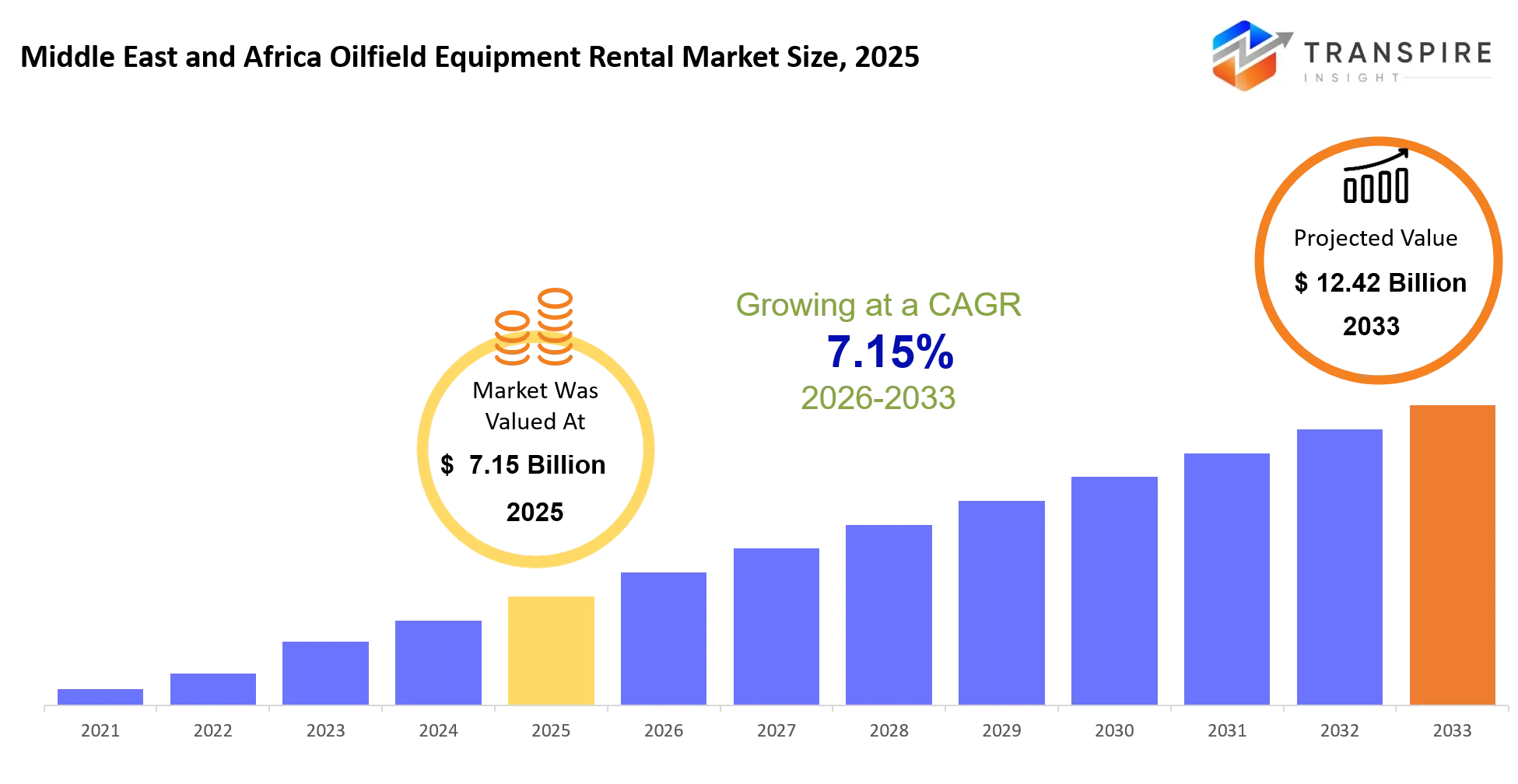
- Middle East and Africa Oilfield Equipment Rental Market Size 2025: USD 7.15 Billion
- Middle East and Africa Oilfield Equipment Rental Market Size 2033: USD 12.42 Billion
- Middle East and Africa Oilfield Equipment Rental Market CAGR: 7.15%
- Middle East and Africa Oilfield Equipment Rental Market Segments: By Equipment Type (Drilling Equipment, Pressure Control Equipment, Fishing Tools, Completion Equipment, Pumps & Compressors, Workover Equipment, Others); By Application (Onshore Drilling, Offshore Drilling, Well Intervention, Production Operations, Exploration Activities, Others); By Rental Type (Short-Term Rental, Long-Term Rental, Equipment Leasing, Managed Rental Services, Others); By End User (Oil & Gas Operators, Drilling Contractors, Oilfield Service Providers, Others)
To learn more about this report,  Download Free Sample Report
Middle East and Africa Oilfield Equipment Rental Market Summary
The Middle East and Africa Oilfield Equipment Rental Market was valued at USD 7.15 Billion in 2025. It is forecast to reach USD 12.42 Billion by 2033. That is a CAGR of 7.15% over the period.
In the Middle East and Africa, the oilfield equipment rental market matters a lot for day to day work like drilling, well intervention, production, and ongoing maintenance. It basically lets operators carry on those activities without having to drop big upfront money on niche, specialized equipment. Rental companies typically provide rigs, pressure control systems, drilling tools, and completion equipment. And that sort of means exploration-production firms keep their day to day operational flexibility, while still dealing with project costs in a more controlled way, you know.
Over the past five years, the whole market has moved more and more toward asset-light operating models, kind of like operators leaning into capital efficiency and shorter project cycles. This shift really picked up after oil price swings, and supply chain disruptions made it clear that owning equipment can become a financial risk, in particular when timelines get messy. At the same time, geopolitical tensions tied to global energy supplies pushed national oil companies and the big producers to ramp up upstream investments and speed up field development programs.
So as drilling activity grows across key producing countries, rental solutions help operators get advanced equipment in place quicker, boost utilization rates, and reduce the cost of assets sitting idle, which honestly is the part that tends to sting. In turn, that creates a pretty direct route to better market revenue growth and wider adoption of related services, across the region.
Key Market Insights
- Saudi Arabia basically leads the regional market, with an estimated 35%–40% share, mostly because of big upstream investments and ongoing drilling programs that never really stop.
- Africa meanwhile is seen as the fastest-growing regional market all the way through 2033, helped by offshore developments in Namibia, Angola and Mozambique, where activity is building step by step.
- When you look at the equipment side, drilling equipment is still the top segment, grabbing around 40% of industry revenue, mainly tied to broad exploration and development work.
- Pressure and flow control equipment comes next as the second-largest segment, and it’s pushed forward by rising well intervention needs, plus production optimization requirements that operators treat as non optional.
- Digital enabled rental equipment is where the growth gets most noticeable, because adoption is up by more than 20% since 2022 among major operators, and they seem to like the smarter, more connected setups.
- In terms of use, onshore applications take the lead with more than 65% market share, driven by large conventional and unconventional field developments across Gulf countries.
- Offshore applications are also expanding pretty fast though, especially as deepwater investment keeps increasing in West Africa, and a few selected Middle Eastern offshore projects move ahead.
- For customers, national oil companies stay the biggest end-user group, contributing over 50% of rental demand across the region.
- At the same time, independent operators and specialized drilling contractors are the fastest-growing customer set, largely due to cost-control initiatives, where efficiency matters a lot.
- Overall, the Middle East and Africa Oilfield Equipment Rental Market is getting more technology driven too, with predictive maintenance and remote monitoring becoming more widely accepted, even if some firms are rolling it out slowly at first.
What are the Key Drivers, Restraints, and Opportunities in the Middle East and Africa Oilfield Equipment Rental Market?
The main driver for market expansion is kinda the growing liking, by oil and gas producers, for capital efficient operating models. After a few years of commodity price swings, operators became more picky about where money goes and they moved more often from owning equipment to using rental agreements. In that way, companies can get access to advanced drilling and production technologies without having to commit a big pile of money at the start. With national oil companies pushing faster field development programs across Saudi Arabia, the UAE, Kuwait, and a number of emerging African producers, rental providers tend to see better equipment utilization and also more steady recurring service income.
The biggest restraint is the market’s exposure to oil price fluctuations, plus geopolitical uncertainty, that part can be pretty uncomfortable. Rental demand stays tied to upstream spending cycles, and when commodity prices soften, operators sometimes postpone drilling campaigns. This is somewhat structural since investment decisions in the oil and gas sector rely on long term price expectations, government policy directions, and even global energy security conditions, none of which get stabilized overnight. So, when projects are pushed back, equipment usage can fall and rental revenues can get squeezed.
A major opportunity is the shift toward digitally connected rental fleets and automated drilling systems. More advanced monitoring platforms, predictive maintenance tools, and remote operations capabilities are showing up across large oilfields. Saudi Arabia and the UAE are investing heavily in digital oilfield infrastructure, which helps create a decent environment for rental providers that bring technology enabled equipment plus data driven service models.
What Has the Impact of Artificial Intelligence Been on the Middle East and Africa Oilfield Equipment Rental Market?
Artificial intelligence is shifting, sorta, how rental equipment gets deployed, monitored and maintained across oilfield work. More and more rental firms are rolling out AI based monitoring systems that track drilling performance, equipment health, how often assets are actually used, and the general operational efficiency, all in real time. And the systems, they tend to spot performance oddities pretty quick and send alerts to operators before anything serious fails, which in turn cuts down on that unplanned downtime.
Then there are machine learning models that help with predictive maintenance programs too. They look at vibration readings, pressure information, temperature trends and also older equipment behavior, and from that they forecast component failures well before they start messing with drilling. In quite a few cases, predictive maintenance has lowered maintenance costs by something like 10% to 20%, while also raising equipment availability and keeping operational uptime higher.
On top of that, advanced analytics platforms are assisting operators in tuning drilling parameters, boosting fuel efficiency, and strengthening well construction results. AI assisted automation, in particular, can suggest operating tweaks that reduce non productive time, and yes, that improves project economics overall.
Still though, adoption is not exactly the same everywhere across the region. A lot of operators hit integration friction because the older equipment fleets weren’t built with digital connectivity in mind from the start. Plus high implementation costs, cybersecurity worries, and sometimes thin operational data coming from remote locations, all of that continues to slow down a wider rollout of AI driven rental management systems.
Key Market Trends
- Since 2021, rental contracts have kinda moved away from short term deals, and toward longer multi-year service arrangements, and it improved equipment utilization too, plus revenue visibility.
- From 2022 to 2025, digital monitoring adoption went up by more than 20% in big drilling and production projects, so yeah that’s a noticeable shift.
- After 2023, Saudi Arabian upstream investments expanded quite a lot, and that in turn created stronger demand for premium drilling and completion equipment.
- Offshore developments in Namibia and Angola started accelerating in the 2024–2026 window, which boosted the need for specialized rental fleets and also intervention tools, not just rentals by themselves.
- Operators are now more likely to bundle equipment rentals together with maintenance and technical support, rather than sourcing everything separately.
- Automated drilling technologies picked up momentum after major service companies expanded remote operation capabilities during 2025 and 2026, which made adoption easier.
- Equipment standardization efforts reduced maintenance complexity too, and helped improve deployment speed across large field development programs.
- In 2026, Halliburton’s acquisition of Sekal kind of underscored how the industry is paying closer attention to drilling automation and autonomous operations, more than before.
- AI-enabled asset management platforms are becoming a real differentiator among global and regional rental providers.
- And lately, strategic partnerships between service companies and national oil companies increasingly influence equipment deployment decisions across the region, even in the background sometimes.
Middle East and Africa Oilfield Equipment Rental Market Segmentation
By Equipment Type
The equipment type segment really points to how wide the range of tools and systems that get rented out is, to back up exploration, drilling, production, and even well upkeep activities across oilfields. Drilling Equipment kind of takes a major spot here, because drilling programs need specialized assets, and those generally come with serious capital investment. Pressure Control Equipment stays just as essential too, since it helps keep operational safety intact, while also managing well pressure during those intense field tasks. Fishing Tools then come in for recovery work when equipment is stuck or ends up lost down in the wellbore, which helps keep delays down and limits operational disruptions.
Completion Equipment adds a lot to field development by helping with the step-by-step shift from drilling over to hydrocarbon production. Pumps & Compressors are used to keep fluid movement going, support pressure management, and improve production efficiency across upstream operations. Workover Equipment is there for maintenance and repair, plus performance improvement work for producing wells. Then there are the Others, meaning specialized rental assets meant for unusual operating conditions, technical needs, and project specific field uses.
To learn more about this report, Download Free Sample Report
By Application
The application segment somehow shows how rental equipment helps across multiple stages in oil and gas development and production work. Onshore Drilling counts for a big portion, since lots of land based reserves in producing countries keep needing constant drilling programs and ongoing field expansion work. Offshore Drilling keeps pulling in money too, mostly because deepwater, and shallow water hydrocarbon resources are still being developed, so demand keeps rolling forward. Well Intervention is another area, it generates steady equipment needs through upkeep, repair, and those production enhancement requests.
Production Operations rely on rented equipment to hold output steady, boost efficiency, and keep daily field performance on track. Exploration Activities end up creating openings for equipment deployment, because operators are assessing new reserves, and also growing their resource portfolios. Others include specialized operational tasks that call for temporary access to advanced tools, and onsite field equipment, so it’s not just standard rigs. Overall, application demand will stay tied to upstream investment cycles, field development blueprints, and production optimization tactics .
By Rental Type
The rental type segment, sort of shows how operators choose equipment access models, based on project duration, budget priorities, and day to day operational goals. Short-Term Rental is still widely used for temporary work, pilot testing programs and other focused operational requirements, where a long-term commitment does not really make sense. Long-Term Rental backs multi-year drilling campaigns and field development initiatives, in cases where equipment continuity is staying important. Equipment Leasing gives a more structured kind of access to critical assets, while also helping organizations control capital outlay more effectively.
Managed Rental Services are continuing to get more traction as operators look for bundled solutions that mix equipment readiness with maintenance and technical support. Service-based rental arrangements help boost equipment utilization, and lower operational complexity a little. Then there are others, like customized rental frameworks that are built around special project conditions and contract obligations. In the end, rental model selection tends to rest on project scale, equipment requirements, and the intent behind financial planning.
By End User
The end user side is mostly about the organizations that use rented equipment to keep oilfield work moving and to support project execution in a more practical way. Oil & Gas operators make up a big part of this because field development, drilling, and production efforts really depend on specialized tools at almost every phase of a project. Drilling contractors typically lean on equipment rental to stay nimble, so they can react quickly when customer needs shift or get more specific. In general, having rented equipment in hand helps with project delivery without having to carry the heavy ownership costs over time.
Oilfield service providers also generate major demand, think about well services, intervention programs, maintenance tasks, and a range of technical field operations. Equipment rental lets these providers scale up their service reach while also easing the workload that comes with buying, storing, and maintaining big equipment fleets. There are also others, like firms engaged in specialized upstream activities that simply need short-term access to advanced field assets. End user demand should keep tracking drilling activity, production targets, and the energy sector’s long-term investment plans, even if the timing of those shifts looks a bit uneven at times.
What are the Key Use Cases Driving the Middle East and Africa Oilfield Equipment Rental Market?
The biggest use case still sits with drilling and well construction activities across onshore oil and gas fields, you know. Operators tend to depend on rented drilling tools, pressure control equipment, and directional drilling systems, so they can keep exploring and producing while staying flexible with capital spend. Honestly this application delivers the largest rental demand, since drilling programs need specialized equipment that may only be required during certain project phases, not all the time.
After drilling though, well intervention and production enhancement are turning into big growth spots. In practice operators bring in rented completion tools, flow regulation systems, and workover equipment to stretch well life and boost hydrocarbon recovery. And offshore operators around West Africa are using these services more and more to squeeze better output from mature assets too.
What’s also starting to show up are emerging opportunities like automated drilling systems, digitally connected rental fleets and remote equipment monitoring solutions. As operators chase operational efficiency and basically lean into data-driven choices, technology enabled rental equipment is likely to be adopted more broadly during the forecast period.
|
Report Metrics |
Details |
|
Market size value in 2025 |
USD 7.15 Billion |
|
Market size value in 2026 |
USD 7.66 Billion |
|
Revenue forecast in 2033 |
USD 12.42 Billion |
|
Growth rate |
CAGR of 7.15% from 2026 to 2033 |
|
Base year |
2025 |
|
Historical data |
2021 - 2024 |
|
Forecast period |
2026 - 2033 |
|
Report coverage |
Revenue forecast, competitive landscape, growth factors, and trends |
|
Regional scope |
Middle East and Africa (Saudi Arabia, United Arab Emirates, South Africa, Rest of Middle East and Africa) |
|
Key company profiled |
Schlumberger, Halliburton, Baker Hughes, Weatherford, NOV Inc., Superior Energy Services, Key Energy Services, Expro Group, Archer Limited, Oil States International, AlMansoori Petroleum Services, Precision Drilling, Patterson-UTI, Nabors Industries, KCA Deutag |
|
Customization scope |
Free report customization (country, regional & segment scope). Avail customized purchase options to meet your exact research needs. |
|
Report Segmentation |
By Equipment Type (Drilling Equipment, Pressure Control Equipment, Fishing Tools, Completion Equipment, Pumps & Compressors, Workover Equipment, Others); By Application (Onshore Drilling, Offshore Drilling, Well Intervention, Production Operations, Exploration Activities, Others); By Rental Type (Short-Term Rental, Long-Term Rental, Equipment Leasing, Managed Rental Services, Others); By End User (Oil & Gas Operators, Drilling Contractors, Oilfield Service Providers, Others) |
Which Regions are Driving the Middle East and Africa Oilfield Equipment Rental Market Growth?
The Middle East still feels like the main regional market, sort of led by Saudi Arabia, the UAE, Kuwait, and Qatar . There’s also heavy government backing for upstream expansion, plus substantial hydrocarbon reserves and a lot of large scale national oil company investment. All of that keeps drilling activity moving. You can also point to the oilfield infrastructure that’s already there, plus service networks that are well established, and a concentration of major international contractors. Together these things make a steadier environment for long term rental equipment rollouts and service contracts too.
Then there’s the Gulf Cooperation Council countries, they show up as the second most meaningful revenue contributor across the wider market. When you compare them with emerging African producers, the GCC typically has stronger financial backing and more predictable investment rhythms. National oil companies keep their spending programs in place even when the market gets jumpy. That kind of staying power helps support continuous demand for rental services, and it also tends to limit how much providers experience revenue swings.
Africa is the region that’s growing the quickest all the way through 2033. New offshore finds in Namibia, ongoing deepwater commitments in Angola, and gas development work in Mozambique have basically changed how people view the investments. More exploration work, faster infrastructure buildup, and international capital moving in are opening new doors for equipment rental providers. So for investors and anyone trying to enter the market, Africa has real expansion potential, especially as new projects transition from exploration into development and later on production stages.
Who are the Key Players in the Middle East and Africa Oilfield Equipment Rental Market and How Do They Compete?
Market competition seems moderately concentrated, and the bigger global oilfield service companies have a lot of the share while the regional specialists sort of handle the narrower operational things, you know. In general, competitive advantage now depends more on tech ability, how well services connect end to end, equipment availability and the actual local presence, not just on pricing. Large providers keep pushing into automation, predictive maintenance, and digital field services, because otherwise it’s harder to stand out.
Schlumberger plays it with integrated digital oilfield solutions, advanced drilling technologies and a broad regional setup. It keeps expanding production management and field development capabilities, plus it has major Middle Eastern contracts that basically reinforce its operational footprint, steadily.
Halliburton leans into automation-led drilling services and remote operations technologies. And then the acquisition of Sekal, it strengthens autonomous drilling capabilities and at the same time it extends its digital drilling portfolio, not quietly. Baker Hughes differentiates via intelligent equipment systems and advanced energy technologies that improve operational efficiency across the board. The company is still investing in digital solutions and infrastructure technologies, those that complement traditional oilfield services, as a pair.
Nabors Industries puts more weight on rig automation and international drilling expansion, especially through long-term projects in Saudi Arabia. It’s a clear emphasis, even if the wording changes. Expro Group focuses on high-performance offshore technologies and integrated well construction solutions, aiming to improve safety and operational efficiency in complicated drilling environments, especially when conditions are rough.
Company List
- Schlumberger (SLB)
- Halliburton
- Baker Hughes
- Weatherford
- NOV Inc.
- Superior Energy Services
- Key Energy Services
- Expro Group
- Archer Limited
- Oil States International
- AlMansoori Petroleum Services
- Precision Drilling
- Patterson-UTI
- Nabors Industries
- KCA Deutag
Recent Development News
In April 2026, Halliburton announced the acquisition of Sekal AS from Sumitomo Corporation. The transaction strengthens Halliburton's drilling automation portfolio by combining LOGIX automation technologies with Sekal's DrillTronics platform, accelerating digital drilling deployment across global oilfields.https://www.halliburton.com
In February 2026, SLB secured a USD 1.5 billion contract from Kuwait Oil Company for the next phase of the Mutriba field development project. The agreement reinforces demand for advanced oilfield services and equipment deployment across Middle Eastern upstream projects.https://www.reuters.com
In February 2026, Nabors Industries announced expanded international drilling activity and continued investment in Saudi Arabian new-build rig programs. The development supports long-term equipment deployment and strengthens the company's regional drilling presence.https://investor.nabors.com
What Strategic Insights Define the Future of the Middle East and Africa Oilfield Equipment Rental Market?
In the next five to seven years, things are likely headed toward technology-enabled rental ecosystems, instead of the old-style equipment leasing models . What really pushes it is the industry wanting to boost operational efficiency, but still keep tight capital discipline. So the providers that actually bundle equipment access with digital monitoring, predictive maintenance, and performance analytics . Those kinds of companies should end up taking a bigger slice of what gets spent in the future.
There is also a risk that is a bit less obvious, but it matters. Market concentration is building around a smaller set of big national oil companies and a handful of major upstream projects. When you depend on a relatively narrow customer base, revenue can get jumpy if investment priorities shift, or if project schedules get moved around.
At the same time, there’s an emerging opportunity too. Expansion of autonomous drilling, plus remotely managed equipment fleets, is starting to show traction across big developments in Saudi Arabia and the UAE. If firms put money in early on those capabilities, it could turn into a real competitive advantage, since operators will be looking for productivity gains they can actually measure, not just assume.
For the players in this market, it makes sense to put emphasis on digital fleet management platforms and on strategic partnerships with national oil companies. The firms that can line up equipment availability with automation and data-driven services are more likely to win long-term agreements, and keep profitability steadier through the next rounds of market cycles .
Middle East and Africa Oilfield Equipment Rental Market Report Segmentation
By Equipment Type
- Drilling Equipment
- Pressure Control Equipment
- Fishing Tools
- Completion Equipment
- Pumps & Compressors
- Workover Equipment
- Others
By Application
- Onshore Drilling
- Offshore Drilling
- Well Intervention
- Production Operations
- Exploration Activities
- Others
By Rental Type
- Short-Term Rental
- Long-Term Rental
- Equipment Leasing
- Managed Rental Services
- Others
By End User
- Oil & Gas Operators
- Drilling Contractors
- Oilfield Service Providers
- Others
Frequently Asked Questions
Find quick answers to common questions.
The Expected Middle East and Africa Oilfield Equipment Rental Market size for the Market will be USD 12.42 Billion in 2033.
Key Segments for the Middle East and Africa Oilfield Equipment Rental Market are By Equipment Type (Drilling Equipment, Pressure Control Equipment, Fishing Tools, Completion Equipment, Pumps & Compressors, Workover Equipment, Others); By Application (Onshore Drilling, Offshore Drilling, Well Intervention, Production Operations, Exploration Activities, Others); By Rental Type (Short-Term Rental, Long-Term Rental, Equipment Leasing, Managed Rental Services, Others); By End User (Oil & Gas Operators, Drilling Contractors, Oilfield Service Providers, Others).
Major Middle East and Africa Oilfield Equipment Rental Market Players are Schlumberger, Halliburton, Baker Hughes, Weatherford, NOV Inc., Superior Energy Services, Key Energy Services, Expro Group, Archer Limited, Oil States International, AlMansoori Petroleum Services, Precision Drilling, Patterson-UTI, Nabors Industries, KCA Deutag.
The Current Middle East and Africa Oilfield Equipment Rental Market size is USD 7.15 Billion in 2025.
The Middle East and Africa Oilfield Equipment Rental Market CAGR is 7.15% from 2026 to 2033.
- Schlumberger (SLB)
- Halliburton
- Baker Hughes
- Weatherford
- NOV Inc.
- Superior Energy Services
- Key Energy Services
- Expro Group
- Archer Limited
- Oil States International
- AlMansoori Petroleum Services
- Precision Drilling
- Patterson-UTI
- Nabors Industries
- KCA Deutag
About the Authors

Avinash Kumar
I’m Avinash Kumar, a Senior Research Analyst at Transpire Insight, with expertise in the Electronics and Semiconductor and Energy & Power industry. My work focuses on analyzing emerging technologies, market trends, industry developments, and innovation across these sectors. I specialize in transforming complex technical and market insights into clear, research-backed content that helps professionals, businesses, and decision-makers stay informed. Through continuous industry research and data-driven analysis, I strive to deliver accurate, reliable, and practical perspectives on the latest advancements shaping the semiconductor and energy landscape.

Chakradhar Khansole
Chakradhar serves as the Research Director at Transpire Insight, bringing over 8 years of experience in technology, innovation, and strategic market intelligence. He specializes in transforming complex market data into actionable business insights that enable organizations to make informed, growth-oriented decisions. Recognized for his strategic vision and analytical expertise, Chakradhar leads high-impact research initiatives, delivering comprehensive market assessments, competitive intelligence, and forward-looking industry analysis.
Recently Published Reports
-
Apr 2026
Active Power Filter Market
Active Power Filter Market Size, Share & Analysis Report By Type (Shunt Active Power Filters, Series Active Power Filter, Hybrid Active Power Filter), By Application (Harmonics Mitigation, Reactive Power Compensation, Voltage Regulation, Power Factor Correction), By Phase (Single Phase, Three Phase), By End-User Industry (Manufacturing, Healthcare, Commercial, Automotive, Oil and Gas, Others), and Geography (North America, Europe, Asia-Pacific, Middle East and Africa, South and Central America), 2021 - 2031
-
Apr 2026
Electrical Transformer Market
Electrical Transformer Market Size, Share & Analysis Report By Core (Closed, Shell, and Berry), By Insulation (Gas, Oil, Solid, Air, and Other), By Phase (Single, and Three), By Rating (100 MVA to 500 MVA, 501 MVA to 800 MVA, and 801 MVA to 1200 MVA), and Geography (North America, Europe, Asia-Pacific, Middle East and Africa, South and Central America), 2021 – 2031
-
Apr 2026
Hydraulic Piston Pumps Market
Hydraulic Piston Pumps Market Size, Share & Analysis Report By Type (Axial Piston Pumps, Radial Piston Pumps), By Operating Pressure (Low Pressure, Medium Pressure, High Pressure), By Application (Construction, Mining, Agriculture, Automotive, Oil & Gas, Industrial Machinery, Others), By End-User (OEMs, Aftermarket), and Geography (North America, Europe, Asia-Pacific, Middle East and Africa, South and Central America), 2021 – 2031
-
Apr 2026
Laboratory Gas Generators Market
Laboratory Gas Generators Market Size, Share & Analysis Report By Product (Nitrogen Gas Generator, Hydrogen Gas Generator, Zero Air Gas Generator, Purge Gas Generator, TOC Gas Generators, Others), By Application (Gas Chromatography, Liquid Chromatography-mass Spectrometry (LC-MS), Gas Analyzers, Others), By End-user (Life Science, Chemical & Petrochemical, Food & Beverage, Others), and Geography (North America, Europe, Asia-Pacific, Middle East and Africa, South and Central America), 2021 – 2031