
Global Dental Anesthesia Market Size & Forecast:
- Global Dental Anesthesia Market Size 2025: USD 2.31 Billion
- Global Dental Anesthesia Market Size 2033: USD 3.82 Billion
- Global Dental Anesthesia Market CAGR: 6.43%
- Global Dental Anesthesia Market Segments:By Type (Local Anesthesia, General Anesthesia, Sedation Anesthesia, Topical Anesthesia, Injectable Anesthesia, Others); By Application (Tooth Extraction, Root Canal Treatment, Cosmetic Dentistry, Dental Surgery, Others); By End-User (Dental Clinics, Hospitals, Academic Institutes, Others); By Drug Type (Lidocaine, Articaine, Bupivacaine, Mepivacaine, Others).
Global Dental Anesthesia Market Summary
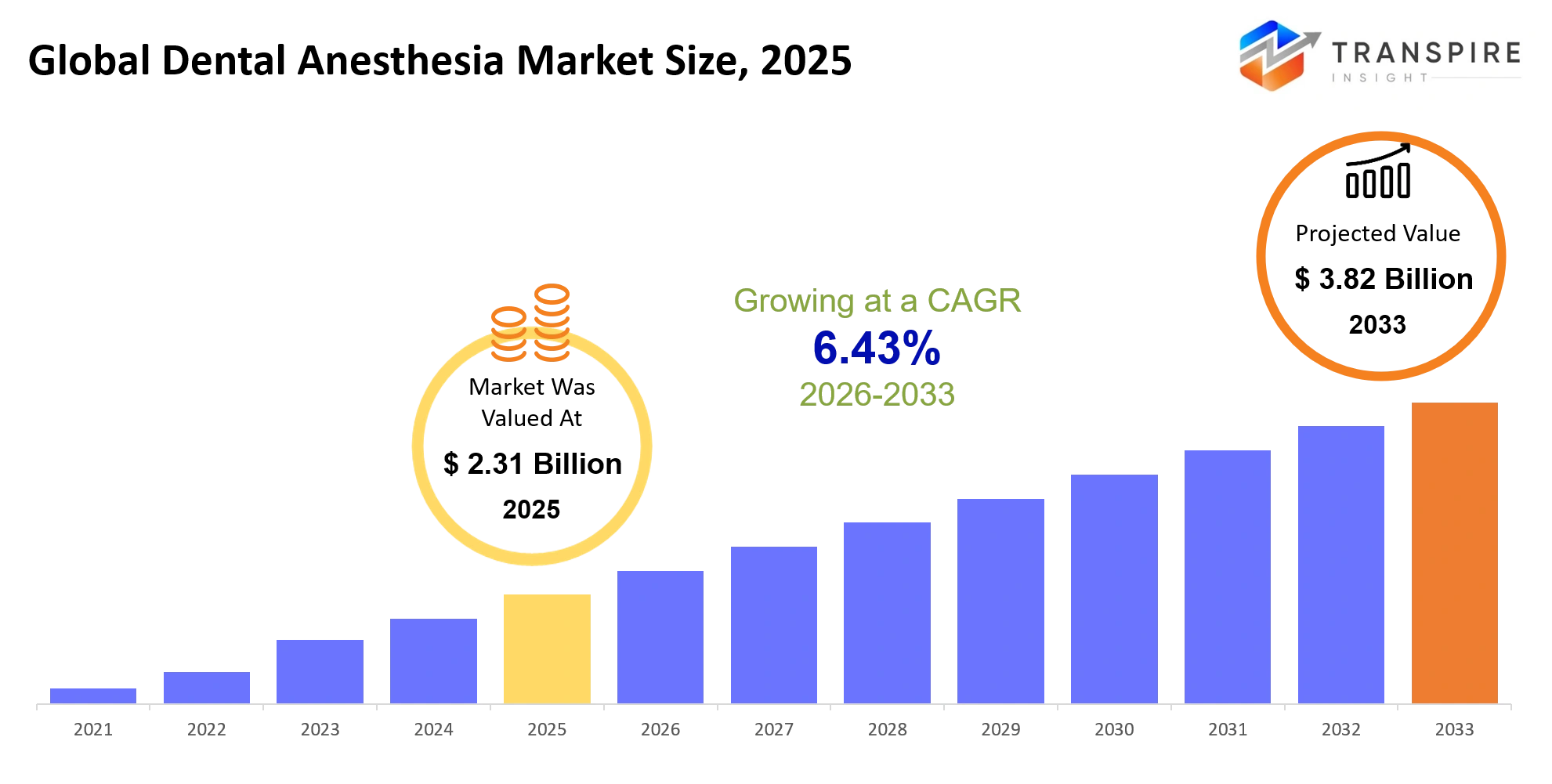
As per Transpire Insight Analysis, the Global Dental Anesthesia Market size is estimated at USD 2.31 Billion in 2025 and is anticipated to reach USD 3.82 Billion by 2033, growing at a CAGR of 6.43% from 2026 to 2033. These specialized pharmaceutical agents, ranging from topical gels to localized injectables, temporarily block nerve conduction to eliminate pain and manage patient anxiety during chair-side clinical procedures.
Over the last few years, the market has undergone a major structural shift driven by the rapid adoption of computerized local anesthesia delivery (C-CLAD) systems and a regulatory push for safer, fast-acting formulations. This shift was triggered by a surge in complex outpatient cosmetic restorations and intricate root canal therapies among an aging population - which require rapid-onset numbing with minimal post-operative tissue numbness. Consequently, demand is growing rapidly because modern dental clinics are systematically replacing traditional lidocaine lines with high-diffusion articaine options to accelerate patient turnaround times, reduce procedural complications, and maximize daily clinical throughput.
Key Market Insights:
The global dental anesthesia market has structurally shifted from broad-acting nerve blocks into rapid-onset, single-use targeted pain management therapies. Driven by soaring clinical volumes and strict infection control mandates, practices are replacing old delivery models with pre-filled safety cartridges to maximize patient turnaround times.
- Pulling 56% of all market revenue, tooth extraction stands as the absolute anchor of the industry; Septodont introduced advanced 4% articaine cartridges with specialized epinephrine to help oral surgeons achieve rapid, profound localized numbness and clean hemostasis.
- Growing at a commanding 12.9% CAGR, articaine-based anesthesia is actively replacing standard formulations; Dentsply Sirona expanded its premium injectable portfolio to provide practitioners with high-diffusion formulas that penetrate dense cortical bone far more effectively than legacy options.
- Controlling the largest volume with a 37% market share, North America relies on massive clinical infrastructure; Henry Schein deployed safety-engineered dental syringe distribution pipelines across the region to help private practices minimize accidental needle-stick risks.
- Advancing at an impressive 12.1% CAGR - Asia Pacific is a powerful value accelerator; GC Corporation launched advanced, localized single-use cartridge systems to help rapidly expanding dental clinic networks across India and China meet surging consumer demand for pain-free treatments.
- Capturing 15% of total revenue, root canal treatment brands are prioritizing lasting anesthetic reliability; Pfizer optimized its buffered local anesthetic architectures to ensure rapid, dependable pulpal numbness even in highly inflamed, low-pH tissue environments.
- Accounting for 10% of total demand, cosmetic dentistry is undergoing a major push toward rapid recovery; Pierrel Pharma engineered fast-reversing local anesthetic formulations that drastically cut post-treatment soft tissue numbness so patients can speak comfortably immediately after aesthetic smile restorations.
- Claiming 8% of the global market, dental surgery demands exceptional long-lasting pain control; Fresenius Kabi upgraded its long-acting bupivacaine glass cartridge frameworks to help specialized maxillofacial surgical centers maintain reliable, multi-hour post-operative pain barriers.
- Securing a steady 30% revenue block, Europe is focusing heavily on advanced clinical automation; Ivoclar Vivadent introduced computer-controlled local anesthesia delivery (C-CLAD) solutions to help European dental networks eliminate manual injection pressure variations.
- Taking up 11% of the global footprint, other localized applications are expanding; Cetylite Industries pushed its fast-acting 20% benzocaine topical gel variants to safely eliminate initial needle-insertion pain for sensitive pediatric and deep-scaling procedures.
- Comprising the remaining 8% global market share, the Rest of the World (ROW) relies heavily on affordable delivery solutions; Hikma Pharmaceuticals expanded its regional logistics networks to supply highly stable, cost-effective lidocaine safety cartridges for community health clinics.
What are the Key Drivers, Restraints, and Opportunities in the Global Dental Anesthesia Market?
Driver
The rising integration of specialized, high-diffusion pharmaceutical agents combined with automated delivery devices is aggressively expanding clinical market revenues. Severe clinical anxiety and fear of needle insertion have triggered a massive engineering push to replace standard, slow-acting manual block injections with precise intraosseous and computerized local anesthesia delivery (C-CLAD) systems. By utilizing advanced formulations like articaine, private dental practitioners achieve rapid-onset numbing that effectively penetrates dense cortical bone structures. This major technological adoption dramatically slashes patient waiting times, minimizes the risk of post-operative tissue injury, and significantly boosts daily patient throughput in high-volume clinics.
In September 2025, French medical device manufacturer Dentalhitec officially launched its QuickSleeper5 computer-guided dental anesthesia system in the United States after obtaining regulatory FDA clearance. This targeted commercial expansion provides oral surgeons with an advanced, electronic pen-style delivery mechanism that injects localized anesthetics directly into the spongy bone surrounding the tooth, delivering immediate, pain-free pulpal anesthesia while eliminating traditional facial numbness.
[https://dentalhitec.us/tag/fda/]
Restraint
The risk of systemic toxicity and serious cardiovascular complications remains a persistent structural bottleneck for steady pharmaceutical adoption. Most premium local dental anesthetics require precise combinations of vasoconstrictors like epinephrine to lengthen the duration of action and limit localized bleeding at the surgical site. However, because these agents can enter blood vessels and trigger sudden spikes in heart rate or blood pressure, they present severe biological liabilities for geriatric populations or individuals with pre-existing ischemic heart conditions. This permanent physiological restriction forces clinicians to carefully limit dosages or stick to less profound, non-epinephrine alternatives, slowing market growth within complex surgical settings.
Opportunity
An exceptional commercial growth window lies in the development and deployment of rapid-reversing pharmacological agents engineered explicitly for outpatient cosmetic dentistry and routine root canals. Integrating active enzyme-altering molecules or specialized subgingival recovery therapeutics directly into clinical workflows will allow dental practices to intentionally cut post-treatment soft tissue numbness times in half. This capability will unlock massive material volume demand across expanding corporate dental networks, especially within the fast-growing Asia Pacific region, by allowing busy professional patients to comfortably speak, eat, and resume their normal daily activities immediately following brief, chair-side aesthetic restorations.
What Has the Impact of Artificial Intelligence Been on the Global Dental Anesthesia Market?
To maximize patient safety and injection comfort, production teams and clinical providers are rapidly moving away from legacy, manual drug administration methods. Instead of relying solely on a clinician’s manual tactile feedback to evaluate structural tissue resistance, modern dental practices use intelligent software frameworks to automate precise fluid-delivery workflows. This shift cuts down on initial needle-insertion discomfort, letting computerized systems continuously stabilize localized flow rates.
On the clinical floor, machine learning models analyze multi-dimensional patient datasets to provide predictive decision support. When evaluating complex medical histories, diagnostic algorithms process anatomical bone structures and physiological vitals to map patient-specific toxicities before an injection occurs. This predictive capability allows dental surgeons to instantly customize epinephrine ratios or select specialized alternatives like buffered articaine for high-risk patients. Furthermore, automated delivery tracking platforms optimize dosing precision, dynamically adjusting the mechanical pressure of injectables to prevent painful local tissue distension during deep palatal blocks.
However, a major structural limitation is the field-specific data bottleneck. High-performing AI networks require massive amounts of precisely labeled, anonymous clinical training data. Because strict medical privacy laws restrict open data sharing among global dental chains, a lack of unified dataset standards often creates an accuracy gap in diverse, real-world surgical settings.
In January 2025, a comprehensive technical report tracking clinical advances in smart anesthesia monitoring demonstrated how machine learning-based predictive models optimize automated pre-operative risk stratification. This digital transition directly allows clinical medical systems to anticipate hemodynamic changes and refine automated drug-delivery workflows, systematically minimizing procedural patient complications without relying purely on manual clinical intuition.
[https://www.mdpi.com/journal/jcm/sections/Machine_Learning_Artificial_Intelligence_Clinical_Medicine]
Key Market Trends:
The global dental anesthesia market - transitioning from simple, commodity-grade pain blockers into a highly specialized, formulation-driven segment focused on precise delivery and fast patient recovery. Spurred by strict safety regulations on needle disposal and an enterprise-wide focus on maximizing room turnaround times, clinical providers are updating standard care paths with automated, safety-engineered injection protocols.
- For years - clinical teams relied on standard, slow-acting manual nerve blocks, but practices are now shifting to buffered lidocaine solutions to neutralize acidity and trigger immediate, near-painless pulpal numbness.
- Instead of dealing with prolonged, uncomfortable post-treatment tissue swelling, oral surgeons are actively choosing fast-reversing anesthetic agents to help outpatient cosmetic clients talk and chew normally within minutes of a procedure.
- Traditional multi-dose glass vials are rapidly being phased out across private clinics, replaced by modern single-use safety cartridges that incorporate built-in, passive needle-shielding mechanisms to permanently eliminate workplace needle-stick accidents.
- To minimize severe injection anxiety in pediatric care, dental practitioners are moving away from sharp initial needle sticks and adopting fast-acting topical cryogenic sprays that numb the oral mucosa in under two seconds.
- Surgical centers are discarding highly variable manual injection techniques in favor of pen-style, computer-controlled local anesthesia delivery (C-CLAD) systems that continuously stabilize fluid flow rates based on precise tissue resistance.
- Rather than sticking to traditional lidocaine options that struggle to penetrate thick bone, modern practices are heavily accelerating the use of 4% articaine formulations to achieve profound anesthesia via simple local infiltration.
- Dental clinics are moving away from basic, short-acting chemical combinations and are utilizing advanced natural polymer carriers, such as chitosan composites, to achieve controlled-release, multi-hour post-operative pain management.
- To bypass the cardiotoxic risks associated with systemic epinephrine absorption, product developers are aggressively transitioning toward safety-enhanced epinephrine combinations that isolate blood pressure surges during deep maxillofacial surgeries.
Global Dental Anesthesia Market Segmentation
By Type
Local anesthesia commands the largest volume across global pipelines because it forms the mandatory pain-blocking baseline for routine chair-side care. Conversely, sedation options and topical gels are expanding at the highest velocity due to rising clinical management of severe dental phobia. This division stems from a direct behavioral shift toward outpatient micro-procedures where complete unconsciousness is unnecessary, but rapid patient recovery is essential. General anesthesia remains a slower-growing segment reserved for complex, multi-hour maxillofacial reconstructions. Looking forward, pharmaceutical manufacturers must pivot toward engineering fast-onset formulations designed specifically to match electronic, pressure-controlled injection devices, bypassing manual needle resistance from day one.
By Application
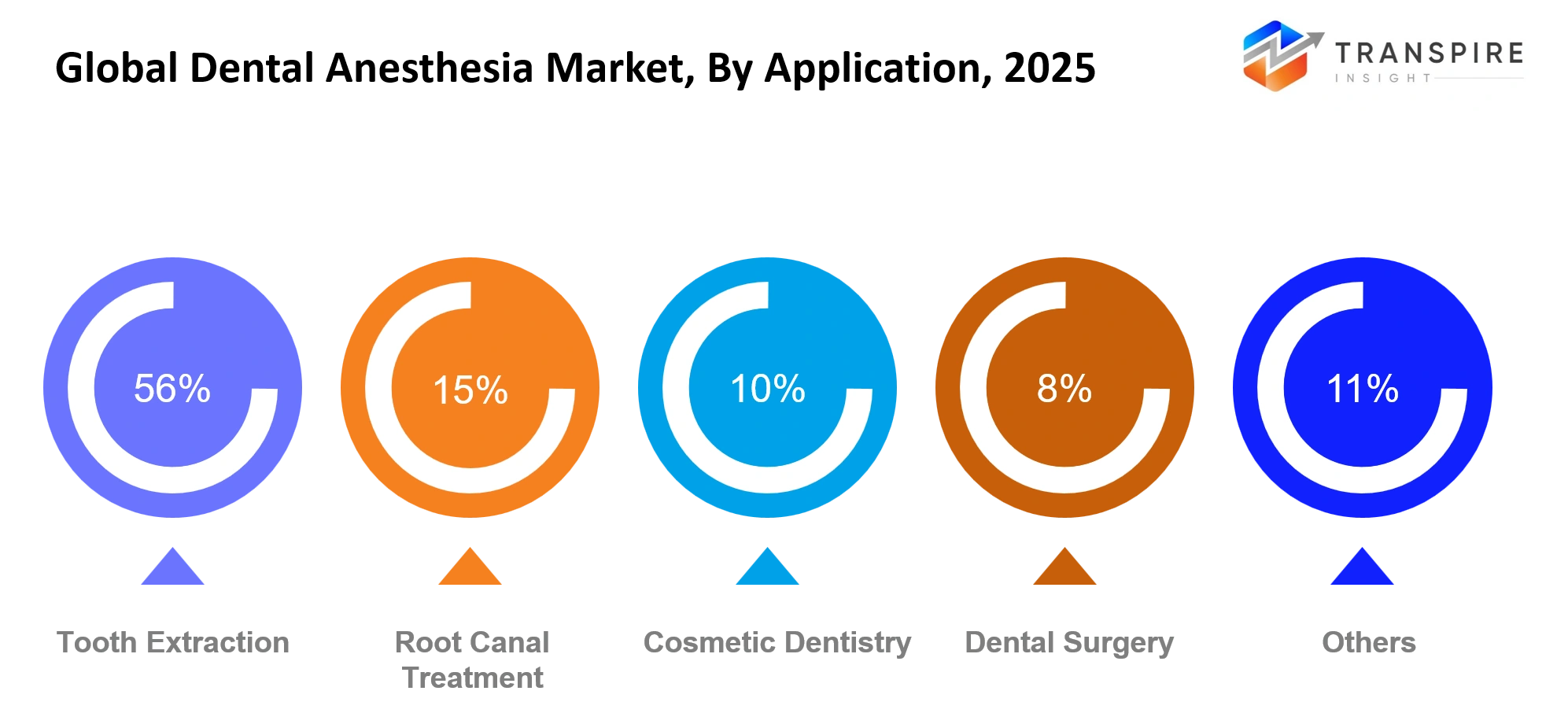
Tooth extraction acts as the absolute financial anchor of this industry, locking down a dominant 56% share of global revenue. Root canal treatments follow closely at 15%, with cosmetic dentistry claiming 10%, major dental surgery at 8%, and secondary clinical treatments covering the remaining 11%. Extractions retain this massive concentration because they represent the most common surgical intervention worldwide, requiring rapid-acting formulations to manage structural tooth failures. Growth is accelerating fastest across cosmetic and root canal streams as aging patient demographics demand single-visit restorations. This requires suppliers to execute a two-track strategy: delivering ultra-reliable, high-volume infiltration blocks for routine extractions while commercializing fast-reversing anesthetics tailored for high-end aesthetic clinics focused on instant post-treatment patient recovery.
By End-User
Private dental clinics generate the primary share of market procurement, while hospitals and regional academic institutes act as steady, secondary institutional consumers. Volume expansion across these networks relies on clinical room turnover speeds and zero-tolerance cross-contamination mandates. Private practices purchase massive quantities of single-use glass cartridges to feed fast patient rotations and protect chair-side profitability. Conversely, hospital surgical theaters handle higher-risk cases requiring extensive intraoperative monitoring and long-acting anesthetic blends like bupivacaine. To win market share, chemical suppliers cannot rely on selling basic chemical vials; they must deliver complete clinical packages that bundle raw cartridge shipments with safety-engineered syringes and specialized pediatric delivery setups.
By Drug Type
Lidocaine continues to serve as the historical volume anchor for routine care, but articaine-based anesthesia has emerged as the dominating and fastest-growing segment, expanding at a notable 12.9% CAGR. Bupivacaine and mepivacaine hold smaller, specialized niche shares dedicated to long-duration surgeries or epinephrine-free procedures. Articaine’s rapid ascent is driven by its high lipid solubility and superior bone-penetration properties, allowing dentists to skip painful palatal blocks via simple local infiltration. Private practices are aggressively prioritizing this rapid numbing to accelerate patient discharge timelines. Consequently, production pipelines are shifting entirely away from multi-dose configurations toward pre-buffered articaine safety cartridges designed to neutralize tissue acidity and establish instant pulpal numbness in infected oral environments.
What are the Key Use Cases Driving the Global Dental Anesthesia Market?
Routine tooth extractions account for the primary, high-volume workload across general practices. Dentists rely on single-use articaine or lidocaine safety cartridges to halt local nerve conduction, establishing the profound pulpal numbness and localized bleeding control required to pull multi-root teeth without causing patient distress.
More complex applications focus on treating highly sensitive nerve structures during root canals and smile reconstructions. Endodontists and cosmetic surgeons inject buffered anesthetic solutions to instantly counteract tissue acidity in infected sections - ensuring deep numbing so lengthy restorative procedures can finish without sudden breakthrough pain spikes.
Newer use cases involve integrating computerized, pressure-regulated delivery setups for anxious children and elderly patients. Clinicians choose these automated micro-infusions to perfectly balance fluid delivery with individual tissue resistance, cutting out initial needle trauma and lowering systemic toxicity risks during outpatient oral surgeries.
|
Report Metrics |
Details |
|
Market size value in 2025 |
USD 2.31 Billion |
|
Market size value in 2026 |
USD 2.47 Billion |
|
Revenue forecast in 2033 |
USD 3.82 Billion |
|
Growth rate |
CAGR of 6.43% from 2026 to 2033 |
|
Base year |
2025 |
|
Historical data |
2021 - 2024 |
|
Forecast period |
2026 - 2033 |
|
Report coverage |
Revenue forecast, competitive landscape, growth factors, and trends |
|
Regional scope |
United States; Canada; Mexico; United Kingdom; Germany; France; Italy; Spain; Denmark; Sweden; Norway; China; Japan; India; Australia; South Korea; Thailand; Brazil; Argentina; South Africa; Saudi Arabia; United Arab Emirates |
|
Key company profiled |
Dentsply Sirona, Septodont, 3M Healthcare, Henry Schein, Pfizer, AstraZeneca, Fresenius Kabi, Patterson Dental, Kulzer, GC Corporation, Ivoclar Vivadent, Pierrel Pharma, Cetylite Industries, Hikma Pharmaceuticals, Zeyco. |
|
Customization scope |
Free report customization (country, regional & segment scope). Avail customized purchase options to meet your exact research needs. |
|
Report Segmentation |
By Type (Local Anesthesia, General Anesthesia, Sedation Anesthesia, Topical Anesthesia, Injectable Anesthesia, Others); By Application (Tooth Extraction, Root Canal Treatment, Cosmetic Dentistry, Dental Surgery, Others); By End-User (Dental Clinics, Hospitals, Academic Institutes, Others); By Drug Type (Lidocaine, Articaine, Bupivacaine, Mepivacaine, Others). |
Which Regions are Driving the Global Dental Anesthesia Market Growth?
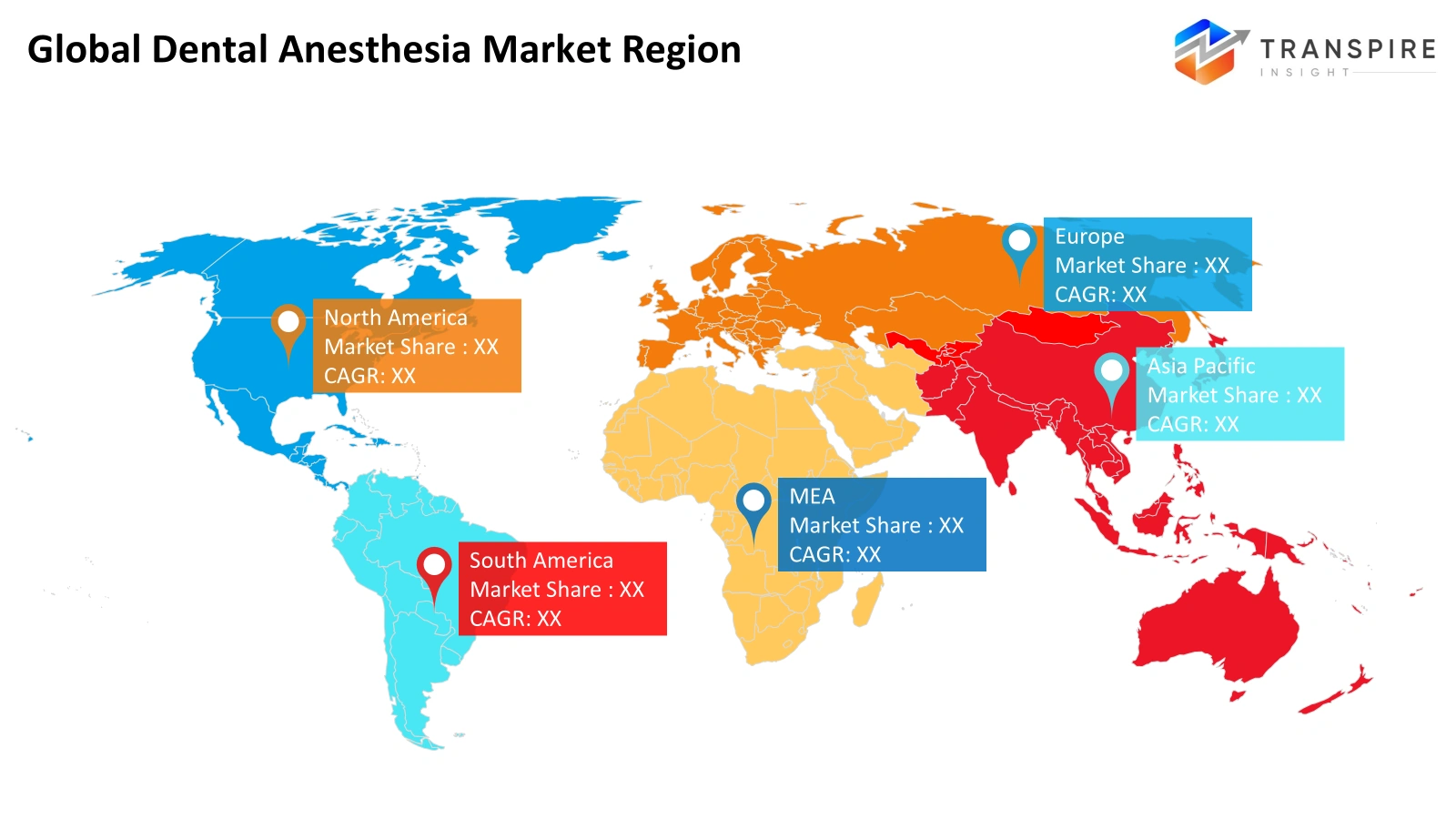
North America maintains a commanding grip on the global dental anesthesia market, locking down a dominant 37% share of global revenue. This strong market position is heavily driven by rigid OSHA clinical safety requirements and widespread occupational insurance policies that mandate the use of safety-engineered needle mechanisms. Private healthcare networks across the United States and Canada buy large volumes of single-use, pre-filled cartridges to mitigate accidental needle-stick risks during back-to-back patient rotations. Consequently, a stable institutional procurement system ensures steady, multi-million-dollar purchasing cycles regardless of short-term shifts in global raw material supply chains.
Europe serves as a highly stable, predictable value pillar for the market, capturing an established 30% share of global sales. While North American market dynamics are heavily shaped by strict needle-safety enforcement, European procurement focuses primarily on maximizing clinical room capacity and supporting unified public healthcare systems. Regional independent dentists and expanding corporate dental support organizations rely on long-term supply agreements to keep procedural costs stable across major countries like France and Germany. This structural integration insulates pharmaceutical sales channels from sudden volume shifts, as national insurance frameworks guarantee steady public access to basic extractions and endodontic treatments. In May 2026, France-based dental specialist Septodont demonstrated this regional stability after securing a stable corporate credit outlook backed by its extensive pain management portfolio and resilient localized operations. The company's well-balanced manufacturing footprint across seven global sites allows it to pass through inflationary costs effectively while maintaining predictable, multiyear contracts with European medical distributors.
The Asia-Pacific region is expanding faster than any other global territory, surging at a market-leading 12.1% CAGR to secure a 25% global market share. This powerful acceleration is driven by an unprecedented consumer pivot toward outpatient cosmetic smile designs and complex root canal therapies across emerging urban corridors. Rapidly expanding dental chains are actively discarding outdated, variable multi-dose chemical vials to meet surging patient demand for completely pain-free, Western-standard localized treatments. Looking ahead, future industry expansion in this corridor belongs entirely to suppliers that can mass-distribute fast-acting articaine cartridges that reduce patient waiting room bottlenecks and speed up overall clinical throughput. In August 2025, prominent dental supplier GC Corporation accelerated this regional growth track by establishing its massive fifth manufacturing plant at the Fuji Oyama complex to radically boost regional manufacturing capacity. This targeted infrastructure development directly allows the company to feed the skyrocketing demand for advanced, localized clinical solutions and high-efficiency dental therapeutics across rapidly modernizing Asian healthcare networks.
Who are the Key Players in the Global Dental Anesthesia Market and how do they Compete?
The global dental anesthesia market operates under a consolidated structure where specialized pharmaceutical developers actively compete against diversified medical device conglomerates. Market dynamics are transitioning away from price-driven competition over traditional lidocaine lines, shifting focus toward high-diffusion chemical formulations, localized buffering systems, and electronic injection automation.
Septodont implements a dedicated niche-containment strategy - anchoring its market footprint in specialized oral pain management and resilient manufacturing across seven worldwide sites. The company protects its position by expanding regional distribution networks and entering targeted technical ventures, including a June 2026 global commercialization partnership with Australian medtech startup Dentroid to advance its patented, needle-free Nuralyte light-energy anesthesia platform. Meanwhile, Dentsply Sirona utilizes an expansive clinical ecosystem strategy, integrating its specialized anesthetic portfolios like Oraqix periodontal gel directly into broad digital imaging and endodontic equipment accounts. This approach drives institutional account retention by supplying large dental support organizations with consolidated, single-source procurement contracts spanning early pain blocks through final tooth restoration.
Company List
- Dentsply Sirona
- Septodont
- 3M Healthcare
- Henry Schein
- Pfizer
- AstraZeneca
- Fresenius Kabi
- Patterson Dental
- Kulzer
- GC Corporation
- Ivoclar Vivadent
- Pierrel Pharma
- Cetylite Industries
- Hikma Pharmaceuticals
- Zeyco
Recent Development News
In June 2026, global dental pharmaceutical leader Septodont finalized a comprehensive development and commercialization partnership with digital health innovator Dentroid. This strategic medical alliance combines Septodont’s extensive pain management distribution pipelines with Dentroid's proprietary light-energy technology to pioneer non-invasive, needle-free local anesthesia alternatives for routine dental procedures.
Source: https://www.septodontcorp.com
In January 2026, computerized medical instrument developer Milestone Scientific Inc. officially launched its specialized Wand Ambassador Program across the global dental sector. This targeted peer-engagement initiative deploys expert clinical networks to accelerate corporate and private practice adoption of its patented, pressure-sensing electronic local drug delivery instruments.
Source: https://www.globenewswire.com
In January 2025, dental healthcare developers Septodont Inc. and Premier Dental announced the official commercial launch of their specialized BufferPro system. This product rollout provides clinical practitioners with an advanced chair-side buffering platform designed to neutralize anesthetic solution acidity, systematically eliminating initial injection discomfort while accelerating the onset of deep localized numbing.
Source: https://www.septodontusa.com
What Strategic Insights Define the Future of the Global Dental Anesthesia Market?
The market is rapidly transitioning toward a personalized, tech-driven ecosystem where clinical efficiency and patient comfort carry equal operational weight. Industry growth is migrating heavily from simple chemical blocks to smart, automated delivery systems that optimize fluid dynamics based on individual tissue density.
However, a critical hidden risk rests in the rising cost of clinical compliance and potential supply vulnerabilities for premium single-use glass cartridges. Regulatory crackdowns on plastic disposal and intensifying strictures on medical-grade glass tracking could severely pinch manufacturing margins for generic suppliers.
Conversely, an exceptional opportunity exists in commercializing localized, fast-reversing formulations specifically targeting the booming cosmetic and elective dental market. Manufacturers should strategically pivot from standard lidocaine blocks to co-developing bundled, buffered articaine safety arrays and automated injection pens. This integrated approach ensures deep, instant pulpal numbing while simultaneously speeding up outpatient turnaround times.
Key Segmentations are:
By Type
- Local Anesthesia
- General Anesthesia
- Sedation Anesthesia
- Topical Anesthesia
- Injectable Anesthesia
- Others
By Application
- Tooth Extraction
- Root Canal Treatment
- Cosmetic Dentistry
- Dental Surgery
- Others
By End-User
- Dental Clinics
- Hospitals
- Academic Institutes
- Others
By Drug Type
- Lidocaine
- Articaine
- Bupivacaine
- Mepivacaine
- Others
Regional Outlook
North America
- United States
- Canada
- Mexico
Europe
- Germany
- United Kingdom
- France
- Spain
- Italy
- Rest of Europe
Asia Pacific
- Japan
- China
- Australia & New Zealand
- South Korea
- India
- Rest of Asia Pacific
South America
- Brazil
- Argentina
- Rest of South America
Middle East & Africa
- Saudi Arabia
- United Arab Emirates
- South Africa
- Rest of the Middle East & Africa
Frequently Asked Questions
Find quick answers to common questions.
The global dental anesthesia market size was valued at USD 2.31 Billion in 2025 and is poised to reach USD 3.82 Billion by 2033, expanding at a 6.43% CAGR.
Key segments for the global dental anesthesia market are Type (Local Anesthesia, General Anesthesia, Sedation Anesthesia, Topical Anesthesia, Injectable Anesthesia, Others), Application (Tooth Extraction, Root Canal Treatment, Cosmetic Dentistry, Dental Surgery, Others), End-User (Dental Clinics, Hospitals, Academic Institutes, Others), and Drug Type (Lidocaine, Articaine, Bupivacaine, Mepivacaine, Others).
Growth is primarily driven by soaring clinical outpatient volumes, strict needle safety regulations to eliminate accidental needle-stick risks, rising demand for pain-free clinical care, and the rapid technological transition away from slow manual injections toward fast-acting, high-diffusion articaine cartridges and computer-controlled anesthesia systems.
The global market is led by major manufacturers including Dentsply Sirona, Septodont, 3M Healthcare, Henry Schein, Pfizer, AstraZeneca, Fresenius Kabi, Patterson Dental, Kulzer, GC Corporation, Ivoclar Vivadent, Pierrel Pharma, Cetylite Industries, Hikma Pharmaceuticals, and Zeyco.
North America holds a dominant 37% share of global revenue, heavily influencing market dynamics through rigid OSHA clinical safety requirements and strong occupational insurance policies that mandate safety-engineered needle delivery mechanisms, sustaining massive, predictable multi-dose cartridge procurement cycles across the region.
Significant opportunities exist in engineering fast-reversing, localized pharmacological formulations tailored to high-end cosmetic dentistry, developing pre-buffered cartridge structures that accelerate numbing onset in infected tissues, and scaling integrated distribution agreements that bundle raw injectable cartridges directly with automated electronic injection devices.
- Dentsply Sirona
- Septodont
- 3M Healthcare
- Henry Schein
- Pfizer
- AstraZeneca
- Fresenius Kabi
- Patterson Dental
- Kulzer
- GC Corporation
- Ivoclar Vivadent
- Pierrel Pharma
- Cetylite Industries
- Hikma Pharmaceuticals
- Zeyco
About the Authors

Pankaj Ghogare Patil
I am Pankaj Ghogare Patil, a Senior Research Analyst at Transpire Insight, specializing in the Pharmaceutical, Chemicals & Materials, Healthcare IT, and Biotechnology industry. My expertise lies in conducting comprehensive market research, analyzing industry trends, evaluating competitive landscapes, and translating complex data into actionable insights. At Transpire Insight, I closely follow emerging technologies, regulatory developments, and market innovations to create accurate, well-researched, and informative content that helps businesses and professionals make informed decisions. I am committed to producing credible, evidence-based articles that reflect industry best practices while making technical topics accessible and valuable for a broad audience.

Chakradhar Khansole
Chakradhar serves as the Research Director at Transpire Insight, bringing over 8 years of experience in technology, innovation, and strategic market intelligence. He specializes in transforming complex market data into actionable business insights that enable organizations to make informed, growth-oriented decisions. Recognized for his strategic vision and analytical expertise, Chakradhar leads high-impact research initiatives, delivering comprehensive market assessments, competitive intelligence, and forward-looking industry analysis.
Recently Published Reports
-
Apr 2026
AI in Diabetic Retinopathy Market
AI in Diabetic Retinopathy Market Size, Share & Analysis Report By Type (Screening AI Systems, Diagnostic AI Systems, and Predictive AI Models), By Application Segment (Hospitals, Ophthalmology Clinics, Diagnostic Centers, and Research and Development), and Geography (North America, Europe, Asia-Pacific, Middle East and Africa, South and Central America), 2021 - 2031
-
Apr 2026
Psychometric Tests Market
Psychometric Tests Market Size, Share & Analysis Report By Type (Personality Tests, Ability/Aptitude Tests, Skill/Knowledge Tests, and Others), By Application (Talent Acquisition and Talent Management), and Geography (North America, Europe, Asia-Pacific, Middle East and Africa, South and Central America), 2021 – 2031
-
Apr 2026
Rare Biological Sample Collection Market
Rare Biological Sample Collection Market Size, Share & Analysis Report By Type (Isolation Kits & Reagent, Blood Collection Tubes, and Others), By Application (Oncology, Transcriptomics, Pharmacogenomics, and Others), and Geography (North America, Europe, Asia-Pacific, Middle East and Africa, South and Central America), 2021 – 2031
-
Jul 2026
Diabetic Retinopathy Market
Diabetic Retinopathy Market Size, Share & Analysis Report By Type (Proliferative Diabetic Retinopathy, and Diabetic Macular Edema (DME)), By Treatment Type (Anti VEGF Drug, Steroid Implants, Laser Surgeries, and Vitrectomy), and Geography (North America, Europe, Asia-Pacific, Middle East and Africa, South and Central America), 2021 – 2031
Our Clients







