
Asia Pacific Hemoperfusion Cartridge Market Size & Forecast:
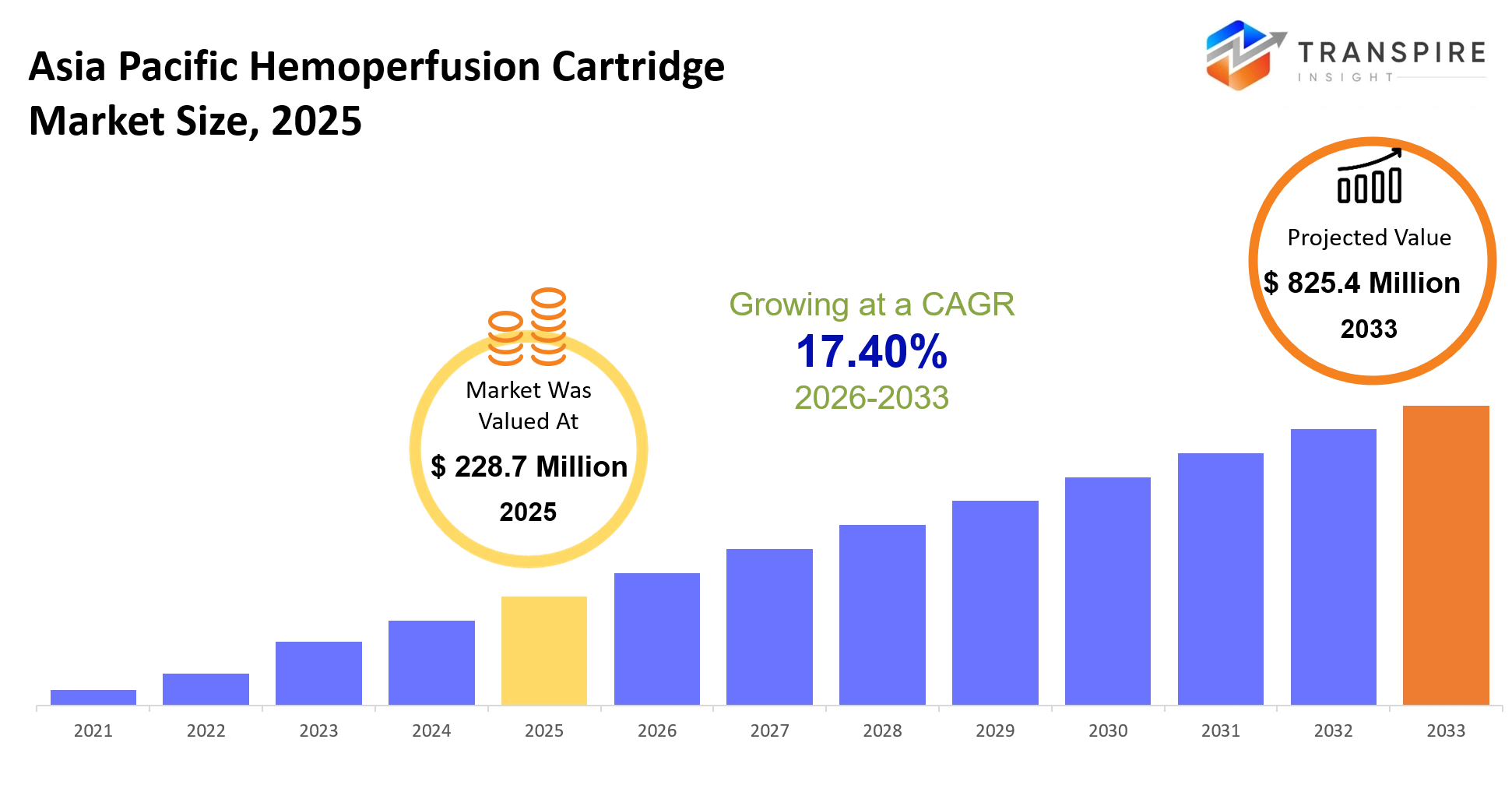
- Asia Pacific Hemoperfusion Cartridge Market Size 2025: USD 228.7 Million
- Asia Pacific Hemoperfusion Cartridge Market Size 2033: USD 825.4 Million
- Asia Pacific Hemoperfusion Cartridge Market CAGR: 17.40%
- Asia Pacific Hemoperfusion Cartridge Market Segments: By Product Type (Disposable Cartridges, Resin-based Cartridges, Charcoal Cartridges, Heparin-coated Cartridges, Others); By Application (Kidney Disorders, Liver Failure, Drug Poisoning, Sepsis Treatment, Others); By End User (Hospitals, Dialysis Centers, Specialty Clinics, Others)
To learn more about this report,  Download Free Sample Report
Asia Pacific Hemoperfusion Cartridge Market Summary
The Asia Pacific Hemoperfusion Cartridge Market was valued at USD 228.7 Millionin 2025. It is forecast to reach USD 825.4 Million by 2033. That is a CAGR of 17.40% over the period.
The Asia Pacific hemoperfusion cartridge market kind of sits at the center of critical care medicine, because clinicians can pull out toxins, inflammatory mediators, cytokines, and other harmful stuff directly from a patient’s bloodstream when things get really severe, like in sepsis, acute liver failure, drug poisoning, and even autoimmune complications. In practice, many hospitals are pairing these cartridges with dialysis and also continuous renal replacement therapy systems—so they can stabilize patients faster and aim for better results in intensive care units, you know.
In the past five years the market has moved away from only the usual toxin removal needs, and it’s been leaning more toward cytokine adsorption, plus multi organ support type therapies. During the COVID 19 pandemic, it kind of sped everything up faster then it would have otherwise. Hospitals began picking up blood purification technologies to handle intense inflammation, including those cytokine storms that show up in the nastier cases. The whole hands on clinical thing, it kind of helped physicians feel more confident about hemoperfusion not only for emergency poisoning, but also for wider inflammatory management. And because healthcare systems across China, India, Japan, and parts of Southeast Asia keep putting real funding into critical care capacity, hospitals are now folding advanced adsorption therapies into day to day treatment routines. This direction keeps pushing cartridge utilization rates higher, so you get steady recurring revenue from consumables, and at the same time it increases demand for more advanced blood purification systems that are technologically stronger.
Key Market Insights
- China really led the Asia Pacific Hemoperfusion Cartridge Market around 2025 with an estimated 38% share, and that’s mostly because of solid domestic manufacturing output, kind of a dependable base.
- India, on the other hand looks like the quickest riser through 2033, mainly from ICU expansion, more dialysis penetration, and higher levels of spending in critical care.
- When it comes to materials, resin based hemoperfusion cartridges made up close to 65% of market revenue in 2025, mostly tied to better adsorption efficiency and a wider range of clinical uses.
- Activated carbon cartridges stayed near the top as well, holding the second largest segment especially for poisoning and toxicology care workflows in emergency departments.
- For disease areas, sepsis plus critical care pulled in over 40% of total demand in 2025, because hospitals have been scaling up cytokine adsorption treatment programs.
- Liver failure treatment is showing up as the fastest-growing application segment, supported by greater uptake of bilirubin adsorption therapies after 2021.
- On the end user side, hospitals accounted for more than 70% of revenue, reflecting heavy use in intensive care and nephrology departments.
- Specialty critical care centers are also pushing growth, they’re adopting cartridges while combining hemoperfusion with continuous renal replacement therapy platforms, bit by bit.
- Key companies like Jafron Biomedical, Toray Medical, Asahi Kasei, Baxter, Fresenius Medical Care, and CytoSorbents keep improving their positions through technology development and broader regional reach.
- And there are strategic partnerships between device manufacturers and dialysis providers, which are helping product access and also speeding up physician training efforts across Asia Pacific.
What are the Key Drivers, Restraints, and Opportunities in the Asia Pacific Hemoperfusion Cartridge Market?
The main thing pushing market expansion is that hemoperfusion is being used more in sepsis care and in multi-organ support therapy,like it’s becoming more common clinically. The momentum really picked up after the COVID-19 phase, when a lot of hospitals across Asia put serious money into ICU capacity plus extracorporeal blood purification equipment. Doctors got real, hands-on know-how with adsorption therapies to deal with severe inflammatory reactions, so acceptance grew beyond the old idea that these methods are only for poisoning cases. And as more hospitals fold hemoperfusion into their critical care routines, cartridge use increases as well, since these products require regular replacement, which directly drives recurring revenue growth.
Still, the biggest brake is mostly the high cost of treatment, and also the patchy reimbursement coverage in several Asia Pacific healthcare systems. This isn’t just a temporary issue, it’s structural. reimbursement rules, clinician education, and hospital procurement structures often take years to catch up. Many secondary hospitals lack dedicated blood purification specialists or advanced monitoring capabilities. So use stays concentrated in bigger city medical centers. That kind of concentration limits how far the market can penetrate across wider healthcare networks, and it slows potential revenue expansion.
A big opportunity is the creation of precision adsorption technologies that are tuned for specific inflammatory markers and particular organ failure scenarios. Firms are investing in sophisticated sorbent materials, biocompatible coating systems, and even integrated blood purification platforms. China and India are starting to look like attractive places for investment, because healthcare modernization efforts are setting up conditions that may allow broader deployment of advanced hemoperfusion options.
What Has the Impact of Artificial Intelligence Been on the Asia Pacific Hemoperfusion Cartridge Market?
Artificial intelligence is slowly, almost quietly, reshaping blood purification therapy across many major hospitals in the Asia Pacific region, not just in a single way but in several overlapping steps like treatment planning and equipment monitoring, and, well, patient management too. In practice, healthcare providers are leaning more and more on AI-enabled clinical decision support tools that help spot patients with high risk of cytokine storms sepsis progression and acute organ failure. The systems typically sift through lab values, inflammatory biomarker patterns, and patient histories, kind of to help clinicians make faster calls while also trying to get more consistent cartridge utilization.
At the same time, machine learning models are getting plugged into critical care monitoring platforms to forecast treatment response, plus flag equipment maintenance needs before they turn into problems. Hospitals that use predictive analytics can time cartridge replacement in a more orderly fashion, which means fewer therapy interruptions and better overall treatment consistency. Meanwhile, advanced digital monitoring tools let clinicians watch how inflammatory marker reduction is trending, and whether the therapy seems effective in real time, which in turn supports compliance with intensive care protocols, at least more reliably than before.
From an operational point of view, these tools contribute to smoother ICU workflow efficiency, less equipment downtime, and better utilization of costly extracorporeal therapy equipment. Still, AI adoption is held back, somewhat, by fragmented clinical datasets, electronic medical records that don’t line up, and integration costs that are hard to swallow. A lot of facilities across developing Asia Pacific markets don’t yet have the digital infrastructure needed to fully support predictive blood purification analytics, so there’s a noticeable gap between what the technology could do and what actually happens day to day.
Key Market Trends
- Since 2021, hospitals have been widening their cytokine adsorption programs, partly because ICU adoption bedcame more common during the severe inflammatory and infectious disease perios you know, the usual.
- From 2022 to 2025 China-based manufacturers really pushed capacity upward, to cover both domestic demand and export expansion.
- Resin adsorption technologies also took a bigger slice of the market, since clinicians tended to prefer wider toxin elimination features instead of the older, conventional alternatives.
- Jafron Biomedical, in particular, expanded global clinical collaborations with more than 80 hospitals, which made physician uptake easier and also helped with evidence generation that feels more solid.
- Automated cartridge production lines lowered manufacturing defects to below industry averages, so scaling up became less messy and supply reliability improved.
- Integrated blood purification platforms, mixing hemoperfusion and dialysis functions, started getting more traction among tertiary care hospitals after 2023.
- By 2026, more than 100 PuriFi hemoperfusion pumps were deployed internationally, which supported the idea of easier therapy implementation.
- At the same time, clinical focus moved toward liver failure and septic shock use cases, because the outcome data kept building up and boosting physician confidence.
- Regional healthcare systems increased investment in extracorporeal therapy infrastructure after learning from pandemic driven ICU surges.
- And the strategic partnerships between blood purification specialists and dialysis providers… those sped up physician training and market penetration, quite noticeably.
Asia Pacific Hemoperfusion Cartridge Market Segmentation
By Product Type
Disposable Cartridges hold a meaningful share, because those single-use products help lower contamination risk, and they also align with tighter infection-control standards in healthcare settings. You can still see strong adoption in hospitals and dialysis centers which keeps demand steady, especially in critical care procedures where patient safety is the main point. Resin based cartridges also contribute a big chunk of the market revenue, since their adsorption performance stays solid and they get used across many different blood purification treatments.
Charcoal Cartridges stay in an important spot for poisoning and toxin removal routines, where fast adsorption really matters. Heparin coated Cartridges are getting more attention, because better blood compatibility can help reduce clot formation during those treatment sessions. The Others bucket covers specialized and advanced cartridge designs, made for more targeted clinical use, and that creates extra openings for product diversification. In turn, it also supports more treatment customization, sometimes in a pretty tailored way.
By Application
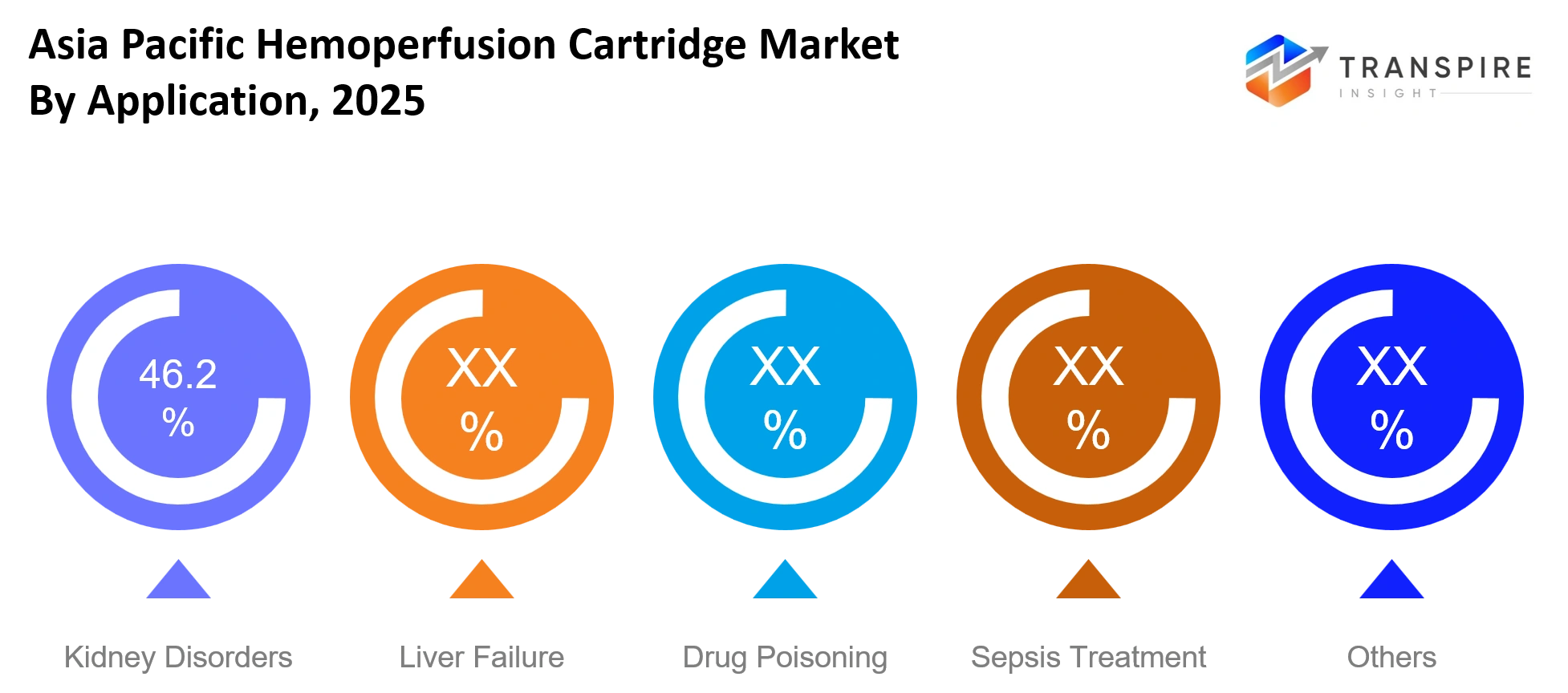
Kidney Disorders are a big application field, because blood purification treatments often help patients who have serious kidney troubles and toxin buildup, kinda all at once. Liver Failure treatment also adds real pressure to the market, since hemoperfusion tools help clear harmful substances that usual therapies might not handle very well. Drug Poisoning is still a well known use case, where getting toxins out quickly matters a lot in emergency medicine.
Sepsis Treatment keeps growing too, because more healthcare teams are adding adsorption based approaches into critical care plans for managing intense inflammatory reactions. Interest in cytokine removal methods has risen, so these cartridges are being used more often in intensive care units. The Others section includes autoimmune disorders, metabolic conditions, and extra therapeutic needs, which keep widening the overall clinical reach of blood purification technologies.
To learn more about this report, Download Free Sample Report
By End User
Hospitals take the biggest share, mostly due to advanced critical care infrastructure, specialized clinicians, and the ready availability of blood purification equipment that leads to steady cartridge use, and all that. Large healthcare institutions also carry out frequent, complicated workflows tied to sepsis management, liver support therapy, and urgent toxin removal. On top of that, ongoing spending into intensive care capacity keeps making hospital adoption feel more and more natural.
Dialysis Centers are another big end-user group too, because integrated care pathways are slowly (but surely) blending dialysis and hemoperfusion techniques, aiming for better patient results overall. Specialty Clinics help grow the market by running targeted treatment services for certain conditions, where advanced blood purification solutions are really needed. Then there’s the Others segment, which covers research facilities, ambulatory care providers, and niche medical centers that are still expanding the broader treatment scene.
What are the Key Use Cases Driving the Asia Pacific Hemoperfusion Cartridge Market?
The biggest use case is still sepsisand the critical care management inside intensive care units. Most hospitals lean on hemoperfusion cartridges to pull out inflammatory mediators and cytokines from the bloodstream, so clinicians can handle serious infections, septic shock,and multiple organ dysfunction. Honestly this is the case that makes cartridges get used the most, because very sick patients often end up needing repeated sessions, back to back.
Liver failure support and drug poisoning care are also getting taken up more widely in tertiary hospitals and emergency care centers. In nephrology unitsdoctors increasingly mix hemoperfusion with dialysis approaches, to boost toxin elimination efficiency, especially during complicated poisoning events and in metabolic disorder situations.
Newer uses are starting to show up too, like cytokine modulation for autoimmune disorders and more advanced organ support options that are delivered before transplantation. There is also active research into precision adsorption technologies that aim at specific inflammatory routes, and that kind of shift could open fresh treatment chances across both critical care and immunological disease management throughout the forecast period
|
Report Metrics |
Details |
|
Market size value in 2025 |
USD 228.7 Million |
|
Market size value in 2026 |
USD 268.5 Million |
|
Revenue forecast in 2033 |
USD 825.4 Million |
|
Growth rate |
CAGR of 17.40% from 2026 to 2033 |
|
Base year |
2025 |
|
Historical data |
2021 - 2024 |
|
Forecast period |
2026 - 2033 |
|
Report coverage |
Revenue forecast, competitive landscape, growth factors, and trends |
|
Regional scope |
Asia Pacific (India, China, Japan, Australia, South Korea, Rest of Asia Pacific) |
|
Key company profiled |
Baxter, Fresenius Medical Care, Toray Medical, Asahi Kasei, Jafron Biomedical, CytoSorbents, B. Braun, Nikkiso, Medtronic, Nipro, Kaneka, Biosun, Weigao Group, JMS Co., Kawasumi |
|
Customization scope |
Free report customization (country, regional & segment scope). Avail customized purchase options to meet your exact research needs. |
|
Report Segmentation |
By Product Type (Disposable Cartridges, Resin-based Cartridges, Charcoal Cartridges, Heparin-coated Cartridges, Others); By Application (Kidney Disorders, Liver Failure, Drug Poisoning, Sepsis Treatment, Others); By End User (Hospitals, Dialysis Centers, Specialty Clinics, Others) |
Which Regions are Driving the Asia Pacific Hemoperfusion Cartridge Market Growth?
China is still the main player across Asia Pacific, mostly because of its big patient basea wide hospital footprint, and a fairly robust domestic manufacturing ecosystem. Over the last years, national backing for critical care setups has pushed more people toward modern blood purification treatments in many big city healthcare sites. Local manufacturers can lean on high-scale production abilities, plus there are physician engagement efforts that keep momentum. Put together, this mix of manufacturing muscleday-to-day clinical uptake, and ongoing healthcare spending still keeps China in the leadership lane.
Japan sits in second place overall and it feels a bit different from China since it leans more on improved clinical protocols and premium healthcare tech. The country also has a mature dialysis ecosystemalong with long-term know-how in extracorporeal blood treatment frameworks. Japanese providers show steadier adoption patterns, backed by reimbursement pathways and regular technology refresh cycles. Firms like Toray Medical and Asahi Kasei keep reinforcing this by focusing on specialized adsorption technologies as well as clinical innovation.
India, meanwhile, is becoming the fastest growing regional market heading into 2033. The surge is driven by more intensive care facility growth, higher healthcare spend, and easier access to advanced nephrology care. Bigger private hospital networks are rolling out advanced blood purification programs that used to be restricted mostly to metro medical centers. That kind of momentum creates strong openings for manufacturers, distributorsand investors who want exposure to expanding critical care infrastructure across South Asia.
Who are the Key Players in the Asia Pacific Hemoperfusion Cartridge Market and How Do They Compete?
Competition is still somewhat concentrated, mostly among long standing blood purification specialists, dialysis technology providers, and a few emerging regional manufacturers. You can see that technology performance, adsorption efficiency, clinical evidence, and physician training support matter more now than pricing by itself. The big companies keep defending their market share with integration moves, while the regional names seem to lean harder into manufacturing scale and more localized distribution.
Jafron Biomedical sort of stands out due to large scale cartridge manufacturing, stronger adsorption materials and not a small number of hospital partnerships. They built a solid presence across Asia via clinical research collaborations and high volume production. Toray Medical is more focused on specialized adsorption technologies and it gets a boost from Japan’s advanced extracorporeal treatment ecosystem. Asahi Kasei leans on deep know how in blood purification membranes, and also on integrated therapy platforms which gives it a fairly strong position in high acuity care settings.
CytoSorbents pushes cytokine adsorption technologies and more integrated blood purification systems, like the PuriFi platform. The way they partner with dialysis providers helps extend clinical reach and it also makes physician adoption feel less “risky”. Fresenius Medical Care and Baxter, meanwhile benefit from wide renal care networks and long established hospital relationships, which helps them distribute more widely and fold hemoperfusion solutions into the existing critical care workflows without much friction.
Company List
- Baxter
- Fresenius Medical Care
- Toray Medical
- Asahi Kasei
- Jafron Biomedical
- CytoSorbents
- B. Braun
- Nikkiso
- Medtronic
- Nipro
- Kaneka
- Biosun
- Weigao Group
- JMS Co.
- Kawasumi
Recent Development News
In March 2026, CytoSorbents expanded international deployment of its PuriFi hemoperfusion pump and launched the HotSwap cartridge exchange system. The development improved workflow efficiency in intensive care settings and strengthened adoption of blood purification therapies.https://www.prnewswire.com
In 2025, CytoSorbents continued its global marketing collaboration with Fresenius Medical Care. The partnership expanded commercial promotion and integration of CytoSorb technology across critical care platforms, supporting broader international market penetration.https://cytosorbents.com
In June 2024 with continued scaling through 2025–2026, CytoSorbents launched the PuriFi advanced hemoperfusion pump across Europe and selected international markets. The platform simplified blood purification deployment and supported future cartridge utilization growth.https://www.sec.gov
What Strategic Insights Define the Future of the Asia Pacific Hemoperfusion Cartridge Market?
The Asia Pacific hemoperfusion cartridge market seems to be drifting toward broader integration inside critical care pathwaysinstead of staying as some kind of niche detoxification therapy. The main push behind this shift is the steadily growing pile of clinical evidence that backs cytokine adsorption, plus multi organ support use cases. Since hospitals are trying to handle sepsis, liver failure, and inflammatory disorders more effectively, repeat cartridge utilization could turn into a very solid revenue driver, not just a temporary thing.
There’s also a quieter risk though, a sort of market concentration issue where only a handful of specialized adsorption materials and manufacturing capabilities really matter. If supply gets interrupted, or if regulatory hurdles hit the big producersit could trigger pricing swings and cause procurement delays across entire healthcare systems.
On the upside, there’s an emerging opening in precision hemoperfusion technologies—these aim at particular inflammatory biomarkers and disease pathways. Firms that place bets early on clinically proven, indication specific cartridges may collect noticeable advantages. Market participants should keep focusing on physician education, build regional clinical research collaborations, and offer integrated therapy platforms, because that combination can help adoption and also protect long term competitiveness.
Asia Pacific Hemoperfusion Cartridge Market Report Segmentation
By Product Type
- Disposable Cartridges
- Resin-based Cartridges
- Charcoal Cartridges
- Heparin-coated Cartridges
- Others
By Application
- Kidney Disorders
- Liver Failure
- Drug Poisoning
- Sepsis Treatment
- Others
By End User
- Hospitals
- Dialysis Centers
- Specialty Clinics
- Others
Frequently Asked Questions
Find quick answers to common questions.
The expected Asia Pacific Hemoperfusion Cartridge Market size for the market will be USD 825.4 Million in 2033.
Key segments for the Asia Pacific Hemoperfusion Cartridge Market are By Product Type (Disposable Cartridges, Resin-based Cartridges, Charcoal Cartridges, Heparin-coated Cartridges, Others); By Application (Kidney Disorders, Liver Failure, Drug Poisoning, Sepsis Treatment, Others); By End User (Hospitals, Dialysis Centers, Specialty Clinics, Others)
Major Asia Pacific Hemoperfusion Cartridge Market players are Baxter, Fresenius Medical Care, Toray Medical, Asahi Kasei, Jafron Biomedical, CytoSorbents, B. Braun, Nikkiso, Medtronic, Nipro, Kaneka, Biosun, Weigao Group, JMS Co., Kawasumi
The Asia Pacific Hemoperfusion Cartridge Market size is USD 228.7 Million in 2025.
The Asia Pacific Hemoperfusion Cartridge Market CAGR is 17.40% from 2026 to 2033.
- Baxter
- Fresenius Medical Care
- Toray Medical
- Asahi Kasei
- Jafron Biomedical
- CytoSorbents
- B. Braun
- Nikkiso
- Medtronic
- Nipro
- Kaneka
- Biosun
- Weigao Group
- JMS Co.
- Kawasumi
About the Authors

Pankaj Ghogare Patil
I am Pankaj Ghogare Patil, a Senior Research Analyst at Transpire Insight, specializing in the Pharmaceutical, Chemicals & Materials, Healthcare IT, and Biotechnology industry. My expertise lies in conducting comprehensive market research, analyzing industry trends, evaluating competitive landscapes, and translating complex data into actionable insights. At Transpire Insight, I closely follow emerging technologies, regulatory developments, and market innovations to create accurate, well-researched, and informative content that helps businesses and professionals make informed decisions. I am committed to producing credible, evidence-based articles that reflect industry best practices while making technical topics accessible and valuable for a broad audience.

Chakradhar Khansole
Chakradhar serves as the Research Director at Transpire Insight, bringing over 8 years of experience in technology, innovation, and strategic market intelligence. He specializes in transforming complex market data into actionable business insights that enable organizations to make informed, growth-oriented decisions. Recognized for his strategic vision and analytical expertise, Chakradhar leads high-impact research initiatives, delivering comprehensive market assessments, competitive intelligence, and forward-looking industry analysis.
Recently Published Reports
-
Apr 2026
AI in Diabetic Retinopathy Market
AI in Diabetic Retinopathy Market Size, Share & Analysis Report By Type (Screening AI Systems, Diagnostic AI Systems, and Predictive AI Models), By Application Segment (Hospitals, Ophthalmology Clinics, Diagnostic Centers, and Research and Development), and Geography (North America, Europe, Asia-Pacific, Middle East and Africa, South and Central America), 2021 - 2031
-
Apr 2026
Psychometric Tests Market
Psychometric Tests Market Size, Share & Analysis Report By Type (Personality Tests, Ability/Aptitude Tests, Skill/Knowledge Tests, and Others), By Application (Talent Acquisition and Talent Management), and Geography (North America, Europe, Asia-Pacific, Middle East and Africa, South and Central America), 2021 – 2031
-
Apr 2026
Rare Biological Sample Collection Market
Rare Biological Sample Collection Market Size, Share & Analysis Report By Type (Isolation Kits & Reagent, Blood Collection Tubes, and Others), By Application (Oncology, Transcriptomics, Pharmacogenomics, and Others), and Geography (North America, Europe, Asia-Pacific, Middle East and Africa, South and Central America), 2021 – 2031
-
Jul 2026
Diabetic Retinopathy Market
Diabetic Retinopathy Market Size, Share & Analysis Report By Type (Proliferative Diabetic Retinopathy, and Diabetic Macular Edema (DME)), By Treatment Type (Anti VEGF Drug, Steroid Implants, Laser Surgeries, and Vitrectomy), and Geography (North America, Europe, Asia-Pacific, Middle East and Africa, South and Central America), 2021 – 2031
Our Clients







