

Global Construction ERP Software Market Summary:
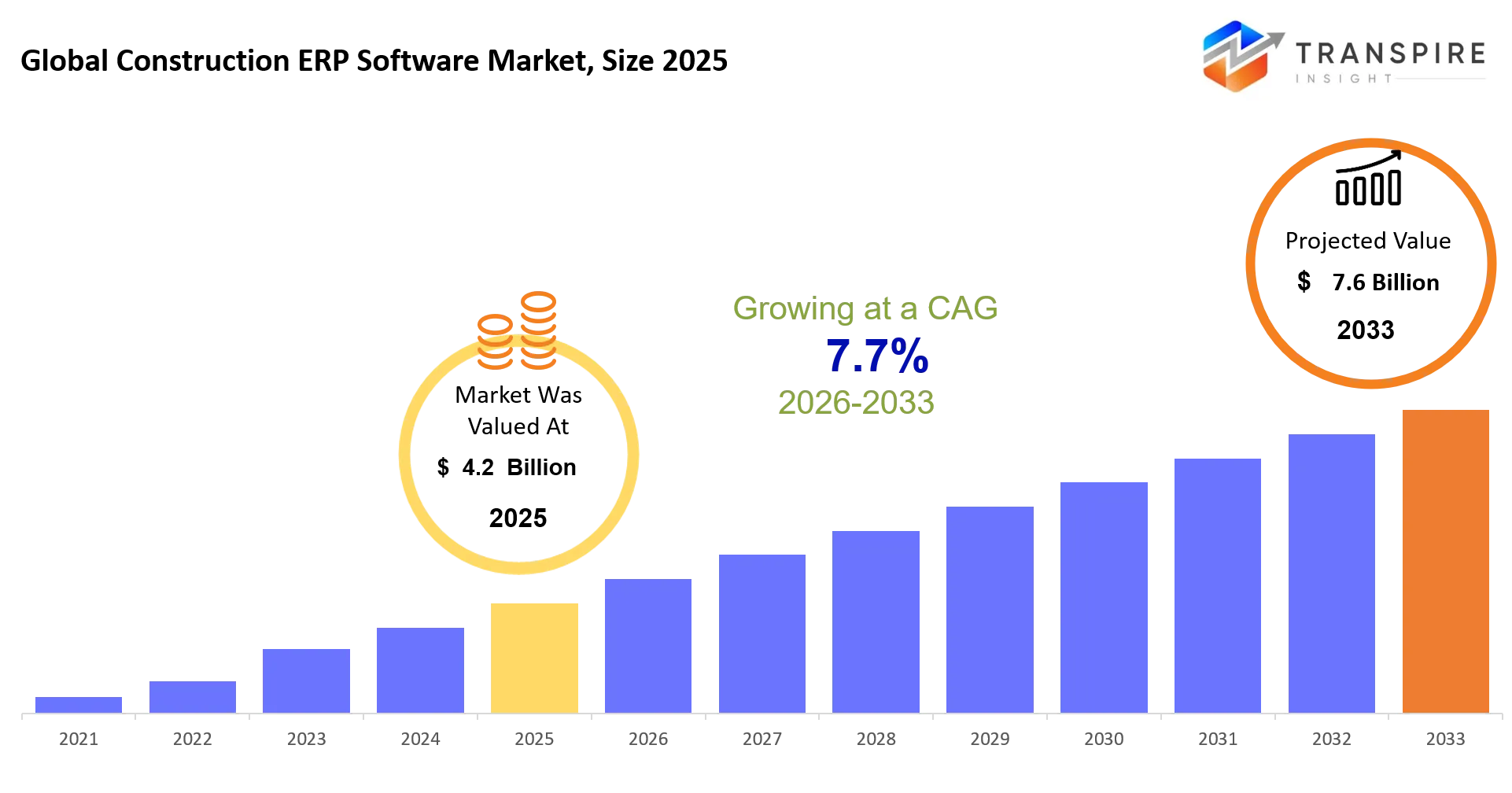
As per Transpire Insight Analysis, the Global Construction ERP Software Market size is estimated at USD 4.2 billion in 2025 and is anticipated to reach USD 7.6 billion by 2033, growing at a CAGR of 7.7% from 2026 to 2033. The market growth driver is the rising use of cloud-based ERP solutions in the construction sector.
The Global Construction ERP Software Market is really taking off because construction companies are using platforms to manage their projects. They use these platforms to plan, budget, buy things, coordinate workers, and follow rules all in one place. In the past few years, the industry has moved away from traditional software that you have to install on your own computers. Now they use cloud-based ERP solutions. This helps companies work together better, get information about their projects away, and work from different job sites.
The construction industry is also using tools more and more. They are using something called Building Information Modelling or BIM for infrastructure projects. This has made the switch to cloud-based ERP solutions happen faster. As construction projects get more complicated and need data, businesses are investing in ERP platforms. They want to work efficiently, avoid delays, have better control over money and make decisions faster. This is creating a lot of demand for global construction ERP software. Construction companies are looking for ERP software that can help them with all these things, which's why the Global Construction ERP Software Market is doing so well.
Global Construction ERP Software Market Size & Forecast:
- Global Market Size 2025: USD 4.2 Billion
- Expected Market Value (2033): USD 7.6 Billion
- Forecast CAGR (2026–2033): 7.7%
- Leading Region in 2025: North America
- Fastest Growing Region: Asia Pacific
- Key Company Profiles: Oracle, SAP, Microsoft, Infor, Trimble, Procore, Autodesk, Viewpoint, Sage, Deltek, IFS, Acumatica, Epicor, CMiC, Jonas Construction Software
Key Market Insights:
Global Construction ERP Software Market dynamics are changing since more contractors prefer software solutions that are able to integrate different systems for improved project transparency, financial performance, and operational efficiency. Cloud computing and intelligent automation are continuing to revolutionise software adoption in the construction industry.
- Cloud-based ERP constitutes 44% of the total market share, with ERP suppliers developing secure cloud infrastructure offering real-time collaboration and centralisation of project-related information.
- ERP with AI is the fastest-growing market segment, expected to grow at a CAGR of 19.2% due to the implementation of predictive analytics, workflow optimisation, and intelligent reports.
- Project Management occupies 18% of the total market share since there is an increased focus on digital scheduling, resource planning, and project management solutions.
- Financial Management is estimated at 14% due to higher demand for budgeting, cost tracking, and regulatory compliance features.
- Procurement Management makes up 10% of the market owing to improved supplier management and digital procurement solutions.
- BIM integration takes 8% of market demand since construction companies increasingly use design data to facilitate project management.
- Contract management comprises 4% of the market share since there is an increased adoption of digital documentation, approvals, and contract compliance.
- Other ERP functionalities make up the balance of 2% of market share.
What are the Key Drivers, Restraints, and Opportunities in the Global Construction ERP Software Market?
Drivers
Increasing digitalisation in the construction industry is a key driver of growth in the construction ERP software market. Increasing project complexity, the need for better budget monitoring, and collaboration requirements led industry stakeholders to abandon scattered software solutions in favour of more unified ERP platforms. The development of cloud computing and the use of Building Information Modelling (BIM) have only sped up this process and made it possible to enhance planning, resource allocation, efficiency, and avoid possible delays or cost overruns.
Restraints
Nevertheless, the adoption of ERP systems remains difficult for a number of reasons. Implementation of an entire solution presupposes a significant financial and technological investment as well as training of the employees. Moreover, small and medium-sized construction companies may lack resources, and fears about data migration, cyber security, and other aspects of change management slow down adoption of ERP in some markets.
Opportunities
The market has several opportunities due to the evolution of artificial intelligence, predictive analytics, and mobile ERP systems. These technologies assist construction firms in identifying risks associated with projects, automating operations, and making decisions based on timely data. The growing interest in investing in smart infrastructure, public construction projects, and digital construction projects in emerging economies can provide fresh opportunities for ERP software vendors to gain a global market foothold.
What Has the Impact of Artificial Intelligence Been on the Global Construction ERP Software Market?
AI has emerged as an essential technological aspect of the construction ERP software industry through enhanced project planning, monitoring, and execution. Advanced ERP software makes use of artificial intelligence in automating tedious activities like invoicing, documentation verification, procurement planning, and workforce allocation, thereby making construction business operations more efficient and productive. Artificial intelligence analytics also analyse past and current information about construction projects for the purpose of predicting budget overruns, scheduling errors, maintenance of machinery and equipment, and resource scarcity issues.
The ability to predict future events has greatly influenced the decision-making process of contractors by helping them make early detection of risks and optimising material procurement, labour distribution, and project timelines. Artificial intelligence dashboards help project managers gain insight into their activities, which enables them to act swiftly when conditions change in order to improve their cost management. In general, better efficiency, collaboration, and completion rates are being achieved by construction firms owing to the integration of AI in ERP software. However, there are some difficulties associated with the adoption of AI due to the high costs involved in such initiatives as well as compatibility issues and data quality problems faced by many organisations. In March 2026, Oracle launched Oracle Construction and Engineering Advisor for Safety, which is an AI-driven predictive intelligence application to help construction companies predict possible safety incidents, understand project risks, and take preventive actions in advance. The solution is powered by AI models trained on the construction industry and built on more than 10,000 project-years of construction experience.
Key Market Trends:
The construction ERP software market is evolving towards intelligent cloud-based software solutions that facilitate streamlined project implementation and foster collaboration in construction ecosystem networks. Automation, mobility, and data-driven capabilities are becoming the core features of today's software solutions to satisfy the demands of the construction industry.
- Construction firms are switching from multiple software tools to ERP solutions to boost collaboration among project teams, accounting departments, and construction sites.
- Cloud-based ERP implementations have become dominant, offering secure access to the software remotely, faster software updates, and scalability options for multiple-location projects.
- AI technologies are increasingly embedded in ERP systems for automating routine operations, early identification of potential project risks, and accelerating decision-making processes.
- The use of mobile ERP solutions is gaining momentum and enables engineers, managers, and superintendents to work with project data from construction locations.
- The BIM integration capabilities of the ERP vendors are improving to enhance collaboration during design, visualise the project, and increase construction planning precision.
- Data analytics functionalities are developing for the purpose of monitoring project performance, controlling costs, and optimising resource usage.
Global Construction ERP Software MarketSegmentation
By Deployment
Cloud-based ERP dominates the market with a 44% market share owing to its flexible nature, reduced cost infrastructure, and the ability to facilitate real-time collaboration for construction projects from different sites. More and more firms are opting for cloud deployment due to its ease of software maintenance and remote accessibility capabilities. Hybrid ERP and SaaS ERP are gaining popularity among organisations looking to have scalable software solutions, and AI-based ERP solutions are the fastest-growing segment with an estimated CAGR of 19.2%.
By Module
As far as module classification goes, Project Management is currently dominating the market with an 18% market share, indicating the increased emphasis on using technology to plan, schedule and coordinate project resources. Financial Management is the second largest module, making up 14% of the market share as budgeting, costing and accounting become the priorities for most firms. Procurement Management is the third largest module, comprising 10% of market share, driven by increasing necessity for efficient procurement process management. BIM Integration is responsible for 8% of market share, facilitating increased collaboration between the design and execution sides of projects. Contract Management is the smallest segment, making up only 4% of market share.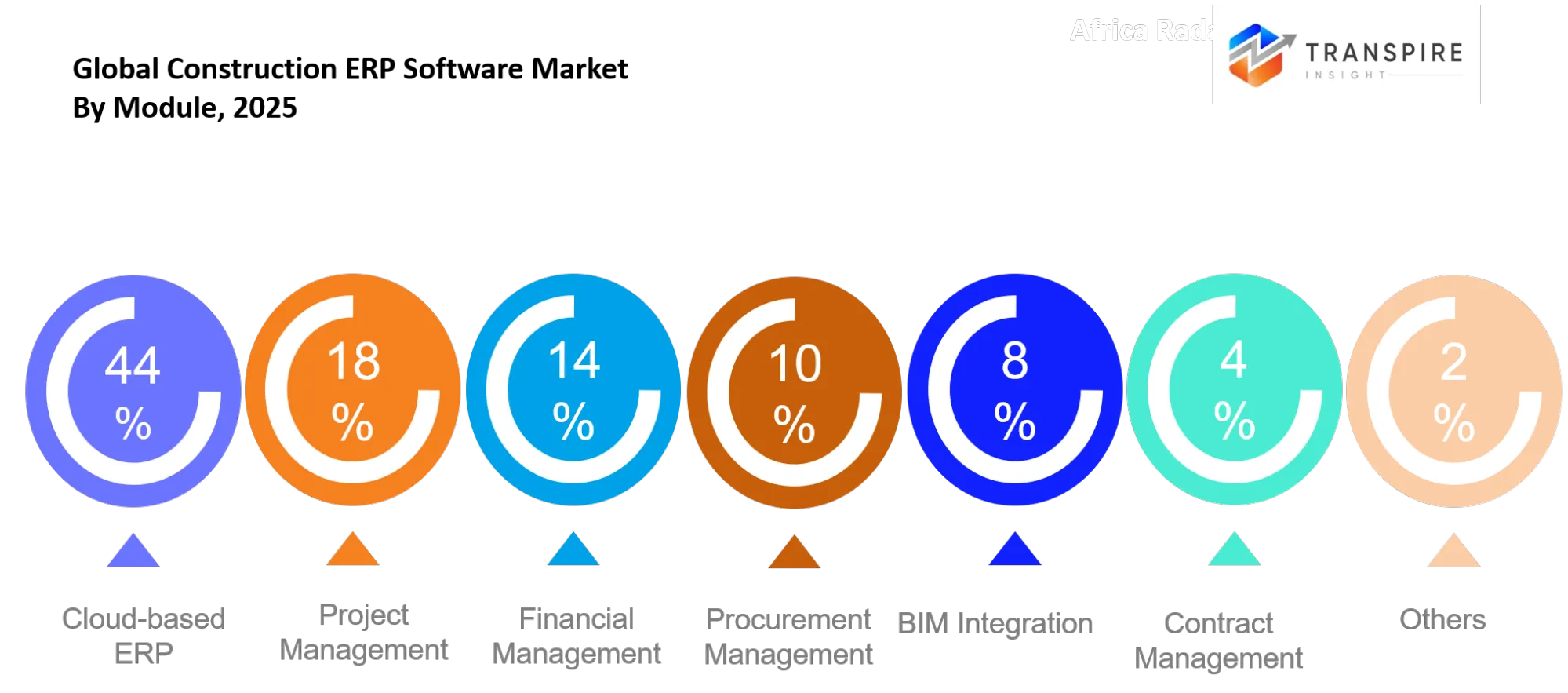
By Enterprise Size
Based on enterprise size, it can be seen that large enterprises will create the maximum demand for ERP systems as they have to manage complex projects spread out over several locations. Large enterprises need centralised control over finance, purchasing, labour force and project implementation. Medium enterprises are increasing ERP investment to increase their operational efficiency and compete with other enterprises. Small enterprises are moving towards adopting cloud-based ERP solutions owing to their reduced cost of adoption. Contractors for the government sector, infrastructure development companies, EPC companies, and real estate development companies are also adopting ERP.
By End User
Commercial and infrastructure construction companies will be the major adopters of ERP solutions because of the complexity involved in managing big projects and the need for proper management of projects in these organisations. Residential constructors will be increasingly adopting ERP solutions as well because of the need to have good cost management and project scheduling. Industrial construction companies are increasingly depending on the use of digital solutions for the purpose of asset management and compliance management.
By Application
Project planning and costing still form the backbone of ERP implementation, as they help companies to be more precise with their budgeting and execute tasks efficiently. There is increasing demand for such ERP modules as employee management, asset tracking, and compliance management, which facilitate operational processes and make reporting easier. As construction companies move towards digital connectivity, contract management and BIM are becoming increasingly important, and the use of advanced ERP systems with the help of artificial intelligence should boost productivity and performance even further.
What are the Key Use Cases Driving the Global Construction ERP Software Market?
Cloud ERP software is the most popular deployment type, which is often used for the management of project planning, budgeting, procurement, scheduling, and financial activities using one central system. It enhances cooperation between office staff and construction site employees as well as allows tracking of project performance in real time. Construction enterprises are also increasing the use of ERP systems in such areas as workforce management, inventory management, document management, contract management, and BIM integration. It can help automate some processes, increase compliance with regulations and improve coordination of activities during project realisation.
Use cases that have become more popular recently are the prediction of the future state of projects by using artificial intelligence, predictive equipment maintenance, risk assessment, and field management through mobile devices. With the development of digital construction methods, ERP platforms have become vital for improving efficiency, managing costs and making decisions faster.
|
Report Metrics |
Details |
|
Market size value in 2025 |
USD 4.2 Billion |
|
Market size value in 2026 |
USD 4.5 Billion |
|
Revenue forecast in 2033 |
USD 7.6 Billion |
|
Growth rate |
CAGR of 7.7% from 2026 to 2033 |
|
Base year |
2025 |
|
Historical data |
2021 - 2024 |
|
Forecast period |
2026 - 2033 |
|
Report coverage |
Revenue forecast, competitive landscape, growth factors, and trends |
|
Regional scope |
United States; Canada; Mexico; United Kingdom; Germany; France; Italy; Spain; Denmark; Sweden; Norway; China; Japan; India; Australia; South Korea; Thailand; Brazil; Argentina; South Africa; Saudi Arabia; United Arab Emirates |
|
Key company profiled |
Oracle, SAP, Microsoft, Infor, Trimble, Procore, Autodesk, Viewpoint, Sage, Deltek, IFS, Acumatica, Epicor, CMiC, Jonas Construction Software |
|
Customization scope |
Free report customization (country, regional & segment scope). Avail customized purchase options to meet your exact research needs. |
|
Report Segmentation |
By Deployment (Cloud-based ERP, On-premise ERP, Hybrid ERP, SaaS ERP, Mobile ERP, AI-enabled ERP, Integrated ERP Platforms, Others); By Module (Project Management, Financial Management, Procurement Management, Inventory Management, Human Resource Management, Equipment Management, Document Management, Others); By Enterprise Size (Large Enterprises, Medium Enterprises, Small Enterprises, Government Contractors, Infrastructure Developers, EPC Companies, Real Estate Developers, Others); By End User (Residential Construction, Commercial Construction, Industrial Construction, Infrastructure Projects, Engineering Firms, Government Agencies, Facility Management Companies, Others); By Application (Project Planning, Cost Estimation, Contract Management, Workforce Management, Asset Tracking, Compliance Management, BIM Integration, Others) |
Which Regions are Driving the Global Construction ERP Software Market Growth?
North America
North America dominates the construction ERP software market in terms of global market share, occupying 42% of the entire market share. North America's dominance is attributed to high digital transformation within the construction industry, high use of cloud-based enterprise software and smart infrastructure projects. The big construction companies keep investing in ERP systems in order to enhance project management, financial control, and compliance with regulations. The existence of software providers and continuous innovations also contribute to North America's dominance.
Europe
Europe occupies 26% of the global market and enjoys stability due to sustainability initiatives in construction, strict regulations, and digital project management practices. ERP systems have been widely implemented by construction companies to help improve operations, document management, and management of cross-border projects. More adoption of Building Information Modelling (BIM) and digitalisation processes encourages the adoption of ERP systems. Infrastructure projects are still being undertaken commercially and publicly in Europe.In February 2026, IFS introduced new artificial intelligence-based features for IFS Cloud that help construction and engineering companies enhance their project management, asset management, and field service operations throughout Europe, contributing to digital transformation in the construction industry.
Asia Pacific
The Asia Pacific region is 24% of the world market share and is estimated to have the highest CAGR of 20.1%. The increase in urbanisation, infrastructural development, and investment in construction activities in developing countries is driving the adoption of ERP software in the region. Organisations are moving towards cloud-based and AI-powered systems to help them execute projects better and manage resources effectively. In contrast, Latin America constitutes 3% of the total market share, while the Middle East & Africa make up 5% of the market share.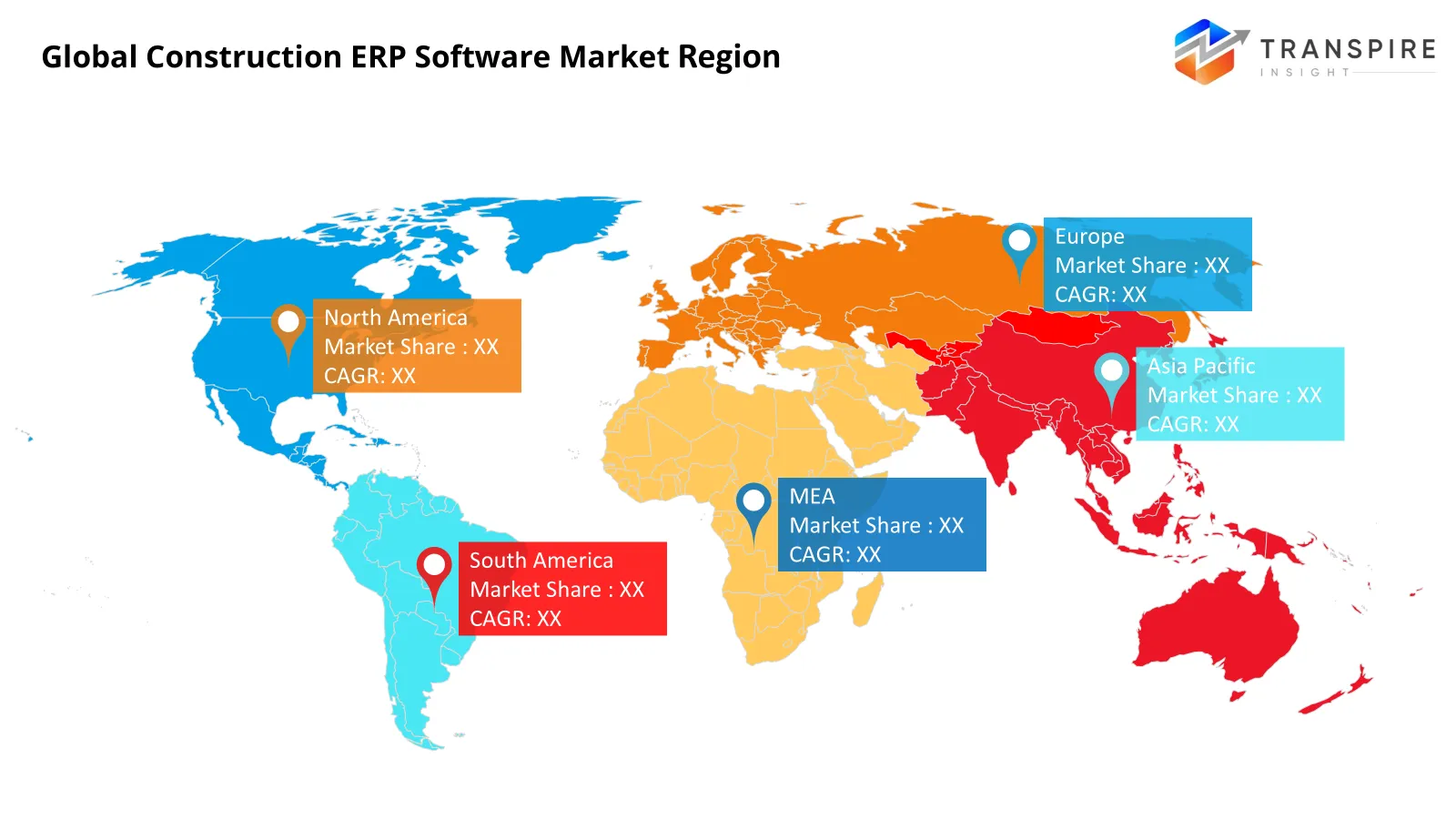
Who are the Key Players in the Global Construction ERP Software Marketand how do they Compete?
The competition in the international construction ERP software industry results from constant innovation, the adoption of cloud technology, and industry-tailored digital solutions. The players are reinforcing their market positions by adding AI capabilities, constructing more integrative solutions with construction management software, and creating scalable platforms that cater to all kinds of organisations, from small contractors to multinationals. Customer service and expertise play a role in this competition. Among others, Oracle Corporation concentrates on enterprise-level ERP systems equipped with the cloud, advanced analytics, and artificial intelligence project management tools.
SAP SE creates value through integrated financial, procurement, and supply chain solutions for managing complex construction processes through one platform. Microsoft Corporation continues to grow its market share in Dynamics 365 by adding ERP functions to cloud solutions, business intelligence, and productivity applications that help in collaborating on projects. Infor Inc. offers industry-specific ERP platforms that make construction processes and asset management easier. Finally, Trimble Inc. enhances its market position with ERP software integration with building information modelling and connected construction technologies. IFS, Sage Group, Acumatica, and Deltek continuously grow their market share through cloud deployment, partnerships, product development, and customer-oriented solutions.
Global Construction ERP Software Market companies
- Oracle
- SAP
- Microsoft
- Infor
- Trimble,
- Procore
- Autodesk
- Viewpoint
- Sage
- Deltek
- IFS
- Acumatica
- Picor
- CMiC
- Jonas Construction Software
Recent Development News
In November 2025, Trimble introduced Trimble Financials, an AI-powered financial management tool that was specifically created for small construction contractors. This innovative technology will help in streamlining job costing, financial statements and profit analysis, thus enabling contractors to make quick and effective decisions.
In March 2026, Acumatica unveiled its 2026 R1 Construction Edition with features like AI-powered forecasting, smart project analysis, automatic revenue calculations, and more precise cost predictions. The release aids contractors in enhancing risk management, financial control, and project execution, as well as operational efficiency. Source: Acumatica Press Release.
What Strategic Insights Define the Future of the Global Construction ERP Software Market?
The Global Construction ERP Software Market will experience growth due to increasing digital transformation efforts by construction firms and incorporation of intelligent technologies in order to enhance project execution and efficiency, financial management, among other operations. The integration of cloud platforms, artificial intelligence analytics and integrated project management tools will become increasingly critical in assisting organisations to efficiently undertake more complicated construction projects as well as fostering collaboration between stakeholders. The hidden threat is that the increasing difficulties that might arise from the incorporation of modern ERP technology into legacy IT systems will result in rising costs and implementation delays of digital transformation efforts. On the other hand, increased investment in smart cities and infrastructure renovation, in addition to digital construction in developing countries, offers many opportunities for ERP firms.
By Deployment
- Cloud-based ERP
- On-premise ERP
- Hybrid ERP
- SaaS ERP
- Mobile ERP
- AI-enabled ERP
- Integrated ERP Platforms
By Module
- Project Management
- Financial Management
- Procurement Management
- Inventory Management
- Human Resource Management
- Equipment Management
- Document Management
By Enterprise Size
- Large Enterprises
- Medium Enterprises
- Small Enterprises
- Government Contractors
- Infrastructure Developers
- EPC Companies,
- Real Estate Developers
By End User
- Residential Construction
- Commercial Construction
- Industrial Construction
- Infrastructure Projects
- Engineering Firms
- Government Agencies
- Facility Management Companies
By Application
- Project Planning
- Cost Estimation
- Contract Management
- Workforce Management
- Asset Tracking
- Compliance Management
- BIM Integration
Regional Outlook
North America
- United States
- Canada
- Mexico
Europe
- Germany
- United Kingdom
- France
- Spain
- Italy
- Rest of Europe
Asia Pacific
- Japan
- China
- Australia & New Zealand
- South Korea
- India
- Rest of Asia Pacific
South America
- Brazil
- Argentina
- Rest of South America
Middle East & Africa
- Saudi Arabia
- United Arab Emirates
- South Africa
- Rest of the Middle East & Africa
Frequently Asked Questions
Find quick answers to common questions.
The Global keyword size was valued at USD 4.2 Billion in 2025 and is poised to reach USD 7.6 Billion by 2033, expanding at a 7.7% CAGR.
Key segments for the Global Construction ERP Software Market are By Deployment (Cloud-based ERP, On-premise ERP, Hybrid ERP, SaaS ERP, Mobile ERP, AI-enabled ERP, Integrated ERP Platforms, Others); By Module (Project Management, Financial Management, Procurement Management, Inventory Management, Human Resource Management, Equipment Management, Document Management, Others); By Enterprise Size (Large Enterprises, Medium Enterprises, Small Enterprises, Government Contractors, Infrastructure Developers, EPC Companies, Real Estate Developers, Others); By End User (Residential Construction, Commercial Construction, Industrial Construction, Infrastructure Projects, Engineering Firms, Government Agencies, Facility Management Companies, Others); By Application (Project Planning, Cost Estimation, Contract Management, Workforce Management, Asset Tracking, Compliance Management, BIM Integration, Others.
Growth is primarily driven by increasing digitization in the construction sector, increased demand for real-time project management, increased use of cloud-based ERP systems, and the necessity to enhance cost control and resource management.
The Global Market is led by major manufacturers including Oracle, SAP, Microsoft, Infor, Trimble, Procore, Autodesk, Viewpoint, Sage, Deltek, IFS, Acumatica, Epicor, CMiC, Jonas Construction Software.
In North America, there is a 42% Market share for construction ERP software in the Global Construction ERP Software Market, which is due to extensive usage of cloud computing ERP software, IT investment and digitisation of construction.
The commercial opportunities in the Global Construction ERP Software Market can be seen through the growing demand for cloud ERP solutions, adoption by smaller companies in the construction industry, AI-based project management and predictive analysis, mobile workforce management, and expanding into new construction markets through digital transformation.
- Oracle
- SAP
- Microsoft
- Infor
- Trimble,
- Procore
- Autodesk
- Viewpoint
- Sage
- Deltek
- IFS
- Acumatica
- Picor
- CMiC
- Jonas Construction Software
About the Authors

Mayur Shinde
I am Mayur Shinde, a Senior Research Analyst at Transpire Insight, specializing in the Automotive & Transportation and Information & Communication Technology (ICT) Industry. My work focuses on analyzing emerging market trends, technological advancements, competitive landscapes, and industry developments to deliver accurate, data-driven insights. I am passionate about transforming complex market information into clear, actionable content that helps businesses, professionals, and decision-makers stay informed and make confident strategic decisions.

Chakradhar Khansole
Chakradhar serves as the Research Director at Transpire Insight, bringing over 8 years of experience in technology, innovation, and strategic market intelligence. He specializes in transforming complex market data into actionable business insights that enable organizations to make informed, growth-oriented decisions. Recognized for his strategic vision and analytical expertise, Chakradhar leads high-impact research initiatives, delivering comprehensive market assessments, competitive intelligence, and forward-looking industry analysis.
Recently Published Reports
-
Apr 2026
3D Optical Profiler Market
3D Optical Profiler Market Size, Share & Analysis Report By Type (Desktop 3D Optical Profiler, and Portable 3D Optical Profiler), By Technology (Confocal Technology, and White Light Interference), By End-Use Industry (Manufacturing, Research Institutions, Automotive, Aerospace and Defense, Medical Devices, and Other), and Geography (North America, Europe, Asia-Pacific, Middle East and Africa, South and Central America), 2021 - 2031
-
Apr 2026
Depth Sensor Market
Depth Sensor Market Size, Share & Analysis Report By Type (Infrared Depth Sensors, Time-of-Flight (ToF) Sensors, Stereo Vision Sensors, Structured Light Sensors, Ultrasonic Depth Sensors), By Application (Automotive, Robotics, Gaming, Consumer Electronics, Industrial Automation, Healthcare, Security & Surveillance, Others), By End Users (Automotive Manufacturers, Consumer Electronics Companies, Healthcare Providers, Industrial Companies, Security Agencies, Gaming Companies, Robotics Companies, Others), and Geography (North America, Europe, Asia-Pacific, Middle East and Africa, South and Central America), 2021 – 2031
-
Apr 2026
Digital Manufacturing Market
Digital Manufacturing Market Size, Share & Analysis Report By Component (Hardware, Software, and Services), By Technology (Robotics, 3D Printing, Internet of Things (IoT), and Others), By Application (Automotive and Transportation, Aerospace and Defense, Consumer Electronics, Industrial Machinery, and Others), By Process Type (Computer-Based Designing, Computer-Based Simulation, Computer 3D Visualization, Analytics, and Others), and Geography (North America, Europe, Asia-Pacific, Middle East and Africa, South and Central America), 2021 – 2031
-
Apr 2026
Digital Visa Services Market
Digital Visa Services Market Size, Share & Analysis Report By Type (Individual Travelers, Group Travelers), By Application (Tourism, Business Travel, Others), and Geography (North America, Europe, Asia-Pacific, Middle East and Africa, South and Central America), 2021 – 2031