

Global Ceiling Fan Market Size & Forecast:
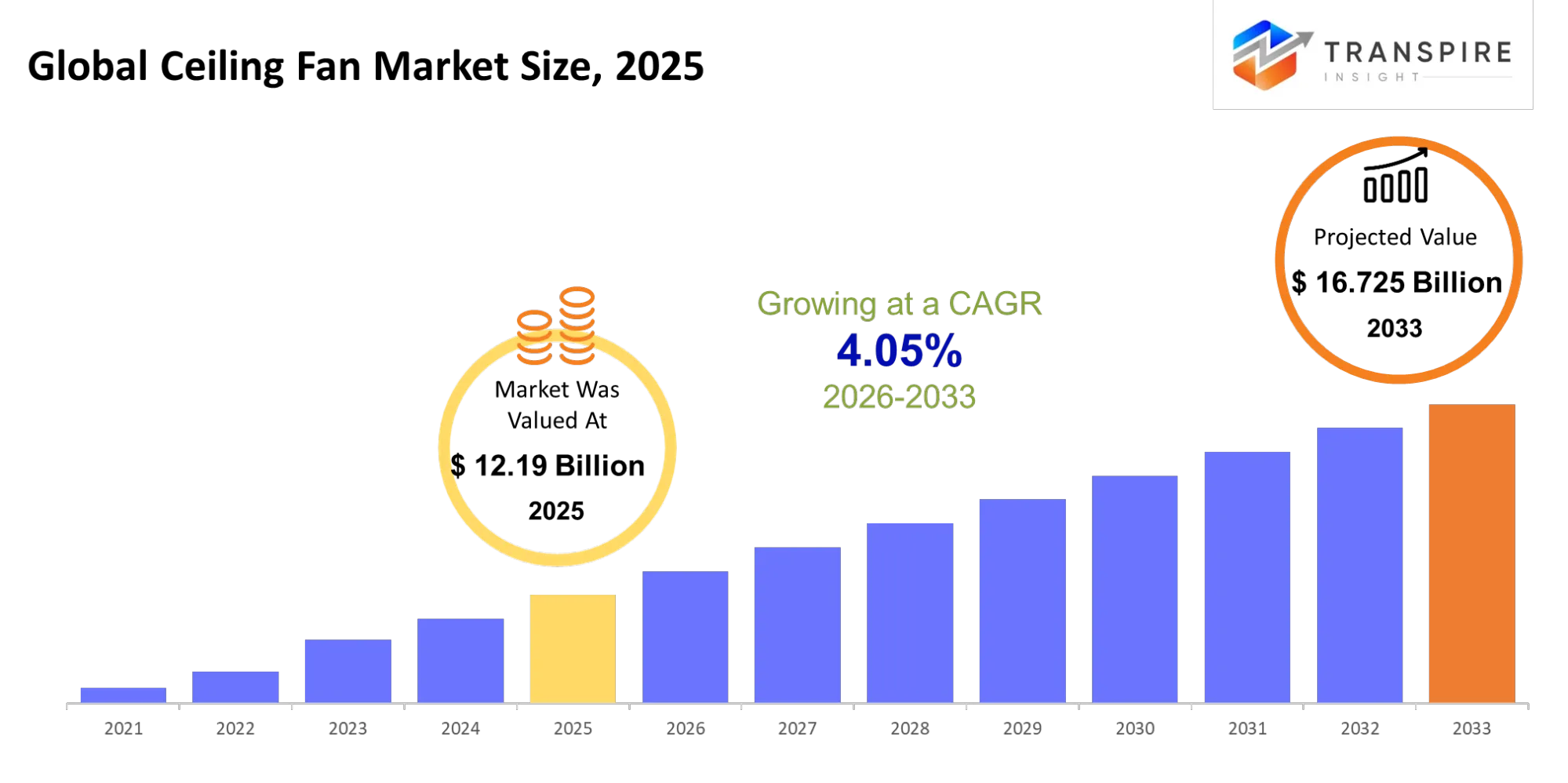
- Global Ceiling Fan Market Size 2025: USD 12.19 Billion
- Global Ceiling Fan Market Size 2033: USD 16.725 Billion
- Global Ceiling Fan Market CAGR: 4.05%
- Global Ceiling Fan Market Segments: By Type (Standard Ceiling Fans, Decorative Ceiling Fans, Smart Ceiling Fans, Energy-efficient Ceiling Fans, Industrial Ceiling Fans, Remote-controlled Fans, Others); By Application (Residential Buildings, Commercial Buildings, Hospitality Sector, Industrial Facilities, Smart Homes, Others); By End-User (Households, Offices, Hotels & Restaurants, Industrial Users, Others); By Blade Material (Metal Blades, Wooden Blades, ABS Plastic Blades, Composite Blades, Others).
To learn more about this report,  Download Free Sample Report
Global Ceiling Fan Market Summary:
The Keyword size is estimated at USD 12.19 Billion in 2025 and is anticipated to reach USD 16.725 Billion by 2033, growing at a CAGR of 4.05% from 2026 to 2033, driven by the rise in residential construction, urbanization, and the rising need for effective cooling solutions at affordable prices. Ceiling fans continue to be an effective cooling device in residential units, offices, stores, institutions, and other facilities, given their relatively lower operation cost when compared with other cooling devices. In the last three to five years, there has been a structural shift in the market towards the use of efficient and connected ceiling fans with BLDC technology fans helping to conserve energy. Increasing electricity costs and the increased adoption of electricity in emerging markets has acted as a major trigger.
Global Ceiling Fan Market Insights:
Market dynamics indicate a shift from traditional air conditioning devices to high-tech ceiling fans, driving growth both through replacements and new installations. Key drivers include advancements in technology, premiumization of products, and higher awareness about electricity savings amongst end-users.
- The residential sector drives about 65–70% of total demand, driven by growing construction activities and penetration of household appliances.
- High-efficiency BLDC motors currently dominate more than 25–30% of the premium fan market share owing to an increase in low-power variants among manufacturers.
- Market share of Asia-Pacific is estimated above 44%, thanks to strong economic and industrial growth, and rising disposable income levels amongst customers.
- Smart or IoT-enabled ceiling fans continue to grow at double-digit rates as consumers tend to opt for smart devices.
- Premium decorative ceiling fans account for about 20% to 25% of the total urban market demand due to increased aesthetic preference among consumers.
- Commercial and institutional sectors make up almost 30% to 35% of the total market demand owing to office buildings, shopping centers, and hospitality sectors.
- Increasingly, manufacturers are coming out with remote control, sensors, and inverter-friendly ceiling fans as a means of differentiating their products.
- The demand for replacement is contributing a great deal towards market growth, particularly because consumers have moved from conventional induction motor fans.
- Online buying platforms are growing tremendously with consumers making comparisons between products online.
What are the Key Drivers, Restraints, and Opportunities in the Global Ceiling Fan Market?
Driver:
The main source driving the ceiling fan industry growth includes the fast adoption of energy-efficient cooling systems in developing nations due to the cost of electricity. Increased building activity in houses, initiatives taken by the governments in electrification, and the increase in electricity costs have contributed to increased use of fans that use less energy. The development of BLDC motors has encouraged the fast adoption of the fans since they use considerably less energy compared to other models.
Restraint:
The market growth is limited due to high penetration rate of air conditioners and consumers' sensitivity to prices, especially in emerging markets. The ceiling fans also have some inherent barriers as the higher-end and advanced products are still relatively costly compared to their conventional counterparts. Moreover, the seasonal demand leads to uneven sales, creating difficulties for suppliers.
Opportunity:
New opportunities are being generated from the integration of smart home ecosystems, connectivity features of home appliances, and luxury interior products. Integrating with voice assistants, IoT technologies, and automation software may open up different customer segments. Opportunities for growth can be achieved by entering the expanding markets in urban regions of Asia, Africa, and other developing countries.
What Has the Impact of Artificial Intelligence Been on the Global Ceiling Fan Market?
Artificial Intelligence is currently affecting the Global Ceiling Fan Market by revolutionizing the conventional cooling devices into energy-efficient appliances by using advanced AI technologies, as well as enhancing production efficiencies through the use of advanced automation techniques. AI-controlled ceiling fans make use of sensors, machine learning capabilities, and advanced automation techniques in order to regulate fan speeds and cooling mechanisms depending on various factors, such as the level of occupancy and temperature.
On the other hand, manufacturers have implemented advanced automation systems based on AI analytics in order to enhance production activities. AI-based analytics also plays an essential role in facilitating efficient demand forecasting and supply chain management, thus enabling manufacturers to save money during production.
Furthermore, AI technology has enabled smart ceiling fans to be able to predict future behaviors based on users' actions and preferences, thus maximizing energy efficiency. In March 2026, various smart appliance brands rolled out AI-based home automation functionalities that allowed for optimized energy consumption patterns in connected devices.
Additionally, AI technology has facilitated efficient monitoring and diagnostic procedures via apps. Nevertheless, there are still challenges associated with cost and complexity of implementation.
Global Ceiling Fan Market Trends:
- Consumer tastes are gradually changing from using conventional fans to BLDC (brushless direct current) fans due to an increase in electricity costs, making energy savings an influencing factor.
- With rising consumer interest in creating smart homes, consumers have opted for app-controlled and voice-controlled ceiling fans equipped with sensors.
- Product development trends now focus on premium and decorative designs since aesthetics are one of the key factors considered by buyers when purchasing fans.
- The dominance of traditional retail methods is giving way to electronic purchasing as consumers do comparisons of features, energy ratings, and price prior to buying.
- Product development has advanced from improvements in airflow to noise reduction, inverter compatibility, and smart automation features designed to enhance convenience.
- Consumers have become proactive, replacing their old products with new fans that are energy-efficient rather than waiting for them to break down.
- There is an increased emphasis by manufacturers on using sustainable material and environmentally compliant energy standards.
- Commercial consumers are increasingly adopting centralized and automatic refrigeration systems for greater efficiency and reduction of overall electrical energy usage.
- The demand pattern is changing from seasonal buying trends to steady annual sales driven by the growth in infrastructural development and urban housing.
Global Ceiling Fan Market Segmentation
By Type
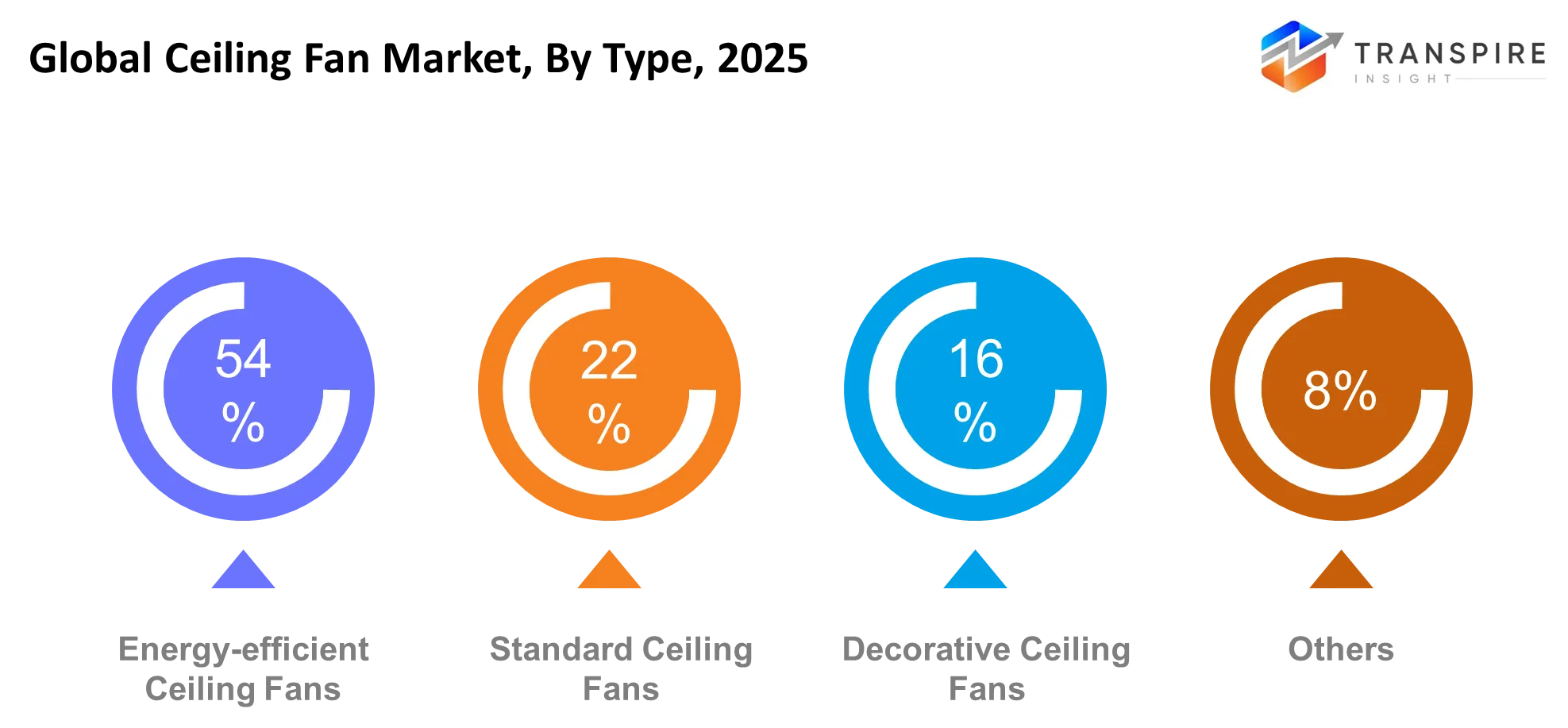
In terms of type, traditional ceiling fans still hold a commanding market share owing to its affordability and installation across many countries. However, decorative ceiling fans will witness significant expansion on account of buying preferences based on design. On the other hand, innovations in the area of smart ceiling fans, remote control ceiling fans, and energy-efficient fans are likely to increase as consumers look for connected home appliance products and energy savings. Industrial ceiling fans will retain their specialized status due to their utility at larger facilities for optimizing air flow.
To learn more about this report, Download Free Sample Report
By Application
Residential application segmentation continues to hold a majority share owing to increased housing as well as replacements, whereas applications in commercial buildings, hospitality, industrial sector, and smart homes have become key growth areas owing to increasing adoption of HVAC technology as part of building automation systems. It is anticipated that future demand will diversify.
By End-User
The households are still the leading end-users due to the nature of ceiling fans being mass-market cooling devices. However, for the offices, hotels/ restaurants, and industries, energy optimization and automation become priorities.
By Blade Material
In terms of blade material, metal blades continue to enjoy market dominance owing to their high durability and cost-effectiveness, while wooden, ABS, and composite blades have made significant progress due to the light weight, quiet operation, enhanced appearance, and greater efficiency in aerodynamics.
What are the Key Use Cases Driving the Global Ceiling Fan Market?
One of the key use cases for the growth in the market of ceiling fans is their application in residential cooling. Many people choose ceiling fans because they provide an effective circulation of air while being relatively cheap compared to other cooling options. The continued adoption of ceiling fans in housing developments, flats, and households continues to drive up the installation and replacement of the fans.
Another growing area of use of ceiling fans is their application in commercial buildings and other business places. Ceiling fans are more often found now in buildings that have air conditioners to make their work more efficient and save energy resources. Also, in many industrial buildings, ceiling fans are used to enhance air circulation.
The growing interest towards smart home appliances brings ceiling fans into the focus of the market because there is increased interest in smart solutions.
|
Report Metrics |
Details |
|
Market size value in 2025 |
USD 12.19 Billion |
|
Market size value in 2026 |
USD 12.663 Billion |
|
Revenue forecast in 2033 |
USD 16.725 Billion |
|
Growth rate |
CAGR of 4.05% from 2026 to 2033 |
|
Base year |
2025 |
|
Historical data |
2021 - 2024 |
|
Forecast period |
2026 - 2033 |
|
Report coverage |
Market size, growth drivers, restraints, opportunities, trends, competitive landscape, AI impact, segmentation analysis, regional insights, company profiling |
|
Regional scope |
North America, Europe, Asia Pacific, Latin America, Middle East & Africa |
|
Key company profiled |
Hunter Fan Company, Havells, Orient Electric, Crompton Greaves, Panasonic, Usha, Bajaj Electricals, Atomberg, Big Ass Fans, Emerson Electric, KDK, Monte Carlo, Luminous, Westinghouse Lighting, Minka Aire. |
|
Customization scope |
Custom segmentation, regional analysis, competitive benchmarking, additional company profiling, country-level analysis |
|
Report Segmentation |
By Type (Standard Ceiling Fans, Decorative Ceiling Fans, Smart Ceiling Fans, Energy-efficient Ceiling Fans, Industrial Ceiling Fans, Remote-controlled Fans, Others); By Application (Residential Buildings, Commercial Buildings, Hospitality Sector, Industrial Facilities, Smart Homes, Others); By End-User (Households, Offices, Hotels & Restaurants, Industrial Users, Others); By Blade Material (Metal Blades, Wooden Blades, ABS Plastic Blades, Composite Blades, Others) |
Which Regions are Driving the Global Ceiling Fan Market Growth?
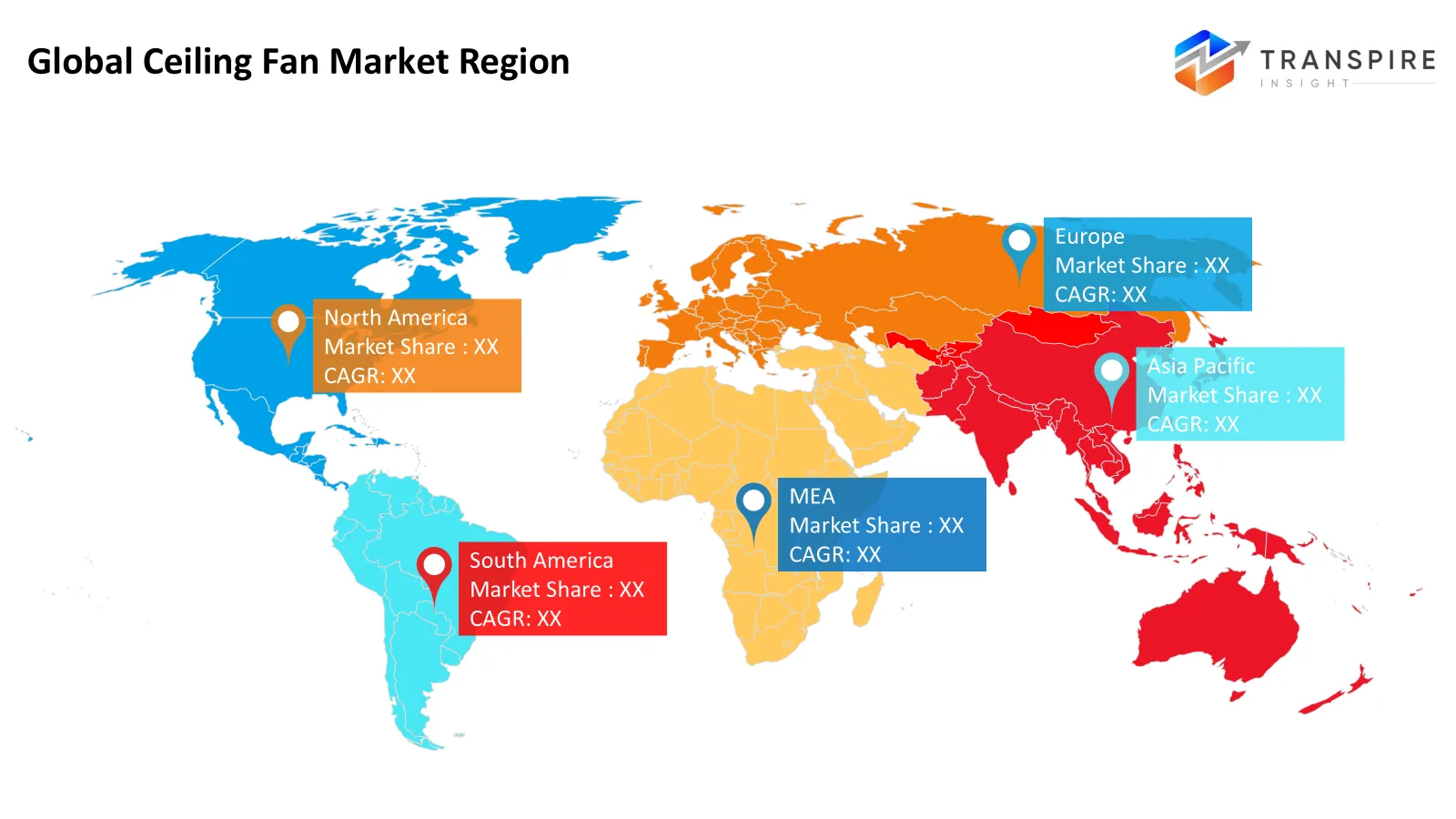
The Asia Pacific region continues dominating in terms of the largest share of the market because of intense residential construction activities and urbanization, along with a massive customer base requiring cost-effective cooling solutions. The growth in the Asia Pacific market is facilitated through increasing electrification schemes, investments in infrastructure development, and reliance on ceiling fans for providing cooling in the houses of the residents. Robust manufacturing industry and regional supply chains enable cost advantages and higher production volumes. In March 2026, additional growth in affordable housing and energy-efficient products supported rising regional demand for energy-saving ceiling fans.
North America accounts for the second-largest regional market, where market conditions differ significantly from those in the Asia Pacific region due to increasing market dominance of premiumization and smart homes. More affluent consumers, greater renovation activities, and increasing prevalence of smart appliances result in steady growth patterns and reduced risk. Commercial properties and connected homes, including the hospitality sector, generate replacement demand. In February 2026, rising consumer willingness to spend money on smart home upgrades has boosted the demand for premium ceiling fans.
The Middle East & Africa is shaping up to be the fastest-growing region owing to increased infrastructure projects, increased electrification, and growing residential constructions. With recent progress made towards urban housing projects and commercial infrastructures, there has been a rise in demand for effective cooling solutions. There has also been a shift in consumption behavior due to growing investments in smart city projects and infrastructure projects towards energy-saving products. In April 2026, infrastructure expansion projects boosted demand in developing economies.
To learn more about this report, Download Free Sample Report
Who are the Key Players in the Global Ceiling Fan Market and how do they Compete?
In the ceiling fans market, competition exists due to pricing, innovation, technological advancements, energy efficiency needs, and robust distribution networks but not because of production capacity alone. Competition among firms is now emerging based on premiumizing products, making appliances smarter, offering customizations, and localized production approaches.
The main strategies used by Havells and Crompton in competing include their broad product range, flexible pricing, and wide-ranging distribution networks. Their main source of differentiation includes their widespread reach in homes as well as the availability of energy-efficient product offerings. Both firms continue to expand based on premiumized product launch initiatives, regional distribution growth, and emphasis on smart appliances.
Orient Electric concentrates its efforts on developing new products and making appliances more premium with attractive designs, BLDC features, and smart appliances. Panasonic differentiates itself by focusing on integrating its appliances with smart houses as well as using technologically superior cooling appliances. Hunter Fan Company stands out through its premium aesthetics and specialized product positioning as well as smart fan ecosystems.
Global Ceiling Fan Market Companies
- Hunter Fan Company
- Havells
- Orient Electric
- Crompton Greaves
- Panasonic
- Usha
- Bajaj Electricals
- Atomberg
- Big Ass Fans
- Emerson Electric
- KDK
- Monte Carlo
- Luminous
- Westinghouse Lighting
- Minka Aire
Recent Development News:
- In April 2026, Crompton introduced its Energion Niteo Pro Premium BLDC Ceiling Fan to enhance its offerings for premium energy-efficient fans. This helped cement the position of the company in efficient cooling solutions and increased competition among premium BLDC ceiling fans.
- In May 2026 product launch by Polycab India was the AeroFame BLDC ceiling fan range with aerodynamically designed aluminum blades and power-saving technology. This initiative reinforced the company’s vision to meet consumer demand for reduced electricity usage and quieter cooling appliances.
https://constructiontimes.co.in
In May in 2026 saw the introduction by Usha International of some more ceiling fans in the BLDC, remote controlled, and designer variants. This move helped in diversifying products and added to their premiumization initiative through energy-efficient coolers.
What Strategic Insights Define the Future of the Global Ceiling Fan Market?
In terms of future trends, the ceiling fan industry is gradually inching towards an era where value creation would not be through quantity but by way of energy efficiency, inter-connectivity, and premium positioning. Growth would come not only from first purchases but increasingly from replacements, offering possibilities to those companies that are capable of integrating their products' efficiency, design, and connectivity into one ecosystem.
One of the hidden dangers is that of commoditization, which may lead to a vicious cycle of price competition, making differentiation hard to achieve, especially for those companies that are manufacturing standard fans. Those dependent on conventional product lines might struggle to increase their income despite growth in market demand.
One of the emerging trends is in smart buildings, efficient energy infrastructure, and intelligent home ecosystems where intelligent cooling products could integrate themselves into a larger network. Manufacturers must focus on investing in BLDC technology, IoT, and premium product development alongside increasing regional manufacturing and distribution capabilities.
Global Ceiling Fan Market Segmentation
By Type
- Standard Ceiling Fans
- Decorative Ceiling Fans
- Smart Ceiling Fans
- Energy-efficient Ceiling Fans
- Industrial Ceiling Fans
- Remote-controlled Fans
- Others
By Application
- Residential Buildings
- Commercial Buildings
- Hospitality Sector
- Industrial Facilities
- Smart Homes
- Others
By End-User
- Households
- Offices
- Hotels & Restaurants
- Industrial Users
- Others
By Blade Material
- Metal Blades
- Wooden Blades
- ABS Plastic Blades
- Composite Blades
- Others
Regional Outlook
North America
- United States
- Canada
- Mexico
Europe
- Germany
- United Kingdom
- France
- Spain
- Italy
- Rest of Europe
Asia Pacific
- Japan
- China
- Australia & New Zealand
- South Korea
- India
- Rest of Asia Pacific
South America
- Brazil
- Argentina
- Rest of South America
Middle East & Africa
- Saudi Arabia
- United Arab Emirates
- South Africa
- Rest of the Middle East & Africa
Frequently Asked Questions
Find quick answers to common questions.
The global ceiling fan market size was valued at USD 12.19 Billion in 2025 and is poised to reach USD 16.725 Billion by 2033, expanding at a 4.05% CAGR from 2026 to 2033.
Key segments for the global ceiling fan market are Type (Functional Foods, Fortified & Healthy Bakery Products, Healthy Snacks & Beverages, Dietary & Weight Management Foods, Sports & Energy Foods), Nature (Organic, Conventional), Calorie Content (Low Calories, No Calories, Reduced Calories), Distribution Channel (Supermarkets & Hypermarkets, Convenience Stores, Online Retail, Specialty Stores).
Growth is primarily driven by fast-growing urbanization, rising residential and commercial constructions, growing demand for energy-efficient cooling systems, as well as increasing use of BLDC and smart ceiling fans. Increasing electricity penetration, soaring electricity prices, construction activities, demand for replacement of traditional fans, as well as growing consumer preference for smart and premium cooling equipment will also boost the market growth.
The global ceiling fan market is led by major manufacturers including Hunter Fan Company, Havells, Orient Electric, Crompton Greaves, Panasonic, Usha, Bajaj Electricals, Atomberg, Big Ass Fans, Emerson Electric, KDK, Monte Carlo, Luminous, Westinghouse Lighting, Minka Aire.
North America holds approximately 25% of the global ceiling fan market share and influences market dynamics through strong demand for smart, premium, and energy-efficient ceiling fans, supported by home renovations, smart home adoption, and increasing commercial infrastructure investments.
Commercial opportunities in the global ceiling fan market include expanding demand for smart and IoT-enabled ceiling fans, increasing adoption of energy-efficient BLDC technology, growing investments in smart homes and sustainable buildings, rising replacement demand for conventional fans, and expansion opportunities across emerging markets with increasing electrification and residential construction activities. Premium decorative fan categories and commercial infrastructure projects also create additional revenue opportunities.
- Hunter Fan Company
- Havells
- Orient Electric
- Crompton Greaves
- Panasonic
- Usha
- Bajaj Electricals
- Atomberg
- Big Ass Fans
- Emerson Electric
- KDK
- Monte Carlo
- Luminous
- Westinghouse Lighting
- Minka Aire
About the Authors

Chetan Dhatrak
I’m Chetan Dhatrak, a Senior Research Analyst at Transpire Insight, specializing in the Consumer Goods, Foods and Beverages industry. I focus on analyzing market trends, consumer behavior, competitive landscapes, and industry developments to deliver accurate, data-driven insights. My research at Transpire Insight is built on credible sources and in-depth analysis, helping businesses and readers better understand market dynamics, emerging opportunities, and evolving consumer preferences. I’m committed to creating reliable, well-researched content that supports informed decision-making and reflects the latest developments in the consumer goods and food & beverage sectors.

Chakradhar Khansole
Chakradhar serves as the Research Director at Transpire Insight, bringing over 8 years of experience in technology, innovation, and strategic market intelligence. He specializes in transforming complex market data into actionable business insights that enable organizations to make informed, growth-oriented decisions. Recognized for his strategic vision and analytical expertise, Chakradhar leads high-impact research initiatives, delivering comprehensive market assessments, competitive intelligence, and forward-looking industry analysis.
Recently Published Reports
-
Apr 2026
Bottled Water Market
Bottled Water Market Size, Share & Analysis Report By Product Type (Still Bottled Water, Carbonated Bottled Water, Functional Bottled Water, and Others), By Packaging (PET, Cans, and Others), By Sales Channel (Supermarkets/Hypermarkets, Convenience Stores/Drug Stores, Grocery Stores/Club Stores, Foodservice, and Others) and Geography (North America, Europe, Asia-Pacific, Middle East and Africa, South and Central America), 2021 - 2032
-
Apr 2026
Color Cosmetic Packaging Market
Color Cosmetic Packaging Market Size, Share & Analysis Report By Application (Mascara Packaging, Liquid Packaging, and Liquid Face), By Type (Tubes & Bottles, Pens & Markers, Compacts & Containers, and Droppers & Pumps), and Geography (North America, Europe, Asia-Pacific, Middle East and Africa, South and Central America), 2021 - 2031
-
Apr 2026
External Microphone For Camera Market
External Microphone For Camera Market Size, Share & Analysis Report By Type (Shotgun Microphone, Lavalier Microphone, and Others), By Application (Digital Camera, Professional Video Camera, and Others), and Geography (North America, Europe, Asia-Pacific, Middle East and Africa, South and Central America), 2021 - 2031
-
Apr 2026
Foot Orthotic Insoles Market
Foot Orthotic Insoles Market Size, Share & Analysis Report By Type (Pre-fabricated, and Custom-made), By Material (Thermoplastic, Composite Carbon Fiber, and Others), By Distribution Channel (Drug Stores, Hospitals & Clinics, and Others), and Geography (North America, Europe, Asia-Pacific, Middle East and Africa, South and Central America), 2021 - 2031