

Global Cap Applicators Market Size & Forecast:
- Global Cap Applicators Market Size 2025: USD 1.97 Billion
- Global Cap Applicators Market Size 2033: USD 3.21 Billion
- Global Cap Applicators Market CAGR: 6.25%
- Global Cap Applicators Market Segments: By Type (Automatic Cap Applicators, Semi-automatic Cap Applicators, Rotary Cap Applicators, Inline Cap Applicators, Snap Cap Applicators, Others); By Application (Food & Beverage Packaging, Pharmaceutical Packaging, Cosmetics Packaging, Chemical Packaging, Others); By End-User (Packaging Companies, Food Manufacturers, Pharma Companies, Cosmetics Manufacturers, Others); By Technology (AI-enabled Applicators, Servo-driven Applicators, Pneumatic Applicators, Others)
Global Cap Applicators Market Summary:
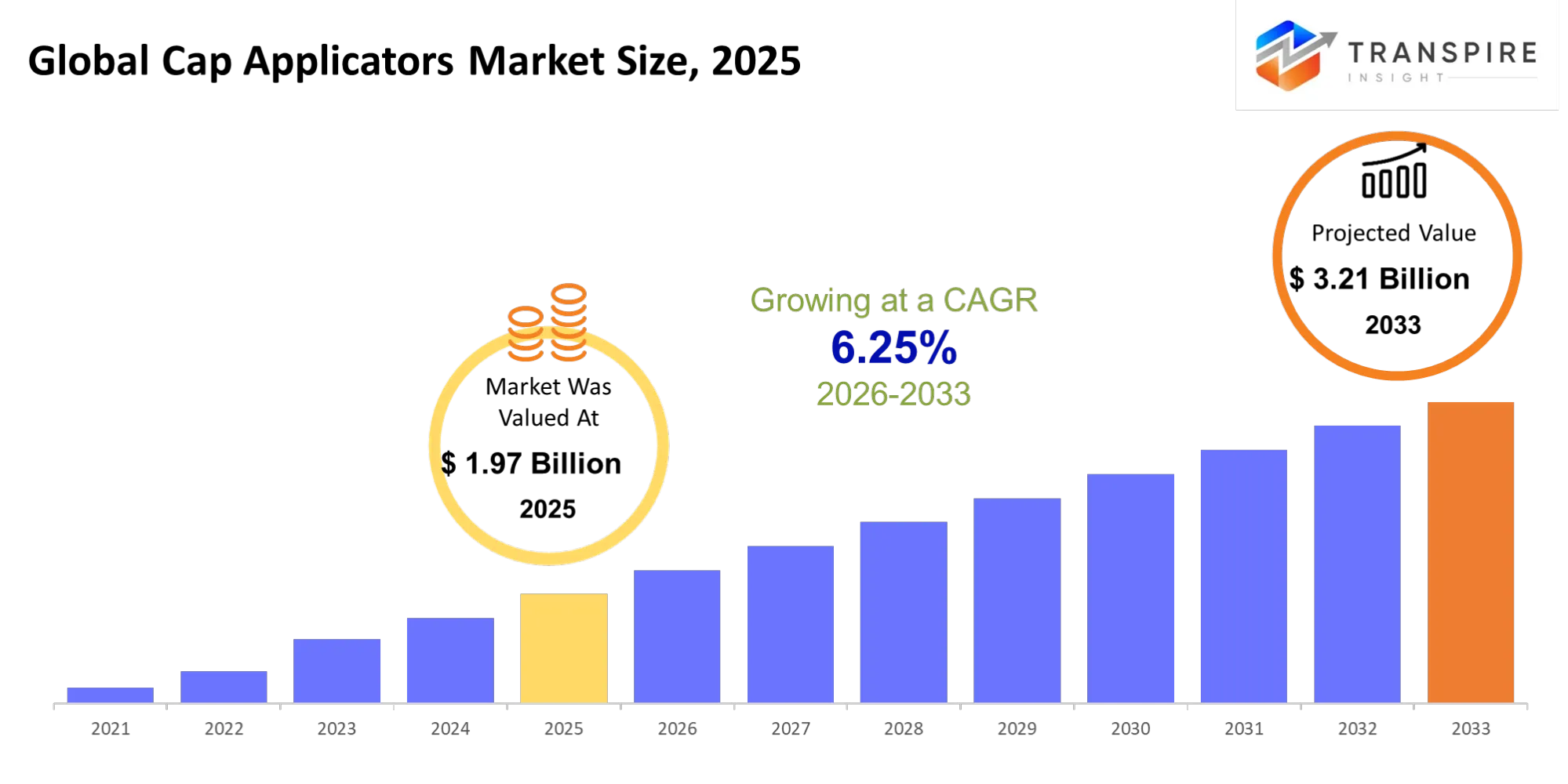
The Global Cap Applicators Market size is estimated at USD 1.97 billion in 2025 and is anticipated to reach USD 3.21 billion by 2033, growing at a CAGR of 6.25% from 2026 to 2033.
The market of cap applicators, across the globe, is extremely crucial for present packaging facilities for precise, rapid placing of caps over the packaging of beverages, drugs, personal care and foods. In the recent past, several companies have switched over from manually operated machines to sensor-based and automated packaging machines in order to increase efficiency and lower downtime. With smart manufacturing becoming a strong aspect of industrial set-ups, systems offering continuous online monitoring, even enabling predictive maintenance, have become instrumental in packaging systems. The growing volume of consumer packaged goods and the rapidly increasing volume of goods being delivered through e-commerce sites have also spurred the demand for such sealing machines that can maintain product sanctity during transit. Stricter regulatory trends to ensure product safety and the increasing demand for tamper-proof packaging solutions are also prompting the market to grow.
Key Global Cap Applicators Market Insights:
The global cap applicators market is stepping into intelligent, highly adaptable packaging systems with stronger operational value due to automation, digital monitoring and quality assurance. Industry participants are increasingly focusing on connected technologies, which enhance flexibility, minimise waste and enable changing packaging needs.
- Food & Beverage Packaging accounts for 56% of the market, and companies like Krones and KHS Group are investing in higher-speed capping machines to boost line productivity.
- In the Asia Pacific, the requirement is 41% of the global demand, which is driving suppliers to increase the number of automated packaging platforms in large manufacturing centres.
- Pharmaceutical Packaging makes up 17% and is pushing Bosch Packaging Technology and Capmatic to create application systems tailored to precision.
- Cosmetics Packaging contributes 10%, and AROL Group has unveiled AI-driven inspection solutions to further enhance seal quality assurance.
- Zalkin's predictive diagnostic innovations are driving increased adoption of connected machinery in North America, accounting for 23% of the market.
- The category of Automatic Cap Applicators is the fastest growing, and manufacturers are investing in intelligent equipment with fast changeover.
- Europe accounts for 28% of the market and has strong demand for digitally controlled applicators, which are in line with the strict standards for packaging compliance.
- “Chemical Packaging” accounts for 7%, and encourages suppliers to develop strong capping solutions for containers with special specifications.
- The Synergy integrated PET packaging platform underscores the industry transition to digital monitoring solutions for improving uptime and resource utilisation.
What are the Key Drivers, Restraints, and Opportunities in the Global Cap Applicators Market?
Driver:
A significant growth driver in the global cap applicators market is the ongoing renovation of packaging plants to achieve increased line efficiency and improved quality control. It has been prompted by the increasing complexity of production at which manufacturers operate with various kinds of containers, kinds of closures, and short product cycles in the same packing plant. Hence, firms are increasingly seeking to deploy sophisticated cap application solutions to achieve minimum setup times, better sealing accuracy, and non-stop working as a direct effect on increased revenue by reduced product rejection rates, low material loss, and high production efficiency. In March 2026, Krones AG showcased its fully automated packaging solutions at Interpack, including the Variopac Pro with autonomous material supply—enabling high-volume plants to run complex, multi-closure container jobs with seamless automated handling, drastically reducing manual setup time and eliminating line disruptions during product changes.
Restraints:
By far the greatest constraint still is the large capital outlay required for new equipment purchases, custom integration and installation. In many small to medium-sized manufacturers, the investment continues in ageing packaging machinery that simply does not interface well with newer automation technologies. This remains a problem due to the operational downtime, employee retraining and length of installation requirements that an entire production line replacement entails.
Opportunities:
Another major opportunity in the near term will be within the space of smart and connected packaging machinery. Growth is expected in many developing manufacturing centres as manufacturing companies in the food, beverage, pharmaceutical, and consumer packaged goods industries increasingly deploy digitally enabled production machinery. Consider AI-driven, remotely monitored capping machines with diagnostic capability that will enable added value to a user through increased asset productivity, faster maintenance determination, and a more rapid and predictable ramp-up capability. In April 2026, EFM Machinery commercially launched the CS1 single-head capping machine at Empack 2026—a fully servo-controlled, intelligent platform that uses micro-servos to individually control sealing movements, deliver real-time torque feedback, and stream live operational data for predictive diagnostics, faster maintenance decisions, and remote performance monitoring.
What Has the Impact of Artificial Intelligence Been on the Global Cap Applicators Market?
Artificial Intelligence has had a large impact on the global cap applicators market by contributing a higher level of precision, control and responsivity within the packaging process. Most newly designed cap applicators incorporate AI sensors or machine vision technologies that analyse cap position, fill amount and sealing during packaging operations, which allows machines to make real-time adjustments that reduce product errors. Predictive analysis has become quite a large component of the AI platform by analysing equipment behaviour and vibration signals, among others, and can detect when an element is prone to fail, which allows the company to conduct repairs and minimise production interruptions and unnecessary expenditures, extending machine life while minimising loss due to malfunctioning machinery. The artificial intelligence algorithms also aid in optimising production by tweaking settings according to the packaging parameters in place, which decreases waste and increases output efficiency. One obstacle that most facilities are struggling with is the difficulty and investment associated with integrating AI technology with older systems; nevertheless, the benefits of increasing performance output are quite tangible for modern packaging facilities.
In May 2026, Cognex launched the In-Sight 3900 Vision System—an embedded edge-AI platform built on Qualcomm Dragonwing that performs high-speed, high-resolution deep-learning inspections (cap position, fill amounts, seal integrity) directly on the factory floor without reducing packaging line speeds.
Key Global Cap Applicators Market Trends:
The global cap applicators market is transforming from a machine-centric industry to a productivity-centric ecosystem with flexibility, automation and packaging adaptability as the key competitive differentiators. Businesses are turning to products that enable product portfolio changes, sustainability and operational efficiency. Companies are looking into technologies that enable product portfolio changes, sustainability and operational efficiency.
- Manufacturing equipment has shifted to a more flexible system that can accommodate multiple package changes without significant changes.
- Machine intelligence is now a priority for packaging operators and is a sign of the industry's move towards data-driven production decisions and performance optimisation.
- Demand has changed from high speed to balanced efficiency with increased focus on accuracy and reduced material loss as strategic value.
- The trend towards sustainability has led to the increasing use of applicators that are compatible with light closure systems and eco-friendly packaging.
- Predictive maintenance is becoming a key advantage for equipment suppliers as a way of minimising unscheduled downtime and maximising equipment utilisation.
- Consumer demand for packaged convenience products has spurred investment in reliable closure application technologies in production facilities.
- Isolated machines are being phased out in favour of integrated packaging platforms that help to synchronise workflows and make lines more visible.
- Product diversification has driven the demand for fast-changing systems that can accommodate a wide variety of cap styles with minimal reconfiguration.
Global Cap Applicators Market Segmentation
By Type:
The Automatic Cap Applicators is the fastest growing segment, because the demand for better production efficiency, reduced manual interference, and improved consistency is high. The rotary, inline, semi-automatic and snap cap applicators are still prevalent for some specific production requirements where the demand on the equipment might be focused on speed, flexibility, or the investment involved. The future development in the segment will focus more towards the automated, "intelligent" operation.
By Application:
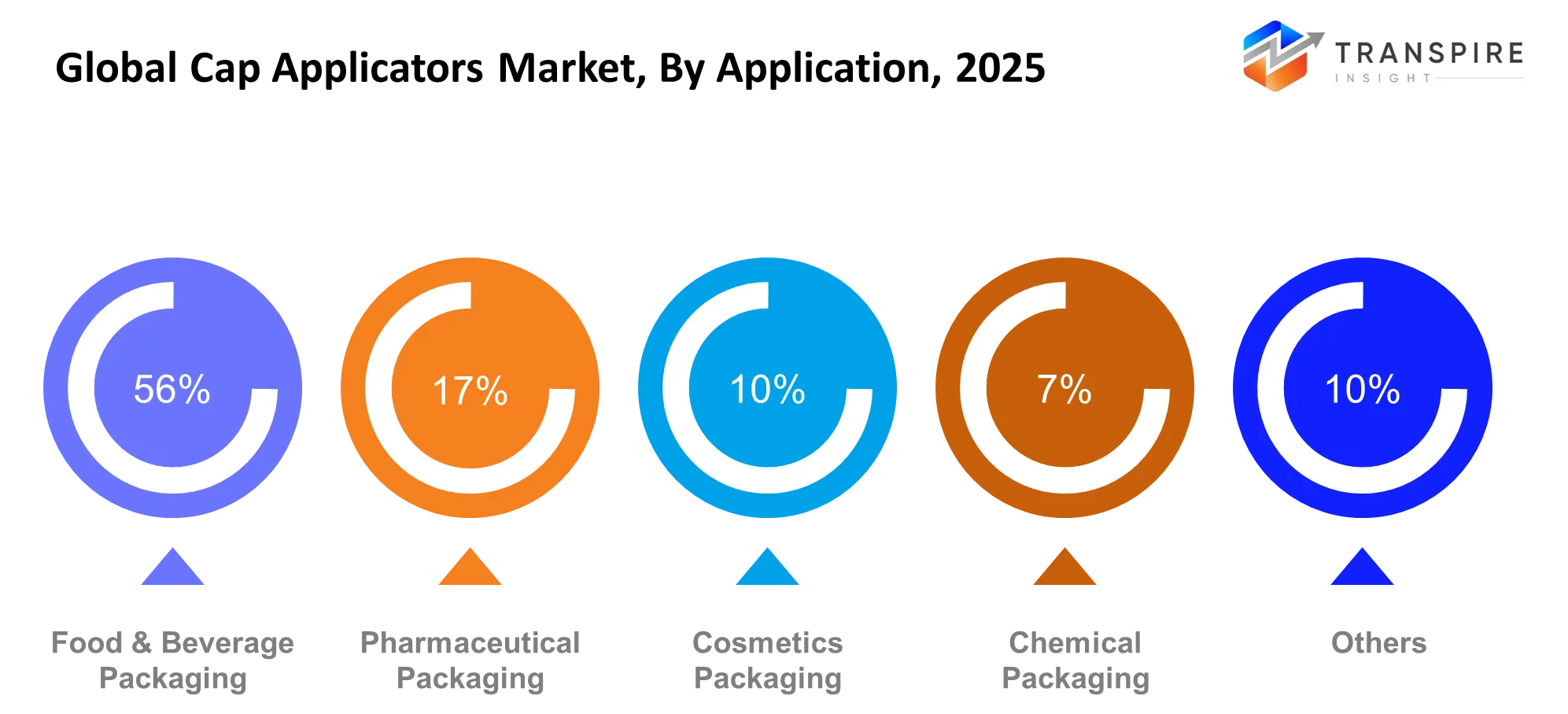
Food & Beverage Packaging held the largest share of 56%, primarily due to a high volume of bottled and packaged goods production worldwide. The market shares of Pharmaceutical Packaging, Cosmetics Packaging, Chemical Packaging, and Others stand at 17%, 10%, 7% and 10% respectively. The respective sectors gain advantages from growing emphasis on product integrity, regulatory safety compliance and packaging accuracy. Emerging packaging formats and escalating packaging quality standards will play key roles in future growth.
By End-User:
Packaging Companies and food manufacturers continue to be dominant as they produce in large quantities, while the adoption in Pharma companies and cosmetics manufacturers is picking up speed due to the standards in special packaging requirements that demand the latest closure technologies.
By Technology:
AI-based applicators stand out as a new category, whereas the servo-driven and pneumatic applicators are established in offering performance and reliable processes. However, the future will be driven by smart, connected, and flexible application systems.
What are the Key Use Cases Driving the Global Cap Applicators Market?
Most demand for capper application machines comes from beverage manufacturing due to continuous bottling that necessitates consistent placement of closures to ensure product freshness, leakage and continuous production runs. Producers require this system for stable packaging performance.
Adoption of the machine has been increasing in the pharmaceuticals, food and personal care sectors due to quality demands, increased line efficiency and assurance of safety when packaging products susceptible to contamination and for longer shelf-life. An increase in the consumption of packaged goods has boosted equipment usage.
New uses include: premium health supplements, ready-to-drink nutraceutical products and sustainable packaging formats. New users who package light containers and new material closures will necessitate more flexible application machines. Investment is growing for systems that can manage variety and consistency.
|
Report Metrics |
Details |
|
Market size value in 2025 |
USD 1.97 Billion |
|
Market size value in 2026 |
USD 2.10 Billion |
|
Revenue forecast in 2033 |
USD 3.21 Billion |
|
Growth rate |
CAGR of 6.25% from 2026 to 2033 |
|
Base year |
2025 |
|
Historical data |
2021 - 2024 |
|
Forecast period |
2026 - 2033 |
|
Report coverage |
Revenue forecast, competitive landscape, growth factors, and trends |
|
Regional scope |
United States; Canada; Mexico; United Kingdom; Germany; France; Italy; Spain; Denmark; Sweden; Norway; China; Japan; India; Australia; South Korea; Thailand; Brazil; Argentina; South Africa; Saudi Arabia; United Arab Emirates |
|
Key company profiled |
Krones, Tetra Pak, Bosch Packaging Technology, Accutek Packaging, Barry-Wehmiller, KHS Group, IC Filling Systems, Closure Systems International, Pack Leader, Capmatic, E-PAK Machinery, Federal Mfg., Filamatic, Serac Group, Adelphi Group |
|
Customization scope |
Free report customisation (country, regional & segment scope). Avail customised purchase options to meet your exact research needs. |
|
Report Segmentation |
By Type (Automatic Cap Applicators, Semi-automatic Cap Applicators, Rotary Cap Applicators, Inline Cap Applicators, Snap Cap Applicators, Others); By Application (Food & Beverage Packaging, Pharmaceutical Packaging, Cosmetics Packaging, Chemical Packaging, Others); By End-User (Packaging Companies, Food Manufacturers, Pharma Companies, Cosmetics Manufacturers, Others); By Technology (AI-enabled Applicators, Servo-driven Applicators, Pneumatic Applicators, Others) |
Which Regions are Driving the Global Cap Applicators Market Growth?
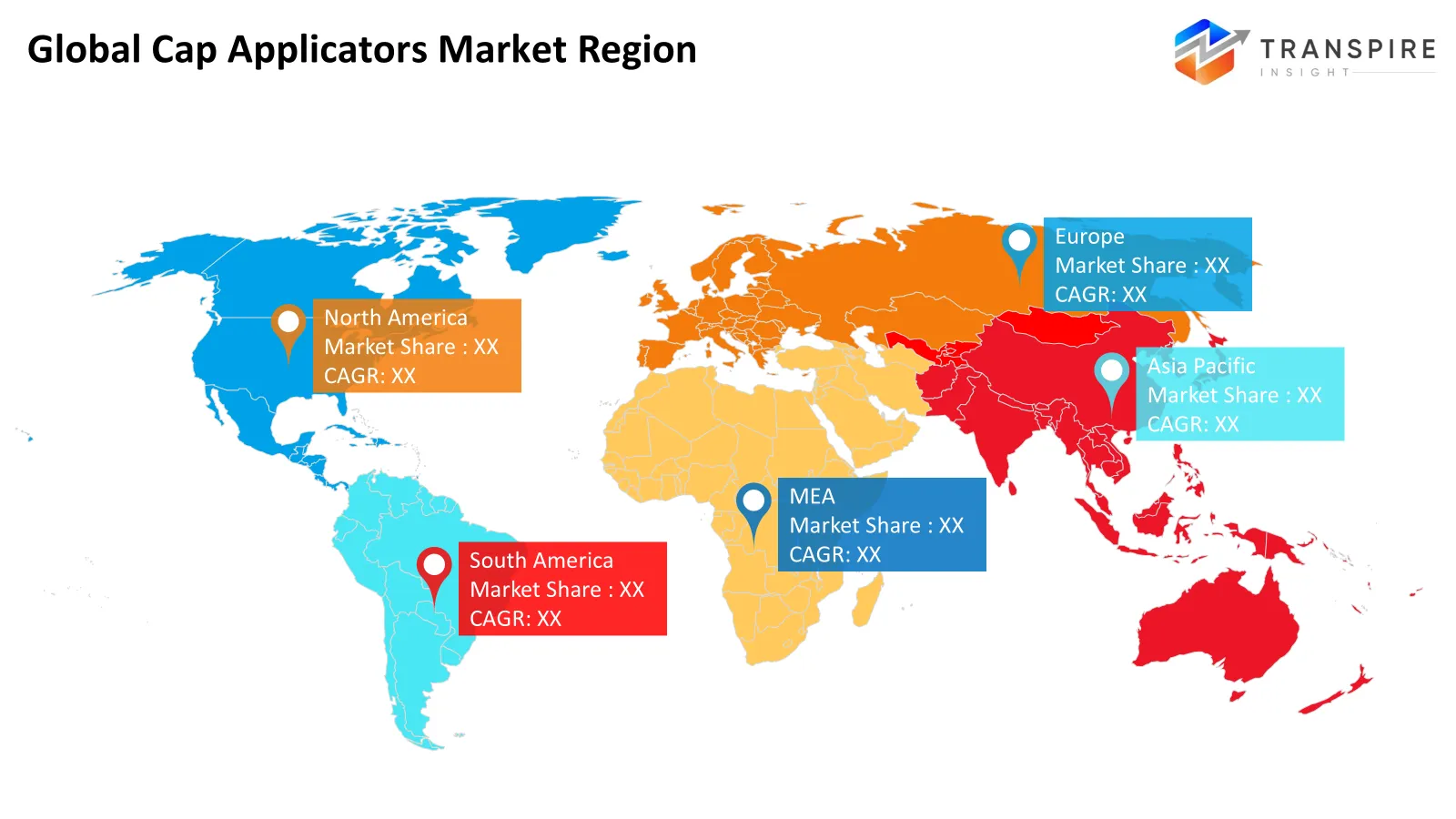
The Asia Pacific region holds almost 41% of the global cap applicators market and is thus the largest regional market. High manufacturing infrastructure, growing capacity in food and beverage processing and increased investment in industrial automation contribute to the region's leadership. Asia Pacific governments are increasingly building up packaging capabilities due to high product manufacturing volumes of consumer goods. Demand for sophisticated closure application machinery will be generated through good manufacturing economics and the presence of mass manufacturing plants. In May 2026, Synergy introduced an integrated PET packaging and bottling platform at ProPak Asia 2026, featuring multi-lane capping technology and digital monitoring tools to enhance production efficiency, reduce material waste, and maintain reliable seal performance in high-speed beverage manufacturing.
Europe has about 28% market share. Europe can secure the market share because of its advantages on the basis of Engineering expertise, regulation compliance and package quality requirements. Production scale contributes to the Asia Pacific's market share, whereas process-optimised technology contributes to Europe. Stable demands on equipment suppliers can be assured by the existing pharma industry, cosmetics industry and speciality foods industry. Ongoing modernising processes for the production industries will continuously support the demand for replacing and updating equipment. In January 2026, Siemens and NVIDIA expanded their partnership to build the Industrial AI Operating System. This collaboration allows North American manufacturers to accelerate AI-driven industrial solutions across the full lifecycle of production, significantly driving the adoption of smart manufacturing technologies.
The most rapidly expanding region is North America, which constitutes approximately 23% of the market, and whose market growth rate is estimated to be 9.9%. The market growth has recently been driven by the rapid adoption of smart manufacturing technologies and digital production systems. Manufacturers are increasing their investments in connected packaging equipment for the enhancement of efficiency and visibility. Future market opportunities come from AI-powered machinery, reshoring and an increase in investments in the manufacture of high-value consumer products. In May 2026, AROL Group, together with MACA and LAMFI, unveiled an integrated capping and closure solution at Interpack 2026 in Düsseldorf, featuring AI-powered visual inspection technology to enhance seal quality, regulatory compliance, and production accuracy for cosmetics and chemical packaging applications.
Who are the Key Players in the Global Cap Applicators Market and how do they Compete?
The race in the global cap applicators market is now more about production flexibility, intelligent machines and life cycle value than about sheer machine performance. Suppliers are locked in a battle of wits to assist manufacturers, struggling to keep pace with changing pack types, more rigorous standards and demands for increased speed. Businesses that offer automation, dependability and quick, seamless integration across complex filling and packaging processes are better placed.
Innovation-focused strategies by Krones, Tetra Pak, Bosch Packaging Technology, KHS Group, and Serac Group. Unique selling propositions are enhanced automation, digital monitoring and integration with high-capacity facilities. The strategies for growth include further expansion of service networks, up-scaling technologies and developing long-term client relationships through new manufacturing areas. A combination of niche specialisation and low-cost customisation is the key unique selling proposition of Accutek Packaging, IC Filling Systems, Pack Leader, Capmatic, E-PAK Machinery, Federal Mfg., Filamatic, Barry-Wehmiller, Closure Systems International, and Adelphi Group. They are differentiating themselves with flexible and easily adoptable machinery, reduced set-up times, and applications tailored to mid-size producers. They also rely on region-specific partnerships, after-sales services, and flexible equipment configurations adaptable to various container and closure innovations, aiming at improving customer retention and market penetration.
Key Players are:
- Krones
- Tetra Pak
- Bosch Packaging Technology
- Accutek Packaging
- Barry-Wehmiller
- KHS Group
- IC Filling Systems
- Closure Systems International
- Pack Leader
- Capmatic
- E-PAK Machinery
- Federal Mfg.
- Filamatic
- Serac Group
- Adelphi Group
Recent Development News
- In March 2026, Packserv Australia launched an Industry 4.0-enabled, PLC-controlled capping machine engineered for advanced automated packaging lines. This intelligent machine delivers higher operational precision and flexibility, enabling manufacturers to seamlessly integrate decentralised digital monitoring while maximising overall line efficiency.
https://www.industryupdate.com.au
What Strategic Insights Define the Future of the Global Cap Applicators Market?
The rising need for flexible packaging lines to handle varied cap types, support shorter runs, and enable quick new product introductions is expected to shape the global cap applicators market in the future. The trend for more intelligently integrated equipment providing operational visibility, increased production flexibility and faster changeover times has gained momentum. Increased complexity of the packaging portfolio is a frequently overlooked risk as brands increase the variety of containers and closures, leading to additional compatibility problems, thus escalating the maintenance expenses and decreasing line efficiency. Opportunities arising from the increasing demand for sustainable packaging are expected to pose a challenge to manufacturers as they search for sophisticated applicators to handle lightweight, recyclable closure materials without compromising sealing efficiency. Companies providing flexible and modular machines that can accommodate the evolving packaging specification would gain a significant position in this market. Regarding strategies, the players would focus on modular design, data analytics of operational parameters, and partnerships with packaging providers.
Key Segmentations are:
By Type
- Automatic Cap Applicators
- Semi-automatic Cap Applicators
- Rotary Cap Applicators
- Inline Cap Applicators
- Snap Cap Applicators
- Others
By Application
- Food & Beverage Packaging
- Pharmaceutical Packaging
- Cosmetics Packaging
- Chemical Packaging
- Others
By End-User
- Packaging Companies
- Food Manufacturers
- Pharma Companies
- Cosmetics Manufacturers
- Others
By Technology
- AI-enabled Applicators
- Servo-driven Applicators
- Pneumatic Applicators
- Others
Regional Outlook
North America
- United States
- Canada
- Mexico
Europe
- Germany
- United Kingdom
- France
- Spain
- Italy
- Rest of Europe
Asia Pacific
- Japan
- China
- Australia & New Zealand
- South Korea
- India
- Rest of Asia Pacific
South America
- Brazil
- Argentina
- Rest of South America
Middle East & Africa
- Saudi Arabia
- United Arab Emirates
- South Africa
- Rest of the Middle East & Africa
Frequently Asked Questions
Find quick answers to common questions.
The global cap applicators market size was valued at USD 1.97 billion in 2025 and is poised to reach USD 3.21 billion by 2033, expanding at a 6.25% CAGR.
Key segments for the global cap applicators market are By Type (Automatic Cap Applicators, Semi-automatic Cap Applicators, Rotary Cap Applicators, Inline Cap Applicators, Snap Cap Applicators, Others); By Application (Food & Beverage Packaging, Pharmaceutical Packaging, Cosmetics Packaging, Chemical Packaging, Others); By End-User (Packaging Companies, Food Manufacturers, Pharma Companies, Cosmetics Manufacturers, Others); By Technology (AI-enabled Applicators, Servo-driven Applicators, Pneumatic Applicators, Others).
Growth is primarily driven by market expansion, which is fueled by packaging line modernisation, as manufacturers adopt advanced capping systems to improve operational efficiency, sealing precision, and production profitability.
The global cap applicators market is led by major manufacturers, including Krones, Tetra Pak, Bosch Packaging Technology, Accutek Packaging, Barry-Wehmiller, KHS Group, IC Filling Systems, Closure Systems International, Pack Leader, Capmatic, E-PAK Machinery, Federal Mfg., Filamatic, Serac Group, Adelphi Group.
Asia Pacific holds 41% of the global market, supported by its extensive manufacturing base, expanding packaging infrastructure, and strong demand from food, beverage, and consumer goods industries.
Commercial opportunities lie in AI-enabled and connected capping equipment, particularly across developing manufacturing regions where digital production technologies are being deployed to enhance productivity and maintenance efficiency.
- Krones
- Tetra Pak
- Bosch Packaging Technology
- Accutek Packaging
- Barry-Wehmiller
- KHS Group
- IC Filling Systems
- Closure Systems International
- Pack Leader
- Capmatic
- E-PAK Machinery
- Federal Mfg.
- Filamatic
- Serac Group
- Adelphi Group
About the Authors

Kartik bhong
I am Kartik Bhong, a Senior Research Analyst at Transpire Insight, specializing in the Packaging, Manufacturing, and Construction industry. My work focuses on analyzing market trends, emerging technologies, industry regulations, and competitive landscapes to deliver accurate, data-driven insights. I am passionate about transforming complex industry information into clear, practical content that helps businesses, professionals, and decision-makers stay informed and make confident strategic decisions. Through continuous research and a strong commitment to accuracy, I strive to create reliable, well-researched content that reflects the latest developments across these dynamic industries and supports the vision of Transpire Insight in delivering valuable market intelligence.

Chakradhar Khansole
Chakradhar serves as the Research Director at Transpire Insight, bringing over 8 years of experience in technology, innovation, and strategic market intelligence. He specializes in transforming complex market data into actionable business insights that enable organizations to make informed, growth-oriented decisions. Recognized for his strategic vision and analytical expertise, Chakradhar leads high-impact research initiatives, delivering comprehensive market assessments, competitive intelligence, and forward-looking industry analysis.
Recently Published Reports
-
Apr 2026
Pharmaceutical Cold Chain Packaging Market
Pharmaceutical Cold Chain Packaging Market By Material (Plastic,(Polyethylene (PE), Polypropylene (PP), Polyethylene Terephthalate (PET), Expanded Polystyrene (EPS), Polyurethane (PU),Others), Paper, Metal, Others), By Product (Small Boxes, Pallets, Large Sized Pallet Containers, Others), By End Use (Biopharmaceutical Companies, Clinical Research Organizations, Hospitals, Research Institutes, Logistics and Distribution Companies, Others)”, By Industry Analysis, Size, Share, Growth, Trends, and Forecasts 2026-2033
-
Apr 2026
Active & Intelligent Packaging Market
Active & Intelligent Packaging Market By Type (Active Packaging, Smart Packaging), By Material (Polymer-Based, Paper & Board-Based, Metal-Based, Glass-Based), By Technology (Time-Temperature Indicators, Freshness Indicators, RFID, Antimicrobial Packaging, Modified Atmosphere Packaging), By Application (Food & Beverages, Pharmaceutical, Cosmetics & Personal Care, Electronics & Consumer Goods, Others), By Industry Analysis, Size, Share, Growth, Trends, and Forecasts 2026-2033
-
Apr 2026
Biodegradable Cut Flower Packaging Market
Biodegradable Cut Flower Packaging Market By Material Type (Paper & Paperboard, Biodegradable Plastics, Natural Fibers, Molded Pulp, Others), By Product Type (Sleeves, Wraps, Boxes & Cartons, Bags & Pouches, Inserts & Holders), By Application (Roses, Carnations, Tulips, Chrysanthemums, Mixed Flowers, Others) and By Distribution Channel (Direct Sales, Distributors & Wholesalers, Online Channels), By Industry Analysis, Size, Share, Growth, Trends, and Forecasts 2026-2033
-
May 2026
Pharmaceutical Packaging Market
Pharmaceutical Packaging Market By Material Type (Plastic, Glass, Metal, Paper & Paperboard, Others), By Packaging Type (Bottles, Blister Packs, Vials, Ampoules, Pouches & Sachets, Others) and By End User (Hospitals & Clinics, Retail Pharmacies, Online Pharmacies, Pharmaceutical Manufacturers), By Industry Analysis, Size, Share, Growth, Trends, and Forecasts 2026-2033