

Global Automotive Relay Switches Market Size & Forecast:
- Global Automotive Relay Switches Market Size 2025: USD 13.9 Billion
- Global Automotive Relay Switches Market Size 2033: USD 21.5 Billion
- Global Automotive Relay Switches Market CAGR: 5.68%
- Global Automotive Relay Switches Market Segments: By Relay Type (PCB Relays, Plug-in Relays, High Voltage Relays, Latching Relays, Signal Relays, Solid State Relays, Others); By Vehicle Type (Passenger Cars, Commercial Vehicles, Electric Vehicles, Hybrid Vehicles, Others); By Application (Powertrain, Body Electronics, Safety Systems, Infotainment, Charging Systems, Others); By Voltage (12V, 24V, High Voltage, Others); By Sales Channel (OEM, Aftermarket, Others)

Global Automotive Relay Switches Market Summary:
As per Transpire Insight Analysis the Global Automotive Relay Switches Market size is estimated at USD 13.9 Billion in 2025 and is anticipated to reach USD 21.5 Billion by 2033, growing at a CAGR of 5.68% from 2026 to 2033.
As vehicles develop more complicated vehicle electrical architectures that have advanced power delivery, battery protection, thermal management, lighting, and other electronic capabilities, the automotive industry requires durable and high-reliability automotive relay switches that isolate electrical current and increase performance and dependability across conventional and electrified technologies (hybrids and EVs). During the past five years, the Global Automotive Relay Switches Market has been changing from low-cost electromechanical relays to intelligent, high-voltage devices necessary in modern EVs and advanced electronic systems. The most noticeable structural development is that vehicle electrical architectures and related platforms are rapidly becoming electrified due to stringent environmental standards and rapidly growing electric vehicle and power electrical systems, with a related demand increase in battery technologies, battery supply chains, and EV charging solutions. Increased safety systems and high-tech connected solutions used in today’s modern vehicles create the need for robust high-voltage-high-power automotive relay technology and increased components in vehicle designs to create steady growth in the automotive relay switches market.
Key Global Automotive Relay Switches Market Insights:
Global electrification of vehicles is changing the architecture and electrical components of vehicle manufacturers, moving away from standard switches toward smart high-voltage relay solutions. Component suppliers use miniaturisation, digital diagnostics, or localisation to secure ongoing contracts with the OEs.
- PCB Relays, holding 36% market share, remain dominant as Omron advances compact PCB-integrated designs for space-efficient electronic control modules.
- High-voltage relays are expanding at a 17.8% CAGR, with TE Connectivity introducing enhanced insulation technologies for 800V EV platforms.
- Asia Pacific, accounting for 45% of the market, strengthens its production leadership as Denso expands regional manufacturing to shorten OEM supply cycles.
- OEM sales continue outperforming replacement demand, with Bosch integrating relay modules into centralized vehicle power distribution units.
- Passenger vehicles generate the largest installation volumes as Panasonic develops lighter relay assemblies supporting vehicle weight optimization.
- Charging system applications are accelerating, with Littelfuse enhancing high-current protection technologies for fast-charging infrastructure.
- Signal Relays, representing 10% of the market, are evolving through intelligent switching, while Hongfa improves low-power relay designs for connected vehicle electronics.
- Europe, holding 24% market share, advances sustainable automotive electronics as Sensata Technologies expands smart relay portfolios supporting software-defined vehicle platforms.
What are the Key Drivers, Restraints, and Opportunities in the Global Automotive Relay Switches Market?
Driver:
Electric vehicle adoption, driver assistance systems, complex battery control, and electronic comfort controls have been major drivers for expansion. Modern vehicles now use more switches as electronic functions become more common and power architectures grow to support faster adoption of electric vehicles driven by environmental legislation, electrification efforts, and consumer interest in connectivity. Manufacturers are adopting more complex, higher-voltage architectures that bring additional components into the vehicle and with them higher component values and improved market revenue to relay manufacturers who will focus on smaller, high-current switches. In February 2026, Renault Group acquired full ownership of the Flexis electric van venture to directly control the development of an advanced 800V electric vehicle platform. This strategic action will accelerate the integration of next-generation high-voltage components and electronic switch architectures for commercial logistics.
Restraint:
The slow transition from the current relay technology to semiconductor switching devices in certain applications. This shift, fueled by factors like higher speeds, lower maintenance requirements, and less mechanical wear associated with the solid-state electronic components for select electronic control duties, has only moved forward in a limited way, largely due to solid-state being ill-suited for high-current needs – necessitating conventional relays anyway.
Opportunity:
Best prospects appear to exist in next-generation high-voltage (HV) automotive electrical platforms and smart electrical power distribution, such as the 800V vehicle architectures, disconnects, and intelligent energy management systems that will rely on smart and thermal relay capabilities. Large-scale EV production investments are growing in APAC, with new software-defined vehicles and platforms needing intelligent relay monitors. Leading with compact, integrated diagnostics/predictive health/safety features, suppliers that offer high-voltage relays are poised to win lucrative design-in contracts. In May 2026, Infineon Technologies expanded its solid-state isolator portfolio with coreless transformer-based tech to allow suppliers to design custom solid-state relays capable of switching over 1,000V. This product launch eliminates the need for a dedicated power supply on the isolated side, providing built-in overcurrent and overtemperature protection.
What Has the Impact of Artificial Intelligence Been on the Global Automotive Relay Switches Market?
Rather than replacing relay technology altogether, artificial intelligence (AI) has driven growth in automotive relay switches by enabling higher-quality manufacturing, lifecycle management, and product quality monitoring processes. The real-time data that AI production systems gather from assembly lines can detect dimensional inaccuracies in products, as well as welding imperfections and inconsistent contact, prior to delivering those products to vehicle makers. AI offers predictive analytics for relay manufacturing and vehicle operation.
For vehicle operation, AI can help automotive engineers analyse shifting cycles, electrical load, temperature swings, and vibrations, providing them with estimates of the relay’s remaining life before it fails, which many auto engineers will integrate into their fleets. When forecasting their supply chains, manufacturers utilise AI to assist with component procurement, inventory, and production levels despite uncertainty about semiconductor availability or a decline in auto sales. With AI-enabled digital twins, relay designers can predict a device's performance under varying voltage, thermal,l and environmental conditions-all without extensive physical tests and in turn cutting down development cycles. Though many new AI adoption processes require an initial investment in sensors, the Industrial Internet of Things (IoT), and the workforce. The investment is often a barrier to adoption, especially for small to medium-sized component suppliers, therefore slowing down adoption rates. In March 2026, AutoTechIQ launched AutoQuoteIQ, an AI-powered predictive diagnostics platform that leverages millions of work orders and real-time vehicle electronics data to accurately assess part lifecycles and streamline component repair estimates.
Key Global Automotive Relay Switches Market Trends:
Modern relay technologies are evolving from simple switching components into intelligent power management devices supporting vehicle electrification, digital architectures, and higher electrical reliability.
- High-voltage switching solutions are replacing conventional designs as EV electrical architectures become mainstream.
- Relay manufacturers are adopting miniaturised designs to support compact vehicle electronics and lightweight platforms.
- Embedded diagnostic capabilities are emerging to monitor relay health throughout vehicle operation.
- Smart manufacturing using AI-driven inspection is reducing defect rates and improving production consistency.
- Thermal management requirements are encouraging the development of advanced contact materials with longer operating life.
- OEMs increasingly prefer customised relay modules integrated directly into electronic control assemblies.
- Sustainable manufacturing practices are expanding through recyclable materials and lower-energy production processes.
- Software-defined vehicles are driving demand for relays compatible with intelligent power distribution systems.
Global Automotive Relay Switches Market Segmentation
By Relay Type:
PCB relays top the list with a 36% share as the smallest-in-size, integrated form, widely adopted in ECU systems of contemporary passenger cars. Plug-in relays make up for 22% of the market as the easily serviceable and generally adapted form in the commercial vehicles' electric vehicle systems. HV relays secure the remaining 18%, with the growing electric vehicle fleet and the modern battery protection mechanism expected to propel the high-voltage relays segment with a 17.8%CAGR, being the highest growth rate.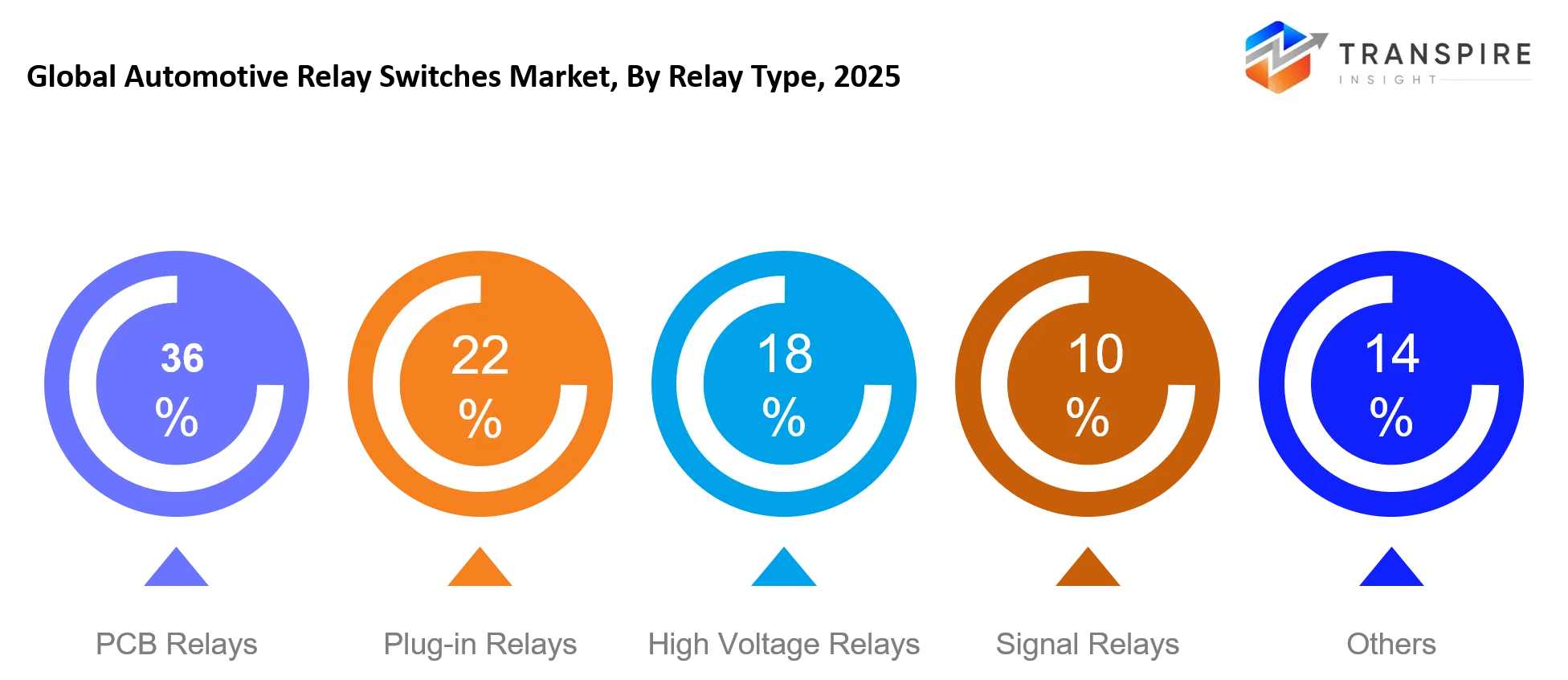
By Vehicle Type:
Passenger Cars still hold the largest share, driven by electronics integration, whereas Commercial Vehicles demand a durable relay system due to the operating conditions. EVs still command the strongest demand in the future based on their future high-voltage requirements, with HEVs supporting the transitional electrification. Others hold their market in application-specific scenarios.
By Application:
Powertrain systems still make the bulk of revenue based on needs from engines, batteries, and energy management. Body Electronics is still growing due to light and comfort functions, including climate, smart lighting, and safety systems, which are gaining market share based on ADAS. The growth from Infotainment and Charging Systems provides more content for connected and electrified vehicle platforms.
By Voltage:
While 12V is prevalent in most of the standard vehicle installations, 24V still plays a critical role in all commercial fleets. With the rise of e-mobility, high voltage is the fastest-growing system in that context. Besides this, you can find different voltage classes designed to meet specific industrial vehicles' needs.
By Sales Channel:
OEM represents the most significant market share, given the direct supply of production for new vehicles that secures stable demand volumes. OEMs the aftermarket utilises a replacement demand stemming from aftermarket services and repairs, and also vehicle fleet renewals, whereas Other includes an assortment of speciality industrial and local market support to boost total stability.
What are the Key Use Cases Driving the Global Automotive Relay Switches Market?
Most of the growth comes in passenger vehicles through power distribution and control (36%) for such functions as lights, climate control (HVAC), ECUs, and core body electronics, with reliable switching for critical components.
With applications being added across electric and hybrid power systems such as battery management systems, electric power steering, ADAS, and charging interface. Increased electrification will demand relays that can carry higher currents, deliver increased thermal robustness and higher levels of operational safety.
Also being deployed into emerging use cases such as high-voltage electric vehicle platforms, intelligent battery disconnect systems, software-defined vehicles and predictive maintenance, with more smart, integrated relay solutions incorporating diagnostics and real-time performance monitoring anticipated with the growing prevalence of connected mobility and the ongoing development of automotive electrical systems.
|
Report Metrics |
Details |
|
Market size value in 2025 |
USD 13.9 Billion |
|
Market size value in 2026 |
USD 14.6 Billion |
|
Revenue forecast in 2033 |
USD 21.5 Billion |
|
Growth rate |
CAGR of 5.68% from 2026 to 2033 |
|
Base year |
2025 |
|
Historical data |
2021 - 2024 |
|
Forecast period |
2026 - 2033 |
|
Report coverage |
Revenue forecast, competitive landscape, growth factors, and trends |
|
Regional scope |
United States; Canada; Mexico; United Kingdom; Germany; France; Italy; Spain; Denmark; Sweden; Norway; China; Japan; India; Australia; South Korea; Thailand; Brazil; Argentina; South Africa; Saudi Arabia; United Arab Emirates |
|
Key company profiled |
Denso, Panasonic, TE Connectivity, Omron, Bosch, Fujitsu, Hella, Eaton, Littelfuse, Sensata Technologies, Hongfa, Song Chuan, LS Automotive, Aptiv, Siemens. |
|
Customization scope |
Free report customization (country, regional & segment scope). Avail customized purchase options to meet your exact research needs. |
|
Report Segmentation |
By Relay Type (PCB Relays, Plug-in Relays, High Voltage Relays, Latching Relays, Signal Relays, Solid State Relays, Others); By Vehicle Type (Passenger Cars, Commercial Vehicles, Electric Vehicles, Hybrid Vehicles, Others); By Application (Powertrain, Body Electronics, Safety Systems, Infotainment, Charging Systems, Others); By Voltage (12V, 24V, High Voltage, Others); By Sales Channel (OEM, Aftermarket, Others) |
Which Regions are Driving the Global Automotive Relay Switches Market Growth?
Asia Pacific comprises 45% of the total world market owing to the presence of a comprehensive auto manufacturing cluster, an electric vehicle mega scale, and significant domestic suppliers. With a push towards electrification, government incentives in the region, battery manufacturing scale-up, investment in the most modern semiconductors remain significant factors underpinning Asia’s competitiveness, and continued high passenger vehicle demand, local components sourcing drive capability on the relay manufacturing front, and the global OEM regional demand maintain innovation at the cutting edge of the global automotive electrical components domain. In April 2026, Toyota partnered with CATL to build and localize hybrid battery cells and modules in Indonesia to boost local EV component supply and facilitate exports. Toyota partners with CATL to produce batteries in Indonesia.
North America holds 22% of the market, benefiting from advanced vehicle engineering, premium automotive manufacturing, and increasing adoption of intelligent electrical architectures. Growth factors in the region compared to Asia Pacific rely on innovation, such as technology penetration and high-value vehicle platforms, as opposed to production volumes. Long-term stability can be obtained by robust aftermarket demand, tough safety legislation, and R&D spend. Ongoing partnerships between OEM and e-components companies provide a steady rise in terms of market development.
Europe accounts for 24% of the total market and has the highest expected growth with a 16.5% CAGR as policies for neutral-carbon mobility encourage quicker vehicle electrification. The trend is toward higher-voltage relays based on a new wave of gigafactory, battery-ecosystem, and software-defined-vehicle development investments. Increasing demand for premium electric vehicles creates opportunities for intelligent switching technologies with enhanced safety features. Continued regulatory support and advanced automotive engineering position Europe as a major innovation hub for future relay technologies.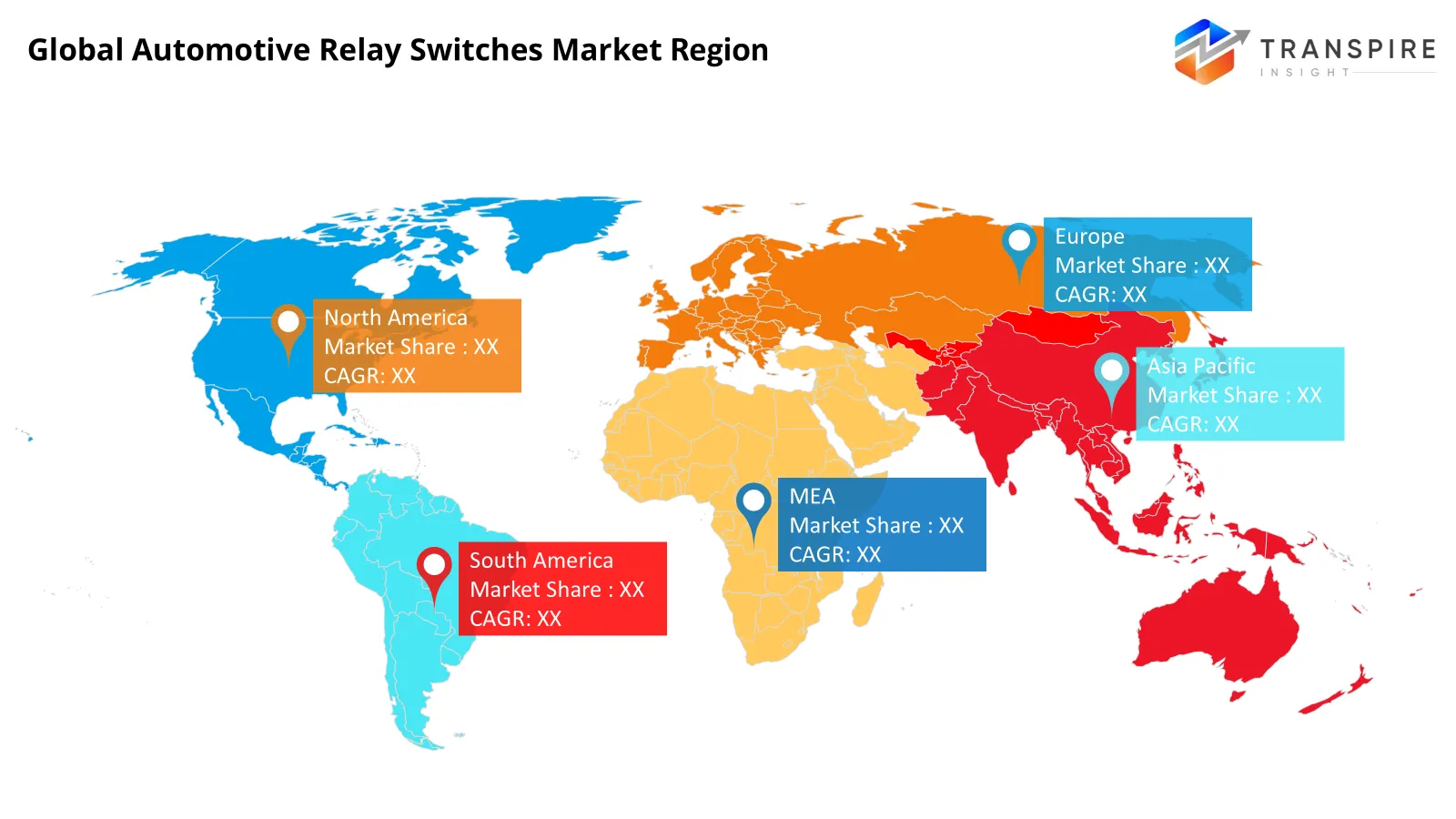
Who are the Key Players in the Global Automotive Relay Switches Market, and how do they compete?
Competition relies more on engineering capability, high-voltage performance, manufacturing scale, and existing long-term OEM relationships than just pricing. This also translates into competition based on tailored relay application platforms, regional manufacturing footprint, and incorporated power management technology that is fit for the electric vehicle architectures trend.
Denso, Panasonic and Bosch will differentiate by building small sized and high-reliability relay systems for electrified applications; TE Connectivity, Omron and Hella via their application specific technologies related to insulation, miniaturisation, and precision-switching capability; Fujitsu, Hongfa and Song Chuan via their cost-effective production and enlarged capacities through Asia for automakers with global reach; and Eaton, Littelfuse, Sensata Technologies, LS Automotive, Aptiv and Siemens will also focus on developing smart power distribution and integrated on-board diagnostics (OBD) features with over-voltage protection, along with expanding their production capacity and leveraging the regional footprint to invest in more collaborations and acquisition targeting EV platform suppliers to further integrate with automakers and address needs for reliability, safety and electrical architecture energy efficiency, particularly as software defined vehicle systems evolve.
Key Players are:
- Denso
- Panasonic
- TE Connectivity
- Omron, Bosch
- Fujitsu
- Hella
- Eaton
- Littelfuse
- Sensata Technologies
- Hongfa
- Song Chuan
- LS Automotive
- Aptiv
- Siemens
Recent Development News on the Global Automotive Relay Switches Market
- In February 2026, OMRON Electronic Components launched the P6K relay sockets, surface-mount connecting sockets designed specifically for the G6K PCB terminal-type automotive and signal relay series. This component enables efficient, solder-free relay replacement to reduce vehicle maintenance downtime and labor costs while maintaining long-term electrical reliability.
- In February 2026, Hongfa Group expanded its global automotive relay industrial footprint by launching the development of the 5th Generation of Signal Relays. This action introduces higher-density and minimized packaging structures designed to support high-reliability safety modules and automated control boards for the latest intelligent connected vehicle platforms.
https://www.hongfa.com/News/Item/25
What Strategic Insights Define the Future of the Global Automotive Relay Switches Market?
Vehicle electrical architectures will increasingly move toward centralisation of functions, placing a greater emphasis on the development of smart, high-voltage, software-aligned switching systems for automotive applications. Future competitive advantage will come from a combination of relay hardware, digital diagnostics, thermal intelligence, and space-saving designs to enable electrified vehicles. Currently, the gradual displacement of some mechanical relays in specific low-current applications with semiconductor-based switching alternatives could dampen the growth outlook of existing product lines. However, the rise of 800V EV platforms, disconnects for batteries, and intelligent power distribution systems presents a major growth opportunity for high-quality, premium relays with integrated monitoring functionality. High-voltage expertise, nearshoring of production near EV assembly plants, and strategic OEM collaboration are key areas of investment, with flexible product platforms that span both legacy and new architectures being the most important to securing competitive and higher-value wins for the next 10 years.
Key Segmentations are:
By Relay Type
- PCB Relays
- Plug-in Relays
- High Voltage Relays
- Latching Relays
- Signal Relays
- Solid State Relays
- Others
By Vehicle Type
- Passenger Cars
- Commercial Vehicles
- Electric Vehicles
- Hybrid Vehicles
- Other
By Application
- Powertrain
- Body Electronics
- Safety Systems
- Infotainment
- Charging Systems
- Other
By Voltage
- 12V
- 24V
- High Voltage
- Others
By Sales Channel
- OEM
- Aftermarket
- Others
Regional Outlook
North America
- United States
- Canada
- Mexico
Europe
- Germany
- United Kingdom
- France
- Spain
- Italy
- Rest of Europe
Asia Pacific
- Japan
- China
- Australia & New Zealand
- South Korea
- India
- Rest of Asia Pacific
South America
- Brazil
- Argentina
- Rest of South America
Middle East & Africa
- Saudi Arabia
- United Arab Emirates
- South Africa
- Rest of the Middle East & Africa
Frequently Asked Questions
Find quick answers to common questions.
The Global Automotive Relay Switches Market size was valued at USD 13.9 Billion in 2025 and is poised to reach USD 21.5 Billion by 2033, expanding at a 5.68% CAGR.
Key segments for the Global Automotive Relay Switches Market are By Relay Type (PCB Relays, Plug-in Relays, High Voltage Relays, Latching Relays, Signal Relays, Solid State Relays, Others); By Vehicle Type (Passenger Cars, Commercial Vehicles, Electric Vehicles, Hybrid Vehicles, Others); By Application (Powertrain, Body Electronics, Safety Systems, Infotainment, Charging Systems, Others); By Voltage (12V, 24V, High Voltage, Others); By Sales Channel (OEM, Aftermarket, Others).
Growth is primarily driven by rapid vehicle electrification, rising adoption of ADAS and connected vehicle electronics, expanding EV production, and increasing demand for high-voltage power management systems.
The Global Automotive Relay Switches Market is led by major manufacturers, including Denso, Panasonic, TE Connectivity, Omron, Bosch, Fujitsu, Hella, Eaton, Littelfuse, Sensata Technologies, Hongfa, Song Chuan, LS Automotive, Aptiv, and Siemens.
Asia Pacific, holding 45% of the market, leads through strong automotive manufacturing, expanding EV production, supportive government policies, localized supply chains, and continuous OEM investments.
Key opportunities include high-voltage EV relays, 800V vehicle platforms, intelligent power distribution systems, smart relay diagnostics, battery disconnect units, and expanding EV manufacturing across Asia Pacific and Europe.
- Denso
- Panasonic
- TE Connectivity
- Omron, Bosch
- Fujitsu
- Hella
- Eaton
- Littelfuse
- Sensata Technologies
- Hongfa
- Song Chuan
- LS Automotive
- Aptiv
- Siemens
About the Authors

Avinash Kumar
I’m Avinash Kumar, a Senior Research Analyst at Transpire Insight, with expertise in the Electronics and Semiconductor and Energy & Power industry. My work focuses on analyzing emerging technologies, market trends, industry developments, and innovation across these sectors. I specialize in transforming complex technical and market insights into clear, research-backed content that helps professionals, businesses, and decision-makers stay informed. Through continuous industry research and data-driven analysis, I strive to deliver accurate, reliable, and practical perspectives on the latest advancements shaping the semiconductor and energy landscape.

Chakradhar Khansole
Chakradhar serves as the Research Director at Transpire Insight, bringing over 8 years of experience in technology, innovation, and strategic market intelligence. He specializes in transforming complex market data into actionable business insights that enable organizations to make informed, growth-oriented decisions. Recognized for his strategic vision and analytical expertise, Chakradhar leads high-impact research initiatives, delivering comprehensive market assessments, competitive intelligence, and forward-looking industry analysis.
Recently Published Reports
-
Apr 2026
Fiber Optic Faceplates Market
Fiber Optic Faceplates Market Size, Share & Analysis Report By Type (< 300 mm2, 300-350 mm2, and > 350 mm2, By Application (Night Vision, Holographic Imaging, Medical, and Others), and Geography (North America, Europe, Asia-Pacific, Middle East and Africa, South and Central America), 2021 - 2031
-
Apr 2026
High Temperature Superconductors Market
High Temperature Superconductors Market Size, Share & Analysis Report By Type (1G HTS, and 2G HTS), By Application (Power Cable, Fault Current Limiter, and Transformer), and Geography (North America, Europe, Asia-Pacific, Middle East and Africa, South and Central America), 2021 - 2031
-
Apr 2026
Industrial Plugs and Socket Market
Industrial Plugs and Socket Market Size, Share & Analysis Report By Type (Industrial Plugs, Industrial Sockets), By Current (Up to 32 A, 32 to 125 A, Above 125 A), By Protection (Dustproof and Splash Proof, Waterproof, Explosion Proof), By End User (Heavy Industries, Oil and Gas, Chemicals and Pharmaceuticals, Power Generation, Others), and Geography (North America, Europe, Asia-Pacific, Middle East and Africa, South and Central America), 2021 - 2031
-
Apr 2026
InGaAs Avalanche Photodiodes Market
InGaAs Avalanche Photodiodes Market Size, Share & Analysis Report By Type (1100 - 1700 nm, and 1000 - 1600 nm), By Application (Missile Warning System, Muzzle Flash Detection, Wafer Defect Inspection, Laser Rangefinders, and Others), and Geography (North America, Europe, Asia-Pacific, Middle East and Africa, South and Central America), 2021 - 2031