Global Automotive Fastener Market Size & Forecast
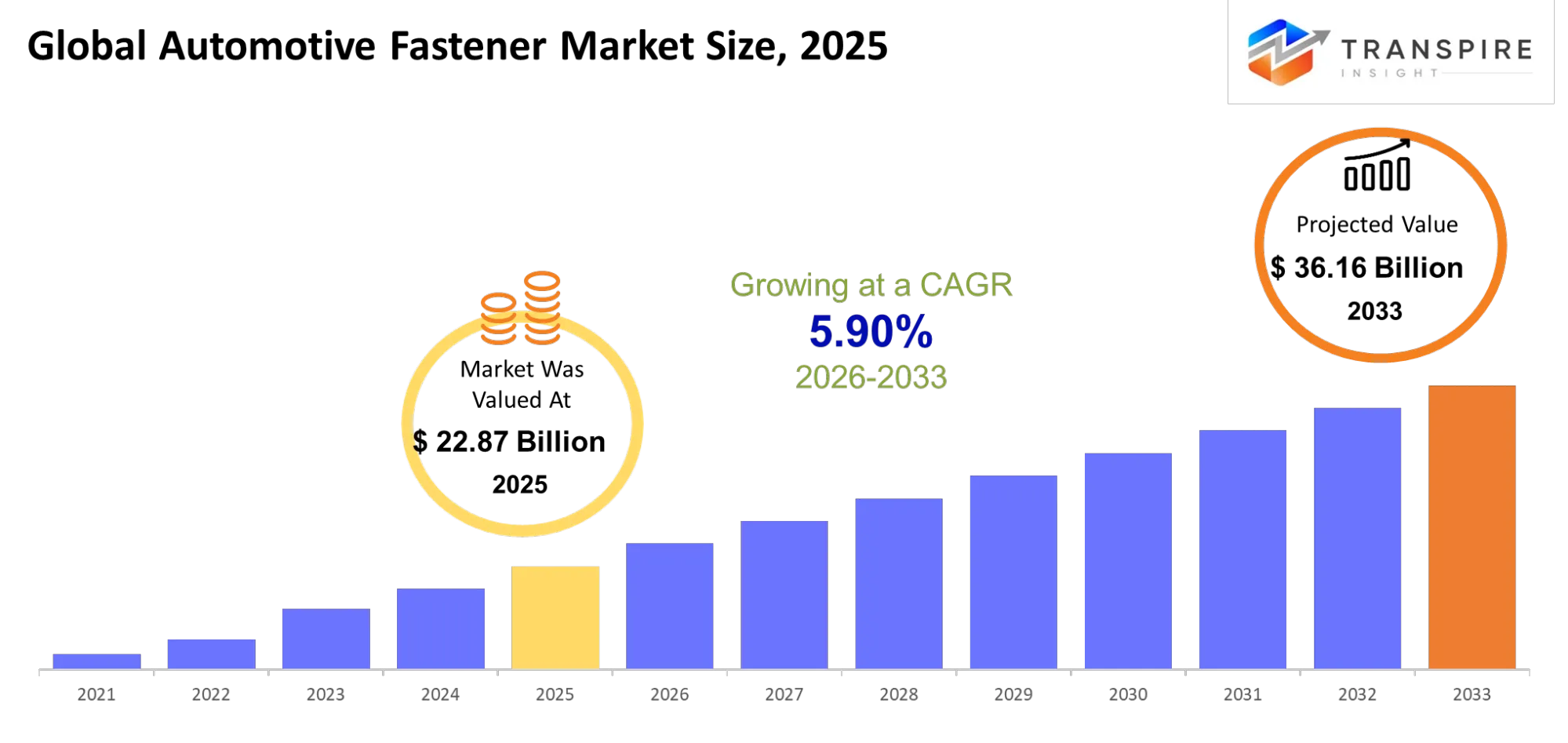
- Global Automotive Fastener Market Size 2025: USD 22.87 Billion
- Global Automotive Fastener Market Size 2033: USD 36.16 Billion
- Global Automotive Fastener Market CAGR: 5.90%
- Global Automotive Fastener Market Segments: By Product Type (Threaded Fasteners, Non-Threaded Fasteners), By Material (Steel, Aluminum, Plastic), By Vehicle Type (Passenger Cars, Commercial Vehicles), By Application (Engine, Chassis, Interior, Exterior)
To learn more about this report,  Download Free Sample Report
Global Automotive Fastener Market Summary
The global automotive fastener market was valued at USD 22.87 billion in 2024. It is expected to reach USD 36.16 billion by 2033, growing at a CAGR of 5.90%. Automotive fasteners hold vehicles together - bolts, screws, rivets, clips, and retaining rings that keep engines sealed, chassis aligned, and body panels secure over decades of vibration, thermal cycling, and mechanical loads. Without them, vehicle assembly really doesn't function properly; a car body won't have any structural integrity without thousands of fastening points holding it at spec.
The biggest change over the last four years has been the shift towards making things lighter, driven by increasingly tough fleet-average emissions regulations all over Europe, North America, and China. Automakers are replacing steel parts with aluminum and composite assemblies - they need fasteners that can join quite different materials without galvanic corrosion or structural loosening - a set of requirements that standard carbon steel fasteners can't reliably meet. The shift towards electric vehicles really accelerated this even further. Battery enclosures, motor mounts, and thermal management systems all carry fastening specifications that didn't really exist in conventional drivetrains, creating a huge demand for new fastener grades and shapes all along the supply chain.
Key Global Automotive Fastener Market Insights
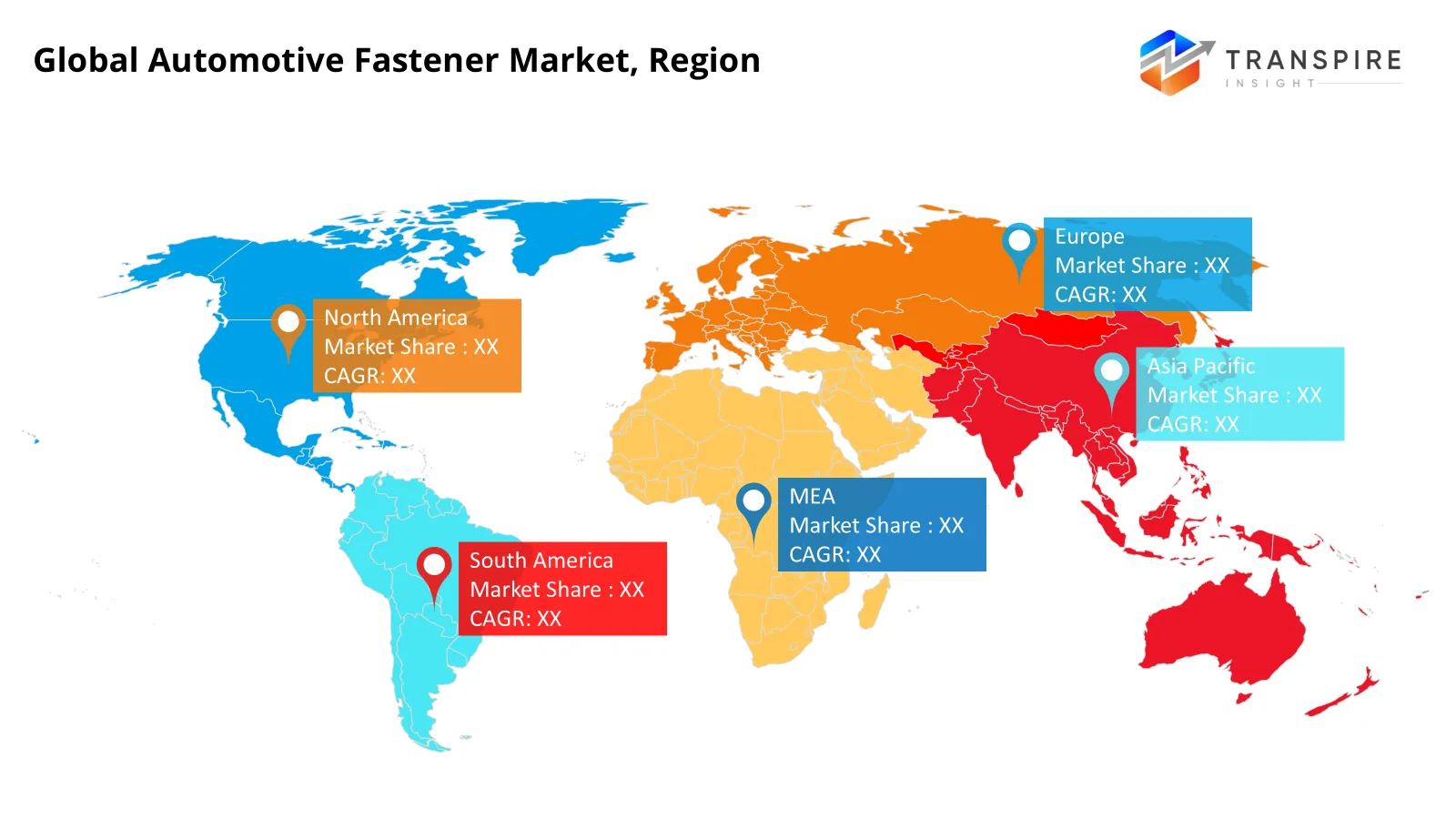
- Asia Pacific dominates the automotive fastener market with the largest regional share. Asia Pacific leads globally with approximately 45% of total revenue in 2024, supported by high-volume vehicle production in China, Japan, South Korea, and India.
- Europe accounts for roughly 25% of global automotive fastener demand in 2024, driven by premium OEM activity, strict EU emission regulations, and the ongoing transition to electric mobility.
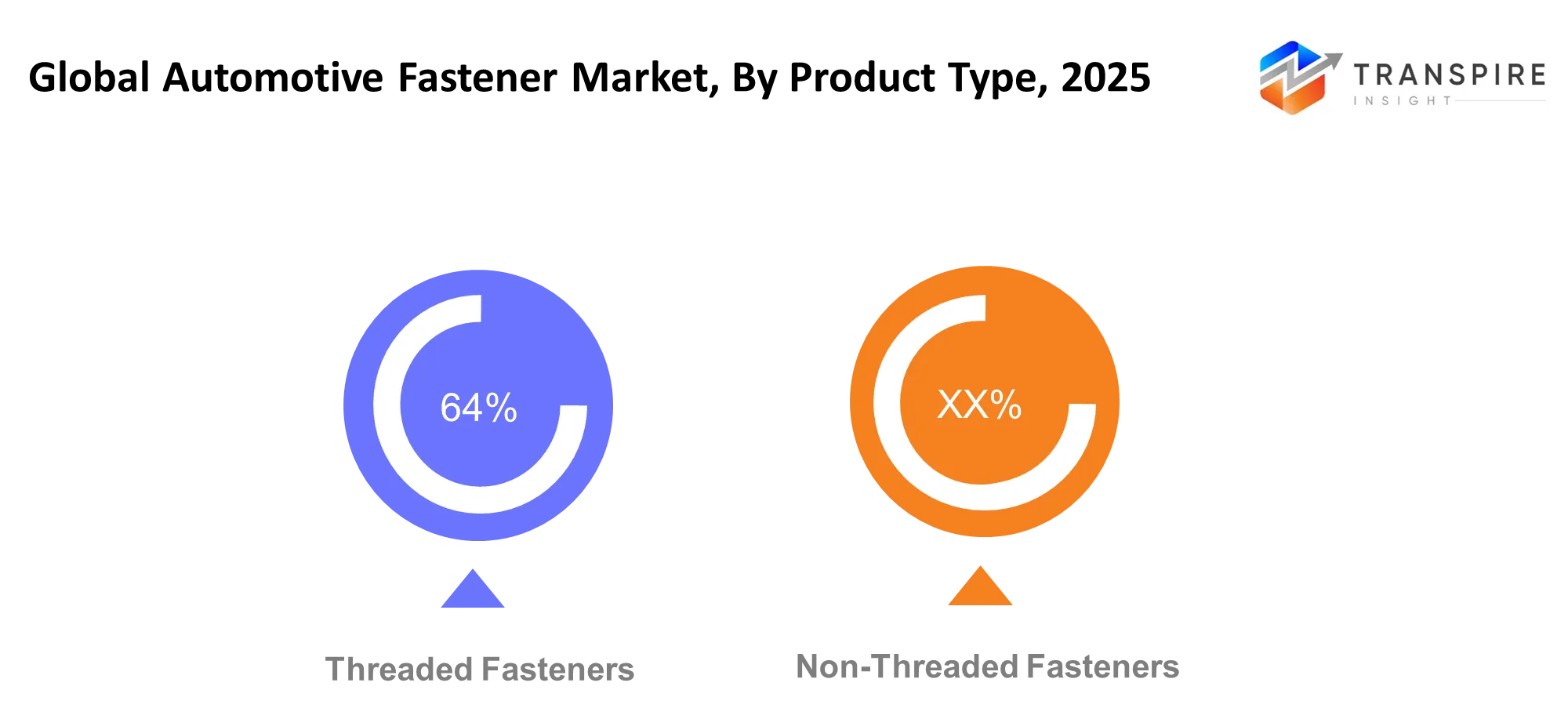
- Threaded fasteners lead the product type landscape in the global automotive fastener market. Threaded fasteners account for 64% of total market revenue in 2024, underpinned by their universal application across engine assembly, chassis, and body-in-white processes.
- Non-threaded fasteners — including rivets, clips, and push-in retainers — are the fastest-growing product segment, gaining share as interior and exterior trim applications shift away from traditional bolt-and-nut configurations.
- Steel remains the leading fastener material with a market share above 60% in 2024, favored for its tensile strength, weldability, and cost-per-unit economics in high-volume powertrain and structural applications.
- Passenger cars represent the dominant vehicle type segment in the global automotive fastener industry. The passenger car segment generates the largest share of fastener demand given total global fleet volumes and the intensive fastener count per unit — typically 3,000 to 4,000 fasteners per vehicle.
- Commercial vehicles, including trucks and buses, are growing as a fastener end-use category as fleet electrification programs expand in China, Europe, and North America, requiring new fastener specifications for battery packs and chassis reinforcement.
- The engine application segment commands the leading position by application, as powertrain assembly requires the most demanding fastener specifications in terms of torque retention, temperature resistance, and vibration fatigue.
- Exterior applications are the fastest-growing category within the application breakdown, driven by lightweighting programs that are replacing welded and adhesive joints with structural fasteners on body panels and closures.
- Stanley Black & Decker Inc. and Illinois Tool Works Inc. maintain leadership in global fastener supply through diversified product portfolios and long-term OEM supply agreements across multiple vehicle platforms.
- Bossard Group and SFS Group AG are gaining traction through engineering services and fastener application consulting, which increases per-account value beyond hardware supply alone.
What are the Key Drivers, Restraints, and Opportunities in the Global Automotive Fastener Market?
The primary drive behind automotive fastener demand is really the worldwide acceleration of electric vehicle manufacturing. EV platforms need a very different fastener combination than internal combustion drivetrains: battery enclosures alone demand fasteners with specific torque-retaining properties, heat resistance up to 150°C operating temperatures, and resistance to the chemical environment generated by lithium-ion chemistry. As EV production quantities scaled from about 6 million units in 2021 to more than 14 million in 2023 - and continue growing - OEMs have really been issuing new fastener specifications at a pace that even established suppliers are scrambling to match. That specification refresh cycle is producing much higher prices for engineered fastener solutions compared to commodity hardware rates, driving both revenue growth and margin expansion for technically capable manufacturers.
The most serious constraint on this market is raw material cost volatility - especially the price behavior of specialty steel grades and aluminum alloys. Fastener manufacturers operate on very thin processing margins and long-term supply contracts with OEMs that severely limit their ability to pass through input cost increases right away. When hot-rolled coil steel prices move very sharply - like in 2021 and again in 2022 due to the Ukraine conflict - fastener producers take on the gap between spot material costs and contracted supply pricing for several quarters at a time. This dynamic isn't really resolvable just through better operational efficiency; it really requires either index-linked pricing mechanisms in OEM contracts or greater vertical integration into steel processing - neither of which scales easily for mid-tier fastener manufacturers.
The clearest forward opportunity is really demand for lightweighting-driven aluminum and titanium fasteners in structural body applications. KAMAX Holding GmbH and Bulten AB have both been expanding their cold-forming capacity for very high-strength aluminum fasteners used in battery housing and closure systems. India's domestic automotive production expansion - supported by the government's PLI scheme for auto components - is creating a similar sourcing opportunity, with Sundram Fasteners Ltd. positioned to serve both domestic OEMs and export markets as production volumes scale through 2028.
What Has the Impact of Artificial Intelligence Been on the Global Automotive Fastener Market?
AI-powered systems are really changing how fastener manufacturers set up their production lines and handle quality. Machine vision platforms now check out cold-formed fastener heads, thread profiles, and surface coatings at speeds that no manual inspection method can come close to - usually examining several hundred parts per minute against dimensional tolerances measured in micrometers. Manufacturers like Illinois Tool Works and Bulten AB have actually implemented automated vision inspection on high-volume threading lines, lowering outgoing defective product rates and greatly reducing the labor needed for inspection per unit of output. The shift really matters financially because OEM quality agreements are including statistical sampling requirements more and more often - something manual inspection just can't meet at production scale.
Machine learning adds its power on the process side through predictive die wear modeling in cold-forming processes. Forming dies gradually degrade and their condition directly affects thread geometry and head concentricity. AI models trained on press force data, cycle counts, and dimensional inspection results can forecast when it's time to replace a die with enough accuracy to eliminate both unnecessary replacement and the scrapped products that come from running worn tooling past its useful life. Certain manufacturers have reported 10-15% savings in consumable tooling costs when they deploy these systems - though the results do vary by part complexity and production volume.
The biggest limitation on AI adoption in this market is data fragmentation all along the supply chain. Fastener manufacturers generally supply dozens of OEM and Tier 1 customers, each with their own distinct quality data formats, measurement systems, and reporting methods. Training AI models that generalize across these diverse data environments is extremely difficult, and the investment required to standardize incoming data streams isn't small at all for manufacturers working on relatively thin profit margins. Until there's more standardization in the data across the automotive supply chain, AI-driven quality systems will have very mixed results depending on the consistency of the customer data environment.
Key Market Trends
- EV battery pack assembly drove a 35% increase in demand for aluminum and titanium fastener grades between 2021 and 2024, replacing standard carbon steel in thermal-sensitive applications.
- Chinese domestic ECA-equivalent fastener quality standards tightened after 2022, forcing overseas suppliers to invest in local certification and production compliance, reshaping global supply sourcing.
- Bossard Group and SFS Group AG expanded engineering service contracts in 2023, shifting competitive positioning from per-unit pricing to per-project value-added consulting in lightweighting programs.
- Aluminum fastener adoption grew from roughly 12% of volume in 2020 to nearly 18% in 2024 as body-in-white programs accelerated use of dissimilar material joining techniques.
- India's Sundram Fasteners Ltd. increased export revenue by approximately 22% between 2022 and 2024, gaining ground in European and North American markets as OEMs diversified supply away from single-country sourcing.
- ARaymond Network secured platform supply agreements for EV-specific plastic clip and retainer systems with multiple European OEMs in 2023, targeting a segment that is growing three times faster than the overall market.
- Commercial vehicle fastener demand shifted composition in 2023, with chassis reinforcement and battery mounting hardware for electric trucks growing faster than conventional drivetrain fastener volumes for the first time.
- Fontana Gruppo expanded cold-forming capacity in North America in 2024 to serve the EV assembly ramp at new battery manufacturing plants, positioning for local content requirements in the Inflation Reduction Act supply chain.
Global Automotive Fastener Market Segmentation
By Product Type
Threaded fasteners hold 64% of the global automotive fastener market in 2024, a position built on the technology's mechanical reliability across virtually every vehicle assembly application. Bolts, screws, studs, and nuts form the primary joining method in engine assembly, cylinder head torquing, suspension attachment, and chassis fabrication — applications where controlled clamping force, re-usability, and resistance to loosening under vibration are non-negotiable. The engineering logic is difficult to displace: threaded connections can be specified to precise torque values, inspected during assembly, and re-torqued in service, which no adhesive or welded joint offers without destructive testing.
To learn more about this report, Download Free Sample Report
By Material
Steel accounts for more than 60% of automotive fastener volume in 2024 and holds that position on the strength of cost, availability, and mechanical versatility. Cold-formed and heat-treated steel fasteners cover the full tensile strength spectrum from general body hardware at property class 6.8 through to critical powertrain bolts at 12.9, with established manufacturing infrastructure globally. The material's weldability and compatibility with OEM coating systems — zinc-nickel plating, phosphate, and geomet coatings — make it the default choice for anything exposed to underbody corrosion environments. The economics are difficult to challenge: steel fastener pricing per unit remains significantly below aluminum or titanium alternatives at comparable strength classes. As electric vehicles eliminate much of the traditional engine bay complexity and replace it with power electronics requiring organized wiring, plastic clip volume per vehicle is rising. Plastic fastener growth through 2033 will outpace steel on a percentage basis, though total volume remains lower.
By Vehicle Type
Passenger cars generate the largest share of automotive fastener demand, accounting for roughly 68% of total market volume in 2024. The arithmetic is straightforward: global passenger car production runs above 70 million units annually, and each vehicle uses between 3,000 and 4,500 individual fasteners across body, chassis, interior, and powertrain assemblies. High-volume production models — B-segment and C-segment cars built on shared platforms across multiple markets — create the most predictable and high-volume fastener demand environments. Platform standardization by OEMs like Volkswagen, Toyota, and Stellantis means a single fastener specification can apply across millions of vehicles annually, which is the demand environment that sustains the largest fastener suppliers.
By Application
Engine and powertrain applications account for the largest fastener revenue share by application, driven by the technical specification requirements that command premium pricing. Cylinder head bolts, main bearing cap hardware, exhaust manifold studs, and transmission mounting fasteners all operate at elevated temperatures, cyclic loads, and chemical exposure conditions that require heat-treated, coated, or specialty-alloy fasteners. These are not commodity items: a cylinder head bolt for a turbocharged diesel operates at tensile loads close to its proof strength over decades of thermal cycling, and OEM specifications require tightly controlled mechanical properties, thread geometry, and surface finish. The pricing premium over commodity hardware is typically 3–5x, which is why engine applications generate disproportionate revenue relative to unit volume.
What are the Key Use Cases Driving the Global Automotive Fastener Market?
Powertrain and structural assembly are responsible for the largest part of automotive fastener procurement. Engine block assembly, transmission housing, and suspension system attachment need fasteners that have been engineered to meet very specific torque requirements and fatigue standards. The volume is huge - a standard passenger car powertrain alone uses 300–600 threaded fasteners - and the technical requirements really justify higher prices, making this the most valuable use case in the whole market. As EV architectures replace combustion powertrain hardware with motor mounts, inverter housings, and battery retention systems, the fastener count in this application category stays relatively similar, though material and coating specifications are shifting.
Battery enclosure and thermal management system assembly is a growing adjacent use case that's grown right out of EV platform adoption. Battery modules need fasteners that give both structural retention and electrical isolation between different metals, and also withstand thermal cycling between −30°C and 60°C. Ferry operators, fleet logistics companies, and commercial EV manufacturers are all involved in this procurement category, which is driving demand for aluminum fasteners with polymer-coated shanks and non-conductive washers. KAMAX Holding and Bulten AB are both very active in qualifying products for this use case across European and Asian OEM platforms.
The emerging use case is semi-structural joining for composite body panels and multi-material assemblies, where neither welding nor adhesive bonding alone offers enough mechanical performance. Carbon fiber reinforced polymer panels joined to aluminum frames require flow-drill screws or self-piercing rivets that can join materials without pre-drilling - a fastener type that's still in active adoption as automakers work out their production processes. Bossard Group has developed application engineering programs especially for this joining challenge, serving OEM body engineering teams during the qualification phase. This use case will be commercially very significant by 2028 as composite body panel adoption expands beyond premium vehicle segments.
Report Overview Table
|
Report Metrics |
Details |
|
Market size value in 2024 |
USD 22.87 Billion |
|
Market size value in 2025 |
USD 24.2 Billion |
|
Revenue forecast in 2033 |
USD 36.16 Billion |
|
Growth rate |
CAGR of 5.90% from 2026 to 2033 |
|
Base year |
2025 |
|
Historical data |
2021 – 2024 |
|
Forecast period |
2026 – 2033 |
|
Report coverage |
Revenue forecast, competitive landscape, growth factors, and trends |
|
Regional scope |
United States; Canada; Mexico; United Kingdom; Germany; France; Italy; Spain; Denmark; Sweden; Norway; China; Japan; India; Australia; South Korea; Thailand; Brazil; Argentina; South Africa; Saudi Arabia; United Arab Emirates |
|
Key companies profiled |
Stanley Black & Decker Inc., Illinois Tool Works Inc., LISI Group, Bulten AB, Nifco Inc., KAMAX Holding GmbH & Co. KG, Sundram Fasteners Ltd., Bossard Group, ARaymond Network, Fontana Gruppo, PennEngineering Inc., Agrati Group, Würth Group, SFS Group AG, Shanghai Prime Machinery Company Ltd. |
|
Customization scope |
Free report customization (country, regional & segment scope). Avail customized purchase options to meet your exact research needs. |
|
Report Segmentation |
By Product Type (Threaded Fasteners, Non-Threaded Fasteners), By Material (Steel, Aluminum, Plastic), By Vehicle Type (Passenger Cars, Commercial Vehicles), By Application (Engine, Chassis, Interior, Exterior) |
Which Regions are Driving the Global Automotive Fastener Market Growth?
Asia Pacific really dominates the global automotive fastener market - and it doesn't look like that will change anytime soon. China is responsible for about 30% of all worldwide vehicle production, and its domestic supply chain for automotive fasteners is quite developed enough to serve both local OEMs and export programs from the same manufacturing facility. Japan and South Korea add to that volume through Toyota, Honda, Hyundai, and Kia production networks - each of which has very tight supplier relationships that give established fastener manufacturers - including Shanghai Prime Machinery Company and domestic Japanese producers - a stable source of revenue. India has really added to regional volume since 2021, with Maruti Suzuki and Tata Motors expanding production - and Sundram Fasteners benefiting from that growth through direct supply relationships and export business.
Europe is the second-largest region and behaves differently from Asia Pacific in one key way: the main driver of growth is upgrading products instead of increasing volume. European vehicle production volumes are fairly mature, but the transition to electric and hybrid platforms is causing a complete specification update of the fastener content in every vehicle program. OEMs such as Volkswagen Group, Stellantis, and BMW Group are testing out new fastener grades, coatings, and geometries across their EV platforms all at once - creating a very busy specification process that also generates engineering services revenue right along with hardware supply. The region's manufacturing base - with LISI Group, Bulten AB, KAMAX, and SFS Group AG all operating European production facilities - is positioned to take advantage of the higher margin associated with this platform transition.
South Asia and Southeast Asia are really growing the fastest through 2033. India's production growth is already quite established, though, but Vietnam and Thailand are getting greenfield auto assembly investments that are generating first-time fastener procurement demand from international OEMs setting up regional supply chains. Thailand's position as a regional hub for Japanese and Korean OEMs is creating some pretty structured sourcing opportunities for fastener suppliers willing to put in the effort to establish local technical support there. For investors and market entrants, the most promising opportunity in this region isn't really replacing established suppliers on existing programs - but rather qualifying for new platform launches where no existing relationship exists - as OEMs setting up brand new assembly operations have fewer switching costs and much more openness to regional sourcing.
To learn more about this report, Download Free Sample Report
Who are the Key Players in the Global Automotive Fastener Market and How Do They Compete?
The automotive fastener market is somewhere between very concentrated and genuinely competitive. A group of really big international suppliers - Illinois Tool Works, Würth Group, Stanley Black & Decker, KAMAX, and Bulten AB - holds the majority of OEM supply agreements for high-volume platforms, but the highly complex development of fasteners specific to electric vehicles (EVs) is creating opportunities for mid-tier specialists who have invested early in aluminum cold-forming capabilities or solutions for joining multi-materials. Competition mainly lies in technical qualification and supply chain reliability instead of price alone - this really benefits suppliers with a lot of engineering depth and quality system certifications over just commodity producers.
KAMAX Holding GmbH really stands out with high-strength fastener engineering for critical applications like powertrains and chassis. The company produces fasteners with property classes from 8. 8 to 14. 9 and has invested especially in EV battery enclosure hardware, where mechanical and electrochemical compatibility requirements are much more demanding than conventional powertrain work. Bulten AB competes by offering a managed supply model - taking full fastener procurement management for OEM customers including Volvo Cars and Scania - which reduces the customer's internal procurement workload and creates a very sticky relationship compared to per-part supply contracts. SFS Group AG really stands out through multi-material joining technology, including self-piercing rivets and flow-drill fasteners for composite-to-aluminum joints, a very specialized market where it faces relatively little direct competition from conventional fastener producers.
Bossard Group has built quite a competitive position - more and more based on logistics and application engineering instead of manufacturing itself. The company offers fastener vendor-managed inventory programs at OEM and Tier 1 assembly plants, combining physical supply management with digital tracking of fastener usage through its SmartBin and C-parts management platform. Nifco Inc. and ARaymond Network compete almost exclusively in the plastic and non-threaded retainer segment, where their injection-molded clip systems serve trim, wiring, and interior assembly. Both companies have really expanded their EV-specific retainer ranges to address power electronics cable management, a growing application that plays to their material and design expertise much more than the high-strength joining competencies of the bigger steel fastener manufacturers.
Recent Developments
In April 2026, Bulten AB announced the acquisition of a minority stake in an Asian automotive fastener supplier to strengthen its regional footprint and expand EV component offerings. https://www.bulten.com
In March 2026, Sundram Fasteners Limited completed the acquisition of a precision components business in Europe to enhance its global supply capabilities for electric vehicle OEMs. https://www.sundram.com
What Strategic Insights Define the Future of the Global Automotive Fastener Market?
The automotive fastener market will be driven more by the pace of EV platform proliferation over the next five to seven years - and its impact on fastener specification complexity - rather than overall vehicle production volume itself. The trend's already visible: EV programs generate 20-30% more fastener qualification work per platform than equivalent ICE vehicle launches, because of dissimilar material joining, battery system integration, and electrical compatibility requirements, all creating new specifications that don't match existing part numbers. Suppliers with well-established engineering qualification processes and OEM-approved development programs will capture a bigger share of this specification activity, giving them long-term supply contracts instead of short-term purchases.
The risk that high-profile growth figures don't show is supply chain geographic concentration. A big portion of our world's fastener manufacturing capacity - particularly for commodity grades - is located in China, and the trade policy environment after 2022 has created a lot of uncertainty for OEMs with supply chains relying on cross-border fastener flows subject to tariff changes. Suppliers based in just one manufacturing location face the risk of losing their spot on an OEM-approved vendor list as customers really push regional sourcing programs in North America, India, and Eastern Europe more aggressively. That risk isn't immediate, but it's building steadily all the time.
The opportunity that most market analyses don't put enough emphasis on is the aftermarket and MRO fastener channel for commercial EV fleets. As battery-electric trucks and buses amass many operating hours, maintenance fastener demand will become a very real revenue source - something that doesn't show up yet in market forecasts based on OEM production volumes. The very practical advice for market participants: established companies should start investing in EV-specific fastener engineering qualification right now rather than thinking the transition is just about substituting volumes. The OEMs designing new EV platforms are making their supplier choice decisions in 2025 and 2026 that will determine who supplies those programs all through the early 2030s. The window to qualify on first-generation EV platforms is really closing down.
Global Automotive Fastener Market Companies
- Stanley Black & Decker Inc.
- Illinois Tool Works Inc.
- LISI Group
- Bulten AB
- Nifco Inc.
- KAMAX Holding GmbH & Co. KG
- Sundram Fasteners Ltd.
- Bossard Group
- ARaymond Network
- Fontana Gruppo
- PennEngineering Inc.
- Agrati Group
- Würth Group
- SFS Group AG
- Shanghai Prime Machinery Company Ltd.
Global Automotive Fastener Market Report Segmentation
By Product Type
- Threaded Fasteners
- Non-Threaded Fasteners
By Material
- Steel
- Aluminum
- Plastic
By Vehicle Type
- Passenger Cars
- Commercial Vehicles
By Application
- Engine
- Chassis
- Interior
- Exterior
Frequently Asked Questions
Find quick answers to common questions.
The Global Automotive Fastener Market size is expected to reach USD 36.16 Billion by 2033.
The key segments of the Global Automotive Fastener Market are By Product Type (Threaded Fasteners, Non-Threaded Fasteners), By Material (Steel, Aluminum, Plastic), By Vehicle Type (Passenger Cars, Commercial Vehicles), By Application (Engine, Chassis, Interior, Exterior).
Major players in the Global Automotive Fastener Market include Stanley Black & Decker Inc., Illinois Tool Works Inc., LISI Group, Bulten AB, Nifco Inc., KAMAX Holding GmbH & Co. KG, Sundram Fasteners Ltd., Bossard Group, ARaymond Network, Fontana Gruppo, PennEngineering Inc., Agrati Group, Würth Group, SFS Group AG, and Shanghai Prime Machinery Company Ltd.
The Global Automotive Fastener Market size is USD 22.87 Billion in 2025.
The Global Automotive Fastener Market CAGR is 5.90% from 2026 to 2033.
- Stanley Black & Decker Inc.
- Illinois Tool Works Inc.
- LISI Group
- Bulten AB
- Nifco Inc.
- KAMAX Holding GmbH & Co. KG
- Sundram Fasteners Ltd.
- Bossard Group
- ARaymond Network
- Fontana Gruppo
- PennEngineering Inc.
- Agrati Group
- Würth Group
- SFS Group AG
- Shanghai Prime Machinery Company Ltd.
Recently Published Reports
-
Apr 2026
ATV & UTV Market
ATV & UTV Market Size, Share & Analysis Report By Type (ATV, and UTV), By Variants (Less Than 400 CC, 400 CC To 800 CC, and More Than 800 CC), and Geography (North America, Europe, Asia-Pacific, Middle East and Africa, South and Central America), 2021 - 2031
-
Apr 2026
Automotive Central Gateway Module Market
Automotive Central Gateway Module Market Size, Share & Analysis Report By Type (Ethernet Central Gateway Module, CAN Central Gateway Module, LIN Central Gateway Module, and FlexRay), By Application (Powertrain Control, Body Control, Infotainment System, Advanced Driver Assistance Systems (ADAS), and Others), By End User (Passenger Vehicles, and Commercial Vehicles), and Geography (North America, Europe, Asia-Pacific, Middle East and Africa, South and Central America), 2021 - 2031
-
Apr 2026
Automotive Engine Oil Filter Market
Automotive Engine Oil Filter Market Size, Share & Analysis Report By Filter Type (Fuel Filter, Engine Oil Filter, Hydraulic Oil Filter, and Others), By Filter Media (Cellulose, Synthetic, and Micro), By Sales Channel (OEMs, and Aftermarket), By Vehicle Type (Passenger Cars, Light Commercial Vehicles, Heavy Duty Trucks, Buses and Coaches, and Off-road Vehicles), and Geography (North America, Europe, Asia-Pacific, Middle East and Africa, South and Central America), 2021 - 2031
-
Apr 2026
Automotive Parts Aluminium Die Casting Market
Automotive Parts Aluminium Die Casting Market Size, Share & Analysis Report By Production Process (Pressure Die Casting, Vacuum Die Casting, Squeeze Die Casting, Gravity Die Casting), By Application (Body Parts, Engine Parts, Transmission Parts, Battery And Related Components, Other Application Types), and Geography (North America, Europe, Asia-Pacific, Middle East and Africa, South and Central America), 2021 - 2031
Our Clients