

Global Art Toy Market Size & Forecast:
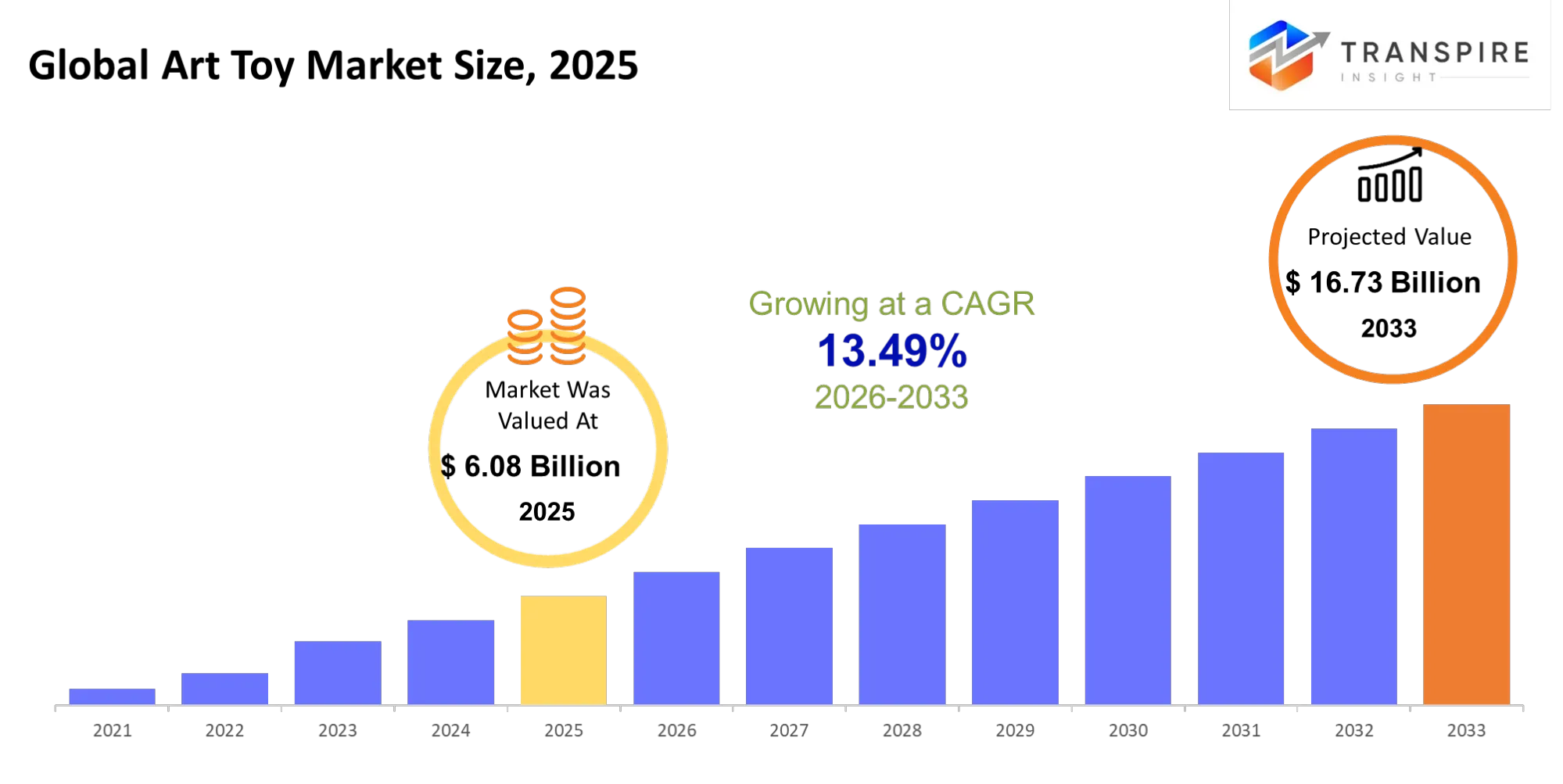
- Global Art Toy Market Size 2025: USD 6.08 Billion
- Global Art Toy Market Size 2033: USD 16.73 Billion
- Global Art Toy Market CAGR: 13.49%
- Global Art Toy Market Segments: By Type (Designer Vinyl Toys, Resin Art Toys, Plush Art Toys, Collectible Figurines, Limited Edition Toys, Custom Handmade Toys, Others); By Application (Collectibles, Home Decor, Pop Culture Merchandise, Gifts & Souvenirs, Fan Merchandise, Others); By End-User (Collectors, Kids, Pop Culture Enthusiasts, Art Communities, Others); By Distribution (Online Retail, Specialty Toy Stores, Comic Conventions, Art Galleries, Others)
Global Art Toy Market Summary:
The Global Art Toy Market size is estimated at USD 6.08 Billion in 2025 and is anticipated to reach USD 16.73 Billion by 2033, growing at a CAGR of 13.49% from 2026 to 2033. The market is characterized by designer toys that can be collected, limited edition dolls, blind box collectibles, and partnerships between artists that are aimed at collectors, hobbyists, and pop culture fans. In the recent past, the market has moved away from being dominated by niche collectors into mainstream adoption due to digital business and social media demand. One major change in the structure of the market has been the move towards IP driven collectibles and direct-to-consumer business models which enable companies to develop fan communities. The fast-growing trend of blind box collectibles and the emergence of collectible trends in reality have acted as the triggers for growth.
Global Art Toy Market Insights:
- The APAC region holds almost 40–45% market share, boosted by growing collector communities and high demand for blind-box collectibles and premium toys.
- Blind-box collectibles make up roughly 30%+ in revenue share, driven by consumers' interest in surprise shopping experience and repeated purchases.
- Adult buyers ("kidults") account for over 25% of total toy spending across several markets, raising demand for premium collectibles and limited editions.
- Brands are scaling direct-to-consumer sales distribution channels, moving away from conventional retail and enhancing customer engagement.
- Launches of limited edition products keep achieving high sell through, and scarcity-driven marketing is one of the main factors motivating purchases.
- Digital communities and social commerce websites are playing an increasing role in purchase decisions and accelerating product discovery.
- Artist-based, entertainment IP-driven, and brand-led collaboration-based product launches are on the rise, offering improved monetization possibilities and cross-sector collaborations.
- Online marketing channels are contributing to over 50% of sales in several types of collectibles, helping ensure worldwide reach and rapid product launches.
- Use of technology like anti-counterfeit measures, digital collectibles, and memberships is increasing customer loyalty and lowering the risk of counterfeiting.
What are the Key Drivers, Restraints, and Opportunities in the Global Art Toy Market?
Driver:
The most important factor behind the Global Art Toy Market's success is the fast growth of the commercialization of collecting culture and intellectual property rights. Expansion into blind box, edition, and creator merchandise lines converted the art toy collectible into a consumer product. Influencer marketing, social media product launches, and fan bases increased the involvement of consumers in the market, resulting in more frequent buying and premium pricing. These factors positively impact the bottom line through improved customer loyalty, scarcity pricing, and direct sales models.
Restraint:
Counterfeit goods and market saturation are key constraints preventing growth. These factors continue to affect the market since collectible items have the element of exclusivity and authenticity, yet it is easier to replicate them using globalized supply chain systems and e-commerce. The existence of counterfeits not only affects brand credibility but also influences resale value and sets pressures on prices. Another key constraint is the overreliance on trendy characters.
Opportunity:
Opportunities for future growth include digital authentication technology, expansion into new markets, and creation of communities around collectibles. Technologies like blockchain authentication, digital ownership certification, and interconnected collectibles can build trust among consumers and justify higher premiums. Expansion of collector communities in Southeast Asia, Latin America, and the Middle East provides additional income potential for both international brands and individual creators.
What Has the Impact of Artificial Intelligence Been on the Global Art Toy Market?
Artificial Intelligence has played an important role in shaping the Global Art Toy Market by enabling efficient product development, accurate demand forecasting, better consumer engagement, and streamlined inventory management. There is a growing trend among the firms to leverage AI analytics tools to understand buyer psychology, their behavior on social media, purchasing pattern, and even activities in the secondary market.
With the help of automation, firms are able to streamline the operation by automating the design process and marketing campaign. The machine learning algorithm allows manufacturers to predict and forecast the demand for limited-edition products, thus minimizing risks associated with inventory management. Based on demand forecasting, firms can determine when to launch a new collection, what price strategy to adopt, and which region to target.
There has been a notable shift towards operational improvements with the use of recommendation engines and customer segmentation techniques, which have proved useful in increasing conversion rates.
For example, in March 2025, many collectibles' brands started using generative AI for accelerating the concept development process and optimizing the release of their collections.
Global Art Toy Market Trends:
- There has been a change from infrequent buying of collectibles to subscription-based purchases due to serialized collections and regular release of limited-edition products.
- In recent years, blind box strategy has developed from being a local product trend to a worldwide business strategy.
- There is a move away from dependence on physical retail stores to more direct-to-consumer ecosystems, giving brands control over pricing, sales, and customers.
- Social media communities have moved from being channels for marketing to platforms for demand generation, as collector communities play an essential role in influencing purchases.
- Product development timelines have been reduced considerably due to the use of digital design software, AI-enabled concept creation, and more efficient prototyping techniques.
- Collaboration-focused business models have grown exponentially popular in recent years as collaboration with artists, entertainment properties, and cross-overs have come to form normal business practices.
- Resale markets have taken on greater importance as secondary market values begin playing a role in consumer purchasing behaviors and the collectibility of items.
- Digital authentication technology and methods of digital ownership are being used more often as companies try to protect themselves from counterfeits.
- Consumer trends have evolved to incorporate ecosystem-based models where membership and exclusivity play a role in building loyal customer bases.
Global Art Toy Market Segmentation:
By Type
Designer vinyl toys hold a dominant market share owing to their collector appeal, scalability, and suitability for collaborative ventures involving licensed intellectual properties. The resin art toys have been able to claim dominance in premium segments owing to their limitation in production processes and unique value propositions, while plush art toys have been gaining ground based on their widespread reach and cross-over appeal. The collectible figurines continue to attract consumer interest owing to fan-driven buying patterns, while limited edition toys contribute to growth through exclusivity. Customized handmade toys continue to remain specialized products but thrive in creator economy ecosystems.
By Application
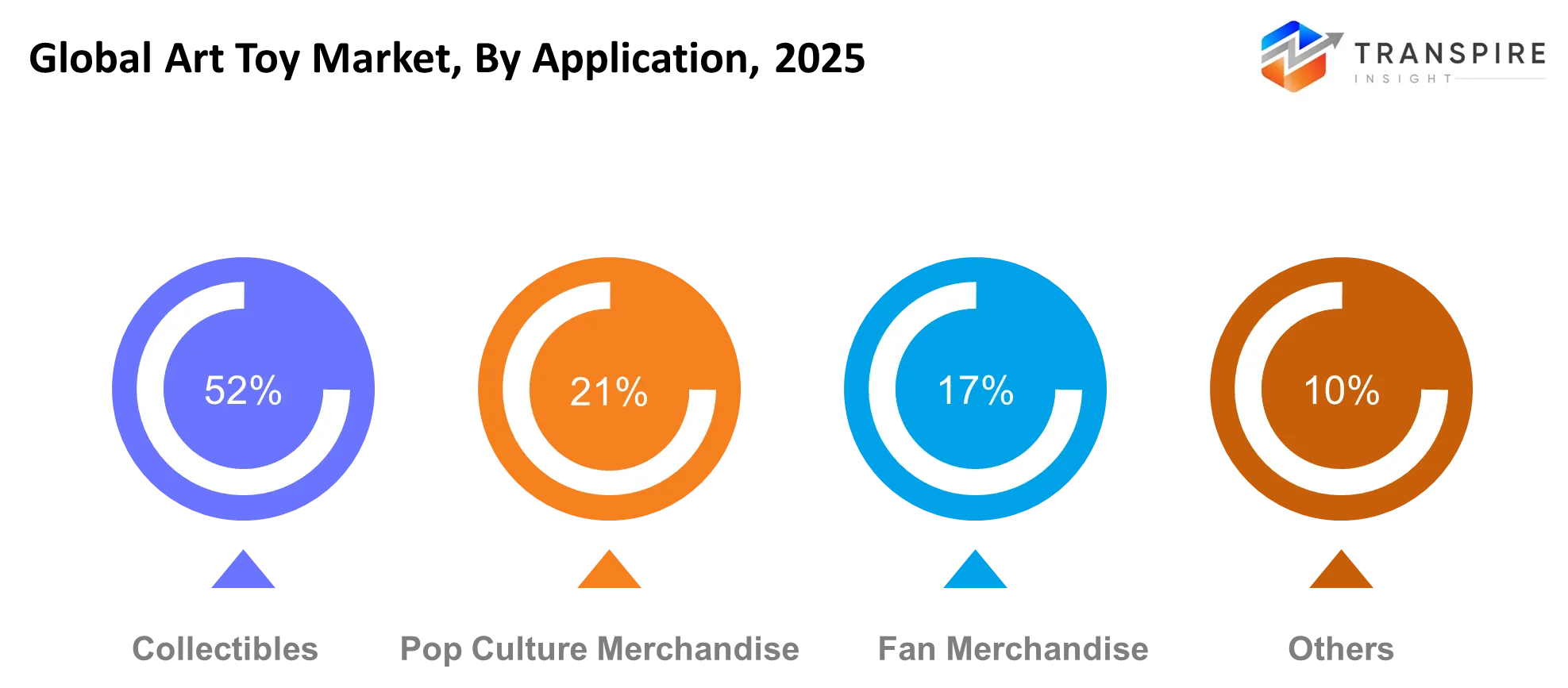
Collectibles will continue to be the market leader since buying behavior is becoming more influenced by value-added ownership, community engagement, and resellability. Collectibles for home décor are increasing as art toys transition to lifestyle decoration items rather than just toys. The markets for pop culture collectibles and fan collectibles will continue to increase due to collaborations within entertainment media, whereas the gifts and souvenirs segments will capitalize on customization trends.
By End-User
As far as end users are concerned, collectors make up the biggest group owing to their increased buying frequency and high-end spending habits. Fans of pop culture as well as those who belong to artistic communities are becoming increasingly important growth sectors owing to the rising importance of communities in encouraging product uptake. Children constitute an important segment within the consumer base for certain products.
By Distribution
In terms of distribution channels, the best option remains online retail due to its accessibility on a global level, interaction with customers, and faster product releases. Toy stores specializing in collectible toys are still catering to their fans, while comic book shows and art galleries will always be key players when exclusivity is the goal. Moving forward, more hybrid distribution models will emerge, incorporating both digital business and experiential physical channels.
What are the Key Use Cases Driving the Global Art Toy Market?
The key application scenario supporting the Global Art Toy Market is ownership-based collecting, which entails buyers purchasing products to build their collections, own limited editions, gain investment value, and engage in fandom activity.
Additional scenarios are developing from the use of art toys as a part of a buyer’s lifestyle and entertainment experience, where art toys serve as elements of home decoration, pop culture merchandise, gifting, and display products. Additionally, companies are exploring ways to enhance art toy usage through collaborations with various brands and entertainment industries.
Future application areas for art toys will be connected with the digital ownership and personalization of collectibles. Specifically, brands can leverage authentic collectible products, hybrid forms of product ownership, and collectible experiences supported by a community of consumers.
|
Report Metrics |
Details |
|
Market size value in 2025 |
USD 6.08 Billion |
|
Market size value in 2026 |
USD 6.9 Billion |
|
Revenue forecast in 2033 |
USD 16.73 Billion |
|
Growth rate |
CAGR of 13.49% from 2026 to 2033 |
|
Base year |
2025 |
|
Historical data |
2021 - 2024 |
|
Forecast period |
2026 - 2033 |
|
Report coverage |
Market size analysis, growth drivers, restraints, opportunities, AI impact assessment, competitive landscape, pricing analysis, consumer behavior trends, supply chain assessment, technological developments, regulatory landscape, and future outlook |
|
Regional scope |
North America, Europe, Asia-Pacific, Latin America, Middle East & Africa |
|
Key company profiled |
Pop Mart, Medicom Toy, Kidrobot, Funko, Mighty Jaxx, KAWS Studio, Bearbrick, LEGO, Hasbro, Mattel, Superplastic, Tokidoki, Hot Toys, Good Smile Company, Bandai Namco. |
|
Customization scope |
Regional analysis, additional company profiling, segment-level analysis, competitive benchmarking, consumer insights, and country-level market breakdown |
|
Report Segmentation |
By Type (Designer Vinyl Toys, Resin Art Toys, Plush Art Toys, Collectible Figurines, Limited Edition Toys, Custom Handmade Toys, Others); By Application (Collectibles, Home Decor, Pop Culture Merchandise, Gifts & Souvenirs, Fan Merchandise, Others); By End-User (Collectors, Kids, Pop Culture Enthusiasts, Art Communities, Others); By Distribution (Online Retail, Specialty Toy Stores, Comic Conventions, Art Galleries, Others) |
Which Regions are Driving the Global Art Toy Market Growth?
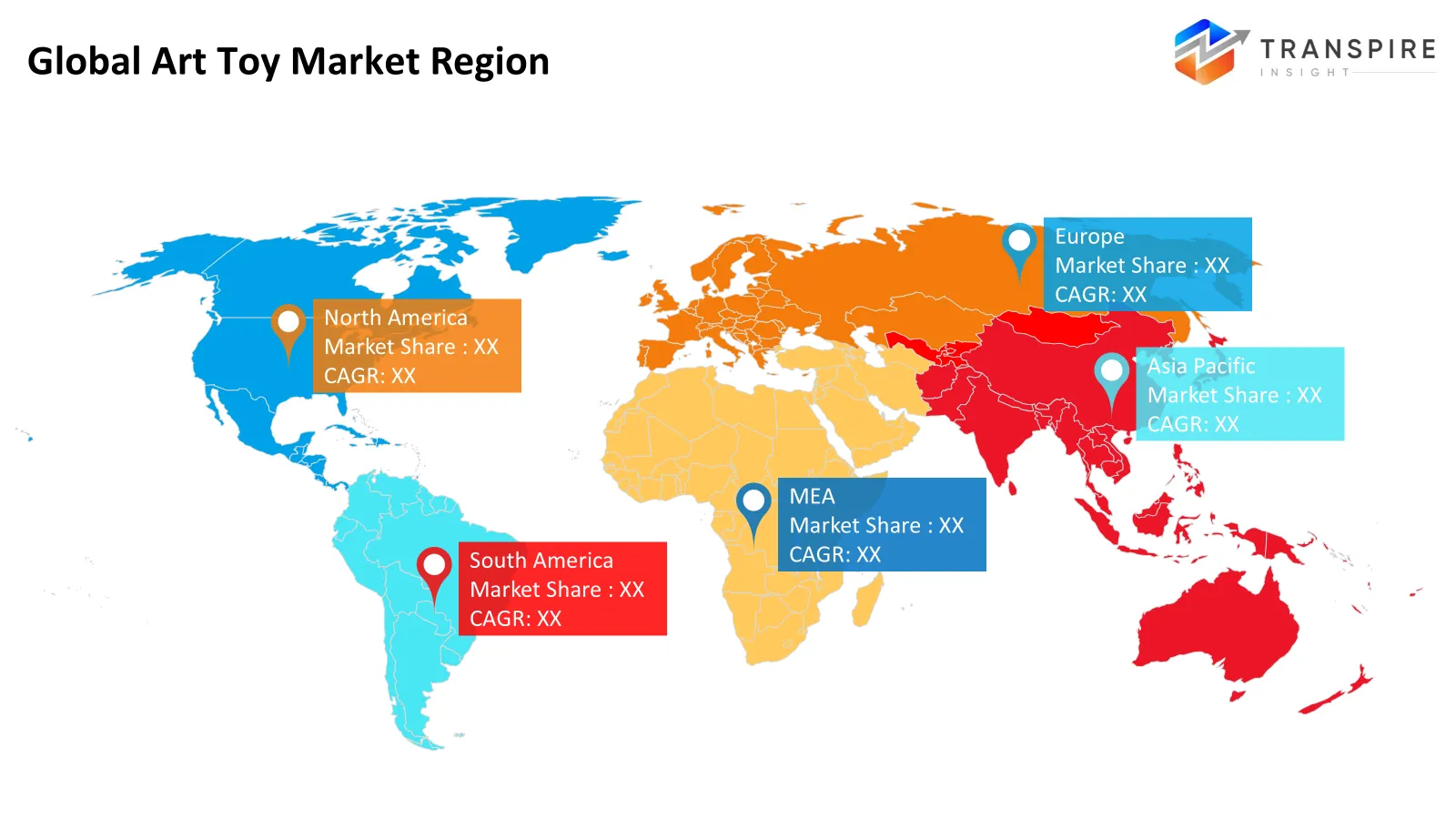
Asia-Pacific leads the Global Art Toy Market because of the existence of an efficient manufacturing environment, existing collecting communities, and a concentrated consumer base fueled by popular culture in the area. The region enjoys well-coordinated production, a developed e-commerce market, and a robust fan economy, thus allowing for faster product launches and purchase frequency. In August 2025, some of the notable collectibles brands fast-tracked their expansion in the region by opening flagship stores and making localized product releases, contributing to the growth in community-led purchases.
The second largest market is that of North America, driven by premium consumer spending and a mature licensing model rather than manufacturing strengths. As compared to the production model economy of the Asia-Pacific region, growth in North America depends more on the entertainment franchise system and collector spending. The sales data for June 2025 indicated an increase in adult consumer spending and collector spending, ensuring the longevity of the market.
With the development of social commerce ecosystem growth and the active involvement of young buyers, Southeast Asia will become the fastest developing region within the year 2025. Recently, the changes have included the emergence of live stream commerce, creator merchandising, and local fan communities that made collecting more accessible. In June 2025, collectible businesses strengthened their relationships with the regional digital commerce platforms in order to increase community engagement and reach. In the future, potential opportunities will arise as a result of growing discretionary incomes, urbanization, and the creator economy.
Who are the Key Players in the Global Art Toy Market and how do they Compete?
Competition in the Global Art Toy Market is not characterized by the size factor but by intellectual property, exclusivity, collaborations between creators, and community involvement. Competitors rely on the strategy of limiting edition, licensing programs, direct to consumer ecosystem, and fan marketing instead of using mass market approaches for developing toys. The market continues to remain highly fragmented due to the various models used by independent artists, small collectible brands, and entertainment companies.
Some of the companies like Pop Mart, Medicom Toy, Funko, Kidrobot, and independent creator platforms compete on the basis of product ecosystem differentiation instead of competitive pricing. Pop Mart depends on product launch backed by big data analysis, creation of blind box ecosystem, and expanding its retail network. Medicom Toy relies on creating a premium brand image, limited edition products, and collaborating with artists. Funko uses large scale licensing deals and entertainment collaboration.
In addition, more and more firms concentrate on niche positioning and creator-based approaches. Kidrobot grows by means of artist partnerships and collectible products that have high value. Custom creator-based brands concentrate on handcrafted products, direct connections with customers, and limited production. Today's expansion strategies incorporate global online sales, local event marketing, and social commerce systems.
Global Art Toy Market Companies:
- Pop Mart
- Medicom Toy
- Kidrobot
- Funko
- Mighty Jaxx
- KAWS Studio
- Bearbrick
- LEGO
- Hasbro
- Mattel
- Superplastic
- Tokidoki
- Hot Toys
- Good Smile Company
- Bandai Namco
Recent Development News:
In March 2026, Pop Mart collaborated with Sony Pictures to create a hybrid live-action/CGI movie based on the Labubu property. Through this collaboration, collectible IP moved from toy merchandise into the realm of entertainment ecosystem, thus providing more long-term business potential and global branding.
In February 2026, the company had grown to include the United States through an exhibition of its AI-based art toy platform in New York Toy Fair. This helped the company penetrate global markets quickly as well as showcase the growing interest in AI innovation in collectibles.
In January 2026, Pop Mart increased its manufacturing capabilities with a new manufacturing facility established in Mexico, which helped in boosting the capability of the company’s supply chain in North America.
What Strategic Insights Define the Future of the Global Art Toy Market?
For the Global Art Toy Market, the future looks like an ecosystem dominated by creators with a strong focus on community engagement, ownership of intellectual property and customer relationship instead of merely scaling up. Those who manage to bring together entertainment, collectibles, digital engagement and exclusivity will secure their spot as providers of choice when it comes to long-term consumer expenditure.
One potential risk is reliance on hype-driven consumer behavior cycles. Too many product launches, too much supply of limited editions and viral trends that last only briefly could erode the concept of exclusivity and impact consumers' buying patterns in negative ways.
An important development for the market will be the ability of companies to design hybrid collectible ecosystems which blend physical collectibles with digital assets, verification mechanisms and communities built around memberships. As consumer behavior moves toward experiential consumption, new ways to monetize will emerge for collectible manufacturers.
In general, it will be critical to concentrate on IP ownership, collaboration with creators and data-driven community management instead of being a mere licensee.
Global Art Toy Market Segmentation:
By Type
- Designer Vinyl Toys
- Resin Art Toys
- Plush Art Toys
- Collectible Figurines
- Limited Edition Toys
- Custom Handmade Toys
- Others
By Application
- Collectibles
- Home Decor
- Pop Culture Merchandise
- Gifts & Souvenirs
- Fan Merchandise
- Others
By End-User
- Collectors
- Kids
- Pop Culture Enthusiasts
- Art Communities
- Others
By Distribution
- Online Retail
- Specialty Toy Stores
- Comic Conventions
- Art Galleries
- Others
Frequently Asked Questions
Find quick answers to common questions.
The Global Art Toy Market size was valued at USD 6.08 Billion in 2025 and is poised to reach USD 16.73 Billion by 2033, expanding at a 13.49% CAGR from 2026 to 2033.
Key segments for the Global Art Toy Market are By Type (Designer Vinyl Toys, Resin Art Toys, Plush Art Toys, Collectible Figurines, Limited Edition Toys, Custom Handmade Toys, Others); By Application (Collectibles, Home Decor, Pop Culture Merchandise, Gifts & Souvenirs, Fan Merchandise, Others); By End-User (Collectors, Kids, Pop Culture Enthusiasts, Art Communities, Others); By Distribution (Online Retail, Specialty Toy Stores, Comic Conventions, Art Galleries, Others)
Growth is primarily driven by rising collector culture, increasing demand for limited-edition collectibles, expanding pop culture influence, growth of blind-box formats, stronger social commerce, and increasing spending by adult consumers and collectors.
The global market is led by major manufacturers including Pop Mart, Medicom Toy, Kidrobot, Funko, Mighty Jaxx, KAWS Studio, Bearbrick, LEGO, Hasbro, Mattel, Superplastic, Tokidoki, Hot Toys, Good Smile Company, Bandai Namco.
Asia-Pacific has a market share of nearly 43%, attributed to a strong community of collectors, advanced manufacturing facilities, growth in blind boxes, solid entertainment IPs, and rising e-commerce usage.
Commercial opportunities in the art toy space include the continued growth of artist-led ecosystems for collectibles, growing acceptance of digital certification of collectibles and digital collectibles, growth potential in emerging markets like Southeast Asia and Latin America, increased popularity of limited edition collaborations, and the growth of direct-to-consumer business models through social commerce and community engagement.
- Pop Mart
- Medicom Toy
- Kidrobot
- Funko
- Mighty Jaxx
- KAWS Studio
- Bearbrick
- LEGO
- Hasbro
- Mattel
- Superplastic
- Tokidoki
- Hot Toys
- Good Smile Company
- Bandai Namco
About the Authors

Chetan Dhatrak
I’m Chetan Dhatrak, a Senior Research Analyst at Transpire Insight, specializing in the Consumer Goods, Foods and Beverages industry. I focus on analyzing market trends, consumer behavior, competitive landscapes, and industry developments to deliver accurate, data-driven insights. My research at Transpire Insight is built on credible sources and in-depth analysis, helping businesses and readers better understand market dynamics, emerging opportunities, and evolving consumer preferences. I’m committed to creating reliable, well-researched content that supports informed decision-making and reflects the latest developments in the consumer goods and food & beverage sectors.

Chakradhar Khansole
Chakradhar serves as the Research Director at Transpire Insight, bringing over 8 years of experience in technology, innovation, and strategic market intelligence. He specializes in transforming complex market data into actionable business insights that enable organizations to make informed, growth-oriented decisions. Recognized for his strategic vision and analytical expertise, Chakradhar leads high-impact research initiatives, delivering comprehensive market assessments, competitive intelligence, and forward-looking industry analysis.
Recently Published Reports
-
Apr 2026
Bottled Water Market
Bottled Water Market Size, Share & Analysis Report By Product Type (Still Bottled Water, Carbonated Bottled Water, Functional Bottled Water, and Others), By Packaging (PET, Cans, and Others), By Sales Channel (Supermarkets/Hypermarkets, Convenience Stores/Drug Stores, Grocery Stores/Club Stores, Foodservice, and Others) and Geography (North America, Europe, Asia-Pacific, Middle East and Africa, South and Central America), 2021 - 2032
-
Apr 2026
Color Cosmetic Packaging Market
Color Cosmetic Packaging Market Size, Share & Analysis Report By Application (Mascara Packaging, Liquid Packaging, and Liquid Face), By Type (Tubes & Bottles, Pens & Markers, Compacts & Containers, and Droppers & Pumps), and Geography (North America, Europe, Asia-Pacific, Middle East and Africa, South and Central America), 2021 - 2031
-
Apr 2026
External Microphone For Camera Market
External Microphone For Camera Market Size, Share & Analysis Report By Type (Shotgun Microphone, Lavalier Microphone, and Others), By Application (Digital Camera, Professional Video Camera, and Others), and Geography (North America, Europe, Asia-Pacific, Middle East and Africa, South and Central America), 2021 - 2031
-
Apr 2026
Foot Orthotic Insoles Market
Foot Orthotic Insoles Market Size, Share & Analysis Report By Type (Pre-fabricated, and Custom-made), By Material (Thermoplastic, Composite Carbon Fiber, and Others), By Distribution Channel (Drug Stores, Hospitals & Clinics, and Others), and Geography (North America, Europe, Asia-Pacific, Middle East and Africa, South and Central America), 2021 - 2031