

France Collectibles Market Size & Forecast:
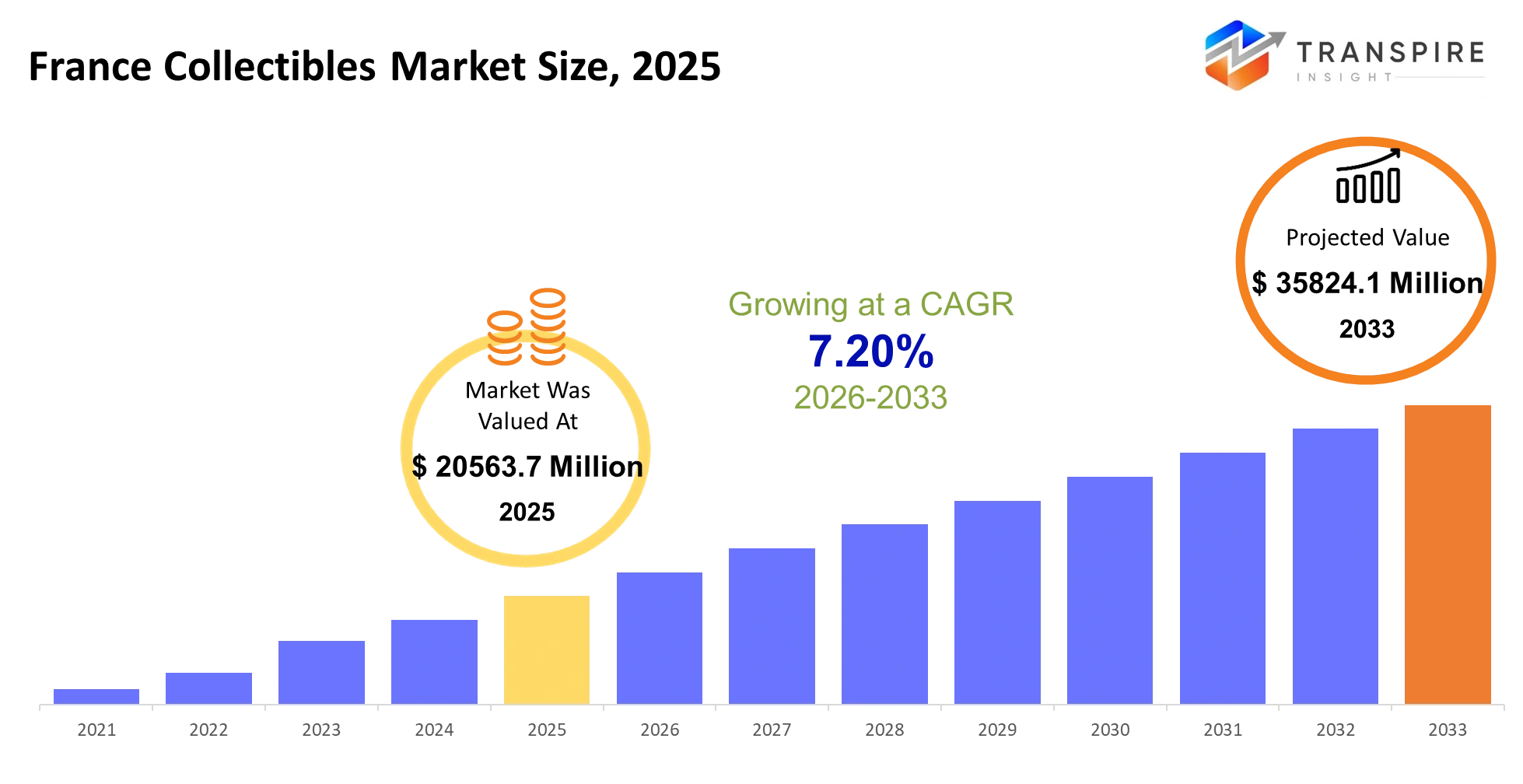
- France Collectibles Market Size 2025: USD 20563.7 Million
- France Collectibles Market Size 2033: USD 35824.1 Million
- France Collectibles Market CAGR: 7.20%
- France Collectibles Market Segments: By Type (Coins & Stamps, Trading Cards, Toys & Figurines, Art & Antiques, Others); By Application (Investment, Hobby, Gifting, Auctions, Others); By End-User (Collectors, Investors, Dealers, Auction Houses, Others); By Distribution (Online Platforms, Auctions, Specialty Stores, Others).
To learn more about this report,  Download Free Sample Report
France Collectibles Market Summary
The France Collectibles Market was valued at USD 20563.7 Million in 2025. It is forecast to reach USD 35824.1 Million by 2033. That is a CAGR of 7.20% over the period.
The France Collectibles Market sort of operates as a value-preservation, and also as an alternative investment ecosystem, where rare items like coins, stamps, luxury memorabilia, vintage art pieces, and limited-edition holdings get exchanged in order to protect wealth and, you know, catch long- term appreciation. In practice, it pulls together private collectors, auction houses, and digital venues that help with authentication, estimation, and resale liquidity for culturally and historically meaningful high-value assets. Over the last five years , the market has been shifting in a more structural way toward digital auction platforms and blockchain provenance checks, which lowers fraud probability and makes the ownership record process more transparent.
One major trigger that has really accelerated this change is the post-pandemic wealth reallocation wave, where people rebalanced and moved out of unstable financial instruments into tangible collectables. As a result, more younger, digital-native buyers have shown up, plus traditional auction houses are now adopting hybrid online-offline bidding models, that in turn extend global access and speed up transaction cadence.
Key Market Insights
- The French Collectibles Market is increasingly kind of pushed forward by online auction platforms that make global folks able to join in, for rare asset trading and then bidding, it’s like participation without borders.
- Digital authentication systems also get more and more focus, they improve transparency, and in turn they lower counterfeit exposure in those high-value collectibles transactions, which is, you know, a big deal.
- Île-de-France basically leads the France Collectibles Market, holding around 38% share, mostly because auction houses are concentrated there, and luxury buyers are too, so it gathers momentum.
- Provence-Alpes-Côte d’Azur is the fastest-growing area, supported by affluent retirees, plus luxury tourism that fuels collectible buying, sometimes impulse driven, but still consistent.
- Coins and numismatics remain the leading segment, largely for the way historical worth tends to stay relevant, and because institutional collectors keep showing up.
- Luxury memorabilia lands in second place, backed by celebrity culture and the involvement of high-net-worth people.
- Digital collectibles and NFTs are the fastest-growing segment too, they’re expanding quickly from 2024 up to 2033, with more adoption than earlier cycles.
- When it comes to end-users, individual collectors are the main force, they take the largest France Collectibles Market share across premium categories, they’re the ones who keep bidding like it’s a hobby and an investment at the same time.
- Investment firms and alternative asset funds are the fastest-growing end-user group, mainly due to portfolio diversification approaches.
- The strategic expansion path now focuses on AI valuation tools, digital provenance tracking, and a mix of hybrid auction models, where physical and online bidding kinda overlap, and people can shift between both.
- Competitive advantage is getting redefined too, it’s not only about inventory anymore, it’s more about authentication accuracy, real access for buyers worldwide, and platform liquidity depth, so execution speed and trust matter.
What are the Key Drivers, Restraints, and Opportunities in the France Collectibles Market?
The main push behind the France Collectibles Market seems to be the growing interest from investors for tangible alternative assets. They offer portfolio diversification beyond stocks and real estate, but people also treat them like a kind of earthy hedge, you know. This trend really picked up after rounds of financial market uncertainty , when sentiment gets shaky. In that context, many high-net-worth individuals started putting money into rare coins , curated art, and luxury memorabilia, all with a longer runway for value growth. Auction houses and digital marketplaces then followed suit, mostly by widening global bidding access . Because of that, transaction volumes have jumped and price discovery feels more efficient than before.
A real restraint, though, is the ongoing hassle around authentication and the ever-present risk of counterfeits. This problem hits hardest in high value art and especially in scarce collectibles. The issue is kind of structural, because verification isn’t simple, it needs specialized know-how, expensive certification workflows, and appraisal rounds that take time. So even if people want in, the “friction” stays stubbornly high , which then limits scaling. Mid tier investors often can’t reach trusted verification networks , so adoption is slower for them.
The most promising opportunity is blockchain enabled provenance systems, paired with AI based valuation tools. Together they can produce an ownership record that is hard to tamper with, while also sharpening price accuracy using data driven appraisal approaches. For instance, digital ledger connections across European auction houses are already improving buyer confidence, plus they’re encouraging more cross-border participation. If this continues, it may open doors for broader retail investors and also increase liquidity across secondary collectible markets , which is something the market still wants.
What Has the Impact of Artificial Intelligence Been on the France Collectibles Market?
Artificial intelligence is quietly reshaping the France collectibles Market, not only by making valuation feel more precise but also by changing how authentication workflows operate, and even how auction price prediction models behave . In practice, modern machine learning systems chew through historical auction data, provenance record trails, and market demand rhythms. From that, they create real-time price estimates for scarce items—like coins, artworks, and luxury collectibles. The upside is that they lower the reliance on manual appraisal work, and transactions move faster across digital auction platforms. On top of that, computer vision tools are being put to work to check authenticity, looking for micro-level weirdness in artwork textures, engraving patterns, and those material aging signatures that can be hard for people to notice right away
Predictive analytics meanwhile supports auction houses in forecasting bidding intensity and choosing better listing timing, which tends to lift final sale prices while also shrinking the number of unsold lots . These tools also tend to improve operational efficiency by boosting auction conversion rates and strengthening liquidity in secondary collectible circles. But, there is still a big snag. The training dataset problem remains, especially for rare and unique assets. Because many collectibles are effectively one-of-a-kind, the AI models can have trouble generalizing cleanly, and that can cause valuation gaps in those narrower niches. Also, the integration expense for advanced AI authentication systems is still pretty high for smaller auction operators, so full-scale rollout across the broader ecosystem gets delayed, sometimes for quite a while .
Key Market Trends
- Digital auction platforms, kind of expanded adoption after 2022 and honestly it pushed cross-border bidding participation up by more than 30 percent across France collectibles transactions.
- Then in 2024 blockchain-based provenance systems showed up, which improved authentication accuracy and also cut down counterfeit risks, especially for high-value collectible categories.
- Around 2023 to 2025 traditional auction houses shifted toward hybrid bidding models, mixing live galleries with real-time global online participation, you know like a blended experience.
- Meanwhile, trading card markets picked up fast after 2021, largely because grading standardization systems got rolled out by firms like Beckett and PSA.
- After 2023 institutional investors increased their allocations in collectibles, viewing rare assets as inflation-hedged alternative investment instruments, pretty straightforward.
- In 2025 AI-based valuation tools gained traction too, and they improved price discovery efficiency for art and rare memorabilia segments.
- Also luxury memorabilia demand climbed after 2022. That was fueled by celebrity culture monetization , plus those limited-edition merchandise drops that keep landing.
- Secondary resale platforms strengthened liquidity between 2023 and 2025, which reduced holding periods for mid-tier collectibles in a noticeable way.
- By 2024 authentication services became mandatory across major platforms. This reshaped trust dynamics in online collectibles marketplaces, like a real shift not just marketing.
- Finally, regional buyer participation diversified after 2023, with more interest coming from secondary French cities beyond the usual Paris-centered trading hubs.
France Collectibles Market Segmentation
By Type
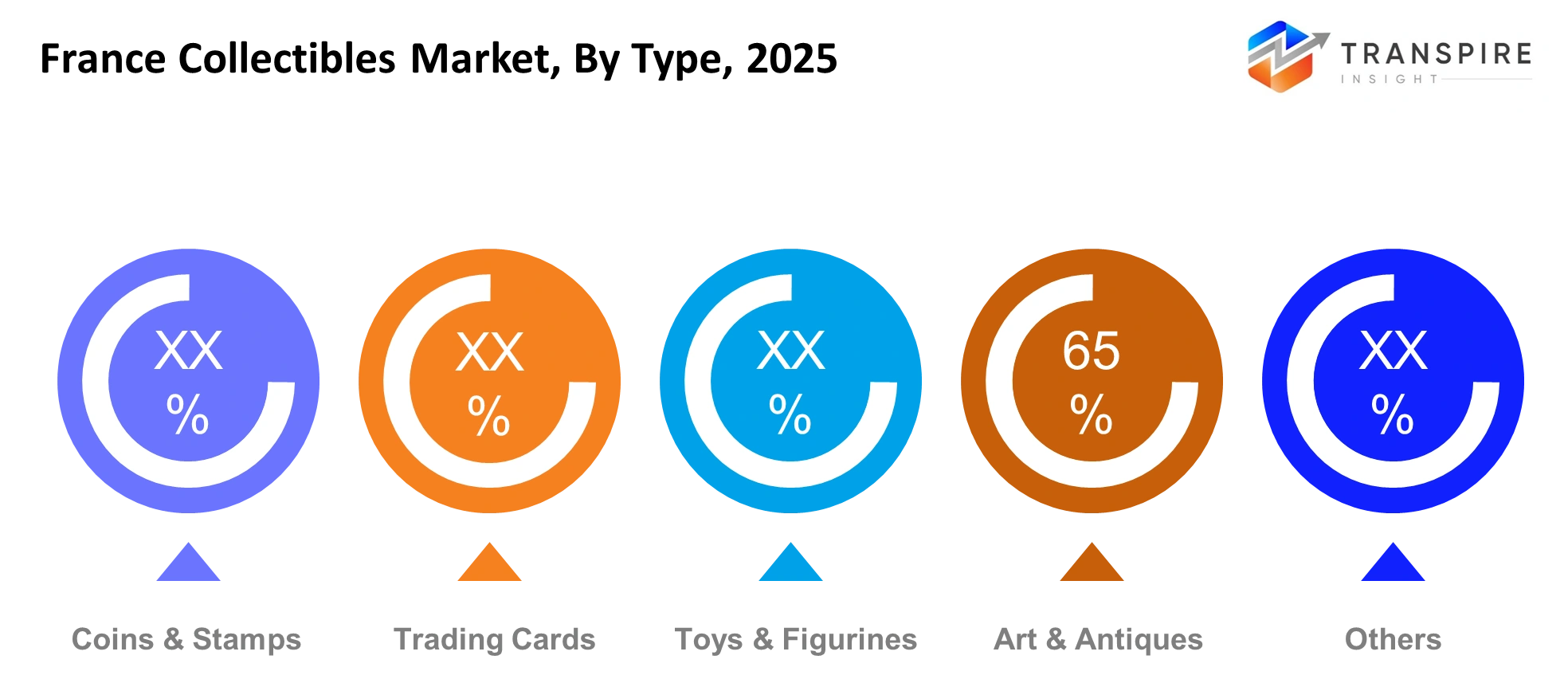
Coins & Stamps keep a sort of dominant place in the France Collectibles Market because of their deep historical value, and also because museums, private collectors, and investment-grade buyers tend to request them pretty steadily. In practice, this area enjoys strong liquidity at auction houses and fairly clear valuation benchmarks, usually tied to rarity, mint condition, and historical significance. What’s interesting is that demand doesn’t really swing much with the usual fashion cycles , it’s more about long-run preservation value, so it becomes kind of a “core allocation” for conservative people.
Trading Cards are the segment that moves the quickest, pushed by sports fandom monetization, digital grading systems, and global resale platforms that add more price transparency. Toys & Figurines stay in a steady middle position, supported by nostalgia, plus franchise-linked collectibles from entertainment industries. Art & Antiques is where the highest value sits, influenced by ultra-high-net-worth buyers and cross-border auction flows that often concentrate around Paris. Over time, digital authentication and the expansion of online auctions will likely shift more weight toward collectible categories that trade faster, even if premium dominance in art assets remains mostly in place.
To learn more about this report, Download Free Sample Report
By Application
Investment use cases pretty much lead the France Collectibles Market, partly because collectibles are starting to behave like alternative financial assets more and more, helping hedge against inflation and the usual equity market wobble. People with higher budgets tend to lean toward asset appreciation and also portfolio diversification , plus better cross border liquidity , especially in coins, paintings, and rare memorabilia. The auction setup in Paris helps a lot here, because it supports price discovery and lets institutions handle deals that are more or less transaction-ready.
At the same time, hobby driven involvement stays steady, but it’s still widening. Younger collectors are getting in through digital marketplaces, and they move through community based trading spaces. Gifting use cases are smaller, yet they’re not going away, usually tied to cultural celebrations , heritage pieces, and luxury memorabilia buys. Auction activity keeps growing too, acting like a hybrid option where live bidding blends with online participation. Over time, investment centered demand should intensify, as financial institutions begin packaging collectibles into structured alternative asset portfolios.
By End-User
Investment use cases pretty much lead the France Collectibles Market, partly because collectibles are starting to behave like alternative financial assets more and more, helping hedge against inflation and the usual equity market wobble. People with higher budgets tend to lean toward asset appreciation and also portfolio diversification , plus better cross border liquidity , especially in coins, paintings, and rare memorabilia. The auction setup in Paris helps a lot here, because it supports price discovery and lets institutions handle deals that are more or less transaction-ready.
At the same time, hobby driven involvement stays steady, but it’s still widening. Younger collectors are getting in through digital marketplaces, and they move through community based trading spaces. Gifting use cases are smaller, yet they’re not going away, usually tied to cultural celebrations , heritage pieces, and luxury memorabilia buys. Auction activity keeps growing too, acting like a hybrid option where live bidding blends with online participation. Over time, investment centered demand should intensify, as financial institutions begin packaging collectibles into structured alternative asset portfolios.
By Distribution
Online platforms dominate the France Collectibles Market growth, or at least that is how it usually looks, thanks to global accessibility, real-time bidding systems and better authentication technologies that lower fraud risk. Digital marketplaces also expand liquidity by linking sellers and buyers across borders, which boosts transaction frequency for mid-tier collectibles, kinda steadily. This channel tends to fit younger, tech-savvy collectors who like transparent pricing, and they also want instant access to global inventories with no delays.
Meanwhile auction houses remain the strongest channel for high-value trades, specially in fine art and rare collectibles, where trust and provenance checks are basically non-negotiable. Specialty stores keep a steady footing too, because they serve niche collectors, and they offer curated, in-person purchasing experiences for things like coins, stamps, and memorabilia. In the long run online platforms should take more and more share, but auction houses will still lead ultra-premium transactions, mainly because of their credibility, expertise, and those exclusive asset sourcing networks.
What are the Key Use Cases Driving the France Collectibles Market?
The core use case in the France Collectibles Market, it kinda leans on wealth preservation via acquisition of rare assets like coins , fine art, and limited-edition memorabilia, yes. High-net-worth individuals plus institutional collectors are the main pull here, because these assets work as inflation-resistant stores of value and also they tend to show long-term value growth, particularly when markets get shaky.
Broader applications spread out into portfolio diversification, mainly for investment firms and alternative asset funds that want to weave collectibles into more structured wealth management plans. Auction houses and online digital marketplaces help with resale liquidity, so collectibles become easier to transfer across secondary markets. That, in turn, boosts investor confidence a bit more than before.
On the newer side, there are emerging use cases such as tokenized ownership of physical collectibles and fractional investment setups made possible by digital platforms. Luxury brands and fintech platforms are also trialing blockchain-backed provenance systems, in order to widen access for mid-tier investors and improve international trading efficiency during the forecast period, which is pretty much the point here.
|
Report Metrics |
Details |
|
Market size value in 2025 |
USD 20563.7 Million |
|
Market size value in 2026 |
USD 22022.9 Million |
|
Revenue forecast in 2033 |
USD 35824.1 Million |
|
Growth rate |
CAGR of 7.20% from 2026 to 2033 |
|
Base year |
2025 |
|
Historical data |
2021 - 2024 |
|
Forecast period |
2026 - 2033 |
|
Report coverage |
Revenue forecast, competitive landscape, growth factors, and trends |
|
Regional scope |
France |
|
Key company profiled |
eBay, Sotheby’s, Christie’s, Heritage Auctions, StockX, Catawiki, Fanatics, Topps, Hasbro, LEGO, Panini, ComicConnect, Bonhams, PWCC, Beckett. |
|
Customization scope |
Free report customization (country, regional & segment scope). Avail customized purchase options to meet your exact research needs. |
|
Report Segmentation |
By Type (Coins & Stamps, Trading Cards, Toys & Figurines, Art & Antiques, Others); By Application (Investment, Hobby, Gifting, Auctions, Others); By End-User (Collectors, Investors, Dealers, Auction Houses, Others); By Distribution (Online Platforms, Auctions, Specialty Stores, Others). |
Which Regions are Driving the France Collectibles Market Growth?
Île-de-France, um leads the France Collectibles Market, mostly because it holds a lot of the big auction houses, luxury galleries and also institutional buyers. Paris , well it works like a global nexus for art trading and rare asset valuation, and that’s helped by solid regulatory supervision. There’s also an authentication setup that is already very established, so people trust it. Another thing is that the area has dense financial ecosystems, and they basically link collectors, investors and cultural institutions. Because of that, the high liquidity in premium collectibles stays strong, since international auctions happen often and global buyers join in a lot.
Auvergne-Rhône-Alpes looks more like a steady secondary region, with fairly consistent demand, especially around affluent urban places such as Lyon . Here, unlike the capital region, growth comes from ongoing domestic collector behavior, not so much from worldwide auction inflows. Economic steadiness and strong cultural heritage institutions keep mid-tier collectibles active, and you can see continual participation. On top of that, there’s a gradual build-out of regional auction houses, plus private dealerships , that help keep transaction volumes predictable, more or less.
Provence-Alpes-Côte d’Azur is actually the fastest-growing region, driven by luxury tourism climbing and more involvement from high-net-worth retirees. Also, recent upgrades in cultural exhibition infrastructure, along with coastal wealth inflows, have boosted collectibles trading. The seasonal international buyers do add some extra transaction volatility . But at the same time, they help expansion happen faster. So, this trajectory suggests meaningful chances for digital auction platforms and mobile-first trading approaches aimed at cross-border collectors over the 2026–2033 period.
Who are the Key Players in the France Collectibles Market and How Do They Compete?
France Collectibles Market feels moderately consolidated, like the legacy auction houses still pull the high value stuff, but the digital platforms…yeah they mess with mid-tier and mass-market trading. So competition really comes down to authentication capability, how far the buyers can reach globally, and how liquid the platform is, not only about pricing. The older players tend to hold ground using reputation and exclusive inventory access, while online platforms scale fast due to accessibility , and those lower transaction barriers too.
Sotheby’s goes heavier on ultra high value art plus rare collectibles, and it leans on curated auctions and private sale routes that bring in elite buyers worldwide. Its main strength is in exclusive asset sourcing , along with invitation based bidding that basically keeps premium pricing power alive. Growth happens via hybrid digital auctions, and also through cross border private client services.
Christie’s, on the other hand, differentiates with global auction reach and strong advisory help for art investment portfolios, and it keeps building digital bidding infrastructure to pull in more international participation. eBay really dominates the more accessible collectibles trading, because it allows peer to peer transactions across coins , memorabilia , and trading cards, and it does it with scale and liquidity behind it. Catawiki grows through curated online auctions, with expert verification, and it targets those mid-tier collectors who want authenticated assets without the whole uncertainty. In the end they compete by mixing trust systems , digital scalability, and that global marketplace integration piece.
Company List
- eBay
- Sotheby’s
- Christie’s
- Heritage Auctions
- StockX
- Catawiki
- Fanatics
- Topps
- Hasbro
- LEGO
- Panini
- ComicConnect
- Bonhams
- PWCC
- Beckett
Recent Development News
In September 2025, eBay expanded its Authenticity Guarantee program to additional collectible categories, including trading cards and luxury memorabilia. The expansion improved buyer trust and increased transaction volumes in high-value secondary collectibles markets.
Source: https://www.ebayinc.com
What Strategic Insights Define the Future of the France Collectibles Market?
The France collectibles market is kinda moving toward a digitally verified, globally liquid asset system, where provenance, authentication, and fractional ownership sort of become the real drivers of long-term growth. Expansion will be powered by blockchain- backed ownership records and AI-assisted valuation models, that cut down uncertainty in pricing those rare items, and at the same time make cross-border trading faster, and less messy.
But there is a hidden risk too. Market concentration, among a few major auction houses, can end up narrowing the spotlight on price transparency, and if digital platforms don’t manage access well, competitive liquidity could get suppressed.
A more interesting opportunity is fractional investment in high-value collectibles, via regulated tokenization platforms, especially around Paris, where fintech and cultural-asset ecosystems seem to be converging. For market participants, the priority should be strong digital authentication infrastructure and multi-channel distribution strategies, so you can reach younger investors while keeping trust in high-value dealings, for buyers all over the world.
France Collectibles Market Report Segmentation
By Type
- Coins & Stamps
- Trading Cards
- Toys & Figurines
- Art & Antiques
- Others
By Application
- Investment
- Hobby
- Gifting
- Auctions
- Others
By End-User
- Collectors
- Investors
- Dealers
- Auction Houses
- Others
By Distribution
- Online Platforms
- Auctions
- Specialty Stores
- Others
Frequently Asked Questions
Find quick answers to common questions.
The approximate France Collectibles Market size for the market will be USD 35824.1 Million in 2033.
Key segments for the France Collectibles Market are By Type (Coins & Stamps, Trading Cards, Toys & Figurines, Art & Antiques, Others); By Application (Investment, Hobby, Gifting, Auctions, Others); By End-User (Collectors, Investors, Dealers, Auction Houses, Others); By Distribution (Online Platforms, Auctions, Specialty Stores, Others).
Major France Collectibles Market players are eBay, Sotheby’s, Christie’s, Heritage Auctions, StockX, Catawiki, Fanatics, Topps, Hasbro, LEGO, Panini, ComicConnect, Bonhams, PWCC, Beckett.
The France Collectibles Market size is USD 20563.7 Million in 2025.
The France Collectibles Market CAGR is 7.20% from 2026 to 2033.
- eBay
- Sotheby’s
- Christie’s
- Heritage Auctions
- StockX
- Catawiki
- Fanatics
- Topps
- Hasbro
- LEGO
- Panini
- ComicConnect
- Bonhams
- PWCC
- Beckett
Recently Published Reports
-
Apr 2026
Bottled Water Market
Bottled Water Market Size, Share & Analysis Report By Product Type (Still Bottled Water, Carbonated Bottled Water, Functional Bottled Water, and Others), By Packaging (PET, Cans, and Others), By Sales Channel (Supermarkets/Hypermarkets, Convenience Stores/Drug Stores, Grocery Stores/Club Stores, Foodservice, and Others) and Geography (North America, Europe, Asia-Pacific, Middle East and Africa, South and Central America), 2021 - 2032
-
Apr 2026
Color Cosmetic Packaging Market
Color Cosmetic Packaging Market Size, Share & Analysis Report By Application (Mascara Packaging, Liquid Packaging, and Liquid Face), By Type (Tubes & Bottles, Pens & Markers, Compacts & Containers, and Droppers & Pumps), and Geography (North America, Europe, Asia-Pacific, Middle East and Africa, South and Central America), 2021 - 2031
-
Apr 2026
External Microphone For Camera Market
External Microphone For Camera Market Size, Share & Analysis Report By Type (Shotgun Microphone, Lavalier Microphone, and Others), By Application (Digital Camera, Professional Video Camera, and Others), and Geography (North America, Europe, Asia-Pacific, Middle East and Africa, South and Central America), 2021 - 2031
-
Apr 2026
Foot Orthotic Insoles Market
Foot Orthotic Insoles Market Size, Share & Analysis Report By Type (Pre-fabricated, and Custom-made), By Material (Thermoplastic, Composite Carbon Fiber, and Others), By Distribution Channel (Drug Stores, Hospitals & Clinics, and Others), and Geography (North America, Europe, Asia-Pacific, Middle East and Africa, South and Central America), 2021 - 2031