

Global Aluminium Fishing Boat Market Size & Forecast:
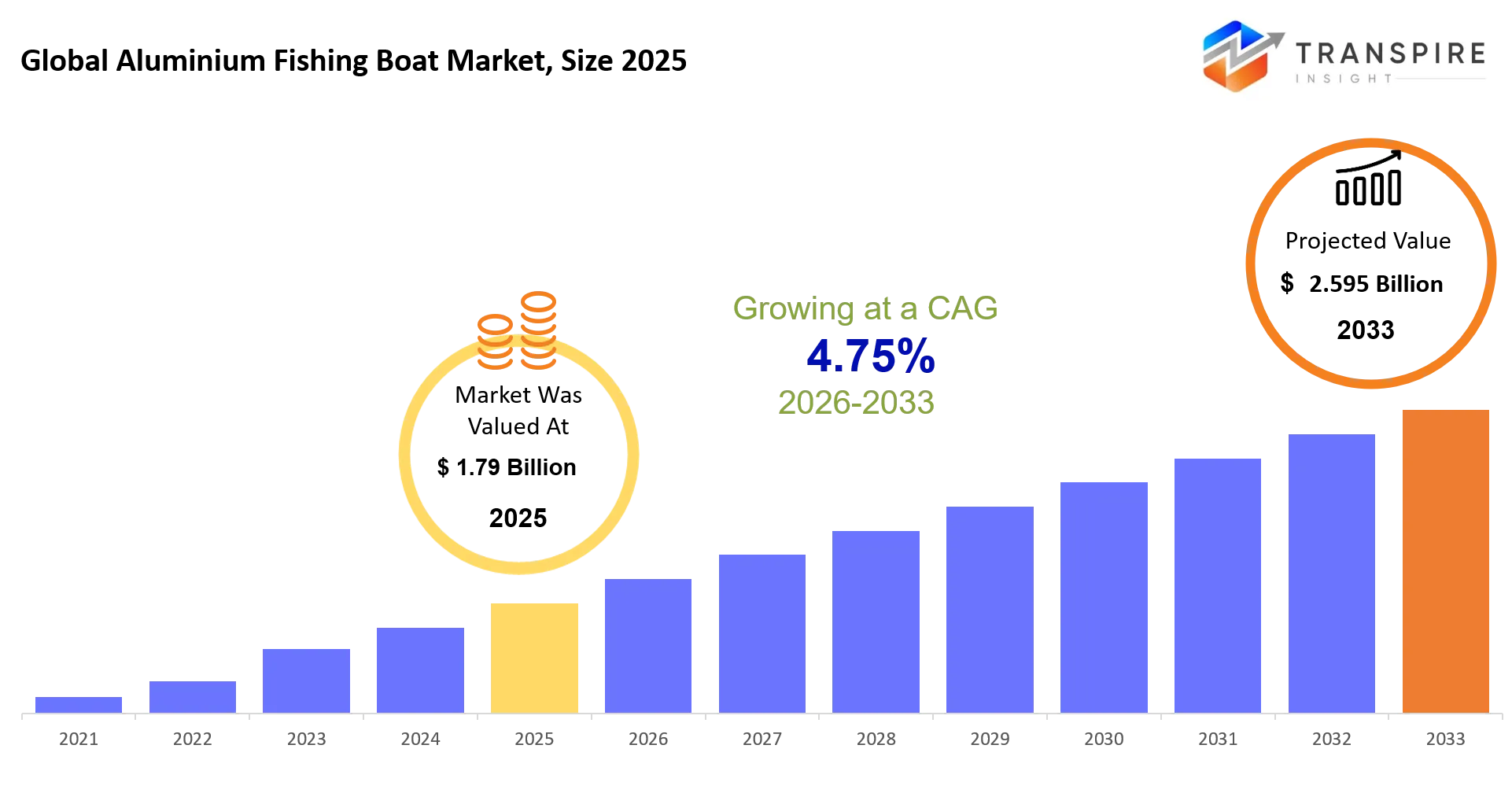
- Global Aluminium Fishing Boat Market Size 2025: USD 1.79 Billion
- Global Aluminium Fishing Boat Market Size 2033: USD 2.595 Billion
- Global Aluminium Fishing Boat Market CAGR: 4.75%
- Global Aluminium Fishing Boat Market Segments: By Type (Jon Boats, Bass Boats, Center Console Boats, Pontoon Boats, Deep-V Fishing Boats, Utility Fishing Boats, Others); By Application (Freshwater Fishing, Saltwater Fishing, Recreational Boating, Commercial Fishing, Sports Fishing, Others); By End-User (Individual Consumers, Commercial Fishermen, Rental Operators, Sports Clubs, Others); By Length (Below 15 ft, 15–20 ft, 20–30 ft, Above 30 ft, Others).
Global Aluminium Fishing Boat Market Summary:
As per Transpire Insight Analysis, the Global Aluminium Fishing Boat Market size is estimated at USD 1.79 Billion in 2025 and is anticipated to reach USD 2.595 Billion by 2033, growing at a CAGR of 4.75% from 2026 to 2033.
Aluminium fishing boats provide lightweight, robust and corrosion-resistant platforms and can be used by commercial or recreational fishers, as they consume less fuel and are easier to maintain. In the last 3-5 years, the market moved from simple utility designs to modular, electronics-ready craft, as anglers and small-scale fleets wanted seamless fish-finding solutions and requested simple retrofits. A real-world trigger – subsidies and tighter marine emission rules in several regions – combined with a structural shift to electrification and lightweight composite fittings (which reduces overall weight and extends the range) was the impetus for buyers to turn to more efficient aluminium hulls. With the fuel savings, advances in battery technology and a preference for low-maintenance boats, manufacturers are finding ways to add value to the vessel with customization—and digital packages—and are finding that those added values are helping the boats sell and thus expanding market growth with greater adoption rates in recreational and small commercial markets.
Key Global Aluminium Fishing Boat Market Insights:
As technology advances, the Global Aluminium Fishing Boat Market is increasingly digital, sales-driven by growing customer demand for simplifying ownership and modular construction. One thing that became clear is that competition is no longer just price-based; it's about the value proposition companies can offer for boat design, electronics and after-sales service wrapped together.
· Freshwater fishing boats have 41% share, and companies are working to meet the demands of inland fishermen who desire compact models that can be easily trailered and maintained and have faster launch times.
· Saltwater fishing boats make up 24% of the total, and manufacturers are adding more corrosion resistance and hull strength to handle tougher conditions.
· Twenty per cent of fishing boats are pontoon boats, and brands are incorporating features that appeal to the family market looking for leisure and fishing all in one.
· Other formats account for 15% while smaller players are opting for special designs that cater to specific and regional use cases.
· The fastest-growing part of the market is electric-powered fishing boats, which grew by 11.7% CAGR, with the fishing boat builders introducing quieter propulsion and cleaner operating systems.
· Online sales channels are growing, and businesses are leveraging online configurators to fast-track the purchasing process and eliminate dealer friction.
· Modular outfitting is getting more popular, and boat manufacturers are creating designs that allow it to be easier to add electronics and accessories.
· North America represents 38% of the market, with big recreational boating expenditure, and also has a high preference for electronics-ready fishing boats.
· Asia Pacific accounts for 26% share and is rising in the market; local production and water transport are making aluminium boats more appealing for new users.
What are the Key Drivers, Restraints, and Opportunities in the Global Aluminium Fishing Boat Market?
Drivers:
Buyers' demand for lighter, more fuel-efficient aluminium fishing boat hulls that reduce operating costs and ease trailering, particularly for recreational anglers and small-scale commercial operators, is driving the industry's expansion. The rising cost of fuel and demand for simple-to-maintain, easily fitted-out vessels with sonar, trolling motors and other electronics has been the catalyst for increased adoption and increased value sales. In November 2025, demand for modular models with electronics saw a tangible increase as manufacturers emphasised durability and simplified retrofits in their positioning.
Restraint:
Aluminium boats with better equipment are more expensive when new, and are also competing with fibreglass and composite boats, which can have better ride qualities and higher price points. This limitation continues as the purchase of boats is cyclical and capital-intensive, and many buyers only replace boats or trade up when boats are too expensive to operate. Furthermore, the competition from the supply side requires manufacturers to focus on price and customization – not just quantity – and narrows their margins.
Opportunity:
There is a big opportunity to introduce electric-ready platforms, lighter modular fittings and regional expansion into areas where there is growing inland fishing and small boat ownership. New uptake in Asia-Pacific and North America includes hybrid and electric propulsion packages that can be dealer-installed with aluminium hulls, which provide higher margins than the sale of a standard aluminium hull. The transition would also benefit manufacturers to attract buyers who are concerned about the environment, who will want quieter, cleaner, and cost-efficient boats. Meanwhile, rental fleets and guided fishing may increasingly adopt these upgrades since they increase the utilization of the vessels and create repeat replacement demand. In March 2026 could see stronger uptake in Asia-Pacific and North America if builders bundle aluminium hulls with hybrid or electric propulsion packages and dealer-installed electronics, turning boats into higher-margin systems instead of standard hull sales
What Has the Impact of Artificial Intelligence Been on the Global Aluminium Fishing Boat Market?
AI is beginning to transform the aluminium fishing boat industry by offering more efficient design, manufacturing, service processes. AI software is being employed by builders to fine-tune hull geometry, weight distribution, and material usage, contributing to enhanced fuel efficiency and lowered waste in production. AI also supports predictive capabilities by analysing usage partners, engine performance, and service data to anticipate maintenance needs before failures occur, which helps owners cut downtime and control repair costs. In the business end, AI enhances production scheduling, stock management, and support for dealers, equipping manufacturers to handle orders more quickly and efficiently. This is particularly helpful when someone is purchasing a customized boat with built-in electronics and improved performance. Despite this, there are still barriers to adoption due to the cost of setup and the integration of AI systems into existing design and production workflows. Smaller manufacturers may struggle with a learning curve, slowing the rollout and stalling efficiency gains. In April 2026, marked stronger interest in AI-enabled simulation and design workflows as manufacturers looked for faster product development and better performance validation.
Key Global Aluminium Fishing Boat Market Trends:
The fishing boats, made of Aluminum, are shifting from basic, utility-focused designs to tech-ready, configurable ones to reduce operating costs and maintenance for rental fleets and recreational anglers. This change has affected the way boats are designed and sold, with buyers now looking for more modular options that allow them to fit an electric or hybrid drive and integrated electronics into the boat.
- More electronics integration: In the last five years, builders are no longer just putting electronics "on option" but are now building the wiring and dash packages into the boat.
- Material improvements: New corrosion-resistant aluminium alloys resulted in fewer maintenance visits and increased customer expectations for longer maintenance intervals.
- Steady transition from retrofit to purpose-built transom and battery space for electric/hybrid outboards.
- Electrification prep: Steady transition from retrofit to purpose-built transom & battery space for electric/hybrid outboard.
- Custom orders and shorter lead times: Storage, livewells and seating are now modular, allowing custom orders to be completed in a quicker timeframe than fixed production interiors.
- Digital sales and service: Online configurators and remote diagnostics have grown, altering dealer processes and shortening OTD.
- Rental and commercial adoption: Low-maintenance aluminium models were favoured by the beginning of guided and rental operators, increasing the demand for high utilisation and robust builds.
- Supply chain sensitivity: High aluminium price volatility and supply chain delays have encouraged manufacturers to shift to keeping the inventory closer to the manufacturing facility and minimize bill of materials.
- After-market packages: The sonar, trolling motor, and battery packages are growing and bringing in repeat revenue after the boat sale.
- Regional market repositioning: Inward regional markets (Asia-Pacific and Latin America) are shifting from imports to regional assembly, altering the competitive landscape and pricing.
Global Aluminium Fishing Boat Market Segmentation
By Type:
The fishing boat market is dominated by Jon boats, bass boats, center console boats, pontoon boats, deep-V fishing boats, utility fishing boats, and other specialty types, reflecting varying purchasing motivations. Jon boats and utility boats are still the economical boats of choice for those who value ease of use and convenience; bass and deep-V boats are continuing to sell to those who value fishing performance and stability. Centre console boats are being seen in more applications as they allow flexible movement and better open water performance, while pontoon boats are finding their niche with those looking for comfort but also for fishing applications. Electric-powered fishing boats are the fastest growing type, with a CAGR of 11.7%, boosted by the growing influence of quieter operation, lower running costs and cleaner ownership as purchase drivers. The change indicates that future product designs are likely to be all lighter, battery-ready and more efficient in-house.
By Application:
The freshwater fishing industry has the best footing at 41%, while the saltwater fishing industry is at 24%, pontoon fishing boats at 20%, and others at 15% by application. However, freshwater fishing continues to outpace other uses by providing consistent daily sales, particularly to those who seek an affordable, easily owned boat. The growth logic of saltwater fishing is different, and the demand is related to the strength of the hull and its performance in adverse circumstances. Pontoon fishing boats are growing in market as they are meeting the recreational boating behaviour of families and leisure buyers who look for a balance of comfort and light fishing utility. The smaller “others” category represents niche demand but also helps to drive market breadth by adding mixed use and specialty demand.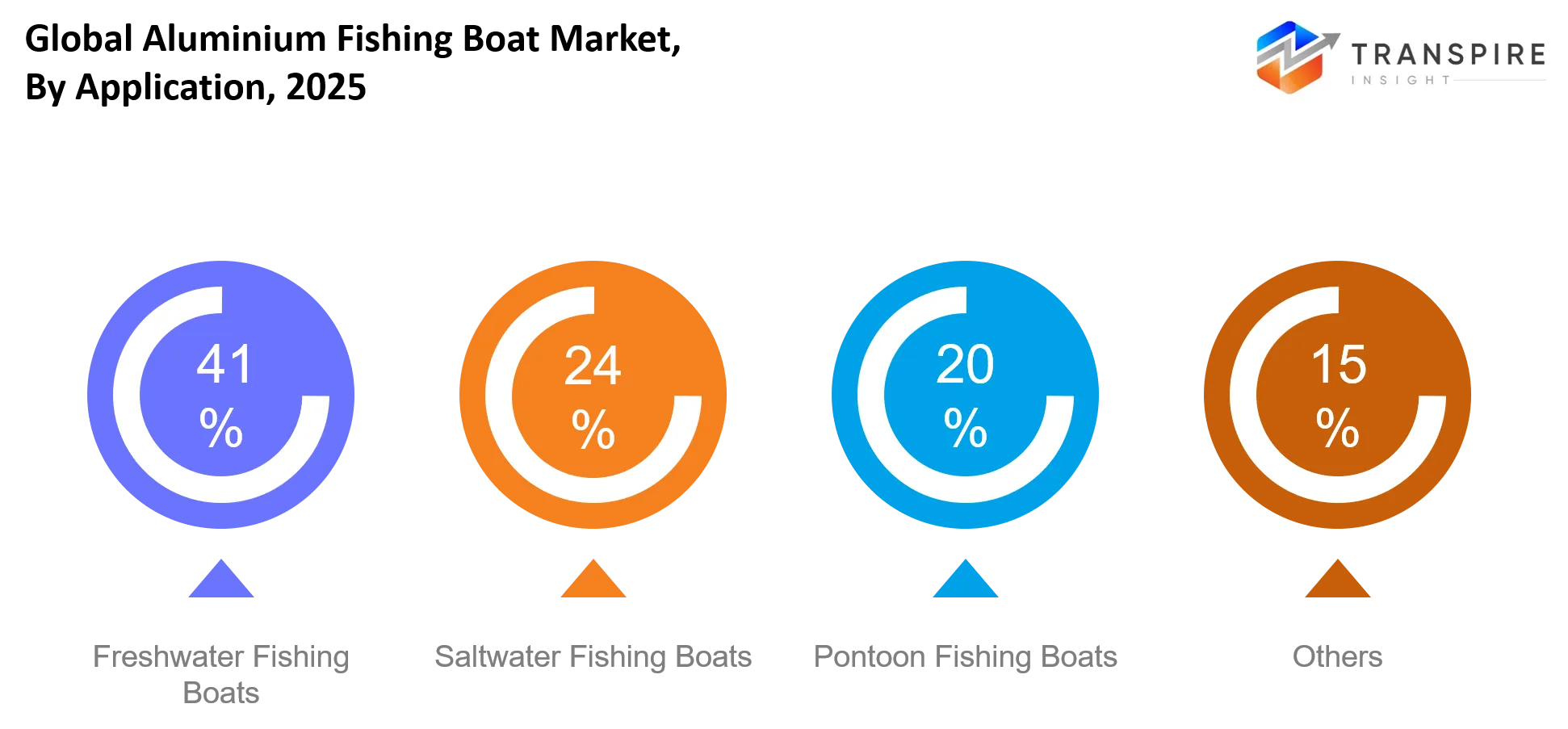
By End User:
Individual consumers are the main market, with various other usage patterns including commercial fishermen, rental operations, sports clubs and more. People purchase aluminium boats as they are simpler to keep, tow, and store. Commercial fishermen are concerned with the reliability of the job and operating efficiency, whereas rental operators are interested in durability and reduced exposure to maintenance due to increased use cycles. Sports clubs increase demand further with organised boating and fishing activities, which drive periodic replacement of boating and fishing fleets. Whether this segment can succeed in the future will be linked to the ability of the manufacturers to cater for each of their buyer groups without making the ownership of these crafts more complicated.
By Length:
Size groups of less than 15 ft, 15-20 ft, 20-30 ft, more than 30 ft, and others have different operating requirements. The 15–20 ft and 20–30 ft sizes are still the most commercially viable as they are ideal for storage, transport and on-water stability for the maximum buyers. Smaller boats, less than 15 ft, come in more often with entry-level and inland use, and larger boats, greater than 30 ft, are more associated with specialized commercial and/or offshore use. This size combination reflects the trend toward more strategic sizing, where buyers are selecting boats for their fishing activities, location, and level of boat ownership convenience.
What are the Key Use Cases Driving the Global Aluminium Fishing Boat Market?
Aluminium fishing boats continue to be predominantly used for recreational and sport fishing where the purchaser values the lightweight, easy-to-trailer boat qualities, low maintenance and ease of use in lakes, rivers and coastal waters. The segment remains a strong support for demand as owners appreciate low maintenance, high fuel efficiency and durability.
New applications are coming from small commercial fishing and charter operators who require boats to be used often, which will carry the gear, and which will have basic electronics. In addition, aluminium hulls are becoming more popular in rental fleets for their minimizing downtime and operating costs.
New applications range from hybrid and electric-ready fishing platforms, particularly for customers with an eco-fishing mindset, and inland water operators. Demand is also growing for boats that combine sonar systems, trolling motors, and smart navigation systems, leading manufacturers to also introduce more and more options that are customized and technologically advanced.
|
Report Metrics |
Details |
|
Market size value in 2025 |
USD 1.79 Billion |
|
Market size value in 2026 |
USD 1.875 Billion |
|
Revenue forecast in 2033 |
USD 2.595 Billion |
|
Growth rate |
CAGR of 4.75% from 2026 to 2033 |
|
Base year |
2025 |
|
Historical data |
2021 - 2024 |
|
Forecast period |
2026 - 2033 |
|
Report coverage |
Revenue forecast, competitive landscape, growth factors, and trends |
|
Regional scope |
United States; Canada; Mexico; United Kingdom; Germany; France; Italy; Spain; Denmark; Sweden; Norway; China; Japan; India; Australia; South Korea; Thailand; Brazil; Argentina; South Africa; Saudi Arabia; United Arab Emirates |
|
Key company profiled |
Lund Boats, Tracker Boats, Alumacraft, Crestliner, Princecraft, Smoker Craft, Ranger Boats, G3 Boats, SeaArk Boats, Lowe Boats, Quintrex, Stabicraft, Weldcraft Marine, North River Boats, Xpress Boats. |
|
Customization scope |
Free report customization (country, regional & segment scope). Avail customized purchase options to meet your exact research needs. |
|
Report Segmentation |
By Type (Jon Boats, Bass Boats, Center Console Boats, Pontoon Boats, Deep-V Fishing Boats, Utility Fishing Boats, Others); By Application (Freshwater Fishing, Saltwater Fishing, Recreational Boating, Commercial Fishing, Sports Fishing, Others); By End-User (Individual Consumers, Commercial Fishermen, Rental Operators, Sports Clubs, Others); By Length (Below 15 ft, 15–20 ft, 20–30 ft, Above 30 ft, Others). |
Which Regions are Driving the Global Aluminium Fishing Boat Market Growth?
North America dominates the fishing boat market for aluminium boats with 38% market share, owing to high spending on recreational fishing, the replacement cycle of the fishing boat, and the wide acceptance of the use of electronics-based fishing gear. The area has a robust marina facility along with robust dealer support and a customer base that appreciates the lakes and coastal lifestyle of low-maintenance, trailer-friendly boats. The interest in cleaner and more efficient marine equipment has also been the backbone of the interest in lightweight aluminium hulls. These compel North America to have the largest commercial attraction in the market. In March 2026, this trend was reflected in stronger preference for upgraded fishing packages and easier-to-own boat models.
The share of Europe is 27%, and it is the second market due to the well-established boating culture, the high product expectations and the constant demand of both leisure and small commercial users. While technology changes more rapidly in North America, buyers in Europe are more concerned with the ability of the technology to last for a long time, efficiency, and durability. It is stable because of its excellent in-land water connectivity, well-established distribution network and the existing customer base that is replacing boats in a more planned manner. This makes Europe a reliable market even when the consumer markets do not go regularly. In January 2026, this preference was reinforced by continued interest in low-maintenance boats suited to regular seasonal use.
On the other hand, Asia Pacific accounts for 26% market share and is the fastest growing region with 10.9% CAGR, which can be attributed to the surge in inland fishing activities, the coming of age of entry-level boats and the region's manufacturing capabilities. The recent expansion has been driven by improved connectivity in waterways, improved dealer networks and more affordable products in emerging markets. The future is in selling more value-added aluminium vessels to new customers and selling more high-performance products to existing customers. This allows space for the region to continue to expand both in volumes and in product sophistication.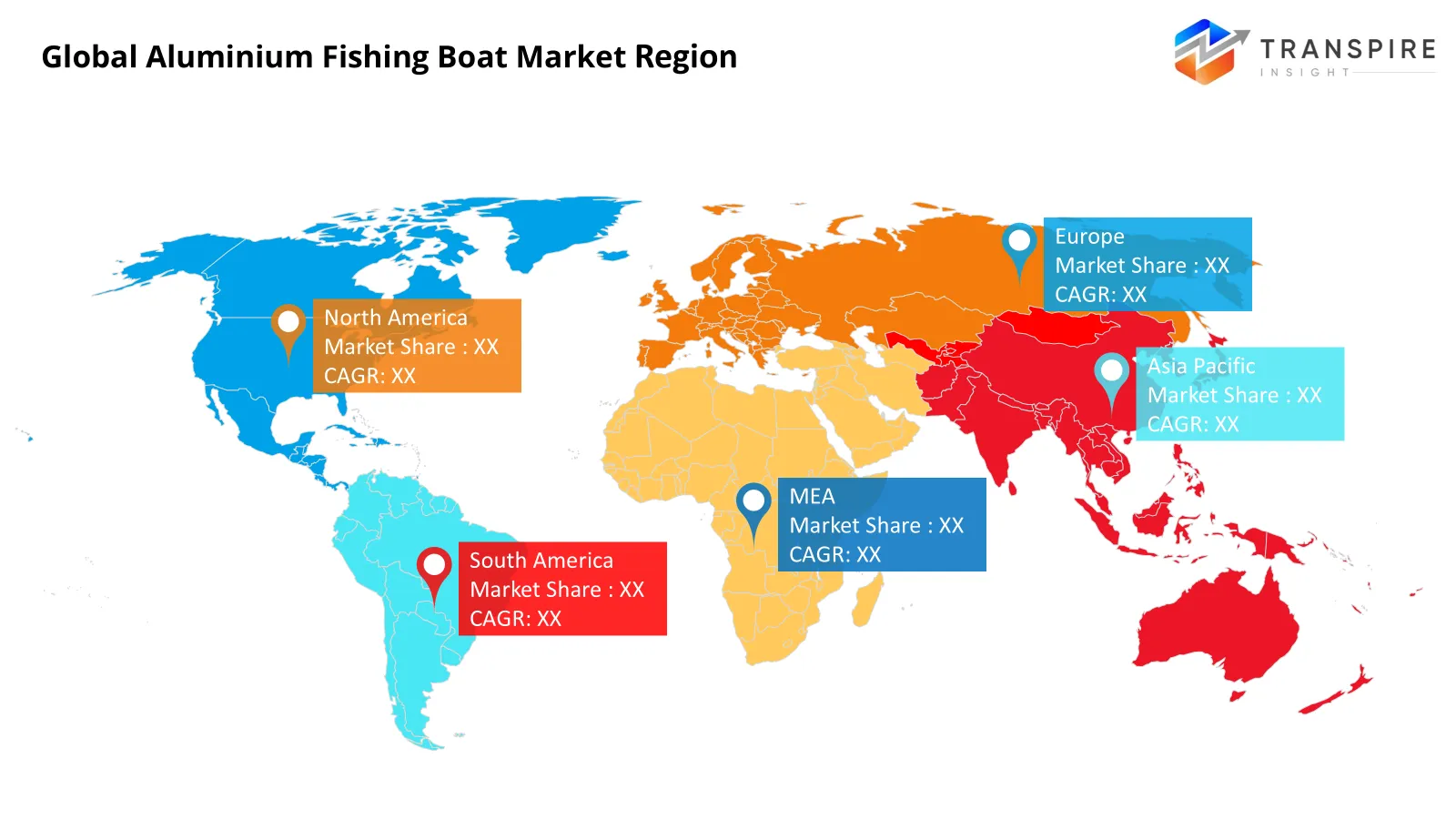
Who are the Key Players in the Global Aluminium Fishing Boat Market and how do they Compete?
The fishing boat market is a competitive one, with many brands that focus on value, innovation, and niche players catering to specific fishing styles or conditions in which the boat is used. Competition is based on hull performance, a range of in-house electronics, extending the reach of the dealers and appealing to different budget segments, instead of a single product format.
The major competitors are focused primarily on price, dealer availability and general interest: Lund Boats, Alumacraft, Crestliner, Princecraft, Lowe Boats and Tracker Boats are all practical and value-driven to win recreational customers. Differentiation is based on simplicity of acquisition, good build quality and package pricing, and expansion usually involves feature additions through package and greater retail distribution. The quirkier models are the Smoker Craft, G3 Boats, Ranger Boats, Quintrex and Xpress Boats, which are more performance-oriented, have improved fishing ergonomics and electronics-ready options and appeal to serious anglers and premium users.
Niche strength is the basis for competition with SeaArk Boats, Stabicraft, Weldcraft Marine, North River Boats and some specialised models from other sources. They can be segmented by ruggedness, offshore suitability or regional preferences, and they grow by serving commercial operators, extreme water users and export markets where durability has greater value than price.
Key Players are:
- Lund Boats
- Tracker Boats
- Alumacraft
- Crestliner
- Princecraft
- Smoker Craft
- Ranger Boats
- G3 Boats
- SeaArk Boats
- Lowe Boats
- Quintrex
- Stabicraft
- Weldcraft Marine
- North River Boats
- Xpress Boats.
Recent Development News
·In March 2026, Alumacraft promoted its 2026 lineup, including Trophy, Competitor, Voyageur, Classic, and Escape models. The refreshed range supports easier customisation and stronger electronics integration, helping the brand appeal to buyers who want more practical, tech-ready fishing boats.
Source:https://www.alumacraft.com/
· In May 2026, Alumacraft continued to push seasonal sales incentives across select boats, engines, and marine electronics. This approach helps improve showroom conversion and encourages buyers to move faster on purchases by lowering the cost of entry.
Source:https://www.energypowersports.ca
· In 2026, Linder highlighted the spring launch of its Arkip 510 Catch, a wider aluminium fishing boat built for serious sport fishing. The launch strengthens the company’s premium niche strategy by targeting anglers who prioritize stability, space, and performance in larger waters.
Source:https://linder.se/en
What Strategic Insights Define the Future of the Global Aluminium Fishing Boat Market?
The Global Aluminium Fishing Boat Market is heading towards a higher level of premium, purpose-built product which offers durability, easier maintenance and smarter onboard product features. A hidden risk is that manufacturers may introduce upgrades more quickly than customers are willing to accept the price increase, potentially reducing their sales and the strength of margin recovery.
A developing opportunity is the increasingly common notion of service-led ownership, which can differentiate brands by providing maintenance support, retrofit options, and dealer-supplied upgrades to extend the life of a vessel and increase brand loyalty. The best strategic advice is to focus on user needs rather than just pricing to foster greater brand preference, retention, and stronger revenue. Customer choice is increasing, and those firms that can match design with after-sales value are likely to be best placed to hold on to their share and continue to grow.
Key Segmentations are:
By Type
- Jon Boats
- Bass Boats
- Centre Console Boats
- Pontoon Boats
- Deep-V Fishing Boats
- Utility Fishing Boats
- Others
By Application
- Freshwater Fishing
- Saltwater Fishing
- Recreational Boating
- Commercial Fishing
- Sports Fishing
- Others
By End-User
- Individual Consumers Commercial
- Fishermen Rental
- Operators
- Sports Clubs
- Others
By Length
- Below 15 ft
- 15–20 ft
- 20–30 ft
- Above 30 ft
- Others
Regional Outlook
North America
- United States
- Canada
- Mexico
Europe
- Germany
- United Kingdom
- France
- Spain
- Italy
- Rest of Europe
Asia Pacific
- Japan
- China
- Australia & New Zealand
- South Korea
- India
- Rest of Asia Pacific
South America
- Brazil
- Argentina
- Rest of South America
Middle East & Africa
- Saudi Arabia
- United Arab Emirates
- South Africa
- Rest of the Middle East & Africa
Frequently Asked Questions
Find quick answers to common questions.
The Approximate Global Aluminium Fishing Boat Market size will be USD 2.595 Billion in 2033.
Key Segments for the Global Aluminium Fishing Boat Market are By Type (Jon Boats, Bass Boats, Center Console Boats, Pontoon Boats, Deep-V Fishing Boats, Utility Fishing Boats, Others); By Application (Freshwater Fishing, Saltwater Fishing, Recreational Boating, Commercial Fishing, Sports Fishing, Others); By End-User (Individual Consumers, Commercial Fishermen, Rental Operators, Sports Clubs, Others); By Length (Below 15 ft, 15–20 ft, 20–30 ft, Above 30 ft, Others).
Major Global Aluminium Fishing Boat Market Players are Lund Boats, Tracker Boats, Alumacraft, Crestliner, Princecraft, Smoker Craft, Ranger Boats, G3 Boats, SeaArk Boats, Lowe Boats, Quintrex, Stabicraft, Weldcraft Marine, North River Boats, Xpress Boats.
The Current Global Aluminium Fishing Boat Market size is USD 1.79 Billion in 2025.
The Global Aluminium Fishing Boat Market CAGR is 4.75% from 2026 to 2033.
- Lund Boats
- Tracker Boats
- Alumacraft
- Crestliner
- Princecraft
- Smoker Craft
- Ranger Boats
- G3 Boats
- SeaArk Boats
- Lowe Boats
- Quintrex
- Stabicraft
- Weldcraft Marine
- North River Boats
- Xpress Boats.
About the Authors

Mayur Shinde
I am Mayur Shinde, a Senior Research Analyst at Transpire Insight, specializing in the Automotive & Transportation and Information & Communication Technology (ICT) Industry. My work focuses on analyzing emerging market trends, technological advancements, competitive landscapes, and industry developments to deliver accurate, data-driven insights. I am passionate about transforming complex market information into clear, actionable content that helps businesses, professionals, and decision-makers stay informed and make confident strategic decisions.

Chakradhar Khansole
Chakradhar serves as the Research Director at Transpire Insight, bringing over 8 years of experience in technology, innovation, and strategic market intelligence. He specializes in transforming complex market data into actionable business insights that enable organizations to make informed, growth-oriented decisions. Recognized for his strategic vision and analytical expertise, Chakradhar leads high-impact research initiatives, delivering comprehensive market assessments, competitive intelligence, and forward-looking industry analysis.
Recently Published Reports
-
Apr 2026
ATV & UTV Market
ATV & UTV Market Size, Share & Analysis Report By Type (ATV, and UTV), By Variants (Less Than 400 CC, 400 CC To 800 CC, and More Than 800 CC), and Geography (North America, Europe, Asia-Pacific, Middle East and Africa, South and Central America), 2021 - 2031
-
Apr 2026
Automotive Central Gateway Module Market
Automotive Central Gateway Module Market Size, Share & Analysis Report By Type (Ethernet Central Gateway Module, CAN Central Gateway Module, LIN Central Gateway Module, and FlexRay), By Application (Powertrain Control, Body Control, Infotainment System, Advanced Driver Assistance Systems (ADAS), and Others), By End User (Passenger Vehicles, and Commercial Vehicles), and Geography (North America, Europe, Asia-Pacific, Middle East and Africa, South and Central America), 2021 - 2031
-
Apr 2026
Automotive Engine Oil Filter Market
Automotive Engine Oil Filter Market Size, Share & Analysis Report By Filter Type (Fuel Filter, Engine Oil Filter, Hydraulic Oil Filter, and Others), By Filter Media (Cellulose, Synthetic, and Micro), By Sales Channel (OEMs, and Aftermarket), By Vehicle Type (Passenger Cars, Light Commercial Vehicles, Heavy Duty Trucks, Buses and Coaches, and Off-road Vehicles), and Geography (North America, Europe, Asia-Pacific, Middle East and Africa, South and Central America), 2021 - 2031
-
Apr 2026
Automotive Parts Aluminium Die Casting Market
Automotive Parts Aluminium Die Casting Market Size, Share & Analysis Report By Production Process (Pressure Die Casting, Vacuum Die Casting, Squeeze Die Casting, Gravity Die Casting), By Application (Body Parts, Engine Parts, Transmission Parts, Battery And Related Components, Other Application Types), and Geography (North America, Europe, Asia-Pacific, Middle East and Africa, South and Central America), 2021 - 2031
Our Clients



